



Abstract
In missing person cases, police often face spontaneous searches by citizens. This study examined the involvement of police and citizens in a well-known Dutch case. It shows that the relationship between police and volunteers is not static, but changes over time. Initially, citizens are more quickly organized and take charge. As the investigation progresses, different types of volunteers are incorporated into the police structure. Citizens pose dilemmas regarding direction and information sharing, but provide valuable search capacity and expertise. The results show the importance of not opposing citizen initiatives, but rather making contact, establishing structure and coordinating efforts early on.
Introduction
Every day a large number of people are reported missing worldwide. In the Netherlands, this involves about 29,000 incidents per year (Lam, 2023). The Dutch police are divided into 167 front-line teams, which means that each station is confronted with a missing person report about three times a week. Because of the large number of cases that require assistance, recovering missing persons forms a substantial part of daily police work. Often, however, it are family, friends, and relatives of the disappeared who are first to act (Lam, 2023). As a result, police face not only the task of finding the missing person, but also the challenge of working with concerned citizens. This paper focuses on the difficulties and opportunities that such unsolicited citizen involvement in missing persons cases presents for the police.
Although those citizen searches are regularly part of missing persons cases, this topic has been relatively little researched. Most studies focus on themes such as characteristics of missing persons, (psychological) consequences for those left behind, and (forensic) investigation such as localization or identification (e.g., Shalev Greene and Alys, 2016; Morewitz and Colls, 2016). Research on citizen participation focuses generally on topics such as motives, media appeals, or long-term cooperation (e.g., Lam, Kop & Kerstholt, 2023; Lam et al., 2023; Uhnoo and Hansen Löfstrand, 2018; Ceccato and Petersson, 2022; Ferguson and Soave, 2021). There is hardly any research on the dynamic and contextual interaction between citizens and police within a missing persons investigation. To that end, we begin with a brief overview of research findings on a closely related topic: emergent volunteerism in emergency situations in general.
Emergent volunteering
Contrary to popular belief, people generally do not panic or lapse into passivity when an emergency occurs (Helsloot and Ruitenberg, 2004). In fact, a considerable amount of research on emergent or spontaneous volunteerism shows that ordinary people more often than not tend to act rationally and adequately when confronted with a disaster (Rodriguez et al., 2007; Helsloot and Ruitenberg, 2004; Scanlon et al., 2014; Tierney, 2003; Drabek and McEntire, 2003). Moreover, civilians respond almost immediately, whereas emergency services generally need some time to get organized and arrive on scene (Whittaker et al., 2015; Twigg and Mosel, 2017). Because local residents are frequently already on or close to the emergency location, they typically spring into action driven by a perceived (local) need and a vacuum of authority (Fernandez et al., 2006; Daddoust, et al., 2021). Therefore, in many cases, citizens can and will respond faster than authorities. As speed is paramount during an emergency, case studies commonly show how large numbers of lives are saved by civilians acting as first-responders, for example, by pulling victims from under the rubble in the wake of an earthquake (Helsloot and Ruitenberg, 2004; Twigg and Mosel, 2017).
In times of need, spontaneous volunteer aid emerges in all sorts of shapes and sizes. Frequently, existing organizations will expand or extend their usual activities. Also, new formal or informal organizations often arise naturally (Quarantelli, 1966; Dynes, 1970 in: Drabek and McEntire, 2003; Whittaker et al., 2015; Scanlon et al., 2014; Paciarotti and Cesaroni, 2020). However, not all aid is formally organized, at least not initially. Friends and family typically step forward to help, but emergencies can also attract large groups of outsiders, a phenomenon known as “convergence” or “informal mass assault” (Dynes, 1994a; Helsloot and Ruitenberg, 2004; Paciarotti and Cesaroni, 2020; Twigg and Mosel, 2017; Whittaker et al., 2015). These organizations or individual volunteers can take up a multitude of meaningful tasks when responding to local needs. For example, common forms of citizen aid are providing food and shelter, cleaning, repairing roads or buildings, evacuating victims, gathering information and, of course, search and rescue for those who are missing (Twigg and Mosel, 2017; Schmidt, 2019; Scanlon et al., 2014).
Although undeniably valuable, spontaneous volunteerism also presents unique risks and challenges to official emergency services. First of all, citizens may unintentionally injure themselves or others, which not only exacerbates the original problem, but additionally raises questions regarding liability. Furthermore, volunteers may inadvertently obstruct emergency services, such as when access roads get blocked due to convergence. Volunteers can also take up scarce resources, for example, when they need coordination, materials, care or when volunteers need to be rescued themselves. Also, when official and volunteer activities are not coordinated, or when citizens decide to “freelance,” the effectiveness of emergency services may suffer. However, aligning efforts, such as matching volunteers’ tasks to their skills, can also be a daunting task, as it is difficult to determine capabilities, expertise, and background in the heat of the moment. As a result of these difficulties, official agencies may be overwhelmed by citizens’ presence and needs (Daddoust et al., 2021; Twigg and Mosel, 2017; Harris et al., 2017; Helsloot and Ruitenberg, 2004).
In general, partly because of these challenges, authorities regard volunteerism with suspicion, or at best with a certain measure of reluctance or hesitance (Daddoust et al., 2021; Twigg and Mosel, 2017; Hansen Löfstrand and Uhnoo, 2020). Their presence is rarely anticipated or planned for and the usual tendency is to respond to either try to exclude or discourage volunteers or to integrate them in the official emergency response. Either course has its own drawbacks and both cause volunteers’ potential to be underutilized. Exclusion doesn’t work because research shows that convergence will happen anyway, which means the emergency services will have to deal with “freelancing” citizens regardless (Schwarzenegger and Renteria, 2001; Daddoust et al., 2021). The opposite of exclusion, integrating volunteerism, often assumes a centralized command and control approach, which as Dynes pointed out is not effective because it is based on wrongful assumptions about both volunteerism and emergency response (Dynes, 1994b, 2000; also: Auf Der Heide, 2006; Whittaker et al., 2015; Drabek and McEntire, 2003). Most notably, integrating informal volunteers into formal systems may come at the expense of adaptability, innovation, and responsiveness (Whittaker et al., 2015). Scholars have therefore long advocated a looser rather than tighter command structure, and a more decentralized approach focused on flexibility, coordination, and problem-solving (Dynes, 1994b; Quarantelli, 1988; Whittaker et al., 2015).
Despite what is known about spontaneous disaster response by volunteers, little research has been done specifically on citizen aid in missing persons cases. Nevertheless, some obvious similarities can be observed: citizens are often the first to respond, even before the police is notified, if at all. Convergence also frequently occurs in missing persons cases: high-profile missing persons cases attract large crowds of volunteers trying to find the disappeared. Furthermore, citizen aid in missing persons cases can be valuable when searching for a missing person, but it can also interfere with police operations and involve physical or psychological risks to the volunteers themselves. Regardless, the reality is that citizens often will come forward in missing persons cases, which means the police will have to learn to deal with this spontaneous help (Lam, 2023; Lam and Kop, 2020).
Aim and research questions
The current study focuses on the disappearance of 25-year-old Anne Faber in the Netherlands in 2017. After two intense weeks, in which police, friends, family, and many concerned others did everything they could to find the young woman, her body was finally found. Investigation revealed that she had been raped and murdered by a convicted sex offender, who was being treated at a nearby psychiatric clinic at the time. Anne Fabers’ tragic disappearance offers rare insight into the collaboration between family, volunteers, and police during a missing persons case. This paper aims to clarify the lessons that can be learned from coordinating and merging volunteer efforts with police assistance and criminal investigation in this case. More specifically, this study addresses the following research questions: • How did the cooperation between police and volunteers develop over time? • What different types of volunteers did the police encounter and how were efforts coordinated? • What opportunities and dilemmas did volunteer searches present for police?
Method
A qualitative research method was chosen due to the intricacies of the case. Fourteen police officers who were involved were questioned about their experiences through semi-structured interviews. These respondents were selected in consultation with the team leader of the Large-scale Investigation Team that handled the disappearance. The selection reflected the composition of the team that worked on the case and included respondents who played a role within the criminal investigation, Special Operations Team, and at street level.
To best understand how the citizens directly involved experienced cooperation with the police, the intention was to interview family and friends as well. However, the timing of the study coincided with the criminal case against the arrested suspect. Due to the emotional impact of the trial, on the advice of the police family liaison officer, it was decided not to approach the next of kin. However, by using other sources, such as media interviews with the family’s spokesperson (uncle), the family’s side could be adequately represented. For verification, the findings of this study were provided to the family with the opportunity to respond to them substantively.
Respondents were interviewed once and individually, most interviews lasting approximately an hour and a half. Four general topics were guiding in the interviews: cooperation between citizens and police, information flows and exchange, police structure and internal cooperation, and utilization of citizen information and expertise. These topics were further explored depending on the respondent’s specific involvement and experience. Appendix 1 provides a general format, although the course and content of the actual interviews depended in part on the role in the investigation. All interviews were recorded with permission and then transcribed verbatim. If necessary, respondents were contacted by email afterwards, to verify and clarify specific pieces of information.
Analysis took place according to the steps of open, axial, and selective coding from the grounded theory approach. The transcripts were divided into text fragments, which were subsequently organized according to the research questions. The next step in the analysis consisted of summarizing the content of the selected text fragments. These summaries were then assigned a code or keyword. The final analytic step consisted of grouping, weighing, and interpreting the codes in relation to the research questions. In the text, the following abbreviations are used to refer to interview sources: O (Special Operations Team), I (Large-scale Investigation Team), and P (Police Other). For example: O1 represents respondent 1 of the Special Operations Team.
The study used several additional sources of information to expand the interview data and fill in gaps in respondents’ memories. First, the internal police evaluation report was made available for this study. 1 Second, the case was discussed in depth by commanders, police spokesmen, and Anne Faber’s uncle at an evaluation meeting. Finally, a multitude of open sources were used, including news reports, an online police file, and a book written by Anne Faber’s uncle, which provides a detailed account of the family’s search (Faber, 2019). By comparing and cross-referencing these open sources with the interviews and the events described in the internal evaluation, the search for Anne and the cooperation between police and citizens could be reconstructed in detail.
Results
An evolving relationship between citizens and police 2
On a Friday afternoon in 2017, the 25-year-old Anne leaves her home for a ride on her bicycle. Surprised by a sudden downpour, she sends a sad faced picture of herself in the rain to her boyfriend. This was to be one of her last signs of life, as she thereafter no longer replies to WhatsApp messages. Later that night, her mother reports her missing at the police station. The report marks the beginning of a search that will last almost 2 weeks.
During the first weekend, there is no real cooperation between the police and friends and family in the search for Anne. It is mainly Anne’s friends and family who are physically searching for her. In the meantime, police are launching a district-wide operation to coordinate ongoing investigation, search, and communication processes. However, the police are reluctant to initiate an extensive search, because there is no indication of where the young woman may be. Uniformed police officers are present during searches, though. Initially, this causes confusion by the family because the police are there to assist and not to lead the search, while from the family’s perspective a “uniform” should take charge.
Over the course of the first 3 days after the disappearance, police search efforts are increasingly intensified. Behind the scenes, a criminal investigation team directs the search, which is focused around the last known location of Anne’s phone. Prioritized areas are searched with sniffer dogs and mobilized riot police units. However, it is one of the family’s search teams that find Anne’s coat by the end of Tuesday afternoon.
Immediately, the place where the coat was found is designated as a crime scene. Because a voluntary disappearance or accident is now unlikely, the police investigation is scaled up to a Large-scale Investigation Team. Moreover, cooperation between citizens and police reaches a turning point. The family strongly demands that the police coordinate all searches, including those of citizens. The general commander agrees to meet with the family, and arrangements are made for information sharing, the deployment of riot police, 3 and a location from which the family can coordinate its own efforts. Most importantly, the meeting leads to increased mutual trust and stronger police leadership in the search.
Meanwhile, in addition to the police and friends and family of Anne, individual volunteers and organizations such as the military, fire department, and Red Cross join the search, unfortunately to no avail. Because of the increasing scope and complexity of the case, at the end of the week, the district-level operation escalates to a Special Operations Team. Notably, cooperation with citizens and family is one of the team’s explicit objectives (Internal evaluation, 2018). Consequently, the police eventually take full command of the joint searches.
After 1 week, a breakthrough occurs. Based on a DNA trace on Anne’s coat, a suspect is apprehended, who several days later reveals a specific location where Anne’s body is eventually found. By then, several hundred people have been searching for Anne for 13 days.
Multi-tiered volunteerism 4
Throughout the search and criminal investigation, there is an ongoing interaction between citizens and police. To coordinate all efforts, it is very important to organize the information flow back and forth. A major complication, however, is that “citizens” are not a single unified entity. Four tiers of citizens can be distinguished, with first and foremost Anne Faber’s direct family. A second tier consists of Anne’s immediate circle of friends and acquaintances, who were particularly active in what would develop into a family command center. The third tier was formed by semi-professional or organized volunteers who volunteered to help in the search, such as military veterans or the Red Cross. Finally, the fourth tier consisted of the general public: the people who followed the case through the media, who submitted tips, scenarios and theories, or actually helped in the search for Anne. The scope of these four different groups of citizens is shown schematically in Figure 1. Different tiers of volunteers.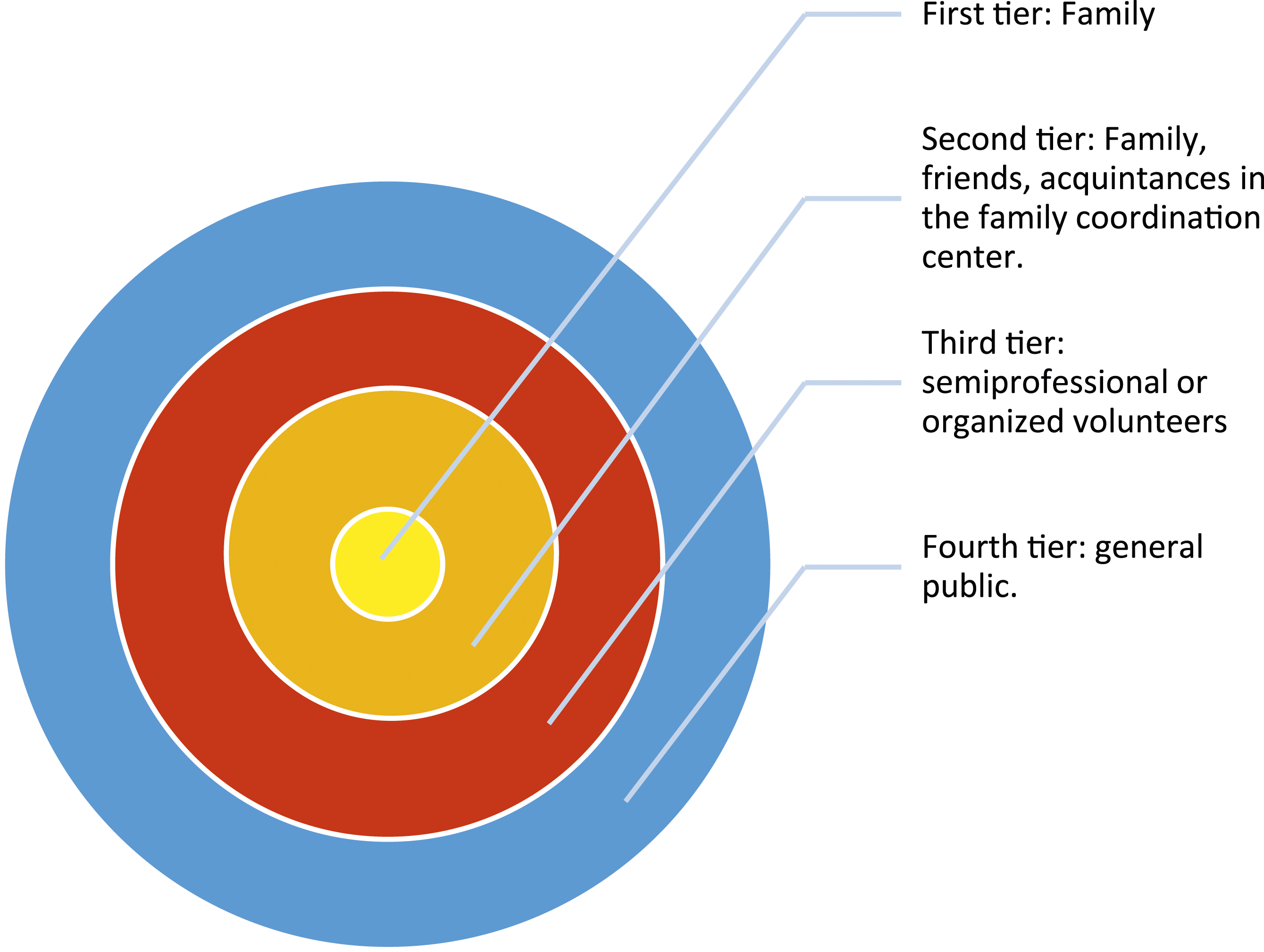
Adding complexity, the police are not uniformly organized. The main reason is that a number of operational processes run in parallel, such as the physical search for Anne, the criminal investigation and communication to the media and the general public. For a proper flow of information, all these groups of citizens and police processes must be aligned. Under normal circumstances, standard operational structures adequately provide for this, but in this case, especially because of the family’s decisiveness, a complex environment quickly developed: Family contact (tier 1) with the investigation team was primarily maintained by the family liaison officers. A front-line police officer was on scene to observe at the family command center (tier 2) and feed information back to the investigation team. A platoon commander coordinated the volunteers (and police officers) who helped search (tier 3), who in turn was directed by the Large-scale Investigation Team and the Special Operations Team. Contacts with the general public (tier 4) were multi-channeled. Information was provided through the communications department. Social media were scanned for relevant information and developments by the intelligence department. Incoming tips were screened and processed by the Regional Criminal Investigation Division. However, it is important to note that this is only a rough outline of the end result of a continually evolving interaction between with different structures and individual contacts.
Opportunities and dilemmas
The case study reveals several advantages and disadvantages of citizen involvement, which will be discussed below.
Opportunities
Coordinated efforts
One of the most important lessons from the Anne Faber case is that, paradoxically, embracing civic initiatives also makes them manageable. Together with previous experiences involving futile attempts to exclude citizens, this case led to an increased awareness that police today cannot stop citizen involvement and that joining forces leads to better results (I1, I3, P1, P5, O5). This cooperative attitude was formally reflected in two of the goals of the Special Operations Team: “optimal coordination of all civic initiatives and optimal support of Anne Faber’s family” (O1, O2, O4; internal evaluation, 2018). By cooperating, initiatives can be redirected where and if necessary, so that police operations are not hindered, but rather benefit from them (I4). What I learned is that you can’t stop it. Embrace it. I honestly don’t care who finds her, as long as she is found. The advantage is also that you can make it manageable and send people into the field with instructions. That when something is found, there is no ‘trace destruction unit' running all over it. As police we have always been hesitant, but in this case it paid off (I1).
In the end, citizens and police were working genuinely together and all initiatives could be reasonably managed and coordinated (Internal evaluation, 2018). As Anne’s uncle later reflected: It’s crucial for a general commander that you quickly make contact with the family. You need to see if you can work together. And if you can work together, you should. And if you can’t, that’s also good to know, because you still have to coach them in what they do. Either way, you need that personal contact.
Eyes and ears
Collaborating with citizens can significantly increase police search capacity (O1, P1, P3). “Additional capacity to search is golden assistance for police (O1).” Especially in the first phase of an investigation where the police have no indication of a crime (yet), citizens can be deployed in searches (I4). If you have to divulge information that you wouldn’t want citizens to know, then it gets tricky. But we also started out of the blue, without anything. Then you can involve every citizen, because they know as much as you do (I4)
The risk of harm to the investigation is then relatively low, except when civilians walk through tracks, for example, which can be prevented with clear explanations and instructions (I4, O5). What we learned from the Anne Faber case is that if you instruct people properly and explain clearly why we ask things of them, it works fine. Because no traces were destroyed, no things were lost. In fact, they helped us tremendously (O5).
Indeed, in this case, it was Anne’s family and friends who provided a breakthrough. A family search team found Anne’s coat in a location that was not a priority for the police at the time (P4, I4). We started at the spot where her phone disappeared. With the intention of working from the inside out that way. That coat was actually in a very illogical place, on the very outside of the search area (I4).
Moreover, the search team handled the find with such care that the DNA trace on it could be matched with the suspect (P4). Although not every case lends itself to citizen involvement in this way, but in this instance, citizens’ eyes and ears proved to be invaluable (I1, I4, O5). No matter how you look at it, the coat that had the DNA on it was found by a voluntary searcher (O4).
Skills and expertise
One of the aspects that made the Anne Faber case special was the manner in which the family operated. They had access to very specific knowledge, expertise, and skills, reinforced by a professional network. However, in the beginning, their search was mainly provisory, friends and family soon developed a command structure in which “coordinators” focused on specific areas (P2). For example, there was a coordinator who directed the people who went searching in the vicinity and a coordinator who kept track of the Whatsapp groups (P5). The family also made effective use of specialist knowledge in their own network. For example, an army helicopter pilot quickly provided staff maps of the area and available knowledge about image processing and Google maps proved valuable in determining possible routes (P2, P5; Faber, 2019). Anne’s uncle later indicated that he found it strange that the family had this knowledge at their disposal and the police did not make use of it (Evaluation meeting, 25 April 2018). The searches went well, but we should have been at that family command center as well. Next time I would assign someone who understands investigations but is not part of the investigation team itself. Who can’t talk his mouth off, can’t exchange too many meaningful looks. But who can assess what is happening there, whether we need to give information or we need to redirect them. You have to be there (O5).
Dilemmas
Who is in charge?
Initially, the police determined that the family was in charge of the search and that uniformed officers would provide support. The reason was that at that time the police had no concrete leads as to Anne’s whereabouts (P2; NOS, 2017a). Unfortunately, the family did not immediately realize that they were in charge (P2, P4). The police were present, but to support and not to take control. This was confusing because people automatically look up to a uniform. Our people searched in the woods, but were not trained for this (Anne’s uncle, evaluation meeting).
Notwithstanding, not only did friends and family spontaneously take the lead in the search, they organized themselves faster than the police (P2, P5, I3). As a result, the police did not have a clear overview of where and by whom searches were being conducted or where camera footage was collected (I4). The police initially deliberately did not take charge of the search, but the investigation team was surprised by the family command center that was subsequently established, which was much like a Special Operations Team(O2, O4). Anne Faber’s family was well organized. They almost had their own Special Operations Team in the end. They had set up a fairly professional organization, with a very broad network as well (O4).
Eventually, the family’s decisiveness, professionalism, network, and pressure on the police made cooperation inevitable (O1, I1). However, structure and overview only really emerged after the establishment of the Large-scale Investigation Team and a Special Operations Team, whose objectives included coordinating civilian searches (P5; Internal evaluation, 2018). For me, one of the most important lessons is to provide structure. You are not immediately inclined to do that. You do have the internal structure, for example, a Large-scale Investigation Team or a Special Operations Team. But to also structure cooperation, that’s a step further. You could try to organize some lines of communication from police to family next time. If you can get the relationships clear in the beginning, you will benefit later (O1).
Information sharing
One of the police’s biggest dilemmas concerned sharing information (e.g., O1, O2, O5, I1, I2, P5). Citizens needed information, but for various reasons not everything could be shared. First, it had to be ruled out that a possible perpetrator was not a relative or acquaintance of the victim (I1, O2, O5). Also, for later use in the investigation, information possibly available only to the offender cannot be disclosed (i.e., offender knowledge; O1, P2, I4). Finally, important search areas had to be prevented from being overrun by civilians and the press, which could destroy traces or evidence (O4, O5). Despite these dilemmas, most respondents agreed that the police needs to share information in order to truly benefit from citizen involvement. These days, as police, you can’t get away with ‘in the interest of the investigation, I can’t share information.’ As far as I am concerned, you are not fit for your profession if that is your standard response (O5).
Therefore, the family were more informed than is usual in similar cases. To a large extent, this openness was due to the mutual trust that gradually developed between the two parties (O1, I1, P1, P2, P4).
Scaling down
When fewer search areas remain over time, it becomes increasingly difficult to manage citizen searches. First, when there are concrete leads, the police may not want citizens to search in certain areas because they want specialist teams to be able to do their work there undisturbed and to avoid the destruction of evidence (O5, O4). However, by indicating that certain areas are not or no longer accessible, information is indirectly provided to the public and media, which may be undesirable for the investigation (O5). Second, at some point, there may be no more places for citizens to search, which raises the question of how to deal with all those people who are very motivated to help (O5). Finally, the investigation and search put a lot of pressure on the police organization and could only be sustained for a limited time (O1, P5, I2; Internal evaluation, 2018). A situation could have risen where the police have to scale down or even completely stop the search due to lack of progress, which can fuel feelings of incomprehension and outrage from those left behind or the general public (O1, I1). We crawled through the eye of the needle by finding her. Without the DNA trail and his statement, this could have taken much longer. At some point the search would have been scaled down, but that would never have been accepted by the family. That would have led to a confrontation and made cooperation more difficult (O1).
Discussion
The purpose of this paper was to examine the lessons to be learned from Anne Faber’s disappearance regarding citizen involvement in missing persons cases. A qualitative case study was conducted, using interviews with police officers involved, internal documents, and open sources. The study focused specifically on how police-citizen collaboration evolved over time, the kinds of volunteers who assisted, and the subsequent opportunities and challenges that citizen involvement presented for the police during their own searches and criminal investigation.
Separate, facilitate, integrate
How citizens responded to Anne Faber’s disappearance is consistent with what is known about emergent or spontaneous volunteerism during emergencies and disasters in general. This is especially evident in how the family reacted. First, friends and family did not panic despite being exposed to such a traumatic event, but managed to act rationally and start an effective search operation. Second, the perceived need and authority vacuum prompted an informal organization in the form of a highly functional family command center, which would later be characterized by the police as a private Special Operations Team. Third, the family made effective use of the social ties, personal network, and the skills present therein. Fourth, friends and family initially organized themselves faster than the police. Several officers noted afterwards that the family’s decisiveness surprised them and more or less forced the police to cooperate. That the effectiveness of citizens makes it hard for police to avoid cooperation has been observed before. For example, something similar happened to the Swedish police with the success of Missing People Sweden, however, over a longer period of time (Uhnoo and Hansen Löfstrand, 2018; Hansen Löfstrand and Uhnoo, 2020).
The manner in which the police handled citizen searches is largely (and unknowingly) consistent with the Amsterdam Amstelland Safety Region model of crisis management, one of the first organizations to deliberately develop policies for the role of ordinary citizens in emergencies (Groenendaal and Padje, 2010). The model distinguishes five different phases with different roles for citizens: initial response by citizens, citizen assistance to emergency responders, official arrangements, coordination by emergency services, and aftercare (Scanlon et al., 2014). This phasing accurately captures how in the Anne Faber case cooperation between citizens and police did not have a fixed form from beginning to end, but progressed through different stages. Initially, it is the family itself that takes the lead and, with the help of friends and acquaintances, organizes the first searches (phase 1). Soon after, front-line police officers join these citizen efforts in a support role (phase 2), while at the same time, the police’s own investigation becomes more structured and intensified. As a result, after several days, police and civilians independently search for Anne. Cooperation improves significantly when the police commander meets with the family at their request and mutual arrangements are made (phase 3). Finally, as evidence found makes a crime increasingly likely and the scope and complexity of the investigation increases, citizen searches are officially integrated into a large-scale operational police structure (phase 4).
On a deeper level, the Amsterdam-Amstelland model relies on three principles: merge with existing social structures, legitimize volunteer activities, and work with the natural leaders within these groups (Scanlon et al., 2014). All three of these principles were applied naturally in the Anne Faber case: front-line officers facilitated the family’s searches, which inherently legitimized them, and several officers and the general commander developed a trusting relationship with the family, especially Anne’s uncle, who emerged as the spokesperson and natural leader of the citizen searches. Most importantly, the case illustrates the importance of connecting with natural leaders among citizen volunteers (Ibid).
Managing volunteers
Disaster and emergency-focused research has long observed that volunteerism can emerge in a variety of organizational forms and compositions (Whittaker et al., 2015; Scanlon et al., 2014; Drabek and McEntire, 2003). Dynes distinguishes basically three different forms of direct aid (Dynes, 1994a; Helsloot and Ruitenberg, 2004): friends and family, (local) organizations and mass assault (convergence). Accordingly, spontaneous volunteerism in this case included new informal groups, such as family and veterans, existing formal organizations, such as the Red Cross, fire department and police academy, as well as individual “walk-in” volunteers.
Moreover, this study clearly shows the complexities that arise when the police have to deal with these different kinds of volunteers, especially when emergency services and a criminal investigation are involved simultaneously. First, there is no single group of volunteers, and second, these different forms of volunteerism affect police work in different ways. For example, the demands and needs of the family burdened the criminal investigation team, volunteers in the field had to be managed by the Special Operations Team, and intelligence officers of the Regional Criminal Investigation Department had to process about 4000 tips from the public. This quickly resulted in a complex organizational structure, with liaisons for the next of kin, the family command center, the volunteers in the field and communication to the public, as well as coordination between the joint criminal investigation and Special Operations Team.
Interestingly, the resulting structure partly contradicts previous observations that have suggested that classic command and control is less effective than a decentralized approach when cooperating with emergent volunteerism in disasters (e.g., Dynes, 1994a, 2000). One explanation is that missing persons cases are fundamentally different from many other emergencies because of the limited scale and extent of impact, public expectations about responsibility and the possibility to turn into a criminal investigation. The latter factors have decidedly influenced the relationship between citizens and police in this case. First, the family did not understand that police were present during their searches but did not take charge. Therefore, after the first few days, they explicitly demanded more police direction on the search. Second, gradually it became clear that the disappearance was the result of a crime. As a result, the information from the criminal investigation became increasingly leading. 5 More importantly, however, finding a missing person is a single shared objective that requires the coordinated efforts of all involved. Unlike other emergencies where efforts must be tailored to local needs and it is more likely that every little bit helps somewhere or someone. As a result, a centralized form of control is arguably more suited for this type of incident.
Opportunities and challenges
Official agencies often do not see the involvement of volunteers as an opportunity, but rather as a risk or burden, and therefore react reluctantly (Daddoust et al., 2021; Twigg and Mosel, 2017; Harris et al., 2017; Barsky et al., 2007; Hansen Löfstrand and Uhnoo, 2020). In part, this hesitancy is justified, because while spontaneous volunteering can be valuable, it poses two major risks to an effective emergency response.
First, volunteers’ actions may be harmful to themselves or those they are trying to help (Harris et al., 2017; Twigg and Mosel, 2017). Moreover, when citizens become involved in investigating a possible crime, the investigation itself may be harmed when evidence is destroyed. However, this study illustrates that citizen assistance can also be a very valuable complement to the efforts of official agencies. Citizens provided extra eyes and ears to comb the area in search of the missing young woman, and even more crucially, they found important evidence in a location not yet a priority for police by searching differently. Moreover, by carefully following police instructions, the investigation was not impaired but traces could be secured that identified a suspect and ultimately led to the recovery of her body.
A second risk is that volunteers may inadvertently obstruct official emergency services. For example, clogging access roads can render areas inaccessible or uncoordinated actions can lead to a lack of oversight at the expense of efficiency (Daddoust et al., 2021; Twigg and Mosel, 2017). This case clearly shows how actions by citizens threatened to hinder police operations in different ways and at different times. For example, the investigation team initially did not have a clear overview of where civilians had searched or were searching. This lack of oversight applied to physically searching the area, as well as collecting camera footage, which was important for both police and family to determine the route Anne had taken.
The biggest contribution from citizens to the Anne Faber case came through helping to search, a labor-intensive but relatively straightforward task. However, volunteers can also contribute by providing their specific (local) knowledge, skills, expertise, and ties to the community (Daddoust et al., 2021). This presents authorities with the challenge of deploying available volunteers where they will be most valuable, which requires the difficult task of assessing their specific skills or background (Whittaker et al., 2015; Scanlon et al., 2014). Although a uniformed officer was present at the family command center, the investigation team did not have sufficient insight into what was happening there. Consequently, the professionalism of Anne Faber’s friends and family was recognized at the time, but their specialized input was underutilized.
Relevance and limitations
This is the first study to examine the contextual dynamics of citizen involvement in an actual missing persons case. Moreover, given the changeable nature of operational policing, conceptualizing participation as spontaneous volunteerism allows citizens’ initiatives to be better understood and better utilized.
The main limitation of this paper is that it is a single case study. While this method provided an in-depth understanding of the studied incident, it cannot be assumed in advance that the results are universally generalizable. This is particularly relevant in this case because the family was unusual in the way it managed to organize, act, and relate to the police. Nevertheless, it is important to take the lessons from this case seriously because even though not every family will be highly self-reliant, missing persons cases will often attract volunteers and civic organizations will play an increasingly important role in the future, either solicited or unsolicited.
Implications for police practice
The current research has a number of practical implications for police practice. First and foremost it is important not to “fight” citizen initiatives. History shows that well-willing citizens are not easily deterred and that their exclusion leads to undesirable effects, such as uncoordinated efforts or even obstruction of emergency services. However, this does not mean that the police should approve all forms of citizen involvement, but rather acknowledge that it is important to connect and, if necessary, guide them. Paradoxically, opening up to initiatives is what makes them manageable.
Second, plan for the unplannable. Most emergency plans or police procedures do not account for citizen involvement, especially since there is no one-size-fits-all solution. However, considering possible scenarios in advance avoids having to devise ad hoc structures, roles, and lines of communication in stressful and chaotic circumstances.
Third, have suitably qualified police officers join citizen initiatives. Having these officers on site allows for an early assessment of whether the initiatives contribute to an investigation or search. For example, by using police officers who know criminal investigation processes and procedures well, the added value of citizen knowledge, skills, and expertise can be better anticipated. In addition, police officers can also support citizens in their activities, thereby increasing their personal and, by extension, the overall effectiveness of the emergency response.
Future research
The results of the current research provide direction for further research. One interesting and valuable topic is how best to support citizens in initiating their own searches. Understanding more about how citizens can effectively conduct their own searches and what specific needs they have in doing so can help develop practical tools, but also that their efforts can be better integrated into a police investigation if the situation calls for it.
Conclusion
This study shows that spontaneous searches by citizens in missing persons cases can be understood as a form of emergent volunteerism. Similar to citizen assistance in large-scale emergencies, the relationship between citizens and official police is not static but dynamic and is influenced by structural changes (of both citizens and police) and developments in investigation. Citizens are likely to take the initiative (i.e., the family), but can be incorporated as a valuable part of the police structure over time. Most importantly, this case illustrates the value of the police not resisting citizen involvement in missing persons cases, but rather embracing it at an early stage. This presents challenges because the police have to align different groups of citizens and different components within their own organization, which requires a complex operational structure. But by clarifying mutual relationships and aligning efforts, search capacity and expertise can be combined, increasing the chances of finding the missing person.
Footnotes
Declaration of conflicting interests
The author(s) declared no potential conflicts of interest with respect to the research, authorship, and/or publication of this article.
Funding
The author(s) received no financial support for the research, authorship, and/or publication of this article.
