




Abstract
Current public debates about rising violence against police officers, and conversely, criticism of racial profiling by the police force, contradict the high levels of trust in the German police reported by public surveys. This raises the question of why the tension between the police and citizens arises. German Criminology has not yet exploited the potential of procedural justice theory to explain the shifting dynamics of trust. Empirical studies on how evaluations of police fairness and effectiveness influence police legitimacy in Germany have long been overdue. Additionally, there is minimal evidence of whether police fairness is experienced differently in different social contexts. Therefore, this study answers two pertinent research questions: (1) To what extent does trust in German police and police legitimacy depend on procedural fairness? (2) To what extent do residents in socially disadvantaged neighbourhoods have lower levels of trust in police fairness? Consistent with international research on procedural justice theory, the results reveal significant effects of normative predictors of trust in the police, such as perceived fairness and neighbourhood trust. Using advanced multilevel modelling, this study observes the effects of two contextual variables (welfare recipients and official crime rates) on neighbourhood levels of trust in police fairness. The results reveal that the impact of personal assessments of the neighbourhood, personal disadvantages, and experiences with the police exceeds neighbourhood context effects.
Introduction: The importance of fairness
Internationally, an extensive body of research on procedural justice theory (PJT) has formed, demonstrating the positive effect of police fairness on citizens’ willingness to cooperate with the police, follow police orders, and comply with the law (Hough, 2012; Hough, 2010, 2013; Jackson, 2019; Madon et al., 2017; Mazerolle, 2012, 2013; Reisig et al., 2007; Sunshine and Tyler, 2003). The pivotal role of PJT in explaining citizen trust is highlighted by the fact that despite a positive security situation, decreasing crime rates, and constant efforts to improve police professionalism and effectiveness, trust in police has not improved. This effect has been reported in England, Wales (Bradford et al., 2009; Jackson, 2009), Australia, and the United States (US) (Murphy et al., 2014). Procedural justice researchers have concluded that trust in the police depends on normative factors, such as interpersonal treatment, rather than instrumental concerns about police effectiveness in controlling crime.
Research has found that the connection between unfavourable attitudes towards the police and procedural fairness is most apparent in disadvantaged urban communities (Bradford, 2014). Studies in the US have repeatedly revealed lower levels of trust in the police in minority communities (Kruger, 2016; MacDonald and Stokes, 2006; Schuck et al., 2008; Tyler, 2005). Disadvantaged neighbourhoods make apparent the social distance between the majority society and minority groups, leaving residents sceptical about society and its authorities (Wu et al., 2009). ‘Perhaps we should not be surprised that those most exposed to the numbing reality of pervasive segregation and economic subjugation become cynical about human nature and legal systems of justice…’ (Sampson and Bartusch, 1998: 801).
However, in German criminological scholarship PJT has so far received minimal attention in explaining the shifting dynamics of trust in the police or in analysing the relations between the police and residents of disadvantaged communities. Research has not detected a discrepancy between increasing police effectiveness and declining or stagnating trust in police. In accordance with the satisfactory security situation in Germany, confidence in the police has been consistently high since the 1980s (Birkel, 2022; Bundeskriminalamt, 2019; Guzy, 2015; Reuband, 2012).
Against this backdrop, normative predicators may have played a minor role in investigating the relations between members of society and the police. However, recent incidents in Germany suggest that more scholarly attention should be paid to the aspects of procedural justice.
However, the high levels of trust in the police emerging from public surveys are contradicted by the public debate on encounters between citizens and the police. This public debate culminated in stricter laws punishing violent acts against police officers in 2017. 1 In 2021, riots were directed against police officers clearing public places in Stuttgart and Frankfurt to enforce COVID-19-related restrictions. Although such violent acts against German police officers are relatively rare, concerns arose from the fact that several bystanders expressed their sympathy with the rioters’ anger directed at the police. Analysts have speculated on the causes of these violent incidents. Critical voices have drawn a connection between suspected excessive use of repressive force against young people, especially from minority groups, and a growing level of public frustration with the police. 2 Others argue that the incidents may have been inspired by recent demonstrations of the ‘Black Lives Matter Movement’ in the US since they occurred simultaneously. 3 Although the level of tension between police officers and members of minority groups is significantly lower in Germany than in the USA, the European Commission against Racism and Intolerance (ECRI) recommended a public enquiry into racial profiling by the German police. However, the German Federal Ministry of the Interior decided not to conduct the study, arguing that German police officers should not be placed under general suspicion. 4 This decision has stirred public controversy. Additionally, a series of right-wing extremist incidents fuelled the debate on whether racist tendencies within the German police force should be investigated. Various chat groups were discovered where police officers shared racist comments, national socialist symbols, and themes. 5
These developments indicate that police effectiveness is insufficient to uphold trust in police. They hint towards ongoing tensions between the police and residents of disadvantaged urban communities that are stirred by unfair police practices. Therefore, this study argues that, in Germany, more empirical evidence is required on perceived police fairness and its impact on police legitimacy. A comprehensive understanding of why German citizens trust (or do not trust) the police is a basic prerequisite for political decision-making in the management of police misconduct or enquiries of racial profiling in disadvantaged urban neighbourhoods.
Thus, the present study had two objectives. First, to investigate the relevance of procedural justice in urban settings in Germany by testing established PJT hypotheses, for which the analyses were conducted using information from a research project on the fair distribution of urban security (VERSS). The data file comprised survey responses from 2939 citizens residing in Stuttgart and Wuppertal. Using structural equation modelling, this study simultaneously analysed the effects of instrumental and normative factors on trust in the police and police legitimacy.
Second, to determine, whether residents in disadvantaged neighbourhoods are less likely to believe that the police are trustworthy and treat individuals with dignity and respect. This analysis used a subset of the data combining citizen-level survey data and tract-level census data from 53 neighbourhoods in Wuppertal (989 respondents). Hierarchical linear modelling allowed us to examine the effects of both tract-level variables (concentrated disadvantage and crime rates) and individual-level variables, such as personal experiences with the police, on trust in police procedural fairness.
What do Germans value more: Fairness or effectiveness?
There is substantial empirical evidence to demonstrate that trust in the police and police legitimacy is based less on instrumental concerns about safety or crime control and more on normative evaluations of police behaviour and fairness. This study provides crucial groundwork for PJT in Germany by testing the following instrumental and normative hypotheses.
Instrumental theory claims that people depend on the police for protection against crime. When citizens feel that the police provide an important service (protection), they are obligated to comply with police orders. Instrumental factors of trust are especially important for authorities and institutions, as they usually serve a purpose in society on which people depend. The instrumental perspective draws a straight line between the role and duties of the police as law enforcement agencies, public perception of the fulfilment of those duties, and public confidence (Jackson, 2009). From this perspective, the antecedents of trust are victimisation (Nix, 2015; Van Craen and Skogan, 2015), fear of crime (Jackson, 2009; Reisig and Parks, 2000), police presence (Bradford et al., 2009), and incivilities (Cao et al., 1996; Nix et al., 2015). This study examined the influence of instrumental factors on trust in the police by testing the following hypotheses:
Respondents who have fallen victim to a crime are less likely to trust in police effectiveness.
Concerns about falling victim to theft, burglary, purposeful injury, and damage to property, reduce trust in police effectiveness.
Police presence is positively related to trust in police effectiveness.
Perceived neighbourhood problems, such as littering, drinking alcohol in public, or vandalism (incivilities), have a negative impact on trust in police effectiveness.
However, the normative model asserts that fair treatment and social cohesion (here, neighbourhood trust) enhance trust in police fairness (normative trust), which consequently results in people’s willingness to obey police orders. Normative trust relies on both social and interpersonal relationships. When police have people’s best interests in mind, they appear to be deserving of trust. According to this perspective, people are especially anxious about finding cues for the intentions and character of legal authorities with the capacity to exert power (Murphy et al., 2014: 407). Consequently, mistreatment reduces citizens’ esteem for the police as a group authority, leading people subjected to policing to question whether the police are in any position to dictate proper conduct (Jackson et al., 2012: 1053). According to the normative approach, experiences with the police, particularly those concerning fairness evaluations, are important antecedents of trust in the police (Reisig and Parks 2000; Van Damme, 2017).
Positive experiences of contact with the police strengthen trust in police fairness.
Owing to police officer’s routine involvement in social negotiations of order/disorder, justice/injustice, and normality/deviance, studies suggest that normative demands directed at the police go beyond fairness (Jackson, 2009; Loader, 2006). According to the expressive model (Jackson, 2009) urban disorder and crime indicate disregard for common rules that the police are expected to defend. Therefore, they are held responsible for any sign of the deterioration of shared values, such as incivilities or a lack of neighbourhood trust (Jackson and Bradford, 2009). There is empirical evidence that residents who believe that their neighbours are trustworthy and helpful indicate higher levels of trust in the police (Nix, 2015). Using Germany-wide survey data, Leitgöb-Guzy (2018) demonstrates that neighbourhood trust along with other aspects of the quality of life (Reisig and Parks, 2000) such as incivilities, the feeling of safety, or neighbourhood reputation, affect confidence in the police.
The belief that people in a neighbourhood are helpful, trustworthy, share common values, and respect law and order, has a positive impact on trust in police fairness.
International studies have repeatedly indicated that while both approaches have explanatory power, the influence of perceived fairness on legitimacy tends to be higher than that of perceived effectiveness (Bradford, 2014; Hinds, 2009; Hough, 2013). This study draws on these insights and tests the effects of trust in police fairness and effectiveness on police legitimacy in Germany.
Trust in police effectiveness is positively related to a person’s willingness to accept decisions made by the police and to obey them.
Trust in police fairness has a positive impact on a person’s willingness to accept decisions taken by the police and police orders.
Disadvantaged communities and tensions with the police
Several arguments have been made about the connection between social disadvantage and trust in police fairness, which are discussed below.
First, disadvantaged segregated communities are disproportionally affected by high crime rates and the relationship between space and delinquency has inspired a vast scientific enquiry on ‘neighbourhood effects’ on crime (Burdick-Will and Ludwig, 2013). Research indicates that an increased requirement for police resources in disadvantaged minority communities does not translate into effective and equal treatment by the police (MacDonald and Stokes, 2006: 363). Owing to higher levels of crime, residents of socially disadvantaged neighbourhoods are subject to different policing strategies. The police’s control behaviour depends on the police’s attribution of urban spaces as ‘dangerous’. For example, the German police classify designated urban spaces as high-crime areas (Gefahrengebiete) to facilitate more frequent stops and frisks, even without reasonable suspicion (Keller and Leifker, 2017).
Second, police officers who express a more negative perception of community social capital tend to rely on their resources to solve community problems. Consequently, police officers resort to proactive policing, utilising their law enforcement powers more frequently (Jackson and Wade, 2005). Qualitative research in Germany indicates, that police officers distinguish between ‘good’ and ‘bad’ neighbourhoods resulting in ‘congruity procedures’, in which proactive policing is justified by the bad reputation of the neighbourhood (Hunold et al., 2016).
Third, in disadvantaged neighbourhoods, respectful treatment by the police and confirmation of belonging are essential for personal self-esteem and a sense of fairness (Tyler, 2000). However, living in a disadvantaged neighbourhood or belonging to a minority or migrant community may be more often confronted with racial profiling, which is perceived as particularly unfair and evidently erodes trust in the police (Tyler and Wakslak, 2004). Increased encounters with deviance in public spaces lead to increased mistrust by police towards people who are present in public spaces (Klinger, 1997: 288). This bias may impede police officers from engaging with residents in an impartial, fair, and respectful manner.
Fourth, neighbourhood contexts may implicitly affect perceptions of police fairness when residents hold police responsible for neighbourhood conditions. Police can serve as a real or symbolic ‘proxy’ for the larger socioeconomic system that perpetuates personal or community level disadvantage (Schuck et al., 2008). For residents of socially disadvantaged neighbourhoods, the police seemingly fail as ‘symbolic guardians’ of social order and justice when urban disorder and crime indicate disregard for common rules (Jackson and Bradford, 2009).
The ‘neighbourhood context model’ is based on the premise that residents of the same neighbourhood share collective experiences and perceptions of neighbourhood conditions and local police performance. Previous research has demonstrated that neighbourhood level characteristics such as concentrated disadvantage (Sampson and Bartusch, 1998), and crime rates (Reisig and Parks, 2000) affect satisfaction with the police. Higher levels of dissatisfaction with the police in disadvantaged, high-crime neighbourhoods seemingly underline the instrumental perspective on trust in the police: residents are sceptical about the police and the fulfilment of their role and duties as a law enforcement agency. However, Gau et al. (2012) found that residents from economically and socially distressed neighbourhoods also believed that police interacted with people less fairly and equitably.
In Germany, research on the contextual effects on trust in police is scarce. A noteworthy study on German juveniles (Oberwittler et al., 2014) suggests a weak link between social disadvantages, perception of disrespectful police behaviour, and less positive attitudes towards the police.
This study includes the adult population in disadvantaged neighbourhoods aiming to identify urban areas where residents perceive the police to be less trustworthy. Using hierarchical linear modelling techniques, this study analyses the contextual effects of poverty (proportion of welfare recipients) and official crime rates on trust in police fairness by testing two hypotheses.
The higher the proportion of welfare recipients in urban neighbourhoods, the lower residents’ trust in police fairness.
High crime rates in urban neighbourhoods have a negative impact on trust in police fairness.
Data
Confidence in police was the subject of a research project dedicated to analysing the security situation in two German cities: Stuttgart and Wuppertal. The Federal Ministry of Education funded a study called VERSS (Aspects of a fair distribution of security in the city), which ran from 2014 to 2017. In 2015, data were collected through a postal survey using a self-completion questionnaire. The random sample was drawn from the civil register, comprising 6552 and 6329 registered residents (aged 18 years and above) of Stuttgart and Wuppertal, respectively. Altogether, 1499 completed questionnaires in Stuttgart and 1440 in Wuppertal were returned, translating into an overall response rate of 23% and total 2939 respondents. Senior citizens and women were over-represented among the respondents, whereas the response rate from migrant residents or those who received social aid was lower. Drawing on complete data, this study uses structural equation modelling to identify the important antecedents of trust and legitimacy in the two German cities.
Additionally, the survey data allowed for a multilevel analytics perspective since all respondents could be assigned to their residential areas based on their official address. Official statistics on welfare recipients and crime rates at the level of administrative urban subarea boundaries were included in the study. The social divide between poor and rich neighbourhoods was more pronounced in Wuppertal than in Stuttgart. In the 69 districts of Wuppertal, the percentage of welfare recipients ranged from 1% to 30%. In Stuttgart, the highest percentage of welfare recipients in disadvantaged neighbourhoods was 21%. Therefore, only results from multilevel analyses in Wuppertal are reported, assuming that contextual effects are higher. 6
Wuppertal, with an approximate population of 350,000 and an area of approximately 17,000 hectares, is divided into 10 boroughs (Stadtbezirke) and 69 districts (Stadtteile). The districts have an average area of 244 hectares and an average population of 5118. In Wuppertal, 53 of the total 69 districts were selected. Socially disadvantaged neighbourhoods are over-represented to increase the variance in contextual variables (welfare recipients). In this analysis, the number of cases in each neighbourhood ranged from 18 to 40.
Measures
To measure felt obligation to obey the police, respondents were asked to report to what extent it is their duty to accept the decisions taken by the police and to obey them. The responses ranged from 0 ‘not at all my duty’ to 10 ‘completely my duty’. Trust in police fairness (normative trust) was measured by asking respondents how often the police make fair and impartial decisions, explain their decisions and actions when asked to do so, and treat people with respect. The response options were ‘barely ever’, ‘not very often’, ‘often’, ‘very often’, and ‘don’t know’. To assess trust in police effectiveness (instrumental trust), respondents were presented with the following scenario: if a violent crime occurred near your residence, and the police were called, how slowly or quickly do you think they would arrive at the scene? The responses ranged from 0 ‘extremely slowly’ to 10 ‘extremely quickly’. Moreover, the respondents were asked how successful the police are in preventing violent crimes and arresting people who commit house burglaries. The responses ranged from 0 ‘extremely unsuccessful’ to 10 ‘extremely successful’.
Instrumental predictors
Police presence was measured by asking respondents about the last time they observed a police patrol in their neighbourhood. The response options were ‘never’, ‘more than 1 month ago’, ‘more than 1 week ago’, ‘last week’, and ‘few days ago’. Victimisation was measured using an aggregate score, including incidents of theft (vehicle, bicycle, money, valuables), damage to property, attempted or successful burglary, robbery, and personal injury within the previous year. To measure fear of crime respondents were asked how often they were afraid of falling victims to theft, burglary, purposeful injury, or damage to property. The response options were ‘never’, ‘rarely’, ‘sometimes’, ‘often’, and ‘very often’. Incivilities were measured using the mean score of undesirable conduct. Respondents were asked how often they had observed signs of littering, drinking alcohol in public, or vandalism. The responses ranged from 1 ‘never’ to 5 ‘very often'.
Normative predictors
To measure experienced fairness, respondents were asked if they recently had an encounter with the police and to what extent, they agreed or disagreed to the following statements: ‘The police treated me in a fair and respectful manner’; ‘The police openly explained their actions to me’; and ‘The police tried to provoke or insult me’ (reverse coded). The responses ranged from 1 ‘strongly disagree’ to 4 ‘strongly agree’. To measure neighbourhood trust, respondents were asked whether people in their neighbourhood were helpful, trustworthy, share common values, and respect law and order.
Contextual factors
To identify socially disadvantaged neighbourhoods, aggregated data on the percentage of welfare recipients were considered (SGB II). 7 Regarding crime rates, the cases of robbery, assault, and theft per capita were considered (PKS). 8
Results
The following model displays both normative and instrumental explanations of police legitimacy. Figure 1 illustrates the results of the fitted structural equation model (SEM) using Stata software. The fit of the model was acceptable based on approximate fit statistics. The results stem from the complete data of 2029 respondents
9
in Stuttgart and Wuppertal. SEM examining predictors of felt obligation to obey the police (Stuttgart/Wuppertal). Note: *p < 0.05, **p < 0.01, ***p < 0.001. Independent variables allowed to covary. Gender and age were added as covariates for fear of crime. Normative and instrumental trust allowed to covary (r = 0.29***). Independent variables allowed to covary. Measurement models were omitted for visual ease. Standardised regression coefficients provided. Multi-level analysis of normative trust (Wuppertal). Estimation: Restricted-Maximum-Likelihood (REML).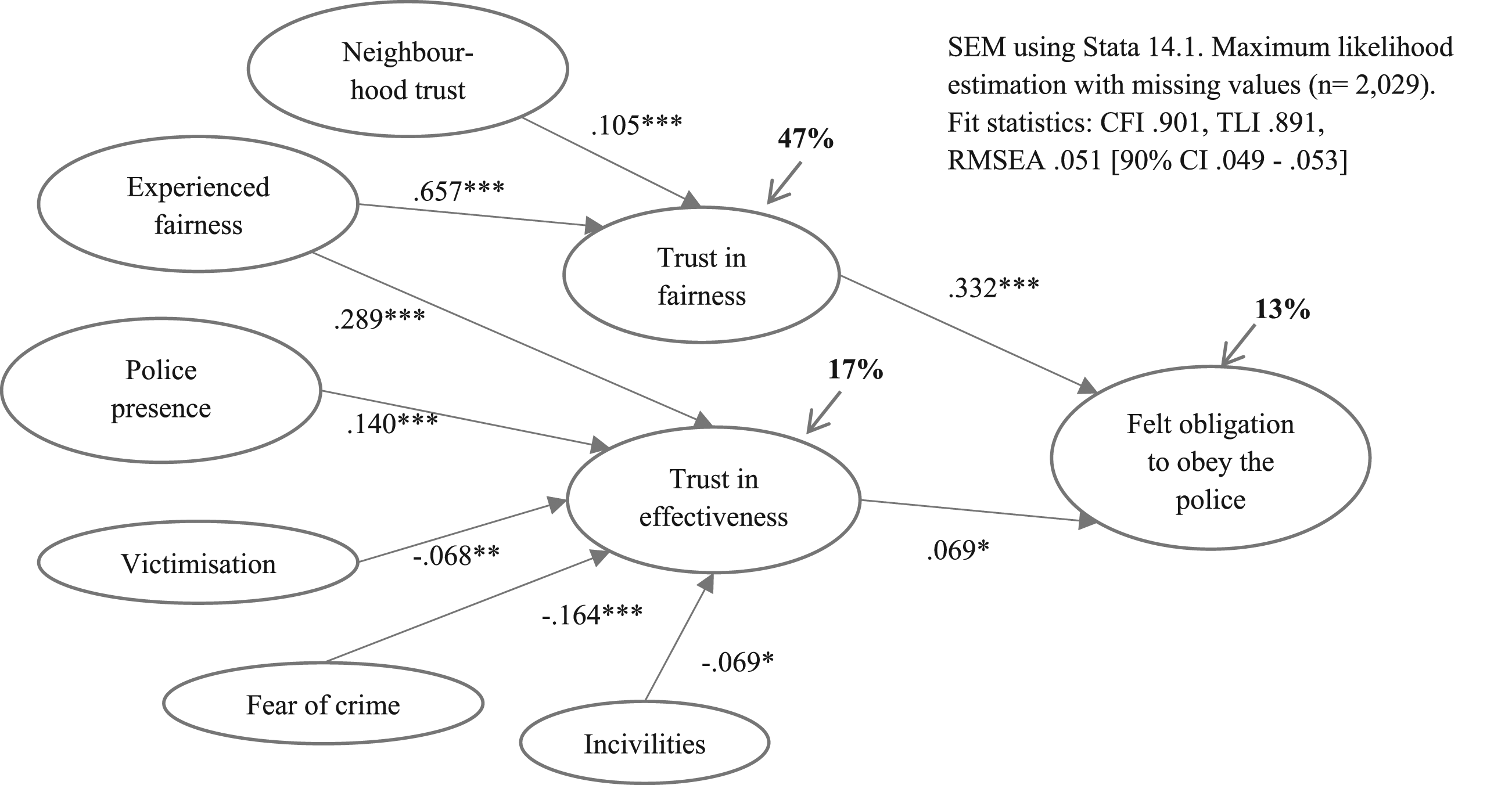
The findings of this study support hypotheses concerning instrumental predictors of trust (H1–H4). Respondents who had fallen victim to a crime (theft, burglary, assault, within the previous year) were less likely to express trust in police effectiveness (beta = −0.068**). Van Craen and Skogan (2015:133) suggest that as the police have failed to protect these victims in the past, their confidence in police protection in the future is negatively affected. In cases of victimisation, subjective evaluations of how the police handle a specific incident might be crucial for future confidence in the police. Unfortunately, these data do not provide insights into specific victimisation cases.
Similarly, respondents who expressed fear of crime did not feel sufficiently protected. Concerns regarding falling victim to theft, burglary, purposeful injury, damage to property, significantly reduced trust in police effectiveness (beta = −0.164***). Alternatively, the results revealed that the mere presence of police strengthened respondents’ confidence in police effectiveness (beta = 0.140***). The more recently had the respondents observed a police patrol in their neighbourhood, the more likely they were to believe that the police were successful in preventing violent crimes, arresting people who commit house burglaries, and responding promptly in the case of a violent crime.
Another significant predictor of trust in police effectiveness was incivilities in the immediate living environment (beta = −0.069*). Incivilities were strongly related to fear of crime (Lüdemann, 2006; Oberwittler, 2008). Thus, the independent variables incivilities and fear of crime were allowed to covary in this model. Nevertheless, we can find a direct path from incivilities to trust in police effectiveness. According to Jackson and Bradford (2009), incivilities signal to observers that individuals and authorities have lost control over the community, leading to the erosion of the social order. Consequently, concerns about disorder question the police’s ability to maintain control. Hence, combining police visibility, victimisation, fear of crime, and incivilities can explain 17% of the variation in trust in police effectiveness.
These findings support the hypotheses of the normative model (H5-H6). Fairness evaluations of previous encounters with police were essential for respondents’ belief that the police mostly made fair, impartial decisions, explained their decisions and actions, and treated people with respect (beta = 0.657***). Respondents who perceived their neighbours as trustworthy, helpful, sharing common values, and respecting law and order were more likely to express trust in police fairness (beta = 0.105***). A general tendency to trust others might influence trust in police and neighbourhood trust. In a different analysis of the same data, generalised trust 10 was added as a predictor of trust in police fairness, without a significant effect (Hecker, 2019). Thus, neighbourhood trust makes people believe in police fairness. Prior research indicates that the police are expected to defend community values. The way the police communicate with citizens embodies community values and sets an example (Jackson and Sunshine, 2007). When the moral structure in the community appears intact, the police can be expected to act as representatives of community values. A relatively large amount (47%) of the variation in trust in police fairness can be explained by the linear combination of neighbourhood trust and experienced fairness alone. Respondents appeared to judge police trustworthiness mainly through personal experiences.
As expected (H7–H8), the results revealed that trust in police effectiveness and fairness predicts felt police legitimacy. Those respondents who believed that the police were successful in crime prevention and responded rapidly to crime felt more obliged to follow police directives and accept police decisions (beta = 0.069*). Therefore, acceptance of police authority depends on people’s personal gain of police work – protection against crime. Trust in police fairness – consistent with extensive procedural justice research – strengthens the felt obligation to obey the police (beta = 0.332***).
Consistent with prior research (Bradford, 2014; Hinds, 2009; Hough, 2013) the impact of trust in police fairness on felt obligation to obey the police is higher than trust in effectiveness, according to standardised regression coefficients in this model (beta = 0.332***). This result confirms the key assumption of procedural justice theory. If the police treat people in a fair and respectful manner, they are regarded as having legitimate authority, encouraging compliance and cooperation.
Police effectiveness and fairness were interrelated. When police adhere to a request, treat a person seriously, and offer prompt help, they demonstrate both their competence and respect for the person seeking help (Bradford et al., 2009: 22). Therefore, trust in police effectiveness and fairness were allowed to covary in this model (r = 0.29***). By combining instrumental and normative perspectives on police legitimacy, only a moderate amount of variation in felt obligation to obey the police can be explained (13%). Hence, the results prove that police legitimacy is strongly affected by factors other than trust in fairness or effectiveness.
Macro level effects on trust in police fairness
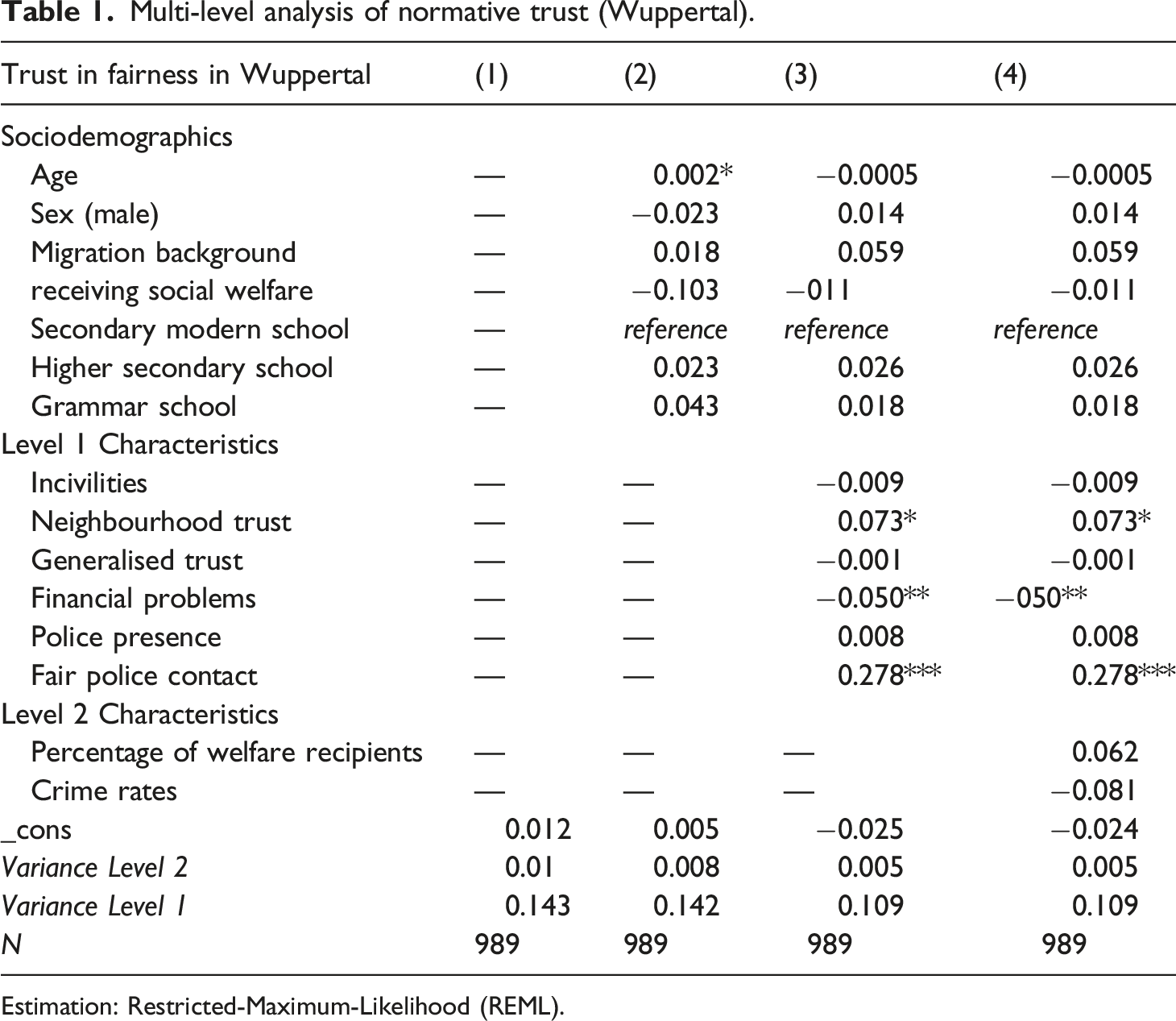
The second objective of the analysis was to determine whether contextual features of the environment are important for residents’ trust in police fairness. Table 1 reports the findings from a multilevel analysis of normative trust in Wuppertal. 11 The results stem from the complete data of 989 respondents. 12 To examine the contextual effects on citizens’ trust in police fairness, a multilevel modelling technique (random intercept model) was employed using Stata 13. Four models were created. Model 1 was the null model, which included only the grand mean-centred outcome variable (trust in police fairness). In the null model, the variance component model for trust in police fairness is reported, the estimate of the between-neighbourhood variance is 0.01 and the estimate of within-neighbourhood variance is 0.143. Thus, only about 7% of the variance in trust in police fairness can be explained by variations in neighbourhood characteristics.
In Model 2, five Level-1 grand mean-centred variables – age, sex, migration background, social welfare, and education – were added to determine their total effect on citizens’ trust in the police. The levels of trust in police fairness possessed by citizens who were older, were women, and had attained more than secondary modern school education were slightly higher. Respondents without German citizenship and those who immigrated to Germany were found to have higher levels of trust in police fairness. Citizens who depended on social aid had slightly lesser trust in the police than those with regular income. The small effects of the sociodemographic factors were not statistically significant. The variance for Level 1 residuals decreased by 0.01, which suggests that sociodemographic factors explain a small portion of the variance in trust in police fairness.
Model 3 examined the relationship between trust in police fairness and personal perceptions of the neighbourhood, personal disadvantages, and experiences with the police. Two ‘quality of life’ indicators (Schuck et al., 2008), represented by incivilities and neighbourhood trust, were added. Incivilities had a negative effect on trust in police fairness (beta = −0.009). Neighbourhood trust was significantly positively related to trust in police fairness (beta = 0.073*). Thus, for every 1 point increase in the factor score of neighbourhood trust, a 0.07 point increase in trust in police fairness can be expected. These findings are congruent with a quality of life perspective (Reisig and Parks, 2000), which suggest trust in police depends on the perception that people in a neighbourhood are helpful, trustworthy, share common values, and respect law and order. The negative effect of perceived neighbourhood problems (incivilities), such as littering and drinking alcohol in public or vandalism, however, is not statistically significant.
Generalised trust was controlled and entered into Model 3 to analyse whether a generalised belief that one can trust most people affects trust in police. The effect was small (beta = −0.001) and not statistically significant. To account for personal disadvantages, a Level-1 grand-centred variable labelled ‘Financial problems’ was added. Citizens who experienced difficulties in managing their lives with the monthly money available to them had significantly less trust in police fairness (beta = −0.05**). Police presence was found to be positively related to trust in police fairness. Citizens who had recently observed a police patrol expressed slightly more trust in police fairness (beta = 0.008). Positive experiences with police were found to have a highly significant positive impact on trust in fairness (beta = 0.278***). Citizens who had experienced a police interaction, during which the police treated them in a fair and respectful manner, openly explained their actions and did not try to provoke or insult them, expressed higher levels of trust.
Model 3, which contained only individual-level variables, explained a decent amount of variance in trust in the police at both Levels 1 (23%) and 2 (38%). Thus, personal perceptions of the neighbourhood, personal disadvantages, and experiences with the police partly explain the differences between different neighbourhoods.
To determine the Level 2 contextual effect, two grand mean-centred variables, the percentage of welfare recipients and official crime rates 13 – were added to Model 4. In addition to the relatively small proportion of variance at the neighbourhood level (7%), the findings did not fully support the hypotheses concerning contextual effects (H9-H10). Controlling for individual characteristics such as personal experiences with the police, personal disadvantage, and neighbourhood trust, social disadvantage at the neighbourhood level (proportion of welfare recipients) did not exert a negative influence on trust in police fairness. The positive coefficient (beta = 0.062) suggests that residents in socially disadvantaged neighbourhoods have higher levels of trust. As expected (H10), trust in police fairness was found to be lower in neighbourhoods with high cases of robberies, assaults, and theft per capita. The negative effect of official crime rates on trust in police fairness was not statistically significant (−0.081).
Discussion
Both instrumental and normative models help to understand police legitimacy in Germany. Trust in police effectiveness depends on subjective evaluations of personal safety. Victimisation and fear of crime have eroded trust in police effectiveness. Conversely, police presence can strengthen trust in the police’s ability to prevent and react to crimes. Trust in police fairness relies on personal experiences with the police. Respondents who felt that the police had acted in a fair and respectful manner during a previous encounter were more likely to express trust that the police would treat people with dignity and respect.
The results confirm the claims of procedural justice theory that police can positively shape their public perception in every police-citizen encounter. The felt obligation to follow police orders does not simply result from a fear of punishment or a lack of options. Legitimacy constitutes a property or quality that makes people believe in the rightfulness of police authority. An internalised willingness to adhere to police power stems from the belief that the police can be trusted to wield their power judiciously (Jackson and Gau, 2016: 50). An individual’s sense of fairness is a strong driver of human actions (Tyler and Blader, 2003). Unfair police practices expose police to criticism and jeopardise public trust. Considering the ongoing tensions between young people and the police and the public criticism of racial profiling and police misconduct in Germany, procedural fairness is becoming increasingly important.
Since tensions between police and citizens have become most apparent in disadvantaged urban communities, this study used advanced multilevel modelling and observed the effects of two contextual variables (welfare recipients and official crime rates) on neighbourhood levels of trust in police fairness. The results revealed that psychologically based reactions to neighbourhood conditions appear to be more important than ecological neighbourhood structures. Residents who believed that their neighbours were trustworthy and helpful were more likely to believe that the police generally treat people with dignity and respect. Community-related bonds that hold society together create the impression that the police fulfil their role as society’s representative of common values (Jackson and Bradford, 2009). Social disadvantage has a significantly negative impact on trust in police fairness. The money available to an individual each month (regardless of whether a person depends on social welfare) is most important. Accordingly, most of the variation in trust in police fairness was owing to within-neighbourhood (or between-person) variation and random error. Citizens living in the same location appear to perceive neighbourhood conditions and social disadvantages differently.
This study had certain limitations which must be acknowledged. First, although the results demonstrate that both trust in police effectiveness and fairness matter in Germany, they also indicate that the explanatory power of normative and instrumental perspectives on police legitimacy is limited. Trust in police, and obligation to obey police orders, depend considerably on factors not incorporated in these models.
Second, quantitative studies such as this study are not capable of capturing the ongoing tensions between the police and German citizens. The willingness to participate in written or online surveys decreases with limited language skills and may be diminished once a deep distrust in the government and the police has been established. Different approaches must be selected to investigate attitudes towards the police, particularly by minority groups. This may be a reason why sociodemographic factors such as migration background have no significant effect on trust in police fairness. A heterogeneous group of migrants deserves more detailed analysis. Minority groups are underrepresented and well-educated individuals are over-represented in this sample. Further research is necessary on disadvantaged minority groups, who cannot be reached adequately using written surveys (Haverkamp, 2019).
Third, neighbourhoods were defined as relatively large administrative subareas. The selected districts of Wuppertal had an average area of 244 hectares and an average population of 5118. The advantage of these areas lies in the availability of official data on welfare recipients and crime rates. However, urban conflict areas or crime hotspots are mostly ‘micro places’ – either street intersections or segments (Braga et al., 2009). Variations in policing style may not become apparent at the district level. Rather, policing strategies focus on parks with conflicting user groups or areas with urban nightlives. Proactive policing is more common in these areas to prevent escalation under the influence of alcohol (Hunold, 2016: 178). Further research is necessary to analyse perceived police fairness in these places.
Regardless of these limitations, this study indicates that making procedural justice theory more prominent in the academic and public debate in Germany can help advocate for the importance of fair and respectful treatment by police officers, thus enhancing the trust and legitimacy of the police as an institution.
Footnotes
Acknowledgements
The Author(s) is (are) grateful to Ian Crichton and Karoline Eickhoff for editing a previous draft of the paper and to the Sage Author Services for their helpful comments and corrections.
Declaration of conflicting interests
The author(s) declared no potential conflicts of interest with respect to the research, authorship, and/or publication of this article.
Funding
The author(s) disclosed receipt of the following financial support for the research, authorship, and/or publication of this article: This work was supported by the Joint research project ‘VERSS’ received funding from the Federal Ministry of Education and Research between 2014 and 2017.
