




Abstract
Understanding the factors that influence domestic violence and abuse (DVA) victims to withdraw from the Criminal Justice System globally continues to be a key focus for professionals and academics working within this area. There is a dearth of extant literature examining the motivations behind victim withdrawal, particularly retraction occurring post provision of an initial statement. This paper examines the phenomenon of retraction, by thematically analysing N = 60 police retraction statements (PRS) collected by police officers in a large suburban police force in the North West of England. In examining these statements, insight can also be garnered from those victims still in an active relationship with their abusers. Findings highlight female victims’ motivations for retraction and are framed around victim problem solving including: a) accepting the relationship which resulted in a discordance in proceeding with the prosecution of the abuser b) rejecting the relationship thereby rendering the prosecution as redundant c) engaging in procedural problem solving where alternative measures such as civil actions were sought to substitute a CJS prosecution and d) the effect of children where motivations were split between retracting to return to the complete family unit including the victim as the mother and retracting due to recognising the importance of the father’s role without involvement from the mother. Notwithstanding limitations, this paper demonstrates that there is significant value in conducting an analysis of PRSs in furthering the understanding of why victims choose to retract at this point in their prosecution journey. The extracts from this dataset add insight and understanding into DVA female victim motivations to retract post-initial statement provision and highlight the differences within victim populations who retract their original statement.
Introduction
Research examining domestic violence and abuse (DVA) and policy initiatives have expanded greatly over the past 40 years, yet it is commonly understood a high percentage of DVA cases reported to police are closed due to evidential difficulties where the victim did not support a prosecution and that a large proportion of victims withdraw their support early on in their reporting of DVA (ONS, 2021). Research shows 54.8% of all DVA cases were discontinued due to victim withdrawing support (HMICFRS, 2021). Comparable patterns of non-supporting victims have been consistently shown to contribute towards these unsuccessful prosecutions (Elkin, 2018) where research shows half of all victims never have the intention of pressing charges as the desired outcome is achieved at the point of reporting or the arrest stage (Boivin and Leclerc, 2016; McPhee et al., 2021). Criminal conviction of DVA cases remains low with some studies showing only 7.25% of all cases reported resulting in a criminal conviction (McPhee et al., 2021). Finally, and poignantly for the context of this paper, victim disengagement in DVA cases continues to present the biggest influence on police officers’ and prosecutors’ decisions to terminate the prosecution of DVA cases (Sleath and Smith, 2017) despite the positive action policy lingering on in various guises across the policing of DVA in the UK.
Given the high percentages of victims withdrawing from the CJS at the point of reporting and/or arrest, this study seeks to broaden the understanding of those victims who have remained engaged with the CJS to the point of providing their police victim statement (PVS) and subsequently reach the decision to retract this statement by means of providing a police retraction statement (PRS). Despite there being a low number of victims who reach this point, it is important to understand what causes this decision to retract, having remained engaged for longer than most DVA victims. Additionally, whilst there has been some quantitative understanding garnered in terms of the frequency and the point at which a retraction occurs, the more nuanced qualitative understanding of motivations behind why victims choose to retract remains lacking. This paper addresses this gap by means of analysing the narratives contained within a PRS which to the knowledge of the author have not been examined previously for this purpose.
Researching retraction in DVA
The different terminologies and frequent additions to policy in DVA make researching this area broadly more challenging and complex (Barnish, 2004), a problem which also extends to and includes the area of retraction. There are several terms used in addition to retraction to indicate a victim who reaches the decision to not proceed with the prosecution: disengagement, recantation, attrition and withdrawal of support. These decisions can feature at any point from when the police are alerted to the incident of DVA, not disclosing any information at the point of police arrival at the scene, deciding not to provide a statement, deciding to provide an initial statement to subsequently deciding to withdraw that statement and finally the decision not to attend court. Retraction for the purpose of this paper will describe a specific point in question where having provided a PVS, the victim then makes the decision to formally retract their PVS by providing a PRS. Thus, the narratives discussed in this paper reflect those victims whose cases have been deemed sufficient evidentially to obtain a statement and where victims who were initially motivated to engage officially with the CJS decide to retract that statement.
Timings of retraction requests can be received a few hours after the initial statements have been obtained following the arrest of the abuser, during the period of time leading up to the court case, and at times, on the actual day of the trial, with some research suggesting that a retraction typically takes place following the first five days of the DVA incident (Barrow-Grint, 2016). This paper does not distinguish between the different stages of retraction and includes both pre and post charge cases.
Previous research on the specific point of retraction
One ground-breaking study proffering considerable insight into why retraction might occur examined victim and offence characteristics indicative of retraction by analysing data from the Specialist Domestic Violence Courts (SDVCs) (Robinson and Cook, 2006). An increased likelihood of retraction when both parties were still in a relationship, previous abuse had occurred, an assault had occurred, the victim became injured as a result of the assault, and the abuser was intoxicated through alcohol during the offence were identified as the main reasons for retraction occurring. Factors not predictive of retraction included having children together, and when the victim was classed as a vulnerable witness, as defined by section 16 of the Youth and Criminal Evidence Act 1999 (CPS, 2021).
Sleath and Smith’s (2017) results showed neither the victim’s nor abuser’s characteristics presented any differences between those cases where victims retracted and where victims remained engaged with the prosecution. They found the three most prevalent reasons for retraction and disengagement were reconciliation, wanting to get on with their lives/end of the relationship, and reasons relating to children.
For some victims, however, their rationale for retraction was borne out of a wish to have their abusers provided with some form of treatment to assist with the problematic behaviour responsible for the violence (Cretney and Davis, 1997). Similarly, evidence obtained in an SDVC in Wolverhampton, UK, revealed victims’ retraction motivations included the following: fear of the abuser and/or repercussions from the abuser’s family, the victim’s family, the community; fear of harming the status and honour of the family; fear of losing children; confusion and lack of information about the criminal and civil processes and thereby fear too; lack of information and delays to progress their case; changes made to bail conditions; and immigration status (Anderson, Boyle, Cook, Hartley, & Roberts, 2001).
Children
As can be deduced from research about reasons for retraction, the effect of children on retraction remains, at best, inconsistent where for some victims having children together with the abuser was shown to be one of the most influential factors in victims withdrawing their support of a prosecution against their abusers (Hester, 2006). Yet for some victims, children created a more diverse and varied effect on DVA victims’ decision-making process throughout their journey in reporting the abusers (e.g. Fanslow and Robinson, 2010). A dual effect of children upon victims’ motivations to retract exists, where for some victims the reason for reconciling (and therefore retracting) with the perpetrator was due to having children yet for others, children deterred victims from wishing to prosecute the abuser in the first instance due to fear of upsetting the children and the prosecution affecting children’s ability to access the father in the future (Rhodes, Cerulli, Dichter, Kothari and Barg 2010; Sleath and Smith, 2017). In short, research demonstrates the presence of children may simultaneously contribute and detract from retraction decisions.
Qualitative understanding of retraction
Given the complex and diverse motivations for victim retraction particularly when considering the effect of children, this paper seeks to add considerable depth to the understanding of the specific point of victim retraction following the provision of a PVS. Additionally, a qualitative analysis of PRSs where the differences within retraction motivations are examined has not previously been conducted in other studies addressing victim retraction. As referred to in Hopkins and Miller (2022), the main limitations of using PVSs are: the victim’s own words are not captured but rather summarised by a police officer interpreting their account; the content of the account is chosen by the officer; there is no possibility for the researcher to expand upon any of the victim’s account; and ultimately a PVS is a legal document prepared for the purpose of its use in a court of law. A fuller discussion on the merits and drawbacks of using PVSs and other court documents compared to the more traditional qualitative methods such as semi-structured interviews can be found in Hopkins and Miller (2022).
Finally, this paper seeks to expand our knowledge on reasons why victims retract their initial Police Victim Statements (PVS) by means of the provision of a Police Retraction Statement (PRS). The focus therefore lies with individual factors that can cause the decision to provide a PRS. It would be amiss, however, not to refer to the wider context within which these decisions are made in addition to acknowledging many victims who consistently do not seek the assistance of police services (Brownridge and Halli, 2001). Furthermore, those DVA victims who do call the police show a much lower rate of satisfaction with the service they receive compared to non DVA victims (Byrne et al., 1999) indicating some potentially specific issues for DVA victims in their reporting experiences. More widely, patriarchal norms within society, in religious institutions (Archer, 2006) and within the criminal justice system (Belknap and Melton, 2005) continue to create a gendered imbalance which have been shown to effect female victims’ decision making on reporting and retracting their complaints of DVA. However, for reasons of space limitations, the focus of this paper will be on the individual motivations for providing PRSs whilst acknowledging the wider context within which DVA is situated and the effect his has upon female victims’ decision making.
Methodology
The data
Exclusion criteria and rationales for excluding these types of PRSs.
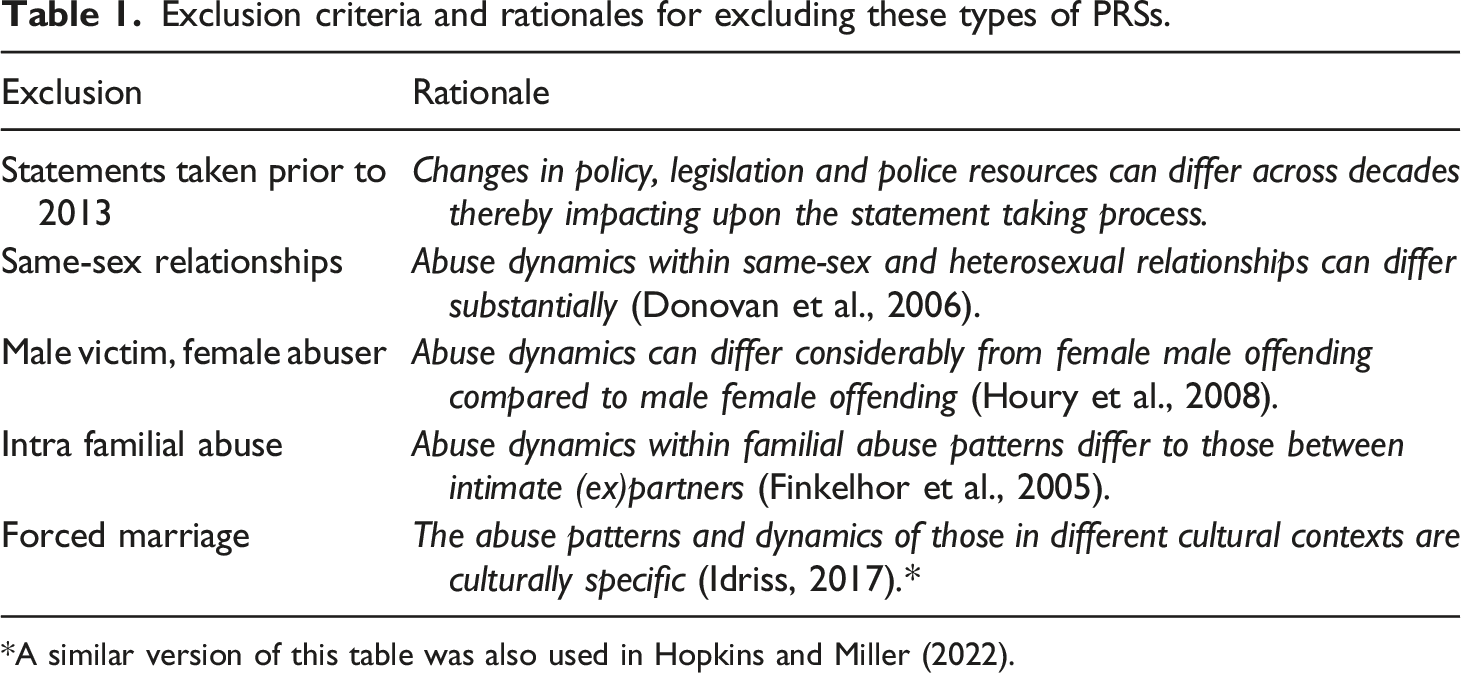
*A similar version of this table was also used in Hopkins and Miller (2022).
Participants
Mean and median ages (years) together with age ranges for victims and abusers in 60 retraction statements.
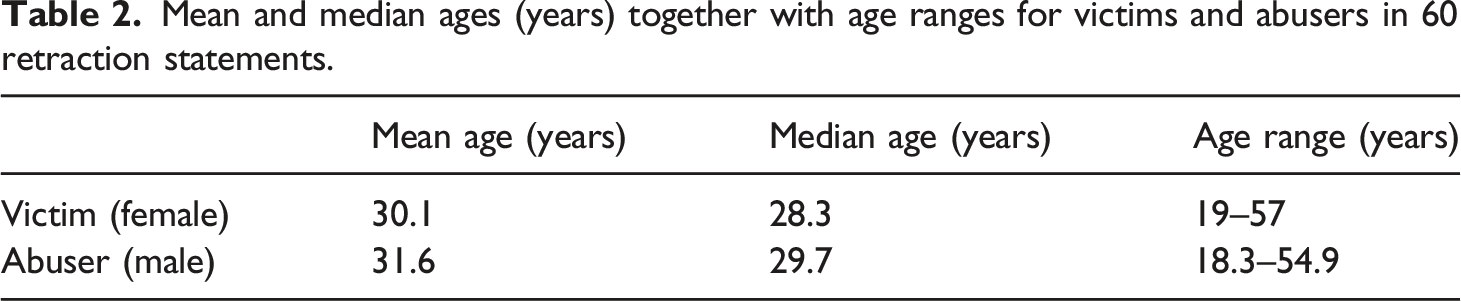
In terms of relationship status, at the time of providing the statement, 63% of abusers and victims were in an ongoing relationship, 20% separated, and 17% were in an on/off relationship. Marital status of victim and offender was not available in the data.
Ethics
Ethical approval was obtained by the author’s institution and by means of a data sharing agreement between the author’s institution and the participating police force. Obtaining consent from the recipient of the PRSs was not possible nor advisable. The original data did contain contact details for victims yet subsequently contacting them for the purpose of obtaining their consent was considered disproportionate and could potentially cause additional harm to the victims, especially those still in their abusive relationships. Withholding any personal information contained in the PRSs ensured victims’ confidentiality was upheld. By accessing the PRSs, narratives of this otherwise hard-to-reach population in terms of those still in abusive relationships were made available without re-traumatising the victims (Epstein, 2010).
Procedure
A data sharing agreement between the author’s educational establishment and the participating police force established the handling and anonymisation of the data. The transcription of the PRSs from the police system to a word document took place on police premises and were stored securely on a password encrypted file and fully anonymised to avoid any identification of either the victim or offender. Most of the PRSs were handwritten and had been scanned onto the system but a small proportion were typed. At the time of obtaining the statements, the author was a serving police officer in the participating police force.
Analysis
The statements were analysed by means of following the inductive thematic analysis approach supported by Braun and Clarke (2006) which includes: data familiarisation; generation of provisional codes; thematic searching; review of emergent themes; defining and redefining themes; naming themes. Familiarity with the data was achieved through careful reading of the data already transcribed and detailed transcription of the evidence that was not. This was a repetitive process where stages were regularly revisited, thereby ensuring optimal levels of analytic accuracy. Provisional coding and thematic searching were completed, thereby providing some familiarity with the raw data. The subsequent emergent themes were reviewed and presented at several conferences for initial peer review. Feedback from peers attending these conferences assisted in achieving the next stage of analysis in terms of the defining and redefining of themes to establish names. The final stage of analysis involved obtaining inter-rater agreement which was achieved by sending the redefined themes to colleagues for feedback. Once consensus had been attained, the final naming of the themes was able to take place. Thematic analysis was chosen due to its theoretical freedom which offers relative ease of understanding for researchers conducting the research and for practitioners making sense of the data, which is considered important as this research is intended for both academics and practitioners interested in motivations for retraction. Additionally, thematic analysis is useful in examining the differing perspectives of research participants by highlighting differences and similarities (King, 2004) and these were both anticipated in the findings of this paper.
Findings
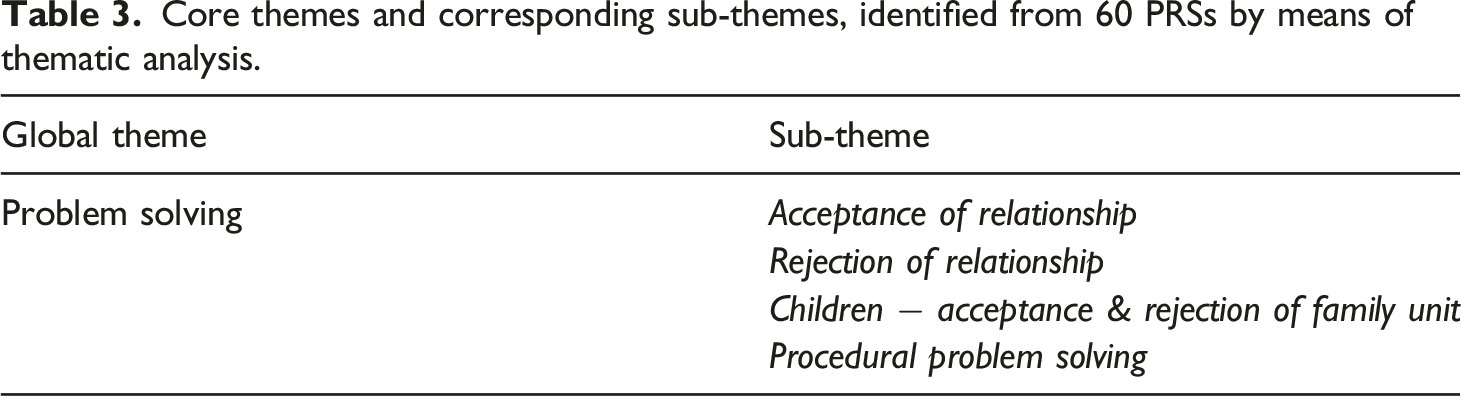
Core themes and corresponding sub-themes, identified from 60 PRSs by means of thematic analysis.
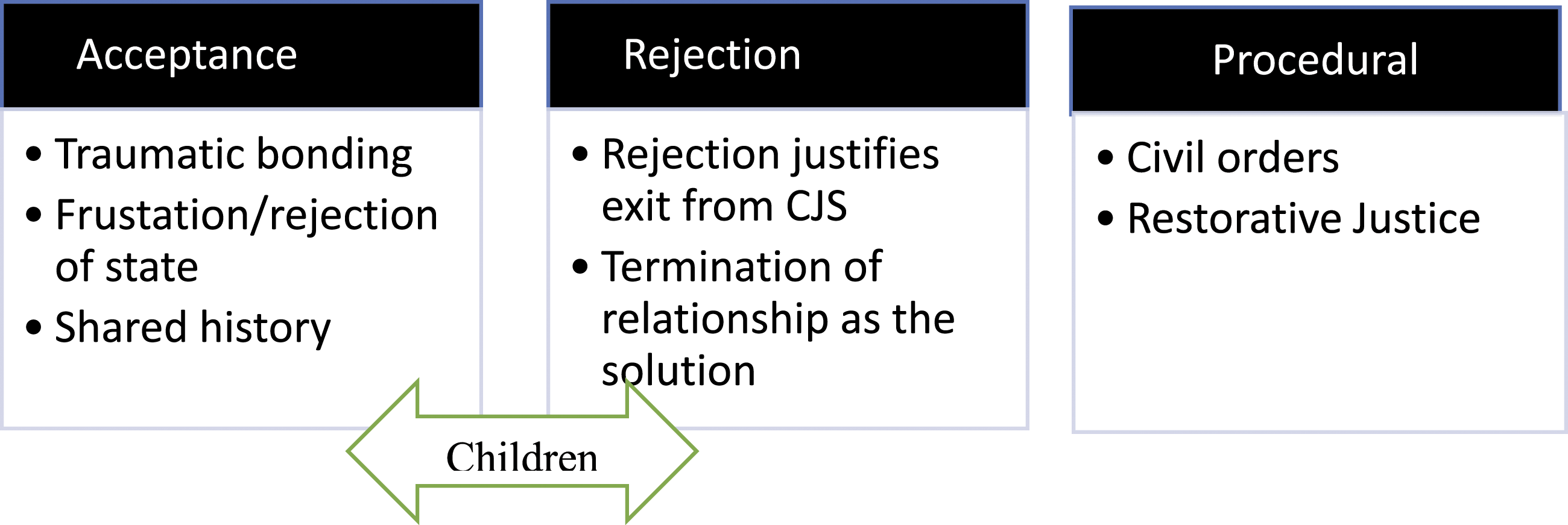
The sub-themes and their main corresponding codes.
There was some overlap in the occurrence of the motivations across the PRSs where some statements contained, for example, a victim who rejected the relationship yet also sought to problem solve away from a formal CJS intervention by seeking out a non-molestation order. In other PRSs there was evidence of acceptance of some of the abuser’s behaviour yet overall the victim wished to remain separated from the abuser and rejected the abuse. Thus, the analysis reveals divergent motivations for victims’ problem solving towards a decision to retract and not typologies of victims as such. Identifying what the motivations are for providing a PRS, thereby signalling the request to exit from the CJS, allows for the differences across motivations of retraction to be highlighted as opposed to differences between cases where retraction occurs versus where victims remained engaged in the CJS process. In doing so, some valuable insights can be shared with both practitioners working with DVA victims and academics researching this area.
Acceptance of relationship
Wanting the relationship to start again was a theme featuring prominently across the data set. It is evident victims in this theme are committed to their abuser and the continuation of the relationship and that this fuels their decision to provide a PRS. This commitment seems to be framed by victims’ senses of loneliness, attachment and hope that the relationship will change and improve.
Acceptance and determination to continue with the abusive relationship featured side by side the rejection of the CJS where victims favoured a return to the privacy of their relationship, coupled with evidence of traumatic bonding between the couple (Dutton and Painter, 1981). Sentiments of the CJS not understanding or supporting the abuser as the victim felt he ought to be, victims’ feelings of sympathy towards the abuser coupled with a desire for assistance with the abuser’s mental health issues were also noticeable:
V53
I will not go to court. I love him and want to live with him forever. He does hit me but I don’t care it’s usually only little hits in the arm, I want him to be let go from the police station and I want him back home and if you give him bail conditions I will ignore them, you can’t stop two people who love each other being together. He is going to have anger management sessions. I believe he will not leave me, he loves me. I was summonsed to court I would not attend. If I was arrested to attend you would have to take me kicking and screaming and I would still not say anything in court.
This quote indicates that the victim very much admonishes the attempts at the perceived coercion by the CJS and states in no uncertain terms any attempts to force her to give evidence would be futile. For this victim, her problem solving is rooted from a central attribution that love can conquer all and that this love is the driving force towards enabling her to stay with her abuser despite acceptance of his violence towards her. With a more victim-focused approach where police officers are able to accommodate the wishes of the victim as opposed to being tied to a positive action policy, this type of retraction could perhaps be avoided in favour of an alternative remedy such as the offender taking a mandatory anger management course as suggested by the victim herself. With the mention of ongoing violence however, this approach is not without additional concerns around victim safety and considerations of the risk posed to the victim.
For V48, the level of investment is apparent and despite the abuser remaining angry “all of the time”, the victim is determined to stay in the relationship. In both abusive and non-abusive relationships, the desire to hang onto a relationship is shared for similar reasons, including fear of not finding a better partner and a belief in the ability to improve the dynamics between partners, despite the current state of the relationship (Gager and Sanchez, 2003).
V48
I have thought about [abuser’s name] going to prison and I don’t want this for him. I love him and get upset because he is not with me. We have been through a lot together and I know he needs help as he is so angry all the time. I want to be in a relationship with [abuser’s name]. I don’t want the bail conditions anymore as they are stopping [abuser’s name] from seeing me. I’m not afraid anymore.
From the victim’s perspective, it is the sense of a shared history during these difficult times that forms a bond towards the abuser and motivates her decision to provide a PRS. Her fear has dissipated, and the acceptance of the abuser’s behaviour enables her desire for reunification. From a policing perspective, this acceptance could represent the source of frustration in police officers who see the victim as behaving counterintuitively. Returning to the abuser can cast doubt on victim statuses and increase the blame proffered towards her (Russell and Light, 2006),
Rejection of the relationship
By terminating and reaching a point of rejecting the abuser and the relationship, the CJS route is no longer considered necessary nor are alternative remedies such as taking civil action. The implicit assumption, however, seems to be that ending the relationship will result in a halt to the abuse, which may not be an accurate sentiment given the high level of post separation abuse commonly found in DVA (Kelly et al., 2014):
V3
I never had any intention of going to court and told the police at the time. [abuser’s name] and I are no longer in a relationship and I do not want to resume the relationship with him. This was the first major incident between [abuser’s name] and I which is why I contacted the police. Due to the length of time this has been going on and the fact my mental health has been getting worse, I just want it to be over.
Similarly for V7, the wish to carry on with life without the abuser is clear and this seems the easier route compared to awaiting the court case:
V7
I have time to think about the situation and have decided to retract the initial statement. The reason why I do not wish to go ahead is that I just want him out of my life. I don’t want it to hang over me and it would be much easier to forget and carry on with my life.
The ending of the relationship seems sufficient to satisfy these victims that they will be able to continue with an abuse-free life thereby negating the need for any further action to take place against their abuser. Relationship statuses have been found to have varying effects upon decisions to retract by victims where the decision to retract features more highly in those victims who are in a relationship (Robinson and Cook, 2006) whereas for others, the end of the relationship is seen as a major contributing factor towards the provision of a PRS (Sleath and Smith, 2017).
Another key factor featured in the data set that sits alongside their rejection of the relationship is the issue of time and the amount of time that has passed since providing their initial statement. Despite V3 and V7 being adamant their relationship was over, both refer to the amount of time it has taken or is taking. Further scrutiny of the effect of time would allow for better understanding of whether those rejecting their relationships may perhaps not retract from the CJS if their case was progressed in a more timely fashion. The effect of time could also be observed in the procedural problem solving sub theme where civil action was preferred due to victims perceiving this as being more expedient.
Children − acceptance of family unit
Victims in acceptance of the family unit were motivated to create a cohesive unit consisting of the abuser, the victim and children together regardless of the abuse that had occurred between the victim and the abuser. The abuse towards the victim becomes secondary, with the role of the father being very much the primary concern.
For V7, the motivation in making the initial call to the police was to make a stand against the abuser and teach him a lesson. The abuser’s role as their father and the wellbeing of the children take precedence and motivate the victim’s provision of a PRS:
V7
Since then I have considered everything and no longer wish to pursue any action or prosecution against [abuser’s name]. I called the police on the day to show him he cannot hit me but I was not expecting the police to take the action they did. He has never hit me before. We have four children: 12, 9, 3, & 2 years old. All the children miss him very much and [abuser’s name] is a very good father to the children. There are no problems between the children and him. I think part of the incident was caused by [abuser’s name] being under the stress from his drink driving case. I received no injuries and I’m sure he has now been taught a lesson. I want no further action taken against [abuser’s name] and will not support any prosecution. I do not want to go to court and it is causing the children problems.
The abusive episode is minimised by means of it being a first time offence and that the arrest has served as a lesson learned for the abuser. The central need expressed here is the return to the family unit, and to ease the distress of the children being separated from their father, a concern at the forefront in the victim’s decision to retract.
Children − rejection of family unit
For victims rejecting the family unit, the rejection centered around the victim’s continued rejection of the abuser due to certainty she did not wish to return to him. At the same time, victims wanted abusers to fulfill fatherly roles towards their children and to ensure abusers had the appropriate means to access their children. Those who continue to accept the importance of the family unit seem to remove themselves from the relationship and place an increased importance on the abusers’ contact with the children regardless of what has occurred between them. The victims reject the abuser (and thereby the family unit that includes the victim as the mother) but acknowledge the needs of the children in having a father in their lives, thereby seeking the rejection of the existing family unit and wishing for a revised family unit solely between the abuser and their children. Often the fear of the father going to prison and not being able to be present is a motivating factor for victims in this theme to retract as per the following PRS:
V27
Since providing the statement to the police I haven’t heard from him. This is unusual as he would normally be phoning me and trying to contact me. I think he has now got the message that I want him to leave me alone. As far as I am concerned, our relationship is over. I’m happy for him to still have contact with the children without me being there. I have had second thoughts about going ahead with the prosecution against [abuser’s name]. The main reason for this is that I don’t want him to go to prison and not be able to see the children. My son is now 5 years old and I don’t want him to grow up to think his dad went to prison because of me. I no longer want to attend court and give evidence against him.
For the above victim, it is clear she desires to remain separated from the abuser, yet she does not want to continue with prosecution as she wishes for her children to remain in contact with their father.
Procedural problem solving
The descriptions of the procedural problem solving sub-theme within the data were centred around victims seeking alternatives to a formal CJS outcome by means of pursuing or stating the intention of pursuing a civil route such as obtaining a non-molestation order against the abuser. Similar to the rejection of the relationship sub-theme, V21 remains adamant her relationship is over and yet is very specific about what action she would take should the situation change to her abuser rekindling contact with her. The availability of criminal and civil remedies in DVA is something unique to DVA victims (Jordan, 2004) yet thereby also creates an area lacking in transparency for victims in knowing which route to choose. For some, this results in a hybridisation of civil and criminal remedies (Bates and Hester, 2020) where victims achieve justice by means of a mixture of both criminal and civil measures to the offences they report. Obtaining civil orders is often seen as a preferable measure against DVA due to empowering victims more by giving them a choice in accessing the protection often within a better timeframe:
V21
[Abuser’s name] has not contacted me since he was arrested and I feel he no longer will. I think he now knows the relationship is over and I am happy to leave it as it is. I’m going to see how things go. And if I have any problems with him in the future, I will look to take civil orders in relation to a restraining order against him. But this will be done through civil action.
The victim is often clear in what solution she seeks to the ongoing abuse against her, which can be far removed from prosecuting their abusers in the prescribed manner (Mcphee et al., 2021).
Another problem solving approach utilised by victims as an alternative to a formal CJS process was the pursuit of an informal Restorative Justice (RJ) arrangement. For the following victim she is clear she never wanted the matter to go to court in the first instance:
V32
I work as waitress and he works as a chef in the same place. Since he was charged I have seen him at work and had minimal conversation with him − mainly about work. The only conversation we have had about the case was a couple of days after he was arrested when he approached me and offered to pay some money back for the damage caused. I accepted that. He gave me £300 in cash on the same day. I put £150 of that into my account. He has said he will give me another 500 in instalments over the next few weeks. This is to replace the items he has damaged. He is not aware that I am retracting my complaint and does not even know I am at the police station. I have not discussed withdrawing my statement with anyone. It is my decision. I never wanted the matter to go to court.
RJ is a process that allows for solutions similar to those described by victim V32 to take place, yet traditionally this has not been applied to DVA (Stubbs, 2007). There exist opposing views on the benefit of RJ where some argue that RJ solutions can be found for any crime (e.g. Bazemore and Earle, 2002) and others who view RJ for crimes like DVA as controversial (e.g. Braithwaite and Strang, 2002). There has, however, been an increase in more creative and alternative justice processes in policing DVA including RJ, partly due to the failings of the criminal justice system in dealing effectively with DVA (Westmarland et al., 2018) which sits alongside the obtainment of civil orders in addressing DVA cases.
Discussion
As has been demonstrated in this paper, there exist multiple and complex reasons why victims at this point in their engagement with the CJS choose to retract their statement. Retraction is situated towards the end of the disengagement process and it is important to understand this particular latter stage of victims officially withdrawing their support by means of a PRS provision. Understanding the range of problem solving skills employed by victims at this stage of retraction enables practitioners to explore what, if anything, can be done to prevent this ultimate stage of withdrawal.
The data illustrated that victims who had reached the crucial decision to provide a PRS did so as an outcome of multiple forms of problem solving. Firstly, remaining emotionally attached to the idea of their relationship with the abuser motivated by a desire to return to the status quo prior to police intervention often rejecting the perceived control the CJS had upon their relationship. These decisions to retract were strongly governed by a shared history with some evidence of traumatic bonding and knowledge of not being able to manage without each other (acceptance of the relationship). Secondly, those who rejected the relationship were determined in their decisions not to return to their abusers yet felt subsequent CPS intervention was redundant, where time taken in processing their cases played an influential role in reaching this point, a point also corroborated in other studies (e.g. Robinson and Cook, 2006) (rejection of the relationship). Thirdly, the effect of children created a divide across the motivations in the provision of a PRS where for some it was to maintain the family unit including the victim as mother (Children − acceptance of family unit) whereas for others it was for the sake of the children with the victim (mother) not wanting to be a part of this unit. In this case, the decision to retract was based on victims distinguishing between the victim and abuser relationship and the relationship between their children and the abuser where the latter was the focal purpose of retracting their statements (Children − rejection of family unit). Finally, victims expressed a need for a more creative solution to the abuse they had experienced by means of either following a civil route of action such as obtaining a restraining or non-molestation order or by means of requesting or having created a procedure akin to restorative justice in finding a solution to their abusive experiences (Procedural problem solving).
The most obvious implication from this study is that ‘one size does not fit all’. This adage was particularly applicable to the procedural problem solving sub-theme where, for some victims, there was a clear desire to follow a route of taking action against the abuser outside of the courtroom. Implications for policy are provided and mainly framed around considerations for topic inclusions in police training programmes to alleviate difficulties police officers face in understanding DVA victim decision-making particularly when deciding to provide a PRS.
Finally, it is important to address some of the limitations of this study: the data analysed originates from one force only thereby not allowing for comparison across other forces; it was not possible to examine the status of the offender in terms of whether they had been charged with offences or not at the point of retraction; the sex of the officer obtaining the PRS was not available which, if available, would have provided an interesting point of comparison to ascertain whether there exist any differences in length and language between male and female officers given the current focused attention on misogyny in UK policing (HMICFRS, 2022) which invariably impacts upon DVA victims’ experiences in reporting and retracting DVA incidents.
Implications for practice
Some of the implications for practice garnered from the analysis of PRSs relate to the external structures and processes of a PRS whereas others relate more to the content of the narratives in the PRSs and what further understanding these can offer practitioners facing a victim who is requesting to provide a PRS.
With regards to the external structure, the length of statement (on average 217 words) reflects an incident per incident approach with officers missing the opportunity to revisit the original statement to find out what has changed, and why the victim, having engaged up until this point, is now motivated to provide the PRS. Although it may seem counterintuitive, the moment the victim provides the PRS is a moment in which they are motivated to interact with the police due to wanting the CJS process to terminate. Seizing the opportunity in that moment would allow for officers to obtain a much more detailed PRS and one that links back to the original statement with further explanations of how the victim has reached this change of mind in deciding to retract from the CJS. Future studies could seek to conduct a comparison between PVSs and PRSs to determine what, if any, patterns in victim decision making exist between the initial moment of reporting and the subsequent decision to retract their complaint.
For those victims who refer to the amount of time it has taken and “just wanting it to be over” in both rejection of relationship and procedural problem solving themes, these retractions may be reduced and avoided all together if the time taken to reach a conclusion of a case is reached within a shorter timeframe. Civil remedies are often quicker and easier to obtain due to the lower level of evidence required (on the balance of probabilities) yet the criminal enforcement is often not guaranteed due to a lack of police records in noting when civil orders such as non-molestation orders have been granted. Yet overall, the civil route is seen by many as being the lesser of evil compared to the painful and protracted process that the CJS offers to victims (Mayes et al., 2017). In terms of the role time plays in the provision of PRSs, an exploration of the motivations of retraction and time from the initial report to point of retraction would allow for further insights into the significance of delays in case processing and the possible links to this causing the decision to provide a PRS.
DVA is a chaotic and turbulent process to experience and not surprisingly can result in victims wavering in their decision-making and for some returning to their relationships having made the decision to report and provide a statement. The analysis of this paper demonstrates there are a multitude of reasons why victims decide to return to their abusers. For some these include a sense of shared history and acceptance of the relationship that is on some levels abusive but also features non abusive and enjoyable aspects while for others the importance of the family unit as a whole is bigger than the abuse that has occurred within their relationship. Officers and CJS professionals need to be mindful of not partaking in any negative reactions and displaying the sense of frustration they may feel. The provision of training that enables deeper insight into causes of fluctuating decision-making by victims may assist towards ameliorating practitioners’ communication with victims who retract at this point.
From a safety and risk assessment point of view, the victim’s sense of the ending of the relationship representing the end of the abuse could be deemed as ill-advised and provide an opportunity for victim support in making them aware of post-separation abuse and signposting to other services, given the prevalence and dangers of post-separation abuse (e.g. Brownridge, 2006). Making victims aware, for example, that 43% of domestic homicides occur when victims were about to separate or had separated from their abusers (femicide census, 2020) would be a pertinent point to raise with victims retracting for this reason.
Finally, the data captured a desire to have a system like RJ or proceeding along a route where the abuser receives support with drug and alcohol and/or anger management issues to resolve the conflict that had occurred. Research has shown evidence of informal RJ processes existing (e.g. Ptacek, 2010) yet a more formalised and risk informed approach to RJ could in the very least, reduce the number of retraction statements received and provide an improved CJS experience for some victims. Consideration should be given for a risk informed RJ route to offer victims of DVA. Further research could enhance the understanding of a RJ route by seeking DVA victims’ views by means of, for example, conducting semi-structured interviews to explore this in more depth.
Conclusion
Having qualitatively analysed 60 PRSs, this study has provided a rich data set to aid the understanding in those so often depersonalised statistical representations of this complex issue. From an academic perspective, a PRS should be viewed as an additional analytic resource to data derived from more traditional interview methods in the qualitative investigation of DVA to produce a more rounded qualitative account of women’s decision-making in reaching the point of retraction (see also Hopkins and Miller, 2022). From a policing perspective, retraction remains problematic and a source of frustration for officers and victims alike, in part due to the amount of work the officer will have already invested in the case prior to the provision of a PRS. In addition to furthering the understanding of how and why victims reach the point of retraction in their journey, some of which are touched upon in this article, what is paramount is changing the way in which the opportunity of a victim providing a PRS is viewed by police officers. The current view can be reflected in the extremely low word count where the implementation of a PRS framework that incorporates the previous PVS and other abusive incidents to better understand how and why victims reach the point would allow a move away from the incident per incident approach to policing DVA and particularly retraction in this instance and allow for a better insight should those victims be re victimised in the future. Capturing a PRS in this manner could also contribute towards an improved service and experience for victims.
Footnotes
Declaration of conflicting interests
The author(s) declared no potential conflicts of interest with respect to the research, authorship, and/or publication of this article.
Funding
The author(s) received no financial support for the research, authorship, and/or publication of this article.
