




Abstract
We present findings from an exploratory study on women’s participation in Emergency Response Teams (ERT). Our findings are based on a qualitative analysis of open-ended questions in a survey of ERT units (n = 30) across Canada. We find women rarely apply for positions on ERT. While respondent answers cite many of the usual barriers—from “lack of interest” to “physical fitness standards”—our interpretation of these themes suggests that appraisals of the requirements to attain and retain these positions may lead potential women applicants to conclude the requirements are too steep, or too biased in favor of men.
Law enforcement agencies are required to have a capability to resolve physically dangerous and potentially psychologically traumatic situations, requiring the application of specialized tactical policing units that assure officer and civilian safety. 1 Known by a variety of names including Emergency Response Teams (ERT), Special Weapons and Tactics (SWAT), or Tactical Response Units (TRU), such units are comprised of police officers who are selected and trained to respond to high-risk events. By definition, accomplishing tasks that eclipse the capabilities of conventional policing units requires specialized skills and abilities. However, the criteria and process for selecting the officers who possess the capability to be trained to the required level is not well understood. Nor it is well understood how these selection processes may contribute to the inclusion, or seeming exclusion, of women on police tactical units.
Instead, much of the research on women in policing has focused on the gendered nature of policing and the challenges women face in an occupational environment that largely privileges masculine conceptualizations of the policing role (Dick et al., 2007). The mental, emotional, and physical stresses of working within such a space for women have been well documented (Garcia, 2003; McCarty et al., 2007; Rabe-Hemp, 2009), as have the impacts of each on female officer’s work–life balance (Duxbury and Halinski, 2018). So too has the role that gendered barriers have on women’s chances for career advancement (Archbold and Schulz, 2008), a fact observed in women’s lower rates of promotion to senior executive levels (Astley, 2019) and transfers into specialized units (Dodge et al., 2010; Robinson, 2013).
In relation to the latter, earlier research into the composition of Special Weapons and Tactics (SWAT) Teams or Emergency Response Teams (ERT) 2 in the United States (U.S.) has shown that members of these units are almost exclusively male (Prussel 2001; Dodge et al., 2010; Dahle, 2015). In 2001, the National Tactical Officer’s Association, a professional organization of ERT officers in the U.S. and around the world, had a membership of over 40,000 individuals (Prussel, 2001). Of their members, only 17 were female ERT officers (Prussel, 2001). Some 15 years later, little had changed. A 2015 U.S. study of 41 agencies found that of approximately 1700 ERT members, only eight were women (Dahle, 2015). Similar estimates for Canada are not available, nor could we locate ERT demographic data for other countries, although we were able to find media releases highlighting the 2019 formation of a 36-officer, all-female ERT team in India (Gupta, 2018). Similarly, in 2021, the United Arab Emirates announced the creation of an all-female ERT team (Ali, 2021).
While we have a relatively clear understanding of the gendered dimensions of police work, what is often less well known are the specific causal mechanisms that might encourage or inhibit women officers from seeking such career opportunities within their organizations. Possibly, women may be actively or subtly discouraged from applying for such positions by colleagues and supervisors (Barratt et al., 2014), or their family responsibilities or other external pressures may contribute to stopping women from applying for career advancement (Cowan and Bochantin, 2009).
In the current article, we present findings from an exploratory study on ERT leaders’ perceptions of women’s participation in ERT work. Based on a qualitative analysis of open-ended questions to a survey of ERT units across Canada, our analysis reveals that there is a lack of female officers applying to these specialized units.
Women in policing and their post-recruitment careers in policing
Gender can play a role in influencing women’s decisions to participate in job competitions and can inform the circumstances under which women self-select to participate. A study of job pursuit intentions by Hogue et al. (2019) observed, for example, that at various points in their employment history, both men and women chose to pursue jobs that were “gender congruent”— that is, stereotypically masculine or feminine. These scholars argue that socialization leads to the adoption of gendered values, thereby placing a premium on occupational roles that support one’s values and gender presentation (Hogue et al., 2019). Given that women have chosen to go into policing, once could expect that women would also want to be on the ERT.
For over half a century, police services in Canada have been hiring male and female officers. In 1986, only 4% of police officers in Canada were female, whereas by 2018, 22% of sworn officers were female (Canadian Centre for Justice Statistics, 2018). This reveals a steady increase of females in policing, although women remain under-represented in policing compared to the distribution of men and women amongst the general population.
The value of including women in policing is evident. Women help shape police services in ways that leverage their unique skills (e.g., communication skills) and police services may, although the data is mixed, benefit from their differing use of force decision making (Carmichael & Kent, 2015), abilities to combat police corruption, and their inclusion will also increase the gender responsiveness of the service (Strobi, 2011). McCarty et al. (2007) also express the value that “soft” policing, which she associates with a reduction in the masculine culture of police services, has in the increased valuing of the mothering role in law enforcement, and the increase in the number of women in policing, and thus the operations of police services. Others, like Rabe-Hemp (2007), also found that female officers, when higher in number, can positively influence, thus decrease violent interactions, with the public (see also Carmichael & Kent, 2015; see also Greene & Del Carmen, 2002), although they did find that female officers were more at risk of being assaulted during an incident in comparison to male officers.
A growing body of research has documented the difficulties women have faced in navigating the policing landscape to craft post-recruitment careers. A recurring theme in much of this literature is the inability of women to secure promotions or otherwise advance their careers through attainment of specialized positions (Shea, 2008; Archbold and Schulz, 2008, 2020). In one of the few studies to directly address women’s participation in promotion processes at the lower to mid-level supervisory ranks, Shea (2008) found that over the period of 2003 to 2008, the number of women applying for promotion had increased but that more work needed to be done to ensure successful applications. Regarding promotion to executive level ranks, an Australian study found that while recruitment of women into policing had doubled, men were still more likely to hold senior level positions (Irving, 2009).
Some scholars have argued that women’s lack of advancement in policing is a likely result of both informal processes and systemic barriers, ranging from problematic mentoring advice and “word of mouth” networks to application requirements that favor male applicants (Rabe-Hemp, 2007). Others have suggested non-advancement may be tied to women’s double roles as police officers and as mothers. Duxbury and Halinski (2018), who did include civilian members in their sample, found that female police feel the impact of balancing family and work stressors, but that organizational culture and structure fail to recognize these demands and the toll these demands can take (see also Archbold and Hassell 2009). This view is also supported by several studies into the unique challenges pregnant and new mothers face in policing—challenges that run the gamut from dealing with demotions or undesirable placements to having to re-prove their abilities post-maternity leave (Agocs et al., 2015; Langan et al., 2017; Langan et al., 2019).
Archbold and Hassell (2009) found that “family responsibilities” were the most common reason cited by female police officers during focus groups when they explained if they aspired to be promoted or not (p. 56). Said differently, role overload may be felt more intensively by females than males (Duxbury and Halinski, 2018). Overall, there are barriers to female participation in policing and women remain under-represented among police officers, including at the higher ranks (Archold & Schulz, 2008; Astley, 2019; Dick & Metcalfe, 2007).
Promotion is one way women can advance in policing. Specialized units, at least the ERTs and Tactical Units, may well be considered another type of career advancement, even without a rank promotion. However, we know very little demographic information about membership in such units, including gender and racial/ethnic identity. To illustrate, the only demographic-related information to be asked in a national survey of ERT teams across the U.S. conducted by the International Association of Chiefs of Police and the National Tactical Officers Association (2018) was member officer ranks.
A 2015 study of 41 US police services found that although females represented 14.6% of sworn patrol officers, females only represented 0.47% of ERT team members (Dahle, 2015). Of 1704 ERT operators, only eight were women (Dahle, 2015). Of note, six of the 41 responding agencies had female officers acting in a front-line ERT role, and 65.9% of the teams had a female team member in the past, with more than half having had more than one female member in their history.
In one of the few studies to explore the composition of ERT membership, researchers interviewed 30 male ERT members and 31 female non-ERT members. Women interviewed tended to view ERT as a male-dominated subculture that excluded women (Dodge et al., 2010; see also Dodge et al., 2010). The masculine, or even hyper-masculine (Kraska 1996, 2001), perception of ERT was captured by one female officer in this study, who stated that the ERT equipment and “cool toys” of ERT reminded her of growing up and watching her brothers collect GI Joe action figures (Dodge et al., 2010: p. 227). Elsewhere, Dodge et al. (2010) observed that women (who were not on ERT) did not believe that women would be welcome. Female respondents also cited the physical testing requirements for ERT membership as a key factor informing women’s decisions as to whether to apply for these positions (Dodge et al., 2010; see also Rabe-Hemp, 2007).
In reviewing this same body of research, Susan Robinson (2013) queried whether there was a possibility that women may be “opting out” of applying for promotions and for transfers into specialist positions in units such as ERT. She concluded “women are not opting out, but rather, are being pragmatic”—that is, making strategic decisions to enter or avoid competitions or roles that do not provide opportunities for success (Robinson, 2013: p. 11). Rather than accepting this as a given within the Canadian context, in the present study, we analyze ERT team leaders’ understanding of gender disparities in their ERT selection process and their experiences recruiting females to the ERT. Our objective is to start to unpack how ERT teams understand the lack of representation of females on ERT teams, and to put forth recommendation for policies around recruitment and selection as well as area of future inquiry that would shed more light on the topic.
Method of inquiry
Our research process was to survey ERT teams in Canada—we did not interview women ERT members or non-members, which is an area of future research. We recognize that asking (presumably) male ERT leaders to make attributions about why women do not apply for ERT jobs strikes as very paternalistic. However, rather than considering this a vast limitation of our study, we recognize that this is the very backdrop against which women police officers consider joining ERT teams, and thus, we present a picture of the current state of recruitment for women onto ERT and the self-reported attitudes of ERT leaders towards efforts to attract more women to the specialization. Steinþórsdóttir and Petursdottir (2022) reflect on what men’s views tell us about the state of gender and policing such specialist roles, showing how researchers can draw on the valuable views of men in a more critical and substantive way to develop analyses and knowledge. They find that male officers perceived opportunities as equal for men and women; however, some hold negative attitudes about the ability of women to service in a police service, which confirms that a gender hierarchy remains at play in policing. Nevertheless, this preliminary exploratory study can then be mapped onto further study of women’s perspectives on the issue of women’s lack of representation on ERTs.
Data collection
Data were obtained through a web-based, self-report survey administered through Qualtrics to members of the Association of Canadian Critical Incident Commanders, an independent professional organization of ERT commanders across Canada. The survey was launched in 2019 and was made available in English and was directed to be completed by a member of each ERT team. Participants accessed the study through the provided website link where we issued a unique computer-generated random code to facilitate repeated entry into the survey. The study was undertaken with the approval of a university ethics research board and in compliance with the Canadian Tri-Council policies on research ethics.
The survey consisted of a series of closed and open-ended questions covering several topics, such as team size, gender/sex, size of police agency and city served, and organizational structure (full time ERT officers versus those who fulfilled ancillary policing duties when not engaged on ERT, training requirements, equipment, and selection processes). We draw extensively on answers provided to relevant closed and open-ended questions on gender, team composition, and recruitment. For example, questions included “How often do women officers try to become member of the SWAT team in your organization?” (n = 30), “In your organization, are there any challenges to recruiting women for SWAT membership?” (n = 28), and after asking “Is the fitness standard the same for males and females?” we present respondents with an opportunity to “Please provide comments if applicable” (n = 26).
Department demographics (gender).
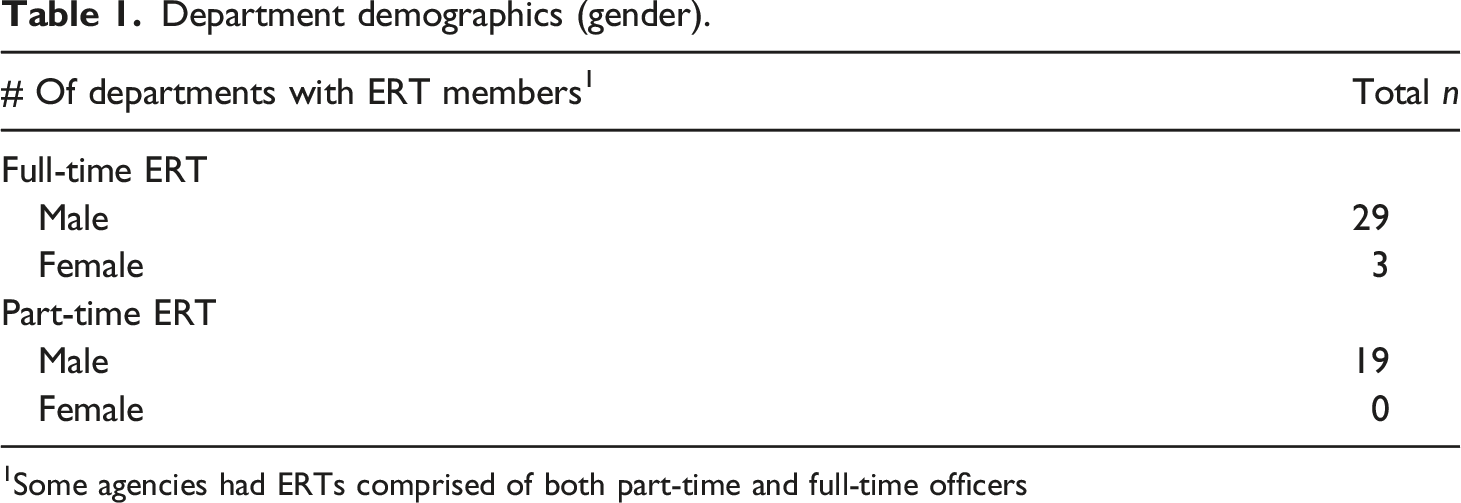
1Some agencies had ERTs comprised of both part-time and full-time officers
Coding and analysis
Data were coded and analyzed using thematic analysis. In the initial coding, we used an inductive approach to identify potential themes. As questions about gender were a major component of the survey, we focused our attention on looking for themes within the relevant open answers. We then conducted a second round of focused coding using a more deductive approach drawing on our knowledge of the recent literature. To ensure reliability in the coding for this project, and thus in the overall conclusions, all coding was independently verified by another member of the research team.
Findings
Initial results
As we noted in the introduction, when we began this work, we could locate no estimates of the number of female members of ERT teams in Canada. Although we cannot provide a definitive answer at this time because of limitations in our knowledge of what would constitute the appropriate sampling frame, we can provide some preliminary estimates. As expected, our survey results yield an estimate of female involvement in ERT that is in keeping with similar findings in the United States (Dahle, 2015).
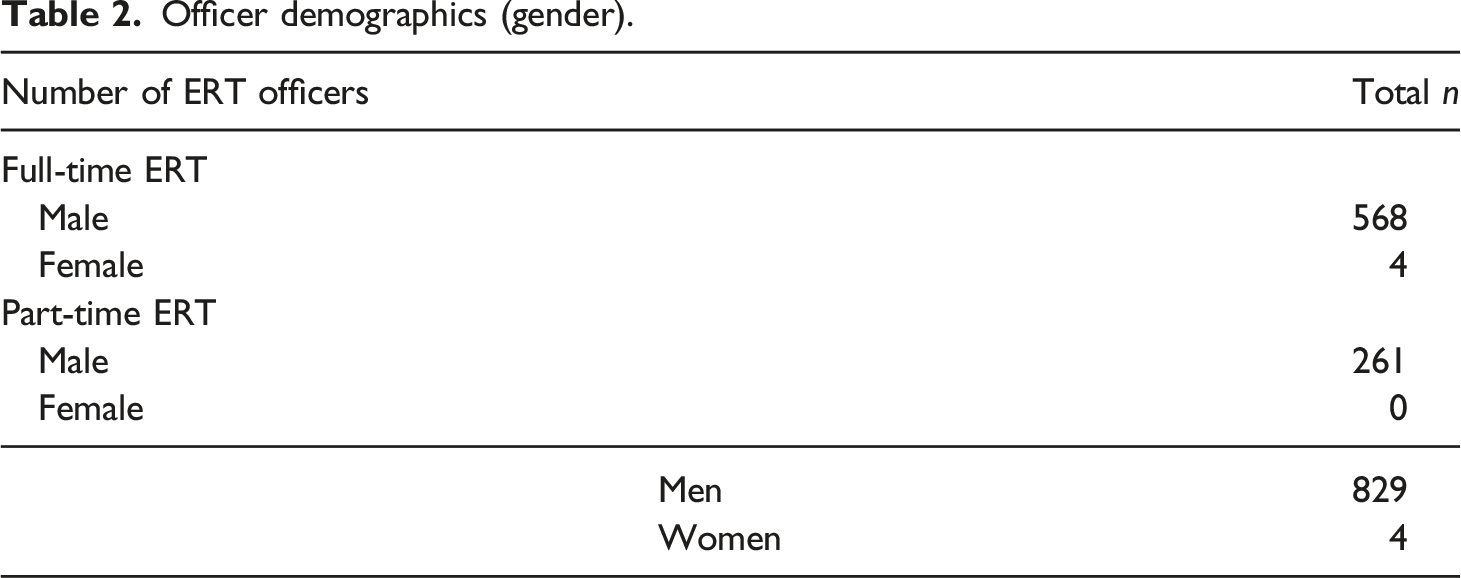
To put these results in greater perspective, female officers account for approximately 22% of the total number of police officers in Canada (Conor et al., 2020). Yet, they appear to make up less than 1% of the ERT members among the 30 agencies surveyed.
ERT entry
Officer demographics (gender).
Of those agencies that use an application process, most respondents also addressed how the agencies advertise vacancies, including eligibility requirements. The standard most adhere to is a minimum of 3 years of service and the ability to pass both physical and psychological fitness evaluations, as well as achieving a higher level of firearms qualification than is deemed necessary for patrol officers. Some also spoke to informal methods of encouraging applicants: “Word of mouth, intranet, personal recruitment.” The extent to which this is a problem for recruiting women at the agencies surveyed remains unknown. Only a handful of agencies indicated these informal tactics were employed to specifically recruit women. For example, one ERT leader advised, “very few female members express interest in the profession even when personally approached.”
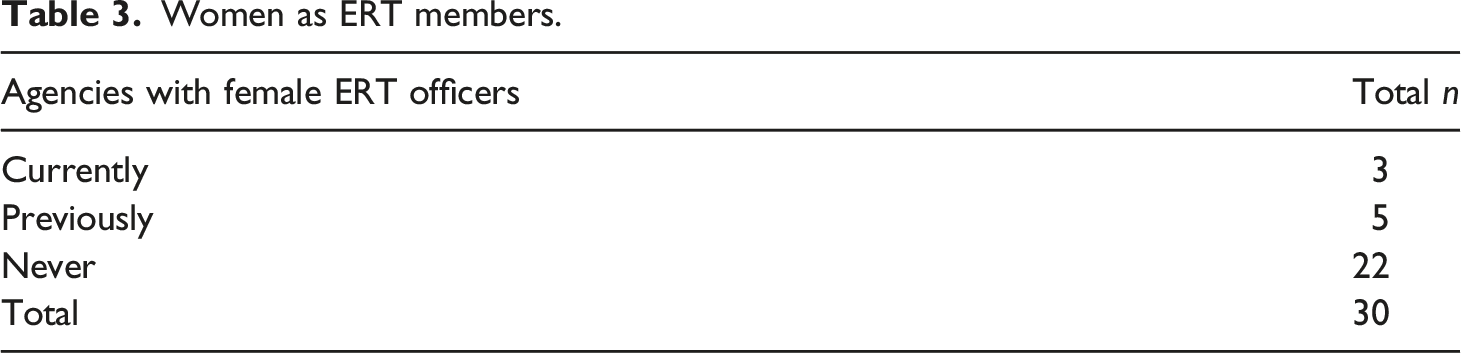
Women as ERT members.
We asked two questions that allowed us to explore if women apply to ERT: “are there any challenges to recruiting members?” and “how often do women officers try to become member of the SWAT team in your organization?” We received a total of fifty-nine (n = 59) responses to these two questions: twenty-nine (n = 29) for the first question and thirty (n = 30) for the second. The generic question about recruitment issues was posed first and only four (n = 4) of the answers received indicating issues with low numbers of female applicants. For example, one respondent advised, “It has been challenging to recruit interested female officers.” When we specifically asked about female recruitment and whether women apply for these jobs, twenty-three (n = 23) of the respondents indicated very low turnout for women at ERT recruitment sessions and in applicant pools. Common comments included: “difficulty recruiting women.” “Very rare. There has been some interest, but no attendance at the ERT Selection camps”. “There seems to be minimal interest from female officers over the last 10 years.” “I have only heard of a couple in [name of agency deleted] throughout my career and have never seen any try-out.” “never had a female officer apply”. “to date (since 1973) we have had three females compete for selection.” “In the history of the [ERT] there have only been five female Officers. Concerted efforts have been made to recruit more female Officers, however it still remains a challenge to attract female candidates.” “Yes, we simply don’t have many female members wanting to come out.”
Only four (n = 4) respondents indicated that at their agency, they do receive applications from female officers when posts are advertised. The remaining answers (n = 4) were either marked “unknown” or were otherwise unclear.
Attributions of reasons for why women choose not to apply
Reasons given for low numbers of female applicants.
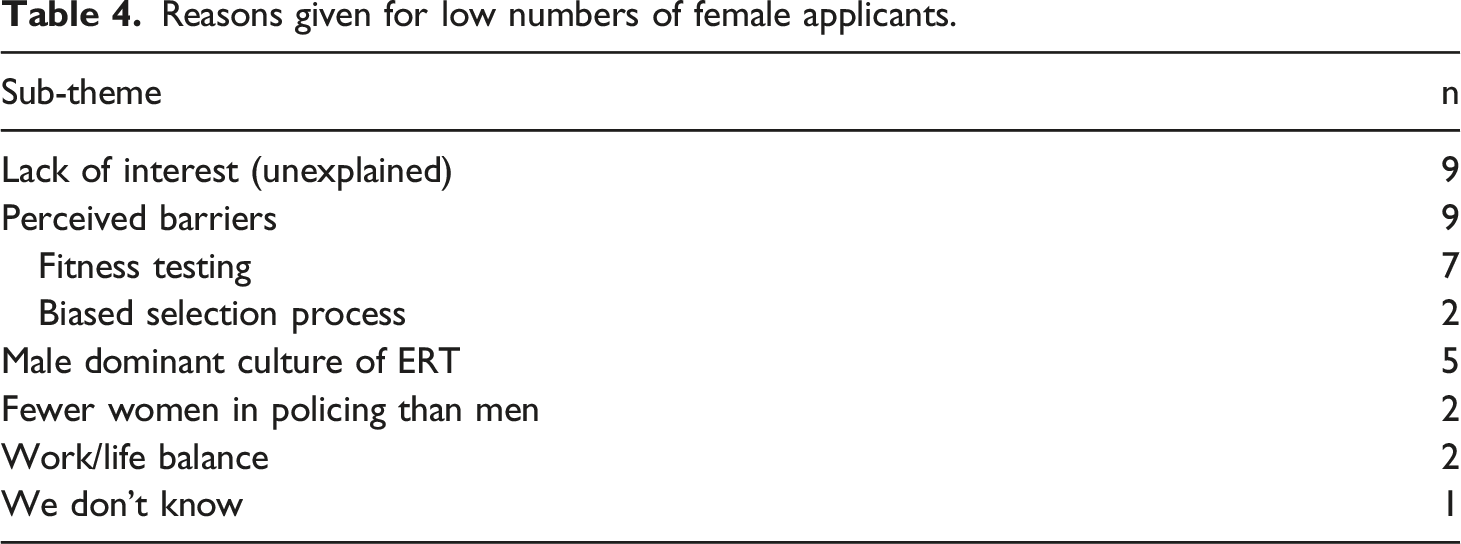
The two most predominant sub-themes to emerge in this category were a perceived lack of interest on the part of potential applicants and barriers to a successful application. In relation to the former category, we received comments such as “only challenge may be lack of interest” and “few women are interested in joining.” Some respondents also noted men were becoming less inclined to apply for these positions as well. As one participant observed, “proportionately this is the same for men.” However, most agreed female recruitment to ERT was an especially problematic issue given current gender imbalances in the composition of these teams within and across nearly all agencies.
To explain that imbalance, some survey respondents felt that women were not applying because of real or perceived barriers. The most frequent barrier cited—and, again, it was often cited as an issue for both men and women—was the physical fitness requirements. In multiple responses we were told, “the physical test seems to be the problem for female applicants” or the issue with recruitment was “trying to get [females] through the physical testing phase.” We note that thirty (n = 30) of thirty-two (n = 32) respondents stated the physical fitness tests for entry into ERT was the same for both males and females.
The extent to which physical fitness requirements are genuine barrier for women or if it is a pseudo rationalization for greater disinterest in ERT remains unclear. A study by the International Association of Chiefs of Police and the National Tactical Officers Association (2018) found that 17.6% of ERTs in the US do not have physical standards as part of their selection processes, and as Dahle (2015) reports, few female applicants were ERT members even in agencies with no or very low physical test requirements. Further, Prussel (2001) found that some of the female ERT members she interviewed reported finishing the physical portion of the selection process within the top half of the applicant pool .
A second related theme cited as a potential barrier was a perception among potential female candidates that the testing and selection process was biased in favor of male applicants. One officer spoke of how his organization had attempted to address this perception by conducting an external review of their selection processes. He noted that despite the positive review—“it is pretty bias free”—his agency still had “decades of reputation to overcome before more female are interested in joining Tactical.”
Related to the issue of gender bias is the perception that entry into ERT is equivalent to entry into a testosterone-driven male preserve. Five (n = 5) of our respondents cited this belief as a reason for why women might not apply for entry into these units. As one observed, “In discussions with female members, the male dominat[ing] and bravado is what causes disinterest.” Another agreed with this, “Yes, [it’s] the stigma of tactical being male dominated.” Given the incredibly low rate of female transfers into these units, the issue of tokenism was raised as a possible inhibiting factor. “A woman would currently stand out,” a respondent stated, “[and] that is a major challenge.”
Less frequently, respondents also cited possible issues with work/life balance, which previous research has shown may contribute to role overload that may dissuade female applicants (Duxbury and Halinski, 2018). As one explained, a requirement of the unit is that personnel make themselves available for callouts at all hours of the day and night which negatively impact work/life balances. Further, personnel are expected to make themselves available to attend training for protracted periods of time throughout Canada and the US which again has a negative impact on work/life balance. Our service also provides Tactical coverage 24 h a day and 7 days a week which does not make it appealing for personnel seeking better work/life balance.
Two respondents also raised the fact that men make up a greater number of the officers in an organization, and thus, we should expect they would also make up most of the applicant pool for various positions. This explanation does not account for the fact that women represent less than 1% of the number of ERT personnel in the 30 agencies surveyed, when they account for almost 22% of the general police work force (Conor et al., 2020).
However, while this is a significant discrepancy on a percentage-basis, a partial explanation may be found in absolute numbers. That is, the (on average) 22% of female officers in police agencies may not be a large enough pool of female police officers to draw from to have consistent female representation given infrequent ERT job opportunities. Even if male and female officers are interested in ERT and pass ERT selection at the same rate, if the interest rate and selection rates are very low, then the lower number of female police officers in an agency could result in there being a high probability of having no successful female applicants in any ERT selection process.
Further, for some agencies, ERT selection processes may be competitive, which may add yet another filter that reduces the number of female officers working on ERT. At one police service, we were told, “we have had females pass but not make the team.” The rationale for why these women were not selected after completing the testing was not provided.
In total, sixteen (n = 16) respondents specifically addressed the issue of women’s success and/or failure in these competitions. Of the four (n = 4) respondents who raised the issue of success, we received comments such as “Have had four female applicants in the last 20 years. One was successful.” More commonly, though, we were advised that female applicants had been unable to successfully compete (n = 12). At one agency, they successfully attracted two female applicants, “however, both unable to complete the physical standards and shooting standards.” At other agencies, “no female candidates have been successful” and “we have not had a female pass the testing to date.” Most respondents cited the fitness testing as an obstacle to women’s success, with the firearms testing also cited as a contributing factor.
To fully assess this aspect of ERT selection, the size of ERT teams relative to agency size, the frequency of ERT job opportunities, the percentage of female and male officers interested in an ERT career, the success rates of those officers in the ERT application process, and the metrics used to resolve competitive processes would have to be known. Indeed, in our research, we found that the agencies that did have female ERT officers were all larger agencies of over 750 officers, which suggests an advantage to having a large applicant pool. Further research would be required on this topic.
Discussion
As we discuss in further detail in the next section, one of the limitations of the present piece of exploratory research is that it does not include the voices of female officers, who are best positioned to answer this question. It is not our intention to exclude them; rather, we sought to conduct this work as a multi-step process, using the survey data as an opportunity to identify issues we might examine in further detail in research directly with female officers. Moreover, we are limited in that often the persons overseeing ERT units are male; thus, our findings are from the perspective of men, despite the gender of an author. This is an inherent and unavoidable challenge as no women in Canada hold such positions. We are also cognizant of Steinþórsdóttir and Petursdottir (2022) findings in Icelandic police services, where male police officers were more likely to believe “that there are equal opportunities within the police force despite holding negative attitudes regarding women’s ability to serve in the police. Young policemen and those policemen that are not satisfied with their own career progression are more likely to have negative attitudes towards women, although for different reasons, than their older and their more satisfied male colleagues” (p. 489). Nevertheless, data from the present study does offer us some insights worth exploring.
We have provided some evidence thus far for the position that women’s lack of representation in ERT units can be explained, in part, by low numbers of female applicants for these positions. We have also reviewed the reasons that ERT leaders and other representatives from the police agencies surveyed believe inform women’s decision-making.
Lack of female representation in ERT units, combined with stories of women failing to meet the testing requirements, or failing to be selected after successful testing, likely has a significant chilling effect on potential applicants. We are not alone in recognizing this possibility. Two agencies have similarly recognized that to the extent there are few women holding these roles, and thus able to serve as examples of success and as mentors for others, they needed to develop methods to counteract the perception that women could not be successful. One agency created “enabler” positions who work directly with ERT on full-time basis in a support role driving the ERT armored vehicles or operating technical equipment and have staffed these jobs with female officers. A second agency similarly developed a “female only” information night aimed at recruiting women into ERT, which they combine with an internal mentorship program to help identify and support women through the process. The success of these efforts in driving further interest in ERT is not known at the time of writing.
We also explore organizations in which women were currently holding a role in ERT. As noted, four (n = 4) women were identified as ERT personnel within three (n = 3) police services. A municipal service with two female team members observed that whenever they have held competitions, “females have competed.” Another municipal service with one female ERT member has had “a female on the unit since the early 2000s.” While it was acknowledged that in some previous years they had had no female applicants, “in our last three postings, we’ve had two females apply.” The third agency, with one female in ERT, also noted remaining difficulties in recruitment, but were working to “actively encourage” females to apply. Unfortunately, we are unable to say what forms this encouragement was taking.
While gender is clearly an important factor in exploring the likelihood that women will apply for certain employment opportunities, we also have to consider the potential influences of race and/or ethnicity, which can relate to gender. Unfortunately, few studies have explored how race affects decision-making among potential job applicants. Thus, we suggest future research in the area is warranted, specifically research looking at experiences of racialized male and female officers in pursuing ERT membership.
Limitations
The study is limited in that we did not have opportunities to probe participants for additional information regarding their qualitative commentary, nor were we able to ensure representation from all ERTs in Canada. As this project was unfunded, we lacked the ability to translate the survey and other related materials into French, which would have ensured a more diverse representation. Future research would have to address this deficit and ensure women were interviewed about their interest and barriers to joining ERT.
Conclusions
Female officers remain a marginally small group in a traditionally male-dominated institution; thus, their presence on an ERT team would only further highlight that status. The fact that few female officers even apply to those teams with little or no physical fitness testing would seem to confirm these notions. Most of the ERT teams in the current study require a stringent, competitive selection process. Team commanders were clear in their position that female applicants are welcome as long as they can meet the same standards as male applicants (Dahle, 2015: p. 25). However, if ERT teams and other specialty units do not make significant efforts to include female members who can stand as role models and mentors for other women seeking entry into male-dominated areas of policing, we will likely continue to see women self-selecting out of competitions for these roles.
Like the findings of Steinþórsdóttir and Pétursdóttir (2022), it is possible that male police perceive opportunities as equal despite the opportunities of ERT placement being inequitable. More is necessary to make ERT placement equitable for women officers, this may include more weight given to work–life balance needs, diverse try out opportunities, and continued emphasis on recruiting women through information sessions and women-only workshops about ERT opportunities. Efforts are necessary to make the recruitment and selection process for ERT more gender neutral, and to recognize the unique skills, women can and do bring to such teams. Indeed, the lack of women on ERT remains a concern for policing services.
Footnotes
Declaration of conflicting interests
The author(s) declared no potential conflicts of interest with respect to the research, authorship, and/or publication of this article.
Funding
The author(s) received no financial support for the research, authorship, and/or publication of this article.
