




Abstract
This study describes police attitudes and perceptions of health and wellbeing among police officers who work on Rape and Serious Sexual Offences (RASSO) cases. A mixed-methods approach was deployed including a cross-sectional online survey of RASSO officers and a qualitative study involving in-depth interviews in one English Police Force Area. Findings show that organisational policies have little salience. There is an entrenched culture of continuing to work despite being unwell, to provide operational support for colleagues. There is a need to develop specific strategies that reduce the stress for a team or unit-level for this cohort of police officers.
Introduction
Reports of Rape and Serious Sexual Offences (RASSO) in England and Wales have grown notably in recent years from total reports of sexual offences of 56,652 in 2002–2003 to 162,936 in 2019–20, an increase of 188% (Office for National Statistics, 2021), yet the number of cases going to court has fallen (Crown Prosecution Service [CPS], 2022). Increases in reports to the police have been seen as a function of police investigations due to Operation Yewtree (Perkins and Ebrahimjee, 2017). Moreover, the requirements for acquiring and processing digital evidence, established in R v Allan, have led to declining charge volumes with only 1.6% of cases resulting in a conviction (George and Ferguson, 2021). The desire to create a victim-focused service has created tensions for police officers striving to improve detection rates whilst also providing a victim-orientated service (Ricciardelli et al., 2021). Commensurate to these changes in the UK, has been the Police Uplift Programme across England and Wales which has placed 20,000 new police officers into service. A recent literature review estimated the likely doubling of younger officers (under 26 years) into service. The study highlighted a possible consequence of a rapid infusion of younger police officers in terms of cultural concepts of working concerning perceptions of work-life balance and acceptance of hierarchical management styles (Williams and Sondhi, 2022).
Stress has been defined as the disruption of an individual’s cognitive and emotional equilibrium by external factors (Lazarus and Folkman, 1984), which in policing have been shown to encompass intra-personal, occupational, organisational and health consequences of episodic stress events (Abdollahi, 2002), which in turn has been shown to impact upon police performance (Shane, 2010, 2013). Consideration of the welfare of police officers is under-researched in the specialist area of RASSO. Research by Grove and O’Connor (2019) calls for the need for trauma-informed training so that officers can protect their long-term health. Trauma can manifest in biological, physical and emotional responses and have repercussions on social or workplace relationships (Peña et al., 2017). A report by the UK Health and Safety Executive (2000) found that officers who deal with critical incidents, along with dissatisfaction in the workplace can be overwhelmed, which may lead to psychological distress and alienation from support networks. Exposure to traumatic incidents could lead to officers developing one or more psychosocial conditions, which are regularly identified in the literature as trauma including post-traumatic stress, anxiety, burnout, fatigue or stress (cf. Bell et al., 2021; Fear et al., 2014; Lentz et al., 2021; Purba and Demou, 2019). Policing is acknowledged as being a stressful working environment, but Keech et al. (2020) recognise the distinction between the stress inherent in frontline policing and stressors resulting from the consequences of broader health and wellbeing factors.
Much of the literature has focused on organisational stressors impacting officers’ health and wellbeing (Violanti et al., 2017). A systematic review was undertaken by Purba and Demou (2019) on the relationship between officers’ workplace wellbeing and found strong associations with a lack of occupational support, long hours and organisational pressure. The organisational response to employees in highly stressful job roles is therefore critical to the health of its workforce. Organisations that support organisational justice initiatives enable staff to promote positive attitudes about their work environment, including commitment and loyalty (Sheppard et al., 19922). Peterson and Uhnoo (2012) outline how officer loyalty can be rewarded with collegiate support and protection from administrative scrutiny and the dangerous environment under which they work. This loyalty to colleagues can conversely be a pressure, whereby individual officers absorb stress, rather than place the burden on their team members (Evans et al., 2013). In addition, there is literature describing the New Public Management (NPM) model which adopts business strategies from the private sector, to promote effective use of resources and transparent use of public sector funding (Fleming and Scott, 2008). The pressures of reporting on performance targets place significant demands on officers in addition to their heavy workloads (Butterfield et al., 2007). Wathne (2020) indicates that work-related stress can be created due to management and organisational priorities, rather than policing itself. The police force is under constant scrutiny to achieve financially driven NPM efficiencies, including measurements such as value for money, officer targets and performance monitoring, creating tension between frontline officers and middle managers (De Maillard and Savage, 2022). The NPM model further exacerbates the tension between the intrinsic needs of officer professionalism and scrutiny by the public about victim care and low conviction rates (Evetts, 2011).
The effect of stressors unique to policing as described above can be applied across police departments, but the recent literature has described some of the specific stressors associated with working with RASSO. Dalton et al.’s (2022) systematic literature review of specialist RASSO policing highlights the relationship between officer wellbeing with team cohesion and resourcing. Williams et al. (2021) further detail these issues by pointing out the negative consequences resulting from organisational changes that have reduced RASSO specialisms across many forces. As work demands increase due to greater attrition, understanding victim vulnerabilities and dealing with trauma, the lack of specialist training has been shown to undermine police office confidence in their ability to prosecute cases (Charman and Bennett, 2022; Williams et al., 2021;. Consequently it has been argued that due to the stigma of wellbeing and health-related concerns including mental health, seeking help is often avoided (Bell et al., 2021; Bullock and Garland, 2018).
The Job Demands Resource (JDR) model posits that sustained effort caused by excessive workload has a psychological cost in terms of enhanced pathogenic health indicators such as elevated stress or burnout. The availability of resources acts as a buffer to elevated job demands through greater resourcing, autonomy and organisational or supervisor support (Bakker & Demerouti, 2007; Demerouti and Bakker, 2011; Demerouti et al., 2001). In addition, the Conservation of Resources (COR) theory (Hobfoll, 2010) proposes that, when confronted with excessive demands, the individual will experience a sense of discomfort themselves in an attempt to minimise the discomfort for others. COR theory (Hobfoll et al., 2018) states that stress is driven by an objective series of events that take place over time. For an officer, this could begin with a perceived unmanageable workload, which subsequently results in working overtime or from home on rest days to meet changing deadlines or supporting victims. The lack of downtime or feelings of being overwhelmed leads to job-related stress or burnout. COR theory suggests that if resources including objects, conditions, personal characteristics or energy are lost, burnout will occur (Hobfoll, 2010). Further, survival and social bonding are key to dealing with both immediate and ongoing stress.
Hobfoll (2001) argued that workers commonly blame colleagues for stress in the workplace, rather than question their working conditions. To consider how a workplace environment can operate successfully, Hobfoll suggests that we should look at removing obstacles that create barriers to effective workplace outcomes, rather than changing the working environment to fit the resources available. This scenario is based on a central tenet of COR theory, that stress in the workplace is principally constructed within social situations. Hobfoll (ibid.) refers to work colleagues as a ‘tribe’, suggesting formal and informal similarities in group behaviour and certain cultures, particularly hierarchal workplaces displaying organisational professionalism. COR theory posits that individuals protect those things that are universally valued, such as health, wellbeing, family, self-esteem and a sense of purpose.
The characteristics of organisations which place demands on employees beyond reasonable work parameters and create conflict with familial and social spaces were originally coined by Coser (1967) as ‘greedy organisations’, or ‘greedy institutions’ (Sullivan, 2014). A greedy institution established working outside of contracted hours as the norm, or not taking lunch breaks or annual leave in order not to ‘let down’ colleagues or victims and to maintain their professional integrity. For example, in their study on ethnic minority officers, Peterson and Uhnoo (2012) suggest that the police enforce exclusivity and loyalty among their ranks and enforced the ‘greedy’ institutional culture by creating symbolic boundaries between themselves and the public, to consolidate collegiate loyalty. Cox (2016) argues that greedy institutions foster exclusivity and interactional processes that demonstrate commitment and loyalty. The greedy institution creates further competing demands between work and home life, which not only can create tension in personal relationships but reduces the possibility of rest and recuperation away from stressful work situations. Segal (1986) and Cooper et al. (2017) discuss similarities within the military, with comparative issues of wearing a uniform, serving the public and loyalty and camaraderie within its ranks.
This study aimed to explore the extent and nature of stress-related factors associated with police officers working on RASSO cases and in particular, how individuals perceive and manage stress-related factors related to policing. The study forms part of Operation Soteria Bluestone. 1 The findings are initially structured to provide a quantitative assessment of the nature of stress and ill health amongst RASSO officers. The subsequent part of the study focuses on a qualitative understanding of police officer perceptions and wellbeing needs.
Methods
Study design
The study deployed a mixed-method approach involving two components. Study 1 involved a cross-sectional survey of police officers with responsibility for RASSO. Study 2 involved an interpretative, inductive qualitative design aimed to explore and probe respondents' experiences. Eight interviews were undertaken with an additional nine focus groups involving 51 participants. The setting for the study was one English Police Force area.
Study 1: Cross-sectional survey of RASSO police officers
A cross-sectional survey was developed online using the JISC platform (www.online_surveys.ac.uk). The survey comprised of four main sections focusing on the learning and development environment, health and wellbeing, perceptions of RASSO cases and demographics of respondents. The survey was piloted by five current and former serving police officers and was implemented in November 2021. Respondents were provided with an online information sheet that included informed consent protocols. 506 RASSO officers were identified of which 198 officers responded to the survey (39%). Data analysis was undertaken using Stata v14.
Study 2: Participants and recruitment
Interviews and focus groups were deployed to collect qualitative data supported by 202 free-text responses. Eight interviews and nine focus groups comprising 51 participants took place. Ethical approval was provided by The Open University Human Research Ethics Committee HRCE/3854. The British Sociological Association (BSA) ethical guidelines formed the basis of all interviews (BSA, 2017).
Interviewees were recruited through police contacts to ensure RASSO officers were selected and all interviews were undertaken online due to Covid restrictions, on a voluntary basis. All participants were provided with an information sheet and consent form before the interview. Interviews and focus groups were recorded and transcribed. Data analysis for the qualitative findings was undertaken using NVivo (v12) by two researchers, to ensure independent inter-rater agreement which was further discussed across the wider research team. The findings were thematically analysed by creating a coding structure to generate a wider thematic framework (Braun and Clarke, 2006).
Results
Study 1: Main findings from the cross-sectional survey (n = 198)
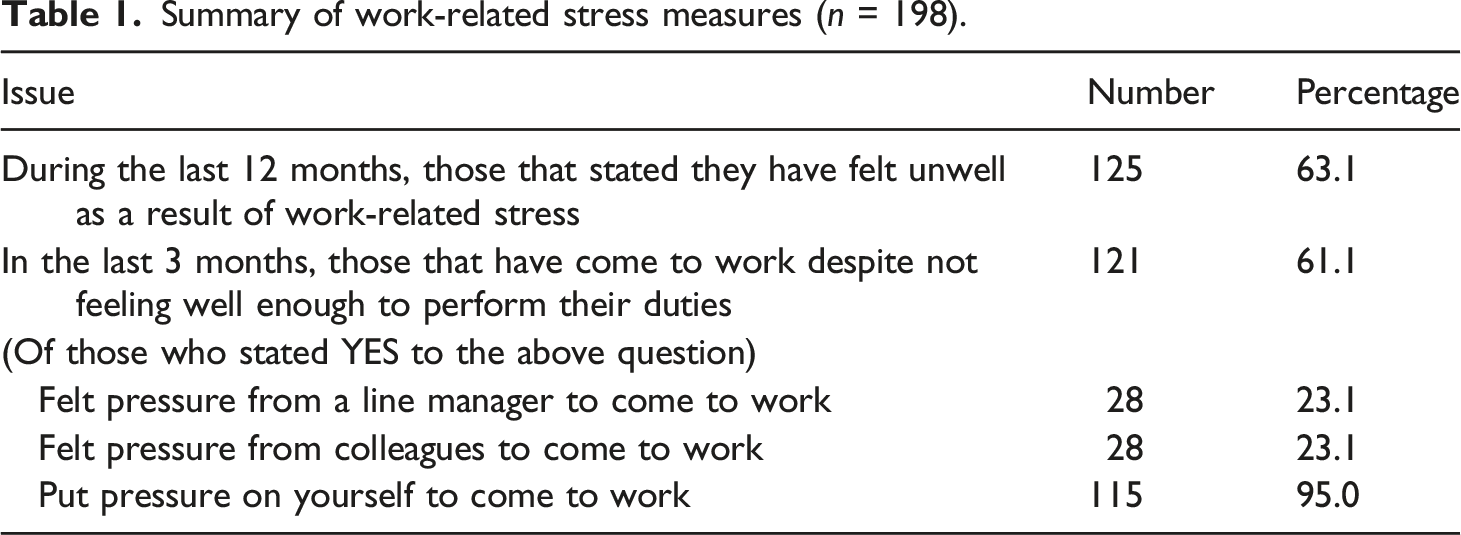
Summary of work-related stress measures (n = 198).
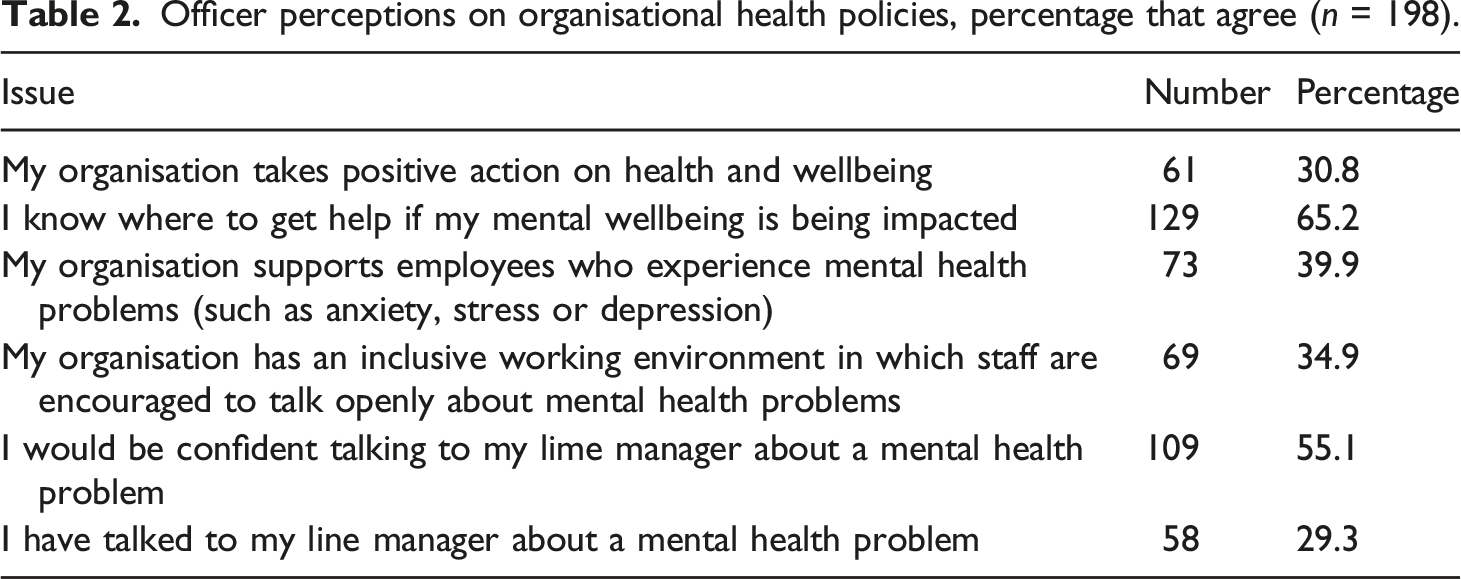
Officer perceptions on organisational health policies, percentage that agree (n = 198).
Perceptions of work-time quality (n = 198).
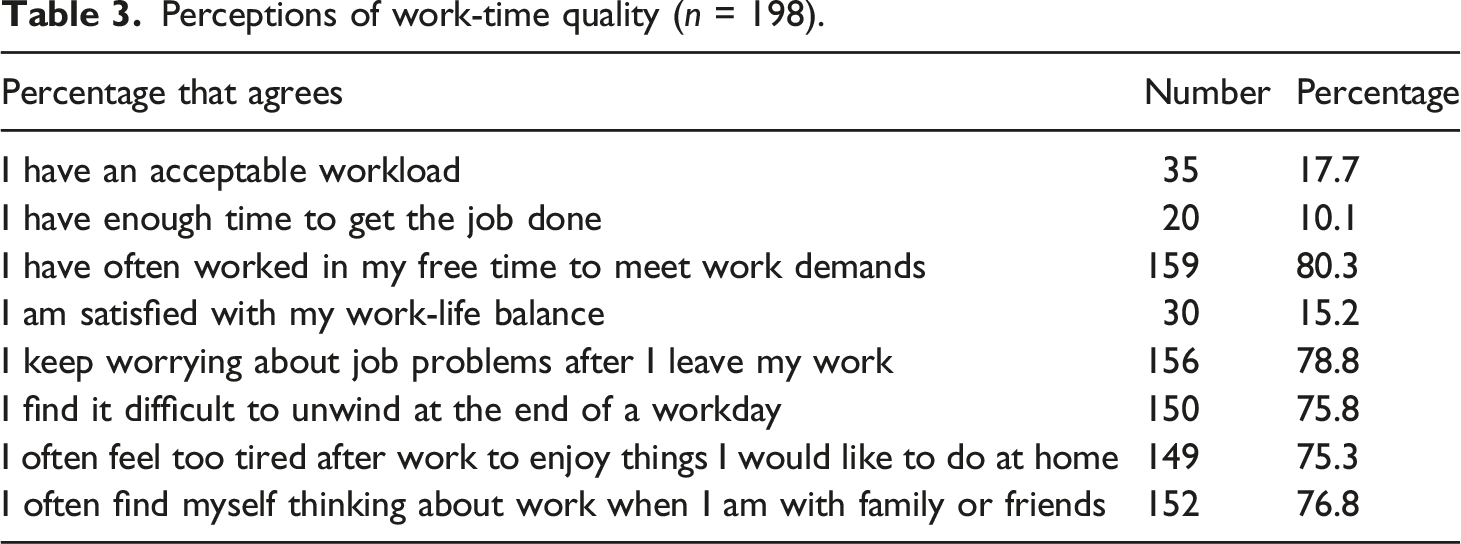
For perceptions of work-life balance (Table 3), less than 17.7% (n = 35) of respondents reported that they have an ‘acceptable’ workload with one in ten (10.1%, n = 20) stating that they have enough time to complete their work such that few respondents were satisfied with the extent of their work-life balance (15.2%, n = 30). Around three-quarters or more of respondents stated that they have worked in their own free time (80.3%, n=159); that they worry about the job after leaving work (78.8%, n = 156); find it difficult to unwind after work (75.8%, n = 150); report tiredness preventing enjoyment of home life (75.3%. n = 149) and that they continue to think about work when with family or friends (76.8%, n = 152).
Study 2 – Interviews and focus groups (n = 51)
Two broad themes were identified from the qualitative interviews. The first theme focused on the effects of resourcing in terms of organisational support, staffing availability and on workload. The second focused on the consequences of high workloads on RASSO officers’ cognitive judgements through the Conservation of Resources model Within each theme are presented a series of sub-themes that will be discussed in turn.
Theme 1: Effects of resourcing
Levels of support
For respondents, there were concerns about the extent and nature of support made available for officers dealing with RASSO cases. Evans et al. (2013) acknowledge that officers have a developed sense of self-efficacy, absorbing the effects of difficult events. Although officers in their study engaged their families in supportive interactions, they also protected them from distressing detail. Whilst many in our study acknowledged the existence of support packages, doubts were raised as to their practical efficacy: ‘It is a very difficult place and there is no outlet. You either go off sick and protect yourself and potentially affect others or you try and work your way through it. There are no quick fixes. There’s all these welfare champions and things like that that is all well and good on paper, but they don’t offer any solutions’ [Focus Group #P858]
The participant here recognises the need to protect themselves from trauma. For some, there was the opportunity cost of managing the workload within existing resource constraints. This perceived choice was seen to have negative consequences on an individual’s mental health: ‘My workload is so unmanageable I don’t have time to do anything but try to keep up with the unrealistic demands placed upon me. I try really hard and feel like I could do a really good job if we just had the staff to do our job properly. Instead, I constantly feel like I have to choose which victim or which area of my work to fail. This has a huge mental impact on someone who genuinely does this job to try to make a positive impact on peoples’ lives’ [Focus Group #P454]
Whilst RASSO officers were cognisant of support packages, there was also the expectation that individuals had to work through any problems with their immediate supervisors and peer group rather than relying on formal support channels (including learning and development support). Houdmont et al. (2020) found that line managers who had a developmental need and lacked organisational support were associated with increased odds of psychological distress, low resilience and low work engagement. Staff were aware of record-high levels of vacancies and the knock-on effect that this had on managing day-to-day operations.
Support teams/self-managing risk
Following a period of austerity and police funding being cut significantly (Lister and Rowe, 2015), the lack of experienced officers coming through the policing system has significantly affected workloads and subsequently a lack of time to access specialist training. This includes inexperienced officers having to learn ‘on-the-job’ and the lack of available staffing: ‘I’m smiling out there all the time. I’m Mr Positive. We can do this. We’re part of a team. In here, I have my head in my hands most of the time. I stare at a sheet that’s full of vacancies or people on secondment and attachment and think, I don’t know how we can do this’ [Focus Group #P723]
Wolter et al. (2019) acknowledge that an organisational climate needs to be supportive and fair, with shared values, to foster improved mental health. They recognise an excessive workload, administrative burdens and inappropriate public behaviour towards officers as predictors of emotional exhaustion, as illustrated in the quote below. ‘Officers with limited experience of rape investigations are then thrown into the 'deep end' and have to make do and struggle. Their training and experience then comes from their peers and their knowledge’ [Focus Group P775]
Number and quality of staff
A key component to the wider theme of resourcing is the availability and quality of operational staff. Both the stressful nature of critical incidents and the tension resulting from long working hours may lead to sickness and additional pressure on already stretched resources. The findings here reflect the pressure on supervisors and more experienced investigators, who have to manage the responsibility for the shortfalls in staff and the lack of experience within their team: ‘I don’t feel comfortable, having been on a better resourced [non-specialist] team, that we’ve got the right staff, the right numbers. And the job itself doesn’t distinguish between an experienced investigator and a brand new one that’s come indirect and all the extra training they need’ ‘I should have seven investigators on my team. I have five, two of whom are off with stress or restricted duties due to stress. I, therefore, have less than 50% of investigators that I should have’ [Focus Group #P598]
Workload levels
Maslach (2003, 2017) suggests that individuals’ struggle with stress in the workplace is due predominantly to the lack of control over organisational factors such that organisations can change people more easily than they can amend processes. Burnout can also present as exhaustion, cynicism and detachment from the job as shown below: ‘We just do not have the time to do a thorough investigation to the level that you would want on all of the investigations we’re given. Then that is demoralising and affects morale, ultimately’ [Focus Group #P574] ‘I’ve probably got another 12 months in me and then I’ll be moving on. I can’t work at this rate on an ongoing period […] It’s an insurmountable workload, it’s just not sustainable to carry on at this work rate’ [Focus Group #P688]
Theme 2: Conservation of resources
The second theme identified the effects of high workload and a lack of organisational support on the mental health and wellbeing of RASSO officers. In particular, the effect of increased workload was to alter the perceptions of victims and survivors and to emotionally remove oneself from the role. For some interviewed, this formed a degree of dissociation.
Officer disassociation
Hobfoll (2001) describes the theory of conservation of resources that allows people in stressful environments to protect the resources they value. Exposure to emotional and stressful situations is a significant risk to officers’ wellbeing. For officers who do not actively seek help, there are proactive coping behaviours which may manifest as disassociation strategies, which officers engage to manage the traumatic nature of their work to protect their psychological balance (Keech et al., 2020). Such behaviours may include compassion fatigue or depersonalisation, displaying emotional detachment from their role, and allowing officers to complete their tasks whilst accepting the issues faced with the investigation. As well as avoiding stigma in the workplace, officers who have stress-related symptoms, but do not report them, often do so to avoid putting a further burden on colleagues (Evans et al., 2013). Further, officers are aware that if they take sick leave, this impacts the day-to-day work of the organisation, including the quality of the work being undertaken, the volume of team workload and how the service manages on-the-job risk as highlighted in the quote below. ‘I think I accepted a long time ago and I don’t let it bother me anymore, but it is strange that I have accepted the fact that possibly one day I might lose my job or be subject to scrutiny or comment that will be unfair and there’s nothing I can do about it, so I might as well not worry about it. If it happens, it happens. If it doesn’t, it doesn’t’ [Focus Group #P290]
The quotes here suggest an interaction between a lack of resources, and burnout. This suggests a degree of disassociation from their ethical, altruistic position to adopt a coping mechanism to deal with stress.
Compassion fatigue
Officers may reflect on traumatic work experiences long after the event, which can additionally lead to tension outside of their work-life (Brewin et al., 2020). Folkman and Lazarus (1988) suggest that individuals retrospectively perceive stress after an event has taken place. The issues of being under-resourced and overworked in a greedy institution have a detrimental effect on officers’ health and wellbeing, creating compassion fatigue (Figley, 1998) and in some cases, can result in negative attitudes towards victims: ‘Victims are coming back the very next day, saying they’ve been raped again. And it’s all for attention […] It’s just attention seeking […] We can’t 100% disprove it, so we have to run with it because nobody’s going to say no. From a police point of view, we’re not going to say no, we don’t believe you […] so we just spend thousands and thousands of people, play the game and tomorrow we’ll write it off […] and lost appointments for real victims. It’s just a game that we play’ [Focus Group #P511] ‘It was something that […] said earlier about the investigations that come in which are perhaps flaky allegations, maybe they’re mental health allegations. Now, that’s not to say, of course, that somebody with mental health can’t be raped or that it didn’t happen, but sometimes an allegation comes in and we know from the outset that there’s something not quite right about this’ [Focus Group #P672]
Dhami et al. (2018) argue that RASSO victims’ access to justice is predicated on officer discretion, particularly where inconsistent accounts are provided. The data here suggest these participants are basing their assumptions on their own experience of something being ‘not quite right’ with no emphasis on a victim-centric approach.
Officers as caring and compassionate
Despite these detrimental consequences of conserving resources, there remained a strong desire for investigators of RASSO cases to offer a caring and compassionate response to victims and survivors. The findings of Schott et al. (2019) suggest that prosocial motivation, contributing to public order values and security, are signifiers of officers’ motivations for continuing in this line of work. For all the difficulties emerging from the data, a key sub-theme to emerge from the qualitative data collection was the altruistic and compassionate nature of the officers who were interviewed. Their main driver for their work was to provide the best service and support for victims and survivors. The commitment to following due process in the service of victims and the wider general public, along with a demonstration of professional pride, is evident in these comments: ‘We have to work together. We have to grow together and we have to try, with the resources that we’ve got, to try and ensure that the victims’ needs are satisfied and listened to. Because otherwise, if we’re not here for the victims, then we might as well all pack up and go home’ [Focus Group #P718] ‘The fundamental reason I do it, and I think many people do it, is because we care, and because we care about our victims and we want to do the right thing and do a decent job by them’ [Focus Group #P341] ‘It’s the goodwill of officers who work extremely hard and very passionate about their job. You wouldn’t be a police officer and undertake half the things you would do, especially the lack of resources, the support and things like that. And that’s where it all lies’ [Interview #P802]
Discussion
The findings from this mixed-method exploration into the perceptions of police RASSO officers in one large police force area suggest that Job Demands-Resource and Conservation of Resources concepts may have some explanatory power in understanding the association between the enhanced levels of stress reported for officers working in this area of policing. For RASSO officers there is clear evidence of high work demands such as perceived unrealistic workloads and low levels of control over their work environment (such as resourcing issues and the levels of pressure that officers face coming into work despite being unwell). JDR theory holds that elevated work demands and low resources act as a driver for health impairment which is manifested through high levels of self-reported sickness and stress rates. An emergent premise underpinning this paper is that RASSO officers have developed emotionally focused coping strategies to manage this level of work-related distress. We have shown that this has manifested itself through maladaptive self-regulation (Bakker and De Vries, 2021) which are workarounds to manage stress and pressure, including dissociation and compassion fatigue towards victims. Yet underpinning the conservation of resources, we have found that RASSO officers who were spoken to as part of this study remain highly motivated and strive to provide a caring, compassionate service to victims and survivors of rape and serious sexual assault.
We contend that there is tension between personal accountability for ensuring charge rates for RASSO offences are high (which is exacerbated by demands from senior management as part of the New Public Management [NPM] prioritisation of performance management metrics) and help-seeking behaviours associated with ill health caused by working in high demand and low control environment. The demands resulting from adapting workload to meet target metrics have created such pressure for officers to keep working despite symptoms of ill-health. This pressure has manifested itself in demands made by a minority of colleagues and supervisors which combined with the concept of ‘greedy institutions’ (Sullivan, 2014), mitigate against any ad hoc remedial action. Furthermore, although there has been much made of police acceptance of diversity and concepts surrounding wellbeing, the force remains driven by a masculine or ‘macho’ identity (Brown, 2007; Silvestri, 2017). Acker’s (1990) work on gender and organisational cultures show that workplace characteristics, processes and structures are universal and easily reproduced. Although gender is outside of the scope of this paper, her work does highlight the negative implications of an overt masculine culture in the workplace, counterproductive to the needs of officers in stressful roles who may need to seek support for stress and related morbidities.
The desire to continue working despite ill-health is a consequence of three main areas – institutional pressure including the NPM performance culture that establishes pressure on the organisation to ensure targets are met. This is also reflected in the pressure described from immediate colleagues and line managers (supplemented by self-regulation) to achieve these targets, alongside a high level of personal accountability that is often rooted in compassion towards victims, recognising that charge and conviction rates can be viewed as an institutional failure to deliver effective justice. JDR theory holds that human resourcing and occupational health can provide a ‘buffer’ by providing additional resourcing or approaches that improve the working environment (Bakker and De Vries, 2021). We contend that these drivers of stress and ill-health need to be addressed organisationally as individual components of a wider approach to managing the pathogenic work environment. To manage ill-health amongst RASSO police officers, there will be a need for a tripartite approach that attends to the use of performance metrics as a driver of work performance both at a senior level and also the impact it has on smaller teams. In particular, there is a need to manage the effect of performance monitoring on teams whereby a minority of staff feel pressurised by supervisors and colleagues to work despite ill-health. Interventions will need to consider how to manage maladaptive strategies such as dissociation and the effects of compassion fatigue that will have negative effects on the duty of care to victims and survivors. Finally, there is a need to maintain the motivation of RASSO police officers who wish to provide a caring and compassionate service which will require resources to deliver such an approach.
Limitations
The study is one of only a few to focus directly on the perceptions of police officers working on RASSO cases. Several limitations should be noted. First, the compliance with the survey was recorded at 39% and therefore may be biased towards certain response types. Feedback from police officer stakeholders suggested that the main barrier to completion of the survey was time. The survey was also cross-sectional and does reflect changing operational practices over time. We, therefore, are cautious as to the representativeness of the survey. Furthermore, as the qualitative interview participants were recruited by the police force voluntarily, there may be biases attached to the type of officer selected to participate.
Conclusion
This study highlights the high prevalence of stress and pressures among RASSO police officers to keep working despite symptoms of stress and ill-health. The sources of stress can be shown to be related to high job demands and low resources compounded by conservation of resources that manifests itself through maladaptive strategies such as dissociation and compassion fatigue of victims and survivors. Pressures relating to organisational performance target culture at all levels of the organisation that foster a working climate that sets a priority of achieving work targets comes at a precedent to physical and mental distress. This is enhanced by the nature of policing as a ‘greedy institution’ that places an onus on the individual to adhere to the prevailing culture. These factors are heightened by RASSO officers’ desire to deliver a compassionate and caring service. Interventions to address ill-health in policing need to consider these factors as part of a holistic organisational response. We would suggest that our findings will be of interest to policymakers, not only in respect of understanding potential mental health implications to members of the police workforce but employees of all frontline public organisations who work regularly in vicarious or traumatic situations.
Footnotes
Declaration of conflicting interests
The author(s) declared no potential conflicts of interest with respect to the research, authorship, and/or publication of this article.
Funding
The author(s) disclosed receipt of the following financial support for the research, authorship, and/or publication of this article: This study was funded by the Home Office as part of Operational Soteria Bluestone.
