




Abstract
Research pertaining to the wellbeing of police focuses on the job at a macro level, neglecting that policing is an occupation made up of thousands of roles. The needs of staff in various roles differs according to the situations that they are exposed to. This paper provides a review of the literature pertaining to the impact of criminal investigation on employees’ wellbeing. Three discernible categories regarding the wellbeing of criminal investigators are revealed and the paper demonstrates that criminal investigation has a negative effect on the wellbeing of staff. The paper concludes with recommendations for future research, training and support.
Introduction
Many police staff encounter traumatic events on a routine, daily basis. Sickness absence due to poor psychological health, in a UK policing context, is at an all-time high with reported absences seen to have almost doubled over the past 10 years (Cartwright and Roach, 2020). The research literature to date, relating to the psychological health and wellbeing of police, has so far overwhelmingly tended to focus on operational aspects of the role, such as the negative effects of ‘patrolling’ on those police that do it. Little attention has been paid so far to how other tasks and roles police undertake can affect the wellbeing of police staff, such as working in counter-terrorism policing or attending violent crime scenes. With this short paper we attempt several things: first, to present a ‘stock-take’ review of the emerging research literature that explores the common negative effects on wellbeing associated with being involved with criminal investigations, particularly child sexual abuse and homicide cases. Second, we review the research on how police staff involved with investigating such cases actually cope with the negative effects on personal wellbeing (e.g. psychologically, emotionally and physically) that often such cases carry. Third, and last, we tentatively suggest some areas for future research consideration. We begin with a brief exploration of the different types of negative effects on wellbeing before moving swiftly to a review of the research in an investigative context.
Negative effects on wellbeing
Despite the serious and disturbing acts of criminality which are investigated by police colleagues, few studies are yet to explore the different ways and extent to which investigating serious crimes such as murder, can psychologically and emotionally affect criminal investigators. The experience of investigating acts of criminality often comprising serious violence, for example, is posited to pose risks of psychological trauma to those involved. Duckworth (1991) defines psychological trauma as “severe emotional and mental disruption which can follow the experience of certain kinds of extreme events—including those where there is no physical injury” (p. 35).
Experiencing trauma and the psychological effects which might follow as a direct consequence have received much attention (e.g. see MacEachern et al., 2011). For example, post-traumatic stress disorder (PTSD) defined by the International Classification of Diseases 11th (ICD-11) edition as a disorder which occurs after “exposure to an extremely threatening or horrific event or series of events that is characterized by all of the following: 1. re-experiencing the traumatic event or events in the present in the form of vivid intrusive memories, flashbacks, or nightmares, which are typically accompanied by strong and overwhelming emotions such as fear or horror and strong physical sensations, or feelings of being overwhelmed or immersed in the same intense emotions that were experienced during the traumatic event; 2. avoidance of thoughts and memories of the event or events, or avoidance of activities, situations, or people reminiscent of the event or events; and 3. persistent perceptions of heightened current threat, for example as indicated by hypervigilance or an enhanced startle reaction to stimuli such as unexpected noises” (World Health Organization, 2019).
For PTSD to be diagnosed, the symptoms above must (1) be considered to have endured for at least 2 weeks and (2) be seen to have substantially impaired a person’s life (e.g. they have been unable to sleep or to concentrate). Generally speaking, it is often more straight-forward to diagnose PTSD for those who have experienced an identifiable traumatic incident ‘first-hand’, for example, they were either present during an earthquake or an act of terrorism). What is less clear-cut however is when people present symptoms associated with PTSD but they have not been exposed directly to an identifiable traumatic event, but they have experienced it ‘second-hand’ or vicariously through others that have. In this situation, the definition afforded by the by the American Psychiatric Association’s in their Diagnostic and Statistical Manual of Mental Disorders criteria is more useful. In the DSM-5 (2013) criteria, PTSD can be diagnosed based upon ‘experiencing repeated or extreme exposure to aversive details of the traumatic event(s) (e.g. first responders collecting human remains: police officers repeatedly exposed to details of child abuse)’ (American Psychiatric Association, 2013: 27).
Where an individual experiences negative effects on their wellbeing ‘indirectly’ as described in the DSM criterion, such as experiencing symptoms of trauma via the traumatic experiences of others, this is often discussed in the literature using different terminology, including secondary traumatic stress (STS) (Figley, 1995), compassion fatigue (Figley, 2002) and vicarious trauma (McCann and Pearlman, 1990.) There are differences between these definitions, but these are often overlooked in the literature and for a detailed discussion of these differences (Rauvola et al., 2019) review is useful. Such descriptions of secondary trauma are due to the diagnostic criteria used for PTSD historically not accounting for indirect trauma. However, this shortfall has been addressed in the latest DSM (5). However, it is important to note that the DSM is not routinely used outside of the United States, as such in this paper we will use the term STS to describe PTSD that is the result of indirect exposure to trauma which is often the case for police professionals.
Although some police will experience direct trauma where they have witnessed a traumatic event directly (e.g. where a colleague is shot in front of them by a suspect resisting arrest), it is more common for many more police to experience trauma indirectly as a result of conducting police work. In relation to the focus of the present paper, experiencing STS as a consequence of being actively involved with the investigation of a violent crime, for example, having to inform parents of the death of their child than directly observing the crime taking place, rather than from witnessing the crime directly. A few years ago, the second writer interviewed several police officers that were working on the night of the terror attack at the Manchester Arena, in 2017. All reported that the most distressing part of the investigation was informing parents that their children had been murdered, rather than witnessing the distressing aftermath of the attack itself. Indirect traumatic stress is therefore likely to pose a significant threat to the wellbeing of those involved in the investigation of serious, emotionally charged, crimes.
The present paper
If one conducts a quick search of the police wellbeing literature to date, it will appear that most of the attention has been placed on the effects on the wellbeing of all police officers or police staff in relation to being ‘a police officer or staff’ per se (Cartwright and Roach, 2020). Although albeit unintentionally (and probably as a result of having to start research in this area somewhere) an impression that may by falsely drawn is that all police and police staff face the same potential trauma hazards. This is of course not the reality as (1) policing involves a plethora of different duties, roles, functions and responsibilities undertaken by involved in policing (Violanti et al., 2017; Foley and Massey, 2019) and (2) not all ‘traumatic events’ will traumatise those who experience them, but if so then not necessarily in the same ways. The point being made here is that negative effects on the wellbeing of police and police staff will depend on what they do and are exposed to, and on who they are as a person. Police wellbeing is therefore not a homogenous entity.
In 2019, the first National Police Wellbeing Survey was undertaken by The National Police Wellbeing Service resulting in 34,529 police employees taking part (Graham et al., 2020). This initiative certainly starts to address the issue that policing is not a homogenous group and the findings of the survey clearly demonstrate on a macro level that there are discernible differences in wellbeing based upon the police employee’s role. That said, the survey still only provides a macro level of information identifying different clusters, which include many different roles. However, from a practical perspective, the survey provides very useful occupational information on wellbeing across the service and readers in particular police management should use the findings to inform future research and management. As such, the present paper seeks to argue that even further detail is needed focusing upon very specific roles and responsibilities.
What is currently a lack of research focusing on how different policing experiences, contexts, situation, roles, duties and responsibilities can affect police wellbeing is hopefully only a temporary state of affairs as researchers hone in on the negative effects on police wellbeing generated by specific aspects of policing. Although arguably still a large umbrella category for a whole range of different roles and situations, research on the wellbeing effects of the criminal investigation of serious crime on those involved with the investigation of such crimes, is one area where wellbeing research has become less general and more targeted. The investigation of serious (often involving extreme violence) is obviously likely to pose different threats to individuals’ wellbeing than, for example, responding to road traffic accidents or working ‘undercover’. Not necessarily worse in terms of the intensity of potential trauma, but in different ways. If proven to be so, then what follows is a realisation that the emotional and psychological support that police and police staff will need will not be the same irrespective of their roles and experiences. Add to this the finding that the primary focus of the existing literature appears to be more on generic levels of ‘occupational stress’ (e.g. shift-patterns, pay and pensions) than on ‘operational stress’ (e.g. trauma induced by a child homicide investigation) and the danger will be a ‘one-size fits all’ approach to supporting police and police staff wellbeing.
The purpose of the present paper is threefold: (1) to provide a review of the research literature pertaining to the wellbeing of criminal investigators, or a ‘stock-take’ of where research stands in terms of current understanding of investigator wellbeing; (2) hopefully to highlight the importance of further research in this area and (3) to help inform the development of more bespoke, better targeted interventions and support for those involved with investigation of serious crime.
Method
Before presenting the findings of the review, it is important to share and describe the criteria by which the papers and articles used were included. Only research has been included in this review that explores the effects (i.e. psychological, emotional and physical) of conducting criminal investigations which we term operational stress (those effects caused directly by ‘doing’ the job). Other negative effects on wellbeing due to either occupational stressors (e.g. working shifts or not liking your line-manager) or by exposure to traumatic events experienced in other functions of policing (e.g. disaster response, fire arms incidents and road traffic accidents), although just as important, are not included in the present review.
A narrative review approach was chosen as it provides a flexible approach to searching literature, which is needed due to the scope of the topic, which would have been difficult to complete using a structured systematic approach (e.g. different conceptualisations of wellbeing, the specification of the police role focused upon here and different professional and academic journals utilised that are not indexed in a consistent database). Furthermore, taking this flexible approach allows the present paper to explore the literature in a way that will be of a practical use (Cartwright, 2019) not only to academics but those on the frontline of criminal investigative work and professionals responsible for managing and supporting investigations.
The review method employed highlighted three main areas in the research literature pertaining to the effects on the wellbeing of being involved with criminal investigation has on investigators: 1. wellbeing effects concerning criminal investigation (general); 2. wellbeing effects concerning the investigation of child abuse and child sexual exploitation and 3. wellbeing effects concerning the effects of crime scene investigation.
Findings/results
Wellbeing and criminal investigation (general)
Stress levels of roles required within criminal investigation (Brown et al., 1999).
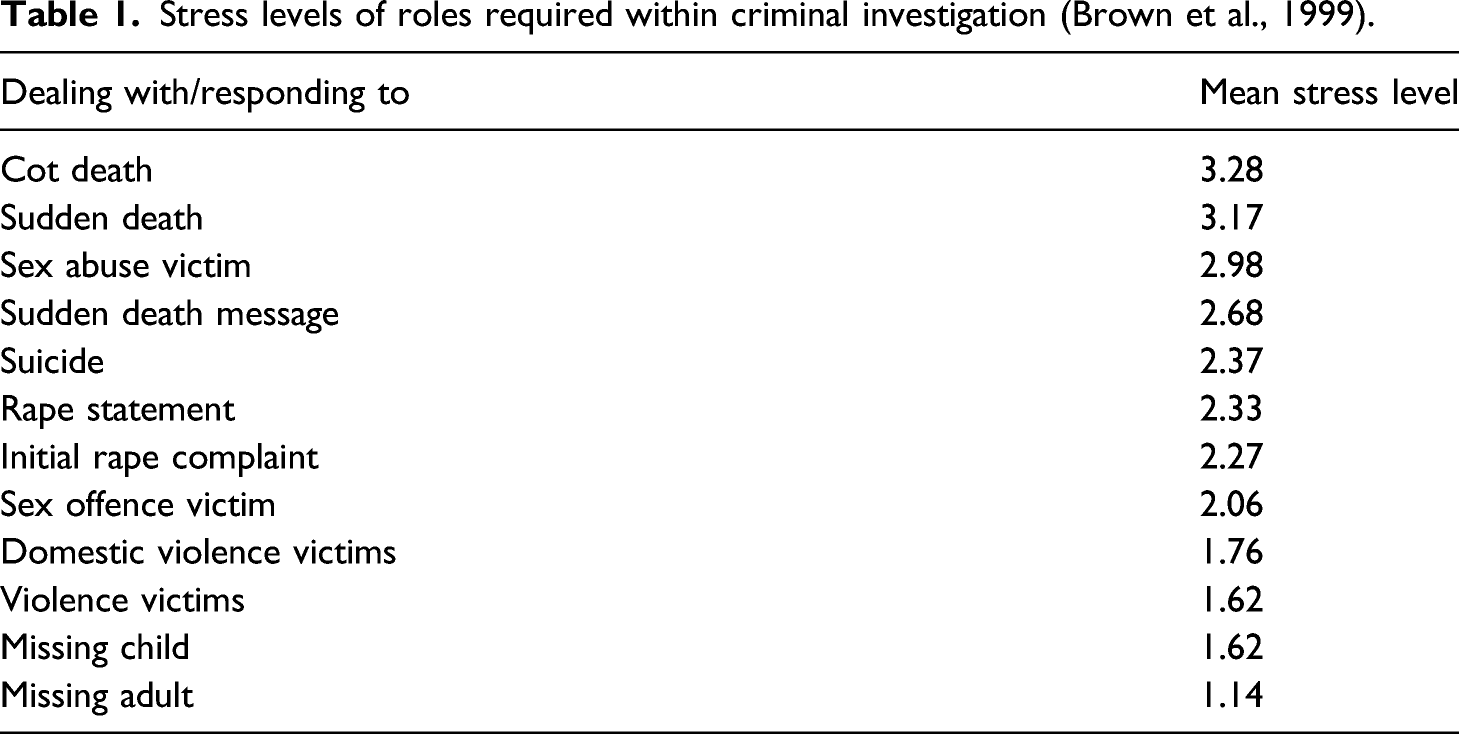
As can be seen in Table 1, participants reported that the different roles and functions within a criminal investigation produced varying levels of stress. Most notably, those roles associated with investigating crimes committed against vulnerable victims were reported to increase investigator stress levels, which could in turn have strong negative effects on their overall wellbeing (Brown et al., 1999).
An American study with 67 police investigators experienced in the investigation of adult and child homicide used a battery of psychometric tests to identify investigator cognitive functioning, psychological effects and levels of psychopathology (Van Patten and Burke, 2001). The findings suggest that although those involved with child homicide investigations experience significantly higher levels of stress-related symptoms compared to the general (non-police) population, these were found not to be higher than the normative scores found for psychiatric outpatients (Van Patten and Burke, 2001).
Although the Van Patten and Burke (2001) study suggests that although it is likely that the investigation of a suspicious child death will have a greater negative effect on the psychological and emotional wellbeing of those investigating, it is difficult to determine whether such effects were a direct result of investigating these cases, or whether it was instead the cumulative result of being involved in a number of homicide investigations per se. Moreover, their sample of investigators would most certainly have investigated significantly more homicides where the victims were adults as adult homicide is a more frequent occurrence than child homicide (Roach and Bryant, 2015).
A study with 99 participants comprising of UK police homicide investigators, provides further suggestion for the existence of different, and potentially more acute, effects on investigator wellbeing in cases of child homicide. Roach et al. (2016) employed an online survey to explore whether (and if so how) potential negative effects on homicide investigator wellbeing differed according to whether the victims were adults or children. The findings highlight that experienced homicide investigators feel that investigating child homicides has ‘greater negative effects’ on their personal wellbeing. Differences reported included experiencing higher levels of intrusive thoughts, more negative emotional reactions, higher perceived levels of investigative complexity and more pressure to resolve the case satisfactorily (Roach et al., 2016).
An additional finding of the Roach et al. (2016) study was that those investigators who reported not being involved with a child homicide investigation for at least 6 months indicated that such investigations affected their wellbeing more detrimentally than those who had not had an interval of up to 6 months since their last child homicide investigation, with many appearing to go from one case to another (Roach et al., 2016). Although this finding might appear to be counterintuitive at first, by way of explanation, the study authors suggest that it is likely that those continuously involved with child homicide investigations will not have had the time and space necessary in which to acknowledge, process and begin to address the effects of child homicide cases on their wellbeing, afforded to those who had at least a 6-month interval period another child homicide investigation. The danger for regular investigators of child homicide is the build-up of ‘negative cumulative effects’ on their wellbeing, which might eventually lead to more acute and profound trauma effects, if un-acknowledged, for example, if they are not given the appropriate opportunity to reflect, debrief and off-load their thoughts and feelings. Unfortunately, as this study also reported that ‘investigative experience’ does not appear to mitigate against the emotional assaults on investigator wellbeing in child homicides, then in terms of those regularly investigating such cases, then the most experienced and less experienced appear equally susceptible to negative impacts on their personal wellbeing (Roach et al., 2016).
In a follow-on study comprising semi-structured interviews with UK and Danish police homicide investigators, it was found that homicide investigations which either involved young children, extreme violence, and where the victim was of a similar age to the investigators own children were reported as impacting most on investigator wellbeing (Roach et al., 2018). Furthermore, all of the homicide investigator participants identified how the death of a child, particularly a young child, was significantly more complex in terms of the investigation processes (e.g. Coroner’s verdicts establishing cause of death) and therefore more likely as a consequence to have an effect on their wellbeing for longer than that experienced in most homicides where the victims were adult (Roach et al., 2018).
Research studies of the ‘negative wellbeing effects’ of child and adult homicides on police staff involved in with their investigation, such as those presented by Roach et al. (2016; 2018), do not provide an accurate measurement of the levels and extent of the effects experienced, as standardised psychometric instruments were not used. This makes it difficult to determine the actual levels of psychological wellbeing and psychopathology identified within their small samples. In a study of 56 Slovenian homicides, sexual offences and juvenile crimes, criminal investigator participants were asked however to complete several psychometric questionnaires to compare coping strategies employed and along with levels of self-reported pathology regarding post-traumatic stress symptomology (Mrevlje, 2017). The findings from this study identified 7.4% of the investigator sample as experiencing ‘clinically significant’ symptomology associated with post-traumatic stress disorder, with a further 3.7% experiencing milder symptomology, which again is associated with post-traumatic stress disorder. Indeed, five of the investigator participants that were found to have high levels of post-traumatic stress symptoms, worked in the ‘juvenile crime’ area of policing. Somewhat surprisingly, only one homicide and sexual offences investigator was found to have high levels. The author concludes that this difference was likely to have been due to the fact that working with child victims of crime is often more ‘emotionally taxing’ (Mrevlje, 2017). Interestingly, an additional finding was that investigators tended to employ more ‘avoidance coping strategies’, which raises obvious concerns for their wellbeing, as avoidance coping strategies generally result in poor long-term wellbeing outcomes (Mrevlje, 2017).
In a study examining levels of STS with civilian police specialist investigator working in violent and sexual offending teams, psychometric testing identified that these specialist investigators had mild STS (Gray and Rydon-Grange, 2019). Although the authors stop short of stating the exact percentage of their sample that might have been suffering with severe STS, what can be assumed is a recognition that investigative work relating to sexual and violent offending is quite likely to lead to mild STS symptomology on those involved with the investigating. The same study reported finding no differences in regard to the gender of the ‘special investigators’, and that ‘length of service’ was only related to increased levels of STS for ‘very new investigators’, suggesting that for ‘non-new investigators’, they were equally susceptible to STS symptomology, supporting the findings of the Roach et al. (2016) study of UK homicide investigators previously discussed. Finally, and perhaps most importantly, the authors reported that those special investigators identified as having ‘insecure and avoidant attachment styles’ were found to be at higher risk of STS, whereas those scoring higher on ‘mindfulness and coping self-efficacy’ were found to be at decreased risk (Gray and Rydon-Grange, 2019).
Similar accounts of the effects of general investigative work associated with sexual offending have also been identified by a further UK study of investigator wellbeing (Parkes et al., 2019)). Parkes and colleagues found with a small sample of UK detectives and civilian investigators (N = 12) that these types of criminal investigation had a negative effect on investigator wellbeing, for example, by intruding into their personal lives, producing symptoms of PTSD and influencing changes in their personal view of the world.
Wellbeing effects concerning the investigation of child abuse and child sexual exploitation
A second category of the research literature pertaining to investigator wellbeing and criminal investigation identified by this review concerns the investigation of cases of child sexual abuse (CSA) and child sexual exploitation (CSE). Modern advances in mass communication, such as the internet and social media, often provide both opportunities to facilitate old types of crime or for the creation of new ones, such as ‘trolling’. One of the worst ways in which these have facilitated criminality is arguably the ease with which videos and photos of children being sexually abused can be made, accessed, shared and distributed on a scale incomparable prior to their invention. Most pertinently for the present paper, in order for suspected offenders to be charged and prosecuted, police investigators are required to analyse and examine what is often abhorrent and emotionally damaging video evidence for victim and perpetrator identification and evidential purposes (Akdeniz, 2008). Exposure to such traumatic and disturbing imagery in such investigations is therefore likely to impact on the wellbeing of even the most ‘battle-hardened’ of investigators.
Burns et al. (2008) studied the wellbeing effects on a small Canadian sample of online child sexual exploitation investigations and found that ‘affect symptoms’ included intrusive thoughts, headaches, irritable mood and extreme fatigue, all consistent with a diagnosis of STS. This study was qualitative in approach and so did not use any psychometric measures to identify any degree or levels of psychopathology present in this group. Nevertheless, from the researchers’ accounts and the qualitative extracts presented, it can be argued that the prevalence of STS as a result of this type of investigative work was likely to be high.
The Burns and colleagues’ (2008) study highlights a number of strategies that this group of CSE investigators reported using to help them cope with the negative effects that investigating such crimes had on their personal wellbeing. These included the viewing strategy used, access to psychological support, availability of peer and social support, use of humour and initial candidate selection (i.e. they were better suited to the role than others). These findings closely echo the later findings of Roach et al.’s (2018) study with police homicide investigators, highlighting common coping strategies used by those investigating CSE and child homicide cases The CSE investigators in Burns et al.’s (2008) study also outlined a number of categories hindered their coping, including the criminal justice system (e.g. its slowness), amount of time spent viewing the evidence, a lack of investigative resources, various psychological interventions and organisational factors which included high workloads.
A small UK qualitative study with participants comprising supervisors of online child sexual abuse investigations found that involvement with this type of investigative work caused emotional distress (Stevenson, 2007). With the extent and intensity of exposure to such disturbing imagery influencing the severity of the emotional distress reported (Stevenson, 2007). Furthermore, it was reported that the supervisors demonstrated a number of additional wellbeing issues, including worries regarding inappropriate sexual thoughts and exhaustion (Stevenson, 2007).
A majority of the research to date exploring the consequences on police employees’ wellbeing posed by exposure to child sexual exploitation investigations has employed qualitative methodologies with small numbers of participants and no use of validated measures of psychopathology. Arguably, as was the charge levied at a majority of the research on the effects on homicide investigations on the wellbeing of those doing the investigating, generalisation of the findings remains somewhat challenging. Research by Perez et al. (2010) however builds upon the work of Stevenson (2007) and Burns et al. (2008) by using self-report data relating to burnout and STS acquired by psychometric measures in this study of a US sample of online child sexual exploitation investigators. Perez et al. (2010) found that 18% of their sample of investigators showed high levels of STS, with a further 18% showing moderate levels of STS. In terms of ‘investigator burnout’, they found that 54% of their sample reported being in the high exhaustion category, 43% were in the high cynicism category and 18% in the low professional efficacy (coping) category. All of these findings are indicative of burnout (Maslach et al., 1996). More positively, social support was found to help reduce the risk of STS and burnout, but the writers raise concern about the low number of their investigator participants that reported, and for a various of reasons, that they had received adequate social support to help them cope and so protect their wellbeing.
The findings of the Perez et al. (2010) study certainly adds to any concern that criminal investigators are routinely exposed to traumatic events and therefore are at a heightened risk of experiencing negative impacts on their wellbeing, such as developing symptoms of psychopathology, particularly STS. To reiterate, these findings come with the caveat that drawing any firm conclusions from studies with small sample sizes, is somewhat problematic. In a study by (Bourke and Craun, 2014a), however, the researchers explored levels of STS in 288 UK and 677 US online child abuse investigators. They found that UK investigators reported significantly lower levels of STS when compared with their US counterparts. Furthermore, it was reported that in the US participants, 15% of investigators reported symptoms associated with severe STS, whereas this was only 10% of UK participants. (Bourke and Craun, 2014a) identified ‘predictors’ of high levels of symptoms of STS included increased exposure to indecent child images and with higher self-reported levels of difficulty from working with such material. This was the same for both UK and US investigators. Other indicators of STS found reported were increased alcohol and tobacco usage in the past year and the denial of any stress occurring as a result of the investigative work (Bourke and Craun, 2014a). In regard to factors they found which mitigate high STS, the ability to rely upon co-workers was found to significantly reduce levels of STS.
One obvious and important question is whether the scores obtained by investigators in studies of STS only relate to the time of data collection (e.g. after a particularly traumatic case) and so do not represent more ‘normal working days’ in criminal investigation. In a more longitudinal study by Craun et al. (2014), however, data collected spanned a three-year period where STS scores were found to remain relatively stable overtime albeit with ‘denial in the previous year’ found to increase the severity of STS, with higher levels of social support in the previous year resulting in a reduction in the severity of STS the following year.
In a further study by Craun et al. (2015), they included a large sample of US investigators of online crimes against children, in order to explore the effects that being involved with such investigations had on ‘family life’. Only 27% of investigators stated that their work had no effect on their family life, with the majority reporting changes such as distrusting others more (24%), withdrawing from family and friends (14%), improvement in their relationships (10%) and inability to talk to others about their work (9.4%) alongside other more infrequently reported changes (Craun et al., 2015). Interestingly, it was found that those investigators in the sample who reported either ‘no changes’ or ‘positive changes’ to their family life had significantly lower incidents of STS symptomology than those who reported marital difficulties, increased irritability and increased social withdrawal (Craun et al., 2015). Lastly, another study by Craun and Bourke (2015) using a sample of 350 US child sexual exploitation investigators examined the role of humour as a coping mechanism. Interestingly, they found that although humour was commonly used as a coping mechanism, humour when directed towards the victim was considered an indication of more severe STS symptoms.
In a US study with 463 internet child exploitation investigators, 24.8% of the sample were found to be at high risk of developing STS, 51.5% at a moderate risk and 23.7% at a low risk of STS (Brady, 2016). Significant predictors of STS in this study included hours investigating such crimes, feelings of being overwhelmed, lack of organisational support, the younger the age of the child victim, lack of home support and being a female investigator (Brady, 2016).
Similar findings have also been reported by Tehrani (2016) who conducted a study with 126 UK internet child abuse investigators. Although Tehrani’s research specifically examined STS and burnout in investigators, it also measured symptoms of anxiety and depression and found that 16% of male and 24% of female investigators had demonstrated cut off scores suggestive of early PTSD; 24% of male and 38% of female investigators demonstrated early symptoms of burnout; 16% of male and 38% of female investigators displayed early symptoms of anxiety; 12% of male and 26% of female investigators demonstrated early symptoms of depression and finally 16% of male and 22% of female investigators reported scores indicative of early symptoms of STS. With regard to clinically high levels of distress, although the percentage of investigators suffering was found to reduce, female investigators continued to be the most affected with 10% presenting clinically high levels of distress in relation to symptoms of anxiety and depression (Tehrani, 2016).
MacEachern et al. (2018) investigated the prevalence of STS in a sample of 63 UK detectives working in child protection and child abuse investigations. MacEachern et al. (2018) found that 11% of their sample had STS symptoms in the high to severe range, with 51% seeming to experience some degree of STS symptomology. Although no significant differences in STS scores between males and females were found, it was only female participants that met the threshold for high to severe STS. This finding from this research again adds support to the view that symptoms of high STS are likely to be prevalent with many criminal investigators. It must be noted, however, that as this study’s sample included different types of criminal investigative work and not just those exposed to child abuse imagery or child abuse investigations, this may provide an explanation for the lower levels of severe STS than that reported in previous studies of the effects of exposure to child abuse imagery and investigations specifically. That said, Seigfried-Spellar (2018) has gone some way to addressing this limitation by distinguishing between digital forensics examiners and those who investigate the other aspects of child pornography investigations. In this US sample, 20 participants were digital forensic examiners only, 71 investigators only and 38 were involved in both aspects of investigation work. The findings suggest that those involved in both forms of investigation work were significantly worse off in relation to STS, feelings of worthlessness, concentration and job satisfaction (Seigfried-Spellar, 2018). The findings outlined here suggest that those involved in both aspects of the investigation 42% could be categorised as suffering from PTSD, 22% for investigators only and 30% for examiners only (Seigfried-Spellar, 2018). The findings, again, highlight the severe impact on investigators wellbeing that these types of criminal investigation can and do have on investigators.
Crime scene investigation
The third area of criminal investigation identified by this review to negatively impact the wellbeing of criminal investigators is exposure to crime scenes, particularly those displaying high levels of violence. In the UK context, Scenes of Crime Officers (SOCOs) are often civilian police staff employees who routinely examine a plethora of different crime scenes to collect and assess forensic evidence – including those resulting from horrific crimes of violence and/or abuse and neglect. The effects on wellbeing of this role appears rather under-examined, with very few published studies to date exploring the psychological and wellbeing effects of those in this role (Sollie et al., 2017). This is perhaps somewhat curious as those involved in crime scene investigation will be frequently exposed to death, evidence of violence and unpleasant smells (Pavšič Mrevlje, 2016).
From a study with 111 Korean crime scene investigators, 42.3% were found to have experienced homicide scenes one to two times per week, 45.1% three to four times per week and 12.6% more than five times per week (Yoo et al., 2013). Here, a quantitative methodology was employed using different psychometric tools. Of most significance was the finding that those who had investigated homicides three to four times per week displayed significantly higher post-traumatic stress scores than other investigators (Yoo et al., 2013). Furthermore, the researchers found that the following variables were all associated with higher PTSD scores: less experience as a crime scene investigator, higher levels of death anxiety, a type A personality and lower emotional intelligence (Yoo et al., 2013). Despite the identification of risk factors which increased PTSD scores, the researchers found that levels of PTSD symptoms were lower than that previously found in research with firefighters; however, no comparison with the general population was made. In a more recent study, Nho and Kim (2017) outlined that from their sample of Korean crime scene investigators (n = 226), 19.9% were found to be in the high-risk group for PTSD. Social support and resilience were found to be factors associated with the low-risk group, leading the authors to suggest that wellbeing intervention programmes and training should focus upon developing these (Nho and Kim, 2017).
In a study of 64 crime scene investigators in Slovenia, participants were asked to complete two psychometric questionnaires exploring coping and PTSD (Pavšič Mrevlje, 2016). The results showed that 17.19% of the sample were suffering clinically significant PTSD symptoms at the time of which seven participants were classed as experiencing moderate symptomology and four participants classed as suffering severe symptomology. The researcher suggested the significance of this by drawing attention to the PTSD prevalence of only 1.8% (Pavšič Mrevlje, 2016). Furthermore, the Slovenian study found that accessing social support as a coping strategy was the most infrequently used. This finding is alarming (as discussed above) when studies have repeatedly shown that low social support can contribute to increased traumatic stress. Furthermore, Pavšič Mrevlje (2016) found that preparing for work tasks through being familiar and experienced with specific crime scenes initiated more long-term beneficial coping strategies; thus, the researcher stressed the importance of simulation training prior to investigators being sent out to traumatic scenes of which they have no experience.
In a study conducted in Australia, attrition rates of up to 50% for crime scene investigator posts were reported from a study of 19 investigators (Kelty and Gordon, 2015). Kelty and Gordon (2015) undertook interviews, alongside employing psychometric questionnaires, and found that for their crime scene investigators, depression and anxiety were lower than that found for the general population, suggesting, at face-value at least, few negative effects on their wellbeing as a result ‘doing the job’. The researchers did find one factor, however, indicative of burnout ‘an idealised personal identification as a crime scene investigator with little to no social support’ (i.e. investigators whose lives were consumed by their work – they could not ‘switch-off’).
A study conducted in the Netherlands comprised the observation of five crime scene teams whilst also undertaking 35 semi-structured interviews with further investigators (Sollie et al., 2017). Sollie et al. (2017) focused on stress induced by crime scene investigators’ role as opposed to specifically measuring trauma; none the less, the findings provide an indicative account of which aspects of their job presented a higher risk of instigating a trauma. Alongside what can be classed as deployment stressors such as workload, disturbed sleep patterns, irregular work patterns and administrative procedures, several stressors were found to be associated with the impact of the crime scene investigation work. Investigators outlined a number of emotional triggers associated with their work including ‘(a) the type of victim, (b) the way in which the crime was committed, (c) identifying with the victim, (d) the circumstances of death, and (e) contact with bereaved relatives’ (Sollie et al., 2017: 1589). The investigators outlined that when the victim was a vulnerable member of society such as a baby, a child or an elderly victim, this can induce greater emotions on the part of the investigator (Sollie et al., 2017) echoing the findings of Roach et al. (2016); 2018) study with homicide detectives. Crimes that were identified as being brutal or committed by a partner or parent were also identified as likely emotional triggers. In relation to identifying with the victim, this refers to the extent to which the crime is relatable to the investigator’s life, for example, being similar to their own personal life, knowing the victim or the age of the victim (i.e. similar to themselves or their children/grandchildren). Circumstances of the death refers to events which are unfortunate such as traffic incidents, dying alone and not being found for a prolonged period or suicide being committed at a young age. Finally, investigators in this study reported dealing with bereaved families to be a significant source of emotional impact, for example, undertaking their work whilst being able to hear and deal with the emotional trauma of victims’ loved ones (Sollie et al., 2017: 1589). The investigators also reported a number of ‘coping styles and techniques’ which they believed had successfully allowed them to continue their work, some positive with some negative. These include avoidance whereby they opt not to attend a particular crime scene that may cause emotional distress, emotionally distancing themselves (i.e. seeing victims as evidence and not human beings), seeking social support and visualisation whereby they prepare themselves through visualising the crime scene prior to visiting (Sollie et al., 2017). Indeed, the accounts of the Norwegian investigators certainly highlight what emotional triggers might instigate secondary trauma, but the paper only deals with exploring how such investigators cope with these stressors, but not the levels of psychopathology within the sample, thereby making it difficult to determine the extent of the psychological impact caused by their occupation as investigators.
Discussion and conclusion
The present paper has reviewed the research literature pertaining to the wellbeing of police employees involved with criminal investigations. This review incorporated over 20 articles specifically relating to the psychological wellbeing of criminal investigators, comprising an estimated three thousand plus participants from police employees across the world. The findings of the review confirm the existence of different types and levels of impact on investigator wellbeing, according to different type of criminal investigation and different investigative roles. Three distinct categories of research area are identified: general investigative work, child sexual abuse investigation and crime scene investigation.
The results of this review highlight a number of factors which impact negatively on investigator wellbeing, primarily those investigations where the victim was a vulnerable individual (particularly a young child). As a result, this line of investigative work is suggested to be the highest risk in regard to negative impacts on wellbeing (e.g. detrimental psychological and emotional effects). In terms of ‘coping with negative wellbeing effects’, important factor that emerged in almost all of the studies reviewed here is the importance of social support, with those reporting as having poor social support being at greater risk of experiencing negative wellbeing effects, and those with good social support seemingly at less risk. This suggest that future wellbeing and training interventions for professionals involved in criminal investigation work should focus on building-up investigator coping resilience in this area. It must be acknowledged, however, that some investigators are better suited and better able to cope with the incidences of trauma that they experience within their role and this serves to mitigate and protect them against the detrimental psychological effects that some colleagues experience with varying severities. Future research exploring the potential of candidate screening and identifying which individuals are more suitable to certain roles may be beneficial. Such approach to recruitment specifically for roles associated with poor wellbeing may help prevent such large volumes of sickness absence for poor wellbeing as identified in Cartwright and Roach’s (2020) review of sickness data.
This review has identified one of the current limitations of research in this area as being the paucity of wellbeing studies that use standardised psychometric tools to measure negative effects on investigator wellbeing. As a consequence, this makes it difficult to compare the levels of wellbeing and psychopathology across police roles and across national and international forces. Therefore, future research using standardised psychological instruments such as the Secondary Traumatic Stress Disorder Scale (Bride et al., 2004) would prove to be beneficial for a more comprehensive understanding of susceptibility to detrimental traumatic responses to criminal investigation work. This is an issue that plagues the academic literature not just in policing but across several disciplines but from a practical perspective, routine wellbeing appraisals that encompass a standard psychometric evaluation is something that should be considered. The literature is clear working for the police can and does have a negative impact on wellbeing. Certain roles are more at risk as the National Police Wellbeing Survey (2020) demonstrates but if something is to be done to support colleagues and to identify the specific aspects of roles that are detrimental to wellbeing then more routine wellbeing screening is needed. Routine wellbeing screening that is used to inform yearly appraisals certainly would allow management and occupational health start to respond to wellbeing needs as they arise and perhaps before they get worse.
Arguably, the main limitation of the present paper is that we opted to use a narrative approach as opposed to a systematic approach and this may have led to some articles not being sourced for the review which otherwise might have been. In defence of our methodological decision, we simply state that investigator wellbeing can at best be described as ‘emergent’, with therefore relatively little published research available in this area. That said, as research into the negative effects on police staff wellbeing continues to gather momentum at an increasing rate, we are optimistic that research on the negative effects of criminal investigations on the wellbeing of investigators will also. In this respect, we hope that this review has provided an audit of the current ‘state of play’ from which future research on investigator wellbeing can build.
We conclude with a plea for researchers to consider three key questions associated with maintaining criminal investigator wellbeing: 1. What are the effects and how do we recognise them? 2. How and when are such effects most likely to influence and manifest? (e.g. different investigator roles and functions). 3. How can we help our criminal investigators be better prepared, protected and safe-guarded against these potential assaults on their wellbeing?
If research in policing ever lacked a noble purpose, then the welfare of those who investigate serious crime is surely it.
Footnotes
Declaration of conflicting interests
The author(s) declared no potential conflicts of interest with respect to the research, authorship, and/or publication of this article.
Funding
The author(s) received no financial support for the research, authorship, and/or publication of this article.
