



Abstract
This Rogue Trader fraud study examines questionnaire data from 26 England and Wales police force intelligence branches (FIB) and trading standards focus group data. Findings highlight police disinclination to investigate and prosecute rogue trader ‘fraud’ due to its low priority; the complexity of level two criminality and stretched police resources, all exacerbated by poor application of the Fraud Act 2006. Placing artifice crimes on separate NPCC portfolios reduces the scope to identify patterns in crime series offending, fragmenting the intelligence picture. Whilst this crime lacks an enforcement arm and straddles trading standards and police remits, rogue trader remains ‘nobody’s problem’.
Introduction
There is no recognised definition of ‘Doorstep Crime’. Both distraction burglary and rogue trader offences are ‘doorstep’ crimes, referred to as ‘artifice crimes’ because such methods often involve deceiving the victim by the use of a falsehood (a trick or a lie) (Thornton et al., 2003) on the ‘doorstep’. Although rogue trader and distraction burglary are found under different offence types, with the former constituting ‘fraud’ by false representation (section 2 Fraud Act 2006) (HOCR, 2020) and the latter an offence of burglary involving entering a property as a trespasser under s. 9 of the Theft Act 1968; there are many overlapping similarities (Day, 2015) in the modus operandi perpetrators employ.
Rogue trading is defined as any incident where individual(s) target a consumer, deliberately overcharging for unsatisfactory goods and/or services. This includes charging for unnecessary work, damaging property in order to obtain money or work, charging for work not carried out, leaving work unfinished and using intimidating behaviour in order to extort money (Barratt, 2012: 6; ACTSO, 2015, as cited in Day, 2017). In summary, the offence includes not providing a service, providing a shoddy service, over-charging or inflating the price (Lister and Wall, 2006; Phillips, 2017).
Limited research has been undertaken on doorstep crime (Gorden and Buchanan, 2013) with only a trickle of UK primary research studies carried out in the last 20 years, and these predominantly focus on distraction burglary (Donaldson, 2003; Lister et al., 2004; Steele et al., 2000; Thornton et al., 2003, 2005). This article focuses on rogue trader criminality, in which there is a paucity of published research, having only previously been examined in England and Wales by Day (2015, 2017, 2019) and Phillips (2017).
The purpose of this paper is to expose findings and set these against more contemporary research to come to new knowledge around the policing and strategic governance of rogue trader crime. Findings offer a rare insight into the operational workings and strategic management of artifice crime in England and Wales, which will benefit policing, specifically the NPCC, Association of Chief Trading Standards Officers (ACTSO), SOAC and Economic Crime Units leads. This paper charts the research undertaken to date, acknowledging the ‘forgotten players’ in the criminal justice system (Duggan, 2018: 3) and the impact of fraud and repeat victimisation on elderly victims. It explores the various modus operandi that constitute rogue trader, delineates the efficacy of policing frauds as well as the current governance of England and Wales ‘artifice crime’ investigations. The methodology shall be explained along with the implications and limitations of the study. Findings explore a lack of understanding around the Fraud Act 2006 along with the low priority attributed to such crimes, which makes the cultural practice of decriminalising cases as ‘civil dispute’ more palatable, particularly in light of radical cuts to services. Strategic issues are examined, in that the complexity of the crime as a level 2 cross border threat, constituting organised crime in some cases, may deem it inappropriate for front line response officers to investigate. The paper concludes by evaluating the current strategic impasse of this specific fraud crime as having an absence of clear governance, particularly since the dissolution of Operation Liberal.
Victimology
Significantly, despite older adults being the least frequently victimised demographic in official statistics (Phillips, 2017), this pattern is reversed in the case of artifice crimes, with perpetrators typically, deliberately and disproportionately targeting the elderly (HMICFRS, 2019a; Thornton et al., 2003) because they are perceived as vulnerable or potentially easy to steal from (CPS, 2019; HMICFRS, 2019a). The average age of victims ranges from 77 years (Lister et al., 2004) to 81 years (Home Office, 2001; Thornton et al., 2003). Trading standards report an astonishing 85% of rogue trader victims are aged 75 years or over 1 (ACTSO, 2015, as cited in Day, 2015; HMICFRS, 2019a). Rogue traders place extreme pressure on older people to obtain their monies, sometimes escorting them to banks and building societies to withdraw cash (Steele et al., 2000).
Victims may significantly under-report doorstep crimes for a range of reasons. Notably, victims are socially isolated with an absence of family to encourage reporting (Brogden and Nijhar, 2000; Lister and Wall, 2006); they are not aware they are a ‘victim’ (Home Office, 2001); they are unsure if property has been stolen (Steele et al., 2000); the embarrassment at being conned by perpetrators on the doorstep is significant (Button et al., 2009; Home Office, 2001; Thornton et al., 2005); the fear of violence should they confront the offender, or worry about future intimidation from fraudsters should they pursue a case; fear of the criminal justice procedures, and the trauma of providing evidence or inconveniencing the authorities also feature (HMICFRS, 2019a; Steele et al., 2000).
Crucially, by reporting the crime, elderly victims fear being removed from their home and institutionalised (Brogden and Nijhar, 2000; HMICFRS, 2019a), associating victimhood with being unable to cope alone. Significantly, where offenders do not gain entry, victims often consider it too trivial to report it to the police (Thornton et al., 2005). Some victims emanate a sense of futility and powerlessness, with 74% who ‘didn’t see the point’ in reporting a scam to the police (Age UK, 2018: 13; also Home Office, 2001). Concerningly, adults defrauded in their own homes and targeted based on their age as a personal characteristic 2 suffer a devastating impact (HMICFRS, 2019a: 37). They are two and a half times more likely to either die or go into residential care within a year of the fraud than those who are not defrauded (National Trading Standards Doorstep Crime Project Report 2014/15, as cited in Baxter and Wilson, 2017: 38).
Therefore, the severe victim impact of these crimes demands a more effective investigative policing response.
What is rogue trader criminality?
There appear to be three broad typologies of the rogue trader. Firstly, the opportunistic ‘chancer’, who attends unannounced (cold calling) and convinces the homeowner of the need to fix an often-non-existent problem at their property (Baxter and Wilson, 2017). Such offenders are less organised and exploit their familiarity with a neighbourhood to select suitable targets to victimise (Lister and Wall, 2006). Fraudsters rely on a variety of guises such as feigning illness, asking for a glass of water; claiming to need the toilet; pretending to be a family friend of a neighbour; a ball has gone into the back garden or needing assistance with a broken-down car (Lister and Wall, 2006; Thornton et al., 2003). Second, there are offenders who imitate legitimate business practice, by setting up as a limited company and providing more specific services in a trade i.e. property maintenance, double glazing, selling products such as security alarms, mobility aids, energy saving devices etc. (ACTSO, 2014, as cited in Day, 2017). The offender may assume the identity of a bogus official (Baxter and Wilson, 2017) (e.g. water board, electricity board, police, council); a salesperson or workman (e.g. door to door sales, gardener, property repairer). Finally, the more ‘professional’ offenders operate in Organised Crime Groups (OCG) (including friends and family members) having spent years developing their ‘trade’ and MO. They utilise fake ID badges, trade flyers, business cards, place company signage on their vans and insignia on their sweatshirts (Phillips, 2017), all of which provides a ‘convincing aura of legitimacy around criminal behaviour.//.blurring it.//.with legal, ethical mercantile practices’ (Sutton, 2007: 254). Such tools used constitute a ‘representation’ and are deemed as ‘articles’ used to mislead an occupant under the offence of fraud by false representation (see section 6 of Fraud Act 2006 which replaced s. 25 Theft Act 1968 going equipped to cheat).
The Fraud Act 2006 and policing priorities
Fraud Act 2006 legislation repealed the previous ‘deception’ offences that the police formerly relied on under the 1968 and 1978 Theft Act. 3 Section 2 Fraud by false representation is the broadest form of the fraud offences and is likely to be the most frequently charged (Ormerod, 2007). It is an indictable offence attracting up to ten-years imprisonment and is defined as when a person ‘dishonestly makes a false representation, and intends, by making the representation, to make a gain for himself or another, or to cause loss to another or to expose another to a risk of loss’ (HOCR, 2020; Padifield, 2014). A representation can be defined as ‘false’ if it is untrue or misleading and the person making it knows that it is, or might be, untrue or misleading. However, for the offence to be complete it is significant to note that no gain or loss needs to actually have been made (CPS, 2019).
Despite frauds constituting almost a third of all recorded crime (31%) (Button et al., 2007; HMICFRS, 2019b) there is mounting evidence of a failure by the police to take fraud crime seriously (Button et al., 2007). Like other frauds, rogue trader is not on any strategic policing priority for many police forces (Button et al., 2007; Gannon and Doig, 2010; Gorden and Buchanan, 2013), indeed 32% of forces assign fraud a low priority, suggesting officers do not investigate fraud to the same standard as other crimes (ACTSO, 2015, as cited in Day, 2017). Trading standards perceive that the police attribute a low priority to rogue trading offences in that ‘we’re the bottom of the pile with these jobs.//. “get to the back of the queue” kind of attitude really’ (Phillips, 2017: 616). The suggestion is that police officers attending these incidents incorrectly classify cases as civil matters and ‘non crimes’, and neither crime record nor pass these cases onto Action Fraud 4 or Trading Standards (ACTSO, 2014: 5). Lack of police capacity to resource is also a relevant concern, in which staff are diverted away from fraud and to priority crimes such as firearms, CSE and drugs (HMICFRS, 2019b). Consequently, fraud investigations are often allocated to front-line officers that are simply not trained to investigate them (Gannon and Doig, 2010; HMICFRS, 2019b).
The governance of artifice crimes
Operation Liberal was initially created in 1998 as an initiative for tackling distraction burglary, involving the joint resources of 8 member forces 5 (Operation Liberal, 2000). Liberal remained the National Intelligence Unit for both distraction burglary and rogue trader offending until 2019 and represented a coordinated ‘one stop shop’ approach to artifice crime (Barratt, 2012). It provided doorstep crime prevention (P) good practice, current intelligence (I) and enforcement (E) activity (P.I.E.) in England and Wales. The relationship between Liberal as the national unit and the 43 England and Wales police forces was facilitated through the Doorstep SPOC (Single Point Of Contact) situated on the volume crime desk in the majority of Force Intelligence Branches (FIB). Both the SPOC and Liberal would liaise around emerging level 2 6 crimes series offences and individuals/OCGs impacting on their own or neighbouring force areas.
Yet, Operation Liberal was disbanded in March 2019 and the responsibility for distraction burglary fell to the current NPCC (National Police Chief Council) lead for burglary DCC Rowley. Alternatively, the portfolio for rogue trader (Fraud) was given to the city of London Police Commissioner of the National Business Crime Centre (NBCC) Ian Dyson (NPCC, personal communication, 3rd June 2020). Rogue trader crime became subsumed into Operation Opal, a National Intelligence Team focusing on Serious Acquisitive Organised Crime (SOAC). However, by comparison, Opal’s remit is broader and encompassing any acquisitive organised crime with an element of cross border criminality (L Rawlins, personal communication, April 20th, 2020). It may be logical to align this crime area with the National Business Crime Centre (NBCC), due to the increase in fraud and cybercrime activities and the need to deal more proactively with level 2 OCGs (Dyson, 2019). However, it remains to be seen whether rogue trader is operationally better policed under a general ‘fraud’ banner. This is because in 2013 the National Fraud Authority put fraud losses at 9 billion per annum, and yet rogue trader crime was not included in their analyses (Baxter and Wilson, 2017). Equally, in the largest fraud survey undertaken in England and Wales, involving 30 face to face interviews and 800 telephone interviews with victim and families, doorstep crime scams were not included (Button et al., 2012). In summary, albeit rogue trader is now included in the Economic Crime Command Fraud policy (Metropolitan Police, 2020), it remains largely absent from the fraud agenda and neither does it ‘fit’ within the broader remit of SOAC.
Methodology
Albeit the original primary research design relies on three
7
mixed methods this article solely concentrates on survey and focus group data: 31 National police questionnaire returns from 24 England and Wales police Force Intelligence Branches (FIB), one regional and one national intelligence unit (2011).
8
A focus group with Central England Trading Standards Authorities (CEnTSA), comprised of 16 Trading Standards officers and two police officers (2011).
9
Consent to assess police participants was secured from the then Chief Constable Peter Fahy of GMP, in addition to the written and informed consent of participants in the surveys and focus group. Whilst undertaking the research, the researcher was employed as a Detective Sergeant in Force Intelligence as strategic lead for Volume Crime which covers doorstep crime (rogue trader and distraction burglary), thus possessing an understanding of procedure, crime investigation and strategy in this crime arena. Her familiarity with navigating force systems and cognisance of the distinctive linguistic register of police occupational culture(s) meant she readily made sense of and was able to apply a ‘common stock of knowledge’ (Atkinson and Coffey, 2011: 85–86) to the data. Although this is advantageous it makes replication difficult.
FIB police officers were surveyed in the specific sample frame, due to their expert knowledge and understanding of doorstep crime intelligence, investigation and crime prevention. The majority of participants were the Doorstep Crime SPOC, largely police officers experienced in intelligence, contributing to their force strategic assessment documents, collating and disseminating information of cross force crime series offending to operational officers and linking in with Operation Liberal around MOs and/or unusual trends. Expert purposive sampling aimed to achieve data reliability and minimise the chance of receiving ‘uninformed responses’ (Saunders et al., 2009: 363). Participants were recruited at an Operation Liberal National Doorstep Crime Conference in Birmingham on 30th June 2011, where the researcher outlined the study. Informed consent was registered via e mail. Accepting there would be an element of non-response, 150 surveys were e-mailed and/or posted to 43 police forces. The 31 survey returns from 24 police forces, and additionally one regional and one national intelligence unit, constituted a 20% return, with on average 56% of England and Wales forces surveyed. The researcher secured arrangements for a focus group with Central England (CEnTSA) Trading Standards officers at the same conference. Sixteen trading standards managers and predominantly enforcement officers, in addition to two police officers, formed the Central England Trading Standards authorities (CEnTSA) focus group. In the collection and analysis, the researcher relied on grounded theory, verifying or refuting theories as details were extracted at the production stage (Denscombe, 2007).
Implications and limitations of the study
Findings were collated in 2011 and a limitation of the study is the likelihood of changes to policing in the intervening years. Loftus argues that there is a ‘stubborn’ endurance of some classical cultural patterns in policing (2009: 198) that can inhibit meaningful change; therefore the time lapse in reporting should not detrimentally impact on the validity of the study. Such findings, taken from an expert sample of intelligence officers across 26 police forces and a focus group with Trading Standards, constitute a unique study which necessitates publication.
Findings and discussion
Insufficient understanding of fraud and doorstep crime
Police officers consider that training for control room staff, frontline operational police officers 10 and supervisors is pivotal in improving the investigation of rogue trader offences. Interestingly, 63% of police officers consider that trading standards are largely responsible for educating the police either solely or linking in with police force FIB’s. Indeed, trading standards deem there to be little evidence of training ‘coming from any kind of internal police route’ (TS focus group). This is supported by the survey data where 39% of forces either provide no training (7/31) or are unaware (5/31) of any training (Figure 1).
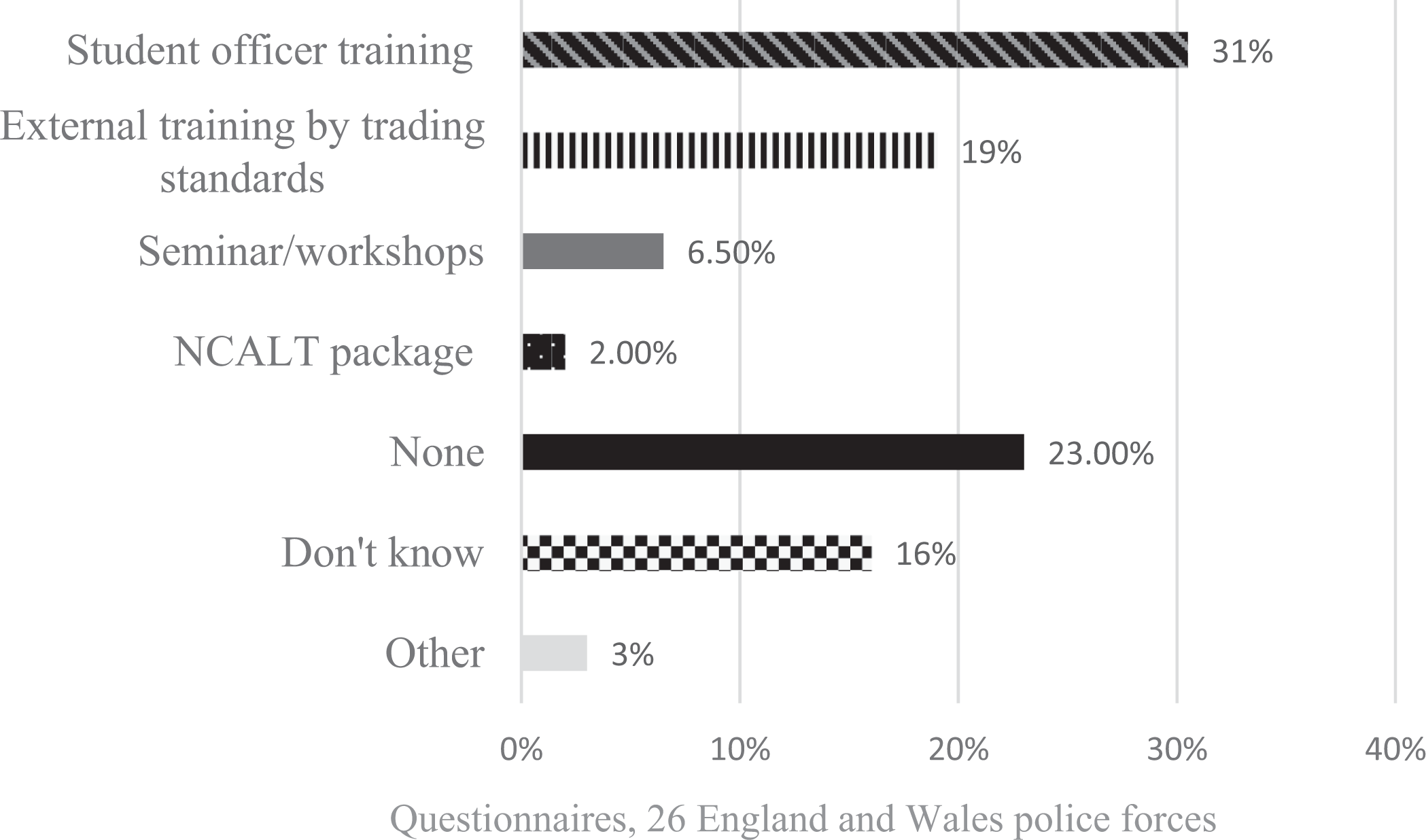
What rogue trader training is undertaken in your force?
Existing training is said to be directed at student officers (31%) and yet officer recruitment was stalled when this research took place. Of the 19 police respondents aware of training provision, 68% (13/19) consider that police training in doorstep crime is insufficient. Officers also lack insight around obtaining ‘expert opinion’ from builders, who would properly estimate the true value and quality of workmanship: They [police] might realise that some things are not right, for instance, property maintenance roofing jobs, they don’t know how to prove the offence. You’ve got to get a surveyor out and then gain the experts opinion. They just don’t know how to go about that. (TS focus group)
Little understanding and application of the Fraud Act 2006
There is strong evidence that operational police officers are ‘very uncomfortable with [the] fraud act’, in that the legislation does not appear to have been ‘embraced by anybody’ (TS focus group): [Operational officers] do not understand relevant legislation. (police officer 12) There remains a lack of knowledge of the Fraud Act 2006 both with response officers and immediate supervisors. (police officer 25) I have seen officers put things on logs like ‘I am not Op Liberal Trained’ or ‘the complainant is too old for me to ascertain if a crime has been committed’ which leads me to believe they are not getting sufficient training input on areas like the Fraud Act. (police officer 14) They said it was £300 [the offender] and they [the victim] have paid them haven’t they – so what? (TS focus group) There is a lack of confidence and knowledge concerning the Fraud Act. The number of times I’ve heard officers say – ‘Well if they agreed to the work, there cannot be a fraud’. And I have to try and point out to them that if the trader falsely told them the work needed doing – that is a fraud. (police officer 2) Told by a snotty call taker that they can’t log it because it’s civil and (TS officer) said ‘no it’s a fraud’ and this individual very condescendingly tells him ‘no just because someone goes and tells a lie doesn’t make it a fraud, they’ve only attempted to get something’. So (TS officer) explains to this call taker – ‘fraud covers attempt’, ‘No it doesn’t it’s civil’. So, it then gets passed from the civilian call taker to a PC to make a complaint. The PC comes on the phone and says ‘look I’ve been a PC for 20 years mate and I know what I’m talking about. There’s no crime in this, I’m not recording it – and I’m not even giving you a log’. (TS focus group) We don’t know anything about the Fraud Act, if you’re telling me it’s a section 2, I believe you.//.the only people who do the fraud act are the economic crime unit, nobody else looks at Fraud. (TS focus group)
Rogue trader as a low policing priority
A low priority is placed on rogue trader, with 62% (19/31) of police surveyed accepting that it is ‘not a priority’ (police officer 2). 19% (6/31) had no view and 19% (6/31) agree it is a priority.
Trading standards consider that the police only concentrate efforts on rogue trader partnership operations when links are made with distraction burglary initiatives: You have to mention distraction burglary when you’re approaching the police for assistance. Because if you say ‘I’m setting up a rogue trader op’ you get a different reaction to when you say ‘I want to do a rogue trader op / (stroke) distraction burglary op’. (TS focus group) In quite a significant number of cases it is not a priority investigation. I remember a detective constable phoning me.//.he had been allocated a fraud involving rogue trading, to spend 20 minutes telling me how busy he was and how many other crimes he had to deal with – that one was filed NFA fairly quickly. (police officer 2) The bobby that’s completely not interested and he just ‘bat it’ to trading standards ‘because I’ve got other more important things’. (TS focus group) It’s a priority piece of work [for trading standards].//.I suspect it never will be a priority piece of work for the police and therein lies – that’s the nub of the whole issue isn’t it. (TS focus group)
The ‘too hard to do’ tray: Complexity, OCGs and level 2 crime series
Findings suggest that some officers file these cases prematurely based on the complex and protracted nature of investigations. In the survey 68% (21/31) agreed (20% strongly agreed) that rogue trader was a complex crime, difficult to investigate, resource and detect. 19% were undecided and 13% disagreed with the statement. Findings from both data sets concur that NPT and response teams do not have the skills, time, and resources to delve into the complexities of rogue trader crime; indicating that cases are inappropriately shelved due to operational expediency: Seen as too complex right from the start and so are often disregarded because of a lack of will and resources. (police officer 13) Unless they [police] come to trading standards and say ‘we’re stuck’, the job just gets binned, sometimes I think because it’s ‘too hard to do’. (TS focus group)
Organised Crime Group (OCG) level 2 offending
Survey data confirms that rogue trader constitutes level 2 cross border organised criminality that is not being prioritised, despite the fact that such crimes can be surprisingly local (Button et al., 2007): They are serious and organised crime groups and resources need to be directed accordingly. (police officer 29) You have that very sort of bizarre situation where it’s been looked at seriously on a regional basis but potentially not at force level. (TS focus group) It makes sense that a team can…follow an OCG across force boundaries, rather than halt at the river and then pass the baton on (forgive the mix of two analogies, but I hope you get the picture).//. quite simply, cross border offenders require cross border investigation. (police officer 23) We’re intercepting people who could be in the process of taking 50 thousand pounds off somebody with dementia. (TS focus group) Made history in the application of POCA. These people operated and need coordination on a similar scale by the police. (DC Townsend, GMP, March 2012)
Stretched resources, austerity and target mentalities
Due to tight policing resources, trading standards report feeling forced to perform a ‘drop everything’ rapid response function to deal with rogue traders, putting their own officers at risk (TS focus group). Police are understandably defensive of this predicament, blaming a ‘lack of resources and other competing demands on resources’ (police officer 12): Cuts by the government have stretched all departments.//.cuts have meant less officers but with the same response expectations. Staff are unable to prioritise and less keen to take on more work. (police officer 31) I’ll be damned if we take on anything we haven’t done in the past on top of the fact of not having enough resources to do what we are supposed to be doing. (TS focus group) For them to take on additional work is…seems a bit more difficult…therefore ‘I’m just going to do the bare minimum .//.then I’m going to leave you with it’. (TS focus group) It’s all their interested in [police]. They’re not interested about some old dear who’s having her life savings ripped off her. (TS focus group)
The governance of rogue trader crime
Enforcement: Everyone’s problem is no-ones problem
Partnership working between police and trading standards is deemed ineffective with teams working in isolated silos and consequently ‘everyone’s doing their bit and no one’s actually pulling it all together’ (TS focus group). Parallels can be drawn here with the offence of metal theft, with the police structure highlighted as a ‘major inhibitor’, lacking a centralised body to coordinate and disseminate data and, akin to doorstep crime, deemed as a ‘low force priority’ with police investigating in a ‘piece meal’ fashion (Coxhead, 2011: 24). Much of this piecemeal policing is attributed to a lack of a recognised and effective enforcement arm to investigate rogue trader crime at both force and regional level. The focus group felt that economic crime units, based in each force, did not perceive RT criminality to be within their remit: The economic crime unit are not interested in rogue trader related fraud – they’re looking at company fraud. (TS focus group)
Whilst rogue trader criminality continues to ‘straddle’ the policing and trading standards arena, this engenders a level of ‘bureaucracy about who owns the offence’ (police officer 31), who will handle the investigation, and crucially who will pay for any surveys required on a victim’s property (police officer 30). In order to resolve this ‘ownership’ dilemma, both police officers and trading standards provide persuasive arguments to support the forming of ‘dedicated teams’ 12 either within force or regionally to investigate and improve rogue trader investigations. One officer was ‘aghast’ to learn that there was no proactive investigative arm to Operation Liberal (police officer 23), with such crimes requiring regional level intervention.
Analysis of eight forces that state they are successful in rogue trader investigations, indicate that they had either forged good partnership links with trading standards (police officers work within the West Bromwich trading standards team); possessed a dedicated police (only) specialist task force, such as Operation Bombay in the North Eastern region; or ensure a specialist unit such as CID perform a crime investigation ‘gate keep’ function (police officer 9). Specialist enforcement teams, notably Operation Bombay, Operation Manhunt (Hertfordshire) Op Radar in Norfolk, Op Liberal team in Wiltshire, employ proactive tactics such as the use of ANPR hotlists, trigger plans and the promotion of cases internally and externally leading to quality intelligence submissions. Such dedicated teams are considered to be the ‘experts’ (police officer 22), responding swiftly and proactively to both rogue trader and distraction burglary incidents. Forces with dedicated proactive teams are confident they had ‘changed the attitude of patrol officers and eradicated the “civil matter” culture’ (police officer 21), although admittedly changing mindsets has been an ‘uphill struggle’ (police officer 24). Having an enforcement arm would provide the ‘ownership’ (police officer 8) that is sadly lacking.
The intelligence picture
From a strategic intelligence perspective the 2019 dissolution of Operation Liberal, as the National Intelligence Unit, to Operation Opal appears to have been a retrograde step. This is not simply a ‘renaming’ exercise (Dyson, 2019) but marks a radical overhaul to the way doorstep crime is managed. First, there is currently no national or regional unit measuring or assessing doorstep crimes. Operation Opal confirm that they do not collate any statistical data on rogue trader or distraction burglary (L Rawlins, personal communication, April 20th, 2020). Indeed, when Liberal was dissolved, the data base that housed distraction burglary and rogue trader data was uploaded onto the Police National Database rendering it no longer available to police forces (A Harwood, personal communication, 17th April 2020). This course of action alone renders the ‘invisible’ nature of doorstep criminality (Day, 2019; Phillips, 2017) more hidden. Second, the impact of this at force level mean that analysts, police and trading standards officers are unable to have a strategic overview of OCGs and individuals traversing force boundaries to commit these crimes; the victim profiles and the types of bogus modus operandi employed. Forces have effectively been rendered ‘blind’, unable to decipher the hidden threats impacting on their force area and therefore unable to respond through enforcement activity. Third, forces no longer have any support in how to deal with this very niche area of criminality, and therefore it is unsurprising to learn that Opal has not had any force referrals nor undertaken any national operation regarding rogue trader (or distraction burglary) since the unit went live on April 1st 2019 (L Rawlins, personal communication, April 20th, 2020). Fourth, none of the original Liberal team are employed in the new Opal unit (A Harwood, personal communication, 17th April 2020), therefore any organisational memory around artifice crime has dissipated. Finally, and most importantly, placing rogue trader within Opal’s general catch all of ‘acquisitive crime’ separates it from its artifice crime partner ‘distraction burglary’. This is a contentious issue, as trading standards officers concur that rogue trader criminality should be managed in isolation, rather than in the ‘shadow’ of its counterpart distraction burglary. This is understandable to some degree, because although Operation Liberal collated monthly distraction burglary crime statistics on their ‘Flints’ database, counterintuitively they did not collect any statistical data on rogue trader crimes; making a policy decision only to input rogue trader intelligence items. This reflects the perception amongst police specialist intelligence and trading standards officers that the investigation of rogue trader is wholly a secondary consideration to distraction burglary. This is summed up with the comment: Operation Liberal over the last couple of years have very strongly nailed their colours to the mast with distraction burglary and gone away from looking at rogue trading.//.in terms of recording.//. they will not log them.//. if distraction burglary figures are falling, operation liberals got a result.//. so operation liberal is not the answer to looking at rogue trading. (TS focus group)
Conclusions and recommendations
In conclusion, no definitive dedicated policing unit has responsibility for investigating rogue trader crime at a local, force or national level. Whilst this crime straddles both trading standards and police force remits no one has ownership and this crime type is essentially ‘nobody’s problem’. Findings expose a lack of will by police officers to resource, investigate and prosecute rogue trader offences. There are an accumulation of factors for this aversion – notably, a disinclination to investigate ‘frauds’ which is apparent across the fraud spectrum, quite possibly exacerbated by a lack of understanding and application of the Fraud Act 2006; because of the level two cross border nature of rogue trader, which make investigations complex and ‘too hard to do’; the culture of officers who abrogate responsibility to trading standards by writing the crime off as a ‘civil dispute’ combined with the low priority of the crime; stretched resources which merely reaffirm to officers that they do not have the time or inclination to investigate these crimes. The impact on victims is reflected across the findings and contemporary research in that rogue trader investigations are ‘inadequate, resulting in professional criminals able to operate with near impunity’ (Day, 2019: 238). It is necessary for officers to receive training, both in fraud and police organisational culture(s), so that decision-making is derived from evidence-based policing rather than outdated and inappropriate cultural practices.
Ownership of rogue trader fraud investigations should remain with police, not trading standards. The lack of clarity between the remits of trading standards and the police is a significant impediment to investigations. The compilation of a service level agreement and intelligence sharing protocols between police and national trading standards would clarify areas of responsibility and accountability that are currently absent, drawing distinctions between offences of mis-selling / fail to give notification rights and serious fraud offences. The instruction to refer cases to NFIB via Action Fraud exacerbates the perception that the investigation of rogue trader is not appropriate for local police forces (Day, 2019) and at the very least makes the ‘batting’ of these crimes to trading standards more palatable for police officers. Consequently, many fraud cases are abrogated to trading standards officials who neither have the resources, skills, financial support and expertise in POCA 2002 to investigate these complex fraud cases. Current Home Office Counting Rules for recorded crime dictate that cases should only be given to TS where ‘it is not clear that the circumstances are fraudulent’ (HOCR, 2020: 6), yet the findings identify far too many cases being erroneously placed in this ‘grey’ category, resulting in a disproportionate level of police workload being abrogated to trading standards.
As a consequence of policy decisions, since the dissolution of Operation Liberal there is not one central policing organisation nationally and strategically accountable for artifice crime from an intelligence, enforcement, or crime prevention perspective. This is regressive and takes us back to 1998. At macro level, it is imperative that one body are nationally accountable; responsible for evaluating OCGs impacting on force areas, having oversight regarding national intelligence, understanding the scale of the problem and able to provide impetus to ensure the Home Office adequately measure these crimes in England and Wales. The removal of the FLINTS data base, the disestablishment of Operation Liberal, the separation of rogue trader and distraction burglary portfolios, have all been detrimental to forces, rendering artifice crime more hidden and forces blind to the threats impacting on them. For continuity one NPCC lead (ideally the fraud lead) should own both distraction burglary and rogue trader portfolios.
It is irrefutable that front line officers are ill equipped, and in some cases unwilling, to investigate rogue trader fraud, as enquiries involve liaison with, and travel to, other force areas in the pursuance of suspects (and other victims) and constitutes serious and organised criminality adversely impacting on the older population. The complex and protracted nature of these financial investigations, coupled with its disposition towards level 2 cross border offending, makes the economic crime unit, as a dedicated department, more appropriate to effectually police it. Such units possess expertise in the Fraud Act 2006, the Proceeds of Crime Act (POCA) and money laundering procedures. This unit could link into the FIB to ensure they have a holistic overview of level 2 threats across the force. For smaller investigations divisional detectives could manage cases and seek advice from the Economic crime unit where complex matters arise. Larger cross force OCGs could be escalated from force economic crime units to SOAC Operation Opal, under the portfolio of the NPCC fraud lead. This situation in which elderly victims are defrauded out of tens of thousands of pounds on their doorstep, whilst professionals deny ownership and abrogate responsibility, should not be allowed to proliferate.
Footnotes
Declaration of conflicting interests
The author(s) declared no potential conflicts of interest with respect to the research, authorship, and/or publication of this article.
Funding
The author(s) received no financial support for the research, authorship, and/or publication of this article.
