




Abstract
This case study reports on a 5-year project which has been running in Hawkhill, a deprived area in central Scotland where violent crime was also of concern. It highlights the steps necessary to move from theory to implementation: the process and impact of change of a unique, innovative police/partnership policy within the framework of Scottish Policing. Through auto-ethnography it reports on utilising an asset-based approach for reducing offending, improving health, well-being and local community conditions by supporting and building on its assets, connecting people and creating conditions for respectful, meaningful, partnership working where all partners can make a valuable contribution.
Introduction
With the recent UK wide focus on how best to address what is perceived as an increase in violence we report here on one such Scottish Violence Reduction Unit (SVRU) asset-based initiative that was successfully implemented in Central Scotland to address such issues. Although asset-based approaches [ABAs] (Green, 2007; Paterson and Best, 2015; Roy, 2016; Siegal, 2005; Walker, 2006) are well established from a theoretical perspective they are still relatively novel initiatives from a practical community policing perspective 1 , particularly in a UK policing context. From a theoretical and pragmatic perspective, ABAs, while taking cognisance of all community issues, prioritise the positives whilst simultaneously recognising people as the primary asset. When implemented effectively it is residents who decide ‘their’ priorities and it is the role of the police, or initiating agency, to support and empower them in doing so. ABAs as a methodology aim ‘…to mobilise and harness the skills, resources and talents of individuals and communities. The central thrust is that communities should drive the development process themselves through identifying and mobilising existing – often unrecognised – assets and, in the process, respond to and create local economic opportunities’ (Roy, 2016). The power and thus utility of the approach is that it develops people through their collective experiences and social capital (Bourdieu, 1986: Putnam, 2000), whilst actively building resilience, knowledge, self-esteem, and confidence. As an approach it is difficult to implement successfully, hence the value and contribution of this case.
This case study narrates how this approach was first introduced and then implemented; and how it has developed over time in a socially excluded and deprived area of central Scotland. Exclusion in this context has less to do with the ‘difficult to reach’ and is more concerned with the difficulty of effective engagement for the police and authorities. In short, the difficulties of implementing the theoretical. The beneficiaries of such approaches will invariably be the people who most need support. In this case, the asset-based approach was facilitated by a Police Inspector seconded to the SVRU who recognises the values of supporting the community in meaningful ways and appreciates that it is an engaging role, not a Monday to Friday 9–5 pm job. The Hawkhill case demonstrates the benefits of ‘leading from the back’ to enable communities to develop an ability to self-direct and problem solve. Police officers, due to their community role, are ideally positioned to help support such an ABA through supporting communities, drawing on their networks to link them with policy makers and service providers to facilitate engagement in meaningful discussions that will impact positively and support change.
In this paper, we begin with a literature review theorising asset-based approaches to contextualise the concept pre-implementation stage, followed by a methodology section to explain the participatory, auto-ethnographic and action-based approaches taken. Following that the action research is presented as a case study. The ensuing sections contextualise the findings for the benefit of readers. The conclusion summarises these benefits and the implications thereof before considering limitations to its implementation.
Theorising asset-based approaches
Asset-based approaches have been utilised in a variety of settings including health, social work, poverty and crime. From a criminological and theoretical perspective, ABAs have been well documented in a variety of contexts including the notion of community building (Mattessich and Monsey, 1997; Pinkett, 2000), building community capacity (Hess, 1999), poverty reduction and regional developmental studies (Carter and Barrett, 2006) in identifiable criminal communities. ABAs were first used in an analysis of poverty studies to make it possible to distinguish deep-rooted, persistent structural poverty (Carter and Barret, 2006). Chronic long-term poverty is often considered to be an individual or private affair but is actually social or public in nature and has a debilitating influence for individuals and communities. Such [PESTEL 2 ] issues are often viewed as being external to, and thus out of the control of, the individual. In the context of poverty, ABAs focused on productive social and locational aspects of households and communities (Siegel, 2005; Siegel and Alwang, 1999) and explored relationships between assets, contexts, behaviours and outcomes. It is linked to livelihood approaches and pluriactivity. Basically, different individuals and families have access to different assets and forms of capital. The theory of capital (Bourdieu, 1986; Putnam, 2000) is interesting because it suggests that people have different types of capital available to them including social capital, human capital and even entrepreneurial social capital (Firkin, 2003) and criminal social capital (Akçomak and Weel, 2008). Acquisition of or lack of forms of capital can determine or at least influence life chances and opportunities available to communities and their residents. Siegel and Alwang (1999) argue that the poor are vulnerable to crime because they have limited capital and capabilities to manage risk. Indeed poverty, Carter and Barret (2006) argue, has long been recognised and acknowledged as being a contributory factor in ‘breeding crime’ and in the production of ‘poverty traps’: ‘high crime-areas’ and ‘criminal-areas’ (Morris, 1957) characterised by the development of ‘sink-housing-estates’ (Cozens et al., 1999). Morris (1957) identifies how in some urban areas where there are concentrations of criminal families and professional criminals they are defined by their criminality. Sherman and Weisburd’s work (see Sherman, 1995; Sherman and Weisburd, 1995; Sherman et al., 1989) on how to target and reduce crime via concentrating efforts on particular identified crime types in such criminal areas or ‘hotspots’ has primarily focused on an enforcement approach to policing in these communities. Nevertheless, consideration of economic issues such as ‘household living standards’, ‘income and expenditure poverty’ are seldom considered.
What asset-based approaches offer is a holistic form of risk management, or ‘social risk management’, which encompasses a broad spectrum of private and public actions. It is an integrated approach to considering household, community, and extra-community assets and risk-management strategies linked to a ‘needs-based approach’ and to notions of active ‘Early Intervention’ (Eloff and Ebersohn, 2001).
Pinkett’s (2000) theory posited the notion of ‘sociocultural constructionism’ for understanding individual and community development initiatives to engage disengaged populations (Hooper, 1998; Papert, 1993; see also Shaw, 1995), drawing from the literature on community building and the practice of asset-based community development (see Kretzmann and McKnight, 1993). This sociocultural framework builds upon and involves engaging community-based participants (community animateurs) as active change agents rather than passive beneficiaries or clients: the animateurs are the active producers of strategy, policy, information and content relating to their community project, rather than passive consumers or recipients of benefits or services (McElwee et al., 2018). The work of John Kretzmann (in Kretzmann and McKnight, 1993) and associates (see Kretzmann and McKnight, 1993, 1997; Kretzmann, et al., 1996a, 1996b, 1996c, 1998, 1999) advocates the need to build communities from inside out and argues that one must encourage the community to mobilise its assets to see any significant changes. Building on this insight Kretzmann and McKnight (1997) suggested that there was a need for communities themselves to build and develop what they referred to as ‘Capacity Inventories’ in order to mobilise community skills and skill-sets of residents as stakeholders. We also take cognisance of the ‘Asset-based Community Development’ (ABCD) approach discussed by Mathie and Cunningham (2003), which argues ‘clients’ should be recognised as active ‘citizens’. Such asset-based approaches move the emphasis from enforcement-led policing to community engagement, working in partnership with communities, statutory and other organisations to empower communities to effect positive changes.
Methodology
An Action Learning/Research methodological approach (Reason and Bradbury, 2005) was adopted for this study because it was considered most appropriate as the lead author was firmly embedded and active within the project prior to commencing a Scottish Institute for Policing [SIPR] Research Fellowship. The purpose of this fellowship was to theorise his work and learn lessons from it. This pedagogic process and the studies it entailed enabled him to engage in a self-directed study of what he did, as he did it, using theory to help him make sense of his everyday realities. It would be impossible to tell the story of the research without including his active participation as an ‘Animator’ or ‘Animateur’ directing and influencing other ‘Animators’ in the community (see McElwee et al., 2018 for a discussion of community animateurship). This action learning approach (see Clarke and Felson, 2004 for a discussion on this approach in criminological settings) is very much aligned to an Appreciative Inquiry approach (see Cooperrider and Whitney, 2005) in which the active participants seek to emphasise the positive aspects which work for them as opposed to concentrating on the negative and divisive. This approach was suited to the methodology adopted for the fellowship. The idea is to build upon and accentuate the positive instead of trying to change often deeply embedded psycho-social elements that are resistant to change. The how and what of this approach which builds community capacity, community pride and community confidence is described in detail below. The methodology is thus aligned to the asset-based community development approach of ‘Building from Strength’ utilised by Walker (2006).
Furthermore, to capitalise on the active involvement of the Inspector, we adopted a partnership approach to acknowledge and capitalise on his presence via an auto-ethnographic focus (Muncey, 2010). We the co-authors acted as critical friends in the academic theorising and conceptualising processes. Yet this is no ordinary ethnography, nor is it strictly speaking an auto-ethnographic exposition in the true sense. Instead, it is about the formation of a genuine collaboration between SVRU/Police Scotland and the Hawkhill Community.
Background to the ABA adopted
From a practical (as well as theoretical) perspective this particular case study was informed by the work of Hazel Stuteley [OBE
3
] in a health care setting. Here we explore the practicalities and efficacies of such an approach for Policing in troubled communities. Adopting an ABA in troubled communities is also in line with the Scottish Government’s vision for ‘Justice in Scotland’ (2017) and the Scottish Policing Authority 2017–2020 Improvement Plan. It also aligns well with the ethos of the Christie Commission (2011) and the Scottish Government’s (2011) response to that commission’s report where the need to work with and for communities, as opposed to working on them, is highlighted. The Christie Commission (2011) objectives were based around 4 key principles. That public services: are built around people and communities and their aspirations and skills are required to work effectively to achieve outcomes must prioritise strategies to reduce inequalities must seek to improve performance and reduce costs in an open, transparent and accountable manner.
Furthermore, the Police Scotland 2026 Policing Strategy sets out seven key policing principles – Localism, Inclusion, Prevention, Response, Collaborative Working, Accountability and Adaptability. These principles develop those previously introduced in the Scottish Government’s strategies as set out in Protecting Scotland’s Communities: Fair, Fast and Flexible Justice (2008) and Reducing Re-offending (2016) and the Criminal Justice and Licensing (Scotland) Act 2010. Consequently, there has been for some time evidence of a shift towards community-based solutions and partnership working especially in the Community Policing context.
The ABA sits well with these current strategies and Police Scotland’s Crime Prevention Strategy – SCD Safer Communities – which focuses on ‘keeping people safe’ and on ‘improving the safety and well-being of people, places and communities in Scotland’. Its vision is to create an environment designed to reduce opportunities for crime and to address both the ‘cause’ and the ‘crime’. These strategies reinforce the concept of policing by consent, working with communities to seek solutions rather than the more traditional forms of enforcement-led policing. The ABA aims to shift the focus on to how to empower change.
Why Hawkhill?
The work was undertaken in Hawkhill housing scheme, a run-down area, and although regularly policed through operational and community policing teams all was not well and the Command Team in the former Central Scotland Police area knew it: a new strategy was required. Despite it being referred to as a ‘dump’, and comments like ‘people don’t care about each other or their community’, ‘everyone has just washed their hands of Hawkhill’, when the time was taken to have one to one conversations with residents it was very clear that they held a deep affection for and loyalty to the area, to their families, their neighbours and the future of Hawkhill. There was a strong if dormant sense of community spirit. Therefore the main questions or challenges were: could an ABA, working with residents in a community, asking the question ‘what is your priority for your area?’,work? could fostering that sense of community spirit and encouraging and supporting people to actually get involved in addressing these issues, create a change in their community that would meet the residents’ aspirations?
The National Health Service (NHS) – as previously mentioned – had introduced an ABA in the area and it was agreed that the SVRU in partnership with Police Scotland [formerly Central Scotland Police] and the NHS, with support from other local statutory agencies and the area’s Third Sector Interface, would now lead on it. It was also agreed at this time that the Council would provide a run-down ‘Hawkhill Community Centre’ as a focal point.
Thus, the main reasons for adopting the ABA in Hawkhill included: being within the top 5% of statistically deprived areas in Scotland (SIMD
4
) having the support of its residents to adopt an ‘assets’ approach for developing their community having an existing coalition amongst statutory agencies to support the approach being a small self-contained area which was manageable being an area that appeared to be crying out for a different approach.
While there were many issues, not least those identified above, there was also a deeply held affection for and loyalty to the area, to their families, their neighbours and the future of Hawkhill: a strong if dormant sense of community spirit with a desire to change and to adopt an ABA to problem solving within their community.
A case study – Hawkhill
The community of Hawkhill, a small self-contained community situated in South East Alloa, Clackmannanshire, Scotland, is a typical Central Scotland, working class small town with many social and socio-economic issues associated with communities in decline as a result of the demise of formerly productive industrial bases, and the current ‘Age of Austerity’. Fyfe (2010) in his opening address to the SIPR Conference ‘Policing in an age of austerity’ pointed out the significance of this for policing. Austerity has impacted on police force budgets and also had wider implications for policing as fiscal constraints feed through into the broader social and economic environment, potentially affect levels of crime and disorder but also the opportunities for innovation and reform that reductions in public spending will require as police forces seek to do ‘more with less’. The VRU approach to policing in Hawkhill is one such example of this. While it remains a deprived community, at the beginning of the project 60% of the population of the area was made up of those of working age but with an average of 13% of 25 to 49 year olds and 14.5% of 16–24 year olds claiming job seekers allowance and with an average of 47.4% of 25–49 year olds and 35.4% of 16–24 year olds claiming key benefits, all of which was higher than the Scottish national average. Similarly, the take-up of housing benefit was also higher than the Scottish average. Violent crime profiles have also identified this community as being of concern. While it is not a discrete crime data zone it suffered from violence and anti-social behaviour which are often linked to and characterised by social deprivation. Furthermore a number of residents in this area had known criminal histories and/or alcohol and drug addictions. Life expectancy in the area for both males (67.9 years) and females (75.5 years) was significantly lower than Scottish national averages of 75.5 and 79.5 respectively 5 . Other measures show the percentage of social housing was higher than national average 73.94% in Hawkhill against a Scottish national average of 29.41%. It was the second most deprived area in Clackmannanshire: with a rank of 121, it was the most deprived data zone in Clackmannanshire in terms of employment (188) and education (41).
Poverty, unemployment, poor health and well-being, lower educational attainment, higher levels of anti-social behaviour and life expectancy levels, which vary by over 10 years between the most affluent areas and the most deprived such as Hawkhill, were rife. Some residents were clearly suffering from a complete lack of control over their lives and a lethal absence of hope for their futures. Nonetheless there was a desire to be socially and economically responsible and to look at interventions which could address these issues, which started to tackle the causes and not just the symptoms of crime and anti-social behaviour.
There was also a recognition that the ‘deficit-based’ models, where service providers identify problems and consider ‘what we do to them’, can unintentionally de-skill residents in resolving issues, which they are more than capable and usually better placed to resolve than statutory services. Despite generations of interventions and (sometimes) huge sums of money being invested, the same poor outcomes in terms of health, educational attainment, higher crime, poorer life expectancy still prevailed. In summary, Hawkhill was statistically a deprived area and as such suffered from poverty, unemployment, poorer health, mental health issues, low self-esteem and confidence and poor educational attainment.
Whilst acknowledging and understanding the issues faced in Hawkhill the ABA looked to identify all the positives, ‘the assets’ in the community: skills, knowledge, facilities, vehicles, and anything else that could be used in a positive way to make it better through supporting local people to use their capacity and potential to get involved in decision making, planning and enacting their priorities as they are viewed as integral to any solutions. In other words, ‘Nothing about us, without us, is for us’!
Implementing and narrating the Hawkhill ABA
Realising the ambition of the Christie report with an ABA in Hawkhill was, in reality, a highly challenging task given the very real challenges and issues in the most deprived communities, such as Hawkhill. Essentially all barriers and issues had to be understood and supported for better outcomes to be realised.
The asset-based model used was adapted from Stuteley and Trenoweth’s work in Falmouth in the 1990s. The model is developed in seven steps which are paraphrased below: address health inequalities improve people’s feelings of well-being support and encourage residents in empowering themselves connect residents to one another and to the wider community develop meaningful respectful partnerships, which deliver results reduce crime and antisocial behaviour build confidence, self-esteem, and respect support people in developing a sense of control over their lives effect attitudinal change support communities in developing a sustainable and continual development of their community, through personal development and in doing so reduce crime and antisocial behaviour.
Initially two working groups were set up A strategic level group comprised of senior figures from each agency that had the power and ability to make decisions and had a degree of control over budgets. This group’s purpose was to support the work of the operational group. An operational group comprised of those directly involved with the work on the ground including residents and those delivering service provision.
The first listening event held in the community was attended by 53 residents and identified three community priorities including:- more facilities for children to play/more activities for young people to keep them actively engaged the need to address traffic issues on the roads within the Hawkhill area to reduce the possibility of injury and address inappropriate driving practices the need to rejuvenate the local environment to improve community residents’ engagement and enhance feelings of well-being.
Since then there have been new priorities set as issues have been dealt with within the community: for example, the establishment of a ‘walking bus’ for children going to and from school. The reasons for this were to encourage physical activity amongst the children and to ensure they were safe on the journey.
The second stage was to provide training around the principles and implementation of the ABA model. Eleven local people took part and they were then able to cascade their knowledge and understanding to others in Hawkhill of what the development was about.
For the Inspector, the first main task was in establishing himself within the community as a ‘community resource’. He was there to effect change but through a different lens from the traditional community and response policing. He opted to work in plain clothes to differentiate himself from the community police but did not seek to hide that he was a policeman. A policeman, who when and if necessary would enforce the law, but also a policeman who sought to engage with this community in a different way. His second task was to establish trust and respect with the community he wished to work with. The challenges that were evident included: a lack of meaningful community engagement which got people involved poverty mental health issues poor physical health alcohol and drugs previous criminal histories low levels of self-confidence and self-esteem a noticeable (lethal) absence of hope residents suffering from damaging levels of lack of control over their lives a deep resentment and mistrust of service providers a lack of belief that meaningful change was possible, or what it could look like changing residents’ mind-set from having things done to them to doing things for themselves.
A simple way of locating where we are in life at any given time can be demonstrated in Figure 1 above.

A behavioural outcome continuum.
It is argued that in many of our most challenged communities residents are perpetually struggling between being chaotic and just coping but when people are in crisis they are least able to deal with anything other than the immediacy of their situation.
The ABA with the partners was committed to helping residents make things better within their community. Therefore, working with the community in the ‘just coping’ phase to move them forward seemed like a sensible place to start. It provided opportunities for him to engage as a police officer, but to carry out a different, but complementary, role to the other local police officers where: he would be visible and approachable he would be seen to be doing things differently and willing to be part of the community the centre provided an obvious place to engage people it would normalise ‘police’ presence in Hawkhill and break down one stigma – that police presence meant another negative event in Hawkhill he could support the efforts of the new committee and centre manager, during what would be a difficult transition communication would largely be direct, not via email or phone, but directly with people.
He also decided to concentrate on local residents, without whom they had no assets or asset-based approach. In practical terms he did the only thing he could see to do: get out of the office and walk around speak to people knock on doors visit groups and clubs communicate with everyone he could to let them know who he was and what he was there to try and do.
The challenge for the police was to support a shift in community attitudes away from ‘otherisation’ – blaming the council, NHS or police for some of the issues faced – towards resolution: fixing the problem, not fixing the blame. The situation was unsustainable where residents believed they were powerless to have any effect on their lives and that in fact it is service providers who possess all the solutions.
Furthermore, in Hawkhill there were real divides amongst residents but also a passion for the place as evidenced at a local meeting where the survival of the local community centre appeared to be in jeopardy. There was little or no agreement amongst those present, everyone blaming each other and highly personal accusations being publicly aired. This led to a number of people walking out, clearly feeling aggrieved, and a number of ongoing feuds being fuelled further. These were going to prove challenging to navigate and they were magnified by the close propinquity and demographic of Hawkhill. However, it was an indication of the success that this approach was having when one of the residents made an impassioned plea for those in the room to look beyond the difficulties and volunteer to stand for the committee, in order to keep the centre open. He was unable to volunteer himself due to his previous convictions, which debarred him; however it was a sign that community spirit did exist and had come from the most unlikely source.
Getting residents involved, building confidence and self-esteem, empowering people to feel respected and involved are all laudable aims but in reality, it is the level of interaction between residents and service providers that is far more difficult to achieve. Changing the mind-set of service providers from being ‘paid to serve’ to working in partnership with communities was challenging. It also has to be recognised that this is not the sole preserve of professionals; community members’ views of other sections of their own community follow a similar, if not more derisory tone. For example, one of the first encounters came from a middle-aged man, who asked, ‘Are you just another **** on a white horse, coming here with a load of fancy ideas, who will then disappear again in 6 months?’; reflecting perhaps the community’s lack of confidence in officialdom to actually effect positive and lasting change. The difficulty was in explaining that the purpose in Hawkhill was to try and empower the community, to support them to help themselves, not to do ‘to’ or ‘for’ them but ‘with’ them; thus putting the onus back on them to accept some personal/community responsibility and to consider what they could do for themselves, their families and their community, rather than to demand what he was going to do for them. It is important to treat people fairly and to recognise the credibility gained from their lived experience: ‘someone who’s been there and done that’, someone whom others can empathise with or be inspired by and these people exist in every community: they just need to be sought out and encouraged. If the most challenging individuals in the community could be engaged it would motivate their peers: ‘If s/he can do it, then so can I’. Examples of the projects/groups initiated are narrated below.
The ‘Man Up’ group
One of the groups which were regularly around Hawkhill was made up of a few men, mostly middle aged, unemployed, hanging around apparently at a loose end with little connection to their community. Eventually one of the men approached, which was hugely encouraging. It showed there was at least an interest from a group who traditionally were not necessarily engaged. This was a very positive sign. Nonetheless it was a challenging conversation which developed over a shortish period of time but led to the identification of them wanting better outcomes for their children in the long term. How they were to effect change was, however, imbued with fear, reluctance, cynicism but also some excitement because they were being listened to and therefore there might be an opportunity to change. The first step was to form the ‘Man Up’ group: a support group for men; somewhere to meet other than the pub; a place (the Community Hub) to meet and be challenged by external speakers on education, behaviour and beliefs; to expand on experiences and knowledge through trips/visits to places of interest, but also projects to get the community working. It was a first step in empowering the community to take control of its own development. With support from the Inspector who facilitated introductions between the groups and the Inspire Scotland’s Link Up programme the group were able to secure funding in order to hire a room in the community hub on a weekly basis to help get the group firmly established in the community. At early meetings of the group health issues were raised as of concern and through a facilitated contact with a local Sport Development Officer basic health checks were offered to those who wanted them.
Creating the community garden
One of the democratically nominated community projects was the group’s desire to build a community garden. The community wanted to have a place where they could gather and congregate to meet and talk in the (unlikely) event that the sun shone on Hawkhill. Developing a community garden beside the community centre fitted the brief of the initiative in that it was entrepreneurial – in effect a community enterprise developing channels of communication between the community and the group an example of partnership working because they had to negotiate its existence as they simply did not have the money nor resources to realise their dream important to the wider partnership to address the ‘health’ and ‘community well-being’ issues an example of building genuine community engagement supportive of the community safety agenda.
However, the project was not without its risks in that it had the potential to transform community relationships but also to fail. Had it done so it would have set the project back considerably. As it happens it didn’t, and the outcome is aesthetically pleasing and it has created a sense of ownership.
This development is another example of an empowered community and genuine partnership support. With help and support from the Inspector the group made contact with a local Plant Hire company in Alloa and were provided with basic tools and the all-important rotivator to get the project started. The group also sought out and got support from a Fife based vegetable supplier who gave them plants to get the community garden started.
Hawkhill now
The community hub has also improved social connectedness as well as improved individual and community self-esteem. Individual and group levels of confidence have risen, as the community realise that they did it themselves. It has led to new groups forming and to improved relations between community and statutory agencies; meaningful partnerships are achieving results. In addition, health issues are being more effectively addressed and well-being is much improved.
While it is still early days, crime and antisocial behaviour are reduced: calls to Police between 2012 and 2013 were reduced in number from 132 to 33. Likewise, recorded crimes which averaged 36/annum in 2010–2012 had been reduced to 20 in 2013. This is not an insignificant drop and the important metric is that the community is now a safer, calmer place to live and work in. One of the most surprising yet effective decisions made by the group was their desire to purchase and husband community hens. It is unlikely that a traditional community police strategy would have come up with such an approach as this as a solution to crime reduction in this, or any other, area.
The narratives above do not do justice to the power of these very practical examples. Although they may strike some readers as being mundane or soft they are far from that. Prior to the intervention initiative the community garden would no doubt have been vandalised and the community hens would have been stolen or even killed. That both survive, and flourish, is testament to the success of the initiative and the courage of the police and partners for trying in the first place. Whilst neither initiative can be regarded as an example of social enterprise per se, they are both nevertheless socially enterprising in their nature.
Furthermore, the community buy-in has developed apace and mothers and children have all formed community-based groups: for example, as mentioned above the walking bus which increases the children’s health and well-being through walking to and from school and has reduced costs for some families who hitherto had been reliant on expensive taxi journeys to get their children to and from school. The women’s group have been exploring ways to improve the diet of the community through improving cooking skills and are keen to establish, if they can get the support, soup packs using ‘ugly veg’ that is often thrown away by producers because they don’t have a market value. Other examples of change include one middle-aged man who had been institutionalised since the age of 6 due to ‘being trouble’ but who now holds down a job, and another who has an addiction issue reported that having the man-up group meant that he had something to do which kept him off the drink at least some of the time. The young and old in the community are also being connected more through, for example, the making and delivery by the young, to the elderly, of Christmas cards.
Conceptualising the Hawkhill model
Here we conceptualise how the Hawkhill Model works (see Figure 2 below). It adopts a ‘hands-off-approach’ by channelling all communications through the Inspector so that the Hawkhill Community have a single point of contact. He liaises with the operational and community policing teams on a daily basis but leaves them to their own devices. He is based in the Hawkhill Community Centre and interacts with the community, the residents both young and old as well as the voluntary centre committee and with various community agents some of whom are citizens who want their opinions heard and concerns addressed. The underlying principle of the ABA is that all residents deserve to be treated fairly and with respect and have a right to be heard and contribute to their community’s future. The voluntary committee acts as a collective voice and makes autonomous decisions. They invariably consult the Inspector but the decisions will be theirs, as will the consequences. The Inspector also consults regularly with the Community Association and other committee groups to support events and make them happen, and when they are successful – like the Hen House and Community Garden – they serve to legitimise the model and how it works democratically. The SVRU’s role is to facilitate and support residents to effect community change themselves. Residents are also encouraged to take part in outreach activities where they disseminate their experiences of change, which further boosts confidence. Local businesses have also been helpful in sourcing materials and support for the community activities. The utility of the model is that it can be adapted to suit the circumstances of individual communities in different policing settings.
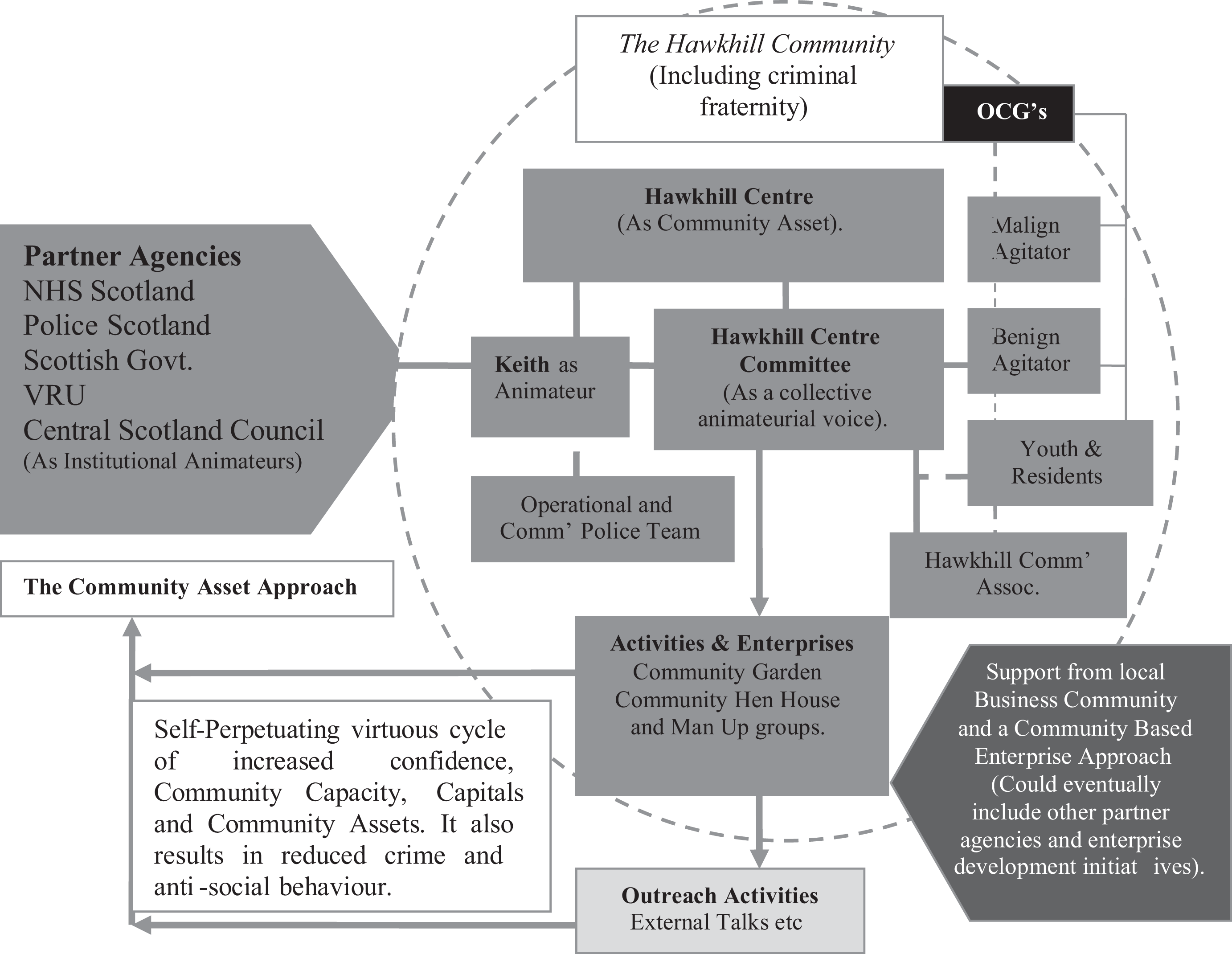
The Hawkhill Model Conceptualised.
The above model is capable of being initiated and implemented in a variety of different settings.
Discussion and conclusion
The above narrative is an example of initiating transformational change through empowering communities (Durie and Wyatt, 2013). It also provides a ‘How to’ script to inspire and enable others to adapt, initiate and implement where applicable. From a theoretical perspective the case illustrates the power of community building (Mattessich and Monsey, 1997; Pinkett, 2000) as well as building community capacity (Hess, 1999). It has explored relationships between assets, contexts, behaviours and outcomes and individual and collective forms of social capital (Bourdieu, 1986: Putnam, 2000). It has reduced crime and antisocial behaviour (Siegel and Alwang, 1999) and made inroads into a former ‘criminal area’ (Morris, 1957). It illustrates a holistic form of proactive policing (Eloff and Ebersohn, 2001) as well as evidencing Pinkett’s (2000) theory of ‘socio-cultural constructionism’ in action. It has engaged a formerly disengaged population (Shaw, 1995). The citizen actors in the case are examples of Mathie and Cunningham’s (2003) active citizens.
The case study has demonstrated that with commitment from all parties, creativity and patience, communities can be empowered to change. The community spirit has been restored and a new thriving community hub has been established. It has its own web page (see https://www.hawkhillcc.org/) which hosts information on the hub’s facilities and a host of activities for adults and young people, a blog and a ‘what’s on’ tab. It also features information on its new Food Larder. This demonstrates the sustainability and continued growth of change in Hawkhill.
The ABA initiative has led to some impressive, tangible and observable outcomes as listed below: there has been a visible increase in community cohesion levels of community tension are lower and less volatile than previously there is evidence of genuine democratic community engagement the confidence of both the community and individuals within it has increased the level of community assets has been built up - the garden and the hens are all testament to this there are increased levels of all types of capital the relationship between police and community has improved there has been a considerable reduction in crime and anti-social behaviour.
The interest this project has attracted here in Scotland and abroad is further testament to the impact it has had on the community of Hawkhill. For example, a number of VIPs visit, including Kenny McCaskill (MSP 6 ), Sheriff David Mackie, a delegation of international visitors (which included the retired chief of the LAPD 7 ), Sir Harry Burns (retired chief medical officer), Keith Brown (MSP), James Horton (Homeboy Industries & ex death row prisoner) and a host of others. These visits added credibility to residents’ efforts, they brought together people from diverse backgrounds and they broadened horizons as to what can be achieved. They also had an impact on the residents’ confidence and feelings of self-worth. The SVRU continues to work directly with the community on a daily basis, dynamically impacting positively on situations and constantly assessing. The visible results are encouraging. In addition, the Hawkhill Success Story has featured as part of the Scottish Community Development Centre report and also in the Carnegie Trust’s Report entitled ‘The Enabling State, Rhetoric to Reality’.
However, it is worth expressing some words of caution: this is not a quick fix; it requires leaders with the vision, willingness and resilience to do things differently. It is the Community who decide if they want to embrace the approach – it cannot be forced or indeed, enforced on them. It is also difficult in that it is not time limited – there is no end point – because it is an ongoing solution which will evolve with community. Every day presents challenges, but by empowering a community to become resilient they should be able to take back responsibility for it. It also requires a change in police and other agencies’ – statutory and voluntary – thinking around what works and what communities value as outcomes. However, the key to success on the evidence of this project is to keep it simple, not to rationalise or professionalise it but if in doubt to ‘Do Something’. Therefore, in conclusion it is not suggested that this ABA is a panacea for the social ills of all communities, but it certainly works in Hawkhill and could thus be implemented and replicated elsewhere.
Footnotes
Declaration of conflicting interests
The author(s) declared no potential conflicts of interest with respect to the research, authorship, and/or publication of this article.
Funding
The author(s) received no financial support for the research, authorship, and/or publication of this article.
