




Abstract
Against a backdrop of austerity, the national ‘Citizens in Policing’ programme aims to engage the wider community and support the police service. Research conducted across a single force area identified the level of motivation and barriers to recruiting those with professional knowledge and skills as police support volunteers. This research study identified that there is a significant appetite to volunteer as a specialist utilising professional knowledge and skills; however, there are barriers to applications to volunteer related to time commitments, lack of professional opportunities available, formal recognition and the volunteering opportunity descriptions.
Introduction
Principally due to austerity, over the last decade, the numbers of both police officers and police staff have continued to decrease, with the year ending 31 March 2018 showing only a slight increase in police staff numbers but the lowest number of police officers since the 1980s (National Statistics, 2018). As a result, the police service has been forced to examine its role and functions to identify the most efficient and cost-effective methods of delivering policing whilst balancing the perceived needs of the community and reducing crime (Fisher and Ritchie, 2015).
Traditionally policing has operated as a ‘customer-focused service’ operating against a backdrop of Charters, Pledges and Neighbourhood Agreements, and so on. This has created a level of expectation and accountability on the police that they will respond equally to every request for service made by the public. Moreover, the remit and approaches of the police have evolved over the years, meaning that when policing fails to meet expectations, confidence in the professionalism of the service can be damaged (Wooden and Rogers, 2014). This is contrary to the intention of policing when attempting to promote community engagement to relieve some of the increased demands created by reduced staff numbers whilst also meeting the requirements of expected professional behaviour (College of Policing, 2014).
The national ‘Citizens in Policing’ (CiP) agenda is seeking to assist in the process of community engagement and participation by recognising the value of the 500,000 people who volunteer in various capacities within the police service (College of Policing, 2017). Wolf (2013) notes that an embedded and robust police volunteer programme could indicate positive community engagement and in turn increased public confidence in policing. Volunteering is a way for individuals to participate in civic life, foster community well-being, support democracy and alleviate social problems (Bloom and Kilgore, 2003; Clary and Snyder, 1999) whilst developing their own social capital (College of Policing, 2017). Kilmartin (1996) summarised how there are a large number of people in the community with specialist knowledge and skills willing to volunteer to support the police.
Definition of the term volunteering
Although the definition of volunteering is widely debated (Haski-Leventhal et al ., 2018), for the purpose of this research, the UK government’s broad definition of an individual donating their time and effort without payment for the benefit of others (NCVO, 2018) was used.
A number of varied voluntary roles are available within the police service. These roles include special constables (SC), who when on duty have the warranted powers of a regular police officer and police support volunteers (PSVs), who freely donate their time to support police officers and staff by performing roles which will free up officers and staff time. There are 8000 PSVs across England and Wales (Callender et al., 2018b), who conduct activities such as completing administrative duties, supporting criminal investigations, monitoring CCTV or engaging with local communities, with other opportunities identified to match specific skills with voluntary roles available (Citizens in Policing, 2019).
This research focused on the role of PSVs, as SCs have defined duty requirements and therefore the individual’s ability to utilise their professional skills within these roles are immediately limited. Whereas, PSVs can volunteer to use their professional skills in specific areas in support of the police service.
The research focused purely on the motivations of potential applicants and barriers to their recruitment as professional volunteers. It did not explore the socio-demographics of volunteering as a means of deepened community engagement; although this is a worthy field in its own right. With continuing debate over the definition of a professional (Scanlon, 2011), for the purposes of the research, the semantics of a ‘professional’ is not explored, instead the researchers adopted a broad definition of a professional as someone who has undergone specific training, be it educational or vocational, to fulfil his or her role.
Review of the literature
Research into volunteers within policing is limited (Callender et al., 2018b; Millie, 2016); although there is some research into the voluntary role of SCs and their motivations to volunteer (Pepper, 2014), there is relatively little on the role of PSVs. This has become of increasing interest to academics post the introduction of the CiP agenda (Bullock, 2015).
One of the concepts of the government’s ‘Big Society’ involved the theme of ‘social action’, which revolved around encouraging and enabling people to play an active part in society (The Conservative Party, 2010). This ‘Big Society’ approach was evolved at the time when austerity measures were beginning to impact on policing and police numbers (Millie, 2013) and the agenda was debated by some as a means of plugging the gap left by the revenue deficit. The subsequent Conservative Manifesto referred to a new workplace entitlement to volunteering leave, allowing people working for large companies or in the public sector to take up to three additional days a year paid leave to volunteer and give back to society, named employer-supported volunteering (ESV; The Conservative Party Manifesto, 2015). The notion of ESV was also evolved to allow the much-needed professional skills of employees to be utilised within the voluntary sector; this volunteering could even possibly be remotely by professionals using technology to support voluntary organisations during their daily commute (Davis-Smith, 2016a).
To date, ESV has not been legislated for and is exercised at employers’ discretion. Regardless of whether mechanisms have been put in place to support volunteering, it is still the case that people will need to be willing to volunteer. Statistics suggest an ongoing reduction in hours volunteered over the 10 years from 2005 to 2015 (Office for National Statistics, 2017) and a reduction in numbers volunteering as SC’s (National Statistics, 2018). This ongoing reduction suggests that potentially the appetite or time available for volunteering is reducing, as such it may be that there needs to be some value associated with volunteering for available opportunities.
However, the concept of volunteering as a means for community engagement and engendering social capital is not a new one, for example, Bourdieu (1986) described the value of social capital as being the sum of resources available to an individual through their sustainable network or collectively through their membership of groups. Stevens (2013) emphasised the importance of public engagement and participation in the police service moving forward, perhaps this could be through volunteering.
In some ways, the concept of gaining additional value from volunteering has been explored by the College of Policing (2018) with their secondment programme. This allows police officers to volunteer to complete secondments in private industry, the notion being that the accepting organisation get the experience and skills of the police officer and the police officers themselves gain knowledge, skills and experience from private industry to bring back into policing, whilst facilitating Continuous Professional Development (CPD) by providing fresh insights and fostering ongoing relationships. Such volunteering could provide the sharing and development of a whole array of transferrable knowledge and skills between the stakeholders involved, such as leading, managing and making decisions within large multifaceted private businesses. However, such opportunities also require the voluntary positions to be available, the acceptance of a range of risks by the partners involved, the release of staff and the associated costs.
Motivations for volunteering
There are a number of reasons why volunteers donate their time and energies. Bussell and Forbes (2002) suggested that as well as altruistic reasons, many people volunteer to increase their human capital or learn new skills for their future careers. Van Steden and Mehlbaum (2018) support this concept as they found that Dutch PSVs donate their time to assist others, support local communities, do something worthwhile and for their own personal development. Whilst Pepper (2014) suggested that a significant number of volunteer SCs are motivated to join the police service hoping for a career with the regular police and to see what policing is really like, although it must be acknowledged that PSVs are not necessarily seeking to do the same.
The concept of small ‘stipends’ or ‘bounties’ for volunteers within policing are sometimes raised as an option; however, research by Carpenter and Myers (2010) suggested that although monetary rewards are of value to the volunteers, for many the altruistic image of a volunteer can be negatively affected by such monetary incentives. Millie (2016) identified that current volunteers bring a range of knowledge and skills into policing that are not always explored or exploited; however, sometimes people are willing to utilise these within their volunteering. Whereas, for others, their motivations for volunteering are to do something different from their norm, perhaps to challenge themselves, support the community (Millie, 2016) or act on their underlying values (Bussell and Forbes, 2002). Carpenter and Myers (2010) suggested that external image and recognition as a volunteer is of value to the individuals who donate their time. Connors (2011) identified that individuals volunteer for many reasons including both personal and career development. What must be acknowledged is that the reasons for volunteering are many, varied and complex, where some volunteers may not want to utilise their professional knowledge and skills, preferring to do something completely different with their ‘free’ time.
The need for professional skills
In a national survey, Callender et al. (2018b) identified that just over half of all PSV respondents felt that their existing skills were both recognised and utilised by their police force; however, this leaves a significantly large number whose skills were not recognised or utilised. Kilmartin (1996) argued over 20 years ago that volunteers with specific specialist skills could be recruited to perform tasks to benefit the service.
In the contemporary world, cybercrime causes significant harm to individuals, businesses and organisations but requires very specific professional knowledge and skills to help deal with such crime. As an example, in Estonia, volunteers with professional IT skills have been recruited by the police to respond to identified cyberattacks by using their specialist IT skills (Hitchcock et al ., 2017). The UK military identified the requirement and established a joint cyber reserves unit in 2013, noting that they needed to be flexible in their recruitment and subsequent availability of the reservists (Brazier, 2014).
The National Crime Agency (NCA) has also acknowledged a similar need to recruit volunteers with such specialist skills in the fight against cybercrime. Since 2015, they have recruited a number of Cyber Crime Special Constables (Hitchcock et al ., 2017) and in 2016, two other police forces pioneered a programme through which cyber experts have been employed as SC and Cyber Volunteers (Dutysheet, 2017). These individuals, whether SC or professional volunteers, assist with the digital investigations unit, offering their expertise to both assist and direct investigations. It is proposed that during 2018, the pool of cyber SC will increase to 235 being in place across police forces (Dutysheet, 2017). It is, however, important that these new voluntary roles are for additional support and not replacing the requirement to employ additional staff. It is worthy to note that volunteers complete tasks of their own free will in their available time, with little or no obligation to donate time, they do not have contracts of employment or receive payment for the work they complete, yet in some cases can be exposed to the same challenges and stresses experienced by an employee. There are ongoing negotiations between the trade unions and employers to ensure that utilising PSVs as resources does not remove the need to directly employ individuals (Unison, 2014).
In addition to the cyber specialist volunteer roles, the NCA has recently advertised for additional specialised voluntary roles with their current breadth of volunteers including those from the cybersecurity industry, financial markets, forensic accountancy, academia and those with language skills (National Crime Agency, 2018). Unfortunately, to date no qualitative evaluation of these professional volunteers focusing on cybercrime has been published assessing their effectiveness and impact in the workplace.
Nationally, there is also a movement towards micro-volunteering. This concept was borne out of the notion that people do not necessarily want to commit to long-term volunteering projects, but instead larger projects are divided into clearly defined and easily manageable task to be completed. The scope of these tasks is only supposed to be a short-time commitment, for example, they can be completed on the commute to work or during an evening and can be completed on a mobile device. Online volunteering was first popularised in the nineties and was aimed at engaging home-based communities, who for a variety of reasons, may struggle to leave their homes. There are lots of pros and cons for the concept of micro-volunteering (Bernstein et al ., 2013): such micro-volunteering allows the individual to be flexible with the time they donate, and it enables them to focus their limited time on the projects they are interested in using the means to volunteer they are comfortable with, whilst working from where they are comfortable. Cravens (2006) highlighted how such an approach potentially allows organisations to reach a much wider cross section of society and their skills as opposed to the traditional approach to volunteering. However, it must be acknowledged that micro-volunteering does have downsides: only small pieces of work can be completed, as a result not enabling the volunteer to see the whole they are supporting, there is not necessarily the interaction with other volunteers causing isolation and its adoption may well reduce the numbers of mainstream traditional volunteers.
Research methodology
The research focused on a police force area where over 3300 police officers, community support officers and staff are employed, providing a policing service across an area of over 1300 square miles of urban, coastal and rural environments along with a diverse population of almost 900,000 (NPCC, 2018).
The research utilised a range of methods aiming to establish the motivation of professionals to apply to be volunteers and identify the barriers which exist to recruiting professionals with specific skills as volunteers. In times of austerity, the use of volunteers is widely encouraged and the engagement of greater numbers of volunteers with professional knowledge and skills could be of huge benefit to the service. To achieve an increase in recruitment, the willingness of this community of professional practice to volunteer was explored, seeking to address the question as to whether professionals were willing to volunteer within policing to utilise their specific skills and would this, in turn, make them feel more engaged with policing and their community. Current serving police volunteers were not surveyed due to the research focusing on professional PSVs, an approach that does not currently exist within the force.
The coordinator of the force’s volunteers programme, an employee, was initially contacted by the researchers to provide a rationale for the research and assist in establishing the trust of the participant. Trust of participants is an important element in any criminal justice research (Jensen and Laurie, 2016; Westmarland, 2011). The coordinator was then sent a self-administered questionnaire for completion and return through the police forces internal mail. This was to recover both quantitative and free-response qualitative information in relation to, for example, the volunteer recruitment process, the profile of serving volunteers and the future targets, how skills are matched to voluntary roles, perceived barriers to recruitment and engagement with the broader CiP strategy.
As participants with professional skills were difficult to reach, the researchers decided to use snowball sampling, a relatively cost- and time-effective approach to collecting primary data from difficult to identify groups. The researchers distributed self-administered questionnaires to known professional associates across the wider region, who were then requested to further distribute the questionnaire to other professionals they know, with the only criteria being that they could not have the same professional skills as the person distributing it. As a result, self-administered questionnaires were completed by 100 non-police professional participants who were selected using the snowball sampling approach, with the added advantage that the majority of the sample group was not known to the researchers. All of the respondents were employed in professional occupations or had retired from professional occupations but do not currently volunteer with the police service. This questionnaire was then used to establish views on volunteering, possible barriers to volunteering, and if they did decide to volunteer what skills they could bring. Of the 100 questionnaires distributed, 100 people completed and returned the questionnaire, 57 were male and 43 female. This high response rate could indicate an interest by those researched in the topic of volunteering and, as Jensen and Laurie (2016) describe, trust by the participants in the researcher, handling of the data and overall credibility of the research. Alternatively, selection bias could be present within the research due to those selected by peers to complete the questionnaire, acknowledging that those not selected may not represent similar views. The representativeness of snowball sampling to the wider population is questionable and may not be generalisable beyond the region due to local prevailing conditions, although the research outcomes do provide an interesting insight. The university provided approval in respect of the ethics for the research and no incentives were offered to any participants.
The ages of participants ranged from 18 years to 56 years; unfortunately due to the sampling approach, this questionnaire did not capture information from anyone 56 years and above. People within this age group may have time to volunteer and could have amassed a wealth of knowledge and life skills of value to the service, but this was not measured.
Informed consent was obtained and confidentiality assured of all participants (Figure 1).
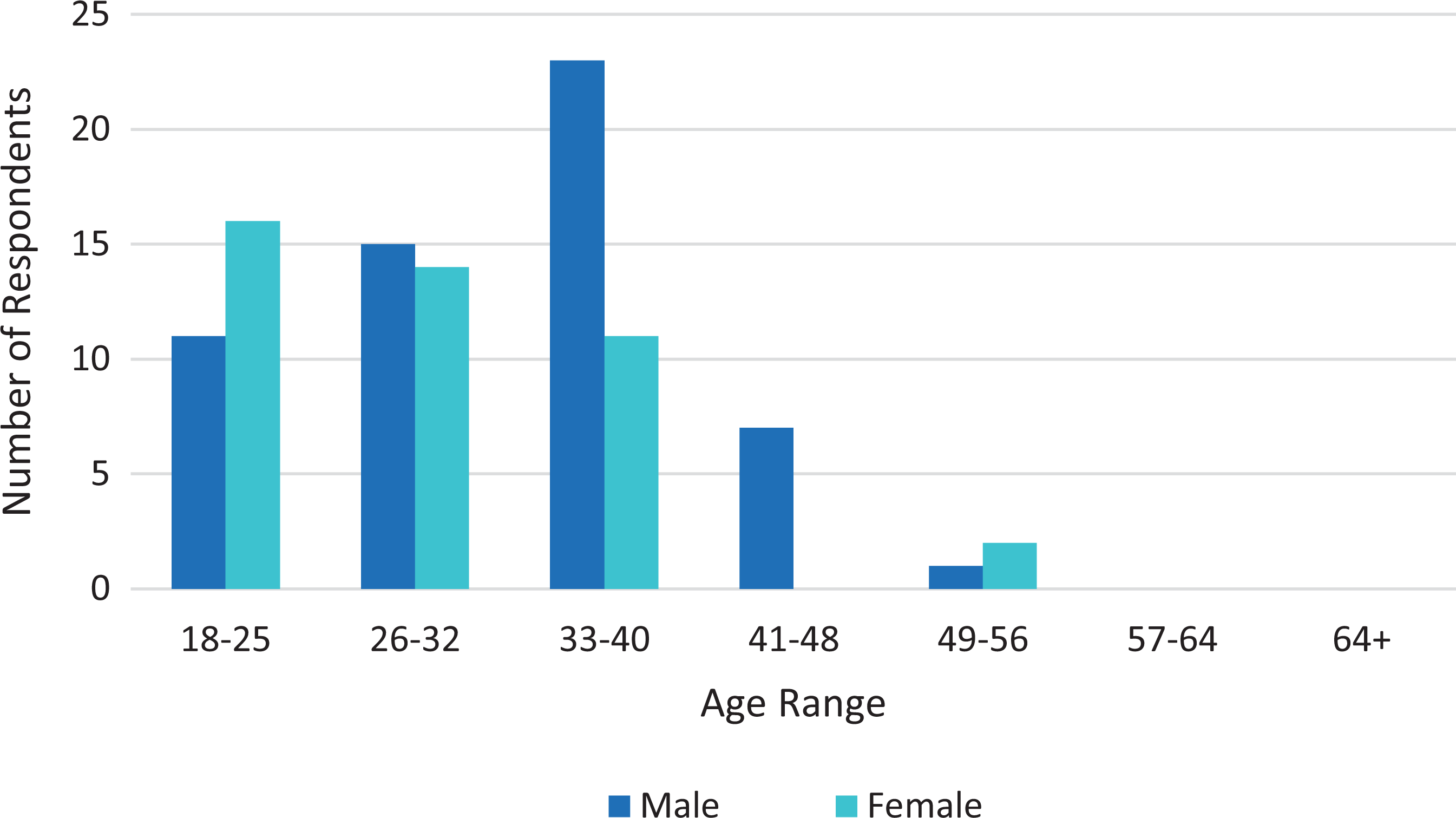
Age and gender of the 100 questionnaire respondents.
Research findings
Results
The research identified that the police force adapted the National Citizens in Policing Strategy and created individual strategies, which are written in conjunction with the Police Crime Commissioner’s Plan.
Currently, the force engages with 80 volunteers (30 of whom volunteer for the force band, 2 are chaplains and a number of police cadet leaders). There is no specific target number of volunteers to be recruited; however, one of the metrics for measuring success is the hours the volunteers complete. Currently, when volunteers are recruited, there is an ad hoc attempt at recording and utilising their existing skills effectively.
Volunteers are recruited in a number of ways: word of mouth, through current staff, job fairs, community events, leaflets, posters, media, radio, papers, website, social media as well as advertising on the police force’s own website. Advertisements do not take place via specific volunteering websites nor are they advertised via professional platforms such as LinkedIn. There is currently no engagement with ESV to encourage employers to release staff for them to support the wider society as well as developing new and existing skills along with the opportunities for ongoing CPD.
Examples of voluntary roles advertised on police force websites are often generic in nature and their role descriptions; these can include roles such as administrative support, community engagement, recruiting assistance and role player. The websites also often acknowledge how an individual’s skills and abilities can be matched to those roles required by the force (Citizens in Policing, 2019). Regularly though, none of the roles advertised require specific skills sets. Once recruited, volunteers are regularly expected to perform administrative duties with the neighbourhood policing team officers. Once the volunteers have completed a specified number of hours within this role, they are then eligible to apply for other volunteering roles within the organisation. When a volunteer has completed a role, there is no specific way of measuring the value to the service or the individual, feedback is often not requested from the department in which they have performed the duty or from the volunteer as to how appropriate the role was and what they got out of it.
Interest and barriers for professionals to volunteer?
The survey aimed to establish if there was an appetite from skilled professionals to volunteer; it revealed that only 2 of 100 respondents stated that they already volunteered, neither of which utilised their professional skills within their voluntary roles. Despite only 2% (2) volunteering, 60% (60) stated that they had previously considered volunteering in some role, suggesting an interest in committing time as a volunteer.
In the 18–25 age group, 66% of respondents (18) said that they had considered volunteering, whereas in the 26–32 age group, this reduced significantly to 33% (10). This would go some way to supporting the ideas of Bussell and Forbes (2002), Pepper (2014) and Van Steden and Mehlbaum (2018), who suggest that volunteers do so for their own personal development. In the 18–25 age group, individuals may be searching and/or starting towards a career and have more time available, whereas in the 26–32 age group, individuals may be more settled in a career and due to other commitments, may have less time available to donate. However, it must be acknowledged that there are other variables, which could influence such findings including exposure to the ethos of volunteering at different points during their lives, differing understandings of what constitutes volunteering and the limitations of the research design.
However, a number of reasons were given as barriers to respondents volunteering (Table 1).
Barriers to volunteering: Respondent’s collated comments from multiple individual responses.
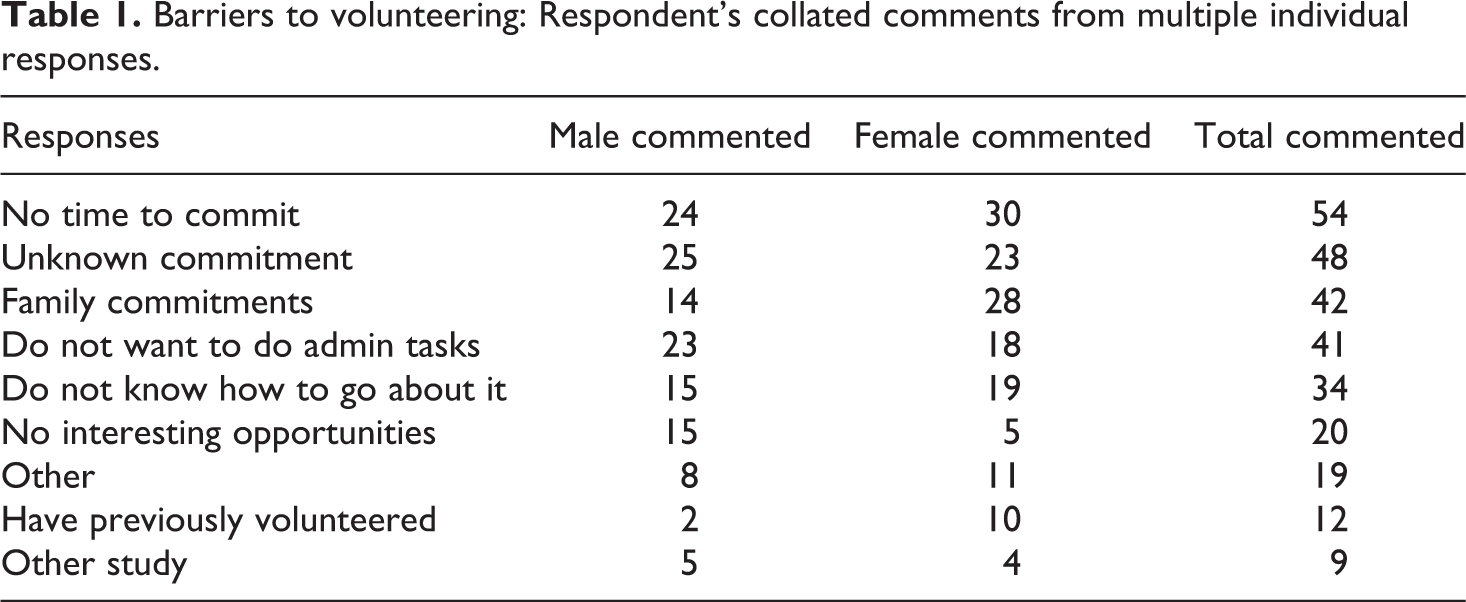
The findings suggest that 54% of respondents do not have the time to commit, with a higher proportion of females 30% (30) as opposed to 24% (24) of males raising that the availability of time is a barrier. This supports the ideas of Davis-Smith (2016b), who suggests that busy lifestyles impact on the willingness of people to volunteer, with possible solutions being the availability of smaller volunteering projects (such as micro-volunteering) or taster sessions enabling people to become engaged in such opportunities. When also linking time available to family commitments, twice as many female respondents 28% (28) as opposed to male respondents 14% (14) stated this was a barrier. This would in part also support the findings of a US survey, where Taniguchi (2006) found that in certain circumstances, there was a lack of balance between the numbers of female volunteers as opposed to male volunteers, continuing to suggest that females spend more time caring for aging family members. The use of micro-volunteering could be particularly attractive to certain groups of volunteers.
Whilst 48% (48) of respondents’ comments also seem to support the idea that a significant number of individuals do not volunteer due to the ambiguity of the term ‘volunteering’, as they are unsure for what they are volunteering. Brundy (1999) also identified the requirement to have specific role descriptions available to target and recruit specific volunteers as this not only provides them with clarity but also allows for effective planning, and evaluation of their effectiveness, this also lends support to Cravens (2006) ideas as a means to engage with the wider society.
Just over 40% of respondents suggested that they did not want to volunteer to complete administrative tasks; this was more evident amongst males 23% (23) as opposed to females 18% (18). Davis-Smith (2016b) suggests that organisations should do more to blend an individual’s passion and interest with the opportunities available to volunteer. It could certainly be that the perception of the volunteering role within policing is different between genders. This would require further research.
An internal barrier to this recruitment process appears to be vetting. As well as establishing their identity, all PSVs are usually required to complete at least Non-Police Personnel Vetting (NPPV) to access police premises, systems and other information. The community engagement officer stated that the current time for vetting applications to be processed is a number of months. However, if there is no requirement for people to come into a police station, there may be the opportunity for a tailored and reduced vetting process. However, vetting processes, such as NPPV, are costly to an organisation, costing in excess of £40 per application (Nottinghamshire Police & Crime Commissioner, 2018; West Mercia Police, 2019), and as such may prohibit short-term or one-off volunteering roles. A full cost-benefit analysis of such an approach should be considered, including opportunities, which may exist for the further sharing of a ‘bank’ of volunteers between forces to mitigate the cost of vetting.
Within the survey of 100 participants, slightly over a third of respondents suggested they would not know how to go about volunteering. This supports the idea that the marketing of voluntary opportunities is working, with almost two-thirds of respondents knowing how to volunteer; however, this also highlights that there is the need for much wider but targeted advertising of opportunities to reach some audiences, as a third of respondents were unaware how to go about volunteering.
Would professionals be willing to utilise their professional skills?
When participants were asked if they had previously considered volunteering, 60% (60) responded that they had, this includes a significant 82% (28) within the age group of 33–40, which could indicate that at this point within their lives, individuals have more time available to volunteer. Such responses demonstrate that there are professionals who consider volunteering but for many reasons do not take up opportunities to volunteer. When asked whether those responding would consider volunteering if they could use their professional skills which they had gained from their careers, overall 66% (66) stated that they would consider volunteering. This is an increase from 60% (60) of respondents who originally stated that they had considered volunteering in the past. Although not a significant difference, this in part supports Millie (2016), suggesting that people would see more value in volunteering if the police service explored and was then able to utilise their professional skills. This proportion of respondents who could potentially be recruited as PSVs also exceeds the findings of Callender et al. (2018b) who suggest that currently just over half of all PSVs questioned felt that their existing skills were both recognised and utilised.
Moreover, when participants were asked if they would be willing to utilise their professional skills to volunteer for one-off tasks as opposed to commit to an unspecified role for an indefinite amount of time, 77% of respondents stated that they would be willing to undertake one-off volunteering tasks. This further supports the ideas of Davis-Smith (2016b) of the approach to engaging with volunteers but also the concept of micro-volunteering, as this would effectively see volunteers completing small tasks that lend themselves to their skills set or potentially, as suggested by Kilmartin (1996), acting in a specialist volunteer consultancy capacity.
This also supports the idea of designing in flexibility to the roles to which the volunteers are recruited that would result in having a number of different tasks available to suit the different interest and skills of the volunteers.
When asked if they would be willing to volunteer online, 59% responded positively, although the survey did not explore the reasons as to why this was a less attractive option, although this does further support the ideas of Davis-Smith (2016a) of individuals using technology to support volunteering. This does, however, indicate that there is a willingness for people to volunteer online, although this is not the choice of all professional volunteers. Such online volunteering as a professional aligns with the ideas of Cravens (2006), enabling individuals who are unable to leave their homes for a variety of reasons, the opportunity to engage with policing who may not otherwise be able to do so. Online volunteering as a professional enables the flexibility to volunteer at a time and location to suit the individual and has the overall additional benefit of deepening community engagement.
Motivation through reward and recognition
In assessing what would motivate people to volunteer, participants were asked if they would be more inclined to volunteer if they could benefit from the experience, such as developing their skills set or receiving a detailed reference from the experience. Results demonstrated that 79% (79) would be more inclined to volunteer if this was the case, 6% (6) stated that they would not be motivated by this and would volunteer regardless, with 13% (13) stating that they still would not volunteer even if there were tangible benefits for themselves, with only 2% (2) not responding. Those in the younger age groups were proportionately more likely to be motivated by reward and recognition, whereas those aged 40 years or over were less likely to be motivated by this, suggesting that those in the younger age group may be utilising the recognition to enhance their professional portfolio.
Within the force area where the research was conducted, there is a ‘recognition and rewards programme’ with certification at ceremonies for those completing 100, 500, 1000 and 1000+ hours in the role as well as for those achieving 5 and 10 years of volunteering. Furthermore, an email is sent every month to the volunteers thanking them for their time. When individuals require a reference or evidence of their volunteering, a letter is produced stating the dates that the person has volunteered between and the number of hours they have committed; however, the nature of the roles undertaken is not articulated, perhaps a missed opportunity to promote the knowledge and skills which can be developed as a volunteer. This supports the findings of Carpenter and Myers (2010), who identify that image and recognition of the volunteer is important and, although not specifically related to PSVs, Callender et al . (2018a) who emphasise the impact of recognition and appreciation on the experience and retention of SC.
Community engagement
When asked whether the participants would feel a sense of pride if they volunteered with the police, the vast majority of respondents (80%) stated that this would be the case. When asked whether they would feel more engaged with the community if they volunteered, the majority (81%) stated that this would be the case and not only would they feel a sense of pride but, as previously identified (Bloom and Kilgore, 2003; Clary and Snyder, 1999), the volunteers would feel connected with their community and have a direct impact upon it. This suggests that utilising professional volunteers could be a way of further deepening community engagement. This would be in addition to the more traditional ways of community engagement through engaging with, for example, those under-represented groups within the community. Whilst further supporting the suggestions of Wolf (2013), that embedding a robust volunteer programme can indicate positive community engagement.
Limitations to the research
Adopting the suggestion of Westmarland (2011), the researchers considered the most appropriate way to conduct the study; however, there are limitations to the approach adopted. The data collected from the force coordinator of the volunteers programme were from a single source who was an employee of the force. A range of options were considered as to the best approach to distributing questionnaires to professionals. Initially, a random survey in the city centre was considered; however, it soon became apparent that there are limited number of professions represented within the city centre concerned. Consideration was also given to conducting a survey in supermarkets; this was discounted for similar reasons. The researchers then considered whether to market the survey via the Police Force’s social media; however, this would only have involved those who have already engaged with policing to some extent. Finally, the researchers decided to distribute questionnaires using snowball sampling to a range of professional associates across the region for them to further distribute questionnaires, with the only criteria being that they could not have the same professional skills as the individual distributing it. The challenge of identifying a suitable sample was overcome by the initial participants nominating others who met the required criteria (Denscombe, 2014).
As detailed in the methodology section, it could be suggested that the 100 surveys distributed, completed and returned were by like-minded people leading to sampling bias. Therefore, the external validity of the research is limited with the findings unlikely to be immediately generalisable beyond the subjects and locality. However, the research provides an insight and themes as to whether professionals are willing to volunteer and the barriers to them doing so, which can be further explored.
Conclusion and recommendations
This research collected quantitative and qualitative data from across a single police force area to assess the level of interest in joining as a volunteer and barriers to recruiting individuals with professional knowledge and skills to act as volunteers. Thus helping to inform the service as to how volunteers with specific expertise can be recruited to work on particular policing roles or tasks. This is of course in addition to the commendable work conducted by those who already volunteer in various capacities across a number of voluntary roles within the police service and supports the long-term commitment to CiP identified within the national strategy (Chief Constables’ Council, 2016).
The research gathered information from the force’s community engagement team and 100 professional members of the wider community. Analysis has identified that there is significant appetite to volunteer as a specialist within policing which will utilise professional knowledge and skills.
The main barriers to volunteering by this group are in relation to potential applicants not feeling as if they can offer an ongoing time commitment due to the lack of time available for them to do so, with varying alternate time commitments present between genders. This is linked to the apparent lack of professional opportunities offered by the force along with the timescales and costs involved for the force to complete the required vetting of applicants. There is also a lack of clarity within the volunteering opportunity descriptions as to how professional PSV’s could utilise their knowledge and skills within particular roles.
One way forward may be to offer short-term volunteering opportunities to these professionals as PSVs to complete specific tasks whether in person at a police station or using technology operated online.
The research identified that the potential volunteers would value being formally recognised for what they do. It seems clear that the opportunity to be involved in policing as a volunteer, in whatever capacity, has a positive impact on police–community engagement and community participation.
Recommendations
Research should be conducted into the level of interest of micro-volunteering and the associated motivations for volunteering online with the police service. Research should explore barriers to professionals volunteering, considering the impact of age, gender and the application/vetting process. The service should consider how to best manage and record volunteering activities, which could result in the provision of appropriate recognition for volunteering (such as detailed references) and could be used to establish reward and recognition mechanisms to attract professional volunteers. Voluntary roles should be advertised in specific terms outlining the expectations, the knowledge and skills that are required to fulfil the role along with the likely time commitment and over what duration.
Footnotes
Declaration of conflicting interests
The author(s) declared no potential conflicts of interest with respect to the research, authorship, and/or publication of this article.
Funding
The author(s) received no financial support for the research, authorship, and/or publication of this article.
