




Abstract
Learning is iterative. It takes time and effort. Real progress in any subject requires we engage, motivate, and support learners as they take next steps to improve their work. Brent Duckor and Carrie Holmberg show how teachers can use progress guides as a formative feedback tool to re-engage and support students where they are, while keeping the focus on concrete steps they can take to move forward in the learning cycle. Drawing from research and case study evidence, they highlight how students and teachers can move conversations forward in safe and respectful ways. Without relying on graded judgments, the progress guide approach preserves the goals of continuous improvement and recenters learning for all students.
Progress guides encourage students to persist in learning by connecting where they are now with what’s next.
The way we assess learning likely contributes to this disengagement. The plethora of tests, quizzes, and homework that dominates education can feel separate and disconnected from actual learning. Too often, these assessment tools and procedures are not accompanied by any positive, useful, just-in-time feedback that allows the learner to improve before it’s too late. Why would anyone try revising a response when the grade is in the grade book and everyone else is moving on?
Feedback reminds everyone there is time to make a change. Far from being merely a letter grade, numeric point, or symbol intended to express an outcome, feedback represents the “not yet” of assessment for learning (Stiggins, 2002). Effective feedback is less about praise or criticism and more about focused support. Ideally, feedback links the “not yet” with the “here’s how.” Those committed to authentic assessment and performance-based assessment have known for decades that feedback is a key ingredient in the recipe for better student outcomes (Darling-Hammond & Adamson, 2014; Darling-Hammond, Ancess & Falk, 1995; Palladino & Shepard, 2023).
Between a rubric and a hard spot
For years, educators have relied on rubrics to guide students, in part, by making learning goals explicit and offering shared standards for judgment. Rubrics — when coupled with criteria for grades — seem to offer more objective, fair, and reliable ways to assess student work. But do rubrics and more objective grading schemes actually meet students where they are? Even if rubrics are a necessary part of how to assess more fairly and equitably, are they sufficient for students who need support to get going and keep making progress day by day?
Through experience and research, we’ve found that some well-intentioned formative assessment tools — including many rubrics — produce anxiety and confusion among students about “what’s next.” James Popham (1997) notes that rubrics sometimes include a dysfunctional degree of detail. In many cases, self-assessment and peer assessment with rubrics can feel like an elaborate, even futile exercise that, frankly, can demotivate our most vulnerable students. For those of us working closely with language learners and students with special learning needs, not to mention most beginners in the field of mathematics, science, and the language arts, the issue of dysfunctional detail is real. Despite the good intentions of educators, rubrics and similar tools often fail to encourage learners to engage in continuous improvement.
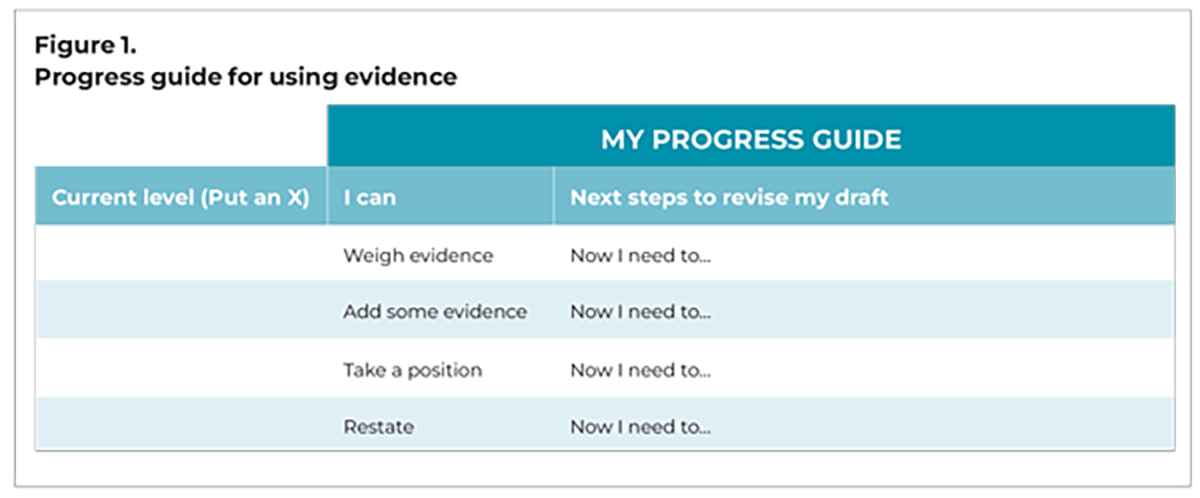
Progress guide for using evidence
Assessment tools and procedures need to support and engage learners — not cause them to shut down and turn away. The rubric too often gets in the way of what matters most: student and teacher dialogue about what’s next.
Putting differentiated feedback to work with progress guides
Across several contexts and case studies, we found that feedback procedures and protocols linked to progress guides helped motivate dialogue between students and their teachers, while leading students to authentic engagement in next steps. Progress guides, unlike more traditional rubrics, more organically support the use of concrete, specific, and timely feedback. So what is a progress guide? Figure 1 presents an example of a progress guide for student self-assessment focused on using evidence.
The purpose of these guides is to support teachers and students to take a deep dive into the formative aspects of feedback before the final project or task is due. By de-emphasizing grades, these guides send the clear signal that everyone is working to figure out next steps in the cycle of learning in which students try, get feedback, and try again. Progress guides serve as checkpoints and offer pit stops along the way to ensure everyone has the resources they need to get to the final destination.
Progress guides can be seen as just-in-time interventions that change the course of the learner’s trajectory of understanding, in part, by attending to the zone of proximal development (Vygotsky, 1978) where the learning students are close to mastering resides. As a shared tool with a common language for teachers, learners, and peers, the progress guide offers clear outcomes at each level and space for determining next steps.
To ensure engagement, progress guides are streamlined and use student-focused, user-friendly academic language. Rather than focusing on graded levels or the accumulation of points, these progress guides place attention on next drafts leading up to the culminating performance. In short, they emphasize the formative aspects of drafting, revising, rethinking, and redoing before the summative assessment phase when one gets a final grade.
A student might use the progress guide in Figure 1 as part of a unit on the Dust Bowl. With their teacher or a peer, they would look at their current “first draft” of a paper on the causes of the Dust Bowl and figure out together which next steps are possible on this assignment. If the student’s work shows they feel comfortable taking a position on the topic, their next steps would be to add some evidence by, for example, “reviewing the primary sources including our video worksheet” to improve their written draft.
In a case study conducted during the pandemic, we piloted the concept and use of progress guides with a group of math and science middle school teachers in Northern California (Duckor et al., 2021). Four of five students in the district come from families that are considered low income, and most speak languages other than English at home — nearly half are designated English learners. Given concerns about equity gaps that had been exacerbated by moves to online instruction, the participating teachers were especially motivated to make a difference in these students’ experience of schooling. Our work — masks and all — began in fall 2021 when everyone came back to the school site for instruction. Our goal was to address the essential question: How can we truly differentiate feedback so everyone finds a next step to improve their work on a task, today?
The purpose of progress guides
Before creating progress guides, the teachers first needed to decide where, when, and how to embed them into their curriculum. This meant reaching clarity about the primary purposes of these evaluative tools. To tap into the full potential of progress guides, teachers should consider: What is the skill the progress guide will target? Is this skill new to students? To what longer-term goal/skills will the progress guide connect? What related concepts will students need in order to engage fully with the progress guide? Assessment tools and procedures need to support and engage learners — not cause them to shut down and turn away.
To guide the teachers’ decision making, we offered a graphic organizer that asked them to identify and share how what they were planning related to, for example, key standards and curriculum topics. We also provided examples of progress guides designed for teacher use and for student self-assessment across various subject areas and unit topics.
Progress guides can serve two main purposes: to help teachers see patterns to better differentiate support and to show students how they can move forward by adding a next step to their learning process. The elements included on the progress guide will vary, depending on the purpose of the guide (see Figure 2).
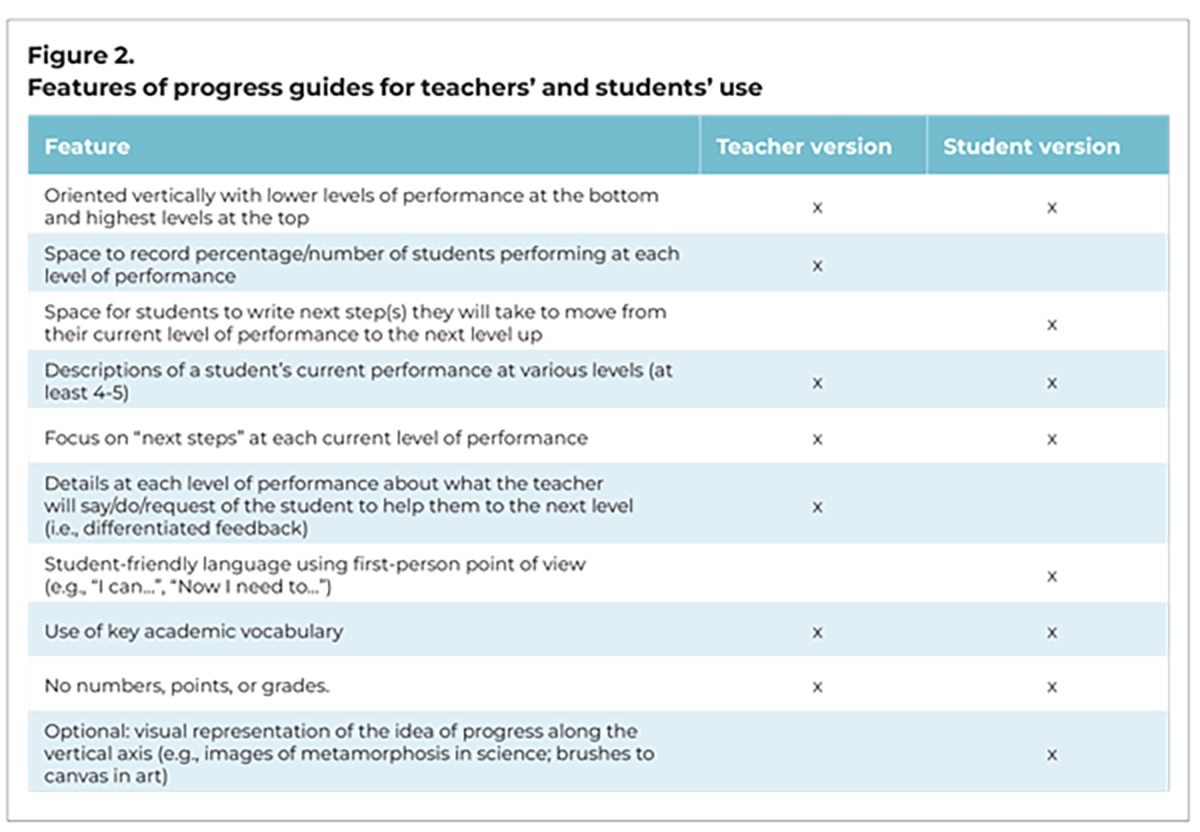
Features of progress guides for teachers’ and students’ use
Progress guides in practice
Teachers typically deploy progress guides at different points in the life of a task or assignment. When provided in conjunction with a rubric, the progress guide breaks out a specific strand of performance, such as “using evidence and documenting sources.” Students are asked to self-assess within a few days of the start of a unit assignment. Peer assessment with these guides can also serve to clarify where a student is stuck or needs help with next steps as each draft of the assignment progresses.
The focus on next steps — rather than on the number of points or a grade — requires students and teachers to have conversations on what it takes to move into the next level. Teachers used the progress guides to encourage safe, ongoing dialogue between individual students, peers, and teachers. One teacher explained that the progress guide “helped me rediscover quickly where [students] were and to engage them on where to go next.”
When creating progress guides, teachers had to be able to categorize student work and come up with possible next steps, requests, probes, and questions for students at each of the proposed levels on their progress guide. But as teachers moved from creating their guides to using and reflecting on them, some quickly discovered they needed additional levels to accommodate all the students’ work. Other teachers found some of their levels could be collapsed or modified slightly (Duckor & Holmberg, 2017). Still others decided students could, with guidance, come up with their own next steps. Over time, teachers revised the probes and cues as they used them with students.
Figure 3 is an example of a science teacher’s progress guide for a unit on genetic traits. Using this guide, the teacher could quickly see where students were in the learning process and find ideas for helping them get to the next level. A student’s version of the progress guide would include the same levels, but it would be written in student-friendly language (e.g., “I can,” “Now I need to”) and not include the column showing the number of student responses. Instead of the prompts in the Next Steps column, there would be space for the student to write what they would do next.
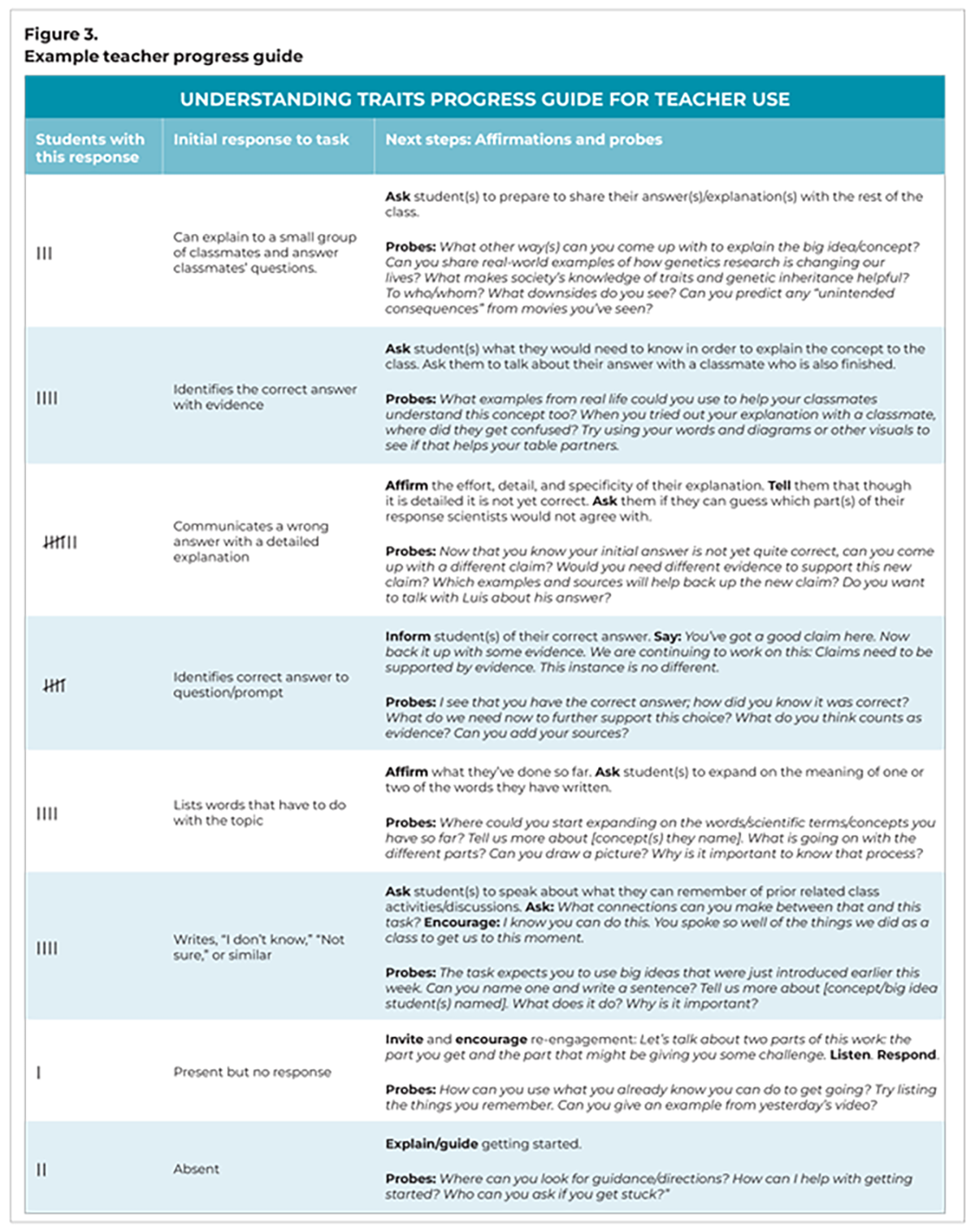
Example teacher progress guide
Helping students persist and self-assess
Many teachers in our study felt that half the struggle with getting everyone on task is learning how to meet students where they are. The progress guides serve as embedded assessment tools (Shavelson et al., 2008; Wang et al., 2021; Wilson & Sloane, 2000) that do not look or feel judgmental. When assessments are centered on grades or points, students often think, “I’ll just turn it [the first draft] in for a grade” or “I don’t know this. Who cares if I don’t get any points?” While observing the progress guides in use, we saw immediately how they helped get students re-engaged in their work. Having the progress guide helped students see how their work fit in their learning path. A math teacher told us: When I saw students really helping each other, I was surprised at how many of the students were doing that. With the progress guides, their stamina in terms of doing a problem was greater. Normally, if they encounter a challenging problem, they will move on. But they didn’t. I think having the progress guide right in front of them really helped. And they had me coming around systematically. They knew I was going to talk with them. The fact they were using progress guides had a lot to do with that.
Being able to describe and explain scientific concepts and mathematical procedures requires that all students use language and tools as scaffolds for learning (Shepard, 2005). Language learners in particular benefit from explicit supports (Walqui & Heritage, 2018) when engaging in performance tasks. Tools such as progress guides for self-assessment and peer assessment serve as entry points into dialogue between teachers and students with diverse learning needs. Participating teachers reported their students stayed with tasks longer, worked with one another more frequently, and spoke with their teachers about content longer and more deeply than they had before.
Sometimes the entry points work straightforwardly, such as when a 7th-grade math teacher asks a student, “OK, let’s check. What do you think your level should be? Let’s start from the guide. Can you identify the variable?” Notice how this use of “identify the variable” supports students in the process of integrating specific vocabulary through meaningful use of academic language during exchanges between a teacher and a student (Duckor & Holmberg, 2019/2020).
Such approaches seemed to work well for students who weren’t having significant trouble with the work, knew their own level on the progress guide accurately, and could respond unhesitatingly to every question their teacher asked. For many students, this isn’t the case. After all, students are learning.
When first interacting with students who seemed disengaged, confused, or stuck, teachers we worked with in this study took indirect approaches, using entry points to dialogue that were “adjacent” to the progress guide. Sometimes this requires teachers to temporarily put aside the expectation that all students had to use their progress guides “correctly.” We see this indirect approach in the following example.
I don’t know what [level on the progress guide] to choose.
You don’t know which one [level on the progress guide] to choose?
(Nods her head)
That’s OK. So how about we don’t even look at this for right now?…What I want you to do is focus on the lesson that we’re doing. How are you feeling about it?
Notice that Ms. Vin immediately reassures Elena it’s OK to be exactly where she is, that is, not sure about the task. Setting the progress guide aside, Ms. Vin asks how Elena is feeling about the lesson. After only a few more exchanges, Ms. Vin was engaging Elena in academic content on the progress guide, and they returned to generating next steps. Multiple teachers in our study found making these kinds of indirect moves were effective at engaging students.
Feedback for engagement
Feedback-for-learning tools like progress guides honor the learning process and foreground the need for dialogue, ownership, and engagement with all parties. Teachers using progress guides for the first time found themselves thinking about the variety of student performances in new ways. One 6th-grade teacher told us: What I really appreciated about creating and using a progress guide is, right off the bat, it put the student performances in categories that allowed me to think about it differently. A lot of the times when we’re talking about student work we’re thinking, “Did they get it right?” or “Did they get it wrong?” But [the progress guide] introduced a whole lot more nuance into the way I’m able to assess student work.
This additional nuance enables teachers to come up with more creative and helpful ways to nudge students’ learning along multiple trajectories.
We can’t say unequivocally that teachers’ use of progress guides increased student motivation, or even that students were undeniably more engaged because of this new feedback tool because our project wasn’t set up to prove that. However, participating teachers reported their students stayed with tasks longer, worked with one another more frequently, and spoke with their teachers about content longer and more deeply than they had before.
In this project in a high-needs school district, with in-service teachers committed to feedback for all, progress guides brought teachers and students closer to a shared vision of continuous improvement, one task, one step at a time. We saw that when teachers bring their creativity, collaboration, critical thinking, and communication skills to the table of assessment reform, their laser focus on visible feedback practices, protocols, and flexible systems ensures the most vulnerable students don’t get left behind.
We wrote Feedback for Continuous Improvement in the Classroom (2023) to invite policy makers, educational leaders, and teachers alike to consider how feedback-rich approaches have the power to surface student thinking, no matter where they are in their current cycle of learning. Formative feedback that keeps students engaged in learning has the power to change learning trajectories. In science labs, art studios, athletic fields, music rooms, and learning spaces across our school communities, we now have the tools to make visible and meaningful progress together.