




Abstract
As part of the agroecological movement, increasing attention is given to ecosystem services within farming systems. Researchers coined the terms ‘service crops’ or ‘service plants’ to describe the strategic introduction of plant species that provide these services. Despite the potential relevance of service crops and plants, inconsistencies in their theoretical definitions pose challenges for practical efforts to promote their use. Therefore, this study aims to refine the theoretical definitions of ‘service crop’ and ‘service plant’ using insights from taxonomy, ethnobotany and categorization literature and highlight the practical challenges of applying these concepts in agroecology through a case study in Mali. In Mali, efforts to encourage farmers to use service crops and plants focused on their economic value – an approach that conflicts with most theoretical definitions. Ignoring the economic value of service crops may reduce their appeal to farmers, suggesting that definitions need flexibility. On the other hand, emphasizing economic value in the promotion of service crops and plants might stretch the concepts to a point where they become meaningless. This reveals the complexity between theoretical definitions and practical implementation.
Introduction
Driven by concerns over population growth and famine, agricultural production has significantly increased over recent decades. This is mainly due to the intensified use of external chemical inputs, such as fertilizers and pesticides, along with the adoption of improved and hybrid crop varieties, mechanization, farm expansion, monocultures and enhanced irrigation systems (Hartmann et al., 2015; Stone, 2022; Tilman et al., 2002). This shift towards what is commonly known as conventional, industrial, intensified or modern agriculture, has enabled short-term gains in productivity. Nevertheless, it simultaneously led to widespread environmental degradation, which could result in a loss of productivity in the long term (Hartmann et al., 2015). Negative environmental and health implications include soil degradation, increased greenhouse gas emissions, accumulation of pesticides and diminished availability and quality of water (Hartmann et al., 2015; Reddy, 2010; Tilman et al., 2002). Ultimately, the hidden costs of intensified agricultural models are often externalized to the environment and human health and well-being (Stone, 2022).
In response to the challenges posed by agricultural intensification, alternative approaches such as agroecology, ecological intensification and organic farming have emerged (Altieri, 1989; Lampkin et al., 2000; Tittonell, 2014). While these challenges are most strongly associated with 'conventional’ agriculture, which predominates in industrialized countries, the promotion of agroecology has largely targeted smallholder farmers in less-developed regions, where conventional systems are less widespread (Lenné, 2023). The role of agroecology in smallholder contexts, however, remains highly contested (Falconnier et al., 2023; Muhumuza, 2023). Critics argue that it often overlooks farmers’ initial farming conditions and risks reinforcing a status quo that traps them in the poverty of their current unproductive farming practices (Mugwanya, 2019; Muhumuza, 2023). In contrast, advocates emphasize its potential benefits. Evidence from African countries, for instance, shows that agroecology can contribute to multiple sustainable development goals and enhance agricultural productivity (Madsen et al., 2025; Romero Antonio et al., 2025).
A central feature of most system-based alternatives to conventional agriculture is the restoration of farming systems through the (re)integration of biodiversity, and the ecosystem services it provides within agroecosystems (Duru et al., 2015; Farina et al., 2018; Najm et al., 2024). With growing attention on the strategic introduction of plant species that provide such valuable ecosystem services, researchers have recently coined the term ‘service crops’ or ‘service plants’. A growing body of evidence indicates that enhancing energy and resource capture within ecosystems through service crops and plants not only increases yields of cash crops but also mitigates the negative environmental impacts of agricultural production (Bommarco et al., 2013; Doré et al., 2011; Schipanski et al., 2014; Tittonell, 2014). Recognizing the significant potential benefits of service crops and plants, and the win–win scenarios they can create, their use was promoted in the FAIR Sahel and SUSTAIN Sahel projects as a way to create conducive conditions for agroecological intensification (AEI; Fair Sahel, 2025; Sustainsahel, 2025).
As part of this initiative, the authors conducted a literature review on service plants, which prompted the writing of this article. This review revealed inconsistencies in the theoretical definitions of service crops and plants. The definitions typically combine several criteria: the measurable traits of plant species (attributes), the ecosystem functions those traits can provide (functional consequences), the ecosystem services resulting from these functions (derived value), and the specific intentions for cultivating them (societal objectives). Inconsistencies among definitions relate to three issues. Firstly, not all definitions encompass all these criteria. Secondly, even when similar criteria are included, they sometimes contradict one another. Thirdly, the criteria used are based on different taxonomic frameworks.
The multiple criteria involved in the theoretical definition of service crops and plants have important implications for their practical use and promotion. For instance, a plant species like soybean may meet the ‘attribute criteria’ for being a service crop due to its ability to form a symbiotic relationship with rhizobia, which supports the ecosystem function of nitrogen fixation. However, when soybean is grown in monocultures with high external inputs for market purposes, it no longer aligns with the ‘objective criteria’ of a service crop, as its role within these systems is primarily economic rather than ecological. There are also examples that illustrate the contrary. Bananas in Uganda are often grown with the primary objective to provide cash and food, which would exclude them as service crops according to the objective criteria. Yet, bananas are often intercropped and provide a range of ecosystem services such as mulch and shade (Kilwinger et al., 2019).
In addition, trade-offs and potential ‘disservices’ – such as competition with cash crops – are not always accounted for (Garcia et al., 2018), which can result in overstated claims about the ecosystem services provided. The broadening of concepts can further contribute to such overestimations. For instance, while cover crops were historically promoted for specific objectives such as soil conservation and pest management, their role has since been broadened to include a wide range of ecological services, even though the scientific evidence supporting some of these claims remains limited (Blanco-Canqui et al., 2015). Together, these examples highlight the complexity of applying theoretical concepts to real-world agricultural practices.
In light of this complexity, the objective of this study is to: a) explore and refine the theoretical definitions of ‘service crop’ and ‘service plant’ using insights from taxonomy, ethnobotany and categorization literature, b) demonstrate, through a case study, the practical difficulties of applying these theoretical concepts when promoting the use of service plants in agroecology projects and c) provide recommendations for future agroecology projects that aim to incorporate service crops or plants based on our findings. We begin by outlining the conceptual framework employed to examine these definitions in the literature, followed by a description of our methods. Our results are then presented, combining insights from the literature review with practical experiences from Mali. In the discussion, we integrate the theoretical findings with the real-world challenges of implementation.
Conceptual framework
Different categorization frameworks
Naming and categorizing reflect a fundamental human need to organize the world into recognizable entities (Dougherty, 1979; Lopez et al., 1997; Ross, 2014). The meaning of an entity is derived from its relationship to other members of a category in which it is grouped (Yanow, 2003). An entity fits within a category when it shares similarities with other members, while at the same time differing from those outside the category. These perceived similarities and differences are often context-dependent (Tversky, 1977).
In addition to categorization, humans also differentiate among entities through hierarchical systems (Berlin, 1973; Fransella et al., 2004). For example, ‘plants’ form a broad category of living organisms characterized by features such as membrane-bound nuclei, multicellularity, cell walls and the ability to photosynthesize. Within this category, plants are further categorized and classified based on various traits, such as their beauty, smell, taste, shape, size, phenotype, genotype or reproductive mechanisms. For instance, apple trees and fig trees are distinct because they produce different fruits, yet both can be grouped together as fruit trees, which in turn distinguish them from nut trees. Because people categorize plants in different ways depending on context, we distinguish between taxonomic classification and goal-derived categorization to explore and refine the concept of service crops and plants.
Taxonomic classification of plants
The scientific taxonomy of plant species is primarily based on phenotype, genotype and evolutionary relationships (Ross, 2014). This classification framework follows a hierarchical structure based upon taxonomic ranks, which include Kingdom, Phylum, Class, Order, Family, Genus and Species (Mayr and Bock, 2002). For example, the groundnut, scientifically named Arachis hypogaea, follows the binomial nomenclature system introduced by Linnaeus (Linnaeus, 1753). This species belongs to the Fabaceae (or Leguminosae) family, commonly referred to as legumes. Legumes hold significant importance in agroecology due to their ability to form symbiotic relationships with rhizobia bacteria, enabling them to fix atmospheric nitrogen and enhance soil fertility (Graham and Vance, 2003).
Although scientific taxonomy aims for objective classification, it is subject to ongoing revisions as new techniques – such as molecular genetics and phylogenetics – uncover previously unknown relationships and distinctions among species (Soltis and Soltis, 2003). Despite these advancements and changes, plant taxonomy remains a rigid, mutually exclusive system: a species belongs to only one category at each taxonomic rank. For instance, the groundnut, Arachis hypogaea, belongs to the Fabaceae family and cannot simultaneously be categorized within the Brassicaceae family.
Goal-derived categorization
In addition to the taxonomic classification of plant species, humans categorize plants in other meaningful ways, including through ethnobotany, folk taxonomy and official taxonomy. These systems reflect how cultures and states name, identify and categorize living organisms (Berlin, 1973; Snijders, 2015). These categorization systems are grounded in everyday human interactions with nature, reflecting how objects and organisms are understood based on their practical uses. What entities mean to us largely depends on how we use them, meaning that people perceive the world in ‘affordances’ (Gibson, 2014; Glover, 2022). When plants are categorized based on their perceived uses – such as for food, medicine or building materials – this represents a goal-derived form of categorization.
Ethnobotany, folk taxonomy and official taxonomy overlap in many ways with taxonomic classification but often include the derived value of plants (Ross, 2014). For instance, plants may be categorized as medicinal, weeds or ornamental based on their functional uses rather than purely biological characteristics. Official taxonomy systems are created to regulate human interaction with plant species and are formally adopted or approved by governments. These systems are embedded in law and policy to manage various aspects of plant use, such as controlling the use of genetically modified organisms, identifying and protecting endangered or indigenous species, managing invasive species and regulating trade and patents.
Like scientific classification, ethnobotany, folk and official taxonomies are not static. However, in contrast, they are highly localized as they reflect the needs of a particular individual, culture or state (Harrison, 2007). They adapt over time in response to cultural, social and environmental shifts. Furthermore, in contrast to the rigid and mutually exclusive nature of scientific classification, folk and official taxonomies are often more flexible (Felcher et al., 2001), allowing the same plant species to be placed into multiple categories depending on context. For instance, a plant could simultaneously be categorized as a medicinal herb, an invasive species and an ornamental plant, highlighting the contextual and goal-oriented nature of these categorization frameworks as they evolve with societal needs.
Defining crops
Crops are plants that are intentionally grown for the value that can be derived from them. More broadly, ‘entities’ become resources when value can be derived from them (De Gregori, 1987; Zimmermann, 1933). This challenges the notion of fixity as plants are not crops, they become crops at the moment that value can be derived from them (Kilwinger, 2022). Likewise, plants become weeds when they are undesirable or cause inconvenience. The construction and transformation of entities into something valuable, worthless or even problematic is largely determined by society’s norms and values, science and technology.
Crops are often categorized as cash or subsistence crops. Cash crops are grown with the intent to be sold at markets to make a profit whereas subsistence crops are grown for the self-supply for farmers (Eurostat, 2025). Crops are further categorized based upon the type of value that can be derived from them such as food, fodder, fibre, fuel, ornamental or oil (Naz et al., 2019). Crops are also categorized based upon other traits such as propagation type (e.g., vegetatively propagated or true seed crops), their origin (e.g., indigenous or exotic crops), the scale of their use (e.g., orphan or staple crops) or their lifecycle (e.g., annual or perennial crops) (Balasubramanian, 2014; Shrestha et al., 2018).
The definition of crops, and different types of crops, is thus rooted in both taxonomic classifications as it often refers to a specific plant species, and goal-derived categorization, as the essence of a plant species becoming a crop depends on the value that humans derive from them. We will further explore the implications this has for the definition of service crops and plants.
Methods
Study 1: Literature review
To explore and refine the theoretical definitions of ‘service crop’ and ‘service plant’ a literature review was done. We entered the following search key in Google Scholar and Scopus, including English, French and Spanish search terms: TITLE-ABS-KEY ‘service crop’ OR ‘service crops’ OR ‘service plant’ OR ‘service plants’ OR ‘agroecological service crop’ OR ‘agro-ecological service crop’ OR ‘ecological service providing crop’ OR ‘plantes de service’ OR ‘cultures de service’ OR ‘plantas de servicio’ OR ‘cultivos de servicio’
After articles were retrieved a screening procedure followed using the following exclusion criteria: a) irrelevance to the topic, i.e., not related to agriculture or agroecology, b) documents that were unretrievable, c) documents that use the concepts but do not provide a definition and d) duplicates. We analysed the remaining articles by eliciting their definition of the concept service crop or service plant. This analysis draws on different categorization frameworks to examine definitions in terms of plant attributes, the functional consequences these provide, the derived value and objectives for growing them. To get an understanding of the history of the concepts we analysed all types of documents, but in our detailed analysis only included peer reviewed scientific articles. We are aware of the body of literature that describes Plant Trait–Service Linkages (Shome et al., 2023). Although the meaning might overlap, we explore the definition of the concepts service crop and service plant, and hence, we consider their inclusion in the literature search beyond the scope of this study.
Using the search key resulted in 294 documents in Google Scholar and 256 documents in Scopus, leading to a total of 550 documents. Upon reviewing the title, abstract and keywords 335 documents were found irrelevant to the topic, and 39 could not be retrieved for further analysis. Of the remaining documents 45 duplicates were excluded. Another 85 documents were excluded from the analysis because despite their relevance to the topic, they did not provide or elaborate on the definition of service crops or plants. This led to a remaining 46 documents that were further analysed, of which 31 were scientific publications.
Study 2: Promoting service crops in Mali’s cotton region
Project background and approach
We use the project ‘Promoting agroecological intensification of agriculture to foster the resilience of farms in the Sahel’ (FAIR Sahel) as a case study to understand the practical difficulties when promoting the use of ‘service crops’ and ‘service plants’. Due to the potential benefits of service crops and plants, they had a significant role within the FAIR Sahel project. The project covered villages in the Southern cotton producing area: Zoumana Diassa, Loutana, Siramana, Dougoumousso and Kong Kala all located in the area of Sikasso. The selection of these villages was based upon their geographical position, previous experiences in collaboration and organization and cohesion regarding research activities.
In Mali, several rural development partners intervene through projects/programs with farmers to facilitate the dissemination and adoption of new agroecological practices. These projects often build upon one another's experience and work in villages more familiar with the topic and activities. This means that often the same villages are targeted by different projects. As such, the intervention area has a long history with agroecology projects including the ‘Organic Matter for Soil’ (ORM 4 soil) project, Sustain Sahel, and various McKnight projects.
Some of these previous projects introduced or promoted the use of plant species in agroecosystems for the ecological value they can provide. Although they were not explicitly referred to as service crops or plants, they could be considered as such. The focus of the Sustain Sahel project was mostly on local plants including Parkia biglobosa (Néré), Vitellaria paradixa (Shea), Guiera senegalensis (N ‘Kudjè). Alongside these local plants, the research team introduced other exotic plants, namely: Gliricidia sepuim, Muccuna and Leuceana leucocephala. The plants targeted by the McKnight project included various hybrid cereal seed varieties – such as sorghum, millet and corn –, selected for their dual-purpose use as both food and fodder, as well as legume varieties like cowpea selected for its dual purpose as food and green manure. The promotion of these plants was also combined with agroecological practices such as intercropping and crop rotation.
FAIR Sahel followed the Sustain Sahel project on agroecology in the same villages within the Klela constituency. The intervention areas for both projects overlapped; for example, the village of Zoumana Diassa was a target site for both initiatives. FAIR Sahel drew on the experience and dynamics created by Sustain Sahel, focusing on the same plant species while implementing innovative AEI techniques. The core objective was to empower producers to manage natural resources more efficiently and sustainably, increase their incomes and enhance household resilience to climate change. Both projects were implemented by the same research institution, the Institut d’Économie Rurale (IER), fostering a synergy between Sustain Sahel and FAIR Sahel. This collaboration enabled continuity and coherence in their activities. For instance, both initiatives utilized the Association des Organisations Professionnelles des Producteurs (AOPP)-led platform to disseminate information and promote AEI practices in the villages.
To gain an in-depth understanding of farmers’ experiences with service crops and service plants, we employed qualitative research methods. This included an adapted version of the four-square method undertaken with farmers, alongside semi-structured interviews held with key project partners. Data collection took place in July and August 2024.
Four-square method
The four-square method is a Focus Group Discussion (FGD) that originates from the field of conservation to identify and describe a community's common, unique and endangered crop varieties (Grum et al., 2008; Mulugo et al., 2021). We used an adapted version of the method to create an inventory of different service crops and plants in the study area, their abundance, and to get a better understanding how farmers use and manage them.
In each of the five villages FGDs were organised with different groups of producers. In two villages, Dougoumousso and Kong Kala, there were five groups: household heads who participated in the project, household heads who did not participate in the project, young men, young women and independent women. Because household heads are generally middle aged or older men, this sampling provided that the perspectives of different groups were included to inform the next steps for the inclusive promotion. The other three villages, Zoumana Diassa, Loutana and Siramana, were relatively less involved in the project activities. Hence, the discussions were held with similar focus groups, except household heads who participated in the project (Table 1).
Focus group discussions (FGD) with different groups in different villages.
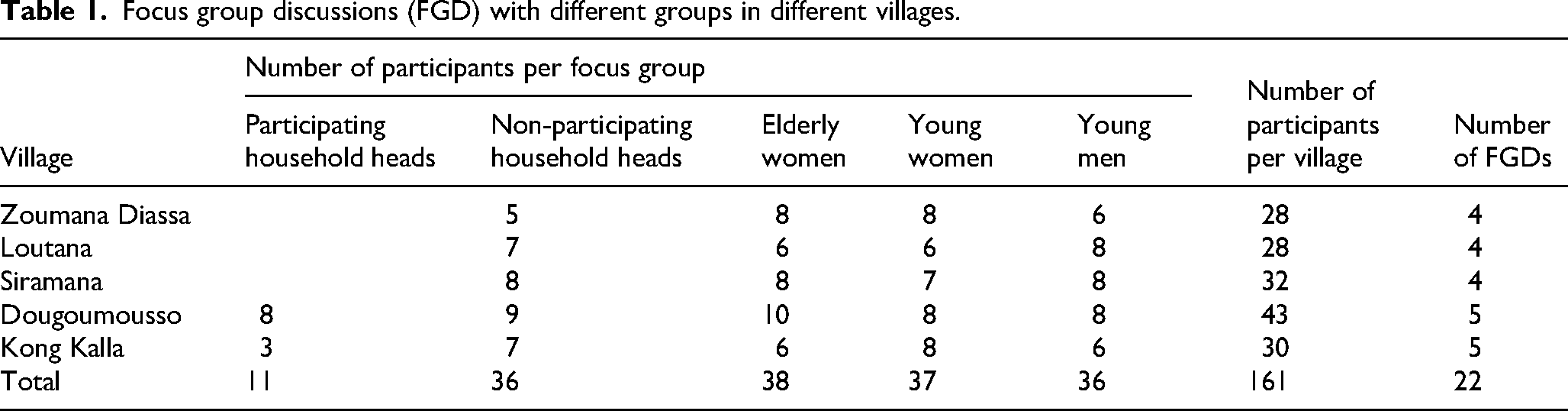
During the FGDs, farmers were first asked to establish a list of service crops and plants grown in the area. The discussions were conducted in Bambara language. In this regard, service crops and plants were defined in Bambara as ‘yiri nafama’. Translated to English, this means ‘plants providing value/service’. After the list of service plants was established, farmers were asked to place them within a square based upon two dimensions of distribution: how many farmers grow them, and on what area they are grown within each farm: 1) grown by many farmers on a large area; 2) grown by many farmers on a small area; 3) grown by a few farmers on a large area; 4) grown by a few farmers on a small area. To better understand the use, importance and management of identified service crops plants, farmers were asked to provide information about their origin, seed sources and multiplication, different uses including the ecological and economic value derived from them, and weaknesses and constraints for their cultivation.
Semi-structured interviews
Semi-structured interviews were conducted with six people from four key project partners including FAIR Sahel (1), Sustain Sahel (2), IER (2) and AOPP (1) to explore the project's approach and challenges. These interviews focused on several core topics, including farmers’ willingness to scale up the use of service crops or plants, and how this relates to factors such as gender, landholding and access to seeds or planting material. Additional areas of discussion included key barriers to adoption and the rationale behind specific project strategies – such as the choice of locations, selection of promoted plant species and methods of promotion.
Results
Defining service crops
The terms ‘service crop’ and ‘service plant’ appear to have originated from the work of the Centre de Coopération Internationale en Recherche Agronomique pour le Développement (CIRAD), as they appear in several working documents and student theses related to CIRAD projects from 2010 onwards. Already in the early use of the concept service crop inconsistencies appear, as some define it as a crop growing alongside the cash crop that provides services to the cash crop such as pest control (e.g., Par, 2013), whereas others use it as a synonym for cover crops (e.g., Moisy, 2011).
After their use in theses, the terms appear in conference abstracts and papers. Their definition is mainly an extension of the term cover crop to acknowledge the multiple services that those crops can provide (e.g., Lavigne et al., 2012, august). A more elaborated definition of the term ‘service crop’ (cultivos de servicio) first appeared in 2014 in an abstract for a scientific conference, wherein it was proposed as a term to describe crops not grown to be harvested but to fulfil various ecosystem functions and provide ecosystem services (Piñeiro et al., 2014). The purpose was to incorporate this concept into the theoretical framework of ecosystem services to shift the crop-centred paradigm of the Green Revolution.
Later, the term gained traction within academic papers, primarily as an extension of the term ‘cover crop’, as cover crops can provide multiple ecosystem services (Ciaccia et al., 2015). At the same time, the term Agro-ecological Service Crops was introduced to address the need for a more comprehensive all-embracing term for all crops used in agro-ecosystems that provide or enhance its environmental functions, including cover crops, catch crops, trap crops, push crops, pull crops and green manures 1 (Canali et al., 2015). Most academic papers that use the terms examine experiments designed to measure particular ecosystem services, provided by one or more selected plant species, introduced within a specific farming system, under controlled, experimental conditions.
The further definitions of service crops and plants continue to differ within scientific literature and focus on various aspects (Table 2). Some definitions include the functional traits of genotypes of specific plant species, which is rooted in the taxonomic classification of plants. Some definitions refer to the ecosystem functions that specific plant traits can provide. Ecosystem functions are the natural processes that sustain ecosystems and life within them. These functions occur naturally within ecosystems, regardless of their direct benefit to humans. Therefore, most definitions focus on the ecosystem services that service crops can provide. Ecosystem services are the benefits that humans derive from ecosystem functions. Ecosystem services are defined by their utility or value to humans and thus fall within goal-derived categorization.
Definitions of service crops and plants in academic literature separated by attributes, consequences, values and objectives.
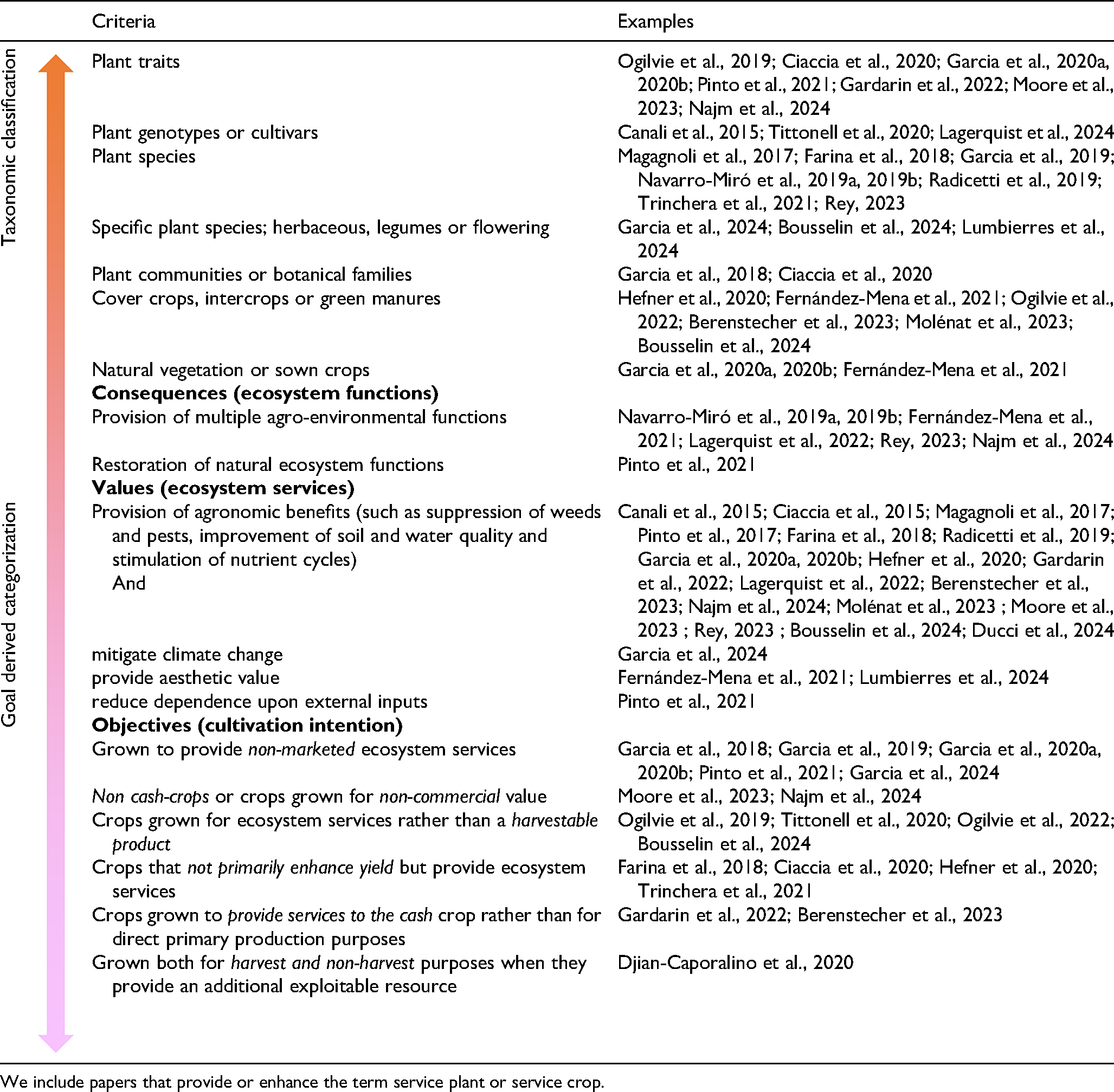
Some definitions also include the specific objectives or intentions behind the cultivation of service crops. Especially in defining these objectives, there are inconsistencies among definitions. In many articles, the distinction is made between a cash crop and a service crop, crops to be harvested and not to be harvested or market and non-market crops. This suggests that the derived value should primarily be ecologic rather than economic. Some articles indicate that the service crops should indirectly contribute to improving yield and quality of the cash crop. Others extended this definition stating that service crops can be grown both for harvest and non-harvest purposes when they provide an additional exploitable resource (Djian-Caporalino et al., 2020), pointing to their multifunctionality providing both economic and ecological value.
Furthermore, a useful distinction between service crops and service plants can be identified. In their definition of service plants Fernández-Mena et al. (2021) include spontaneous vegetation (plants) that requires the same management needs as crops, whereas others exclusively refer to the intentional cultivation of plants (crops). Tittonell et al. (2020) and Moore et al. (2023) and include breeding aspect suggesting that traits of service crops and plants can be manipulated to suit a specific cropping system, making them contribute to multiple objectives.
In sum, the terms service crops and plants appear to have evolved out of different bodies of literature within agroecology such as plant trait function linkages (e.g., Garcia et al., 2020a; Shome et al., 2023), the functions of different types of crops, such as cover, pull or push crops (e.g., Canali et al., 2015; Wezel et al., 2014) and multifunctional plants (e.g., Ciaccia et al., 2015; Parada and Salas, 2023). As a result, their definitions are embedded in different categorization frameworks.
While scientific taxonomy classifies species into mutually exclusive categories at each taxonomic rank, crop categorization is goal-derived and therefore cross-categorical. This means that a plant species may be a cash crop when deliberately cultivated for its economic value, a service crop when deliberately cultivated for its ecological value, or anywhere in between. The key distinguishing factor among these categorizations lies in the farmers’ intention – whether they aim to derive economic or ecological value from the crop. As a result, any plant species can ‘become’ and ‘unbecome’ a cash or service crop, introducing a degree of fluidity and ambiguity into these categories.
Local and introduced service plant and crops
When asked to identify ‘plants that provide value/service’, farmers collectively listed in total 116 types of service plants of which they indicate that 10 are introduced whereas the others are local 2 . Due to this large number the FGDs further focused on the introduced and local species that were most frequently mentioned across groups and villages (Table 3). Farmers listed a range of uses such as food, fodder, beverages, medicinal, timber, construction, firewood, hedges, crafts, seeds, shade and soap. Farmers associated all the identified plant species with both ecological and economic value. Ecological value included the attraction of beneficial insects, erosion control, pest control, fertilization, hedge or windbreak, climate adaptability and shading. Economic value was mainly related to saving money because the products sourced from these plants – such as animal feed, fertilizer or soap – would otherwise have to be purchased. Additionally, some plants offered income-generating opportunities – such as the sale of fruits and contributed to income diversification.
The eight most frequently mentioned local and introduced plant species identified by farmers as service crops or plants in the focus group discussions, with their main uses, ecological value and economic value.
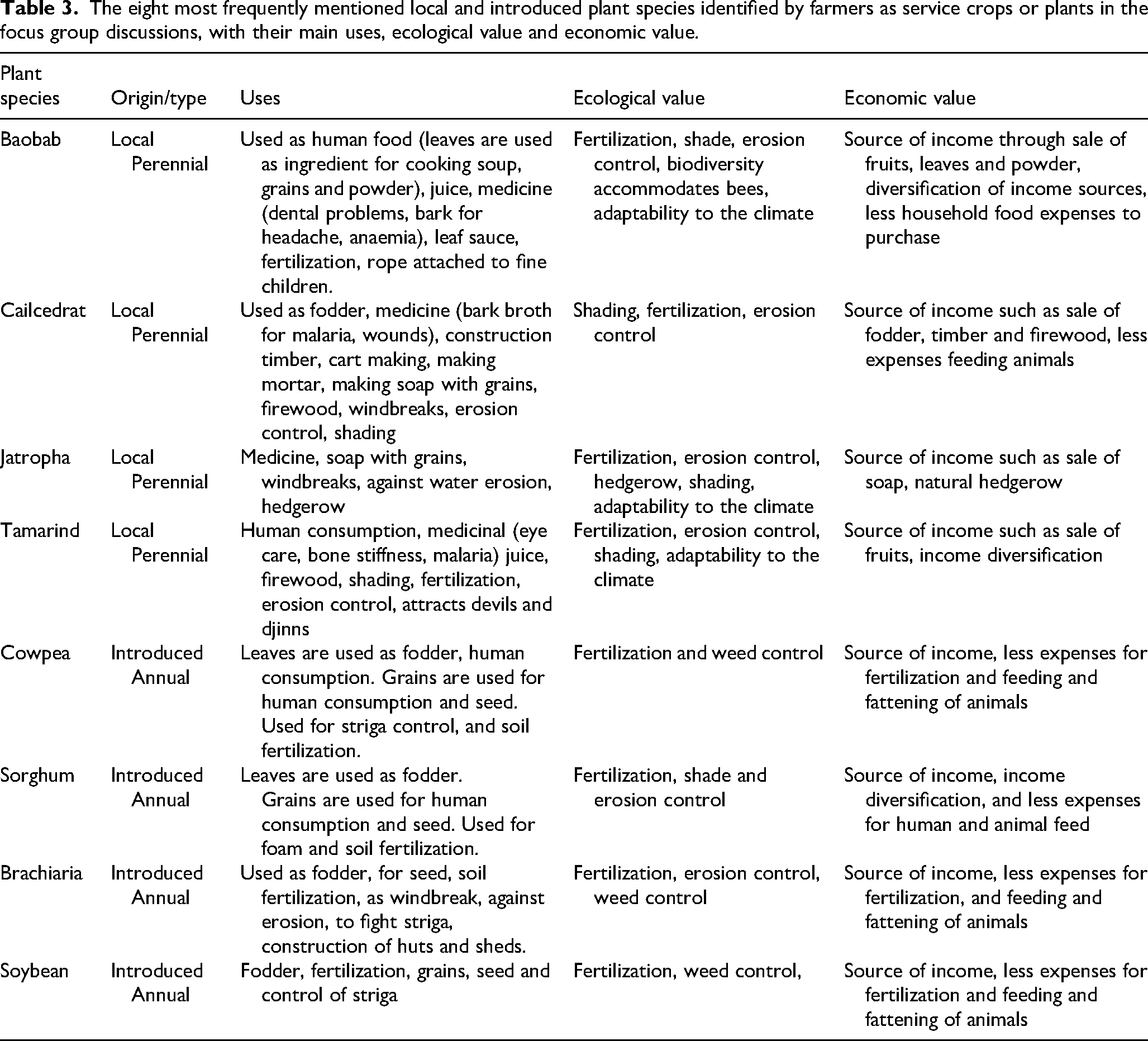
Most of the identified service plants are local perennials that either naturally regenerate or are available in nurseries. Plants that naturally regenerate are typically left undisturbed during field clearance when they are not expected to negatively impact the annual crops. Many of these species are also characterized by slow growth, which leads farmers to rarely plant them. There are no dedicated plantations for these plants; instead, the same field may host Shea trees alongside Tamarind, Néré trees and others. As a result, the density of these wild plants is high in the bushes and sparse in the fields. Although these naturally growing trees belong to the field's owner, others might be allowed to derive benefit from them, depending on local customs and practices. The primary challenge farmers identified for naturally occurring local service plants is their competition with annual cash crops and a lack of economic opportunities and markets. Mango, Cashew and Jatropha, which are planted in orchards, are exceptions to the generally wild growth of local perennial service plants.
The introduced service crops are mainly new varieties of well-known annual crops in the community, such as sorghum, cowpea and groundnut, which serve dual purposes. This generally meant that besides human consumption there is an additional service such as fertilization or fodder. Some of these crops are newly introduced species selected by researchers for their potential to meet community needs. These include Mucuna, Brachiaria and Gliricidia, which were introduced through research projects due to their potential role as animal feed. While competition with cash crops was identified as the primary challenge for locally occurring perennial service crops and plants, the main issue for the introduced annual service crops is the cost of purchasing seeds.
Farmers mentioned several other weaknesses related to the plants including the attraction of animals, snakes, devils and djinns; competition with crops for light, water, space and other resources; deep root systems that cause drought and complicate ploughing; invasive species; thorns; the requirement to purchase seed; a lack of drought resistance. Farmers identified several constraints to scaling up the use of service crops and plants. These included increased competition with food crops; heightened risk of bush fires; limited land availability; lack of economic incentives or markets; insufficient resources; and concerns about certain plants being invasive. Cultural norms also play a role: farmers noted that the number of plants of a given species in a field is often culturally prescribed and should not be exceeded. In addition, some non-household heads reported being prohibited from planting trees or perennials. A further key constraint that farmers highlighted was seed access – planting material is often unavailable locally or must be purchased, creating a dependency on seed companies.
Promoting the use of service crops and plants
Farmers related all plants to both ecological and economic value. However, interviews with project partners in Sikasso revealed that simply raising awareness about the ecological services of certain plant species is not enough to motivate farmers to scale up their use. The partners explained that farmers are primarily interested in improved varieties of annual crops for their economic value rather than their ecological value. Farmers often compare the income derived from new initiatives with the income derived from cotton, the main source of income in the area.
When interacting with the farmers to identify the conditions under which farmers would allocate more land to service crops or plants, project partners mentioned that the following quote kept coming up in generic terms: ‘Farmers expect introduced crops to generate income as it is the cotton case, if that is not, they are hesitant in adopting them’. Furthermore, farmers mentioned they are willing to allocate more land to the service crops or plants if there is a market for them. In the end, farmers are primarily concerned with feeding their families and have to balance the needs of today and tomorrow.
Partners also highlighted economic barriers to sustaining the project's impact. During projects, farmers often received seeds and other types of planting material of the service crops for free. One of the partners explained how this common approach of free distribution of materials within projects undermines their sustainability: ‘We are in a country where there are difficulties, and people are always willing to receive everything for free. They see the benefit, but when they are asked to pay, it becomes an obstacle’. Projects introduced Gliricidia plants in Zoumana Diassa and helped sell them, including through marketing messages on local FM radio. However, despite these efforts, many of the plants produced remained unsold because producers preferred to receive them for free. This is a weakness of the project. After the project ended, this mentality posed challenges.
They furthermore highlighted the importance of demonstrating the economic benefits of using planting material: ‘Farmers should not always expect to receive these plants for free. But when you ask them to pay for plants that are not going to allow them to obtain results, it is very discouraging’.
Given farmers’ concerns about economic aspects, project partners concluded that the most suitable approach was to link service crops and plants to markets, identify economic opportunities and promote their dual value – both ecological and economic. As a result, selected plant species were promoted as harvestable and non-harvestable, cash and non-cash crops, as indicated by the following quote of one of the partners: ‘It is possible that in the coming days, Gliricidia and Leucaena will be cut down and sold. That is the goal. This will not only serve to fertilize their soils and feed their animals, but also provide them with additional income’.
Thus, while economic value can serve as a key driver for the adoption of plant species that offer ecological benefits, this stands in contrast to most theoretical definitions, which describe service crops as non-cash, non-harvested or non-market species. This tension suggests that such definitions may need to be reconsidered or broadened to reflect practical realities.
Discussion and conclusion
The definition of service crops and plants is rooted in both taxonomic classification and goal-derived categorization and seems to have evolved out of different bodies of literature within agroecology (e.g., Canali et al., 2015; Ciaccia et al., 2015; Garcia et al., 2020a; Parada and Salas, 2023; Shome et al., 2023; Wezel et al., 2014). Our analysis of the concepts suggests that the farmer's intention to derive ecological value from a plant is the key distinguishing factor, which means that in theory, all plant species can ‘become’ and ‘unbecome’ service crops or plants. We have further shown how this has implications for the practical promotion and implementation of service crops and plants.
For scientific research and knowledge to make an impact in society, it must be taken up by non-academic societal actors (Trouwloon et al., 2024). When projects want to implement, promote or evaluate the use of service crops and plants a working definition should be communicated to the farmers. Communicating concepts developed by scientists to smallholder farmers is challenging due to language barriers (Mwogela et al., 2023), and this is further complicated by the personal and contextual nature of the meaning of a concept (Ludwig et al., 2022). In our case study, farmers were asked to identify local and introduced ‘plants that provide value/service’, which resulted in an elaborated list of plant species.
Among the identified plant species, we can distinguish between service crops and service plants. Some are intentionally cultivated as crops, while others are naturally occurring plants that are preserved during land clearing for the benefits they provide. Farmers recognized both ecological and economic value in all the identified plants. However, the main barriers to increasing the use of service crops and plants were economic in nature such as competition with cash crops, the cost of purchasing seeds, and a lack of economic opportunities. Therefore, the FAIR Sahel project decided to further focus on the promotion of the plants based upon their economic value.
These findings reveal a paradox: while theoretical definitions of service crops and plants emphasize their ecological value, ignoring their economic value may limit their appeal to farmers. In practice, unless their economic value is emphasized, farmers are unlikely to adopt or scale up the use of service crops and plants solely for their ecological value. This suggests a need for more flexible definitions that reflect practical and non-experimental realities. On the other hand, when economic value is emphasized in the promotion of service crops and plants there is a risk of ‘conceptual stretching’. This happens when a concept is broadened to a point where it becomes meaningless (Collier and Mahon, 1993; Sartori, 1970, 1984).
Stable concepts and a shared understanding of categories are routinely viewed as a foundation of any research community. Yet ambiguity, confusion and disputes are a common result when the context of application is extended (Collier and Mahon, 1993). Many studies on service crops and plants focus on an experimental context: a specific plant species is introduced in a specific farming system with a specific purpose. These farming systems are typically conventional, characterized by high input use, monocultures and mechanization. In such experimental contexts, the concept ‘service crop’ remains stable, as it is very clear which plant species is grown for what purpose. In contrast, our findings show that in real-world contexts, the categorization of a plant species as a service crop or plant is not always clear. Many farming systems in Sub-Saharan Africa are ‘agroecological’ by default, characterized by low use of artificial fertilizers, mixed crop–livestock systems and a high crop diversity including legumes (Falconnier et al., 2023). Accordingly, farmers in our study reported that they already grow a wide diversity of crops and plants from which they derive both ecological and economic value. This highlights broader implications for transferring agroecological principles, concepts and practices to diverse farming contexts.
A comprehensive definition of service crops and plants should consider not only the specific traits of the plant species but also the objectives behind their cultivation. Many of the introduced service crops – such as improved varieties of corn and soybean – are typically grown as cash crops in high-input monocultures within conventional farming systems. In contrast, smallholder farmers often grow them in intercropping systems. Their role as service crops therefore depends largely on the context in which they are grown. This has important implications for both the theoretical definition – shaped by researchers’ objectives and analytical priorities – and the practical implementation and use of service crops and plants, which reflect farmers’ goals and realities. The key difference lies in when, where, how and – crucially – why these plants are grown. Understanding these factors is essential because it highlights how agricultural practices are shaped by both economic and ecological considerations, and it helps bridge the gap between research-driven and farmer-centred definitions of service crops and plants.
Based on these findings, we recommend that projects adopt a systems perspective, focusing on the role of different plant species within agroecological systems, rather than the introduction and promotion of single plant species with traits that could provide ecosystem services. As suggested by Najm et al. (2024), this requires tailored, context-specific advice. Additionally, it is important to recognize the value of indigenous species and to incorporate farmers’ knowledge and the value they derive from different plant species. In Africa, Asia and Latin America, the relationships between ecosystem services and human well-being – including social progress, economic growth and human development – often remain understudied, particularly at the community level, where context-specific differences are likely to emerge (Cruz-Garcia et al., 2017). Collaborative strategies that integrate farmers’ knowledge, objectives and practices are essential to realizing agroecology's transformative potential (Levidow et al., 2014). Without a clear conceptual and inclusive boundary around service crops and plants, there is a risk that their use will reinforce dominant agricultural regimes – repurposing agroecological language while conforming to existing systems – rather than contributing to the systemic transformation that agroecology aspires to achieve.
Footnotes
Acknowledgements
The authors want to acknowledge the contributions of all partners and participants in this study. The authors also want to thank the funders of this research.
Ethical approval and informed consent statements
The research was conducted in accordance with local guidelines in Mali, where formal ethical approval is not required for non-health-related interviews. All participants were informed about the purpose of the project and verbally agreed to participate in focus group discussions or interviews. They were also informed that participation was entirely voluntary, and that all information shared would be treated as confidential and used solely for research purposes.
Authors’ contributions
All authors contributed to the conceptual development of the paper. Fleur Kilwinger, Moussa Macalou and Amadou Sidibé conducted the literature review. All authors have been involved in the design of the research methods. Moussa Macalou, Amadou Sidibé and Mohamed Sidibé collected data in Mali, and all authors were involved in analyzing the data. Fleur Kilwinger led the writing process, and all authors assisted in shaping the argument and refining the final manuscript.
Funding
The author(s) disclosed receipt of the following financial support for the research, authorship, and/or publication of this article: This work was part of the ‘Fostering an Agroecological Intensification to improve farmers’ Resilience in Sahel (FAIR Sahel)’ project co funded by the European Union (EU) under grant number FOOD/2019/412-095 and The Agence Française de Développement (AFD) under grant number: AFD CZZ2374 02 E. For the full list of funders and partners please visit:  .
.
Declaration of conflicting interests
The author(s) declared no potential conflicts of interest with respect to the research, authorship, and/or publication of this article.
Availability of data and material
The (anonymized) data used for this article will be made available upon request.