




Abstract
The livestock sector needs to become environmentally sustainable in ways that ensure fairness and inclusiveness for all, while leaving no one behind: it needs to undergo a just transition. Simultaneously meeting future consumer demand while surviving increasing frequency and severity of climate change hazards, as well as achieving net zero emissions targets and outcomes for water, biodiversity, social resilience and economic development, is a huge ask. Here we discuss what is needed to achieve these multiple outcomes in ways that are socially just. Industrialized livestock production systems will need to invest in adaptation and mitigation measures. In the more extensive systems in which livestock are critical for smallholders’ food security and livelihoods, governments and development partners will need to anticipate the wider range of interventions required to increase resilience in such systems as well as the possibility of facilitating transitions to other livelihood activities. Measures are already available to help livestock farmers in lower-income countries adapt to climate change and reduce emissions. These measures will require finance, policy, technical support, research and development, and monitoring, to incentivize new or modified practices at scale. Both public and private sectors need to move from pledges and commitments to incentives and action through policy targets and disclosure requirements, sustainability-linked finance, and development assistance for innovation.
Keywords
Introduction
Climate change and sustainability concerns are creating increasing pressure around the globe for more resilient, low-emission and environmentally sound livestock production, from the level of feed inputs and farm management to consumption of meat and how waste is handled (FAO, 2023a, 2023b; Kerr et al., 2022; Mukherji et al., 2024). Multiple initiatives have been launched to meet these requirements, including the United Nations Framework Convention on Climate Change (UNFCCC)'s Sharm el-Sheikh Joint Work on Implementation of Climate Action on Agriculture and Food Security in 2022 (UNFCCC, 2024a) and the UAE Declaration on Sustainable Agriculture and the Call to Action for Transforming Food Systems for People, Nature and Climate (Food Systems Call to Action) in 2023 (Mukherji et al., 2024). Because the needed transformation of the sector is significant, an accompanying concern is how to support a transition for the livestock sector under climate change to be also socially just. In this article, we review the outlook for the livestock sector under climate change and discuss some solutions for just transition pathways to more equitable, humane and sustainable, climate resilient and low-emission livestock systems in both higher-income countries and lower- and middle-income countries (LMICs).
Drawing on the experience of the energy transition over the last decade (Sovacool et al., 2019) and building on global commitments to address climate change in an equitable way, a call for a just transition to low-emission food production, including livestock systems, has emerged—a transition that would reduce the negative consequences of moving to a carbon-neutral economy on the well-being of the most vulnerable groups of society, especially workers, communities, and regions relying on climate-sensitive sectors for their livelihoods and development, as well as supporting climate resilience, environmental outcomes, and other sustainability goals (Chatterjee and Swarnakar, 2023; IPCC, 2022; Mukherji et al., 2024; Steiner et al., 2020; UNFCCC, 2016, 2024b). The European Green Deal further emphasizes that we must “leave no one behind,” paying attention to workforce but also to sectors and regions most affected by transitions (EC, 2019). The vulnerability of the world's rural and food-producing population is at the center of this call. For example, in Africa, agriculture-based livelihood systems carry the greatest burden from the adverse impacts of climate change, and yet the region emits <4% of GHG emissions into the atmosphere (IPCC, 2022; Mukherji et al., 2024). Food system transformation can cause significant impacts within and beyond food systems, aggravating inequalities and unsustainability and hampering equal engagement in the transition itself (Tribaldos and Kortetmäki, 2022). A just transition aims to reduce such negative impacts (Mapfumo et al., 2025). In the livestock sector, calls for just transitions have focused on the loss of livelihood along the supply chain (Aubert et al., 2021) and workers’ rights (Montague-Nelson, 2022), reducing industrialized animal production (Verkuijl et al., 2024), reducing animal agriculture altogether (Blattner, 2020), and increasing the voice of marginalized livestock producers such as pastoralists (Darmet and Barnaud, 2025).
A just transition follows three interconnected tenets of justice (Kaljonen et al., 2023; Mapfumo et al., 2025; van Uffelen et al., 2024).
A just transition for livestock under climate change therefore recognizes the role of all livestock system actors, especially less advantaged farmers who are usually politically marginalized, to participate in and have full transparency about how multiple agrifood objectives can be achieved. These include decisions that promote climate resilient, low-emission agriculture for increased food and nutrition security; that shift diets toward healthy and lower-emission foods; that reduce animal waste and support reuse of waste and the circular economy; that improve water and environmental outcomes; that preserve farm- and food-related cultural heritage and tradition; that create farm and value chain employment and livelihood opportunities while reducing inequality and providing for inclusive economic growth and development; and that contribute to peacebuilding and restoring dignity (Mapfumo et al., 2025; Mukherji and Majdalani, 2024). Critically, a just transition also recognizes the role of wealthy countries historically responsible for greenhouse gas emissions to contribute financially and technically to support adaptation in affected countries.
Livestock agriculture is the largest, most decentralized sector on the planet. It employs more people than any other sector of the global economy and supports the livelihoods of some 1.3 billion people worldwide, including farmers, ranchers, feed producers, meat processors, and numerous others (FAO, 2016). The global meat market is valued at about USD 1 trillion (Verkuijl et al., 2022). The ramifications of a just transition for the livestock sector are thus far reaching. In this article, we draw on research undertaken by the CGIAR Research Initiative on Livestock and Climate and partners. In the “anticipated climate change trends and impacts on livestock systems” section, we outline the major impacts of climate change on livestock. The “reducing livestock's impact on climate” section discusses the impacts of livestock on climate and ways to mitigate emissions. In the “trends in technology: feed innovation, energy, digitalization” section, we outline trends in technology regarding feed innovation, energy and digitalization. The “livestock and data gaps” section discusses data gaps. The need for support and the opportunities for a just transition of the livestock sector are outlined in the “toward a just transition” section, and we conclude with a few recommendations for future action in the “conclusion” section.
Anticipated climate change trends and impacts on livestock systems
Climate change is having substantial effects on all livestock systems, including the specialized intensive production systems common in many higher-income countries, to mixed crop-livestock systems and pastoralism where grasslands are a key resource in LMICs, although intensive and industrialized livestock production is on the rise in LMICs. These impacts will become more pronounced through time. Information on the economic costs of these impacts on livestock systems is incomplete, but some estimates are shown in Table 1.
Estimates of the costs of climate change (or the costs of adaptation inaction) on livestock systems.
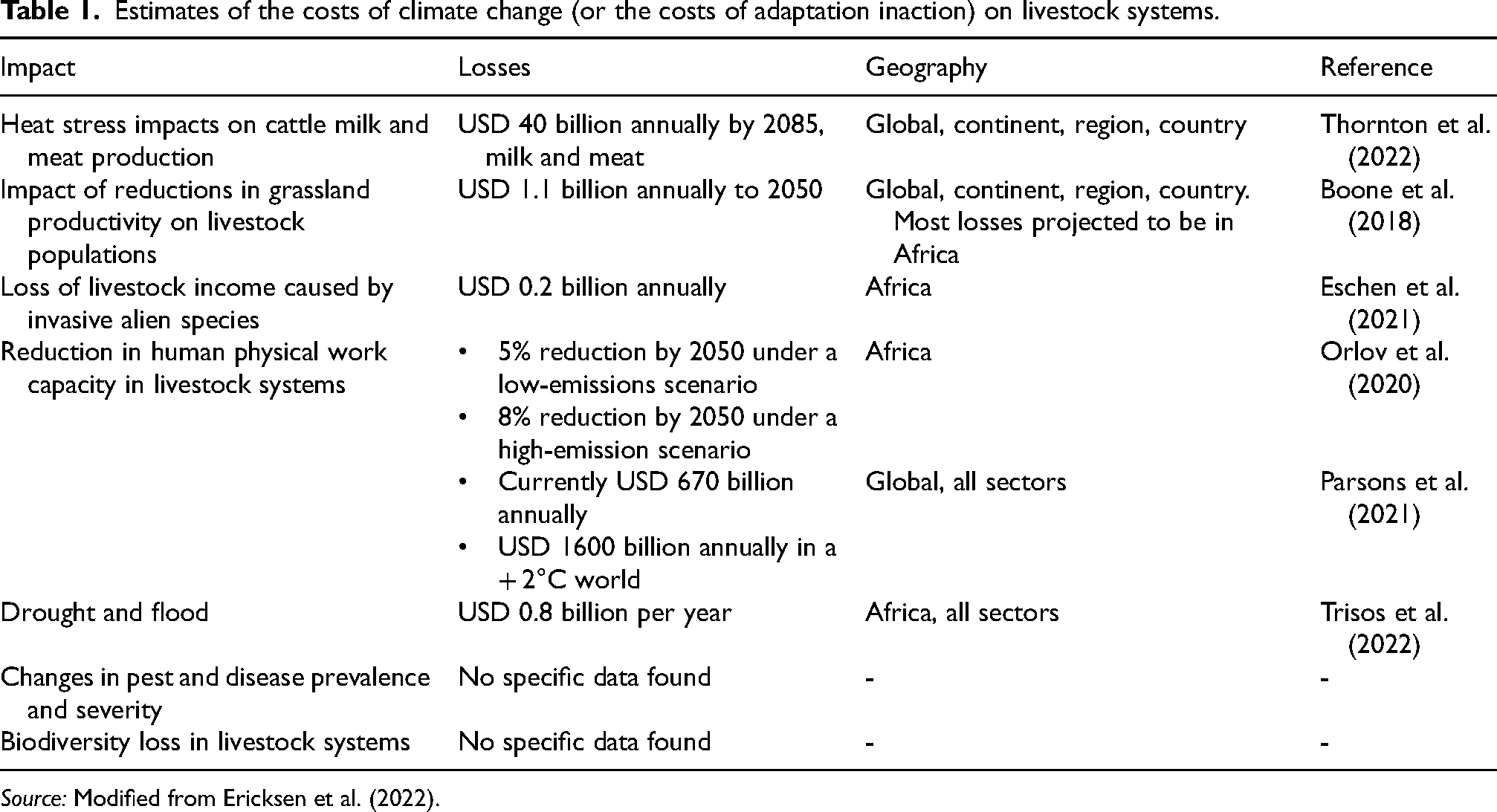
Source: Modified from Ericksen et al. (2022).
Direct impacts of heat stress on animal health and production will become increasingly serious, with reductions in productivity and fertility and increasing disease susceptibility (Godde et al., 2021). Goats cope better with heat stress than sheep, and both species are more heat resistant than cattle (Silanikove, 2000). To mid-century, land suitability for all domesticated livestock production, particularly cattle, will decrease because of increased heat stress prevalence in mid and lower latitudes (Thornton et al., 2021). The costs of cooling in intensive production systems will inevitably rise. There is limited information on the impacts of heat stress on backyard pig and poultry production. Increasing heat stress will also negatively affect human labor capacity, possibly by up to 20% by mid-century in the low latitudes of Asia and Africa, with knock-on effects on several communicable diseases (Nelson et al., 2024).
Grassland productivity is projected to be seriously affected to the middle of the century, though there are regional differences in the impacts. Changes to African grassland productivity will have substantial, negative impacts on the livelihoods of >180 million people, though the future makeup of grasslands in general under climate change is uncertain (Boone et al., 2018). Grassland composition and quality changes will inevitably modify their suitability for different grazing animal species, with switches from herbaceous grazers such as cattle to goats and camels to take advantage of increases in shrubland (Kerr et al., 2022).
Direct and indirect processes link climate change and infectious diseases in livestock (Bett et al., 2017). Some like Bluetongue virus show a positive association between temperature changes and expansion of the geographical ranges of arthropod vectors, while others like tsetse flies show a contraction (Kerr et al., 2022). Increased risk of flooding and future Rift Valley Fever outbreaks are projected in East Africa this century (Taylor et al., 2016). In general, though, the impacts of climate change on livestock diseases remain highly uncertain.
Water resources for livestock may decrease because of increased runoff, greater plant evapotranspiration, and reduced groundwater resources. Changes in availability will likely be accompanied by changes in water quality, such as increased levels of microorganisms and algae, compromising reproductive performance and productivity in domesticated animals. Although water consumption by livestock is only 1–2% of global water consumption (Hejazi et al., 2014), warming will increase animals’ needs. Increased frequency and intensity of droughts and floods will severely affect herd stability and increase restocking time (Godde et al., 2021).
Biodiversity will also be increasingly affected by changing climate hazards. Biodiversity losses can have negative impacts on resilience in small-scale farming systems, which may be compounded by increased competition for other land uses. However, and in some cases when well-managed, livestock production can help improve the biodiversity of grass and tree species and the soil, especially in rangelands where it is difficult to produce other types of food (AU-IBAR, ILRI and GIZ, 2024; Frija et al., 2024).
Reducing livestock's impact on climate
Livestock is the single largest driver of emissions in the land sector, with enteric fermentation and manure contributing about 38% or 4.6 GtCO2 of global agricultural land emissions and indirect emissions from feed, energy and land use change contributing an additional 26% or 3.1 GtCO2 (FAO, 2023a, 2025). Mitigation is therefore a priority to meet Paris Agreement targets (Arndt et al., 2023). Livestock is the top driver of land use emissions in every region of the world (Roe et al., 2021), and livestock emissions are projected to grow by about 17% by 2050, with LMICs shouldering much of the growth (FAO, 2025). Without addressing livestock emissions, it will be difficult if not impossible to meet global climate policy targets.
Yet most countries lack domestic policy for tackling absolute reductions for methane from enteric fermentation, the major source of emissions from domesticated animals. Livestock is a major source globally of methane, which has a global warming potential 28 times that of carbon dioxide. The digestive systems of ruminants alone contribute 27% of global anthropogenic methane (Arndt et al., 2022). Methane is also a gas that breaks down quickly in the atmosphere (Costa et al., 2021), so reducing methane emissions can also quickly have an impact on the balance of methane in the atmosphere and global warming. Methane emissions from ruminants need to decrease by 24–47% by 2050 to meet the 1.5°C target (Arndt et al., 2022).
Many countries have existing policies and programs to improve animal productivity, which can decrease emission intensity, or methane-efficiency per unit of livestock product. Improvements in emission intensity are a good low-emission development strategy that enables producing food with higher GHG efficiency. However, if animal numbers also increase, absolute emissions will increase and worsen climate change. The challenge for the livestock sector is to develop accessible and affordable technologies that can help reduce methane in absolute terms, and enable the policies, finance and technical support to implement these technologies at large scales. Additionally, if the transition is to be just, then higher-income countries need to provide greater capacity building and financial support to LMICs on their transition pathway.
Although some 100 countries have committed to livestock-related mitigation or adaptation measures in their first nationally determined contributions (NDCs) to the Paris Agreement (Dittmer et al., 2024; Richards, 2019; Rose et al., 2022), countries now need to increase ambition, provide quantified targets, reference levels of indicators and mitigation potentials, and most importantly develop realistic measures for implementation. Yet as of November 2024, only 68 of 178 countries had provided new or updated NDCs that included livestock measures with the majority of these being higher-income countries (Dittmer et al., 2024). These included seven of the top 10 emitters of livestock emissions (India, Brazil, China, USA, Pakistan, Ethiopia, Argentina, Mexico, Australia, and Chad). However, India and Australia had yet to make commitments (Rose et al., 2022), which reflects an ongoing battle to encourage the highest emitters to take the greatest action, rather than those who have contributed less having to take up the slack. Reducing emissions across all countries is nonetheless needed to meet climate targets and for many LMICs livestock emissions are a large proportion of their domestic emissions. Common measures for mitigation include manure management (22% of countries), feed management (17%), and silvopastoralism (11%). For adaptation, common measures include breed management (18%), silvopastoralism (10%), and feed management (10%). A minority of countries set mitigation targets related to reducing emissions from the livestock sector within their NDCs and only 12 included targets consistent with the Global Methane Pledge of reducing methane 30% by 2030 (Dittmer et al., 2024).
Absolute net emissions reductions are possible and necessary at large scales to make a difference for the climate. While at least 35 measures have been shown to reduce methane emissions directly, reductions vary from 5% to 43% and some measures reduce only product-based emissions (Arndt et al., 2022). Product-based strategies for reducing emissions such as improved feed and increased feed intake can reduce emissions by 9–17% per product—but need to result in absolute emissions reductions or be combined with emissions offsets such as carbon sequestration through agroforestry or grassland restoration to reduce climate change. Measures for absolute reductions include reducing animal numbers through more intensive production, shifting to different kinds of animals with lower emissions (e.g. low-emissions cattle, chicken), or using products such as methane inhibitors, tanniferous forages, electron sinks, oils and fats, and oilseeds in the diet. Such products can decrease daily methane emission by 12–32%, or on average 21% (Arndt et al., 2022; Hegarty et al., 2021). Using multiple measures will be needed to achieve targets. Use of renewable and efficient energy in the supply chain can be an important mitigation option, especially in dairy systems. Making these technologies and options easily accessible to livestock farmers and giving farmers’ representation and influence over mitigation decisions will contribute to all three tenets of social justice. Measures such as feed improvement are most likely to achieve distributive justice and create the least disruption in the production system but may not go far enough for mitigation. More radical mitigation measures such as shifting away from livestock farming, or away from cattle to another type of livestock, may better support mitigation but require livelihood alternatives.
Where appropriate, a middle-ground strategy toward fewer but more productive animals can be a core strategy to reduce GHG emissions and the land footprint of production. This would have both economic competitiveness and sociocultural implications in many LMICs, challenging the principle of distributive justice. For the transition to be just, considerable investment in increasing the efficiency of livestock value chains will be needed, through market and improved service development and increased institutional support, for example. The latter may be tougher to address, as the implications for livelihoods could be profound, though improved profitability and resilience to extreme weather events could help in the longer term. Other promising prospects for reducing absolute methane emissions from livestock are available but need further investment and research to make them feasible at large scales. Some of these are considered in the “trends in technology: feed innovation, energy, digitalization” section.
The livestock sector also has a tremendous opportunity to offset emissions through carbon sequestration in pasture soil and biomass, including rotational grazing, optimizing grazing intensity, sowing legumes, and restoring grassland cover and biodiversity. Grassland management can increase soil carbon stocks by about 0.5 t C per ha per year, contributing to as much as 10.2 billion tCO2e per year, although only one-third of that is realistically achievable (Bai and Cotrufo, 2022). Avoided burning of grasslands or crop residues will also maintain carbon. And working through approaches such as participatory rangeland management also have potential—a recent study concluded that by doing so, 0.7–1.7 tCO2e per ha per year can be sequestered per year (Ritchie and Sircely, 2024). Grassland restoration has a high potential for impact at large scales. Mitigation strategies need to be tailored to country conditions. In LMICs, for example, improving feed might best focus on human inedible feeds (i.e. forage and byproducts) to reduce competition with food production (Arndt et al., 2022; Cardoso, 2024). Because these practices generally increase productivity and are accessible to most farmers, they foster distributive justice.
Changes in human population and consumption per person will continue to drive future livestock consumption increases overall, although their relative importance varies by region (Herrero et al., 2023). This increased demand for livestock products may have significant challenges for land use and environmental impacts; for example, soybean exports from Brazil to Asia to feed the latter's growth in pork and poultry consumption could lead to additional deforestation for soybean production in Brazil, thereby increasing the embedded environmental impacts of the meat produced (Herrero et al., 2023). Overall, stronger measures than we have hitherto will be needed to address increased demand. In countries with high or “over” consumption of meat, mitigation strategies should include reducing meat consumption and food waste (Frija et al., 2024; Rust et al., 2020). These measures may include changing dietary norms, marketing, improving consumer awareness, and developing new products.
Trends in technology: Feed innovation, energy, digitalization
Technology development in the livestock sector, as in many other sectors, is proceeding rapidly but access is often highly inequitable because technologies tend to be expensive and concentrated in higher-income countries. Below we briefly highlight a selection of technologies in three broad domains of innovation—feed innovation, energy, and digitalization—that may have substantial impacts on the ways in which livestock inputs and products are produced, marketed, and utilized.
Feed innovation
Many
Energy technology
Traditionally, ammonia production is highly energy-intensive, and most of the 180 Mt produced annually is used as fertilizer. The fossil fuels used in its production account for nearly 2% of global CO2 emissions (and its inefficient application and use account for another 2%) (Rocque et al., 2024).
Digitalization
Although these technologies could make important contributions to the transition to low-emission food systems, if distributive justice is to be attained, many of them will need to be adapted and made more accessible in LMICs. From the perspective of procedural justice, regulations and standards for new technologies need to be developed through inclusive processes, bringing in the voices of both women and men farmers and especially marginalized groups among farmers.
Livestock and data gaps
The relative lack of up-to-date, timely and salient information is a serious impediment to the prioritization of investment options and policy formulation and implementation in the livestock sector, and to the monitoring of livestock, livelihood and environmental performance.
The current state of global livestock and climate data is moderate at best. Data on livestock numbers and production levels are available at country level in FAO's statistical databases, collated from a wide range of sources such as national censuses, surveys, and estimation procedures. These data allow comparisons across and between all countries and regions, and annual time series are provided going back to 1961 for most variables. The Gridded Livestock of the World dataset (Gilbert et al., 2018) contains spatially modeled population numbers for 2010 (recently updated to 2020) for eight species. Another resource is FAO's Global Livestock Production Systems (Robinson et al., 2011), and the Herrero et al. (2013) dataset contain information on livestock biomass use, production, feed efficiencies, and greenhouse gas emissions; the latter is being updated to the year 2020. There are many datasets at subnational level, but these often have limited coverage, a big constraint for comparative studies. Several sources of household survey data provide some comparative information on livestock. These include the World Bank's Living Standards Measurement Studies (LSMS) and the Rural Household Multi-Indicator Surveys (RHoMIS) (Hammond et al., 2017). Both contain livestock modules, and LSMS data cover more than 40 countries and RHoMIS currently contains data for some 54,000 households in 36 countries.
Other livestock data gaps persist. Ruminant diets are often made up of a wide range of feed resources, such as natural and planted grassland of different types, crop residues, grain-based and other supplements, and cut-and-carry fodders. RHoMIS and other household survey data are invaluable in understanding livestock diets in different situations, but incomplete coverage remains a barrier to many types of analysis. Though the Rangelands Atlas (ILRI et al., 2021) provides broad figures of coverage, it is insufficiently granular. Another gap concerns the number and distribution of different animal breeds. Dairy and dual-purpose (milk–meat) production generally must be inferred from other data, and we still lack detailed distribution datasets of even broad classes of livestock such as cattle. In rangeland systems, where animal movement is a crucial management tool, transboundary risks of animal diseases that may have devastating impacts is a further complication, as neighboring countries may not have comparable data collection initiatives on animal health and cattle movements (Kebede et al., 2024).
To increase the coverage and scope of information on livestock systems and production, substantial investments will be needed. While there are many opportunities for more accurate, affordable and timely data collection (see the “trends in technology: feed innovation, energy, digitalization” section), if a just transition is to be achieved the challenges of data governance and information disclosure, particularly by major corporations, need to be addressed.
Major research and development funders could play a key role in promoting standardized data collection, documentation, and accessibility procedures, as a requirement for funding. Investment will also be needed in data for climate information services and early warning systems for livestock farmers. As the frequency and impact of extreme climate events increase because of climate change, the role of climate information services and early warning systems could expand substantially, to help farmers dampen seasonal and annual fluctuations in productivity and income. With appropriate interventions, these tools could also help shorten the time required to rebuild herd and flock numbers after devastating drought and flood. Investment in farmer training and provision of timely and salient extension information will also be needed.
Toward a just transition
The above sections have described the mitigation opportunities available for a transition to reduced-emission livestock production systems. However, for this transition to be just, there is a need for mitigation of livestock's impact to go together with support for adaptation of livestock keepers to climate change in equitable, fair and timely ways. Using the three tenets of a just transition (procedural, distributive, and recognition justice), we summarize actions for moving toward a more sustainable yet just livestock sector.
Procedural justice
Procedural justice focuses on issues of participation and decision making, and full information disclosure, in the process of climate risk management. This starts with moving from expert toward pluralist understandings of knowledge (Tschersich and Kok, 2022) including mobilization of local knowledge, as well as information disclosure by all stakeholders and fairer institutional representation including LMICs in global decision-making processes (Jenkins et al., 2016; Tanzer et al., 2022). Though forums such as the 2021 UN Food Systems Summit managed to support the emergence of new, more transformational and holistic narratives around regenerative versus extractive systems, information disclosure and institutional representation was not achieved, mainly due to procedural reasons. This highlights the need for change within such organizations as the UN, if they are to support sustainability transition (Tanzer et al., 2022).
At the same time, rigorous monitoring is necessary to track progress at the food system and farm levels. Frameworks already exist that are loosely aligned with the Paris Agreement and Sustainable Development Goals. However, there is a need for strengthening normative frameworks that assess different claims for justice of transition and that can assist in evaluating these claims and relating them to each other, supporting the planning, implementation, and critical evaluation of just transition policies, including identifying tradeoffs and blind spots that may need to be addressed (Tribaldos and Kortetmäki, 2022).
New indicators are being developed to specifically monitor methane and mitigation practices and to set science-based targets for livestock or methane. But there remains a need for simple, small sets of science-based indicators for tracking resilience, adaptation, and mitigation effectiveness, as well as checklists for investment specialists on GHG reductions and carbon sequestration for livestock. Policy makers can support improved statistics and Tier 2 emission estimates at country and regional scales through enhanced public data platforms, modeling and capacities for measurement and monitoring for improved emissions and reductions estimates (Gurmu et al., 2024). Without this kind of monitoring, holding different food system actors to account will be very difficult. In addition, such monitoring will be crucial, linked to climate forecasting and early warning systems, for timely identification of impending droughts and floods, and in other situations where the provision of humanitarian assistance may be needed (Synnestvedt et al., 2024).
Distributive justice
Distributive justice is concerned with equitable distribution of resources, opportunities, and burdens considering regions and systems that are disproportionally affected by climate change, as well as intergenerational equity. In the last five years, the issue of “loss and damage” has been increasingly on the table in global discussions, but agreement on how higher-income countries can compensate LMICs for climate change impacts remains elusive.
Although industrialized systems can better invest in the feed, adaptation and mitigation measures needed than smallholders’ systems, livestock are critical for smallholders’ livelihoods and food security, and we need to anticipate the wider range of interventions that may be needed in such systems. In places, this may involve livestock farmers diversifying or transitioning to other livelihood activities. Because the future is highly uncertain, fostering anticipatory and responsible governance at local, landscape, and national levels will be critical. In view of its multidimensional importance to livelihoods, the livestock sector needs serious investment for its development, and this needs to be planned in an integrated cross-sectoral way. Small-scale producers who become early adopters of technologies that help reduce emissions and sequester carbon will need to be compensated through credible payment mechanisms or brought under social safety nets through transition support programs. Protecting the livelihoods of the most vulnerable small-scale producers while they move to lower-emission modes of production will be a key part of reducing inequality.
As noted above, many livestock-related climate actions have adaptation, resilience-enhancing and/or mitigation benefits, leading to healthier land and healthier and more productive animals. These include raising the quality of animal diets, breed and species diversification, and improved land-use practices, for example. The possibility of introducing new risks to public health and animal welfare through such changes does require careful attention to equity issues, however; such risks may be mitigated by utilizing a One Health approach (Verkuijl et al., 2024).
At the farm level, the uptake of such options is often constrained by factors such as lack of access to data, technology and upfront costs or benefits that are deferred to subsequent seasons. However, these can be addressed with policy, investment and well targeted research and development initiatives (Burkart and Sandoval Yate, 2024). Examples of such measures include preserving livestock mobility traditions in pastoral lands; assistance with destocking and restocking before and after drought; promoting wider use of index-based insurance products and other risk transfer mechanisms; and enhancing farmers’ effective use of extension information using social media and digital platforms (Burkart and Sandoval Yate, 2024; Cardoso, 2024).
The economic role of livestock may shift significantly in the future, as current trends in livestock demand and supply under climate change are likely to become more uncertain and equity and productivity gaps will intensify in the coming decades (Herrero et al., 2023). Moving toward low-emission food and water systems where none are left behind will entail policy coherence and governance support at all levels. This will include aligning agricultural, environmental, and social policies to support sustainable practices, and strengthening land tenure rights, as well as promoting participatory approaches to decision-making at all levels (Flintan et al., 2025; Pereira et al., 2020; Rutting et al., 2021). The viability of options to adapt, mitigate and increase adaptive capacity is highly dependent on local contexts that are often characterized by capital, land, and labor constraints and limited accessibility and knowledge. Investment is needed in rural extension and technical assistance systems to facilitate the coproduction of knowledge and provide long-term support for sustainable livestock practices, especially those that target youth. Investment is also needed to create incentive mechanisms and support farmer-facing groups to provide technical assistance and finance to farmers. Incentives to farmers to take up innovative practices can be bundled with technology and finance, to support implementation of climate change measures at scale. Incentives can be created through consumer awareness and demand (e.g. via labeling), market premiums, more attractive finance options, policy compliance or tax concessions, carbon markets, impact investment, subsidies, and payments for ecosystems services.
One way of compensating LMICs for the impact of higher-income countries on climate change can be through climate financing aimed at unlocking the potential of the many technologies and approaches that have been shown to be effective (Mukherji et al., 2024). In 2019–2020, agrifood systems received just 4.3% of total climate finance tracked at the project level, with an annual average of USD 2.8 billion. Methane abatement finance to livestock-related activities attracted USD 2.9 billion annually in 2021–2022. Although this is a significant rise from USD 1.6 billion in 2019–2020, it falls far short of the estimated USD 27 billion required per year until 2050 to meet the subsector's abatement needs (Chiriac et al., 2023). Several financing initiatives have recently emerged in an attempt to fill this gap. The Enteric Fermentation Research and Development Accelerator Initiative was launched at COP28 by the Global Methane Hub, the World Resources Institute and other partners, with USD 200 million in funding. This initiative, one of several at the global level, is supporting a range of coordinated research efforts to reduce livestock methane emissions, such as identifying low-emission forages and breeding low-emission cattle.
Among several recommendations put forward for increasing finance for the livestock sector, Mukherji et al. (2024) highlight increased provision of concessional loans and grants from the multilateral development banks and donor countries, aimed at mitigation and adaptation options that can fit relatively easily within livestock production systems in lower-income countries. Low-methane forages are one example: there is considerable potential for productivity improvement in addition to emissions reduction, but their upfront costs constrain their adoption in many situations. Demonstrating and documenting livestock productivity and mitigation gains from such technologies are essential steps in incentivizing provision of grants, credit lines and blended finance mechanisms to help derisk investment in the sector.
There is enormous potential in repurposing the hundreds of billions of dollars spent annually by governments on agricultural support, much of which is regressive, distorts markets, and incentivizes unsustainable production practices. In some contexts, there may be critical tradeoffs that need to be managed in repurposing agricultural subsidies, between achieving food security and nutrition objectives (Walls and Matita, 2023). Moreover, subsidy reform may be difficult to achieve. Existing support policies are often politically popular, and repurposing will almost inevitably result in winners and losers; these are challenges that must be managed effectively (Vos et al., 2022).
Recognition justice
Recognition justice concerns the adequate recognition of all actors in ways that build self-confidence, law that builds self-respect, and status order that builds self-esteem, vital for interpreting contestations around sustainability transitions and addressing power imbalances. Some stress further that if a deeper democratization of agri-food transition governance is to be attained there is a need for a paradigm shift that not only strengthens pluralist understandings but moves away from economic materialism toward postgrowth strategies, and from anthropocentrism toward reconnecting and valuing human–nature relationships (Tschersich and Kok, 2022), so tackling some of the deepest root causes of global inequities.
A wide range of response pathways will be needed for different situations to reduce inequality, and many of these will need to address cross-sectoral issues: humanitarian assistance, human nutrition and health, sustainable intensification, industrialization, water supply, energy, infrastructure, nonagricultural activities, gender equity, and social inclusion, to name several. Ensuring that women, youth, and other marginalized groups are involved in livestock and climate policy responses will be critical (Bullock et al., 2024; Flintan and Eba, 2023).
Locally led adaptation is a critical pathway to scaling that enables local producers to drive adaptation solutions. Mechanisms such as farmer-to-farmer field days can be used, that foster farmer-centered knowledge networks where livestock producing households exchange practical knowledge with other farmers, private sector, financial institutions, extension agents, and other stakeholders (Habermann and Crane, 2024). Local context determines the viability and appropriateness of different transition pathways, and there may be multiple pathways being pursued even in the same place. Options that may be able to assist with climate proofing production include restoring neglected or underutilized crops and livestock genetic pools, which can enhance ecological adaptability, human nutrition and environmental sustainability; developing markets and trade opportunities that enhance access, inclusivity and elimination of gender disparities; managing land and soil fertility in the most appropriate ways possible (Snapp et al., 2024); and conserving biodiversity to further develop and unlock the economic value of carbon sinks in rangelands and pasture lands.
Despite many uncertainties, it is likely that the livestock sector by mid-century will be considerably more different in richer and poorer countries and more diverse than it is today (Herrero et al., 2023; Loboguerrero et al., 2020). A just transition will not be achieved unless there are fundamental shifts of power and contestations relating to livelihoods and cultural values of farming are addressed (Kaljonen et al., 2023). Governments and the private sector, particularly those in higher-income countries, need to move from pledges and commitments to incentives and action. Private-sector support is needed to help promote the development of value chains that connect producers to markets and enhance access to inputs. Public-sector support will be essential for promoting collaboration between funders, research institutions, the private sector, farmers and consumers, to facilitate innovation throughout the livestock sector.
As the livestock sector changes in the future in response to climate change and other drivers, capacity strengthening of populations in diverse settings will be crucial for empowering farmers to seize new opportunities to enhance their livelihoods. Capacity development with respect to financing, technology development and innovation, skills training and education and access to information to enable dynamic responses will be required, to help farmers address the unfolding impacts of climate change. Enhancing the capacity of communities to self-organize and establish agency to navigate their own transitioning pathways will be fundamental for the attainment of the tenet of recognition justice.
Conclusions
In summary, time's up: the livestock sector needs urgent investment and innovation to move it onto new trajectories if it is to generate successful climate change and livelihood outcomes. Development of the livestock sector has focused conventionally on economic factors such as productivity, finance and livelihoods with nutritional and social factors additional concerns in LMICs, but the challenge now is how to integrate environmental and climate concerns and to do so in socially just ways. Systemic changes are required in both food production and consumption, as well as technological solutions. The opportunities discussed above for modifying the trajectory of livestock development in the face of climate change broadly revolve around the following. First, building on the considerable store of what we do know about livestock and climate change and bundling new methods and technology with old, to create innovative responses to the challenges that assail livestock systems and the people who operate and depend on them in an open, transparent, and accountable way. Second, where there are persistent data and information gaps, aligning new investments to help fill these, enabling better-informed decisions to be made recognizing and including all actors. Third, dealing with future uncertainty, fostering anticipatory and responsible governance at local, landscape, national, and global levels, via participatory, multistakeholder processes and coalitions of the willing, in the search for just, sustainable and equitable livestock development. Finally, addressing power imbalances, giving attention to recognition, distributive and procedural justice in the livestock transition, building the capacities of the weak to engage in decision making processes and make their voices heard, alongside financial support to take emission-reducing actions. We face monumental challenges in ensuring that the livestock food systems transition is just. It will take considerable time and investment, but the longer-term costs for people and planet will be incalculable if we fail.
Footnotes
Acknowledgments
We thank Stefan Burkart, Danny Fernando Sandoval Yate, Renee Bullock, Tanaya Dutta Gupta, Natalia Triana-Angel, Birgit Habermann, Todd Crane, Aymen Frija, An Notenbaert, Yigezu Atnafe Yigezu, Veronique Alary, Amal Mannai, Thea Synnestvedt, Gracsious Maviza, Sindiso Ndlovu, Grazia Pacillo, and Juan Andres Cardoso Arango for their contributions to this work.
Declaration of conflicting interests
The authors declared no potential conflicts of interest with respect to the research, authorship, and/or publication of this article.
Funding
The authors disclosed receipt of the following financial support for the research, authorship, and/or publication of this article: This article was written and published with support from the CGIAR Science Programs on Multifunctional Landscapes and Climate Action. This article draws from research and publications produced in the CGIAR Research Initiative on Livestock and Climate. We thank all our donors who contributed to this work through the CGIAR Trust Fund,  .
.