




Abstract
Recent contributions to the literature on agricultural deskilling argue that the increasing commercialisation of smallholder agriculture and a reliance on externally developed technologies has undermined the environmental basis of farmer learning. Despite many compelling attributes, the initial contributions to the deskilling thesis insufficiently analyse key social dimensions of smallholder agriculture. Farming is not merely a technical activity and agricultural knowledge does not begin and end at the boundary of the fields. Rather, the pursuit of agriculture is a deeply social process and we must broaden our understanding of farmer knowledge to better incorporate the social dimensions of agriculture. Accounts of agricultural learning must therein address the skills through which farmers manage a range of relationships that underpin agricultural livelihoods, including complex market transactions, credit/debt relations, labour sourcing, off-farm employment and networks for accessing government schemes. This form of knowledge practice is what we call ‘agrarian skilling’ and stands as a necessary extension of the more bounded and technical notion of agricultural knowledge. Focusing on agrarian skilling in this manner allows greater analytical purchase on the power relations inherent to knowledge creation and dissemination within and across smallholder populations.
Keywords
Introduction
Through a series of contributions to the literature on agricultural knowledge, Glenn Stone advanced a theoretically sophisticated and empirically robust argument around agricultural deskilling in rural India. He argues that the increasing commercialisation of Indian agriculture and an ensuing reliance on externally developed technologies has undermined the environmental basis of farmer learning creating a process of widespread ‘deskilling’ among smallholders (Stone, 2004; Stone, 2007; Stone, 2016). This tendency is most visible in crops such as genetically modified cotton and hybrid rice, both of which are characterised by a high turnover in available varieties and limited distinguishing features between brands (Flachs and Stone, 2019). Unable to engage in an effective process of environmental learning, farmers tend to fall back on ‘social learning’ by emulating prestigious farmers or copying neighbours in an act of herd behaviour. In the case of Warangal cotton farmers, this led to the emergence of frenzied seed fads and the empowerment of commercial knowledge brokers with clear conflicts of interest.
In this paper, we engage and advance Stone's primary theory of agricultural deskilling and the foundational analysis of farmer learning upon which is based. We acknowledge its many attributes, including a sophisticated analysis of different modalities of agricultural knowledge production alongside its keen empirical insights. More critically, however, we note that Stone's general theory obscures two important characteristics pertaining to the social dimensions of learning in smallholder agriculture. First, it gives short shrift to the kinds of collective learning through networks that, paradoxically, is all the rage in current extension thinking. In sidelining this important modality of learning, there is insufficient analytical room in Stone's formulation to understand the complex dynamics of farmer networks through which knowledge is circulated and skilling processes occur. Critically, this has the impact of downplaying how social differentiations of class, caste and gender are highly significant within the networked dynamics of agricultural learning.
Secondly, building from an expanded conceptualisation of these social dimensions, we then seek to expand the terms of the debate on agricultural knowledge production. In centring field-level technical processes as the core domain of agricultural knowledge, Stone follows an established yet problematic tendency in the wider literature. This is to portray agricultural knowledge in narrow agronomic terms. Farming, however, is not simply a technical activity that begins and ends at the edge of the field. As a deeply social process, analyses of farmer knowledge and skilling must also explain how farmers learn to manage a range of social relationships essential to agricultural livelihoods. These include complex market transactions, credit/debt relations, labour sourcing and management, engagements with government schemes and regulations among others. We term these vital processes of knowledge formation as agrarian skilling and position the latter as a necessary supplement to the more bounded and technical notion of agricultural knowledge. Using examples from case studies of agricultural extension projects in Maharashtra, we highlight diverse types of agrarian skilling and their associated knowledge dynamics. While the paper concurs that many forms of agricultural deskilling are indeed ongoing in the Indian countryside, we argue that new forms of agrarian skilling exist as a parallel and compensatory process.
The agricultural deskilling thesis
Stone's original deskilling thesis was shaped by the nature of his intervention in the increasingly polarised debate around genetically modified cotton in India. With the seed industry arguing that the widespread adoption of Bt cotton by smallholders was de facto proof of the technology's virtues, Stone stepped in to muddy the waters. Contrary to standard adoption-diffusion theory, in which new technological innovations are argued to proliferate based on their demonstrated superiority, Stone argued that the trends he observed in Bt cotton adoption in Warangal could not be explained in this fashion. Rather, Stone and collaborators provided a wealth of comparative and longitudinal village-level data to demonstrate that cotton seed selection was highly volatile and largely driven by fads (Stone, 2004; Stone, 2007; Stone, Flachs and Diepenbrock, 2014). In contrast to discerning farmers carefully selecting seeds based on their agronomic properties, this evidence showed clearly that farmers no longer had the experiential basis on which to make informed decisions. As a result, they fell back on herd behaviour and other forms of mimicry, fuelled by the branding and marketing strategies of seed companies and their local agents. This left farmers trading in uncertain rumours about brands rather than acting according to demonstrable seed qualities (Flachs and Stone, 2019: 623).
At the core of this detailed study was Stone's foundational thesis about how farmers learn. As systematically put forward in his ‘general theory of agricultural knowledge production’, Stone identifies three modalities of learning that together contribute to agricultural skilling, which he defined as the ability to perform effectively with a technology under variable conditions (Stone, 2004). First, environmental learning denotes where farmers can experiment and observe empirically the outcomes of differing cultivation strategies over time. Following Paul Richards (1985), smallholder farmers typically experiment with cropping strategies in an ongoing fashion and these observations form the basis for prolonged experiential learning (see also Sumberg, Okali and Reece, 2003). For Richards, this ‘people's science’ provides a relatively robust and autonomous basis for farm-level decision-making. As Stone clearly sets out, however, to be effective this environmental learning must satisfy a series of core conditions: Observability of cause and effect, consistency of results, and recognisability of outcomes. If these conditions are absent—such as when Bt cotton seed firms provide a bewildering array of poorly labelled seeds under different brand names that change from year to year—effective environmental learning is severely challenged (Stone, 2007).
Second, farmers also rely on social learning, which Stone uses in the manner set out by evolutionary psychologists Boyd and Richerson whereby individuals emulate the behaviours of others based on social criteria rather than direct observation of results (Boyd and Richerson, 1985; Boyd, Richerson and Henrich, 2011). Within the context of agriculture, this form of social learning occurs when farmers copy the technological innovations, cropping strategies or other management practices of others. In this rendering of social learning as mimicry, Stone highlights two key dynamics. First, social learning can take the form of emulating ‘prestige farmers’, i.e., copying those individuals who for reasons of high social standing are seen to be worthy role models. Second, social learning also takes the form of a conformation bias in which farmers ‘follow the crowd’ in lieu of making informed individual decisions. This tendency underlines what Stone, Flachs and Diepenbrock term the ‘rhythms of the herd’ in which Telangana farmers gravitated collectively towards varieties that appeared to be popular at a village level, therein accentuating the very conformist pressures that they were responding to (Stone, Flachs and Diepenbrock, 2014).
The third form of learning that Stone highlights is ‘didactic learning. This denotes when parties external to the smallholder population advance particular techniques or technologies through some combination of ‘instruction, demonstration, exhortation, advertising, regulation, coercion, adulation, or shaming’ (Stone, 2016). Here, Stone is emphasising the role of extension agencies, non-governmental organisations and agricultural input firms, the presence and role of which has expanded greatly within current trends towards commercialisation in Indian agriculture. With new technologies undercutting environmental learning, didactic learning gathers greater importance. As others have commented, in many parts of rural India agricultural input dealers rather than farmers are commonly noted to have become a dominant locus of knowledge in the rural sphere, assuming an important didactic role despite their clear conflicts of interest (Aga, 2018).
In normative terms, agricultural learning can best occur when a balance exists between these three modalities of learning. In conditions where strong foundations for environmental learning exist in conjunction with social learning, important innovations can circulate, be tested and adjusted according to local contexts. Didactic learning is also important to compensate for the limits of observability, consistency and recognisability of local experimentation through recourse to formal scientific methods and knowledge (cf. Sumberg, Okali and Reece, 2003). However, in the case of Bt cotton in Warangal, Stone and collaborators argue that the agricultural learning process had become deeply imbalanced leading to a deskilling process that plunged smallholders into destructive seed fads and left them exposed to duplicitous protagonists of didactic learning with narrow commercial interests.
The thesis on agricultural learning and (de)skilling was therefore an emphatically political one: It sought to explain deep-rooted problems in cotton farming and fundamentally challenge the triumphalist narrative surrounding transgenic (Bt) cotton in India. As Stone and Flachs summarised, ‘If Warangal cotton farmers suffer from deskilling due to inconsistency, unrecognizability, and accelerated technological change, then an increasingly rapid flood of transgenic technologies and brands may alleviate symptoms at the expense of exacerbating the underlying cause’ (Stone and Flachs, 2014: 652). To apply the analysis outside of the particularities of Bt cotton, Flachs and Stone (2019) have since usefully extended the analysis to cover a range of crops, emphasising how each exists upon a commodification spectrum. At one end of the spectrum, crops such as Bt cotton and hybrid rice represent technologies created by private companies and sold through a confusing array of brand strategies. In such cases, the breakdown of environmental learning increases the risk of smallholders getting caught on technological treadmills and the risk of escalating debt traps. At the other end of the spectrum, crops where farmers save their own seeds or in which the pace of change in commercial varieties is slow, provide far stronger grounds for environmental learning, therein deleveraging the risks involved in their cultivation (see also Flachs, 2019).
Mind the gap! Evaluating the deskilling thesis
When evaluating the enduring salience of the deskilling thesis, the first element to note is that our research in Maharashtra conducted in 2023–2024 confirms the presence of strong barriers to environmental learning in cotton farming. 1 Local farmers—and even local input dealers—demonstrated a low level of confidence in understanding the specific properties and distinctions between different brands of Bt cotton seeds. In response, one common adaptation reported by multiple farmers is to plant three or more cotton varieties simultaneously across their fields. This is a process that Stone (2007) noted occurring in the fields of some larger farmers in his original research but it has now become widespread. The strategy offers a tentative foothold towards renewed environmental learning through direct comparison and evaluation of varieties. That said, as predicted by Stone, the ongoing annual ferment of new brands and the difficulties of distinguishing between them in practice tempers this aspiration. For many farmers, the trend for planting three varieties was adopted as a risk mitigation approach. They hoped that one or more varieties would prove to be sufficiently bollworm resistant to ensure a crop, while still expecting to lose up to 50% of their overall harvest to the pests despite extensive spraying.
Equally, for hybrid rice—another signature crop for which Flachs and Stone argue that deskilling has been extensive (2019)—our earlier research in the irrigated zones of Karnataka confirms core elements of their argument. Notwithstanding dissemination efforts by both local extension officers and commercial entities, farmers demonstrated a general unfamiliarity with the names and characteristics of different brands of hybrid varieties. This led to most farmers labelling all hybrid varieties under an invented collective moniker ‘Jaya Cross’ as if it was a single variety. Precisely because of this uncertainty and resulting risks involved in cultivation, most farmers simply refused to adopt hybrid varieties despite their professed yield advantage. To the chagrin of the local zonal agricultural extension station, most smallholders instead remained faithful to tried and tested non-hybrid varieties, while others sought to lower costs by adopting local landraces farmed without use of chemical fertilisers (Taylor and Bhasme, 2018; Taylor, Bargout and Bhasme, 2021). Importantly, there was a strong class, caste and gendered basis to these trends, with relatively more prosperous male farmers who had greater resources and better connections to extension services proving more willing to try the hybrid varieties than their resource constrained counterparts (Taylor, 2020).
In these respects, the deskilling thesis remains highly relevant to help explain current agrarian dynamics. The above emphasis on how social differentiation shapes the adoption process for new agricultural technologies, however, serves to highlight an important element that is glossed over in Stone's general theory of agricultural learning. The uneven nature of knowledge dissemination and skilling across an agrarian environment is not shaped solely by a generalised interruption to environmental learning. Rather, as Kees Jansen argues, it is profoundly shaped by ‘social differentiation, local forms of small-scale exploitation, unequal access to resources, and differential incorporation into more or less powerful networks of political parties, kinship and friendship ties’ (Jansen, 1998: 203). These key social dimensions get little airtime in Stone's account, potentially reflecting an approach to smallholder agriculture that follows Netting's (1993) agrarian populism in representing the smallholder population as a relatively singular and coherent unit. While there are analytical and political advantages to this perspective, the trade-off is that it tends to flatten out key drivers and patterns of social differentiation within the rural sphere, many of which are vital to understanding skilling/deskilling processes (Bernstein, 2010). As Iyer and Rao (2024) argue, farmer learning across rural India takes place not as individuals, but as ‘persons-in-the-world’ embedded in everyday social practices and networks. This means that social groups and networks are vital conduits for information sharing and practical learning yet are shaped by social hierarchies and relationships of inclusion/exclusion.
It should be noted that Stone's first exposition of agricultural deskilling in cotton farming highlighted that farmer learning is a complex social process (Stone, 2004: 30). Skill, Stone pointed out, is largely generated, maintained and implemented socially with farmers engaging a collective process of skilling through observing, participating and discussing each other's operations. However, despite opening this door towards a deeper examination of the networked dynamics of knowledge production, Stone does not pass through it. On the contrary, much like successive generations of bollworm becoming resistant to Bt technology, subsequent iterations of Stone's deskilling thesis become increasingly desensitised to these social dynamics. In Stone's (2016) general theory of agricultural knowledge production, the earlier insights about the inherently social dimensions of environmental learning are absent. Instead, we face a dichotomy between a category of environmental learning posed as the interaction of the individual farmer with the environment, and a category of social learning as the mimicry of prestigious individuals or groups.
Between individual learning and social mimicry, however, there is a lot of middle ground that is being compressed. Lost in this gap is the important role of social groups and networks through which knowledge transfer and collective troubleshooting occur, with both being fundamental to the skilling process. Notably, in current agricultural extension theory, the concept of social learning has come to mean the almost exact opposite of how Stone frames it. There, social learning is held to exemplify a form of collective learning that ‘emerges through practices that facilitate knowledge sharing, joint learning, and co-creation of experiences between stakeholders around a shared purpose’ (Ensor and Harvey, 2015). From this perspective, social learning occurs in group contexts through a shared analysis of constraints and problems and the co-production of innovations that can be more contextually appropriate to a community or group. Put simply, contemporary extension recognises that knowledge transfer and agricultural learning takes place to a significant degree within bounded networks and most approaches to extension in practice explicitly seek to harness these dynamics (Leeuwis, 2004).
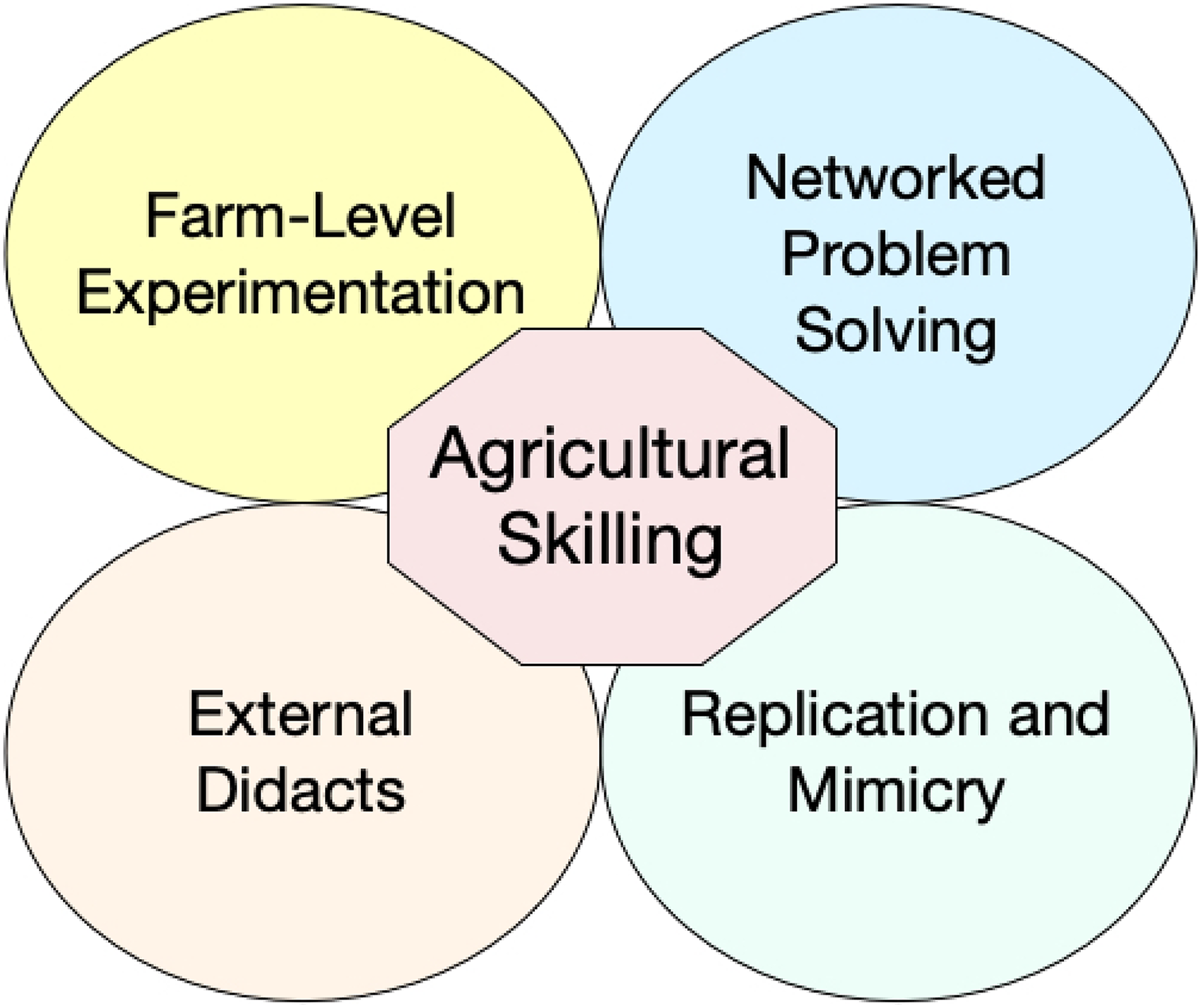
Social learning projected as a group or collective process has therein become fundamental to what Sumberg et al. characterised as “the participation agenda” in agricultural research (Sumberg, Thompson and Woodhouse, 2012). Notwithstanding its marginalisation in Stone's theory, there are strong reasons to provide a more critical examination of these dynamics to challenge some of the highly normative work within the field that tends to studiously ignore power dynamics in agricultural learning processes (Gardeazabal et al., 2023). To adequately capture these dynamics, we can usefully advance Stone's theory by adding the networked dimensions of agricultural learning that provide a vital middle ground between Stone's categorisation of environmental and social learning. Figure 1 below captures this expanded framework in which networked problem solving emerges a fourth modality of learning.
Agricultural skilling.
Two points stand out. First, these four elements are, of course, not independent. As our analysis of hybrid rice dissemination schemes in Karnataka demonstrated, model farmers might serve as exemplars for replication within a village while also actively working with relatively closed farmer networks on problem-solving issues arising from farm-level experiences. Equally, they are often sourced into the realm of external didacts, hired by agricultural extension or commercial agents to demonstrate new varieties, technologies or management strategies (Taylor and Bhasme, 2018). In short, all four elements of agricultural learning are tightly intertwined. By reintroducing the importance of networked learning, the essential permeability of each modality can be better understood.
Second, if learning is inherently a social process involving group and network dynamics, then the examination of social hierarchies, power relations and forms of inclusion/exclusion must constitute an essential element of analysis. As Scoones and Thompson emphatically warned, any discussion of farmer knowledge requires a thorough investigation of ‘who knows what’ through the analysis of differences in knowledge acquisition, adaptation, and diffusion by class, caste, gender and other social cleavages (Scoones and Thompson, 1994). To this end, Saurabh Arora's detailed study of village social relations and knowledge hierarchies within a participatory agroecological innovation initiative in Telangana demonstrate clearly how extant power differentials create considerable ‘lumpiness’ in knowledge transfer through community networks that are skewed along caste, gender and class differentials (Arora, 2012). These dynamics can regrettably be missed without a more expansive approach to the social dimensions of agricultural learning.
Beyond ‘agricultural knowledge’: Towards a theory of agrarian skilling
A second lacunae in Stone's general theory of learning is an overly restricted domain of what constitutes agricultural knowledge. Stone centres the locus of learning within the management of field-level agricultural production processes. Without doubt, on-field knowledge is vital to implementing effective agricultural strategies in challenging conditions. It allows farmers to demonstrate ‘sensitivity to the unfolding progression of farming operations and the vagaries of the weather during the agricultural season, so that he or she can monitor progress towards a successful harvest, detect emerging threats and opportunities, and be ready to make timely adjustments if things appear to be going wrong’ (Glover, 2018: 691). However, such on-field knowledge, learning and practice is only one part of the portfolio of skills needed to be successful in agriculture. As David Ludden notes, the fundamental character of farming is as a social activity involving relationships that extend widely across rural space (Ludden, 1999: 18). It is therefore important to recognise that agricultural knowledge does not begin and end on the field. Rather, knowledge of the social processes through which agricultural strategies become feasible is every bit as an important as knowledge of plant growth, soil quality, pest cycles, and other elements of a farming system.
The point here is not that farmer learning occurs in a social context. Rather, farmers must continually learn about the social context. Effective farming requires the ongoing accumulation of knowledge about the shifting social contexts, relationships and dynamics through which agricultural production becomes possible. In contemporary smallholder agriculture, farmers need to engage with merchants to sell goods, input dealers of various stripe to secure the means of agricultural production, diverse pools of potential labourers to secure a timely workforce, state bureaucracies that provide valued resources, and so forth (Pattenden, 2016). These are complex, evolving and challenging relationships that require skilled management season-over-season in a fashion similar to Glover's portrait of farmer's on-field activities above. Learning how to engage these social facets of agriculture are as much a part of agricultural skilling as being able to recognise an early outbreak of downy mildew in a pearl millet crop.
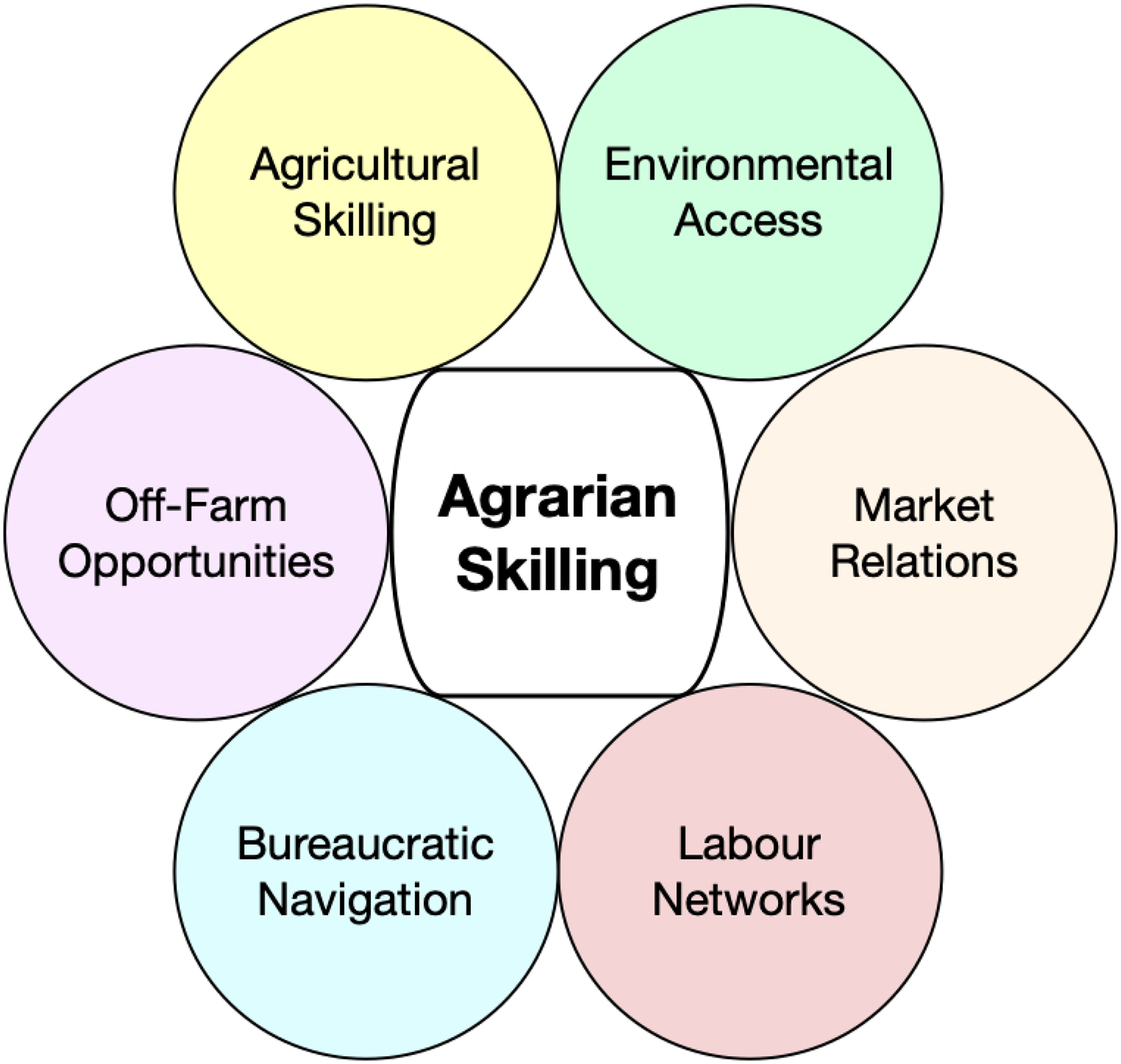
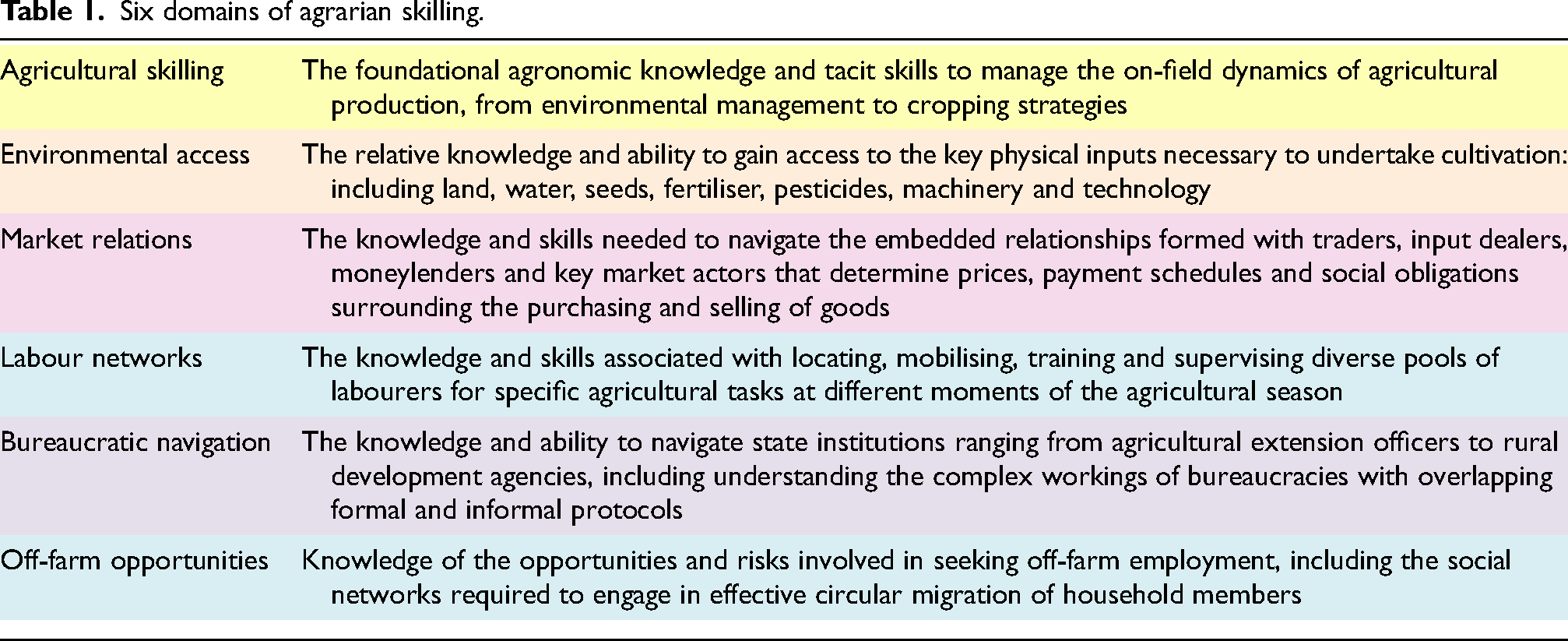
We term this expanded process of agricultural knowledge formation as agrarian skilling. This expanded concept denotes the relative ability and means for farming households to navigate the social contexts through which agricultural production and its associated livelihoods take place across the agricultural calendar. To do so requires acquiring information about opportunities, constraints and risks, while also developing the skills essential to bargain, negotiate and otherwise gain access to key resources and services. By synthesising a range of longstanding contributions to the field of agrarian studies, Figure 2 below highlights six domains in which agrarian skilling occurs. Table 1 then illustrates the key elements of each domain, demonstrating their fundamental importance to agricultural practice and livelihoods.
Schematic of agrarian skilling.
Six domains of agrarian skilling.
Expanding the remit of agricultural knowledge in this manner shifts our underlying conceptualisation of knowledge from an instrumental one to a relational one. This transformation is exemplified in David Mosse's (2005) seminal account of the consequences of a participatory development project in western India in which an NGO-driven project was intended to partner agricultural scientists with Adivasi farmers to coproduce new agricultural knowledge and develop locally adapted yet highly productive maize varieties. Despite the application of considerable resources and energies, Mosse concludes that the primary aim of the project—to coproduce knowledge leading to the development of new varieties for wide adoption—was a failure. Far more significant, however, were the unintended consequences of the project wherein the community underwent a process of agrarian skilling through its interactions with the NGO that enhanced its ability to interact with a range of local actors and agencies. Mosse wryly notes how community leaders learned and leveraged the very engagement techniques such as data-laden presentations that project implementers had used on them, turning these new skills outwards to negotiate with public health agents. As Mosse puts it, the knowledge generated within the project was not significant instrumentally in terms of direct benefits to agricultural production, but it was highly significant relationally for the connections and engagement skills that it facilitated (Mosse, 2014).
Mosse's example captures a key point about agrarian skilling: smallholders are not born with an innate ability to navigate these complex and changing social processes. They must learn to do so through a combination of direct experience, networked troubleshooting, emulation of other farmers, and being taught didactically through the intervention of outside agents, such as the NGO. In a heavily commercialised agrarian environment such as contemporary rural India, the ability to effectively engage these social relationships is a fundamental determinant of livelihood success that partially compensates for the undermining of environmental learning at a field level.
While all households evolve agrarian skilling strategies as a prerequisite to accessing varied forms of resources, there is no guarantee of success. In this respect, one of the signature advantages of becoming part of organic agricultural networks that Andrew Flachs highlights in his ethnography of cotton farming in Telangana was that, under the institutional backing of an NGO, farmers learned to perform roles that aided their ability to navigate agrarian social relations, therein providing valued skills to access valued resources (Flachs, 2018; Flachs, 2019). This can be particularly important for farmers of older generations who typically have little formal schooling and limited training in engaging complex institutional contexts. Indeed, for smallholders whose marginality restricts the process of agrarian skilling, a cycle of dependency on outside agents can quickly emerge. As Jonathan Pattenden has elaborated, rural India is replete with various levels of gatekeepers who capitalise on barriers to agrarian skilling among marginal classes by helping excluded households navigate the social terrain to ‘get things done’. This, however, comes at both a financial cost and/or various forms of social and political dependency, making gatekeeping a lucrative accumulation strategy for those with the appropriate skills and contacts (Pattenden, 2011). Such compromises, however, are typical for marginal smallholders wherein failure to adequately manage the social dimensions of farming escalates the risk of debt traps, distress land sales and an exit from agriculture (Harriss-White, 2008; Ramakumar, 2022).
Two further examples from our ongoing research in semi-arid Maharashtra help to exemplify these dynamics. First, one relatively affluent and politically important farmer that we interviewed boasted about how he never struggled to find agricultural workers despite neighbouring farmers complaining bitterly of regional labour shortages. Local people, he argued, willingly made themselves available to help on his farm at peak times of the agricultural cycle. This phenomenon undoubtedly reflected his highly leveraged role as a village gatekeeper who could ‘get things done’ through mobilising his resources and political connections. For local smallholders, a key component of their agrarian skilling was to position themselves as part of his social network through repeatedly volunteering their labour at no cost. The choice was stark. Being ‘adversely incorporated’ into the lead farmer's network that combined elements of reciprocity with dependency was preferable to being excluded (see Mosse, 2010). Incorporation provided the means to gather knowledge about new public programmes, farming techniques, changes to canal operations, and to learn how to engage with outside agencies. These elements were valued higher than the trade-off of providing in-kind labour commitments at the busy end of the year.
Importantly, the very commercialisation processes that Stone and Flachs rightly highlight as driving agricultural deskilling have upped the ante on agrarian skilling as a compensatory mechanism. With higher risks in agricultural production, effective mobilisation of resources through the wider agrarian environment is vital. Many marginal farmers, however, struggle to access the informal networks necessary to agrarian skilling owing to barriers that are heavily shaped by class, caste, kinship, gender and age. As a result, they can be excluded from a key modality of knowledge transfer, collective planning and opportunity recognition. This tendency was captured in the words of a scheduled caste farmer who commented about the prevalence of government schemes to transfer new technologies to farmers in Maharashtra: ‘Once marginal farmers learn about a new scheme it's too late. The elite farmers have already taken everything that's worth having’.
Focus groups with various smallholders confirmed these dynamics across rural development programmes. The clearest example came from the World Bank funded Programme on Climate Resilient Agriculture, which distributed heavily subsidised goods such as irrigation equipment, storehouses, farm ponds, tractors and pickups, throughout target villages in the region. In a strident example of elite capture, large farmers in the studied villages mobilised their knowledge of comparable programmes and their capacity to engage the bureaucratic system to extract considerable resources from this initiative. In contrast, many smallholder farmers had insufficient skills and resources to manage the complicated application process that was required, a factor compounded by a general absence of formal schooling for older farmers. As the programme drew towards closure, these farmers increasingly made informal deals with input dealers to apply on their behalf. In return for these gatekeeping services, they paid those dealers a cut of the subsidies available for the most elementary equipment available through the programme.
Conclusion
Through an engagement with Stone's general theory of agricultural knowledge production, this paper sought to advance our understanding of skilling and deskilling processes in smallholder agriculture in two primary ways. First, the paper identified a gap in Stone's analysis by highlighting the importance of social networks as a key modality of agricultural learning. We argued that social networks help drive forward processes of agricultural learning, yet often create enduring power dynamics and dynamics of inclusion/exclusion. In response, the paper offered a modified version of Stone's theory that seeks to enable a fuller engagement with the collective dynamics of technological change in agriculture (cf. Glover et al., 2019).
Secondly, the paper then emphasised the ways in which the concept of agricultural knowledge is typically restricted to on-field processes of learning. Placing the boundary of agricultural learning at the edge of the field has the unintended consequence of downplaying the social dynamics of farming despite their manifest importance to contemporary smallholder agriculture. In response, the paper advanced the concept of ‘agrarian skilling’ to help redress this balance. With this concept, we foregrounded the knowledge of and skills required to navigate the social processes surrounding access to environmental resources, market opportunities, diverse labour forces, government schemes and off-farm employment. These domains of learning and practice should be central to any comprehensive theory of agricultural knowledge.
On a practical level, the analytical framework of agrarian skilling may help to specify a key weakness in current agricultural improvement strategies that often focus on changing farmer behaviour through knowledge transfer. A failure to engage with the relative ability of smallholders to manage the social dimensions of agriculture repeatedly leads to underestimations of the risks involved with new technologies or management strategies (Glover et al., 2019; Sinclair and Coe, 2019). Governmental efforts to improve agricultural production can only improve their effectiveness only if they relax their focus upon agronomic knowledge transfer and consider whether farmers have the appropriate level of agrarian skilling to access and sustain new technologies and management strategies (Taylor and Bhasme, 2024). In this respect, the typology of agrarian skilling can help further the process of operationalising the “socio-economic niche” concept that seeks to incorporate the agro-ecological, socio-cultural, economic and institutional dimensions of smallholder agriculture within agricultural extension strategies (Descheemaeker et al., 2019).
Footnotes
Data availability statement
Data are contained within this article. The original contributions presented in this study are included in this article. Further inquiries can be directed to the corresponding author/s.
Declaration of conflicting interests
The authors declared no potential conflicts of interest with respect to the research, authorship, and/or publication of this article.
Ethical approval
Research conducted for this paper was approved by Queen's University General Research Ethics Board and required the informed consent of all participants.
Funding
The authors disclosed receipt of the following financial support for the research, authorship, and/or publication of this article: This research was funded by the Social Science and Humanities Research Council of Canada (SSHRC), grant number 1232014-435.
