




Abstract
African indigenous vegetables (AIV) have high densities of important micronutrients but qualitative and quantitative food losses along the value chains could threaten their nutritional potential in Africa. We conduct a systematic review of the estimations of food quality losses of AIV along their value chains. Our review reveals that there is generally limited evidence on food quality losses along AIV value chains. In addition, existing studies are often of low quality and have inadequate experimental descriptions. For our final analysis, we consider the yields and malnutrition-relevant nutrients for two major AIV, vegetable amaranth (Amaranthus ssp) and African nightshade (Solanum nigrum and Solanum scarbrum). We observe a consistent and substantial decrease in carotenoids and iron contents starting from selecting appropriate seed material to processing practices. Losses are particularly severe at seed selection and production. Almost half of the original potential is lost after cultivation for the reviewed nutrients. While qualitative losses appear to be significant during post-harvest, processing by consumers leads to comparatively small reductions. While our results suggest that the current value chains need to be improved to supply nutrient-rich foods to urban and peri-urban areas, better data are also needed to conduct more comprehensive assessments of nutrition-sensitive AIV value chains and to derive evidence-based interventions to reduce nutrient losses for AIV along the value chain.
Keywords
Introduction
Hidden hunger remains one of the greatest challenges for global food security, in particular in Sub-Saharan Africa (SSA) (Stevens et al., 2022; WHO, 2006). One potential way to reduce widespread micronutrient deficiencies is to increase local production and consumption of nutrient-rich and health-promoting vegetables (Bokelmann et al. 2022). In SSA, a wide range of leafy African indigenous vegetables (AIV) grown by smallholder farmers has gained prominence in recent decades (Shackleton et al., 2009). AIV are plant species whose primary or secondary center of origin is known to be in Africa and that are well adapted to local environmental conditions (Towns and Shackleton, 2018). AIV include, for example, species such as amaranth (Amaranthus ssp), African nightshade (Solanum nigrum and Solanum scarbrum), spider plant (Cleome ssp), cowpea leaves (Vigna unguiculata), pumpkins leaves (Cucurbia maxima, C. pepo), and jute mallow (Corchorus olitorius). Leafy AIV have been cultivated in SSA for centuries and were regularly grown in home gardens or as intercrops in fields but remained economically marginal for a long time (Brückner, 2020; Mwadzingeni et al., 2021). In the last two decades, it has been increasingly recognized that these vegetables contain higher levels of micronutrients compared to exotic vegetables (Yang and Keding, 2009) and also require less external inputs and are more climate resilient (Bokelmann et al., 2022). Due to these characteristics, AIV could have an important role in reducing micronutrient deficiencies in SSA in the context of climate change.
However, studies suggest that large nutrient losses along value chains limit the potential to provide nutrient-rich foods from AIV growing areas to urban centers in SSA (Gogo et al., 2017, 2018a). These losses occur throughout the value chain (Gustafsson et al., 2013), for example during selection of appropriate seed material, cultivation practices, post-harvest management and processing procedures. Specifically, the sector has been constrained by inadequate transportation and market infrastructure—particularly the absence of cold chain facilities—a lack of final processing capabilities, and insufficient cooperation along the value chain (Lenné and Ward, 2010). These challenges have also been widely documented in the horticulture sector of low-income countries in SSA over the past several decades (Lenné et al., 2005). The costs of these inefficiencies are high, even in countries with more developed infrastructure such as South Africa, annual food loss and waste amounts to about 2.1% of GDP, with the majority stemming from processing and distribution in horticulture (Nahman and Lange, 2013). While some countries such as Kenya and Senegal developed a successful export business for horticultural crops (Lenné et al., 2005; Van den Broeck et al., 2018), the production for the local market continues, however, to suffer from major inefficiencies during cultivation as well as along the value chain (Fabi et al., 2021). Recent estimates for other crops such as maize, sweet potato and cowpea suggest that reducing food losses along value chains could significantly improve access to nutritious food for populations in low and middle-income countries (Bechoff et al., 2022). Overall, while there continues to be a lack of high-quality data (Delgado et al., 2021; Fabi et al., 2021), the topic continues to emerge frequently as a major topic among policymakers to address food security in SSA (Sheahan and Barrett, 2017).
Similar to the broader context of the horticultural sector—and even the agricultural sector as a whole in SSA—there is a significant lack of evidence regarding both the magnitude and extent of quantitative and qualitative losses along the AIV value chain. This gap in knowledge limits our understanding of how effectively these vegetables can contribute to addressing the widespread micronutrient deficiencies faced by households, particularly those living outside regions where AIV are commonly grown. The lack of evidence also complicates the conceptualization and implementation of effective interventions. Identifying appropriate interventions to reduce dietary post-harvest losses is an important goal for effective and sustainable food systems, as also noted by the EAT-Lancet Commission (Willett et al., 2019). However, most studies focus on specific conditions, varieties, or individual stages of value chains, and few studies consider the entire value chain, encompassing the multiple conditions faced by the agricultural sector in SSA. In addition, divergent study designs complicate the comparison of findings across papers.
To address this knowledge gap, we synthesize the specific contributions of different papers on quantitative and qualitative, that is, nutritional, food losses from AIV along value chains based on a systematic review of the current literature. We draw on data from four different supply stages: selection of appropriate seed material (genetic diversity and origin), production (commercial and subsistence production with different cropping practices), post-harvest (storage, transport, and marketing), and processing (preparation for consumption, i.e. cooking, stewing, blanching and fermentation). We aggregate the experimental data from the reviewed papers to map the level of different nutritional indicators at each individual stage of the horticultural value chain. This allows us to examine standardized quantitative and qualitative losses across diverse settings along the entire value chain.
Our review reveals several insights. First, there is generally limited evidence on food quality losses along the value chain for AIV, in particular for AIV such as cowpea leaves. Second, existing studies are often of low quality and have inadequate experimental descriptions for comparative assessment. Third, for the included studies, we do find a consistent and significant decrease in carotenoids and iron contents from selecting appropriate seed material to consumption. Losses are particularly severe at seed selection and production. Almost half of the original potential is lost after cultivation for the reviewed nutrients. While qualitative losses appear to be significant during post-harvest, processing by consumers leads to comparatively small reductions. Our results contribute to studies on nutritional losses along food value chains in the Global South (Bechoff et al., 2022) and in particular to the growing body of literature on AIV value chains (Bokelmann et al., 2022; Gogo et al., 2017; Mwadzingeni et al., 2021).
Systematic literature review
For our review, we considered three major AIV in SSA, including vegetable amaranth (Amaranthus ssp), African nightshade (Solanum nigrum and Solanum scarbrum), and cowpea leaves (Vigna unguiculata). To obtain data, we conducted a systematic review of the literature using Google Scholar. The review process took place in July 2021. We included peer-reviewed papers, working papers, and conference presentations from 1990 onwards. The key words (including headings, subheadings, abstract, and keywords) were “amaranth,” “African nightshade,” and “cowpea.” These three keywords were combined with “yield,” “carotenoids,” “phenolic compounds,” “phenol,” “flavonoids,” “provitamin A,” “vitamin C,” “micronutrients,” “nutritional value,” “health value,” “food loss,” “food waste,” “seed systems,” “production,” “cultivation,” “post-harvest,” “processing,” “consumption,” “cooking,” “storage,” “transportation,” “packaging”. Titles and available abstracts were scanned regarding their relevance and articles requiring further consideration were shortlisted, and full papers were retrieved. To decrease the risk of missing relevant papers, we asked for papers from researchers that worked within a former large-scale research project “Hortinlea” on AIV (Bokelmann et al., 2022).
In total, we found 86 papers for amaranth, 255 papers for nightshade, and 267 papers for cowpea. Most papers used data from SSA but some also from Asia. We then categorized the papers according to the four stages of the value chain by applying the following allocation rules. Studies analyzing the genetic potential of different varieties for different nutritional indicators, but also for yield, were assigned to the seed system stage. Seed systems are commonly understood as the source of seeds, but we consider here the genetic potential that different varieties have and hence the potential that a well-functioning seed system would have if high-yielding varieties would be accessible to all farmers. Studies show that seed selection influences not only yield potential but also nutritional quality at early stages of the value chain. For example, Kamga et al. (2013) show that the iron content of five different African nightshade species of Solanum scrabum originating from different countries could range from 147.37 (±1.69) µg/g dry weight (DW) for seeds from Kenya and to up to 387.93 (±13.61) µg/g DW for seeds originating from Cameroon. Studies that reported cultivation practices such as water regime/irrigation, fertilization, and temperature conditions affecting plant growth, nutrient composition and yield were assigned to the production stage. These studies should also include immediate preparation of the sample for analysis using appropriate transport methods that should minimally affect plant characteristics, or direct freezing of the sample after harvest. Many of these studies took place under controlled conditions such as greenhouses. Studies that report prolonged transportation or storage after harvest or acquiring their sample from local markets were assigned to the post-harvest stage. This includes studies on handling, packaging, storing, and transporting the AIV after harvest. Finally, studies that prepared or processed their samples for final consumption including cooking, stewing, blanching and fermentation were assigned to the processing stage. We acknowledge, however, that, for instance, the bioavailable iron content of leafy vegetables can be increased by blanching. Overall, one challenge was that not all studies provided sufficient details about how the sample was obtained, so some studies had to be excluded, while assumptions had to be made for other studies due to limited information. Studies that measured nutrient density after processing, for example, may already have post-harvest losses due to improper handling or, conversely, may be subject to careful procedures that are not common among AIV value chain actors in SSA.
The nutritional indicators included malnutrition related compounds such as provitamin A, carotenoids, phenolic compounds, vitamin C, iron, zinc, and other minerals. Only papers that reported either nutritional losses along the value chain of the specified crops or specific levels of nutritional indicators at specific stages of the value chain were included. The results are reported in Table 1. We found only 22 studies that contained data relevant to cowpea leaves and decided to exclude this crop from our analysis. However, we found 37 studies on African nightshade crops and 44 studies on amaranth, giving a total of 74 studies, as some papers included data on both crops. In the end, we considered only four indicators for both crops due to the low numbers of papers. We selected the four indicators with the most papers across African nightshade and amaranth. These included vitamin C, carotenoids, iron and yield. For carotenoids, we included work measuring total carotenoid content, β-carotene, and lycopene content, as well as provitamin A including also α-carotene and β-cryptoxanthin as all these are considered the most important representatives in AIV. We also determined that for African nightshade, we only consider Solanum scrabum and Solanum nigrum, which are important leafy vegetables in the region, while for amaranth, no species/variety was excluded because a lot of species can be used as leafy vegetables in our study context.
Number of studies identified from the review of the literature.
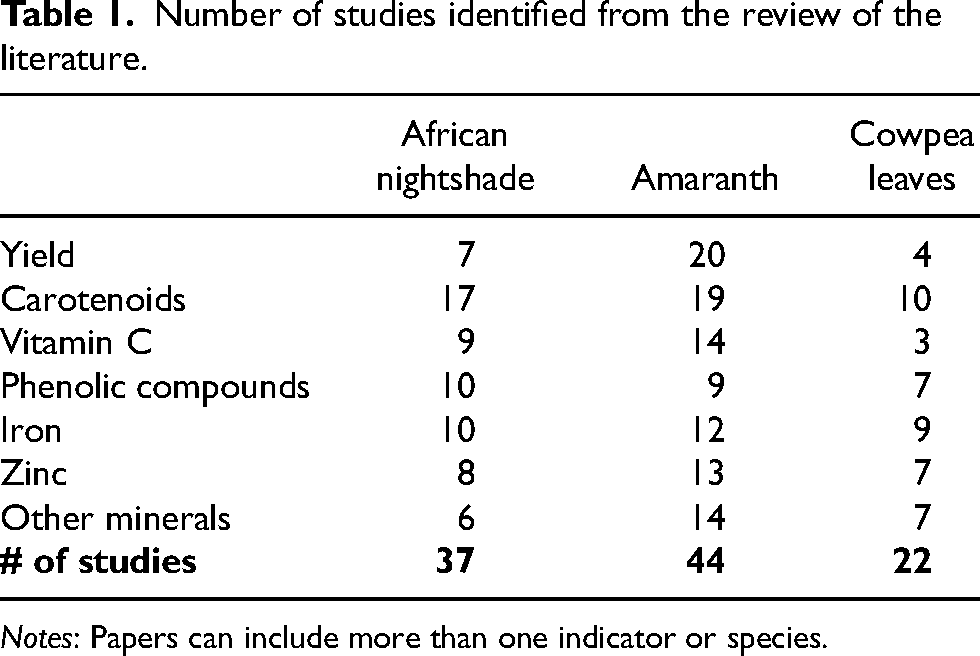
Notes: Papers can include more than one indicator or species.
For the four selected indicators, we found 66 studies for both amaranth and nightshade. In the next step, 16 studies were discarded because accurate data were not provided, units were unclear, key characteristics such as value chain stage were not identifiable, or the quality of the work was insufficient. When extracting data points from the literature, the following guidelines were applied for consistency. G1: If multiple treatments were given in one paper, they were counted separately. G2: If multiple intensities were given for a treatment, the average was used. G3: For the seed system category, the maximum achievable level reached by any variety was used. G4: If data were given for multiple countries, only countries in SSA were selected. A total of 50 papers with 195 data points were considered. For amaranth, 92 data points were extracted (Table 2). The majority of the data points concerns carotenoids with about 50%. Few papers were found dealing with nutrient contents during production. Table 2 also shows that 103 data points were extracted for African nightshade. Also in this case, most data were found for carotenoids with 47 data points. Compared to amaranth, considerably more studies were found that contained data for the production stage as well as for vitamin C. Yield as measured in kilograms per unit area is only relevant up to the production stage and has no relevance at the post-harvest stage, thus we only considered yield at the seed systems and production stages. In general, few seed system data were found for African nightshade, making a detailed comparison for this supply level across all indicators difficult.
Data points for amaranth and African nightshade.
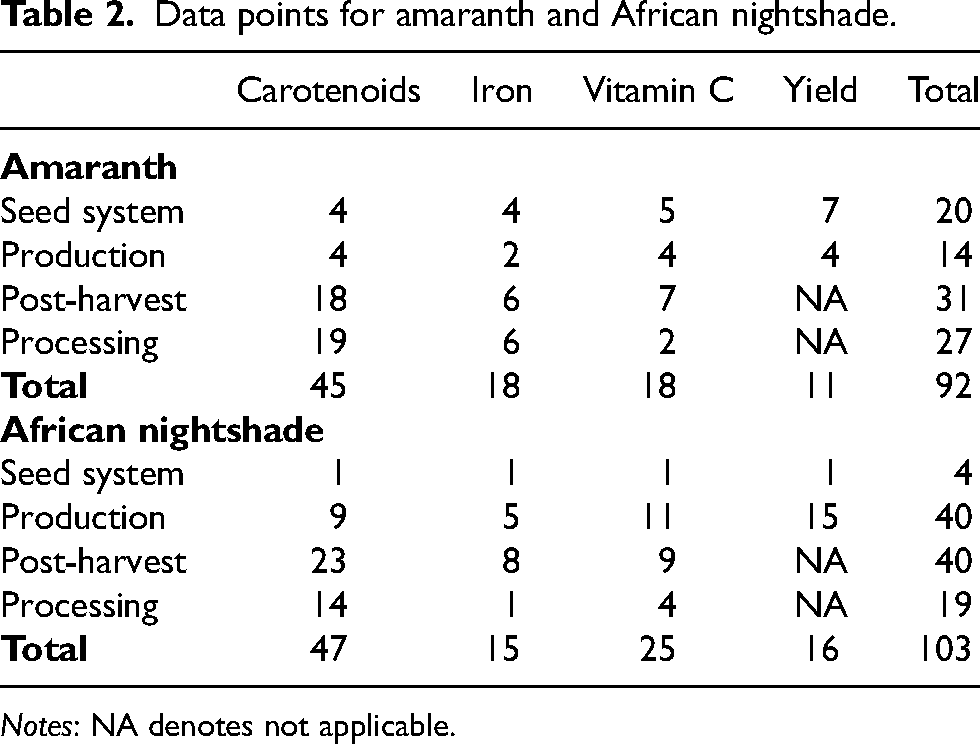
Notes: NA denotes not applicable.
For our analysis, we convert all values into fresh weight (FW) to provide nutritional related changes in compound compositions using the conversion factors of 0.12 (DW/FW) for African nightshade and 0.19 (DW/FW) for amaranth based on own experiments. Vegetables are known to have a substantial water content. The primary weight loss experienced from farm to market predominantly stems from water loss, with leafy vegetables being particularly susceptible to wilting. Based on the data of Gogo et al. (2017) on water loss, we extrapolate a cumulative weight reduction of approximately 40.98% between the harvesting and the marketing stage, derived from an aggregate average across three distinct sample regions in Kenya. We use these data to adjust our estimates from studies that report FW measurements at the post-harvest stages of the supply chain and where the plant material was sourced from markets. We also convert all nutritional values to mg/100 g FW and yield to t/ha. We exclude all data points greater or less than two times the respective standard deviation plus the mean of the data points in each category (2 crops × 4 supply stages × 4 indicators). To illustrate the distribution of our results, we use box plot diagrams for both crops. Finally, we create a percentage graph to aggregate the results for both crops. To this end, we specify that the average value obtained in the seed system represents the maximum value (100%), while the average of each subsequent stage is divided by the maximum value to illustrate the available share of each indicator in each stage. For the aggregation for both crops, we sum up the average of each indicator for each crop weighted by the respective number of observations.
Results
Figure 1 shows the qualitative and quantitative food losses of amaranth based on data points taken from the literature. For vitamin C, we observe a decrease until the end of the post-harvest period, but an increase after processing, based on two studies with relatively high vitamin C levels after processing. The increase after the post-harvest period is, however, not significant. For the other indicators, the Figure shows a steady decline throughout the value chain. In particular, we observe a significant decline between the production and post-harvest stages, suggesting strong losses during post-harvest processes. For carotenoids, for instance, levels decrease from 92.81 to 28.41 mg/100 g FW between production and post-harvest. We also find substantially higher iron content in amaranth during the seed selection compared to the post-harvest or processing stages. The contents decrease from 75.38 mg/100 g FW at the seed stage to about 11.66 mg/100 g FW at the post-harvest stage and 3.61 mg/100 g FW after processing. For quantitative losses, we find that yield decreases from 34 t/ha to 6 t/ha in in the seed system and production stage, respectively.
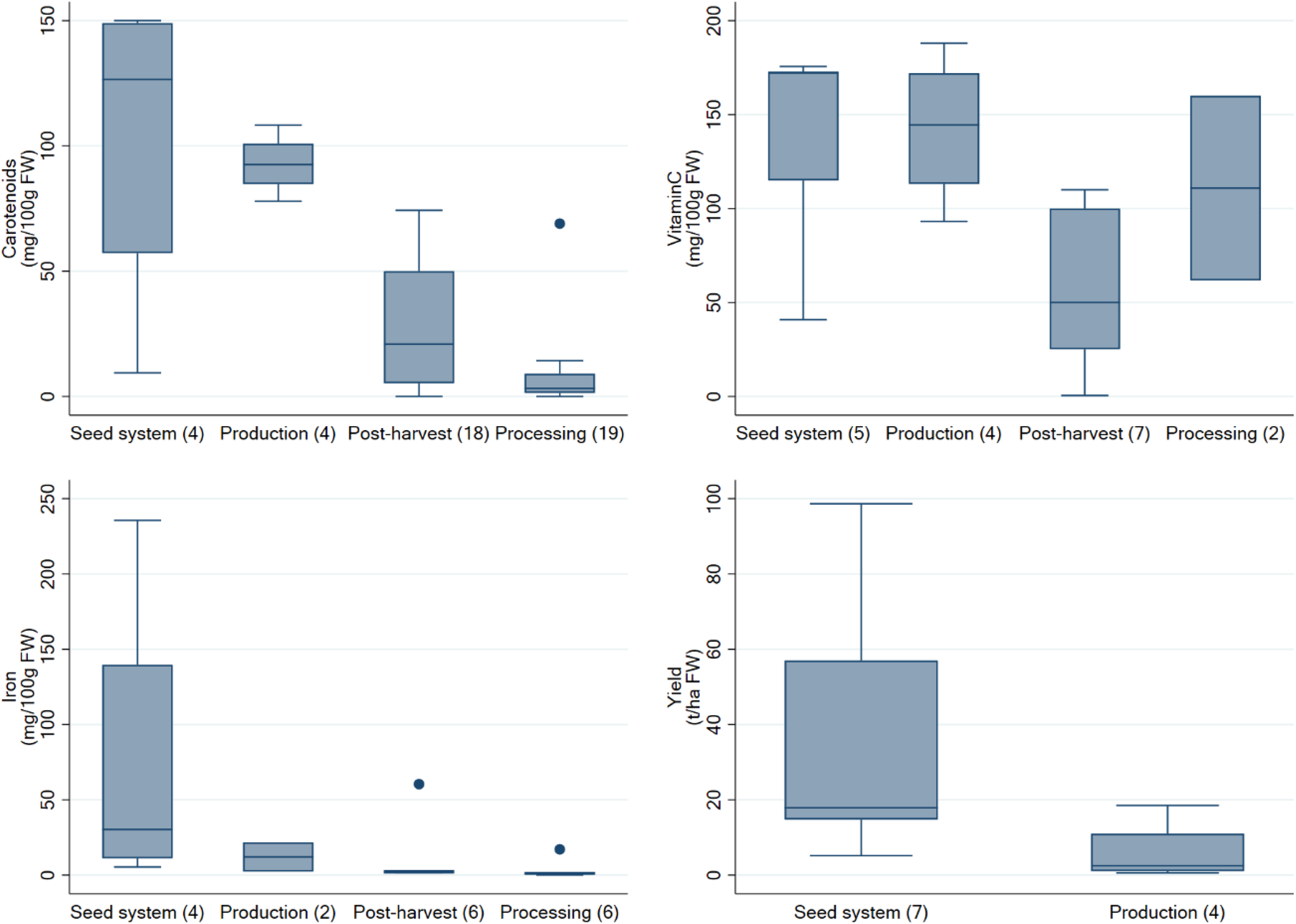
Qualitative and quantitative food losses for amaranth. Notes: Number of observations are in brackets. The box represents the interquartile range, which is the middle 50% of the data. The whiskers represent the variability outside the upper and lower quartiles excluding outliers.
Overall, we note large variations within the different indicators. The variation is extremely large when considering, for example, the content of carotenoids in the seed stage of amaranth or for iron in the seed system. These wide variations also explain why, despite a steady decline, we often cannot detect a significant difference between value stages.
Figure 2 shows the results for African nightshade. For carotenoids, no steady decline is observable, but the increase between production and post-harvest stage is not significant. For three indicators, including vitamin C, iron, and yield, we observe a more continuous decline along the value chain. For vitamin C, the contents decrease from 167 mg/100 g FW at the seed stage to 41.94 mg/100 g FW at the post-harvest stage. The mean for carotenoids decreases from than 119.41 in the seed system to about 17.74 mg/100 g FW after processing. Unlike for amaranth, no significant differences are observed between production and post-harvest due to large differences between the data elicited from the studies except for iron. No studies on iron processing were included because the only study found in the review process reported values that were excluded at a later stage as they were extreme outliers. For quantitative losses, we find that yield decreases from 24 t/ha in the seed system to 11 t/ha in the production stage.
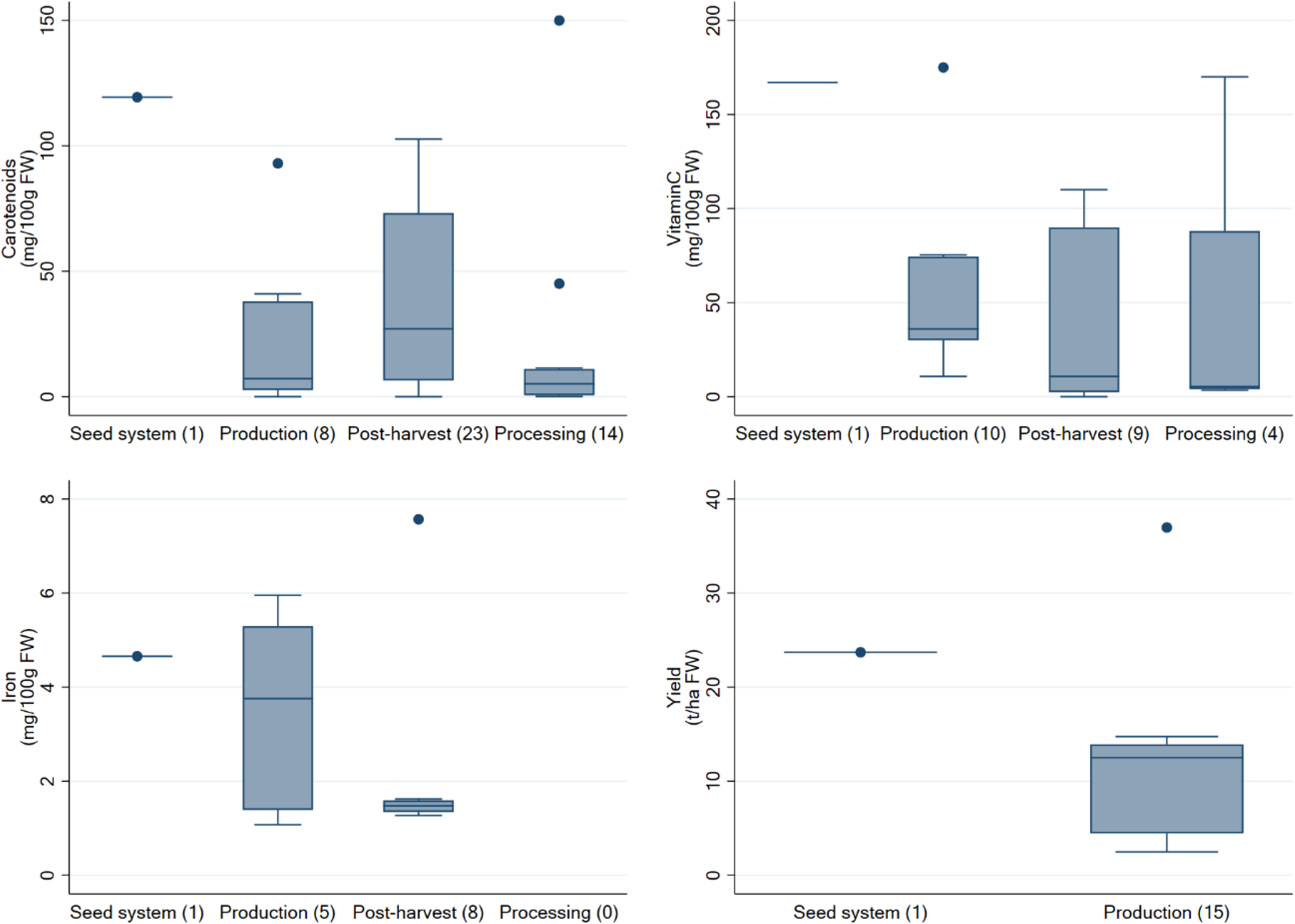
Qualitative and quantitative food losses for African nightshade. Notes: Number of observations are in brackets. The box represents the interquartile range, which is the middle 50% of the data. The whiskers represent the variability outside the upper and lower quartiles excluding outliers.
The most evident finding is again that we have large variation for each indicator similar as for amaranth. For carotenoids after post-harvest, we observe for instance values between about 1 mg/100 g FW up to 102 mg/100 g. These wide variations again justify why, despite an overall decline, we often cannot detect a significant difference between value stages.
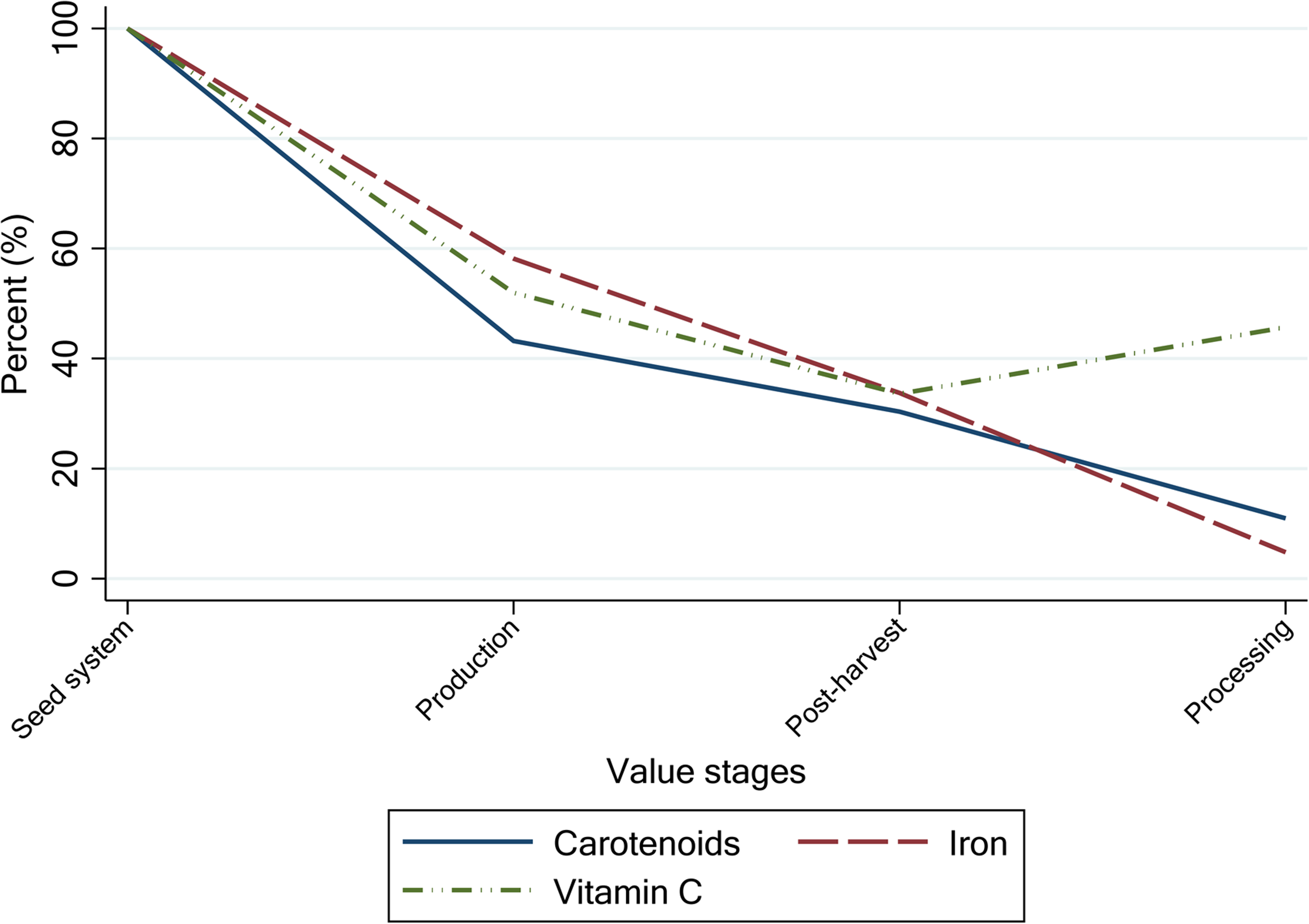
Figure 3 shows the aggregation across both crops and in percentages. The results show that a steady decline is observed for iron and carotenoids but not for vitamin C. The initial increase in Figure 2 that we observed for carotenoids in African nightshade are partly smoothed out by the larger number of observations. Overall, for all three nutrition related indicators, there is a strong decline from nutrient densities achievable through optimized seed selection to those observed after cultivation in the production phase. For all indicators, almost half of the original potential is lost after cultivation. After post-harvest procedures, nutrient densities decline even further, ranging from 30% to 34% of the original potential. After processing, nutrient densities range from 5% to 46%. However, only a few data points are available for this last stage of the value chain and in particular for vitamin C, the small number of available studies could have potentially resulted in an increase between the post-harvest stage and processing. Due to the great variation of different parameters in the reviewed literature, the dataset itself, and comparisons between the data, should be conducted with caution. Even considering only studies published in acknowledged journals did not reduce the large variations (see Figures A1 and A2 in the online appendix). The reasons for the large variations in the data will be discussed in the following section.
Discussion
Qualitative and quantitative losses of AIV along the value chain
Based on our extensive literature review, we observe a decreasing trend for most of our indicators of food quality. This is in line with our expectations and respective literature since after harvesting numerous changes in physicochemical and nutritional related properties of products occur, resulting in a decline in storability and shelf-life (Botton et al., 2019).
Our results reveal that studies investigating different
In addition, the results suggest that
For
In contrast, our results indicate that
Heterogeneity in agroecological conditions and cultivation practices
Starting with the seed system, the first difference between the accessed papers concerns the
Not only the prevailing agroclimatic conditions such as seasonality, rainfall patterns, temperature, and relative air humidity but also
Another challenge in comparing the nutrient content of AIV in the existing literature is the different
In addition, the
Food losses can also be minimized or exacerbated by various
Finally, another important consideration concerns potential differences in general
Heterogeneity in methodological approaches
The comparison of indicators across studies is also challenging due to the different methodological approaches. For example, for the determination of vitamin C, several completely different
Inaccuracies also occurred in
Apart from methodological differences, the high variation might be directly connected with
Conclusions
Our systematic review of the literature on food losses of AIV along the value chains in Africa yields several conclusions. Methodologically, there is generally limited evidence. For cowpea leaves, for example, no systematic analysis could be conducted due to the lack of data. However, data are also quite limited for amaranth and African nightshade crops. We found fewer than five data points for 13 of our 28 categories. Furthermore, many studies have inadequate descriptions for conducting a comparative assessment. Many studies incompletely report their experimental designs and analytical methods. To compare studies with each other, a complete methodological description is necessary and consistent and comparable methods for measuring different parameters need to be applied.
Despite the lack of evidence and quality issues with some studies, we conclude the following for food quality losses along the AIV value chain in SSA. First, we find a considerable loss of nutritional quality for most indicators reported in literature, however, also, widely varying in terms of their conditions and methods. Furthermore, we find consistent decreases in carotenoids and iron contents in amaranth and African nightshade across the value chains. While the results are not always consistent for both crops, they still suggest that the levels of these nutrients decrease considerably at different stages from seed system to consumption. Losses are particularly large at seed selection and production. For all indicators, almost half of the original potential is lost after cultivation. While qualitative losses appear to be significant during post-harvest, processing by consumers seems to imply comparatively small reductions. Although we cannot derive consistent data on quantitative losses during post-harvest until consumption across different studies, we find that the maximum yield achievable by selecting the most productive variety is substantially higher than yields observed in studies where optimal seed variety selection was not conducted and non-optimal cultivation practices have been applied.
One caveat of our study is that the different stages of the value stage are still rather coarse. We cannot, for instance, determine if the large observed losses after cultivation are due to the selection of seed material or inappropriate cultivation methods. In addition, while we tried to reduce biases through aggregating a relatively large number studies, data points elicited for the later stages of the value chain could already suffer from large biases since the handling during production and post-harvest is likely to be different for each study.
Due to the relatively high nutritional and health-promoting contents of AIV compared to many other vegetable crops such as kale and collard, increased AIV production and consumption could have the potential to reduce widespread micronutrient and vitamin deficiencies in SSA. However, to assess the potential contribution of local AIV production to addressing hidden hunger in SSA, researchers need accurate and well recorded data on the area planted, the amount harvested, and the initial micronutrient content at the time of harvest, losses along the value chain, and, in addition, accessibility, bioavailability, and specific micronutrient and vitamin deficiencies in the population.
While our results suggest that the value chains exhibit quantitative and qualitative food quality losses, we cannot say much about the potential of AIV growing regions in SSA to supply nutrient-rich foods to urban and peri-urban areas. To develop sustainable and nutrition-sensitive food systems, better data and better records are needed to assess the specific qualitative food losses at each stage of the AIV value chain to design appropriate interventions to address current deficiencies in the AIV value chain. Reducing food losses along value chains also contributes to SDG 12.3, which aims to reduce global per capita food losses and waste by 50% by 2030. Better data are also important considering current debates about food system transformations to healthier, more sustainable, equitable and resilient food systems. In this context, concepts of agroecology are gaining importance. Nevertheless, cropping systems such as AIV farming, which broadly resemble the principles of agroecology and including cultural appropriate food, climate resilience, and low external inputs, remain under-researched.
Supplemental Material
sj-docx-1-oag-10.1177_00307270251314520 - Supplemental material for Quantitative and qualitative food losses of African indigenous vegetables along the value chain: A systematic literature review
Supplemental material, sj-docx-1-oag-10.1177_00307270251314520 for Quantitative and qualitative food losses of African indigenous vegetables along the value chain: A systematic literature review by Christoph Kubitza, Ann-Marie Kalla-Bertholdt, Susanne Huyskens-Keil and Tilman Brück in Outlook on Agriculture
Footnotes
Acknowledgments
The study is part of the project Social Cohesion, Food and Health: Inclusive Food System Transitions (IFST) being supported with funds from the Excellence Initiative of the Federal Government and the Länder by the Berlin University Alliance (BUA).
Declaration of conflicting interests
The authors declared no potential conflicts of interest with respect to the research, authorship, and/or publication of this article.
Funding
The authors disclosed receipt of the following financial support for the research, authorship, and/or publication of this article: This work was supported by the Excellence Initiative of the Federal Government and the Länder by the Berlin University Alliance (BUA), Germany. This work was also funded by the German Federal Ministry of Education and Research as part of the joint project “food4future.”

Supplemental material
Supplemental material for this article is available online.
References
Supplementary Material
Please find the following supplemental material available below.
For Open Access articles published under a Creative Commons License, all supplemental material carries the same license as the article it is associated with.
For non-Open Access articles published, all supplemental material carries a non-exclusive license, and permission requests for re-use of supplemental material or any part of supplemental material shall be sent directly to the copyright owner as specified in the copyright notice associated with the article.
