




Abstract
Gene editing has the potential to make new crop varieties faster and more efficiently. New and more suitable crop varieties can increase sustainable agriculture, for instance, in the form of disease-resistant varieties that facilitate integrated pest management. The European Commission's proposal on the regulation of gene-edited and cisgenic plants produced with New Genomic Techniques (including CRISPR/Cas) has re-opened the discussion on Intellectual Property Rights on plants in Europe. We provide an overview of the possible impact of patent rights and Plant Variety Rights on the availability of technology and gene-edited alleles to breeders on an European level. We highlight potential problems with the two Intellectual Property Right systems and indicate potential avenues to solutions.
Introduction
Breeding of new varieties is done using conventional breeding methods, including crossing and selection. Various techniques have been developed to increase or fix genetic variation, and to enhance precision or speed of breeding. Random mutagenesis techniques, which employ radiation or chemicals, increase the genetic variation available for breeding. These mutagenesis techniques are exempted from the genetically modified organism (GMO) legislation (Directive 2001/18/EC) in the European Union (EU). Mutations can also be introduced using new targeted mutagenesis techniques, such as CRISPR/Cas. CRISPR/Cas is one of the new genomic techniques (NGTs), also called new plant breeding techniques. Applications of NGTs in plant breeding have been placed under lighter regulatory regimes in large parts of the world (ISAAA Inc., 2024). In the EU they remain under the EU GMO Directive as ruled by the European Court of Justice in 2018 (Case C-528/16).
NGTs are a valuable addition in the breeder's toolbox for developing gene-edited (GE) or cisgenic crops (Schaart et al., 2021), and can contribute to increasing the available crop varieties to growers, including disease-resistant varieties allowing integrated pest management systems (Barzman et al., 2015; Depenbusch et al., 2023; Dolatabadian et al., 2022). NGTs can generate targeted mutations, such as deletions, inversions or insertions, leading to a new variant of the gene in a certain genetic background, which we refer to here as a new ‘GE allele’. NGTs can also be used to make targeted insertions of larger DNA fragments. These can either be transgenes from a non-crossable species, or cisgenes from a crossable species. The latter tends to be more acceptable from a societal viewpoint (Lotz et al., 2020) since the same result can be obtained by crosses and selection. Cisgenesis is included in the proposal of the European Commission for an adapted regulation of plants produced using NGTs published in July 2023 (European Commission, 2023a). Ultimately, the effectiveness of NGTs depend on the knowledge of which genes to modify, and how to modify them, to achieve a certain phenotype.
Intellectual Property Rights (IPR) can stimulate the development of new products or technologies by providing protection to the innovation regarding its use, and by generating revenue to earn back investments in research and development (Kim et al., 2024), although their need for crops is contested by others (Glenna, 2023). In plant breeding, various forms of IP protection may be used. This note will discuss the use of Plant Variety Rights (PVR) (also called Plant Breeder's Rights) and European patent law in plant breeding, but note that there are other forms of protection, including trademarks and copyright protection (Smulders et al., 2021).
New alleles derived from ‘essentially biological processes’, such as crossing and selection, are not patentable (see Box 1), but a ‘GE allele’ developed using NGTs is patentable when the ‘GE allele’ can be introduced in more than one variety. However, these new alleles may be identical to those that could be found in germplasm (including wild relatives), having been generated spontaneously (or by random mutagenesis), and thus, without knowledge of the underlying process, may be indistinguishable from native (natural) traits. In addition, the detection of a ‘GE allele’ might be difficult due to small changes introduced. Note that the ability to detect a ‘GE allele’ is a separate issue from patentability of a modification, and is outside the scope of this article.
Here we will look at how patents or PVR can contribute or hinder access to new plant varieties made using NGTs. The advantages and disadvantages of both IP systems are presented from the viewpoint of a plant breeder. Potential solutions are given regarding freedom to operate for breeders, while also generating sufficient revenue.
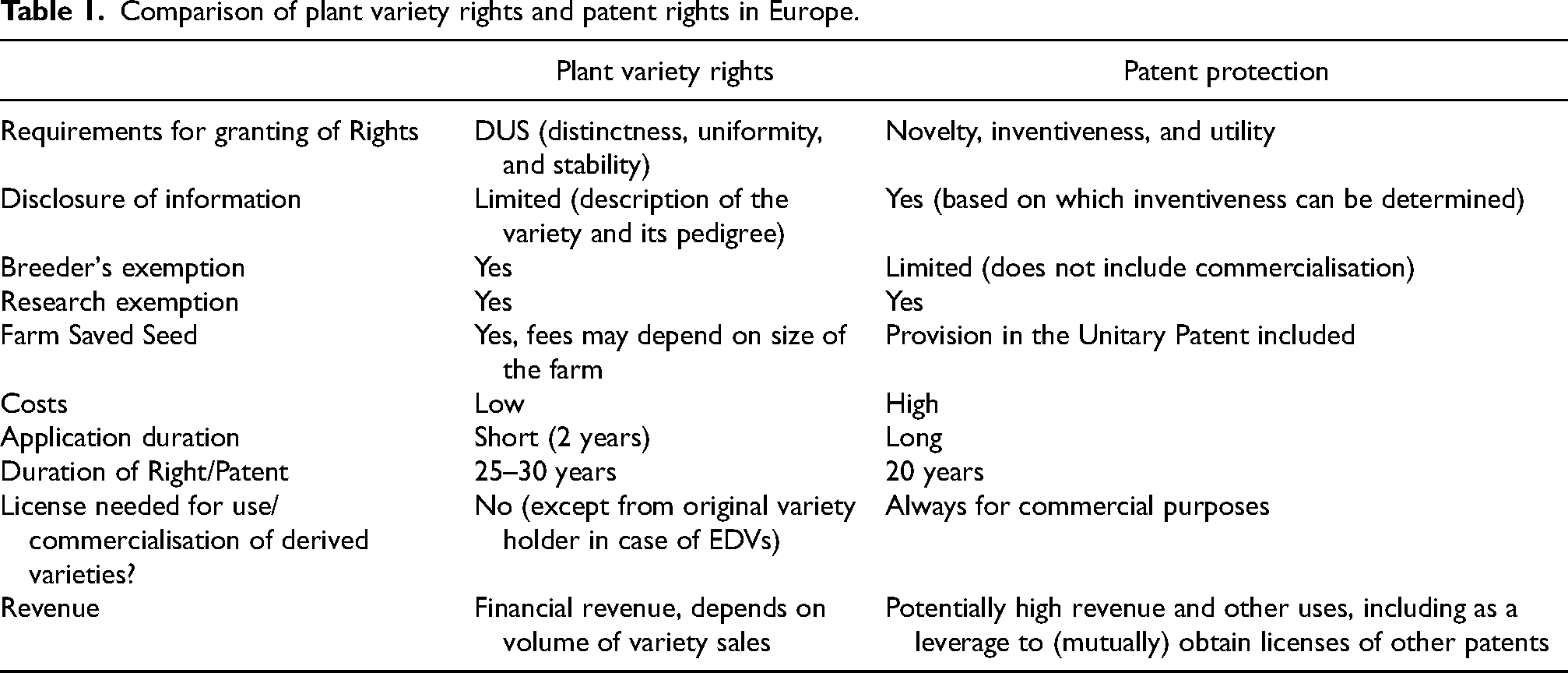
Explanation of main concepts (see also Table 1)
Plant variety rights
Plant varieties have their own protection system in the form of PVR. These rights are based on the UPOV (Union pour la Protection des Obtentions Végétales) Convention (and the resulting Article 27(3)(b) of the TRIPS agreement), first adopted in 1961, and revised in 1972, 1978 and 1991. Under these rights, only novel plant varieties can be protected, and they need to adhere to the distinctiveness, uniformity and stability (DUS) standards set out in the Convention.
In the European Union, PVR can be applied for nationally or at European level through the Community Plant Variety Office (CPVO). An applicant cannot register a variety at European level when another variety that is similar already has obtained national PVR. When applying at CPVO, CPVO decides where distinctiveness, uniformity and stability (DUS) testing of the variety takes place and grants PVR under Council Regulation No 2100/94 (EUR-Lex, 1994). PVR is valid for 25 years (30 years for some crop species including fruits (apples, grapes) and potato). Growers have to pay for PVR of protected varieties. Usually, this is done in the form of a fee that is included in the price of the seeds or plant. Paying this fee allows using the protected variety in the food production system and selling the harvest on the market.
There are three exemptions in the European PVR regulation that allow the free use of the protected plant variety. The first two exemptions involve the use of the protected variety for private and non-commercial purposes, and the use for experimental purposes. The third exemption allows the use of the variety for breeding, or discovering and developing new varieties. This is also referred to as the breeder's exemption. This exemption is not restricted to the breeding process itself, but also allows the new variety to be commercialised under its own PVR. That means, in effect, that PVR protect a particular combination of traits, but not the genetic material itself.
Another provision from the UPOV Convention is the Agricultural Exemption or Farm Saved Seed (also called Farmer's Privilege). This provision allows seed to be propagated and used on the same farm, but it cannot be commercialised (i.e. sold). While the first three exemptions are mandatory under the UPOV 1991 Convention, the Agricultural exemption is voluntary. Therefore, the extent of the provision differs among countries.
Essentially derived varieties
The fourth revision of the UPOV Convention in 1991 introduced the concept of ‘Essentially Derived Varieties’ (EDV), which covers varieties that only slightly differ from the original variety and for which less breeding effort was done (Lawson, 2016). For example, plant varieties developed using random mutagenesis techniques are often EDVs (Krieger et al., 2020; Yu and Chung, 2021). EDVs get their own PVR, but for commercialisation an agreement from the owner of the original protected variety is necessary. Like all new varieties, EDVs are determined based on phenotypic characteristics and these include mutants of existing varieties, but otherwise the EDV concept is not precisely defined in the UPOV guidelines (Ekvad, 2022; Kock, 2021a; Lawson, 2016), and discussions on a precise EDV definition are ongoing (Kim et al., 2024) (see ‘Discussion’). MacDonald and Jamali (2024) delve deeper into the complexity of defining EDVs and offer potential solutions such as determining plant varieties from EDVs based on their genetic background.
Patents
Patent protection is a generic system for inventions that are defined as being novel, inventive and industrially applicable. Patents are granted by national patent offices, or by the European Patent Office (EPO) on the basis of the European Patent Convention (EPC) and the Implementing Regulations (including the EU Directive on the legal protection of biotechnological inventions (Biopatent Directive 98/44/EC) (EUR-Lex, 1998)). Applications can also be made through the WIPO (World Intellectual Property Organisation) and in Europe evaluated through EPO or national patent offices. Patents are valid for 20 years.
Until recently, patents were granted nationally, and not on a European level. On the 1st of June 2023, the ‘Unitary Patent’ came into force through the Unified Patent Court Agreement in the European Union (2013/C 175/01). This was designed to enable universal patent rights in all Member States of the EU based on EU law. The Unitary Patent does not extend to non-EU Members of the EPO, and some EU Member States (notably Spain and Poland) have opted out of the Agreement. The Agreement is therefore initially in effect in only 17 EU Member States (European Commission, 2023b). The Unitary Patent reduces costs, while being effective in more countries. Countries that have opted-out object to the fact that the patent needs to be applied for in English, French, or German only, or they fear that European patents will overflow their national market.
A plant variety can be protected by PVR but cannot be patented in the EU (this is slightly different in the US as it has a special system called ‘plant patent’ for variety protection in asexually reproduced crops) (USPTO, 2017). Innovative plant traits that can be integrated in more than one plant variety can, however, be considered inventions and are therefore patentable (Ekvad, 2022; European Patent Office, 2024a). The applicant needs to describe what the invention entails and formulate claims defining for which elements of the invention protection is desired. Direct use of the patented material is only allowed with permission (in the form of a license) from the original patent holder.
The characterisation and introgression of a trait using NGTs in itself implies that the genetic sequence (coding for the trait) can be introgressed in any genome and therefore is patentable. Apart from more general discussions about patentability of living organisms such as plants, there are no technical issues at the EPO about patenting transgenic plants, as they are seen as the products of a technical intervention in the plant's genome (leading to novel traits). Whether producing an allele that already exists in the germplasm using NGTs in a new genetic background is or will remain sufficiently innovative (novelty criterium), remains to be determined.
Most genetically modified varieties carry transgenic events that have been patented. When a grower buys the seeds, the price includes the fee for both the PVR and the patents included, for producing a harvest. The same mechanism may be used for plant varieties that have patented ‘GE alleles’.
There are several exemptions in European patent law that are consistent with exemptions in PVR; these are the exemptions for private and non-commercial use, and for research purposes. Before the Unitary Patent came into force, the research exemption differed between European countries (Jaenichen and Pitz, 2015). There is a limited breeder's exemption, which allows the use of a plant variety protected by a patent in breeding programmes to discover and develop new plant varieties (Kim et al., 2024). However, the resulting variety cannot be commercialised without obtaining a license from the patent holder (Kim et al., 2024). Thus, it is a limited breeder's exemption, instead of a full one as in PVR where commercialisation of the new variety is allowed.
Patents and plant varieties
Plant varieties are explicitly excluded from patent protection in Europe according to the EPC and EU Directive 98/44/EC (see Box 2). Although traits found in nature or derived from crosses and selection are not patentable, patent lawyers have been creative in applying for innovative patents that, in effect, may come close to patents on native traits. When applying for a patent on a trait that can also be discovered in nature or through crosses and selection, a disclaimer is needed that specifies that the same native trait is not patentable. The applicant thereby actively acknowledges that using the native trait is not an infringement upon the patent. This disclaimer is compulsory in relevant patent applications in Europe after the 1st of July 2017 (see Box 2), but it does not apply to patents filed before this date (European Patent Office, 2024a). If such a disclaimer is not added by the applicant, the patent application can be rejected. A disclaimer is not needed on transgenic traits, since these traits can only be produced using a genetic technique (Ekvad, 2022; European Patent Office, 2024a).
Patents on traits derived from ‘essentially biological processes’
There has been an extensive debate in Europe about patent protection on native traits in plants. Upon a resolution of the European Parliament in December 2015 (2015/2981) and a November 2016 paper by the Commission, the Enlarged Board of Appeal (EBA) of the EPO decided to stop granting patents (enforced in 2017) on native traits in plants based on an updated interpretation of the exclusion from patentability of ‘essentially biological processes’ for the production of plants (Article 53(b) (European Patent Office, 2024b) and Rule 28(2) (European Patent Office, 2024c) of the EPC and Article 4(1)(b) Directive 98/44/EC). ‘Essentially biological processes’ refer to breeding methods such as crosses and selection (Article 2(2) Directive 98/44/EC) for the production of plants, and this also excludes the products of those processes from patentability.
This decision was made after several rounds of appeals cases concerning marker-assisted breeding starting in 2010 with the G2/07 (‘broccoli’ where a method of production (including crosses and selection) and molecular markers to identify desired hybrids are patented) and G1/08 (‘tomato’ where production of wrinkled tomatoes by crosses and selection, reducing the water content in the fruit while on the vine and subsequent screening, is patented) (Godt, 2018). In a follow-up decision of the EBA in the ‘broccoli’ (G 2/13) and ‘tomato’ (G 2/12) cases in 2015, it was been confirmed that ‘essentially biological processes’ of crosses and selection remain excluded from patentability. However, at the time, the decision further indicated that plant products were eligible for patenting, if conforming to the conditions of novelty, inventiveness and industrial applicability, even when the underlying methods are not eligible under the EU Biotech Patent Directive 98/44/EC. With EBA opinion G3/19 on ‘pepper’, also the possibility of patenting plant products based on native traits came to an end (European Patent Office, 2020).
Using plants freely in further breeding and commercialisation is not possible when a trait is patented, in contrast to the breeder's exemption in PVR. This raises concerns for plant breeders, as they would be reluctant to use varieties with a patented trait in their own breeding programs. A limited breeder's exemption in the Unitary Patent allows breeding with a variety containing a patented trait, but it does not include commercialisation. This provision already existed in French, German, Swiss, and Dutch patent law (Van de Wiel et al., 2016). As Kim et al. (2024) rightly mention, it is unlikely that a breeder will put in time and money based on this limited exemption when obtaining the license for commercialisation of the variety developed is uncertain. Kock (2021b) argues that the (limited) breeder's exemption stops functioning once multiple patented traits, from different owners, are present in a single variety that is used as a parent in a breeding program. The breeder will have to navigate with multiple patent owners, which can be complicated. The cost of multiple licences will be included in the price of the seed, but it remains to be seen if that price is reasonable or not for farmers. The payment of royalty fees under Farm Saved Seed might also become complex when a variety contains PVR and multiple patents, as farmers up to now only deal with the holder of the PVR on the variety, while this holder might not be the representative for all other patent owners (Kim et al., 2024).
According to Ekvad (2022), there were also considerations to include an Agricultural exemption before the Unitary Patent was adapted in the EU. The final Agreement on a Unified Patent Court signed by the European Council (2013/C 175/01) does include several exemptions (Article 27 Limitations of the effects of a patent). Exemptions which are interesting for plant breeders are the following: ‘acts done privately and for non-commercial purposes, acts done for experimental purposes (…), the use of biological material for the purpose of breeding, or discovering and developing other plant varieties’. Another relevant exemption does resemble the Agricultural exemption as under PVR: ‘the use by a farmer of the product of his harvest for propagation or multiplication by him on his own holding (…)’. Based on these exemptions, it is apparent that an attempt has been made in the Unitary Patent to enable breeders and farmers to use protected plant varieties, in a similar fashion as under European PVR. However, an essential difference remains as commercialisation of new varieties is not allowed under the patent system without a license.
Access to CRISPR/Cas foundational (basic technology) patents
Gene editing can be done using various technologies, notably Zinc Fingers, TALENs and CRISPR/Cas. While the IPR situation for the first two technologies is straightforward, the IPR situation for the use of CRISPR/Cas9 is complex. The foundational patents on the use of CRISPR/Cas9 as a technology in eukaryotic cells are being contested between The Broad Institute at Massachusetts Institute of Technology (MIT) (lab of Feng Zhang) and the University of California, Berkeley (UCB) (Jennifer Doudna and Emmanuelle Charpentier, Nobel Prize winners in 2020 for developing gene editing using CRISPR/Cas9). The patent held by the latter is collectively called ‘CVC’ (for the Regents of the University of California, the University of Vienna, and Emmanuelle Charpentier). In the United States, ‘CVC’ was the first to file a basic patent at the USPTO (United States Patent and Trademark Office) for CRISPR in any type of cell, but The Broad Institute used a fast-track procedure during patent filing for the application in eukaryotic cells. At the time of filing (May 2012 for UCB and December 2012 for The Broad Institute), the ‘first-to-invent’ counted and not the first to file (this was changed in March 2013 and the ‘first-inventor-to-file’ is now followed) (Schinkel and Schillberg, 2016). After examination the court ruled in favour of The Broad Institute on February 28, 2022 (Ledford, 2022). However, since ‘CVC’ has contested this decision, the fight could still go on for years. Other parties have also stepped in, but the claims by ToolGen and Sigma-Alrich were rejected by the USPTO (Martin-Laffon et al., 2019). It is unlikely the dispute will reach the Supreme Court, as there are apparently no fundamental patenting issues at stake (Ledford, 2022).
The foundational patent issues may be settled differently in the EU compared to the United States, which may lead to legal uncertainty or the need to license with multiple applicants to exploit varieties with traits developed with NGTs. The EPO judged in favour of ‘CVC’, as The Broad Institute's application faltered due to an administrative issue, namely the failure to obtain written consent from one of the inventors who was removed from the original application (Ledford, 2022). In addition, in Europe, third-party observers are allowed to contest the novelty of a patent claim, as was done to the initial fillings for CRISPR patents by The Broad Institute (Brinegar et al., 2017; Kupecz, 2014).
Patent application on GE technology and traits in the EU lags behind China and the United States (Martin-Laffon et al., 2019; Ricroch et al., 2022), likely reflecting the precautionary approach in regulation of GMOs in the EU (Directive 2001/18/EC and Regulation 1829/2003 on genetically modified food and feed), the history of the few applications for obtaining authorisation for cultivation that all failed except for the early transgenic Bt maize MON810, and the judgement on targeted mutagenesis by the European Court of Justice in 2018 (Case C-528/16) stating that GE falls under the regulatory scope of GMOs. An amendment of the regulation, as recently proposed by the European Commission, may have a positive effect on technology development (Ricroch et al., 2022), especially considering that the current GMO Directive is largely beneficial to larger companies that can navigate the regulations (Kim et al., 2024).
License agreements and legal uncertainty of CRISPR foundational patents
Anyone that wants to use a product containing a patent or patented technology needs to obtain a license. The license for using technology and the cost thereof may be automatically included when buying laboratory equipment (e.g. molecular kits). Licenses for broader use may be granted by the owner under exclusive or non-exclusive schemes. Under an exclusive license, only the named licensee can use the relevant IPR. Companies usually grant non-exclusive licenses when it comes to non-commercial research and tool development (Contreras and Sherkow, 2017). The licencing program used by universities regarding CRISPR IP can be compared to other breakthrough technologies such as the production of recombinant DNA in bacteria (Cohen-Boyer patents), the invention of co-transformation of eukaryotic DNA (Axel co-transformation technology) or the discovery of small interfering RNA (siRNA) (Egelie et al., 2016).
The divide in claims on foundational IPR for CRISPR/Cas has led to different ways of investing in breeding applications in agriculture. Large multinationals have taken licenses from multiple owners such as The Broad Institute and UCB to prevent legal uncertainty (Ferreira et al., 2018). DuPont Pioneer licensed CRISPR IP from The Broad Institute in October 2017, and subsequently licensed it to several other (smaller) companies, including the Dutch vegetable company Bejo (Bejo, 2021), the Californian company Amfora (Feedstuffs, 2019) and the potato breeder Simplot (Simplot, 2018). DuPont also has an exclusive license from Vilnius University and from Caribou Biosciences (Grushkin, 2016; Schinkel and Schillberg, 2016), which is the surrogate licensing company of UCB/Jennifer Doudna. DuPont Pioneer licensed CRISPR for use in major crops such as corn and soybean, while Caribou Biosciences focused on fruits and vegetables (Egelie et al., 2016; Grushkin, 2016). Dow and DuPont merged in 2015 and Dow-DuPont's agricultural division Corteva Agriscience became a standalone company in 2019. Through this merger and the acquisition of Danisco in 2011 by DuPont, DowDuPont has become one of the largest player in the licensing landscape (Ferreira et al., 2018). Bayer licensed from ERS Genomics, while other large companies, such as Monsanto (before being acquired by Bayer in 2018), BASF and Sigma-Aldrich licensed from The Broad Institute (Contreras and Sherkow, 2017). Another contender for CRISPR patents, ToolGen, licenses to Thermo Fischer Scientific for research applications (Grushkin, 2016). Calyxt obtained a license from the University of Minnasota to use the CRISPR/Cas technology in plants (Egelie et al., 2016; Ferreira et al., 2018).
To circumvent licensing schemes, small technology providers could build their business model on alternative GE systems or could even aim at developing their own CRISPR systems (Ricroch, 2024). The Broad Institute mentions on its website (Broad Institute, 2014) that CRISPR tools, knowledge, methods and other IP for gene editing are freely available for research and UCB has also made their CRISPR technology available for non-commercial and research purposes through Addgene, thereby promoting academic research and tool development (Contreras and Sherkow, 2017; Egelie et al., 2016), since such provisions are not build-in in United States patent law (Brinegar et al., 2017; Kupecz, 2014; Prifti, 2015). Wageningen University & Research has announced that it will provide its GE IP for free to non-profit organisations for non-commercial applications, aiming to promote use in crop breeding in low-income countries (Van der Oost and Fresco, 2021). This is probably aimed at countries outside of the EU since European patent law already provides exemptions for (limited) breeding and research (see above). Kim et al. (2024) discuss problems and solutions of overlapping patents in CRISPR technology which block efficient utilisation. They consider that a voluntary patent pool is not likely to be established if the ownership disputes are not resolved.
Intellectual protection of ‘GE alleles’
Breeding companies will use targeted mutagenesis technologies to produce new ‘GE alleles’ in their own varieties. A new variety with one ‘GE allele’ with PVR protection will generate income through royalties on the sales of the variety. Competitors may make crosses and introduce the ‘GE allele’ into their own breeding programs through the breeder's exemption, ultimately leading to other improved varieties that can be commercialised. These new varieties would compete with the original variety with the ‘GE allele’. To prevent this, ownership can be extended to the ‘GE allele’ itself by patenting it, in which case the use of the allele in varieties of other companies would need a license. Licenses will produce additional income for the companies, while refusal of a license means that the competitor cannot use the patented ‘GE allele’. The breeding company may, however, also choose not to patent the ‘GE allele’ and rely solely on the royalties of the variety with the ‘GE allele’ based on PVR protection. This choice may depend on the expected useful lifetime of a variety, of the ‘GE allele’, the extra value that can be attributed to it in a variety, how easy it is to cross the ‘GE allele’ into varieties by a competitor and the additional costs of patent protection in the major countries in which the company is active. The lifespan of a variety also differs greatly depending on the crop and market demands. For instance, a ‘GE’ or cisgenic allele in an apple variety cannot be crossed into other existing varieties, as apple is an outbreeder and all offspring is unique. At the same time, if successful the ‘GE’ variety may be cultivated for many decades. In contrast, a ‘GE’ allele in a tomato variety can be introduced into other varieties within a couple of years using marker-assisted breeding in this selfing crop, while the improved variety may only be successful for a few years in the market. These differences partly explain why some large companies claim they cannot commercially apply gene editing without patent protection of the ‘GE allele’, while some SME breeding companies assure that PVR provide sufficient protection.
The increase in patents in GE technology and ‘GE alleles’ in plants can lead to a ‘patent thicket’ (Kock, 2021b; Shapiro, 2001) making it hard for companies or breeders to navigate which licenses to obtain. There is also a trend towards plants with multiple patented traits (Kim et al., 2024). Golden Rice is often cited as a ‘patent thicket’ with more than 70 patent families (Kock, 2021b; Kowalski, 2015). Kock (2021b) calls the patent landscape for native traits a ‘patent minefield’ rather than a ‘patent thicket’ as it is difficult to identify relevant patents and negotiate licenses efficiently.
Protected traits may be licensed through platforms, which facilitate the access to collections of patented technologies and traits (Kock, 2021b). The ILP (International Licensing Platform) Vegetables and more recently the ACLP (Agricultural Crop Licensing Platform) exist for this purpose in the EU. The ILP currently represents 60% of the global seed market for vegetables (Kock, 2021b). The ACLP has been launched by nine companies in 2023, and specifically mentions the eventual inclusion of traits derived from NGTs (ACLP, 2023). These patent platforms make licenses better accessible, but therefore also indirectly reinforce the proliferation of patents in plants by enabling the patent system to function. Patented traits in varieties are disclosed through the Euroseeds PINTO database to increase transparency. The database is criticised however, amongst others for being voluntary and only binding to Euroseed members (Kock, 2021b). Other disadvantages of licensing platforms are the lack of mechanisms for varieties with stacked traits developed by different companies, and that profits are not always reciprocal. Small breeders often will not own patents, while academic institutions (who own most CRISPR-related patents) often have no interest in obtaining licenses for commercial purposes and are overall not members of licensing platforms (Kim et al., 2024). Cross-licensing between large companies could promote oligopolies of interconnected multinationals (Mali, 2020), as already has been seen with the ongoing consolidation of the breeding industry.
Discussion
Breeders need access to genetic resources to produce new varieties, but also a return on investment. There is evidence that the use of GE technology can accelerate the rate of plant innovation for some crops (Salonia et al., 2020; Schaart et al., 2016, 2021). The breeder's exemption in PVR is criticised for not providing enough protection, especially since the time required to breed a new variety is decreasing in several crops with the use of, amongst others, marker-assisted backcrossing. This would lead breeders to seek patent protection on ‘GE alleles’ instead (Godt, 2018). While patents can restrict access and inhibit utilisation for breeders, especially without licensing, they can also encourage investment and R&D (Kim et al., 2024). Clancy and Moschini (2017) argued that larger innovation gains through stronger IPR are hard to prove (apart from R&D investments). Kock (2021b) argues that abandoning patents could trigger a ‘tragedy of the commons’ effect, that is, a stimulus to underinvest in own innovation and instead exploit third party inventions. He therefore sees patents as a ‘necessary evil’ (Kock, 2021b).
Kock (2021b) mentions that the problem of distinguishing a ‘GE allele’ from spontaneous mutations or native traits in plant material will also affect breeders. As mentioned above, a disclaimer is needed which excludes patentability of the same trait not obtained by technological processes. However, if the holder of a patent suspects foul play, it can be challenged in court and the defendant needs to prove that an infringement has not taken place, something that might be difficult to do (Godt, 2018; Kim et al., 2024). With regard to ‘GE alleles’ that are indistinguishable from naturally occurring alleles, as wild germplasm and alleles from older varieties would be excluded from the reach of GE patents by definition, direct evidence on the origin of the allele from breeding records may be used as valuable and effective proof. However, this only applies to genes in publicly available gene banks, and in cases where markers are patented (see Box 3). An unexpected occurrence of the protected edit in other varieties would mean that the patent holder has not done a sufficient job in enforcing his patent.
Patents on native traits based on molecular markers
Patents have been granted on specific molecular markers, sometimes spanning large genomic areas, blocking use by others of these markers and indirectly also the genetic background to other breeders. According to EPO, plant varieties and plants produced by crosses and selection (‘essentially biological processes’, see Box 2) and the general breeding process (including marker-assisted breeding) are not patentable. Plants obtained by a technological processes are patentable (European Patent Office, 2024a), because this is seen as a technological innovation (the ‘inventiveness’ requirement for patentability). In this regard, it is contentious that the KWS patent on improved digestibility of maize was granted (filed in 2018), which describes naturally occurring mutations which can be obtained ‘not exclusively by means of an essentially biological process’ including random mutagenesis techniques and CRISPR/Cas gene editing (patent EP3560330B1). (Something similar was patented in the KWS patent of cold-tolerant maize (EP3380618), but this patent was filed before 2017). The patent describes the specific detection methods for identifying the relevant (natural) QTL, and ‘any described marker alleles’. While the use of molecular markers is not patentable, molecular markers themselves are (Greaves Brewster, 2020). The KWS patent has been criticised by several parties and is being contested by Christoph Then (a.o., No Patents on Seeds and TestBioTech) (European Patent Register, 2018). To limit the negative backlash caused by the granting of this patent, KWS performed damage control by offering ‘non-assets’ (a type of free license) on the patented trait (KWS, 2023). (However, this is essentially a limited breeder's exemption wherein breeding with KWS patented material is allowed, but for commercialisation fees need to be negotiated.) Critics argue that, to prevent future contested patents, the term ‘essentially biological process’ needs to be expanded (No Patents on Seeds, 2022).
Breeders may still be afraid of generating varieties that are similar to varieties with protected ‘GE alleles’ (Dederer, 2020). This needs attention from legislators as to whether amendments to law may have to be made to avoid discouraging innovations in plant breeding (Dederer, 2020). Also the costs of defending patents, particularly the foundational ones, are enormous. Thus, a patent pool for the foundational patents under favourable conditions might be a solution, but it also requires more attractive conditions than presently offered (Kock, 2021b). On the other hand, breeders that infringe upon a patent, might be deterred from further activity by the threat of a legal procedure.
The indistinguishability of ‘GE alleles’ and native alleles furthermore poses a problem since patent applicants can claim the innovative trait by GE methods such as CRISPR/Cas without actually having done so (Food & Drug Law Institute, 2021). The applicant of the patent needs to provide enough data to show that a technical step, apart from crosses and selection, has been used. Applicants might try to hide how certain traits have been obtained, and instead often various approaches for random and targeted mutagenesis are described (Kock, 2021b).
In the context of patents on native traits or traits derived from ‘essentially biological processes’ (see Box 2 and Box 3), problems were foreseen in identifying the reach of overly broad patents or, more specifically, method patents that also extend to derived plant products when this is not immediately obvious. Kock (2021b) calls these ‘hidden risks’ for freedom to operate which can lead breeders to limit themselves to their own gene pool. In addition, there is the complexity stemming from many overlapping patents in GE (also called a ‘patent thicket’, see above). This may also deter breeders from using genetic material outside their own germplasm (Kock, 2021b). This clearly is disadvantageous for optimal use of genetic diversity in breeding.
Patent protection may be unpractical (i.e. too expensive) whenever new ‘GE alleles’ can be more quickly engineered and introduced into new varieties than patents are granted, or when ‘GE alleles’ quickly lose importance because superior alleles and therefore traits are continuously being developed. In such cases, PVR on the new variety in combination with possible trade secrets might be a good alternative form of protection. However, these trade secrets would be restricted when information on NGT varieties needs to be disclosed in a public database (Kim et al., 2024), as proposed by the European Commission.
For PVR protection of varieties, the unclear definition of EDV (see Box 1) is a potential problem (Ekvad, 2022; Kim et al., 2024). If an existing variety is edited with one ‘GE allele’, it will most likely be considered an EDV (Kim et al., 2024; Krieger et al., 2020). In a hypothetical chain of EDVs with serial modification of one ‘GE allele’ at the time, intermediate owners of the EDV varieties will be left out of negotiations between the owner of the last EDV and the owner of the original variety (Kim et al., 2024). This implies that one targeted mutation at the time may not be a valid approach as long as you are not the owner of the original variety. This problem with ownership may benefit companies with strong breeding programs and a steady stream of varieties, but put companies who have a small portfolio or less germplasm at a disadvantage. It would also form a barrier to starting a breeding program in new crop, and limit companies to work with their own germplasm (Kock, 2021a). A possible solution may be to insert not one but two or three edits in genes in one variety leading to full PVR, or to edit an ‘essential’ characteristic to avoid being considered an EDV.
To briefly sum up the major constraints of patents regarding the freedom to operate for breeder: the complexity of multiple patents, either on traits or on the technology (‘patent thickets’) needs to be addressed, this can potentially be solved through ‘patent pools’ or cross-licenses; it needs to be made clear what is patentable and what not (further explanation or expansion of ‘essentially biological processes’), and how to distinguish between patented ‘GE alleles’ and native alleles; and it needs to be transparent which plant varieties are covered by which patents, possibly through making the PINTO database mandatory (Kock, 2021b). Not allowing patents on GE traits will not remove the abovementioned problems of the patent landscape in plant breeding since there are currently contested patents that do not make use of GE technology (see Box 3). Nevertheless, the European Parliament has voiced that it does not support patents on traits made with NGTs (European Parliament, 2024). Kim et al. (2024) points out that this can be achieved under Article 27(3) of the TRIPS agreement. Whether this will be followed by the Council of the European Union and EPO remains to be seen, since there have also been voices to keep patents on plants and products developed using NGTs, and instead safeguard the breeder's exemption in European patent law (Bruins, 2024). Kim et al. (2024) also addresses several possible issues arising from the lack of patents such as the increase in trade secrets (although this would not apply to NGTs due to the mandatory public database, see above) and the legal uncertainty of already granted patents. Lastly, if NGT plants and products will be deemed EDVs per definition they would, in some circumstances, enjoy lower protection (Kim et al., 2024; Kock, 2021a).
Future perspectives
The European Commission's proposal for an adapted regulation of NGTs may lead to an increase of patents in plants on ‘GE alleles’, as seen in other parts of the world where a large number of patents have been filed on GE technology or traits (Martin-Laffon et al., 2019; Ricroch et al., 2022). While PVR is seen as accommodating to breeders through the breeder's exemption, patents are considered by many as restricting the freedom of breeders through costly licenses (Louwaars et al., 2009). Certain patents, as the KWS patent on digestibility of maize has shown, have led to negative reactions (see Box 3). Recently, the European Parliament proposed amendments on the European Commission's proposal and demanded that patents should not be allowed on NGT plants. This would mean that PVR should ensure enough revenue on the ‘GE allele’ developed in a new variety. Especially since all information on the ‘GE allele’ needs to be disclosed in the public database on NGT plants as proposed by the EC. The ‘GE allele’ therefore cannot be protected by trade secrets (Crittenden et al., 2015).
The Unitary Patent of the EU includes exemptions that resemble a limited breeder's exemption and an Agricultural exemption (Farm Saved Seed). There is further consolidation needed of patent law with PVR to avoid friction. Compulsory cross-licensing under the Biotech Directive (Article 12 Directive 98/49/EC) is mandatory when a patent or PVR cannot be used without infringing upon a previous patent or PVR (Kim et al., 2024). However, there is uncertainty about the likelihood of obtaining such a cross-license due to vague criteria as ‘significant technical progress of considerable economic interest’ in Article 12 of the Biotech Directive 98/44/EC. Kock (2021b) and Kim et al. (2024) argue that one way of making this operational may lie in using the criteria of ‘Value for Cultivation and Use (VCU)’, which is a system of testing new varieties of arable crops in the EU. New varieties are only included in the Common Catalogue if they are improvement on the varieties already on that list, and they must be on the list to be marketable in the EU. Therefore, they represent a subset of the varieties with ‘significant technical progress of considerable economic interest’ that, one could argue, must be made available for further breeding purposes. Even more so considering that a new VCU system is considered for vegetable, fruit and vine crops (Value for Sustainable Cultivation and Use (European Commission, 2023c)) but not for ornamentals. And it remains to be seen if this proposal will become regulation in the EU. Cross-licenses for varieties on this list can be made mandatory to comply with PVR. A disadvantage of this solution would be that it connects two distinct legal proposals, with possible negative side-effects.
PVR can be combined with a moratorium (delay) on the breeder's exemption to increase revenues on PVR. This delay would prevent the use of the GE variety in breeding programs for a number of years after market release, thus extending the window for the breeder to earn royalties, and this might be enough to forego patent protection. For example, it is common practise in maize to only allow further breeding with a new hybrid variety after three years. However, it remains to be seen if this gentleman's agreement would hold with the use of NGTs. In itself, a delay would slow down breeding progress somewhat, but it would avoid cumbersome and expensive patent protection that, according to Kock (2021b) could hamper the use of germplasm even further.
Similarly to the use of random mutagenesis, a ‘GE allele’ might not have enough novelty to be patentable. In theory, similarly to the use and patentability of molecular markers, a ‘GE allele’ has been made with technological methods and is therefore patentable if all conditions are met. As vaguely outlined in Article 8(2) of the Biotech Directive of the EU, ‘specific characteristics obtained as the result of the invention’ that are novel and inventive can be patented (Kim et al., 2024). Although there is no explicit requirement to mention these specific characteristics, it would be necessary to show how the derived trait is obtained through the inventive step (Kim et al., 2024). This would mean that the altered DNA sequence or the specific gRNA or nuclease used for GE will need to be disclosed (Kim et al., 2024). The criterium of distinctness needed for the DUS standard might be another problem, since the final product may be indistinguishable from a native trait based on (external) characteristics alone. These characteristics would need to be extended to agricultural performance such as drought-resilience, heat-tolerance or nutrient efficiency (Kim et al., 2024). As mentioned above, a new VCU for arable crops, and vegetable, fruit and vine species is proposed by the European Commission where traits related to sustainability will be considered.
Conclusions
In this overview, we presented the major issues regarding IP, with a focus on patents and PVR, in plant breeding. First, access to patented GE technology to breeders may be a complicated process due to the complexity of the patent landscape, especially regarding CRISPR/Cas. Breeding companies might need to buy multiple licenses, the costs of which would be passed on to the customer. Cross-licenses, patent pools, compulsory licenses or a broader breeder's exemption can help in making the complexity of the patent landscape manageable and prevent stifling of innovation (Kock, 2021b).
New plant varieties in the EU with ‘GE alleles’ can be protected under PVR or the ‘GE allele’ can be patented. A plant variety cannot be patented under European patent law, but the combination is possible: a protected plant variety can have a patented trait that occurs in multiple varieties. In this case, a cross-license is mandatory to prevent infringement upon the PVR (Article 12 of Directive 98/49/EC). Both IPR systems have a breeder's exemption, but there is an essential difference as commercialisation is not allowed under the patent system without a license. Patents give a stronger negotiating position and the potential to generate more revenue as the ‘GE alleles’ can be used in several varieties, but can also be costly to maintain when patents are challenged in court.
A license is needed for ‘GE alleles’ made using NGTs when such a trait is used in commercialisation of new breeding efforts. Alleles found in nature or traits from ‘essentially biological processes’ are not patentable, and a disclaimer is needed that specifically excluded these from the patent. However, the lack of clear distinctions between traits generated by GE and native traits poses problems for patent protection. Transparency on which patents are present in a plant variety is also important in clarifying which licenses need to be obtained before using a variety (Kim et al., 2024; Kock, 2021b).
To conclude, several issues need to be addressed in PVR and patent law with the introduction of ‘GE alleles’, separate from the NGT discussion on an adapted EU regulation for plants with NGT traits. First, the patent landscape needs to become more transparent, for example, through patent pools or patent licensing platforms that are freely accessible, thus preventing the creation of (new) oligopolies of breeding companies. Second, protection of breeders using native traits that are the same as patented ‘GE alleles’ has to be guaranteed. This includes further broadening the definition of ‘essentially biological processes’. And lastly, the freedom to operate of breeders needs to be increased. This can be done through a potential extension of the breeder's exemption under patent rights (Kim et al., 2024). This inclusion would allow breeders the same freedom to operate as under PVR. As an alternative to pushing for patenting, sufficient room for return on investment under PVR may come from an agreement among breeders to delay using new varieties in crosses for a couple of years. It is argued that this delay is needed since the speed of introgressing traits into new varieties is greatly increased with the use of NGTs in combination with other technologies, including marker-assisted (back-)crossing, notably in self-fertilising crops.
Comparison of plant variety rights and patent rights in Europe.
Footnotes
Acknowledgements
This study was partly funded by the Netherlands’ Ministry of Agriculture, Nature and Food Quality (BO-43-121-001). The funders had no influence in the analyses, writing, or the decision to publish.
Declaration of conflicting interests
The authors declared no potential conflicts of interest with respect to the research, authorship, and/or publication of this article.
Funding
The authors received no financial support for the research, authorship, and/or publication of this article.
