



Abstract
Countries of Emerging and Developing Europe (EDE) significantly transformed their agri-food sector in the last decades, and it has specific implications for agricultural tendencies and the economy of these countries. This research focuses on the sources of growth of agricultural production in countries belonging to EDE, as the former communist countries classified by the International Monetary Fund. This group of countries is particularly interesting because there is room for further growth in agricultural production, which can be crucial in times of crisis. This article's main objective is to estimate agriculture's production function and analyze the relationship between agricultural output and used inputs. Based on data for the period 2008 to 2019, results showed that the increase in the use of mineral fertilizers is a key source of production growth among production factors. Due to the economic importance of fertilizer use and its environmental effect, it can be concluded that agricultural policy must be created carefully in these countries to achieve a balance between economic, social, and environmental goals.
Introduction
At the beginning of the new millennium, the topic of the transformation of the agricultural sector in the countries of Eastern Europe during the 1990s was significant among agricultural economists, as the dissolution of the Soviet block and establishing of the market economy had a significant effect on the economies (Larsson et al., 2013). The most detailed analyses are given in several studies (Mathijs and Swinnen, 1998; Cungu and Swinnen, 2003; Rozelle and Swinnen, 2004; Macours and Swinnen, 2000; Swinnen and Vranken, 2010). In these researches, analyzed countries are categorized into few groups: Central and Eastern European countries (CEECs), South-East Europe countries (SEECs), and the former Soviet Union. What is common to all countries is that they have been in the process of transition, and improvements in agricultural productivity are important to favor a structural economic transformation (Garcia-Cebro et al., 2022). However, today, it is difficult to determine in which countries this process has been fully completed because this process was often identified with the process of European integration. This research assumes that the country has not completed the transition process if it is not classified as a developed European country. Therefore, the countries categorized by the IMF (International Monetary Fund, 2018) as Emerging and Developing Europe (EDE) were selected. These countries are distinguished from advanced economies based on analytical criteria that reflect the composition of export earnings and a distinction between net creditor and net debtor economies. It includes all European countries that have not fully transformed into developed countries, regardless of whether they became members of the European Union (EU). These are Albania, Bosnia and Herzegovina, Bulgaria, Croatia, Hungary, North Macedonia, Montenegro, Poland, Romania, and Serbia. Although agriculture was the research subject in most of these countries during the 1990s, they were categorized as Central and Eastern Europe and Southeast Europe, allowing a comparison with previous research. This article aims to determine which production factors were key to the growth of agricultural production in the EDE countries in the period 2008 to 2019 to give policymakers recommendations.
After the political changes at the end of the 1980s, CEECs advanced much faster in the reform process than SEECs. Poland was the first to start the trade and price liberalization, followed by Hungary, Bulgaria, and Romania. The reform process in the last two countries was much slower and had more problems. The most important elements of the reform process, in addition to the liberalization of prices and markets, also include the re-establishment of private property in agriculture, demonopolization, privatization, as well as trade flows with agricultural products. The entire reform process was aimed at abandoning the centrally planned economic model and establishing the functioning of the market economy system. The transformation of property relations led to the re-establishment of private ownership, primarily land in collective and state ownership. In Poland, agriculture was not collectivized, that is, relatively small individual farms dominated the agricultural structure. Part of the state-owned land was subject to sale and lease to individuals or companies. In Bulgaria, there was restitution of land in collective ownership, which was also done to a certain extent in Romania and Hungary. In Hungary, two-thirds of collectively owned land has been privatized through voucher privatization and the distribution of land to employees. Distribution to employees was also present in Romania (Swinnen and Mathijs, 1997).
Due to war events in the former Yugoslavia countries, the agri-food system's transformation lagged behind other former socialist countries. As with Poland, Yugoslav agriculture was not collectivized, but there were several large state/socially owned agricultural holdings. Privatization processes proceeded at different paces in these countries and eventually led to the liquidation of state and so-called social ownership in the agri-food production system (Zekić et al., 2010). Albania had collectivized almost all its agricultural land, which was fully distributed to the agricultural population and workers employed in agricultural enterprises after political changes. This led to a high degree of fragmentation of land tenure (Cunga and Swinnen, 1997). Apart from Albania, in all analyzed countries, the processes of transformation of agriculture in the first half of the 90s of the past centuries led to the transition shock, that is, significant reduction in agricultural production. After a certain time, production started to increase again. Reforms in the processing sector, which was privatized with a high share of foreign capital, advanced much faster than in the agricultural input industry. The reason lies in the low profitability of agriculture, which reduced the attractiveness of investments in the production inputs for agriculture (Zekić and Lovre, 2004).
In the EDE, agriculture's natural conditions and structure are quite heterogeneous among countries. As for the structure of agricultural holdings, relatively smaller holdings predominate, which is particularly pronounced in the former Yugoslavia, Albania, and Romania, and to a certain extent in Poland. The EU's Common Agricultural Policy (CAP) was applied throughout the analyzed period in Poland and Hungary, while Croatia became a full member in 2013. This significantly reflected the level of support for the agri-food sector and rural areas. Other countries from the SEECs have significantly more modest opportunities to support this sector—support that is often variable in scope and structure. Except for Albania, direct market support dominated, while support for rural development measures was less prevalent (Volk et al., 2019), so production-related support was dominant. In this period, the support to agriculture in the SEECs was not in line with the current CAP (Volk et al., 2014). Agricultural policy in SEECs must be more oriented toward rural development policy, where the modernization of the agri-food sector must become the priority for improving the competitiveness of the rural economy. Reforms are also needed in the areas of land policy, as well as in the construction of basic infrastructure. Countries that are in the process of EU accession must take more care about the compliance of the agricultural support system with the mechanism provided for in the CAP (Erjevec et al., 2014). A big challenge for these countries will be the competitiveness of processing and distribution systems that will be under pressure in the EU single market, and it is very important for these sectors to improve efficiency and competitiveness during the preparations for accession, in order to take advantage of the much greater market potential in the EU (Mizik and Meyers, 2013).
The reason for re-interest in this topic is multiple. Firstly, it is interesting to analyze the situation in the agricultural sector of these countries after more than 20 years of the European integration process. Second, the topic of causes of agricultural growth is interesting because of the EU's agricultural policy's focus on environmental goals. And third, European society is facing two major crises: the pandemic and the Ukrainian crisis, which significantly impact the food sector and food security. From all the above, the article's
The
Literature review
Numerous studies in the literature analyze the contribution of production factors to the growth of agricultural output, which are based on the estimated parameters of the production function. The Cobb-Douglas production function is often used to analyze the productive potential of a country (Hajkova and Hurnik, 2007), so this type of production function is a convenient starting point for empirical analyses (Petrick and Kloss, 2012). Macours and Swinnen (2000) state the following arguments that support the use of Cob-Douglas-type production function: the limited number of observed units, the possibility of comparing the obtained parameters with other research, and the possibility of calculating changes in total factor productivity based on these parameters.
In the recent literature dealing with the production performance of agriculture in the EU and SEEC countries, there are mainly researches that analyze the technical efficiency or the total factor productivity of agriculture. The articles mainly deal with individual countries or compare SEEC with EU countries. For example, research by Đokić et al. (2022a) shows a significant lag of the SEEC in comparison to “old” members of the EU in terms of the technical efficiency of agriculture, and as one of the main reasons these authors noted the high level of support to the “old” EU member states within the CAP. Marcikić Horvat et al. (2020) who also compared the technical efficiency of the EU countries and SEEC concluded that SEEC are noticeably worse than the EU, and as a main reason these authors emphasize labor productivity. Additionally, Djokic et al. (2020) investigated determinants of the technical efficiency of agriculture of SEEC and “new” member states of the EU. They concluded that land, fertilizers, and membership in the EU positively influence the efficiency of agriculture. At the same time, the problem of increasing the consumption of mineral fertilizers is highlighted, which has a positive impact on improving the efficiency of agriculture, and the main reason is that the increased consumption of mineral fertilizers can have negative consequences on the environment. As labor productivity of the SEEC is concerned, another research (Đokić et al., 2022b) showed that number of livestock units per hectare and mineral fertilizers are the crucial sources of the growth in land productivity, which indicates that the creators of agricultural policy will have to consider both ecological and economic goals when creating adequate measures.
Because of the negative impact of significant growth determinants of agricultural output—mineral fertilizers and livestock production on ecology, it is necessary to take environmental performances into account when assessing efficiency (Streimikis et al., 2022), which is not an easy task as productivity growth decreases with government expenditures on environmental protection (Fedotenkov and Gupta, 2021). Namely, making agriculture sustainable is a global challenge, so CAP is failing with respect to biodiversity, climate, soil, land degradation, and socio-economic challenges (Pe'er et al., 2020). In the process of creating an adequate agri-environmental policy, it is necessary to take into account the fact that this policy must be tailored to the specificities at national, regional, and local levels while spreading ecological awareness is key for the success of this policy (Zekić et al., 2018).
As Matkovski et al. (2020) showed, all EDE countries except Poland have a considerably lower level of food security, which could be critical in a crisis. This results in a
Materials and methods
Following the aim of the research, the production function was used to consider the relationship between the level of agricultural production and the used inputs. In this article, the Cobb-Douglas production function will be used due to the specifics of the research itself and the benefits that this model provides. Within this research, the production function is estimated in the following format, and considering the data used, the model is estimated based on the panel data:

All data is collected from FAOSTAT (2023) and include five inputs and one output:
Labor (X1) includes all persons of working age who belong to one of two categories: paid employees or self-employed. Land (X2) that includes arable land and land under permanent crops and pastures. Capital (X3) is represented as gross fixed capital formation. Fertilizers use (X4) is calculated as the amount of nitrogen, potassium, and phosphorus used in agriculture at the state level. Livestock units (X5) calculated according to the FAOSTAT methodology using the following coefficients: cattle (0.9), sheep (0.1), goats (0.1), pigs (0.25), donkeys (0.5), horses (0.65), and poultry (0.01). Other animals were not included in the analysis, primarily due to negligible participation and unavailability of data. The total value of agricultural production is only output.
Based on the estimated parameters of the production function, it is possible to determine the contribution of individual production factors to the growth of agricultural production:
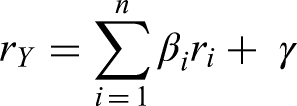
Data for the period 2008 to 2019 is included in the analysis according to availability in the FAOSTAT database. Considering that this is a period of 12 years, where 10 countries were analyzed, the model is estimated in the form of a data panel, that is, a balanced panel with 120 observations was formed. Model evaluation and testing were conducted through the Gretl 1.10.0 software package.
Results
The methodology for creating a production function model based on panel data requires several steps to meet all econometric criteria. In the first step, it is necessary to determine whether the method of ordinary least squares or the random effects (RE) method is adequate for the estimation of the production function model, which can be verified using the Breusch-Pagan test. To estimate the model of production function in EDE, the results of the Breusch-Pagan test (p < 0.05) prefer the RE method (Table 1). The next step involves choosing between the RE and the fixed-effects (FE) model using the Hausman test (Mundlaks criterion). According to the Hausman test, the FE model is preferred. However, using the Durbin-Watson (DW) test in the FE model, a first-order autocorrelation problem is evident, as the DW test value (1.47) is lower than the lower critical value of 1.56 at a significance level of 5%.
Estimation of production function of agriculture in emerging and developing Europe in the model of random-effects and fixed effects.
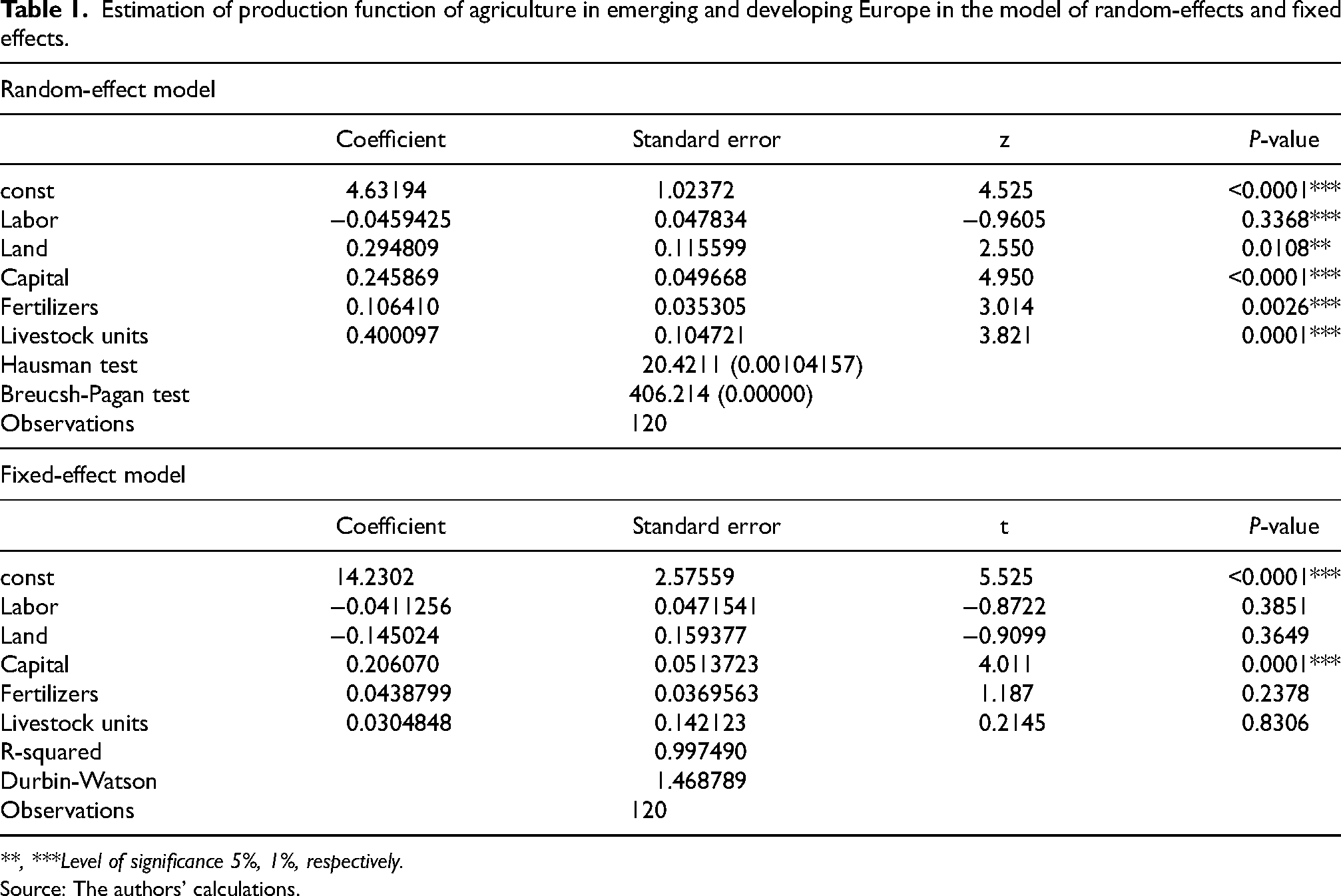
**, ***Level of significance 5%, 1%, respectively.
Source: The authors’ calculations.
Eliminating the problem of autocorrelation is the next step in this process of estimation. In the literature (Baltagi and Liu, 2012), weighted least squares (WLS) methods are generally recommended in this case. The results of the estimation of the production function of agriculture in EDE using the WLS model are given in Table 2. The model covers 120 observations of the panel. The results show that all estimated parameters are statistically significant (all parameters at the significance level of 1%), while the coefficient of determination is 0.9966, which shows that this estimated model explains 99.66% of the variation of the dependent variable. The F-test also confirms the validity of the model. Production is the most elastic in relation to changes in mineral fertilizers (0.30), followed by livestock (0.29). A relatively lower level of elasticity is present in the case of land (0.20) and capital (0.15), while in the case of labor, the elasticity is only 0.06.
Estimation of production function of agriculture in emerging and developing Europe in the model of weighted least squares.
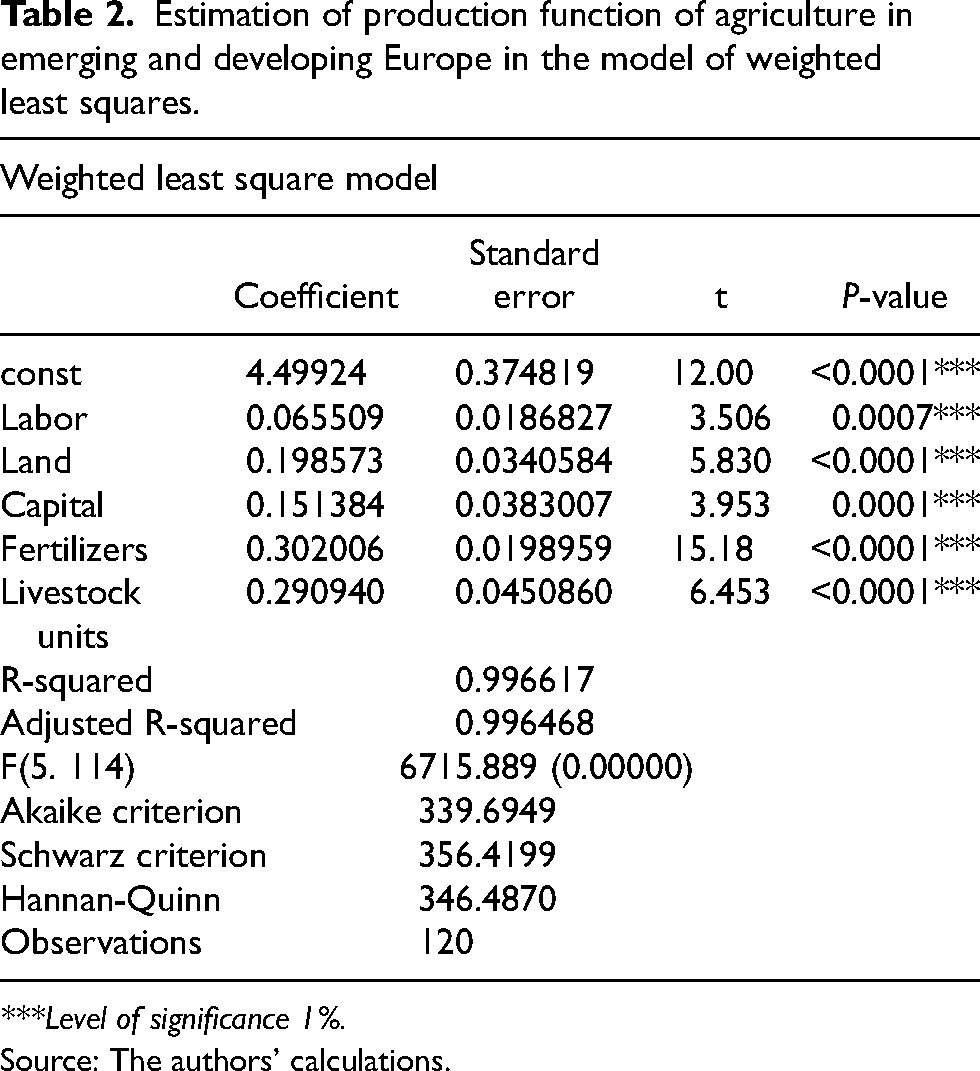
***Level of significance 1%.
Source: The authors’ calculations.
The estimated production function parameters fit relatively well into the results obtained in previous studies. Two studies related to the Eastern European countries before and after the transition are particularly important (Swinnen and Vranken, 2010; Cungu and Swinnen, 2003) because some of the countries analyzed in these papers are also included in this study. It can be concluded that the estimated parameters roughly correspond to the results of these two studies. The only significant exception is in the case of fertilizers.
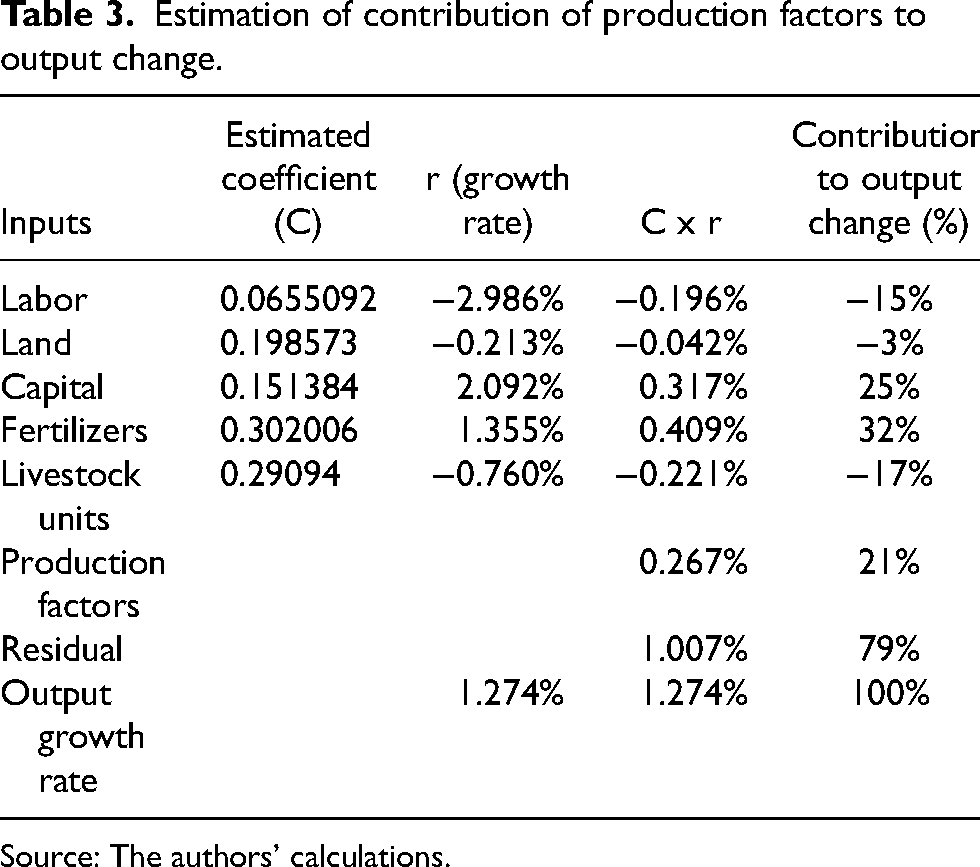
Based on the obtained results of the estimation of the production function, the relative contributions of production factors to the growth of agricultural production were calculated. Table 3 presents an approximation of the sources of growth of agricultural production. Production factors contribute to this growth with 21%.
Estimation of contribution of production factors to output change.
Source: The authors’ calculations.
Discussion
The research results showed that in the EDE countries, the critical source of growth among production factors is the use of mineral fertilizers (estimated coefficient is 0.3 and contribution is 32%). This result is relatively expected due to the transition period when these countries have a low level of fertilizer use. They only intensified the use of mineral fertilizers in the last 10 years, which is still not at the level of EU countries in most of the EDE countries if the use per cropland area is observed (Figure 1). The results are
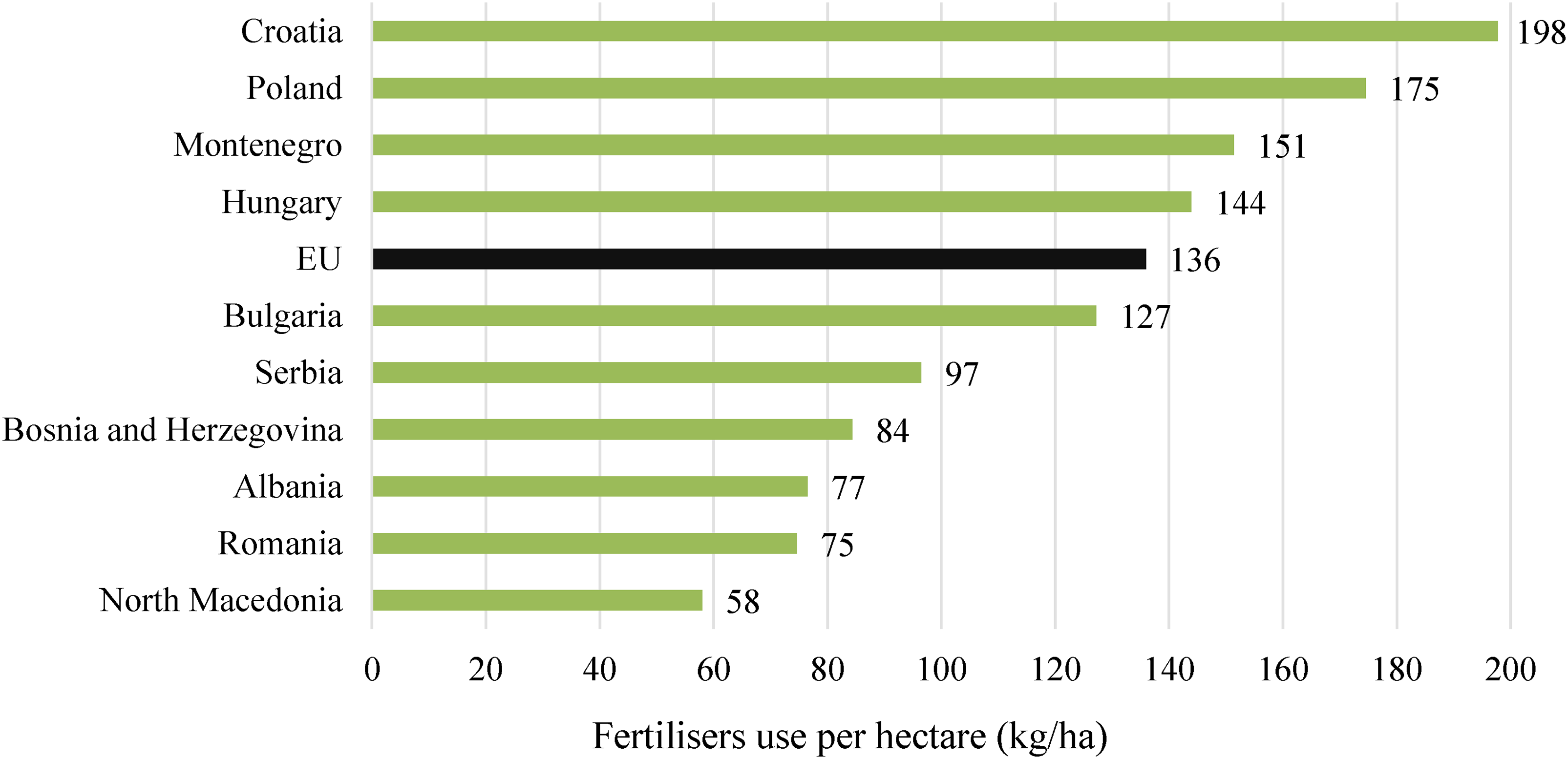
Fertilizers (N, P, K) use in EDE countries (3-year average 2017–2019). Source: FAOSTAT (2023). EDE: Emerging and Developing Europe.
The problem is twofold. First, the growth of mineral fertilizer use cannot be unlimited, so it cannot generate production growth in the long run. Therefore, it is necessary to change the focus on other potential sources of production growth (capital use and technological progress). It is imperative in countries with high-intensive fertilizers usage like Croatia, Poland, Montenegro, and Hungary. Secondly, intensive use of mineral fertilizers harms the environment, and it is debatable whether it is right to stimulate production growth at the expense of natural health. According to Chen et al. (2018), possible solutions are environmentally friendly fertilizers which can reduce environmental pollution from nutrient loss by retarding, or even controlling, the release of nutrients into the soil. Also, nanotechnology can improve productivity by taking advantage of the features of nanostructured materials and contributing to nutrient retention for optimal growth (Madzokere et al., 2021). The problem of using mineral fertilizers is also a political issue, considering the latest EU strategies, such as the European Green Deal and Farm to Fork Strategy. The Farm to Fork Strategy sets a clear goal to reduce the use of pesticides and fertilizers (Vrolijk and Poppe, 2021). Also, the latest Common Agricultural Policy reform for the period 2021 to 2027 intends to expand and strengthen environmental support (Kranjac et al., 2021). It is clear that farmers from EU member states should align their production practices with the goals of these strategies. Still, other states in the European integration process also need to make such adjustments. Moreover, the use of mineral fertilizers is also a global problem, especially if population growth is considered. Xiang et al. (2020) shows that population pressure has significant impacts on fertilizer use in countries with high population pressure. Their analysis demonstrates that an increase in population pressure by 1% yields a 0.118% increase in fertilizer use intensity for this group of countries. In addition to the negative environmental effect, the crisis in Ukraine also caused the problem of the availability of mineral fertilizers due to the import dependence of certain countries on Russia. According to Brankov and Matkovski (2022), the problem of mineral fertilizer availability can lead to reduced use and lower yield in the countries of the Western Balkans, so these countries should influence the strengthening of domestic capacities for fertilizer production, but also the use of practices and techniques that will increase the sensitivity of plants to the used mineral fertilizer.
Capital is the second production factor considering the contribution to agricultural growth (25%). It is particularly interesting if the negative growth rates of labor and land are observed since it can be concluded that agriculture is becoming capital intensive in these countries. The reduction of agricultural land did not significantly affect the value of agricultural production (−3%). However, a significant decrease in the number of employees in agriculture in the observed period affected the negative contribution of this factor to a production growth (−15%). Reducing the number of farmers is a typical development trend and may even be necessary to create modern farms. However, the significant outflow of workers from this sector often causes new problems which concern rural areas. Additionally, labor market in EDE changed a lot, and the reasons for this phenomenon are the emigration of the labor force from the countries of the former Eastern Bloc to the Western countries, negative demographic tendencies, economic crisis, and the significant wage differences in the wealthier EU countries (Poór et al., 2021).
The rural areas in EDE countries are characterized by a poor demographic structure and a drastic decrease in the number of inhabitants. Also, a big problem is the age structure of the agricultural and rural populations. The migration of young people from rural areas and the agricultural sector is also a problem for global food production. Deotti and Estruch (2016) believe that as many young people as possible must remain in the agricultural sector to increase food production by 60% by 2050, which is one of the goals set by the Food and Agriculture Organization of the United Nations. In addition, migration to urban areas also leads to the problem of a lack of seasonal labor. In the EU, there is a noticeable trend of economic migration, which means that the employment of foreign workers who are ready to work for a lower daily wage on agricultural farms is becoming more common, which significantly affects the demographic structure of rural areas (Rye and Scott, 2018). To preserve rural areas, synchronization of agricultural, social, and regional policies is necessary by adopting integrated sustainable rural development (Dimitrijević et al., 2021). Additionally, focus on improving the education of rural population is important. Education is also a major pillar on the new Europe 2020 strategy, as education in the long run has positive impact on economic growth, productivity, and social cohesion (Fedotenkov and Gupta, 2021).
The biggest problem of EDE countries is the negative growth rate of livestock units with a negative contribution to output growth (−17%). On the other hand, according to Matkovski et al. (2021) livestock production can boost the value of agricultural production since it gives products more added values. Therefore, the economic contribution of livestock production is indisputable. However, a potential problem is an environmental effect. Schut et al. (2021) stated that better integration of crop and livestock systems offers excellent potential to rebalance the economic and environmental trade-offs in both systems in Europe.
Finally, it is possible to conclude that the increase in the use of mineral fertilizers and capital compensated for the decrease in the use of other inputs and enabled all production factors to contribute to the growth of agricultural production in EDE countries. However, that contribution amounts to 21%, so what about the other 79%. This part of production growth belongs to the residual, that is, the part that this model does not explain. That part of the growth was often identified with technical-technological progress, which is excellently explained in the research of Saidi (2019). However, caution is necessary for such an interpretation. Hartley (2000) concluded that this way of measuring technological changes is not adequate because the residual often moves in the wrong direction, that is, a negative technology shock causes a positive residual, and referring to the work of Hall (1990), he states that the following factors can affect the residual: market power, increasing returns, external technical complementarities, chronic excess capacity, unmeasured fluctuations in labor and hours, capital measurement errors or output and monopsony power in the labor market.
Indeed, a significant share in the growth of agricultural production in these countries may be a consequence of technical progress caused by European integration and transformations to the market economy. However, it is not possible to adequately quantify this impact. Therefore, this research focuses only on the effect of production factors on the growth of agricultural production.
Based on these results, it is possible to make specific recommendations for policymakers. As the results showed, using mineral fertilizers is a crucial factor in the growth of agricultural production. In countries where the use is above the EU average, it is necessary to find a solution that is in line with current EU policies and will not harm agricultural production's economic performance. One of the solutions is organic fertilizers. Wang et al. (2018) point out that most farmers still prefer chemical fertilizers over organic ones because they fear they will achieve lower yields and income. The same authors state that the popularization of organic fertilizers requires the support of the state and that membership in cooperatives can have a positive impact.
Even more interesting is the position of countries such as North Macedonia, Bosnia and Herzegovina, and Albania, where the use of mineral fertilizers is far below the EU-27 average. The question arises whether these countries should first reach the EU-27 level to generate higher yields and exploit the advantages of intensive agriculture or whether they should already limit further intensification to make production more environmentally responsible. Indeed, technological solutions, such as organic fertilizers and precision agriculture, can reduce the harmful environmental effect. Palm et al. (2004) believe that developing countries should not stop using mineral fertilizers for environmental reasons because their lack can also cause soil degradation, which can have far more significant consequences for agricultural production. If this recommendation is followed and if the EU standards are what these countries strive for, it is possible to find some
However, one of the fundamental limitations of technology application is fragmented land and unfavorable farm structure, especially in Western Balkan countries. According to Mizik (2016), the majority of the agricultural producers of the Western Balkans are small ones with a vast number of parcels, which makes production more costly and less efficient. These circumstances make accumulating capital to reinvest in production and new technologies difficult. In addition, a particular threat is the potential overuse of chemical inputs to maximize the use of existing agricultural land.
Conclusion
Based on data for 2008 to 2019, results showed that the production factors contributed to agricultural output growth by 21% (fertilizers 32%, capital 25%, land −3%, labor −15%, and livestock −17%). So, the positive effect of fertilizers and capital use increase overcame the negative effect of the decrease in the use of other inputs and enabled all production factors to contribute to the growth of agricultural production in EDE countries. Therefore, increasing the use of mineral fertilizers is a crucial source of production growth in EDE countries, suggesting that agricultural policy must be created carefully to achieve a balance between economic, social, and environmental goals, considering the economic importance of fertilizer use and its environmental effect. In the case of EDE countries that are EU members, the agricultural sector must turn to sustainable production systems as soon as possible, especially regarding mineral fertilizers.
As for labor migration from agriculture, finding an adequate solution is a big challenge, even for the most developed countries. Simply put, agricultural jobs are not attractive to most workers. In addition, the optimal use of modern technology requires the possession of significant resources, primarily land, which also influences small farms’ exit from production. Due to all the above, the revitalization of rural areas no longer focuses exclusively on agriculture but on the development of other sectors. Indeed, it seems that the process of labor migration from agriculture is a necessity, which additionally indicates the importance of further technological development and capital investments.
Labor shortages and the need to optimize the use of chemical inputs suggest that it is necessary to encourage innovation in the agricultural sector. Certainly, innovations promote technological progress and can significantly contribute to these countries’ overall economic development. Unfortunately, the contribution of technical progress to the growth of agricultural production was not clearly established within this research, which is a key
Footnotes
Acknowledgements
The article presents a part of the research from the Erasmus + Jean Monnet project Agricultural Policy of European Union and its influence on competitiveness of agri-food products of Serbia – AgriCOM (620128-EPP-1-2020-1-RS-EPPJMO-MODULE).
Declaration of conflicting interests
The authors declared no potential conflicts of interest with respect to the research, authorship, and/or publication of this article.
Funding
The authors received no financial support for the research, authorship, and/or publication of this article.
