




Abstract
China has provided strong policy support for Farmers’ Cooperatives (FCs) in a bid to achieve its agricultural ambitions; however, scholars are divided on their contribution. Based upon three in-depth case studies, we interrogate the simple dichotomies used to describe FCs in China – authentic/inauthentic and failed/successful – arguing that FCs can have beneficial implications for smallholder livelihoods regardless of their organisation, operation and viability. Our research finds that local leadership and smallholder-led initiatives are more important than the authenticity and success of local FCs. We therefore call for a more nuanced understanding of the value of FCs and propose that resources should be diverted to other smallholder-led avenues to sustain China's rural development.
Introduction
The rise of China over the past three decades is largely attributable to rapid industrialisation. In the agricultural sector, the introduction of the Household Responsibility System (HRS) in the 1980s de-collectivised farming and made production the responsibility of households. While it went some way towards mobilising agricultural production and securing land tenure for farmers to a certain degree, agriculture has remained largely relegated compared to industrial development. A decline in the rural labour force, together with the continued pursuit of development favouring urban people and places threatens smallholder livelihoods. The Chinese government has commenced reorganising the country's agricultural sector with the aim to involve small-scale farmers in both national and international market economies along with the national policy of modernisation and reform (Huang et al., 2012; Song et al., 2014).
The core task is to establish (or restore) a rural labour force. To achieve this goal, the Chinese government has been developing agricultural entities called ‘New-type Agricultural Operators’ (NAOs) which include four entities (farmers’ cooperatives [FCs], dragon-head enterprises, family farms and specialised large farms) in an attempt to link agriculture with such post-harvest sectors as processing and marketing (Lingohr-Wolf, 2010). As one of the four NAOs, FCs have received considerable policy attention and financial support over the past decade. In 2006, the Chinese government introduced the ‘Law on Specialised Farmers’ Cooperatives’ (henceforth, the Cooperatives Law) to promote vertical integration of small-scale farmers as a part of a broader and ongoing agricultural industrialisation campaign. Since that time, FCs have proliferated in China and, as of 2018, there were over 2.1 million officially registered FCs (Xinhua, 2019).
In addition to the efforts of the central government, international agencies and domestic NGOs are also promoting FCs in China via various rural development projects and programmes (Song et al., 2014). Adopting a grassroots approach, the FCs initiated by NGOs and international organisations attempt to meet the farmers’ needs by supplementing government efforts. While significant resources have been channelled into the establishment of FCs from both the state and the NGO sectors, to date the effectiveness and impact of their investment on smallholder farmers is not well understood. Details of their durability and operation are under-documented. Thus, there is an urgent need to interrogate the understandings of FCs and their contribution to smallholder livelihoods and, by extension, situate their role in current agricultural reforms in China.
While there is a growing corpus of literature on FCs in China, most are dominated by quantitative research. These quantitative research topics include the factors to increase FCs participation (Liu et al., 2019; Ma and Abdulai, 2016), the potential benefits of FCs to farmers’ incomes (Ito et al., 2012) and environment (Sarkar et al., 2022), the role of the government in supporting FCs (Deng et al., 2010) and the formalisation of contractual arrangements (Jia and Huang, 2011). While these quantitative studies provide useful insight into the development of FCs in China, they often lack the nuance and context that qualitative research can offer. Qualitative research can delve into the intricate dynamics and the socio-political aspects surrounding FCs.
Along with growing concerns about whether FCs are adequate to achieve their goals (Yan and Chen, 2013), others are concerned about the factors that produce successful FCs (Garnevska et al., 2011) and the potential exclusion of smallholder participants (Ito et al., 2012). Shen and Shen (2018) claim that while FCs provide positive impacts on production and profit growth, many FCs operate more like private companies than voluntary associations. Hu et al. (2017) provide a typology of FCs and suggest that China's FCs are inauthentic in their operations and thus fail to deliver benefits to smallholders. Finally, studies of NGO-led FCs document certain positive aspects in improving sustainable resource use and local livelihood participation (He et al., 2009, 2011; Song et al., 2014).
Unlike the extant literature, this study moves beyond the narrow focus of authentic/inauthentic FCs and their success/failure. We seek an understanding of the impacts on smallholder activities, regardless of whether they have persisted and/or are characterised as authentic or successful. Our research adopts an ethnographic research methodology and an empirically-grounded approach to understand how FCs operate in practice. As our research is in the context of Chinese FCs, we define an FC, in line with China's FC laws (National People's Congress, 2006b), as an entity organised by farmers and operated based on the principles of autonomy, volition, equality and democratic management. We distinguish FCs from capitalist entities because of these distinct principles. In general, the operation of a capitalist entity is largely controlled by its owner(s), and its objective is often to fulfil the economic needs. In contrast, a FC is managed by its members in accordance with the principles listed above, and its objective could cover a wider range, including economic, social and cultural needs. This definition aligns with the ICA's definition in principle (International Cooperative Alliance, n.d.). We explore the FCs that were initiated in response to government policy and incentives and by NGOs. Unlike most research on China's cooperatives that are focused on the eastern and central regions (such as Ito et al., 2012; Ma and Abdulai, 2016; Wilmsen et al., 2023), this study aims to enhance the understanding of how China's frontier is responding to the rise of FCs. We argue that regardless of their operation and persistence, FCs can provide significant benefits to smallholder livelihoods. What sets our research apart from previous work (such as Deng and Wang (2014), Hu et al. (2023), Jia and Huang (2011)) is that we do not assume that the perceived flaws of FCs in China impact negatively on the capacity of smallholder farmers to access the market. Smallholders engage or disengage with FCs in ways that benefit their livelihoods even if the literature may categorise these entities as ‘fake’ or ‘failed’ FCs. In essence, this article, as well as complementing the extant literature on the development of FCs in China, has useful policy implications for China's agricultural agenda by complicating the simple narratives that characterise FCs: authentic/good and inauthentic/bad.
Farmers’ cooperatives in China: An overview
The CCP's definition of ‘farmer specialised cooperatives’ is ‘mutual-help economic organizations joined voluntarily and managed in a democratic manner by the producers and operators of the same kind of farm products or by the providers or users of services for the same kind of agricultural production and operation’ (National People's Congress, 2006b). The motto ‘established by the people, operated by the people, and profits for the people’ (Li, 2017: 205) is often used to summarise the core principles behind the establishment of China's cooperatives.
Although the proliferation of FCs in China is a recent occurrence, FCs themselves are not new. The first FCs emerged in the 1930s as the result of the Rural Reconstruction Movement supported by the CCP, KMT and non-partisan intellectuals (Yan and Chen, 2013). During the planned economy era, FCs were again promoted as state-organised communes (Hu et al., 2017). During the reform era and concomitant with the introduction of the HRS in the late 1980s, new forms of cooperatives emerged (Song et al., 2014). However, the number of FCs did not grow significantly until the promulgation of the 2006 Cooperatives Law (Huang et al., 2012).
The Cooperatives Law lists five principles of FCs in China, which are: (1) the main body of members will be farmers; (2) the mission is to provide services for members and share benefits among all members; (3) voluntary membership and free withdrawal; (4) members are equal and practice democratic management; and (5) profits should be returned to members (National People's Congress, 2006a). In practice, FCs can be established under different names, such as Farmers’ Associations, Specialised FCs, and Farmers’ Organisations. Whilst different in name, FCs in China are meant to operate like cooperatives elsewhere in the world in terms of purchasing the means of agricultural production, marketing, processing, transporting, storing farm products and providing technologies and information related to agricultural production and operation (Deng et al., 2010).
We consider it important to situate the development of FCs within China's broader ambitions for agricultural modernisation. According to the State Council (2016), China is introducing a range of reforms described as a mix of ‘agricultural restructuring, enhancing the quality and efficiency of agricultural products and market competitiveness and ensuring the effective supply of important agricultural products’. To this end, restrictions on land transfers have been formally loosened and powerful NAOs such as agribusinesses, large family farms and cooperatives are beginning to replace small-scale farmers. According to Tang Renjian, deputy director of the central government's Rural Work Leading Group, ‘new industries and new types of businesses will become engines of rural development and increase the income of farmers’ (Ministry of Agriculture and Rural Affairs, 2017).
While all NAOs have received significant policy attention, the central government has been particularly attentive to smaller, farmer-led NAOs since 2010. For example, in 2013, the central government released a series of documents which demonstrated strong support for small farmer-based NAOs; FCs in particular. Document No. 1 clearly states ‘the strong support to the development of new types of FCs of various modes (大力支持发展多种形式的新型农民合作组织)’ as a key area of work. Under this point, the document further elaborates that ‘FCs are the main bodies mobilising farmers into market…. [we will] strengthen and accelerate the development of FCs (农民合作社是带动农户进入市场的基本主体…加大力度、加快步伐发展农民合作社)’ (Xinhua News Agency, 2013). Document No. 1 listed certain incentives for developing and empowering FCs such as encouraging the establishment of demonstration FCs (把示范社作为政策扶持重点), channelling capitals into eligible FCs (安排部分财政投资项目直接投向符合条件的合作社), augmenting the development fund for FCs (增加农民合作社发展资金) and providing tax benefits for FCs (完善合作社税收优惠政策). The document also specifically calls for land transfer from smallholder farmers to FCs (鼓励和支持承包土地向…农民合作社流转). This is the first time that a document has specified many incentives for the development of FCs. The reason for the central government's focus on FCs is not only due to its concern about an overdependence on large corporate agribusinesses (Schneider, 2017) but also because of the reports of such negative impacts as the coercive participation of contract farming (Gong and Zhang, 2017; Luo et al., 2016). Scholars also argue against depending on large agribusinesses as the drivers of agricultural production. Huang (2011), for example, suggests that small farmer cooperatives are the future of China's agriculture as does Yao (2017), who argues that smallholder farmers are more suited to China's agricultural scenario than large enterprises. Speaking officially, the deputy director of the Central Leading Group on Rural Work, stated that ‘large farms are not suitable for China’ (Shen 2015). These arguments suggest that, despite government rhetoric about corporatising agriculture and creating large farms, there is support for smallholder farming and small FCs within China.
FCs are also actively promoted by many aid agencies and NGOs as a way of organising bottom-up, autonomous initiatives. The Ford Foundation, a major international donor which has operated in China since the 1980s, has actively supported herders and FCs in China's western provinces (Ford Foundation, 2011). For some multilateral financial institutions such as the World Bank, the development of FCs is a key element of its development agenda in rural China: for example, the Guizhou Rural Development Project involving 72 FCs with a total of 18,402 farmer households (The World Bank, 2014).
The Center of Consultation for Farmers’ Associations (CCFA, 农禾之家), a domestic NGO founded in 2005, has been central to the growth and coordination of FCs in China. The CCFA connects academic scholars to the NGO sector in order to promote FCs and has eventually developed into an alliance of many FCs around the country and acts as a hub for the active promotion of FCs. The CCFA arranges various activities including on-site peer learning between cooperatives and overseas visits to places such as Taiwan and Korea where different kinds of FCs have played important roles in agricultural development (China Development Brief, 2023). The CCFA also organises nation-wide workshops about financing, product marketing and leaderships for developing FCs (China Development Brief, 2023) and has been central to mobilising domestic NGOs to actively promote autonomous farmers’ organisations in their project areas.
Government support for FCs, together with their promotion by NGOs, has facilitated the exponential growth of FCs, especially in the provinces designated as the pilot areas for specialised cooperative organisations such as Shandong and Zhejiang (Zhao, 2016). The number of FCs has increased from 9500 in 2000 to 1.79 million in 2016, accounting for 44% of farming households countrywide (National People's Congress, 2017).
Across the country, the exponential growth of FCs since 2000 has two possible explanations. First, farmers spontaneously organised themselves as intermediary organisations between rural households and enterprises in an attempt to achieve vertical integration (Huang, 2011). Second, the subsidies on offer from the central government to establish FCs drove their registration. For example, in 2014, the central government paid out two billion RMB (approximately US$290 million) in subsidies; individually, the subsidy that each cooperative received ranged from hundreds of thousands to millions of RMB (Hu et al., 2017).
However, significant gaps in FC coverage exist between eastern and western provinces, including Yunnan, our case study location. By the end of 2015, Yunnan had only 16.3% household membership and fewer than 30,000 FCs. Despite the introduction of the Cooperatives Law in 2006, it was not until 2016 that the Yunnan government began to align with central policies with its issuance of guidelines and specific target: by 2020 at least 60,000 FCs with a minimum of 30% household membership (Government of Yunnan Province, 2016). During 2016–2020, promoting FCs was a key focus of the Yunnan government. A committee, comprising the Departments of Agriculture, Development and Reform Commission, Finance, Forestry, Water Conservancy, etc., was formed for FC development. ‘FC development’ also became a crucial element in the performance evaluation of various government levels.
Notably, FC policy in Yunnan (and many other western provinces) was integrated into the poverty-alleviation campaign. The rationale is that FCs can potentially mobilise agricultural production, serving as a tool for eradicating rural poverty. The central government's ‘Outline for Development-oriented Poverty Reduction in China's Rural Areas (2011–2020)’ explicitly recognises FCs as institutional innovations to enhance incomes and build capacity among poorer farmers. As a result, government subsidies for FC development and poverty alleviation programs were combined to mobilise impoverished households into FCs and support agribusinesses linked with FCs in poverty-stricken counties (Yunnan Department of Agriculture, 2018). While the 2020 target was somewhat achieved, with 58,400 FCs (a 58% increase since 2015) and 36.4% household participation in Yunnan (Yunnan Department of Agriculture, 2021), FC coverage remains relatively moderate compared to the eastern part of China.
Notwithstanding the central government's enthusiasm for FCs across China, it is worth examining the effectiveness of those efforts. In China, the management of many FCs has proven questionable due to various internal and external factors. Internal factors include social differentiation and a lack of trust among co-op members (Hu et al., 2017), while external factors include unpredictable markets, poor policy design and implementation and competition from capitalist entities (Hu et al., 2017, 2023; Yang et al., 2018).
To clarify this conundrum, this research contextualises the development of FCs in China's south-west frontier and examines the outcomes of the significant effort and investment involved. Adopting an empirically-grounded approach using three case studies, this research will provide thoughtful insights into the development of FCs in China's frontier where farming has remained an essential part of livelihoods for many rural households. The case studies examined will demonstrate that despite various policy efforts, FCs remain rhetorical rather than the reality. This article will enhance the current understanding of how China's frontier is responding to the state policy of agriculture modernisation.
Research methods
In this study, we adopt a quantitative survey, in-depth, semi-structured interviews and participant observations. We also adopted case study analysis; our case studies are not for generalisation but to highlight the different patterns existing in FCs’ operation in China. Our analysis was mainly qualitative, although we relied on some quantitative information gained from the survey to provide a broad picture of the patterns of FC membership and attitudes towards FCs.
The survey, part of a broader collaborative project on agricultural transformation in China, includes 42 question sets. One question set, comprising five sub-questions, is directly related to FC membership and their attitude towards FCs. Additional 12 question sets are relevant to FCs; for example, if the households transfer land to FC or if they sell their produce to FC. Systematic sampling was adopted surveying every second household. In our survey, we pre-determined eight tangible benefits for FC participation, including insurance, free or subsidised agrochemicals, guaranteed/minimal purchased price, good price, training, time-saving produce marketing, technical service and dividends. In addition, farmers could also specify ‘other benefits’.
To capture local dynamics and socio-political aspects overlooked by quantitative research, we conducted unstructured interviews, semi-structured interviews and participant observations at each study site. The ethnographical data provides rich information about the operation of the FCs and the detailed value of these FCs to farmers’ livelihoods, especially the impact of FCs beyond any tangible/direct benefits. Interview notes were jotted and then transcribed to full interview scripts during the fieldwork for conducting analysis later. All surveys and interviews were conducted in Mandarin, eliminating the need for translation, as the first and second authors are native Mandarin speakers proficient in Yunnan dialect. Detailed methods for each case study are outlined in the following paragraphs.
Data spanning from 2011 to 2019 was collected in three villages, situated in different prefectures of the inland province of Yunnan in Southwest China. Yunnan is at the frontier of China, bordering countries including Myanmar, Lao and Vietnam (see Figure 1 for the location of the three villages). These case studies were strategically chosen to encompass various FC operations and were all conducted in areas where small-holding farmers predominate in the production system.
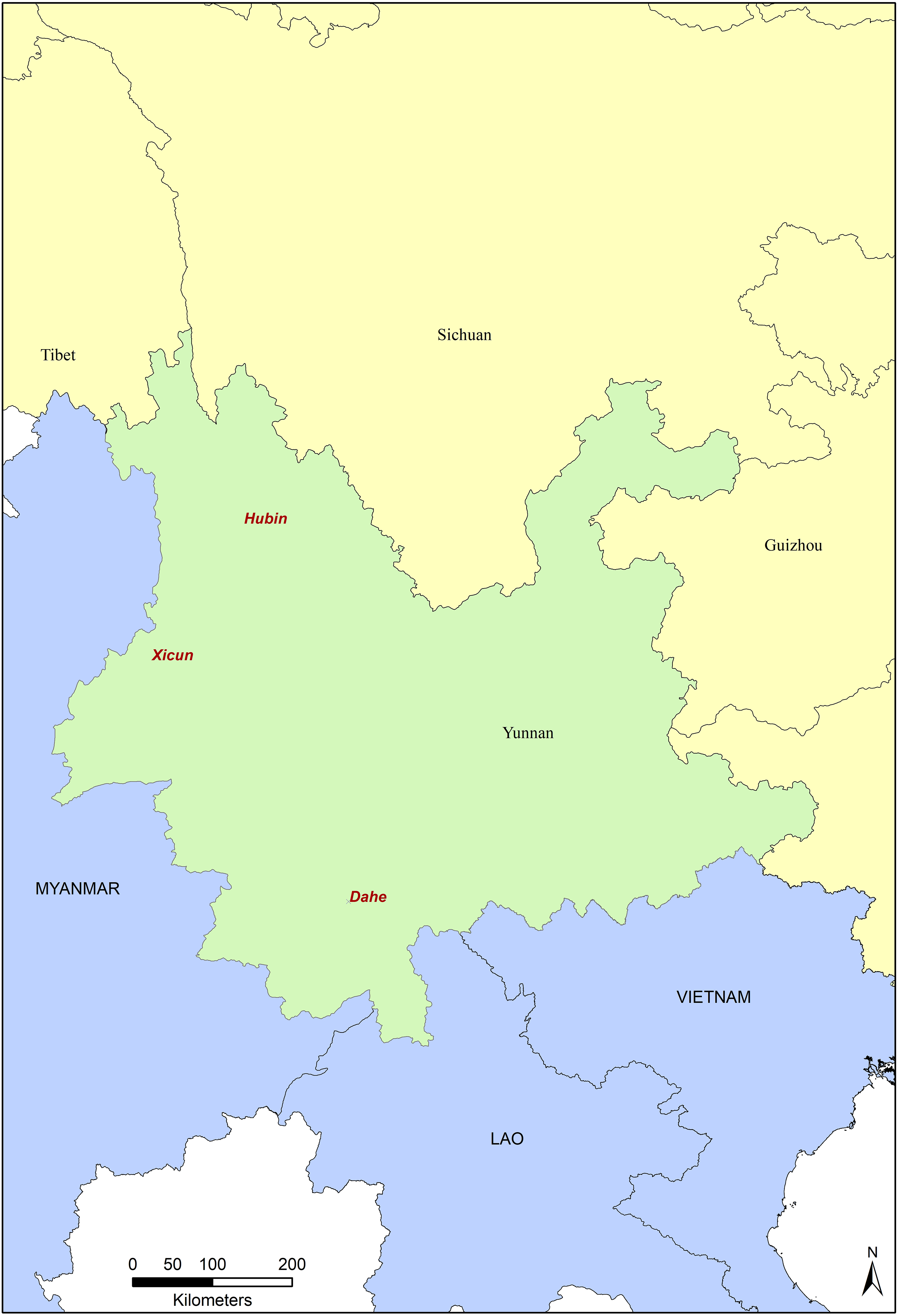
Locations of the three case study villages in Yunnan, China.
The selection of these case studies was driven by specific criteria. Firstly, FCs were chosen based on their establishment in response to either government policy/incentives or NGO initiatives. Secondly, case studies were selected to explore differences in local marketing channels, specifically to observe the impact of the local presence of large agribusinesses. Case 1 involves a government-initiated coffee-producing/marketing FC in an area with a notable presence of international coffee companies. Case 2, also a government-initiated coffee FC, operates in an area without dominant agribusinesses. Lastly, Case 3 is a fruit-marketing FC initiated by an NGO project.
Data for the first case study was collected from Xicun 1 village of Baoshan in western Yunnan. Between November 2016 and March 2019, the lead authors made three visits to the research sites. 12 semi-structured interviews were conducted with local farmers, local coffee business owners, coffee traders/middlemen, village head, FC leaders and the staff of international and domestic coffee traders. Interviews lasted between 30 and 60 min. Household surveys were administered in May 2019 by a group of research students from Yunnan University, who had attended survey piloting and was trained by the second author for conducting household surveys ahead of fieldwork. Systematic sampling was conducted, and in total 50 questionnaires were valid.
The second case study, Dahe village of Puer in southern Yunnan, was visited four times between November 2016 and March 2019 to collect qualitative and quantitative data. Similar to the first case study, the authors employed 18 semi-structured interviews with various stakeholders; and two key informants (the local FC leader and the agronomist from Nestle) were both interviewed twice (in 2017 and 2019). Participant observation was also conducted in this village. The same household survey was administrated in the same method in May 2019 with 51 valid questionnaires.
The third case study is a fruit FC in Hubin village in northwest Yunnan, and data was collected in 2011 and 2012 when the lead author was conducting ethnographic fieldwork for her PhD. For ten months, the author employed participant observation and conducted unstructured and semi-structured interviews. Interview participants include Hubin villagers (both members and non-members of the FC), FC board members, the FC chairman, middlemen and NGO staff and director. Although the authors did not conduct the household survey in Hubin, the extensive long-term ethnographic work provides in-depth data from which we draw our understanding of Hubin village and its context.
The authors recognised that the three case studies span eight years, during which situations may change. Nevertheless, this temporal span does not compromise the validity of our data or the value of our analysis. Our approach aligns with the logic of individualising comparisons (Haydu, 1998), aiming to understand how FCs impact on smallholders’ livelihood activities in diverse ways. We do not seek to represent or explain the link between the three cases in different time periods. The advantage of individualising comparison lies in providing descriptively richer accounts and treating historical details as resources for interpretation (p. 347, ibid). Despite these strengths, we acknowledge our method imposes limitations on the scope and explanatory value of our case studies.
Dysfunctional and fake FCS in Southwest China
Case study 1: ‘There is no benefit in joining FCs’
The first case study is based on research undertaken in Xicun village of Baoshan, an area that is home to approximately 500 households. Located close to the border of Myanmar, Baoshan has the longest history of commercial coffee production in China and the producers are predominately small-scale farmers (Neilson and Wang, 2019). Since 2010, under the policy promotion mentioned in earlier sections, three coffee FCs were established in Xicun. In this section, we will demonstrate that while the participation rate of FCs in Xicun seems promising, in reality, all three FCs operate as de facto businesses and fail to deliver benefits.
Coffee farming started in this area as a government project aimed at supplying coffee to Russia in the 1950s when coffee plants were planted in a state-owned farm. It was not until 1995 that Xicun started to grow coffee commercially on a massive scale – approximately 10,000 mu of land. From time to time, farmers opted to other crops (mainly vegetables and fruit) due to the fluctuation in coffee prices. However, in 2015, the local government designated the title ‘China's first coffee village/10,000 mu coffee plantation’ to Xicun and subsequently banned the farmers from cutting down coffee trees. In subsequent years, the reputation of the plantation has become a selling point for tourism and various activities like local bike tours.
As well as the 500 households in the village, there are also three coffee FCs. Survey data suggests that 38% of the households joined at least one FC and, as of 2019, 28% of the village households had retained their membership. According to the village head, the FCs operate as follows: the farmer pays 100 RMB to join the cooperative as a shareholder. The farmers then sell their processed coffee beans to the FCs, who on-sell the beans to large corporate businesses. The farmer should receive a higher price for their beans relative to selling to middlemen outside of the village and should receive a bonus if the cooperative makes a profit.
Mr Yin is the chairman of one of the FCs, ‘Good Partner Agricultural Co-op’, in Xicun. 2 This FC was established in 2006 and in 2019 there were 153 household members. Mr Yin's description of the operation of the FC is like that of the village head: ‘farmers contribute a membership fee as their share and enjoy the benefits’. According to Mr Yin the bonus from the profit was 15% in 2017.
On paper, the participation rate of the FCs seems promising (almost 30%) and, based on the interviews with the FC leader and village head, the FCs appear to function for collective benefit. However, interviews with Xicun villagers reveal a different story. First, sales to the FCs are non-exclusive – member and non-member households can sell to Mr Yin's FC, and both parties can use his processing facility. There is also no difference between the purchase price offered by the FC to members and non-members. Therefore, there are no exclusive rights or benefits for the FC members. Second, the FC does not operate collectively, but by one person: Mr Yin. Members have no power in decision-making on FC matters. During discussions, the farmers said that ‘FCs are not owned by the member farmers, but by businessmen’.
An analysis of a statement made by Mr Yin about the operation of his FC suggests there are irregularities. He claims to own 30 mu of coffee plantations and earns 200,000–300,000 RMB annually from the sale of ‘his’ beans. However, we calculate the profit for that area of coffee to be around 100,000 RMB, 3 suggesting that the profit he made was 2–3 times higher than it should be. Our calculations indicate that Mr Yin has included the beans sold to the FC as part of his own production and consequently profited from their sale.
Our findings reveal that the vast majority (93%) of surveyed households, including 28% of those who retained FC membership, do not perceive any tangible benefits from being FC members. Only a minimal 4% specified a benefit, citing the use of processing facilities for free. Those who withdrew from the FC reported never receiving any benefits, with some highlighting lower prices offered by FCs compared to other middlemen.
Despite the absence of tangible benefits, 28% of households retained their FC membership. This retention appears to be driven more by village politics than economic considerations, aligning with findings in the literature (Wilmsen et al., 2023). The importance of maintaining personal relationships with village elite (such as Mr Yin) emerges as a significant factor in rural China, influencing members to refrain from withdrawing despite the lack of anticipated economic benefits.
Meanwhile, non-members state various reasons for their non-participation: 50% are not interested in the FC; 30% consider there to be no benefits in joining the FC; and 20% do not trust the FC. Further interviews also reveal that many local farmers are disgruntled with the FC leaders, stating that these businessmen owed them money from the previous coffee season.
In Xicun, the establishment of three FCs was driven by government policy, and the coverage of FC membership rate is moderate. Nevertheless, the FCs are not true cooperatives because they operate as de facto businesses rather than collective, farmer-driven organisations. While the local government forbids farmers from converting coffee plantations to other more lucrative uses due to their importance for tourism in the region, Xicun villagers are cutting down (or contemplating cutting down) coffee trees to make way for other crops such as mangos due to the declining coffee price. In Xicun, villagers have no trust in the FCs because they failed to provide benefits to local farmers and protect them from plummeting global coffee prices. In sum, government policies promoting and supporting FCs have failed as they resulted in minimal benefits to local farmers.
Case study 2: ‘There is no FC here!’
The second case study is an organic coffee cooperative in Dahe village of Puer, an area that produces approximately 40% of China's coffee; many international companies source their coffee either directly or indirectly from the area (Neilson and Wang, 2019). A coffee FC was set up in Dahe in response to the policy promotion. This case study will demonstrate that the local coffee farmers have been benefiting from the FC to a certain degree. Almost every coffee-producing village in Puer set up at least one FC. The push to establish FCs in Puer was mainly due to the policy as previously discussed. A secondary factor contributing to the establishment of FCs in Puer was the preference of large buyers, including Nestlé and Starbucks, to deal with FCs rather than individual farmers. For these companies, the transaction cost of providing training programs to the FC members, ensuring the latter complies with the buyer standards and awarding them the relevant certificates, is less than providing training and granting certificates individually. As for the individual farmers, it is relatively convenient to sell their beans to a large international buyer under the name of each co-op.
It is within this context that Dahe, a village that had produced coffee for 30 years, established a coffee FC in the early 2000s, with the village party leader Mr Hu as the chairman. Mr Hu, whose father was also a party leader, is very entrepreneurial. In the 1980s, Mr Hu assisted in managing a state-owned farm during which time he self-initiated coffee farming and has been working for the coffee industry ever since. Drawing upon his entrepreneurial spirit and using his good relationships with the local government, in 2013 Mr Hu mobilised his resources to reorient his FC to produce organic coffee. After securing the support of the Puer government for developing a ‘green industry’, he secured a three-year supply of free organic fertilisers for the FC, as well as a stipend for intercropping seedlings.
According to Mr Hu, the FC comprises nearly 300 households, which is around 50% of the residents of Dahe village. Many member households are located within close proximity to Mr Hu's residence and factory. Mr Hu claims that the total production area of EU-certified organic coffee is approximately 1000 mu. He says production is well-managed, with organic fertiliser applied over the entire area, and only the full-red cherries are harvested. Mr Hu also owns a coffee trading company through which organic coffee is marketed under the name of the FC. It has many domestic coffee buyers, including small roasters and chain shops whose staff participate in on-site processing. Interviews with the staff from these companies confirmed that their understanding of the production model of the area is of an FC-based, organic-produced coffee.
However, in-depth interviews in Dahe revealed an alternative narrative which suggests that neither the production nor the marketing of the coffee occurs under the FC. The modus operandi is, to say the least, somewhat diverse/individual than uniform/collective. Mr Hu admitted that no collective activities, including marketing, training or dividend provisions, are provided by the FC. In this sense, it does not behave according to the official characterisation of an FC in China.
Contrary to Mr Hu's description, interviews with local farmers reveal that the coffee produced by the FC is not comprehensively organic. On average, each household owns approximately 20–40 mu of coffee plantation area, but organic fertiliser is applied to only a fraction of the plantation (usually less than 10 mu). Therefore, the majority of production in the area is inorganic. Local farmers sell their beans to various buyers, including Mr Hu, other middlemen, domestic companies and/or international buyers. Mr Hu, who owns a large processing factory and a trading company, purchases, processes and resells both organic and non-organic coffee supplied by the villagers, irrespective of whether they are FC members or not. The price offered by Mr Hu is based on the market price, and the profit is retained by Mr Hu's trading company rather than redistributed to the FC member base. The coffee is then on-sold to domestic and international coffee buyers. The coffee sold by Mr Hu to his buyers is not solely produced by FC members, thus claims by Mr Hu that the coffee beans are produced by the FC are false. When I conducted further interviews with the local farmers about the FC, their consistent answers confirmed the story. Many farmers, some of whom lived next to Mr Hu and supplied him organic coffee beans to be sold under the name of the FC, had never even heard of the FC and firmly denied that they were members of it. This reflects the sentiments of many of the farmers we interviewed who repeatedly said, ‘there is no FC here!’
The cases of Xicun and Dahe are certainly not unique. Our interviews with a dozen coffee FC leaders and with several long-term experts in Yunnan's coffee industry suggest that no FCs in this region undertake collective activities, and profit is rarely returned to the FC members. Moreover, FCs in Yunnan rarely function as knowledge brokers to facilitate information dissemination (Rogers et al., 2023). In most cases, leaders of the FCs are local elites, some of whom openly admit that the establishment of the FC was simply for the purpose of ‘registration’. In reality, most FCs simply operate as private businesses run by the FC leaders.
Although the FC in Dahe is not a true cooperative, smallholder farmers are not disadvantaged by its presence. It is because a transparent market of coffee trading had already been established due to the long-term presence of Nestlé, prior to the formation of the FC. Nestlé staff trained the farmers to check the New York Stock Exchange (NYSE) price for themselves and, during the coffee harvesting season, Nestlé announces its purchase price publicly, which is often a few US cents less than the NYSE. Although the global coffee price has not been very stable for Puer coffee farmers, they are able to negotiate based on the international market price which has given them confidence when selling their beans. Other international firms who joined the Yunnan market later than Nestlé, found that the farmers are well educated about price expectations and realised they therefore also need to work within the international prices established by the NYSE. Their knowledge of international prices also enables the farmers to bypass the FCs to sell their beans if they can negotiate a better price outside of the FCs, although price may not be the sole reason for deciding who to sell to.
Since 2018, local farmers have benefited from the organic coffee production introduced by the FC to the village. Mr Hu, who is the head of the FC, re-distributed the organic fertilisers to the FC members and taught them to grow organic coffee. The profit from organic coffee sales is significantly higher than that from inorganic coffee sales. More than these tangible benefits, however, what is more valuable is the reputation of this area which has attracted both domestic and international buyers to Dahe village specifically to access organic or speciality coffee. Since 2018, many domestic roasters including notable chain store like Luckin Coffee, have come to the village to participate in coffee processing in order to secure supply from Dahe village. As a result, local farmers are able to market their organic coffee to a wider range of buyers. Therefore, even though the FC is fake, its name still brings fame and benefits to the local farmers. Because the organic fertilisers have been provided for free, at least for a proportion of the area, the cost of growing organic coffee has not as high as it would otherwise be, compared to that of non-organic coffee (even though the labour requirement is higher). Overall, local farmers are satisfied with the profit that accrues from organic coffee.
More importantly, the experience of producing organic coffee beans has encouraged local farmers to produce other value-added products such as specialty coffee. When the price of ordinary coffee beans reached a historic low, such as in 2018, this provided an alternative source of income. The willingness of the Dahe farmers to experiment with a higher-quality product stands in stark contrast to the reluctance expressed by farmers from other coffee-producing regions. Our interviews with coffee growers in other parts of Yunnan indicate that smallholder coffee farmers are reluctant to shift to producing speciality or organic coffee due to the higher costs and risks associated (conversely, owners of medium to large estates are more positive about producing speciality or organic coffee). Overall, the entrepreneurialism of Dahe's FC, as well as the establishment of a transparent market external to it, benefited smallholder farmers even in the absence of a clear collective function of the local FC.
Case study 3: ‘There is an FC but we don’t need it’
The focus of the third case study is on a fruit-marketing FC in Hubin village in northwest Yunnan. Founded in 2009, this FC was part of an NGO project promoting agro-forestry activities and this particular project aimed to stabilise the sloping land by replacing shallow-rooted crops with deep-rooted fruit trees (Wang et al., 2019). Within a decade, different varieties of peaches, pears, apples and other fruit started to generate significant incomes. Some Hubin villagers who were working in other towns returned home to resume smallholder farming. In 2009, the NGO, which was closely associated with such organisations as the CCFA and the Ford Foundation, organised and facilitated the establishment of the FC. In this way, this case study is different from the other case studies presented here: it was not established by local elites in response to government policy or monetary incentives but was initiated by a domestic NGO in response to an abundance of new cash crops.
Selling produce from Hubin has long been problematic because of its remote location. Rather than organising village-level sales and logistics, individual households typically arranged the transport of their fruit to the city markets. Recognising the problem, in 2004 the opinion leader and former village head, Mr Li, arranged for a businessperson in his network to buy fruit directly from the Hubin farmers. Through this intermediary, the farmers were able to receive a good price and could sell large quantities of pears at one time, which reduced the time and effort required to individually sell fruit in urban markets. According to the businessman, the quality of the Hubin pears is superior to that of pears grown in other nearby villages and attracts a higher price. However, Mr Li exercises favouritism regarding who is allowed to deal with the businessman and takes a cut of the profit by charging commission for each truckload of fruit he arranges. Thus, while most smallholders can access this sales channel, it's not open to all and the profits accrue unevenly.
Unaware of Mr Li's role as an intermediary, the NGO's efforts to establish an FC in Hubin began five years later. Recognising that the agro-forestry project had created a viable fruit industry in the village, the NGO set about establishing an FC in the hopes to fully represent the farmers. It was envisaged that through collective cooperation, the fruit industry in Hubin would flourish and benefit all members. Approximately half of the households (33 out of 72) in Hubin joined the cooperative by paying a 300 RMB membership fee. In 2011, the NGO, in collaboration with the CCFA, arranged a study trip for several of Hubin's FC board members to visit the Yongji Farmers’ Association, an integrated organisation encompassing 22 FCs, in Shanxi Province. It was off to an encouraging start.
Despite the good intentions of the NGO, the FC struggled to gain full support from the villagers to achieve its objectives. While the FC provided bulk-purchase agricultural chemicals at a discounted price to its members and the farmers appreciated this, non-members could also access the chemicals through the members. Moreover, the main objective of the FC, which was collective fruit sales, never eventuated due to most households continuing to sell through Mr Li's connection. By 2011, some member households began withdrawing from the cooperative, partly due to a waning confidence in the FC's operation. Towards the end of 2011, the board member in charge of distributing agricultural chemicals also left the FC because he was not being paid for his services. Following his decision merely two years after its initiation, the FC ceased operations.
While the intention of the NGO was to establish a true FC run by the farmers for the farmers to provide collective sales and marketing, like the other cases in this paper, it was untenable. While many FCs in China are established merely in the interests of receiving a stipend from the government or for political purposes (Hu et al., 2017; Wilmsen et al., 2023), the case of Hubin village is different. The initial intention of the FC's establishment was genuine. The villagers had full consideration of whether or not to join, and there was genuine discussion among members regarding the management and operation of the FC. However, the establishment of Hubin's FC was not fully spontaneous: it was initiated, organised and promoted by an NGO which shared an ideology with such organisations as the CCFA and the Ford Foundation. While these organisations advocate for a formal, institutionalised mechanism of collective actions, villagers may not fully internalise these ideologies due to their own agendas (see Wang et al., 2019). After all, villagers are more interested in tangible benefits rather than an ideology. In the case of Hubin, selling through Mr Li provided somewhat similar benefits as joining the FC and therefore the FC was deemed unattractive.
Discussion
Recent studies on the impact of China's FCs fall into two camps. Some argue that FCs are beneficial for smallholder farmers as they provide services and information (Huang et al., 2012), improve incomes (Ma and Abdulai, 2016; Yang and Liu, 2012) and increase yields (Lin et al., 2022; Ma and Abdulai, 2016; Shen and Shen, 2018). On the other hand, they are described as problematic by excluding smallholders (Ito et al., 2012) and inauthentic as they tend not to be collective, farmer-driven organisations (Hu et al., 2017). Our research does not fit comfortably into either camp. While we find that the FCs in this study are inauthentic in the sense that they are not farmer-driven, collective action organisations, we do not conclude that FCs are therefore problematic or detrimental to smallholder farmers. Our study, moving beyond the narrow focus of identifying whether FCs work, attempts to understand in what ways the FCs have impacted on rural livelihoods. We find that even ‘fake’ cooperatives (Hu et al., 2017) can have indirect benefits for smallholder farmers.
In the first case study, Xicun village, the coffee FCs are private businesses run by local elites, and neither members nor non-members derived benefits. The establishment of the FCs had its genesis in state policy and the local government's promotion of the coffee industry. They were not farmer-driven collective organisations and are therefore inauthentic in terms of their organisation and operation. However, as farmers have the capacity to withdraw from the cooperative or ignore it altogether, the risks of its operations, even its irregular activities, are minimal to smallholder farmers. Cooperatives such as those in Xicun are in a sense ‘innocuous’, as they can be bypassed by smallholder farmers as seen in Wilmsen et al. (2023).
The second case, the organic coffee FC in Dahe, is another example of an inauthentic FC established by local elites in response to central government policy. Like Xicun, it operates as a private business and receives support from multiple government programs. However, unlike the innocuous cooperative at Xicun, the ‘fake’ cooperative at Dahe had indirect and unintended benefits for smallholders. In observing the activities of the FC, other smallholders began to practice organic coffee production, and experiment with speciality coffees to produce value-added products.
The final case study, the Hubin FC, was a genuine attempt by a domestic NGO to establish a true cooperative managed by the farmers for the farmers. However, without concrete support from local elites, it struggled to operate and never achieved its main objective of establishing a collective sales channel for its members. Even in its failure, however, this FC did have benefits in underscoring the value of the existing informal sales channel to the majority of smallholder farmers.
Our research suggests that rather than detrimentally impacting the livelihoods of smallholder farmers, they also derived unexpected benefits from so-called ‘fake’ and ‘failed’ FCs. These unexpected benefits, often intangible in nature, extend beyond the predefined ‘benefits’ outlined in our survey. In Case Studies 2 and 3, the enhanced reputation of the locality/village, contributing to potential marketing opportunities (even beyond the scope of the FC), serves as an illustrative example. Additionally, the identification of opportunities and the farmers’ willingness to engage in value-added or alternative operations represent another set of unexpected benefits.
This study also indicates that the support of village leadership is crucial to the integration of smallholder farmers into supply chains and the viability of FCs. Our use of the term ‘leadership’ here refers to both formal (village heads or village party leaders) and informal (opinion leaders). Chinese village leadership is often accountable for rural villagers’ welfare; the accountability can be either formal or informal (Tsai, 2007). In both Dahe and Hubin, the village leaders were not only resourceful and entrepreneurial but indirectly contributed to the introduction of sustainable farming practices especially in Dahe. The village party leader, Mr Hu, mobilised various types of government programs for local development, such as free agricultural inputs, and was pivotal in initiating (at least partial) organic farming in the village. Local farmers thus gained benefits such as higher profits for the sale of organic coffee, which buffered them from the volatile coffee market. The role of leaders in accessing supply chains was also observed in Hubin, where an effective sales channel was made possible by a local leader. Even though Mr Li did not hold any official post, he was well-respected by the villagers as an opinion leader. Mr Li's active recruitment of a middleman not only secured a sales avenue for smallholder farmers but minimised the possible financial losses associated with multiple transactions. To a certain degree, the failure of Hubin's FC was a direct result of the success of the informal marketing avenue established by Mr Li. However, there are risks associated with reliance on local leaders. For example, in Dahe and Hubin, an untrustworthy leader would deprive the communities of a collective force for achieving a reasonable level of sales.
The Hubin FC also demonstrates that, in the context of rural China where kinship and personal relationships often take precedence over formal institutions, informal arrangements are important. This is especially so when they ensure effective marketing and sales channels that promise to benefit most of the community members. In an environment where bottom-up and democratic institutions are difficult to achieve, informal arrangements for collective marketing may prove both effective and practical. Even with the formal establishment of FCs, disparate power relations and/or unequal access to opportunities and information by certain community members may persist (Holmberg, 2011; Mayoux, 1993; Wedig, 2013). These commonly-observed problems are often encountered when mobilising collective action for natural resource management (Baland et al., 2007). In short, formal institutions do not guarantee that farmers’ collective efforts will be immune from the impact of power relationships.
Earlier studies attribute NGO support to the successful establishment of FCs in China (Garnevska et al., 2011). However, our research demonstrates that non-government initiatives do not guarantee the success of FCs. To be ‘true’ cooperatives, FCs must be farmer-led and collectively actioned. In the absence of this approach, FCs can hardly be considered spontaneous and voluntary and would face difficulty mobilising members. It would be difficult for autonomous groups like FCs to function adequately in a restrictive political environment where bottom-up initiatives addressing common resources are deemed difficult (Wang and Connell, 2016), an observation well supported by the case studies discussed. Farmers’ Cooperatives in China face significant challenges as the current socio-political context is unfavourable to a bottom-up approach. Based on the three case studies explored, our research suggests that FCs are largely rhetorical in Southwest China: that is, they are not true cooperatives. This situation is irrespective of whether the FCs are established by the government or an NGO. ‘Fake’ or ‘failed’ FCs do not always signal harmful impacts for smallholder farmers who can still derive benefits. Smallholder farmers are adept at navigating the presence of FCs to sustain viable smallholder livelihoods, a finding that concurs with a recent study by Wilmsen et al. (2023).
The Co-operative Law underwent revision in 2017, expanding some FC functions and the means of operation, and our data covers periods before and after this revision. It is noteworthy that the revision had a minimal impact on our case studies, largely due to the inherent time lag between the implementation of central policies and FC development in Yunnan. The revision of the law appears to have more pronounced influence on FC development in Yunnan after 2020, suggesting a shift in authorities’ focus towards emphasising quality over quantity. This shift is reflected in the Yunnan Agricultural Yearbooks. Before 2020, information about FCs primarily focused on numerical growth, while post-2020, there is a notable shift towards evaluating performance, such as highlighting model FCs.
Conclusion, limitations and future research
In China today, FCs face significant challenges in terms of operation and durability. While both government and NGO sectors have invested significant amounts of resources into supporting FCs in China, the outcome has been less than remarkable. Recognising these challenges, we offer policy makers the following two propositions: first, a more nuanced understanding of FCs’ flaws and failures is needed. Our argument is not that the authorities are entirely oblivious to these shortcomings; rather, our case studies offer nuanced lessons encompassing invaluable insights: not only is it important to learn from mistakes but it is also important to learn from the unexpected benefits that these ‘failed’ organisations generate. Secondly, instead of advocating for strict law enforcement (Shen and Shen, 2018) and stronger government support for FCs (Garnevska et al., 2011), we argue that the Chinese government should re-calibrate and re-channel the significant resources allocated to FCs under its agricultural modernisation agenda towards a wider range of farmer-led production and marketing initiatives. Further research is needed to delineate the characteristics of such initiatives. As illustrated in this article, potential hindrances posed by local hierarchies and power differentials between local leaders and farmers warrant a more in-depth exploration of strategies to enhance the success of these initiatives. One avenue for investigation could be the effectiveness of investing in external training and capacity-building programs for farmers, irrespective of FCs. By equipping farmers with knowledge and skills, they become empowered in negotiations and decision-making processes, and potentially to fostering a more balanced relationship with local leaders, a proposition necessitating further empirical validation. Another strategy is to implement robust monitoring and evaluation mechanisms to assess the impact of government support on farmer-led initiatives. This is a topic warranting future research. Despite the institutionalisation of monitoring mechanisms for FCs in China, their critical examination and effectiveness remain understudied.
We also acknowledge some limitations of this study, mostly the scope of our case studies. The unique circumstances of each case might limit the broader applicability of our conclusions. Another limitation lies in the study time frame. Each case study was conducted within a specific time frame and therefore our data might not capture the dynamic nature of FC development, especially in response to the shift in authorities’ focus post-2020.
Footnotes
Declaration of conflicting interests
The author(s) declared no potential conflicts of interest with respect to the research, authorship, and/or publication of this article.
Funding
The author(s) disclosed receipt of the following financial support for the research, authorship, and/or publication of this article: This work was supported by the Australian Research Council, (grant number DP180100519).
