




Abstract
The South African policy sphere hails the commercialisation of small-scale farming as the answer to a myriad of socio-economic, ecological and political challenges of rural livelihoods. Yet the low agricultural productivity of this sector challenges the realisation of this pathway. Through comparison with large-scale farmers, this review sought to elicit the main reasons for differences in productivity and explore the prospects of small-scale farming. It highlights that low productivity of small-scale farming cannot be solely ascribed to biophysical constraints and that differences rather arise at farm and regional level. Therefore, intervention strategies should not be solely sought at field scale, which seems to be the norm. While the prospects of small-scale farming may seem gloomy at first glance, opportunities such as investing in horticulture exist. Prospects for small-scale farming are limited by the country's very competitive and thriving large-scale farming that saturate most agricultural markets. A key conclusion from this review is that we still do not know enough about small-scale farming systems in South Africa. For example, what is the contribution of small-scale farming to the living income of households? Are farming households food and nutrition secure? In particular, the role of agriculture in improving rural livelihoods is poorly understood. Farming is likely to remain an important supplementary livelihood opportunity for the majority of rural households. As such, small-scale farming needs to be rethought as part of a broader livelihood strategy by all stakeholders while continuously seeking alternative entry points towards thriving rural livelihoods. This means provision of support for transition to more commercial farming activities for those with interest and sufficient resources, while alternative employment or social protection is provided for others. A key question for research is what types of farming (crops and livestock) and what scale of operation is needed to achieve commercial success in different regions.
Introduction
The agricultural landscape of South Africa has been coined dualistic in nature, consisting of on the one hand, a diverse and well-developed large-scale sector with established supply chains and on the other hand, large numbers of underdeveloped, small-scale farms. It is therefore not surprising that farm sizes and diversity of agricultural production vary substantially across the country (Okunlola et al., 2016). According to the 2017 Agricultural Census by Stats SA (2020), the large-scale agricultural sector consisted of 40,122 farms, while small-scale farming consisted of more than 300,000 units. Furthermore, the General Household Survey of 2019 reported that in addition to the 300,000 units, a further 2.3 million households were engaged in subsistence-orientated agricultural production activities (Stats SA, 2020). Even so, the large-scale sector produces about 95% of the marketed agricultural output on farms with an average size of 2113 ha (Liebenberg, 2013). Small-scale farmers are said to be primarily seeking to augment food security in agriculture on farms ranging between 1 and 5 ha (Elleboudt, 2012) and selling excess through informal trade (BFAP, 2020; Stats SA, 2020; Rusere et al., 2019; Zantsi et al., 2019; Thamaga-Chitja & Morojele, 2014).
Although small-scale farmers outnumber the large-scale farmers, they are regarded insignificant contributors to national food production. This oddity is not unique to South Africa. It remains a common read in both scholarly and policy reports that the productivity (production per unit of land) of small-scale farmers lags behind that of their large-scale counterparts (Cervantes-Godoy, 2015) although they remain key players in local food systems. In South Africa, this “poor productivity” is often ascribed to the “inferior agricultural potential” (Obi et al., 2013) of the bioregions within which the majority of small-scale farmers are located. Most small-scale farming communities in South Africa are concentrated in the eastern parts of the country in what were previously termed homelands located in the summer rainfall bioregion. The summer rainfall area lies in the subtropics and most of the area has a temperate, semi-arid climate with erratic rainfall. Unlike in many African countries where smallholder agriculture predominates (Giller, 2020), the uniqueness of the South African agricultural landscape sees farmers at the two ends of the spectrum both co-existing within the same bioregion - in many instances “only separated by a ditch or a fence” (Henriksson-Malinga et al., 2018).
Besides biophysical conditions, agricultural potential is influenced by management practices, which in turn are influenced by the socioeconomic contexts of the people who manage these agricultural landscapes. For example, large-scale farmers, although more productive, are not without their fair share of challenges. With labour costs rising faster than inflation, their farms have become larger and more mechanised resulting in employment declines. Employment has shifted from permanent to irregular, temporary employment, leaving farm workers and their households vulnerable and insecure (BFAP, 2020). Existing within the same region and reliant on the same biophysical resources of that region, why is the agricultural productivity of small-scale farming so much less than that of the large-scale sector within the same region? Furthermore, are there prospects for small-scale farming to develop into more commercial farming activities?
This review aims to explore and understand the differences between large-scale and small-scale farming. Our main objectives are to:
Compare and contrast large-scale and small-scale farming and elicit the main reasons for differences in productivity. Review intervention strategies aimed at improving the productivity of small-scale farmers. Explore the prospects of small-scale farming in South Africa.
This review uses the term small-scale farmer to refer to all farmers who do not have much commercial activity. Commercial and large-scale farmer are popular but non-informative terms often used interchangeably in literature. We object to the implication that small-scale farmers do not pursue commercial strategies and therefore, opt to use the term large-scale farmers. While the focus is on crop production, we acknowledge the integral role of livestock in small-scale farming. As the summer rainfall region is large, we focus on the cropping area of the eastern part of the country where the majority of small-scale farming is located. In our review of intervention strategies, we do not judge the merits of a strategy but rather focus on collating what we know in order to identify knowledge gaps.
To identify eligible literature, a systematic search was conducted in the following electronic databases: Cab Abstracts, Scopus, and Web of Science, as well as local journals: South African Journal of Plant and Soil, South African Journal of Science, African Journal of Agricultural Research, and Agricultural Economics Research, Policy and Practice in Southern Africa. The systematic search consisted of three search terms: smallholder, South Africa and production. Different combinations of these search terms were used as search terms based on the requirements and limitations of each database. Studies that did not make any clear connection between the development or intervention strategy proposed, evaluated or analysed and how it was intended to increase production, efficiency or sustainability of smallholder farms were excluded (See Appendix 1).
An overview of the summer rainfall region
South Africa has almost 12 million hectares of soils with a moderate to high potential for cropping, which comprise 10.3% of the country. However, when suitable climatic conditions are added, this figure falls to just over 2 million hectares, or around 1.8% (Waldner et al., 2017). Rainfall in South Africa is seasonal and erratic, and divides the country into three broad climatic zones. A narrow strip of the regions bordering the eastern edge of the country receives rainfall throughout the year, while the winter rainfall zone is confined to a relatively small area in the south-west of the country. The summer rainfall zone is the largest and houses the majority of SA's small-scale farmers.
Biophysical characteristics
The cropping area in the summer rainfall region is mainly flat and rolling, becoming mountainous towards the Drakensburg escarpment. The region has large variations in elevation, ranging from 300 m above sea level over the lowlands to over 2800 m above sea level in the Drakensberg Mountains (Mucina & Rutherford, 2006). The mean annual rainfall in the cropping areas ranges from 400 mm to more than 2000 mm per year and follows a gradient across the landscape increasing from the west to the east Rainfall occurs mostly in the summer months (October to March/April) with an aridity index between 20 and 40% (Mucina & Rutherford, 2006). The region is categorized by warm to hot summers and cold winters. The occurrence of frost increases with elevation. Soil cover is dominated by the red-yellow-grey latosol plinthic catena, which constitutes almost half of this region. Other soil types include black and red clays and well-drained sandy soils. For a comprehensive description of the biophysical characteristics of the summer rainfall region, see (http://daffarcgis.nda.agric.za/comp_atlas_v2/; Strauss et al., 2021).
Socio-economic setting
Administrative boundaries divide the summer rainfall region among seven provinces i.e. Limpopo (LP), Kwa-Zulu Natal (KZN), the Eastern Cape (EC), Mpumalanga (MP), Gauteng (GP), North West (NW) and the Free State (FS) Provinces. The political history of South Africa is related to the uniqueness of the country's agricultural landscape that – in addition to farming scale – has entangled race connotations to farming where large-scale farming is associated with the white farmers while small-scale farming has become synonymous with the black farmers.
The South African government has sought to create a class of black farmers, commonly known as “emerging farmers” and found in the middle range of the country's agricultural spectrum. They include beneficiaries of land reform programmes and new entrants who took advantage of opportunities to enter into agriculture. Although not within the scope of this review, this class is worth mentioning as they have been the targeted recipients of substantial government investments through the land reform programmes. While many have not been very effective due to the type of models used (Sebola, 2018), there are reports of successful black commercial farmers who have independently entered the commercial market (Zantsi et al., 2019).
Land use is predominantly dry-land cropping and livestock grazing by both large-scale and small-scale farmers as well as pockets of irrigated agriculture by large-scale farmers. Large-scale farmers produce field crops for national and international trade, while small-scale farmers grow them primarily for own consumption with the occasional sale of excess in “good years” to supplement their low income, primarily from social grants (Sinyolo et al., 2016). For example, as reported by the Census of commercial agriculture of 2017, commercial farmers in the FS, KZN and EC contributed 14.1%, 10.2% and 8.1% respectively to the country's total agricultural income while the contribution of small-scale farmers is negligible. Poor job opportunities increase reliance on agriculture-centred livelihoods or trigger migration to urban areas (Mlambo, 2018), which perpetuates the socio-economic differentiation among farmers.
Differences and similarities of large-scale and small-scale farming
Productivity
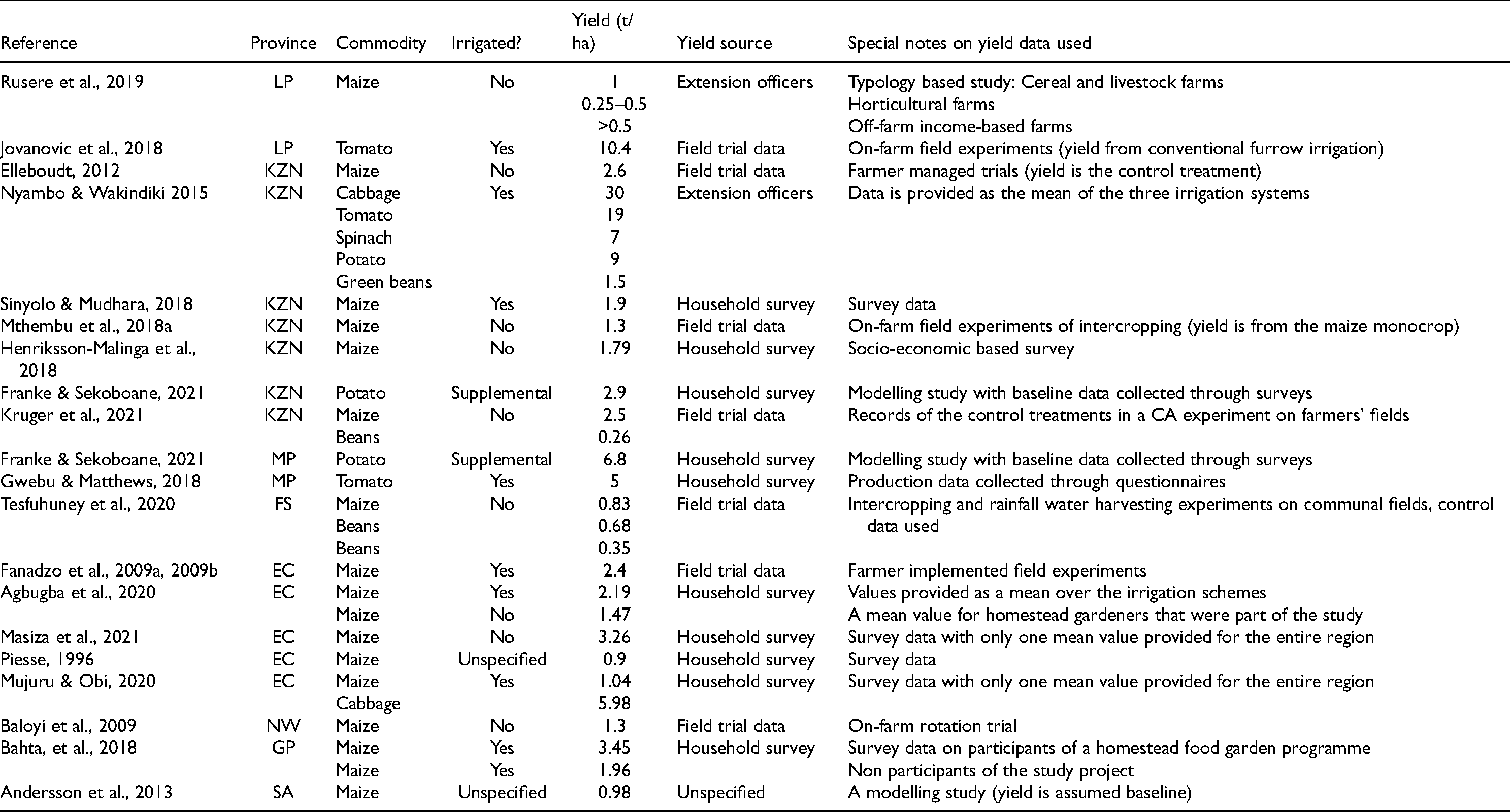
Productivity records of large-scale farmers (deduced from deliveries to silos and estimates based on cropped areas) are regularly updated and easily accessible. For small-scale farmers, one has to rely on memory recall of farming households which complicates data collection and analysis. Hence, researchers often assume their experimental control treatments to mimic small-scale farmer's practises and yields, which is questionable (Table 1). Even so, it remains uncontested that the productivity of small-scale farmers is far outmatched by that of large-scale farmers (Table 2). Jovanovic et al. (2018) found that tomato yields commonly achieved on small-scale farms were well below the attainable yields of > 70 t ha−1 recorded on some large-scale farms in South Africa. For example, tomato yields of 19 in KZN, 10.4 in LP and 5 t/ha in MP (Table 1) pale in comparison against the 64 t/ha national tomato average yield recorded in the Census for commercial agriculture by Stats SA in 2017. Drawing further comparisons between productivities of large-scale vs small-scale farmers with different commodities leads to the same outcome (Table 2).
Reported yields of small-scale farmers in the summer rainfall region of South Africa.
Maize yields of small-scale farmers and the 10-year (2011–2021) average of large-scale farmers (t/ha).
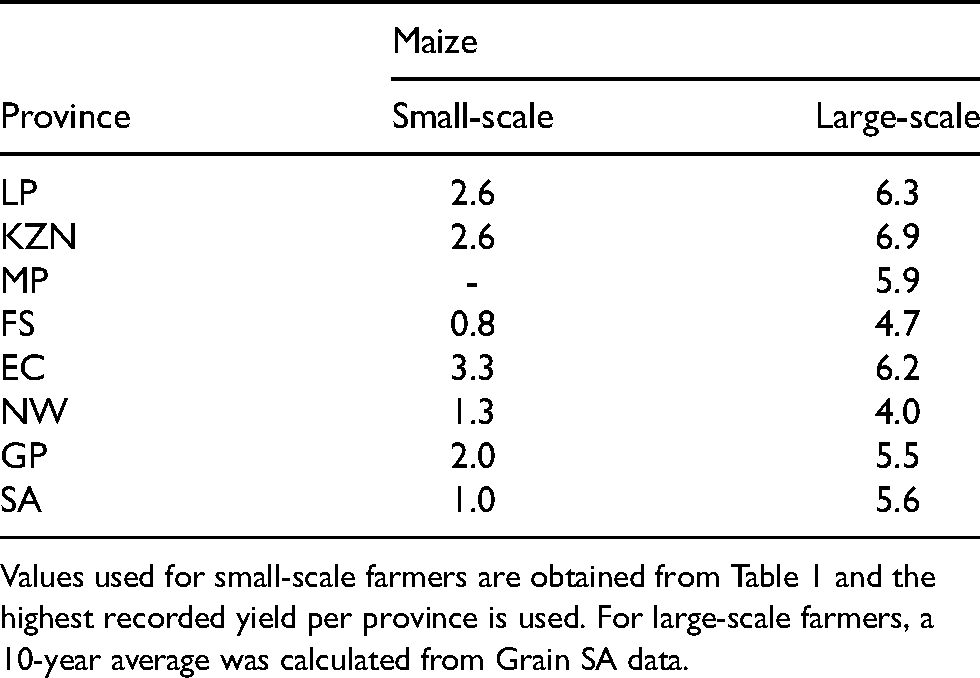
Values used for small-scale farmers are obtained from Table 1 and the highest recorded yield per province is used. For large-scale farmers, a 10-year average was calculated from Grain SA data.
Agricultural production constraints
Both large-scale and small-scale farmers face a multitude of production constraints (Table 3).
Production constraints in the summer rainfall region at the field, farm and regional scale based on a detailed review of the literature. See Appendix 1 for sources on small-scale agriculture and the criteria used to assign scales (i.e. field, farm or region). For constraints of large-scale farmers, primary sources consulted were Clarke et al. (2012); Wilk et al. (2013); Gwebu & Matthews (2018); Henriksson-Malinga et al. (2018) and Popoola et al. (2018).
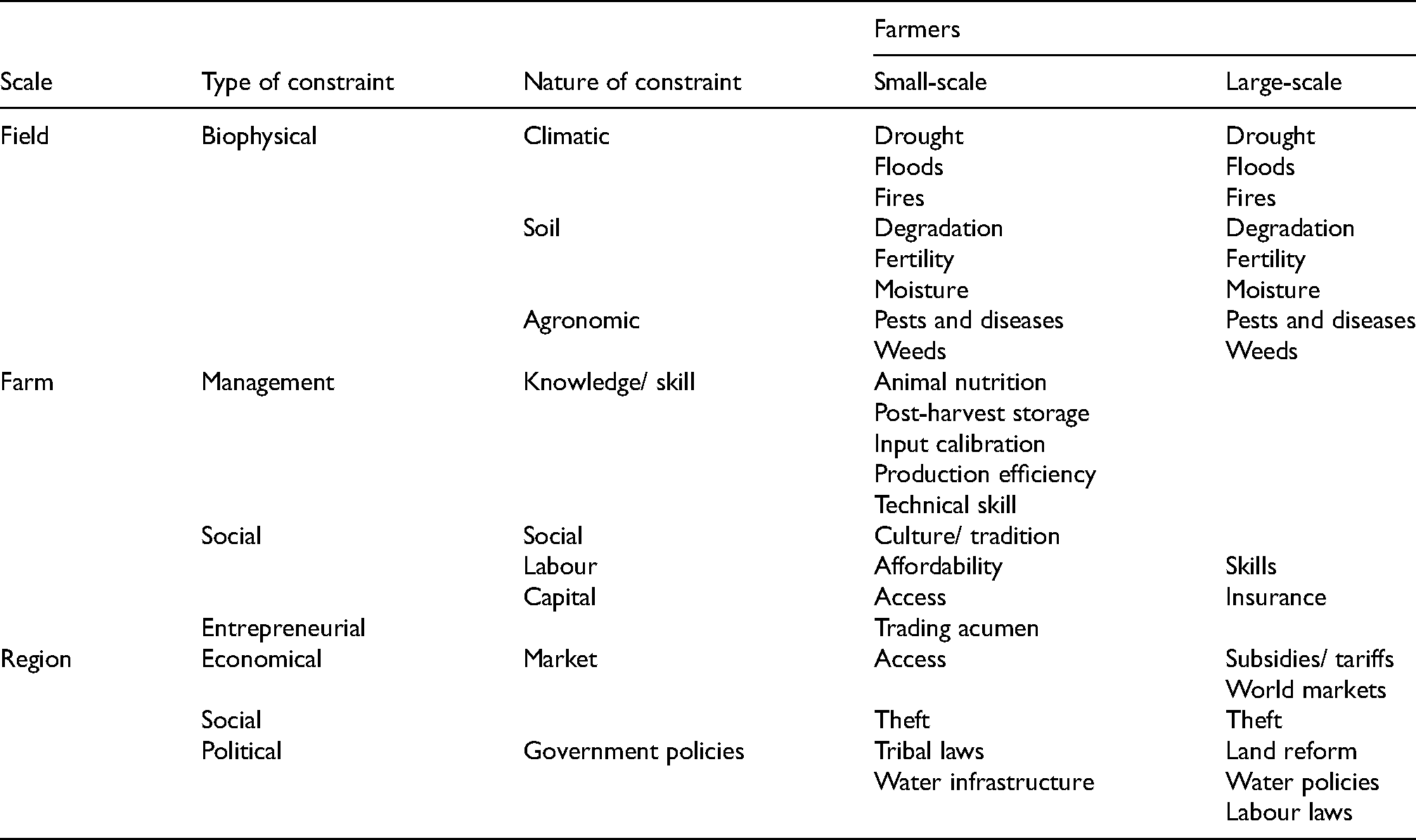
Small-scale and large-scale farmers are exposed to the same biophysical constraints at field scale. Unlike large-scale farmers, small-scale farmers are faced with a list of management related constraints at farm scale (Table 3) which are exacerbated by climate change with more frequent extreme climatic events such as fires, flooding and recurrent droughts. However, management is the most important yield-reducing factor for small-scale farmers. Moswetsi et al. (2017) who concluded in their review that the large gap between farmer yields and the biophysical potential could be reduced through better management practises support this observation.
At regional scale, theft is a common constraint for both small-scale and large-scale farmers. Furthermore, the slowness of government bureaucracy constrains the productivity of farmers differently. Typically, households have exclusive use rights to arable land and communal rights to grazing land. Small-scale farmers do not enjoy private property rights, rather the land is owned by the State and under control of traditional authorities, making long-term farm investment unattractive. For large-scale farmers, constraints manifest through delays in the processing of water licences as well as uncertainties of the land reform programmes (Wilk et al., 2013).
Adaptation and coping capacities
Large-scale farmers have access to relevant information pertaining to agriculture that provides them a better footing in terms of adjusting management strategies of their commercial agricultural activities (Wilk et al., 2013). For example, in a bad year, large-scale farmers might adjust their herds to clear some debt, cut back on labour, even restructure bank loans, or borrow from business partners in other ventures. In good years, commercial farmers boost their future adaptive capacity by investing in their farms. Concerning socio-economic factors such as theft, large-scale farmers can enhance security measures by hiring guards, improving security features such as fencing and by proper marking of livestock and livestock protection against predators (Brink et al., 2021). Ultimately, large-scale farmers are thought to be able to cope better with production constraints and shocks because of the diversified nature of their production activities (Clarke et al., 2012).
Coping strategies of small-scale farmers are primarily based on traditional methods such as studying weather conditions over time, harvesting water from rain, and practising indigenous water and soil conservation methods (Popoola et al., 2018). In more severe cases, coping may be misconstrued as “giving up” such as discontinuing the planting of specific crops or varieties (Popoola et al., 2018) or completely abandoning fields (de la Hey, 2017; Blair et al., 2018; Shackleton et al., 2019). While some strategies may be desirable by small-scale farmers such as the use of fertilisers and biocides, their lack of access to capital restricts their adoption as most rural households depend on social welfare. During bad years, small-scale farmers often have to compromise on most necessities. Selling livestock would be the ultimate resort as livestock serves as both savings and an indicator of wealth or social class. In good years, coping may entail selling of excess grain to buy fertiliser for the next year's crop. However, money obtained from selling excess produce in a good year is typically used to buy food and other households items (Popoola et al., 2018).
The striking difference is that the respective long term versus short term planning of large-scale and small-scale farmers alludes to the differences in access to credit. The prospects of small-scale farmers to take out a loan or crop insurance is shaky as they lack records to demonstrate land ownership and the ability to farm. Their inconsistent income from farming prevents them from investing their own capital into farming. This has a ripple effect on their priorities in saving and spending as well as their risk attitudes. For example, while stock theft is a common occurrence, large-scale farmers bear a further brunt of associated asset theft (e.g. fencing). Yet, they continue to take the risk of acquiring such assets as they cannot farm at scale without them. While one might argue that their risk is eased by obtaining insurance, associated insurance premium changes. Furthermore, livestock is not insured against theft.
Coping strategies for large-scale farmers revolve around diversified forms of off-farm investments. For small-scale farmers, coping strategies are more traditional in nature. Taking a risk that does not pay off may mean debt for large-scale farmers while this may mean food insecurity for small-scale farmers. Nonetheless, farmers need to perceive adequate welfare gains from any technological intervention before choosing to adopt it (Senyolo et al., 2018); (Abegunde et al., 2020). As such, adoption of proposed coping strategies remains modest at best (Guo et al., 2020). For small-scale farmers, technology adoption is limited by poor access to necessary resources (Guo et al., 2020). Furthermore, differences in agricultural resource endowments (Henriksson-Malinga et al., 2018) drives decisions on managing production constraints as well as technological adoption.
Intervention strategies to increase productivity of small-scale farmers
The feasibility and sustainability of small-scale farming in South Africa has been questioned (Hart et al., 2005). Over the years, this issue has been met with variable efforts both from the research and policy perspective.
Research perspective
Studies on interventions aimed at improving the productivity of small-scale farming are provided as Appendix 1. There is ample research addressing field scale constraints and these constraints (Table 3) have been mitigated through for example, breeding for improved crop varieties. Recorded benefits of this technology include increased yields, less demand for labour and lower pesticide use (Beyers et al. 2002). Small-scale farmers already use improved crop varieties of cotton (Yousouf et al. 2002), soybean (Schutte, 2020) and maize (Fischer et al., 2015). While there are plenty to choose from, some field scale interventions techniques such as manuring for soil fertility management are favoured for their cost effectiveness (Mkhabela, 2002) while some approaches like conservation agriculture (CA) are disliked for taking time before their benefits become obvious (Chiduza & Dube, 2013; Swanepoel et al., 2018).
Several terminologically different, but conceptually similar production approaches have also been pursued to enhance crop yields improvement advantages, as well as for added benefits of environmental protection. These approaches include CA, climate-smart agriculture (CSA), sustainable intensification (SI) and ecological intensification (EI). Practices found in these production approaches are focused on reorientation of crops at field level (e.g. intercropping; diversification). These practices have been investigated at great length and reported to be economically viable as they minimise input costs (Berry et al., 2009; Mthembu et al., 2018a). Farmers are said to be motivated by risk avoidance to adopt these strategies (Hitayezu et al., 2016).
Although limited, there has been research addressing farm-scale interventions that may directly or indirectly contribute to increased productivity. Such interventions include alternative storage techniques to reduce post-harvest losses; techniques improving water use efficiencies; succession planning and creation of field nutrient-management zones. An example is the compact arrangement of crop-livestock integration (Hosu & Mushunje, 2013) also known as mixed farming.
While there is ample research at field scale, there is a lack of research at regional scale. Furthermore, there is little research that takes on a multi-disciplinary farming systems approach that can encompass the wider socio-economic environment of small-scale farmers. This multi-disciplinary research approach to small-scale farming has been implemented in other African countries such as Malawi (Franke et al., 2014), Ethiopia (Josephson et al., 2014), Uganda (Van Campenhout & Bizimungu, 2018), Mali (Falconnier et al., 2016), Rwanda (Rosa et al., 2017), Mozambique (Roxburgh & Rodriguez, 2016) and Kenya (Willy et al., 2019). In South Africa, this type of research has been very scanty with only one study to mention (Rusere et al., 2019), where the DEED cycle (Describe; Explain; Explore and Design - meant to limit researcher's assumptions while encouraging co-learning among stakeholders (Giller et al., 2006)) formed the basis of its methodological approach. As such, there is an overall limited understanding of small-scale agriculture in South Africa.
Policy perspective
The government has, through the National Development Plan (NDP), proposed integration of small-scale farmers into existing commercial value chains as a key objective in rural areas. According to the NDP, agriculture is poised to prosper and continue to contribute meaningfully to the country's rural poor by ensuring food and nutrition security. However, a closer look at recent policy initiatives by Chapman et al. (2021) paints a picture of ineffective policy interventions that result in fruitless expenditures. This reality is unpalatable given the governmental investments to increase productivity, enhance sustainable agricultural resource use and facilitate economic growth and development of small-scale farmers. Chapman et al. (2021) further highlight that opposing voices to the current status quo of policy processes and implementations lack the “empirical evidence base needed to lend weight to their convictions”. Furthermore, Okunlola et al. (2016) stated that although government policies have recently shown cognisance of emerging knowledge about small-scale farming such as the diverse nature of this sector, this awareness does not translate into practical programmes of support that take these differences into account in meaningful ways.
One could argue that these “fruitless expenditures” are a result of the wrong starting point. That is, the idea that all small-scale farmers should and will participate in the commercial value chain while basic conditions of scale, access to credit and land ownership are not met (NDP). This then results in white elephant projects like the agri-parks (https://www.gov.za/about-government/government-programmes/agri-parks-programme). Another argument for the “fruitless expenditure” could be poor implementation (lack of capacity and pervasive corruption) as also recognised by the The President's Advisory Panel on Land Reform's report of 2019. Either way, South Africa can no longer afford to run the risk of development programmes and policies that are ineffective (Hall & Kepe, 2017). Hence, the need for a holistic analysis of the dynamics of small-scale farming in guiding strategies and policies to improve the likelihood of success.
On the other hand, a national scan in South Africa by Okunlola et al. (2016) indicated a wide variety of forms of support offered to small-scale farmers by private sector and other actors outside of government. Examples of these actors include university research and support groups such as the Agricultural and Rural Development Research Institute (ARDRI) at the University of Fort Hare and the Farmer Support Group (FSG) of the University of KwaZulu-Natal. While perhaps limited in scope and reach, successful outcomes of such programmes have been documented. For example, the Farmer field school by ARDRI is reported to have increased farmers’ self-assessed knowledge and skills of production, consumption and selling of vegetables in the Eastern Cape Province (Apleni et al., 2019). Similarly, the Integrated Sustainable Agriculture Project (ISA) by FSG assisted farmers to start a communal garden where they grow vegetables for their own consumption and the local market (http://base.d-p-h.info/en/fiches/dph/fiche-dph-7074.html).
Likewise, successful collaboration between non-governmental organisations and small-scale farmers have been developed. Companies such Grain SA (https://www.grainsa.co.za/pages/farmer-development/projects) and Meat Naturally (https://www.meatnaturallyafrica.com/services/) have instituted mentoring programmes where they directly link up with small-scale farmers who demonstrate potential to make it into competitive farming. In some of these programmes, small-scale farmers are assisted with financial management; production training, grazing planning and mapping, farmer and header training, mobile auctions and abattoirs, vaccinations, livestock tagging, to name a few. Such collaborations could help eliminate the government shortfalls of poor implementation of policies.
From all this, an observation is that policy interventions are often based more on ideology and party-political wishes than on empirical research. They are often not very realistic with a slow and messy implementation that yields little impact in the end. For example, while the Presidential Advisory Panel (2019) recognised the capacity constraints and corruption within the government, it still made its recommendations based on the assumption that the government can successfully fund, initiate and oversee interventions. Just the same, the key objective of the NDP is to commercialise small-scale farming while the reality is, the majority of small-scale farmers will not manage to be active participants of formal agricultural markets.
Prospects for small-scale farming in South Africa
A fundamental question when assessing the prospects of small-scale farming is given that large-scale farming is capital and knowledge intensive as well as very competitive, is it realistic to expect small-scale farmers to fight their way into formal markets and develop into small- to medium-scale commercial farmers? Unlike large-scale farmers, small-scale farmers do not benefit from the economies of scale. This means either farms should be consolidated (a very sensitive option given the political history of the country) or production intensified (an option deemed foreclosed by land fragmentation and a lack of alternatives outside agriculture; Giller et al., 2021a). Scale remains important but with certain high-value irrigated crops like vegetables or nuts, one could at least make a living from a small area of land. A bottle neck for commercialising small-scale farming in South Africa is that, unlike in other African countries (Giller et al., 2021b), the thriving large-scale farming sector already saturates most agricultural markets. This leaves very little room for growth and possibilities of breaking into formal markets, a challenge that may be overcome through for example, input subsidies (Rangoato & Oluwatayo, 2018), provision of post-harvest storage facilities (Achiano et al., 1999), and negotiating for pre-concluded contracts (Adewumi et al., 2010).
Small-scale farming in South Africa seems unlikely to act as an engine for growth and economic development in rural areas as assumed by the NDP. Given the reality that people are not purely focussed on farming and have diversified livelihoods, perhaps small-scale agriculture should be pursued to provide affordable and nutritious food for the rural populations while other opportunities for employment in rural and urban areas are explored. There are opportunities to diversify production to provide more nutritious diets with the inclusion of crops such as pulses and vegetables. It however remains unclear what scale of operations is needed to achieve commercial success in different regions of small-scale farming. A potential alternative for job creation could be investing in the high-value horticultural sector. For example, the ZZ2 Company directly employs about 10,000 people through horticultural production activities (www.zz2.co.za).
While the NDP strongly advocates for investing in small-scale agriculture as a route towards reducing both rural poverty and food insecurities of many rural South Africans, Gassner et al. (2019) argue against this dual role thrust upon small-scale farming. The argument is based on the premise that, although poverty and hunger are inextricably linked, they remain two distinct concepts requiring distinct intervention measures. Therefore, two main questions remain. Is small-scale farming still the appropriate entry point for improved rural livelihoods in South Africa? If so, then towards what objectives (job creation, main source of income, food security and self-sufficiency, supplementary income etc.) should small-scale farming be supported?
Concluding remarks
Despite scouring the literature, only few papers were found that were explicit on the poor productivity of small-scale agriculture. Through comparison with large-scale farmers in the same bioregion, this review highlights that low productivity of small-scale farming cannot be solely ascribed to biophysical constraints and that differences rather arise at the farm and regional level. Furthermore, this comparison has indicated that productive and profitable farming is knowledge intense, competitive and not without challenges and should be managed as a business enterprise – something not always at the forefront of interventions in small-scale farming.
Notwithstanding the scarcity of available data, the observed large yield gaps between large-scale and small-scale farmers suggest that there is potential to intensify production on small-scale farms. However, prevalent interventions have been sought at field scale. Farm and regional scale studies are scarce with integrated studies even scantier. This creates a misalignment between constraints, interventions and livelihood dynamics of small-scale farming households. Furthermore, it seems that policy interventions are largely driven by ideologies/paradigms/political considerations and are not evidence based.
While prospects of small-scale farming may seem gloomy at first glance, the opportunity to invest in high value crops exists. However, this prospect is limited by the fact that the country's very competitive and thriving large-scale farming already saturates most agricultural markets. In essence though, it seems that for those with secure land holdings and some access to other factors of production, investment in high value vegetable production could be the way forward. For those without sufficient land, small-scale farming remains a small but important contribution to household food security.
A key reflection that emerges from this review is that we know remarkably little about small-scale farming systems in South Africa. The evidence base is incomplete. Better structured and context-based farming systems / livelihood based research is needed to understand the constraints and opportunities of small-scale farmers. Furthermore, it should be acknowledged that different farmers have different objectives, different possible development pathways and require different interventions. This will provide insights into potential development pathways and the policies needed to support them.
Farming is likely to remain an important supplementary livelihood opportunity for the majority of rural households, more likened to cottage gardening than a thriving commercial venture. What are seen as constraints to agriculture, are more a manifestation of the lack of remunerative jobs in rural areas of South Africa. A diversified approach to rural development is required. Such an approach could support a transition to more commercial farming activities for those with the interest and sufficient land, while providing alternative employment or social protection for others. An important step towards such an approach is to avoid the use of small-scale farmers as a blanket term for rural households. A key question for research is what types of farming in terms of crops and livestock, and what scale of operations is needed to achieve commercial success in different regions. This will clearly differ in relation to the local agroecological conditions and market opportunities, requiring a tailored and nuanced approach.
Footnotes
Acknowledgements
The library services of the University of the Free State and Wageningen University and Research are acknowledged for their valued contribution with access to and management of literature.
Declaration of conflicting interests
The author(s) declared no potential conflicts of interest with respect to the research, authorship, and/or publication of this article.
Funding
The author(s) received no financial support for the research, authorship, and/or publication of this article.

Appendix
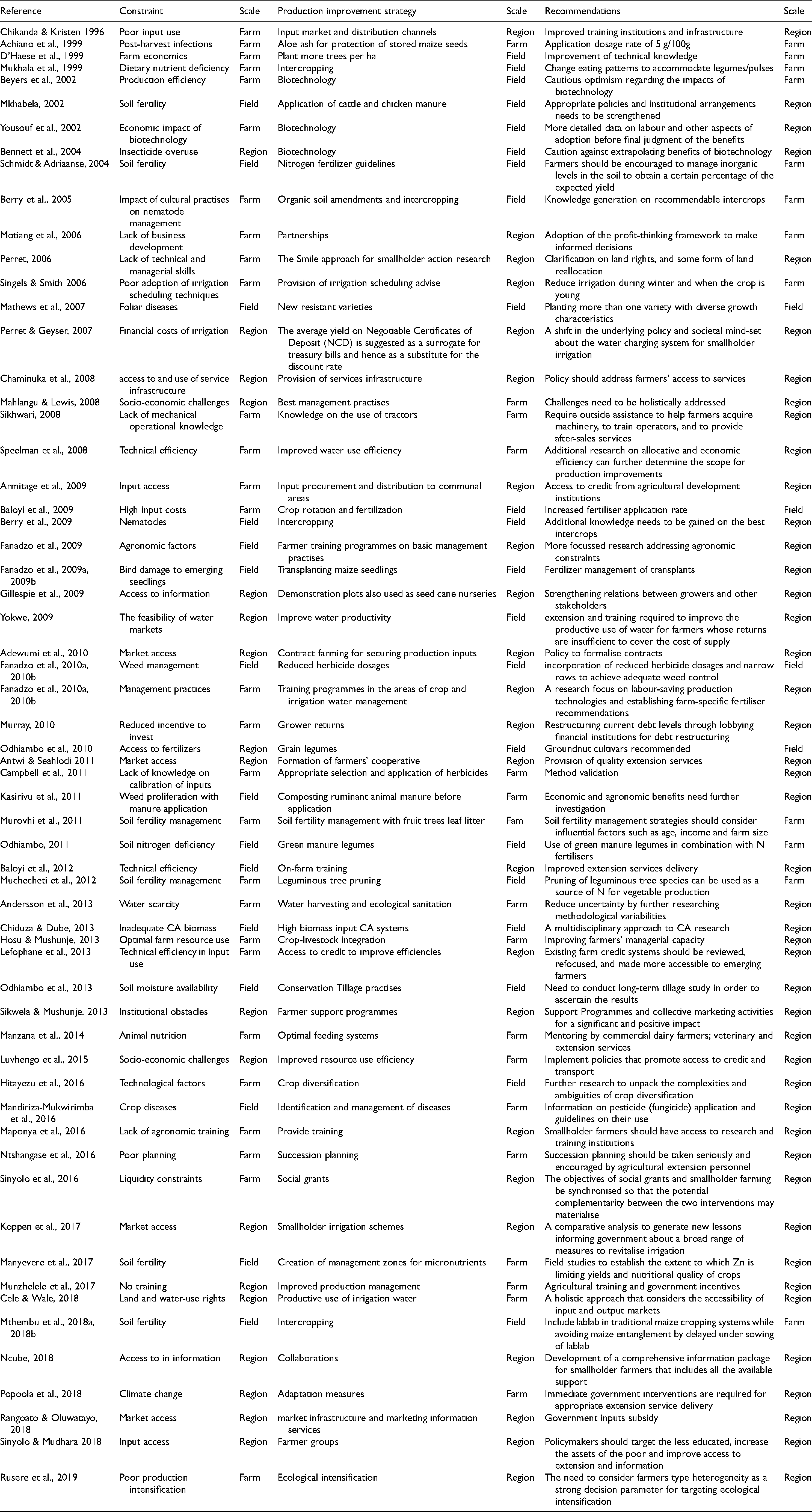
Literature on agricultural constraints of small-scale farmers and proposed intervention strategies at field, farm and regional scale
| Reference | Constraint | Scale | Production improvement strategy | Scale | Recommendations | Scale |
|---|---|---|---|---|---|---|
| Chikanda & Kristen 1996 | Poor input use | Farm | Input market and distribution channels | Region | Improved training institutions and infrastructure | Region |
| Achiano et al., 1999 | Post-harvest infections | Farm | Aloe ash for protection of stored maize seeds | Farm | Application dosage rate of 5 g/100g | Farm |
| D’Haese et al., 1999 | Farm economics | Farm | Plant more trees per ha | Field | Improvement of technical knowledge | Farm |
| Mukhala et al., 1999 | Dietary nutrient deficiency | Farm | Intercropping | Field | Change eating patterns to accommodate legumes/pulses | Farm |
| Beyers et al., 2002 | Production efficiency | Farm | Biotechnology | Field | Cautious optimism regarding the impacts of biotechnology | Farm |
| Mkhabela, 2002 | Soil fertility | Field | Application of cattle and chicken manure | Field | Appropriate policies and institutional arrangements needs to be strengthened | Region |
| Yousouf et al., 2002 | Economic impact of biotechnology | Farm | Biotechnology | Field | More detailed data on labour and other aspects of adoption before final judgment of the benefits | Region |
| Bennett et al., 2004 | Insecticide overuse | Region | Biotechnology | Field | Caution against extrapolating benefits of biotechnology | Region |
| Schmidt & Adriaanse, 2004 | Soil fertility | Field | Nitrogen fertilizer guidelines | Field | Farmers should be encouraged to manage inorganic levels in the soil to obtain a certain percentage of the expected yield | Farm |
| Berry et al., 2005 | Impact of cultural practises on nematode management | Farm | Organic soil amendments and intercropping | Field | Knowledge generation on recommendable intercrops | Farm |
| Motiang et al., 2006 | Lack of business development | Farm | Partnerships | Region | Adoption of the profit-thinking framework to make informed decisions | Farm |
| Perret, 2006 | Lack of technical and managerial skills | Farm | The Smile approach for smallholder action research | Region | Clarification on land rights, and some form of land reallocation | Region |
| Singels & Smith 2006 | Poor adoption of irrigation scheduling techniques | Farm | Provision of irrigation scheduling advise | Region | Reduce irrigation during winter and when the crop is young | Farm |
| Mathews et al., 2007 | Foliar diseases | Field | New resistant varieties | Field | Planting more than one variety with diverse growth characteristics | Field |
| Perret & Geyser, 2007 | Financial costs of irrigation | Region | The average yield on Negotiable Certificates of Deposit (NCD) is suggested as a surrogate for treasury bills and hence as a substitute for the discount rate | Region | A shift in the underlying policy and societal mind-set about the water charging system for smallholder irrigation | Region |
| Chaminuka et al., 2008 | access to and use of service infrastructure | Region | Provision of services infrastructure | Region | Policy should address farmers’ access to services | Region |
| Mahlangu & Lewis, 2008 | Socio-economic challenges | Region | Best management practises | Farm | Challenges need to be holistically addressed | Region |
| Sikhwari, 2008 | Lack of mechanical operational knowledge | Farm | Knowledge on the use of tractors | Farm | Require outside assistance to help farmers acquire machinery, to train operators, and to provide after-sales services | Region |
| Speelman et al., 2008 | Technical efficiency | Farm | Improved water use efficiency | Farm | Additional research on allocative and economic efficiency can further determine the scope for production improvements | Region |
| Armitage et al., 2009 | Input access | Farm | Input procurement and distribution to communal areas | Region | Access to credit from agricultural development institutions | Region |
| Baloyi et al., 2009 | High input costs | Farm | Crop rotation and fertilization | Field | Increased fertiliser application rate | Field |
| Berry et al., 2009 | Nematodes | Field | Intercropping | Field | Additional knowledge needs to be gained on the best intercrops | Region |
| Fanadzo et al., 2009 | Agronomic factors | Field | Farmer training programmes on basic management practises | Region | More focussed research addressing agronomic constraints | Region |
| Fanadzo et al., 2009a, 2009b | Bird damage to emerging seedlings | Field | Transplanting maize seedlings | Field | Fertilizer management of transplants | Region |
| Gillespie et al., 2009 | Access to information | Region | Demonstration plots also used as seed cane nurseries | Region | Strengthening relations between growers and other stakeholders | Region |
| Yokwe, 2009 | The feasibility of water markets | Region | Improve water productivity | Field | extension and training required to improve the productive use of water for farmers whose returns are insufficient to cover the cost of supply | Region |
| Adewumi et al., 2010 | Market access | Region | Contract farming for securing production inputs | Region | Policy to formalise contracts | Region |
| Fanadzo et al., 2010a, 2010b | Weed management | Field | Reduced herbicide dosages | Field | incorporation of reduced herbicide dosages and narrow rows to achieve adequate weed control | Field |
| Fanadzo et al., 2010a, 2010b | Management practices | Farm | Training programmes in the areas of crop and irrigation water management | Region | A research focus on labour-saving production technologies and establishing farm-specific fertiliser recommendations | Region |
| Murray, 2010 | Reduced incentive to invest | Farm | Grower returns | Region | Restructuring current debt levels through lobbying financial institutions for debt restructuring | Region |
| Odhiambo et al., 2010 | Access to fertilizers | Region | Grain legumes | Field | Groundnut cultivars recommended | Field |
| Antwi & Seahlodi 2011 | Market access | Region | Formation of farmers’ cooperative | Region | Provision of quality extension services | Region |
| Campbell et al., 2011 | Lack of knowledge on calibration of inputs | Farm | Appropriate selection and application of herbicides | Farm | Method validation | Region |
| Kasirivu et al., 2011 | Weed proliferation with manure application | Field | Composting ruminant animal manure before application | Farm | Economic and agronomic benefits need further investigation | Region |
| Murovhi et al., 2011 | Soil fertility management | Farm | Soil fertility management with fruit trees leaf litter | Fam | Soil fertility management strategies should consider influential factors such as age, income and farm size | Farm |
| Odhiambo, 2011 | Soil nitrogen deficiency | Field | Green manure legumes | Field | Use of green manure legumes in combination with N fertilisers | Farm |
| Baloyi et al., 2012 | Technical efficiency | Field | On-farm training | Region | Improved extension services delivery | Region |
| Muchecheti et al., 2012 | Soil fertility management | Farm | Leguminous tree pruning | Field | Pruning of leguminous tree species can be used as a source of N for vegetable production | Farm |
| Andersson et al., 2013 | Water scarcity | Farm | Water harvesting and ecological sanitation | Farm | Reduce uncertainty by further researching methodological variabilities | Region |
| Chiduza & Dube, 2013 | Inadequate CA biomass | Field | High biomass input CA systems | Field | A multidisciplinary approach to CA research | Region |
| Hosu & Mushunje, 2013 | Optimal farm resource use | Farm | Crop-livestock integration | Farm | Improving farmers’ managerial capacity | Region |
| Lefophane et al., 2013 | Technical efficiency in input use | Farm | Access to credit to improve efficiencies | Region | Existing farm credit systems should be reviewed, refocused, and made more accessible to emerging farmers | Region |
| Odhiambo et al., 2013 | Soil moisture availability | Field | Conservation Tillage practises | Field | Need to conduct long-term tillage study in order to ascertain the results | Region |
| Sikwela & Mushunje, 2013 | Institutional obstacles | Region | Farmer support programmes | Region | Support Programmes and collective marketing activities for a significant and positive impact | Region |
| Manzana et al., 2014 | Animal nutrition | Farm | Optimal feeding systems | Farm | Mentoring by commercial dairy farmers; veterinary and extension services | Region |
| Luvhengo et al., 2015 | Socio-economic challenges | Region | Improved resource use efficiency | Farm | Implement policies that promote access to credit and transport | Region |
| Hitayezu et al., 2016 | Technological factors | Farm | Crop diversification | Field | Further research to unpack the complexities and ambiguities of crop diversification | Region |
| Mandiriza-Mukwirimba et al., 2016 | Crop diseases | Field | Identification and management of diseases | Farm | Information on pesticide (fungicide) application and guidelines on their use | Region |
| Maponya et al., 2016 | Lack of agronomic training | Farm | Provide training | Region | Smallholder farmers should have access to research and training institutions | Region |
| Ntshangase et al., 2016 | Poor planning | Farm | Succession planning | Farm | Succession planning should be taken seriously and encouraged by agricultural extension personnel | Region |
| Sinyolo et al., 2016 | Liquidity constraints | Farm | Social grants | Region | The objectives of social grants and smallholder farming be synchronised so that the potential complementarity between the two interventions may materialise | Region |
| Koppen et al., 2017 | Market access | Region | Smallholder irrigation schemes | Region | A comparative analysis to generate new lessons informing government about a broad range of measures to revitalise irrigation | Region |
| Manyevere et al., 2017 | Soil fertility | Field | Creation of management zones for micronutrients | Farm | Field studies to establish the extent to which Zn is limiting yields and nutritional quality of crops | Region |
| Munzhelele et al., 2017 | No training | Region | Improved production management | Farm | Agricultural training and government incentives | Region |
| Cele & Wale, 2018 | Land and water-use rights | Region | Productive use of irrigation water | Farm | A holistic approach that considers the accessibility of input and output markets | Region |
| Mthembu et al., 2018a, 2018b | Soil fertility | Field | Intercropping | Field | Include lablab in traditional maize cropping systems while avoiding maize entanglement by delayed under sowing of lablab | Farm |
| Ncube, 2018 | Access to in information | Region | Collaborations | Region | Development of a comprehensive information package for smallholder farmers that includes all the available support | Region |
| Popoola et al., 2018 | Climate change | Region | Adaptation measures | Farm | Immediate government interventions are required for appropriate extension service delivery | Region |
| Rangoato & Oluwatayo, 2018 | Market access | Region | market infrastructure and marketing information services | Region | Government inputs subsidy | Region |
| Sinyolo & Mudhara 2018 | Input access | Region | Farmer groups | Region | Policymakers should target the less educated, increase the assets of the poor and improve access to extension and information | Region |
| Rusere et al., 2019 | Poor production intensification | Farm | Ecological intensification | Region | The need to consider farmers type heterogeneity as a strong decision parameter for targeting ecological intensification | Region |
A matrix for the different components of Appendix 1

| Number of studies in each component of the research | |||
|---|---|---|---|
| Scale | Constraint | Production improvement strategy | Recommendations from studies |
| Field | 15 | 21 | 4 |
| Farm | 28 | 17 | 12 |
| Region | 18 | 23 | 45 |
|
|
|
|
|