




Abstract
Nature-based solutions, principally diverse systems, are increasingly being promoted as the solution to future food production as they are perceived to be more productive, resilient and ecologically based. This ‘paradigm of in-field diversity’ approach is inciting a growing perception that monocultures, the source of most global food production, are ecologically dysfunctional and highly vulnerable to diseases and pests. Our perspective paper clearly shows that natural monodominant vegetation is common in nature and that the ancestral species of major cereals including wheat, barley and rice grew in monocultures maintained by disturbances such as fire or flood. Early farmers mimicked these ecological stresses during field management, favouring annual monodominant crops. We also present well-supported evidence that cereal monocultures are an ancient method of farming founded in the origins of agriculture and that modern plant breeding generates and supports monoculture crops that are inherently genetically diverse and usually resistant to prevailing diseases and pests. Until research has been done on the ecology, agronomy and management of diverse nature-based solutions to future agriculture, the scarce funding to agricultural research for future food production is better targeted at improving monoculture agriculture to be more efficient, productive, resilient and environmentally benign. Monoculture agriculture, particularly for cereals, is a proven natural model for future food production.
Keywords
Sima Qian in 148 BC wrote of the Yangtse Valley, ‘where the land is tilled by fire and hoed by water’ (Grist, 1975)
Introduction
Agriculture is the practice of cultivating the soil to produce food and other products. Global food security depends on agriculture's productivity. If agriculture is to benefit from mimicking some aspects of natural systems, then the requirement to produce food cannot be jeopardized (Denison and McGuire, 2015). This perspective paper is therefore written in the context of nature-based solutions for future food production.
Over the past 30 years, anti-monoculture propaganda has fomented a growing perception that monocultures are ecologically dysfunctional and highly vulnerable to pests and diseases in spite of the overwhelming evidence that they have become progressively more productive and resistant to pests and diseases through advances in agricultural research (DeGregori, 2003; Lenné and Wood, 2011a). There have been growing calls for more sustainable, resilient and ecologically-based agriculture (Altieri, 1999; Carlisle et al., 2019; Ewel, 1999; Frison, 2016; Gross and Smith, 2002; Jackson, 2002; Magdoff, 2007; Malézieux, 2012; McIntyre et al., 2009). These authors claim that, to ensure this, modern agriculture should mimic natural systems. Nature-based solutions, principally diverse systems, are increasingly seen as the solution to future food production (Artmann and Sartisan, 2018; Peter et al., 2017) in spite of the lack of scientific evidence to support this view (DeGregori, 2003). In most cases, these supposedly ecological solutions involve increasing vegetational diversity in agricultural fields – leading to an unsubstantiated ‘paradigm of in-field diversity’
The ‘paradigm of in-field diversity’ approach makes a major assumption: that natural vegetation is always diverse and all the better for it. This false assumption is then used to criticise agriculture: ‘Little is “natural” in contemporary agriculture. It is not nature's way to allow large expanses of land to be planted to a single crop, much less to a single variety of that crop’ (Fowler and Mooney, 1990). Based on the supposed `unnaturalness’ of contemporary cropping, more extreme, evidence-free claims include: ‘Monoculture is, in essence, a system working against the farms natural ecological process’, 1 ‘Nature abhors monocultures. Nature abhors them so much that they do not exist in accordance with nature’ 2 and ‘Monocultures don't exist in nature’. 3
There are even scientific attacks on monocultures, for example Tilman (1999), claims: ‘A hallmark of modern agriculture is its use of monocultures grown on fertilized soils. Ecological principles suggest that such monocultures will be relatively unstable, will have high leaching loss of nutrients, will be susceptible to invasion by weedy species, and will have high incidences of diseases and pests—all of which do occur’. Nowhere in his paper does Tilman say what these `ecological principles’ are, so his is a specious criticism. There is also the belief that, at the time of crop domestication, humans began to replace species-diverse ecosystems dominated by perennial plants with annual, monoculture croplands dependent on frequent and intense soil disturbances (Crews et al., 2018). We show below that this is not just an unfounded belief but, for the first cereal domesticates, quite wrong.
Further, if the belief that natural vegetation is always diverse is true, then the persistence of natural monodominant vegetation should be ecologically impossible: over time monodominant vegetation will always be invaded and replaced by multi-species vegetation. We emphasize that this belief – that natural vegetation is always diverse – is wrong. If wrong, the multiple arguments that diverse natural vegetation has to be the best model for arable farming are also wrong.
Monoculture defined
Monoculture agriculture is the practice of cultivating a single crop species – a monospecific, monodominant stand – on a specific area of land. 4 In recent years, this definition has been significantly broadened and synonymized with modern, industrial and intensive agriculture and continuous monocropping. It is used more often by critics of modern agriculture than by farmers. The original definition of monoculture does not include any reference to time or definitive space and to how the monospecific stand is managed. How long it is grown; how much space it covers; and how it is managed are not inherent to what a monoculture is.
Monoculture agriculture is the major form of farming practiced worldwide to produce most of our plant-based food – by large, medium and small farmers, by developed and less-developed countries and even by subsistence farmers. Some of our most important food crops including wheat, rice, maize, barley, potato, oil seeds and pulses are almost always grown as monocultures (Lenné and Wood, 2011a). For example, the irrigated lowland rice system produces 75% of the global rice production from about 93 million ha; a further 20 m ha of rice is subject to uncontrolled flooding (Rao et al., 2017). These vast areas of irrigated and flooded rice are always monocultures, each with ability to grow in extreme ecologies.
Humanity relies on monocultures for food security and this is unlikely to change in the foreseeable future. Monocultures are easier to plant, weed, manage, harvest, market and process and are generally higher yielding and more profitable than mixed crop cultures. Although monoculture agriculture is blamed for most of the negative aspects of intensive agriculture such as overuse of fertilizers and pesticides, soil degradation, reduction in biodiversity and other environmental impacts, these aspects relate to the management intensity of the crop and not to the crop itself. Much monoculture agriculture is practised with moderate inputs (even no inputs in less-developed countries), integrated pest management, crop rotation, minimum tillage as well as efforts to manage landscape biodiversity.
Crop rotations of monocultures including cereals and legumes (Franke et al., 2018) and cereals and oil seeds (Angus et al., 2018) provide simple, profitable and productive solutions to some of the negative aspects of intensive agriculture. These include improved soil fertility (N and P), increased soil organic matter and management of soil borne diseases, pests and parasitic weeds. Minimum tillage in conservation agriculture reduces soil degradation through maintaining soil cover (Denison and McGuire, 2015) while managing monoculture crops in diverse landscapes reduces biodiversity loss (Gardiner et al., 2009).
Objectives
Our main objective is to validate crop monocultures of cereals as a Nature-based response to ecological stress. Our approach is therefore a sharply contrasting one to the ‘monocultures are unnatural’ claim. Firstly we give examples of natural monodominant grassland maintained by flood or fire and then attempt to show that the wild relatives of cereals also grow in fire or flood conditions, that is, in stressed ecological conditions that favoured monodominance. In effect, species ancestral to crops were tough, that is, so highly evolutionarily adapted to certain conditions of ecological stress that other species could not compete. As early farmers mimicked these ecological stresses during field management they favoured early annual crops and also achieved weed control. Secondly, we look at claims that monocultures are a modern method of farming; monocultures lack diversity; and monocultures are highly vulnerable to pests and diseases. Finally, we explore the relevance of some proposed principles for cropping system design based on natural ecosystem mimicry for monoculture agriculture. We will draw on several chapters in Wood and Lenné (1999) and Lenné and Wood (2011b) which are just as relevant today as when they were written, as well as other literature to interrogate these claims to show a lack of solid scientific foundation. We will present strong evidence that monoculture agriculture, particularly for cereals, is a proven natural model for future food production.
Monodominant vegetation in nature
In fact, different types of vegetation with a single monodominant species are widespread in Nature. The easiest pattern to visualise is vegetation at the edge, beyond which ecological conditions become too harsh for any plant to grow. As a benign environment transitions to harsh conditions the number of plant species able to grow falls, often through a series of species-poor zones where different species are adapted to different limiting conditions. At the edge a single species forms the exclusive constituent of the vegetation, that is, it becomes monodominant.
Flood
There are multiple examples of this where land borders fresh or saline water. Only very limited examples are given here, from the Family Poaceae.
There are extensive stands of Phragmites australis monodominant to dominant in many swamp community reed-beds between shallow and deeper fresh water pan-globally (Packer et al., 2017). In mud-flats inundated daily by the sea, large areas of monodominant Spartina anglica are found round Britain (Online Atlas of the British and Irish Flora, n.d.). In the Okavango Delta, Botswana, the salt-tolerant Sporobolus spicatus forms extended monodominant stands (Bonyongo, 1999). Miscellaneous examples of monodominant grasses include:
dense stands of Echinochloa stagnina in tropical West Africa; ‘prairies’ of the grass Vossia cuspidate around Lake Chad; inundated zones of the Massenya (Chad) floodplain covered by Hyparrhenia rufa (Wigham et al., 1993).
Fire
Another characteristic driver of monodominance is fire. Again, examples are from the grass Family Poaceae.
Imperata cylindrica (cogongrass) ‘…cogongrass invasion could shift sandhill ecosystems from a species-diverse pine savanna to a monotypic cogongrass grassland…’ and ‘Cogongrass fires are very intense and hot, with little above-ground vegetation able to survive…’ (MacDonald, 2004). For Sorghum in Australia: ‘Presumably, enough seed is buried through use of hygroscopic awns, then protected from the heat of the fire by the soil covering, to provide a crop the following year.’ … ‘…population decline of the annual grass Sorghum intrans in the unburnt plots was consistent with the absence of fire.’ (Gill et al., 1990). Harlan noted for Africa: ‘Massive stands of truly wild races of sorghum can be found widely distributed over the savanna zones.’ (Harlan, 1992). Also ‘… a large percentage of African savannah is affected annually by fire…’ (Cahoon et al., 1992)
Not all these examples of adaptation to fire or flood are appropriate for cropping for food. How did the first farmers choose between the many natural examples of monodominant vegetation for appropriate cereal species to grow in the earliest fields?
Ecological validation of monodominance
It has been noted that ecological research is the weak link in agricultural origin studies, in comparison to archaeological and genetic investigations which are going ‘great guns’ (Blumler, 1998). Blumler (1996) had argued that dense stands of wild relatives were a ‘paradox and a puzzle’. However, by then, a sound ecological rationale for monodominance had been provided by an ecologist, Grime (1977), who located plant strategies within a triangle determined by species abilities as ruderals, stress tolerants, or competitives. Importantly, Grime noted that at the respective corners of the triangle members of each of the three classes become the ‘exclusive constituents of the vegetation’. That is, members of each class become monodominant, in effect, tougher than any other available species under the local conditions of stress. We see no remaining `paradox or puzzle’. Rather, it seems remarkable that attacks on crop monocultures still ignore the real ecology of monodominance in Nature.
Note that Grime offers three types of strategies to attain monodominance in natural vegetation. Is any one of these strategies more relevant to post domestication field management? The answer seems to be ‘Yes’. The ruderal strategy includes ‘Rapid curtailment of vegetative growth and diversion of resources into seed production’ and also ‘Rapid production of seeds ensures rehabilitation after disturbance’. Grime refers to earlier work of MacArthur and Wilson (1967) on r and K selection with the r-selected type made up of organisms with a ‘short life expectancy and large reproductive effort’. Grime also references Pianka (1970), who gives as a feature of r-selection ‘recolonization each year’.
The key features of ‘ruderal’ monodominance therefore include (our comment in brackets):
‘short life expectancy’ (that is, annual growth habit) ‘large reproductive effort’ (either large seed and/or lots of seed) ‘disturbance’ (clearing away of other, non-adapted species) ‘rehabilitation’ and recolonization (of open habitats)
It should be apparent that these features are those of annual cereal crops and, to a great extent, also their wild ancestors.
As only some wild progenitors were domesticated from specific natural vegetation types, the key question to ask is what attracted early gatherers to domesticate these plants? Principle qualities would most probably have been desirability as food and ease and efficiency of harvesting. Large seed would have been an attractive character as less effort would be needed to gather food. Dense monospecific stands would also have been attractive as more could be gathered in less time. Hence large seeded, monodominant stands of food bearing plants would have been the most attractive plant-based food sources for the early gatherers (Wood and Lenné, 2018).
We now suggest that the present-day production of major cereals (with the exception of maize) is a close mimic of certain types of natural monodominance under conditions of strongly wet-dry seasonality. Two types of ecological stress are considered (both leading to monodominant vegetation where only one, tough species can survive):
Seasonally naturally flooded wetland vegetation, eventually leading to floodwater farming of special importance for rice The probable role of natural grassland fires in the ecology of wild relatives of the first cereals in and around the Fertile Crescent.
Seasonally flooded wetland
The term ‘floodwater farming’ (Bryan, 1926) refers to crops planted on floodplains after flood waters have receded or where fields are watered by flash floods on alluvial fans – no regular diversion of water is maintained. In describing floodwater farming, Denevan (1995) noted that such ‘natural irrigation’ was undoubtedly earlier than canal irrigation but leaves little archaeological evidence.
Prain (1903) described the ecology of Oryza coarctata, a wild relative of rice, as the most common and plentiful grass species in the Sundarbans mangrove swamps of Bengal. Mud- flats are: ‘closely and uniformly covered by a sheet of Oryza coarctata.’ In Pakistan Oryza coarctata forms dense mats covering miles of flat land at the mouth of the Indus River within tidal influence (Blatter, 1929).
A swamp in Thailand was densely covered with Oryza rufipogon plants with coverage of 60–70% (Akimoto et al., 1999, Figure 2a). Wild wetland stands of wild Oryza rufipogon known as ‘tinni’ (red rice) can be sufficiently dense to be managed through soil improvement within the Bhar community of eastern Uttar Pradesh, India. Yields are 0.62–1.19 tonnes per hectare (Singh et al., 2012). To us the management of ‘tinni’ rice represents the first step on the road to domestication.
Wild rice, for example Oryza meridionalis, can be monodominant in Australia (Wurm, 2004). Our notes from wild rice specimens in the CSIRO Herbarium in Canberra show that other wild rice species in the region show monodominance. For example, the annual Oryza australiensis is ‘gregarious’ and in ‘large populations’, O. meridionalis forms ‘pure stands above water’, O. longiglumis in Papua is ‘gregarious’, and O. minuta in Indonesia is ‘gregarious’ on lake margins.
Harlan (1989a: Figs. 5.2–5.3) describes and illustrates harvests from dense stands of wild rice (Oryza barthii) in Africa. Harvest was on a massive scale and formed a local staple across Africa from the southern Sudan to the Atlantic. Evans (1998:34) reports that the grain yields of wild rice stands in Africa and Asia can exceed 0.6 tonnes per hectare – an indication of the stand density of wild rice.
Natural grassland fires
Many grasses of genera from which our most important cereals evolved grow in monodominant stands, for examples native annual Sorghum species are found growing in monocultures in tropical northwest Australia and in Africa. Harlan (1989b: 336) identified the verticilliflorum race of Sorghum bicolor as the wild progenitor of cultivated sorghums and noted that it was dominant and in enormous quantities in the tall grass savannas of Sudan and Chad.
Many scientists have provided strong evidence of monodominant ‘fields’ of wild cereals with stands developing as dense as sown cultivated fields when protected from livestock (Harlan, 1981). Zohary (1969) details extensive masses and ‘wild fields’ characteristic of wild einkorn and wild emmer wheats. In the Near East, Harlan (1967, 1992) noted that massive stands of wild wheats cover many square kilometres. For example, wild emmer is as abundant in the Upper Jordan Valley as the vast stands of wild einkorn in the north, from Palestine to south eastern Turkey, west to Anatolia and eastward to western Iran and north to the Caucasus. Hillman (1996) reported that wild einkorn tends to form dense stands which when harvested give yields that often match those of cultivated wheats under traditional management. Similarly, wild barley was massively and continuously spread over primary habitats (all reviewed by Wood and Lenné, 2001). There is a significant need for field work on this key monodominant vegetation of species ancestral to cereal crops before it disappears.
We suggest that natural grassland fire is the selective force for this type of monodominance. The above wild relatives of wheat, barley, and oats all show an unusual syndrome of large seed coupled with scabrid or hygroscopic awns capable of burying seed in soil – an obvious adaptation against periodic grassland fires (Wood and Lenné, 2018).
The ecological stress of fire and flood that we suggest determines the monodominance in natural grassland continues to this day in field management. Agricultural fires for managing fields are firmly entrenched. For example, in Southeast Asia cropland burning was substantial, contributing 16–20% of the total fire counts; high levels of cropland burning were found in Eastern Europe and Russian Federation; there was a consistent application of fire to crop management in China (Korontzi et al., 2006). In addition to the tabula rasa impact of fire as a mimic of natural burning, there is now also seasonal disturbance – to remove plant competition – of ploughing, tilling, and seeding. Increasingly, associated with minimum tillage, there is a substitute for fire with a herbicide ‘burn’. In the case of flood, seasonal flooding is still important as a selective force, latterly augmented by irrigation. Disturbance of various kinds during field management favours the crop but controls weeds.
Cultivation of monocultures is not a modern method of agricultural production
The origin of monoculture agriculture is often linked to the ‘industrialization’ of agriculture where ‘diversified farms’ were replaced by monocultures (Iles and Marsh, 2012). It should be noted that in these ‘diversified farms’, diversity was partitioned at landscape-level between fields of different crop monocultures. Hence the main change at this time was reduced diversification between monoculture fields which inevitably led to larger monoculture fields.
The belief that monocultures originated with the industrialization of agriculture about 200 years ago is widespread: ‘Monocultures would be unknown but for modern man’ 5 and ‘The cultivating of monocultures is very much a modern method of agricultural production’ 6 or even later: ‘…the beginning of monoculture farming… is dated back to 1901’. 7 In reality, the cultivation of cereal monocultures for food is many thousands of years old. Although there is no single answer about the period of domestication for our major cereals, considerable archaeological evidence for wheat and barley suggests a protracted transition of up to 3000 years during 10,000 to 7000 BC (Allaby et al., 2008). Sweeney and McCouch (2007) and Gross and Zhao (2014) note the same for rice in Asia. Recent studies on rice have benefited from new evidence from archaeological sites and techniques such as flotation for grain sampling. This has firmed up existing evidence that Oryza japonica was first domesticated in the Yangtze River area of China and Oryza indica in the Ganges area of India about 8000 years ago (Gross and Zhao, 2014). Although cultivation of the soil for growing crops began in different parts of the world from approx. 10,000–6000 years ago, many published papers cited in Wood and Lenné (1999) and Lenné and Wood (2011b) show that monocultures of wheat, barley and rice are as old as the origins of agriculture. Wood and Lenné (2018) present strong evidence that the first fields of wheat and barley were a managed mimic of an entirely natural niche and ecologically sustainable, the naturally disturbed ground occupied by monodominant wild cereals. This view is supported by the archaeological evidence of the incidence of non-shattering (domestic type) over time. Hence the cultivation of cereal monocultures is ancient. Although there is limited information about the ecology of the wild ancestors of other food plant groups, it is probable that early farmers grew other food crops in monoculture due to its efficiency and effectiveness for growing and harvesting food and for management.
Modern monocultures are inherently genetically and functionally diverse not uniform
The perceived uniformity of monocultures – ‘uniform agriculture’ – is frequently used to foment the mythology of their ecological dysfunctionality and high vulnerability. For example: ‘Many of the problems (of industrial agriculture) are linked specifically to ‘uniform agriculture’: the input-intensive crop monocultures …. that now dominate farming landscapes. The uniformity at the heart of these systems ……..leads systematically to negative outcomes and vulnerabilities.’ (Frison, 2016) and ‘Agricultural ecosystems are composed of genetically depauperate populations of crop plants’ (McDonald and Stukenbrock, 2016).
Crops grown in monocultures are of single species, which may be morphologically uniform, but increasingly highly genetically diverse. Monocultures are inherently functionally diverse.
In much of the farming world, today's monocultures are made up of crop varieties developed through modern plant breeding. The key objective of modern plant breeding is to identify, access and combine functional traits to combat biotic and abiotic stresses, improve nutritional quality and marketability and increase yield. This is functional diversity – diversity for a purpose rather than genetic diversity per se. Modern plant breeding is supported by storing a vast diversity of gene pools of old cultivars, experimental lines, ancestral taxa and wild relatives, as well as advanced biotechnology (Lenné and Wood, 2011a). This is sifted by screening and combined by plant breeding into varieties. This varietal improvement had been a feature of farming since domestication but farmers did not and do not have access to sufficient variation; could not apply the intense selection pressure for pests and pathogens; nor could they cross-breed predominantly self-pollinating cereals to have the rapid impact of modern plant breeding. For genetic diversity alone of two Green Revolution institutes; the International Rice Genebank holds 132,000 samples sourced from all rice producing countries and an International Wheat Genebank maintains 150,000 samples of wheat for use in breeding programmes. ‘Modern plant breeding therefore greatly increases the potential for broadening the [genetic] diversity for useful traits in crops locally, regionally and globally and has allowed on-going use of a wealth of crop diversity by millions of farmers’ (Lenné and Wood, 2011a). The pyramiding of genes for resistance against pathogens and pests and pedigree complexity in released varieties supports functional diversity in monocultures.
The final result of institutional plant breeding – a single variety suited to certain field conditions – is a result of intense selection pressure, where a multitude of samples is intensely screened. This is a remarkable, but unintended, parallel with intense natural selection of natural vegetation, where the many plant species available come under ecological stress in Nature which selects a single species to form monodominant vegetation. The tough varieties of the plant breeder or a single species in Nature survive, the unfitted are winnowed out: quality over quantity in both human and natural selection.
It is often argued that the genetic base of modern crop varieties is highly restricted – perhaps even depauperate - but evidence from studies on their parentage does not support this pessimistic view (Witcombe, 1999). An analysis of the pedigrees of spring wheat from Canada, USA and Mexico found 47, 133, and 90 different parents, respectively (Beuningen and Busch, 1997). In the USA and Mexico, the introduction of novel alleles from wild ancestors has contributed to a broadening of the genetic base. An examination of the number of landraces in the backgrounds of 11 CIMMYT (International Centre for Improvement of Maize and Wheat) wheat varieties indicated that the number of landraces used increased from less than 10 in 1950 to more than 60 in 1990 (Evans, 1997). Smale and McBride (1996) noted for wheat that yield stability, resistance to rusts, pedigree complexity and the number of modern varieties in farmers’ fields have all increased since the early years of the Green Revolution. An analysis of the pedigrees of IRRI (International Rice Research Institute) rice varieties from 1966 to 1994 showed that use of landrace parents in their development increased from 4 to 47 (Witcombe, 1999). IR 64 is one of the most popular rice varieties in south-east Asia due to its high yield, early maturity, excellent cooking quality and resistance to major diseases and pests. Its pedigree is substantially diverse with 79 parents including 20 landraces, one accession of Oryza nivara and 58 older varieties (Mackill and Khush, 2018).
The genetic diversity in monocultures may also be partitioned between plants as multi-lines and mixtures (Cox and Wood, 1999). Multi-line varieties are composed of genetically identical lines with the exception that each line differs genetically for a specific trait often for disease or pest resistance. The mix of lines provides a buffering effect against new races of pathogens or new biotypes of pests and against environmental challenges, for example, under changes in climate. Mixtures of varieties can be composed of closely related lines or unrelated lines or varieties. In both cases, additional functional diversity, usually for pest and disease resistance, is added to the monoculture which may be at the expense of grain quality. Landraces are monoculture mixtures (both old and modern varieties) which are still widely grown today by millions of farmers in less developed countries (Lenné and Wood, 2011a).
Crop varietal mixtures, especially of cereals, have received considerable attention in temperate developed countries (Finckh et al., 2000; Kiaer et al., 2009; Marshall, 1977; Mundt, 2002; Reiss and Drinkwater, 2018; Smithson and Lenné, 1996; Wolfe, 1985). From a review of 120 published studies, Smithson and Lenné (1996) showed that improved stability and decreased disease severity were common features of mixtures relative to their components in pure stands. However in the majority of cases, the yield advantage was small, being highest for wheat (5.4%). Two further meta-analyses of 50 published papers on cereal mixtures and 90 similar studies confirmed these findings with an overall yield advantage of 2.7% (Kiaer et al., 2009) and 2.2% (Reiss and Drinkwater, 2018), respectively. The latter authors concluded that cultivar mixtures – that is, in crop monocultures – are a viable strategy to increase diversity in agroecosystems, promoting increased yield and yield stability, with minimal environmental impact (also see Bianchi and van der Werf, 2022 this issue).
Monocultures are not necessarily more susceptible to diseases and pests than diverse stands
One of the most common misconceptions about monocultures is their apparent vulnerability to pests and diseases. For example: ‘In monocultures are no natural defences, no barriers…….. that would stop pest infestations’; 8 ‘A hallmark of modern agriculture is its use of monocultures…… ecological principles suggest that such monocultures will have…. high incidences of diseases and pests’ (Tilman, 1999); ‘Monocropping also creates the spread of pests and diseases….’ 9 and ‘The uniform host populations facilitate the specialization of pathogens to particular crop cultivars and allow the build-up of large population sizes’ (McDonald and Stuckenbrock, 2016). Critics justifying their stand on the vulnerability of monocultures to pests and diseases continually hark back to the Irish potato famine caused by late blight (Phytophthora infestans) more than 170 years ago; the Bengal rice famine caused by brown spot (Cochliobolus miyabeanus) of 80 years ago; and the Southern corn leaf blight (Bipolaris maydis) in the US more than 50 years ago (DeGregori, 2003; Frison, 2016). It is true that genetic uniformity to the respective fungal pathogens was a feature in these epidemics but the individual circumstances deserve greater scrutiny.
The potato late blight epidemic was far more widespread than Ireland. In 1842, late blight was introduced from the Toluca valley in Mexico, where it was common on both wild and cultivated Solanum spp., to the eastern USA. By 1845, blight had spread to Europe through Poland, Germany, Belgium, France and England under favourable weather conditions with every variety of potato being attacked (Large, 1940). There was no resistance in the entire potato genepool in Europe to this new-encounter pathogen. In Ireland, the reliance of the rural poor on potatoes as a staple food meant that blight affected the Irish more than the rural poor in other countries. Most importantly, the social regime in Ireland (absentee landowners) and the political regime in England (protection of home agriculture from imported food) made a significant contribution to the famine in Ireland (Large, 1940). It is noted by Goss et al. (2014) that this is one of the few examples of a pathogen with a known origin that is secondary to its current major host. In 1942, a rice brown spot epiphytotic affected rice crops in Bengal with yield losses of over 50% in some areas (Barnwal et al., 2014). The trade mechanism for the distribution of food throughout eastern India was slowly strangled, transport of rice was restricted by World War II and rice supplies were hoarded by the wealthy (Sen, 1981). By the spring of 1943, Bengal was unable to import rice leading to market failures, food shortages, famine and widespread death. For both the Irish potato famine and the Bengal rice famine, the relationship between plant disease epidemics and famines was severely impacted by political and social factors.
The Southern corn leaf blight of maize resulted from an over-reliance on Texas cytoplasmic male sterile lines (cms-T) and an unpredictable mutation in Bipolaris maydis which had previously been a minor disease of maize (Bruns, 2017). Although 15% of the crop was destroyed, use of cms-T was replaced by detasseling the female parent and the year following the blight secured record yields (DeGregori, 2003).
It is worthwhile to note that history provides many examples of devastating epidemics in early diverse agriculture. Rust of wheat (Puccinia graminis f.sp. tritici) is recorded in the Bible five times in Genesis 41: 1–7; 1 Kings 8: 37; 2 Chronicles 6:28; Amos 4:9 and Haggai: 2:17 where serious rust epidemics caused widespread famine throughout Egypt and the Near East (Carefoot and Sprott, 1969). Wheat in this period was cultivated as genetically and morphological diverse landraces and mixed species e.g. emmer and bread wheat. There are also many records from the Roman period (Large, 1940). Ceremonies were held each April to Robigus the rust god to protect wheat from the disease. Yet, rust often devastated these diverse wheat fields over vast areas.
Monocultures are not inherently more susceptible to pests and diseases compared to diverse stands. It depends on their genetic make-up and the nature of the pathogens. New-encounter diseases and changes in pathogen virulence are often unpredictable and cannot be planned for. Significant advances in the understanding of pathogen genetics and state of the art surveillance systems such as RustTracker for the UG99 race of wheat rust with over 35,000 survey sites from 39 countries (see https://rusttracker.cimmyt.org/) allow today's agricultural scientists to more effectively manage diseases and pests in monocultures of our major food crops.
Furthermore in spite of claims that natural vegetation is less susceptible to pests and diseases because it is diverse, there are examples of natural systems and their components being devastated by diseases and pests. Phytophthora cinnamomi is among the world's most destructive pathogen of hundreds of host species in diverse native vegetation (Tommerup, 1998; Weste and Marks, 1987). The pathogen caused epidemic dieback and death of 75% of the mixed flora of the Jarrah forests of Western Australia, the stringy bark forests of the Brisbane ranges and the silvertop forests of East Gippsland, Australia in the 1970s and 1980s. More recently, Phytophthora ramorum is emerging as a generalist pathogen of mixed coastal forests on the western USA (Maloney et al., 2005) and is now threatening forest trees in the UK. 10
Desert locusts (Schistocerca gregaria) have often been called the world's most devastating pest Swarms form when locust numbers increase and become crowded. In this sociable phase, the insects are able to multiply 20-fold in three months and reach densities of 80 million per square kilometre. A swarm of 80 million can consume food equivalent to that eaten by 35,000 people a day no matter how uniform or diverse the vegetation. In the Bible, the locust plague is the eighth plague mentioned in Moses indicating the antiquity of a devastating pest affecting diverse vegetation. In 2020, locusts swarming in large numbers in dozens of countries, including Kenya, Ethiopia, Uganda, Somalia, Eritrea, India, Pakistan, Iran, Yemen, Oman and Saudi Arabia devastated both food crops and native vegetation. 11
Claims that diversity protects natural vegetation from pests are questioned by a recent study. Gibson and Nguyen (2021) noted that observational studies of natural host populations showed no consistent relationship between genetic diversity and parasitism, with both strong positive and negative correlations reported. In a review of a number of studies of pests in diverse natural vegetation, Denison and McGuire (2015) concluded that not all diversity will lead to complexity that supresses pests. Clearly more research is needed before nature-based diversity is promoted as a solution to vulnerability to pests and diseases in agroecosystems.
Monocultures in time and space
Following domestication, many crop monocultures became separated in space and/or time from their co-evolved pests and diseases in their region of origin. We use the word fugiphytes ( = fugitive plants) for such crop species that reduce their encounters with native pests and pathogens. Escaping or reducing high pest and disease pressure allows crop monocultures to flourish without the need for in-field interspecific genetic diversity of the crop (widely claimed as essential to counter pests and disease). Simply, rather than increasing crop genetic diversity to reduce the impact of native pests and pathogens, fields are managed to allow crops to avoid contact with such pests and pathogens.
The first mechanism of escape is through time. For example, the native immediate relatives of Old World annual cereals bury their seed in the soil for nine months of each year beyond the reach of pests and pathogens. This is entirely natural and of the highest importance, as the proposed mechanism for the origin of our earliest cereals (Wood and Lenné, 2018). The second mechanism is trans-oceanic crop introduction. If coupled with adequate quarantine this removes crops from most co-evolved pests and pathogens, the possible exception being fungi such as rusts (Wood, 2011). It seems that the genetic bottleneck of plant introduction – that is, lower crop diversity – has less impact on crop success compared to the benefit of avoiding co-evolved pests and pathogens. The third mechanism is escape in space and time, where crop rotation is practised, avoiding the build-up of soils pests and pathogens. This is not natural: there are no vegetation rotations in Nature.
Relevance of principles for cropping system design based on natural ecosystem mimicry to monocultures
Malézieux (2012) suggests that cropping system designs based on natural ecosystem mimicry require the integration of concepts from both ecology and agronomy and their application to agricultural systems. He calls for the application of principles to guide the approach. In Box 1 we give examples of how monoculture agricultural systems which mimic natural monodominant ecosystems meet several of these principles drawing on earlier sections of the paper.
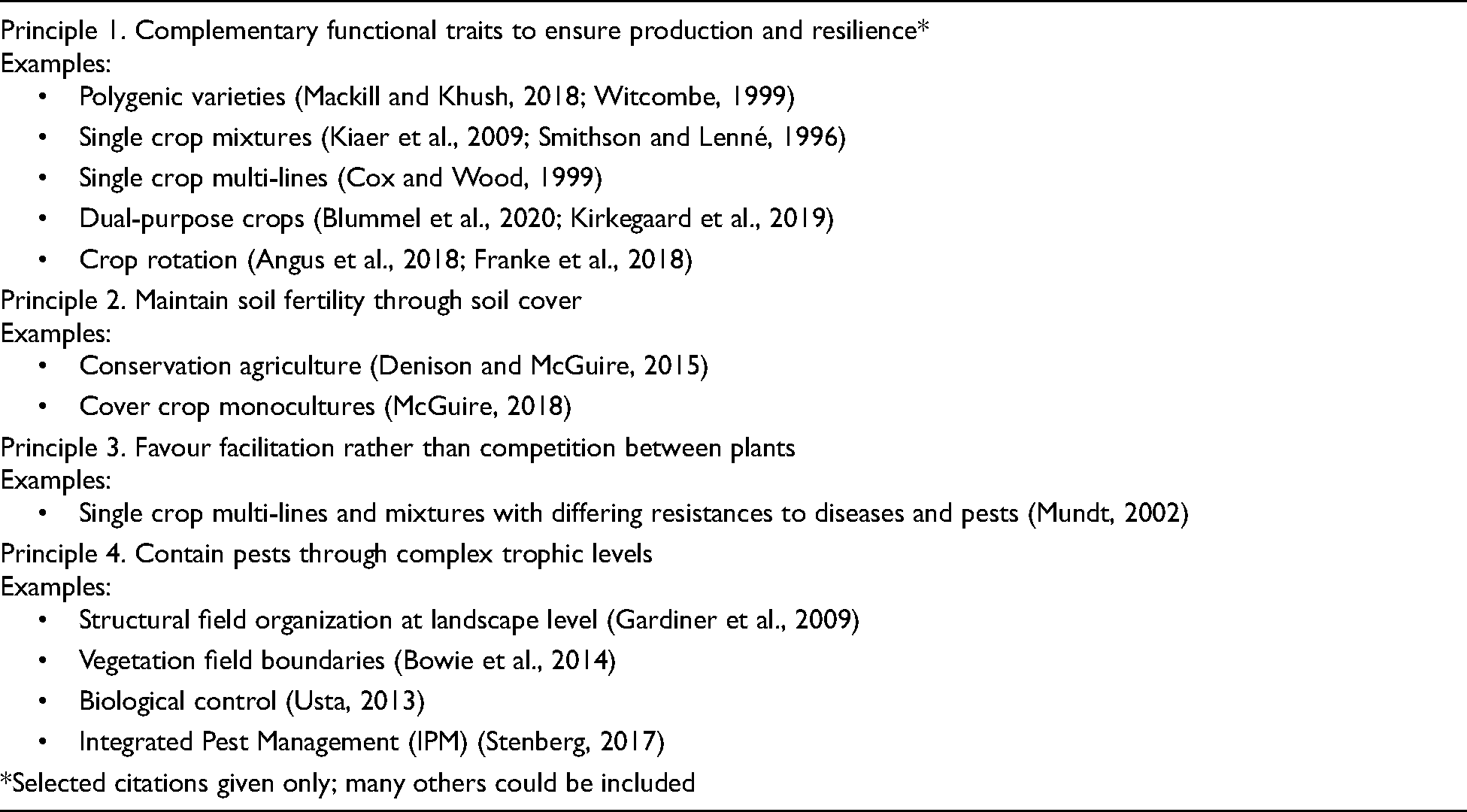
Monocultures of polygenic varieties, single crop mixtures and multi-lines as well as dual-purpose crops and crop rotations have complementary functional traits to ensure production and resilience. Conservation agriculture in monocultures through minimum tillage and mulching as well as monoculture cover crops maintain soil fertility through soil cover. Single crop multi-lines and mixtures favour facilitation rather than competition between plants. Finally containing pests through complex trophic levels is achieved in monocultures through landscape level diversity including patchworks of crops, vegetation field boundaries, biological control of pests with bacteria, fungi, viruses and nematodes and IPM. The principles of cropping system design based on natural ecosystem mimicry as defined above are relevant to a many monoculture practices and management.
Challenging the in-field diversity paradigm
‘There is nothing more dangerous than blind passion in science. This is the direct path to unjustified self-confidence, to loss of self-criticalness, to scientific fanaticism, to false science’ Nikolay Semyonov (1965) in Reiter (2009).
Throughout this perspective paper we have challenged the in-field diversity paradigm by presenting overwhelming evidence that monodominant vegetation in nature provided models for present day cereal agriculture. We have also presented evidence to challenge the false claims made about monocultures. Unfortunately there are many more examples of a blinkered preoccupation with complex late-successional models for all agriculture together with abuse of monoculture agriculture in both the soft and scientific literature.
The most egregious example we have encountered of anti-monoculture activism is the Frison (2016) report which misinterprets the Cardinale et al. (2007) meta-analysis. The report claims that Cardinale et al., show that ‘Mixtures have also been shown to produce 1.7 times more harvested biomass on average than single species monocultures and to be 79% more productive than the average monoculture’. However the Frison report
The claim that in-field species diversity of crops should always mimic the inevitable diversity of vegetation in Nature is unsound. It is also dangerous, as it rejects cereal monocultures, jeopardizing future food security. We have shown that there are very many examples of monodominant vegetation in Nature resulting from ecological disturbance. Some of this vegetation is of the direct ancestors of our first cereals and the natural ecology of disturbance is carried through in farming by tillage and irrigation. Clearly, our first cereals have a close ecological and evolutionary heritage of monodominance obtained directly from natural grassland vegetation. That is, cereal monocultures are Nature-based (with the possible exception of maize).
The `diversity in-field’ paradigm errs in totally rejecting monocultures as unnatural. In contrast, we do not reject in-field diversity. It has a part to play in the range of diverse field management systems. In particular, species-diverse cropping is widely found in traditional fields, where the different component species can be hand-harvested. As noted above, cereal-legume intercropping can be especially valuable in providing naturally-fixed nitrogen. Until research has been done on the ecology, agronomy and management of diverse nature-based solutions to future agriculture (yield, quality, stability etc.), the scarce funding to agricultural research for future food production is better targeted at improving monoculture agriculture to be more efficient, productive, resilient and environmentally benign – it is the source of most of global food production.
Footnotes
Declaration of conflicting interests
The author(s) declared no potential conflicts of interest with respect to the research, authorship, and/or publication of this article.
Funding
The author(s) received no financial support for the research, authorship and/or publication of this article.
