



Abstract
A recent study found that adoption rates of improved chickpea varieties were above 90 per cent in Andhra Pradesh, India. In this paper, we use a novel perspective to reconstruct and attribute how this outcome came about. The accepted success narrative is that the public international agricultural research system developed some excellent new chickpea varieties, which were well suited to local agro-ecologies, farming systems and cropping patterns, and highly appreciated by farmers. We argue that this narrative is incomplete, because it constitutes only a partial explanation of the confluence of factors that led to the outcome. We reconstruct the success story using a recent conceptual framework that decomposes the technological change process into four aspects: propositions, encounters, dispositions and responses (PEDR). We show that many of the factors which contributed to the spread of modern chickpea varieties in Andhra Pradesh lay beyond the control of the international agricultural research system, and operated across large spatial and temporal scales. In conclusion, we argue that the success of improved chickpeas in Andhra Pradesh underscores the value of basic plant breeding and research, which aim to produce public goods. We relate our analysis to current discussions about the future strategic direction of international agricultural research organisations and the CGIAR. Our argument implies a criticism of the drive to develop new varieties which conform to product profiles that are based on predictions of current and near-term demand. While that approach makes sense for product developers seeking to serve commercial markets, basic research is needed to create and diversify technical options, which anticipate a range of future needs that are hard to predict in the present.
Introduction
When analysts find that nearly all the farmers cultivating chickpeas in a region are planting modern varieties—products of public international and national crop breeding programmes—we have evidence of a remarkable impact from an investment in international agricultural research for development (IAR4D) (Gumma et al., 2016; SPIA, 2015). This is a cause for celebration, but also reflection: how was this impact achieved? Are the steps that led to this outcome replicable for other crops, farming systems, and places?
The present moment is an interesting time to reflect on the role, achievements and future strategy of publicly funded IAR4D. This year (2021), the organisation that coordinates a substantial share of publicly funded IAR4D, known as the CGIAR, 1 is wrapping up one strategy period and embarking on a new one. The CGIAR Research Programmes (CRPs; 2011–2021), which are coming to an end, aimed to organise and integrate the diverse work of multiple international agricultural research centres (IARCs) and their partners within a common strategic framework (Birner and Byerlee, 2016). During 2018–2020, the CGIAR, its funders and stakeholders strategised for what would come after the CRPs. A new plan emerged, to combine the separate CGIAR centres under a single entity. This ‘One CGIAR’ plan aims to overcome the fragmentation of efforts across multiple IARCs by encouraging convergence around a common mission, a unified governance structure, and a collective focus on large, integrated research programmes that have transformative potential (CGIAR System Council, 2019). The publication of the One CGIAR strategy (CGIAR, 2021) and the debates which it has stimulated (e.g. Barrett, 2020; IPES-Food, 2020) make it timely to reflect on the performance of international agricultural research organisations and consider the role they should play.
A recent estimation of the impact of CGIAR research and development efforts concluded that the organisation has delivered a 10:1 return on investment. However, impact pathways across the CGIAR’s diverse portfolio of activities are highly heterogeneous and the keys to success remain elusive (Alston et al., 2020). What can be learned from looking at past experiences? This paper is part of an effort within the CRP on Grain Legumes and Dryland Cereals (CRP GLDC) to reflect on and learn from decades of effort to improve and disseminate crop varieties. We look at the case of chickpeas in Andhra Pradesh, India, where chickpea production has increased rapidly and a recent survey found that well over 90 per cent of growers in the state are planting improved cultivars, which originated in breeding programmes run by the International Crop Research Institute for the Semi-Arid Tropics (ICRISAT) (one of 15 CGIAR research centres) or national agricultural research system (NARS) institutions (Gumma et al., 2016). This ‘silent revolution’ in chickpea cultivation in Andhra Pradesh—the spread of modern varieties combined with a significant increase in the area under chickpea cultivation—is interpreted as a remarkable success of research and development efforts over several decades by ICRISAT and its partners (SPIA, 2015).
The accepted narrative of this impact story is that genetically improved chickpea cultivars were developed, which ideally fitted farming systems and cropping patterns in Andhra Pradesh. Effective collaboration between ICRISAT and national research, development and extension organisations helped to push these new varieties into the seed system and promote them to farmers, and the improved varieties were highly appreciated by the growers, so that they spread widely and spontaneously from farmer to farmer. Chickpeas were planted on larger areas, leading to a rapid increase in chickpea production in the state (e.g. Charyulu et al., 2015). We argue that this narrative is not wrong, but it is only—and could only be—a partial explanation of the confluence of factors and processes that helped chickpea cultivation to take off in Andhra Pradesh. We suggest that broadening the understanding of how this remarkable transformation occurred allows lessons to be identified and learned, which can inform strategic thinking about the future of IARCs and the CGIAR.
We apply an agent-centric framework to reconstruct how the wide uptake of improved chickpea varieties in Andhra Pradesh came about and reconsider the roles of involved stakeholders. This framework, which was proposed by Glover et al. (2019), decomposes the process of technological change into four interrelated aspects: Propositions, Encounters, Dispositions and Responses (PEDR). We offer a reconstructed story of the chickpea success in Andhra Pradesh and demonstrate that it provides a basis for a realistic appreciation of the contribution made by publicly funded IAR4D. The paper thus has two objectives: on one hand, we offer a new narrative of technological change to inform strategic choices in IAR4D; on the other hand, we aim to demonstrate that the PEDR framework is a useful and practical analytical tool that provides new insights, which might not have been revealed through conventional analytical approaches.
Our analysis is based on a purposive search for relevant information, including published and unpublished documents from ICRISAT and the CRP GLDC, academic and technical literature, and unstructured key informant interviews with informed experts who have personal knowledge of the historical operations and performance of international agricultural research and plant breeding for dryland legumes in South and Southeast Asia (see Acknowledgements).
The paper is organised as follows. The next section recounts the conventional story of chickpea in Andhra Pradesh as a remarkable and rapid success that transformed agricultural landscapes and farmers’ fortunes during the 2000s. We then add complexity to the simple success narrative, by broadening the focus historically and geographically. Next, we introduce the PEDR framework and use its conceptual language to retell the story of chickpeas in Andhra Pradesh. We then draw out the new insights which the PEDR framework reveals, and use them to support an argument with two key claims: first, that prescience does not account for the chickpea revolution in Andhra Pradesh; second, that the organisations of international agricultural research should use the principles and tools of strategic foresight to anticipate and prepare to meet a range of possible futures, rather than attempt to predict and place bets on one or a few future states of the world. In the final section, we identify some practical implications and draw conclusions.
The rapid and widespread uptake of improved chickpeas in Andhra Pradesh: A conventional account
Chickpeas (known in India as chana or Bengal gram) are the most important pulse crop in India and the second most important food legume globally, after common bean (Gowda et al., 2015; Singh et al., 2015). Despite this, as recently as the early 2000s, there was concern that legume production in India was stagnating. The declining availability of pulses per capita saw the country rely increasingly on imports to meet consumer demand (Nain et al., 2015; Singh et al., 2015). Then, after 2005, Indian legume production increased rapidly. Chickpea production saw the fastest growth, at over 5 per cent in half a decade (Bantilan et al., 2014; Gowda et al., 2015).
In Andhra Pradesh, the rapid increase in chickpea production occurred through two mechanisms: a displacement of long-duration chickpea varieties with new, short-season and disease resistant cultivars; and the expansion of the chickpea cultivated area through the replacement of alternative post-monsoon crops, such as cotton, tobacco, chilli, sorghum, groundnut and sunflower. By 2013, almost all the chickpea growers in the state were reported to be planting improved varieties. Between 2000/01 and 2012/13, the chickpea area in Andhra Pradesh grew from 0.22 Mha to nearly 0.6 Mha, which is especially remarkable because chickpea was not even considered a minor crop in the state before the mid-1980s (Bantilan et al., 2014; Gumma et al., 2016).
Conventional accounts attribute the rapid expansion in chickpea production in Andhra Pradesh to the introduction of improved varieties that were early maturing, wilt-resistant, and tolerant to heat and drought stress, so that they could be grown successfully in the warmer conditions of central southern India (Charyulu et al., 2015; Gaur et al., 2018). With the new cultivars, chickpea productivity in Andhra Pradesh doubled over two decades, from about 600 kg ha−1 in the early 1990s to over 1,200 kg ha−1 in the late 2000s (Bantilan et al., 2014).
The heroic roles in this narrative of impacts from investments in IAR4D are given to three improved chickpea varieties that were developed by ICRISAT and Indian NARS institutions and released to farmers between 1999 and 2001: a desi type called JG 11 and two kabuli varieties, KAK 2 and Vihar (see Box 1 on desi and kabuli varieties). The widespread popularity of these three cultivars is usually attributed principally to the excellence of their genetics, which combine traits of early maturity, resistance to Fusarium wilt and other biotic and abiotic stresses, high yield potential, and attractive grains that make them desirable to consumers. Production costs were proportionally lower, so profit margins increased.
Desi and kabuli chickpea varieties.
Chickpea varieties are commonly divided into desi and kabuli types. Desi varieties typically have small, brown, irregularly shaped and wrinkled grains, while kabuli varieties typically have larger ‘bold’ grains, which are smoother and paler in colour. Kabuli varieties are less common and are typically grown for export; desi varieties are much more widely grown and consumed within India. Desi varieties are comparatively high yielding and cheaper to cultivate, but command lower market prices. They can grow well on marginal lands and in rainfed conditions. The kabuli types are more costly to cultivate and perform best on irrigated plots with fertile soils, but usually attract better market prices. Kabuli types produce taller and more erect plants, which are more amenable to mechanisation, whereas desi types are typically shorter and more bushy (Bantilan et al., 2014).
The conventional story emphasises the agronomic suitability of the new chickpea varieties. It argues that the intrinsic attractiveness of these high-performing and well adapted varieties made them easy to promote, with the assistance of an effective public seed system that multiplied and distributed the seed. The state government offered a subsidy to encourage uptake, although most growers purchased their seeds from other farmers. In this way, the new varieties spread spontaneously from one farmer to the next, thanks to the enthusiasm of earlier adopters. The improved varieties were suitable for mechanical cultivation (except for harvesting), which made management easier. Profitable intensification pushed chickpea into new agro-ecological niches, as farmers increased seed rates and rented additional land in order to expand commercial production (Bantilan et al., 2014). We contend that this narrative is incomplete. It constitutes a partial and simplified account of the confluence of factors that contributed to the widespread uptake of new chickpea varieties in Andhra Pradesh during the 2000s. In the next section, we broaden the scope of attention both temporally and spatially.
Broadening the story’s scope historically and geographically
To be fair to the conventional accounts of the chickpea revolution in Andhra Pradesh, we must admit that they do not completely ignore factors aside from the quality of the new cultivars that were released around the turn of the century. For one thing, the successful development of these varieties is tied, in the conventional narrative, to far-sighted decisions that were made in the 1970s and 1980s. In 1974, the goal to improve chickpea was set by ICRISAT, with drought tolerance and disease resistance as key objectives. However, as we noted above, chickpea was cultivated principally in northern India at that time. In Andhra Pradesh, where ICRISAT’s headquarters was established in 1972, 2 chickpea was scarcely planted at all (Bantilan et al., 2014). Research into short-duration chickpea varieties began in 1978, with a joint investment by ICRISAT and NARS institutions. The first result of this effort was an early-maturing, wilt-resistant kabuli variety named Swetha (ICCV 2), which was released in 1993. It was not a hit with Andhra farmers. Focus group discussions and other feedback found that Swetha was considered too early-maturing by both farmers and breeders at that time (Bantilan et al., 2014: 97).
Farmers’ lack of enthusiasm for Swetha should lead us to ask, how had things changed between 1993, when Swetha was released, and 1999, when JG 11 and KAK 2 were released and met with a warmer reception. Table 1 allows the characteristics of the breakthrough varieties JG 11, KAK 2 and Vihar to be compared with other improved cultivars that were released in Andhra Pradesh between 1978 and 2012, including Swetha. It shows that breeding programmes were actively developing and releasing a range of promising varieties over three decades, but only a small handful of them took off. Swetha stands out as a particularly early maturing variety, but as a kabuli type it was offering an opportunity for commercial cultivation to serve international markets, at a time when the focus was on domestic markets and channels available for chickpeas to be exported from Andhra Pradesh had yet to be developed. The table also shows that Swetha’s grains were not especially large or weighty compared to those of other kabuli types that came after. This leads us to hypothesise that Swetha’s lack of impact, in spite of being very early-maturing, stemmed from these two facts: its seeds were not yet good enough to meet the expectations of consumers in foreign markets, and they were released into a production system that was not yet geared up to export chickpeas from Andhra Pradesh into international value chains.
Major chickpea cultivars released in Andhra Pradesh, 1978–2012.
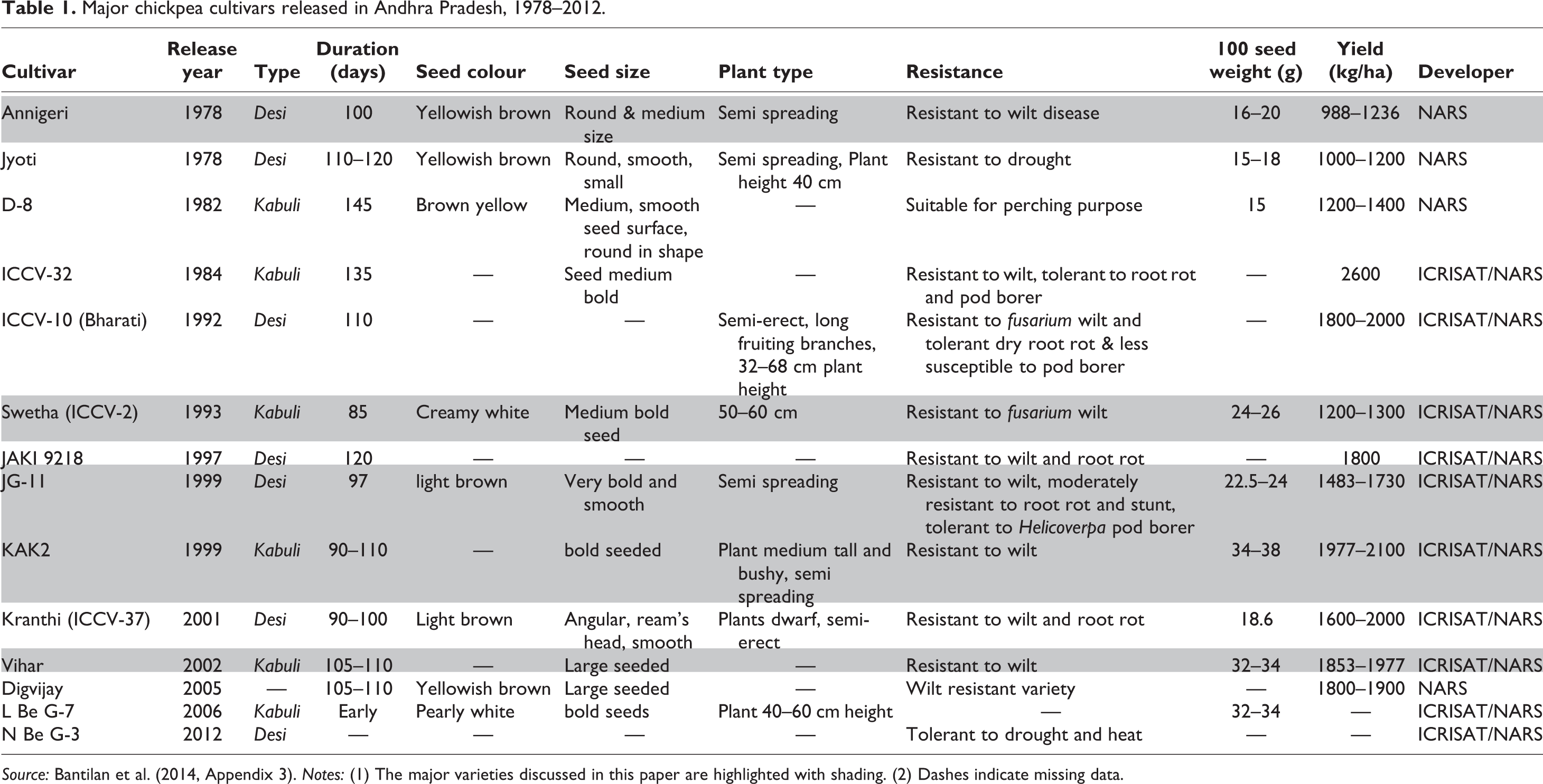
Source: Bantilan et al. (2014, Appendix 3). Notes: (1) The major varieties discussed in this paper are highlighted with shading. (2) Dashes indicate missing data.
To discover what changed in Andhra Pradesh farmers’ attitudes towards chickpeas during the 1990s, we need to look at bigger changes in the macro economy that were transforming the agrarian landscape in Andhra Pradesh and India as a whole. Over a half-century, the geographical distribution of chickpea cultivation changed dramatically in India. Between the mid-1960s and the early 2010s, the chickpea area declined from about 4.7 to just 0.7 million hectares (Mha.) in the northern states of Punjab, Haryana and Uttar Pradesh, while chickpea cultivation expanded from about 2.1 to 6.1 Mha. in the southern states of Madhya Pradesh, Maharashtra, Karnataka and Andhra Pradesh. In other words, about 4.0 Mha. of chickpea fields moved southwards over a 50-year period, from the cooler, long-season environments of northern India to the warm, short-season environments of more southerly states (Gowda et al., 2015). In Andhra Pradesh specifically, the chickpea area was 163,000 ha. in 1999/2000, of which 90 per cent was planted with Annigeri, an improved, medium-duration desi variety that had been released to farmers in Karnataka in 1978 and had spread slowly and without official support to farmers in neighbouring Andhra Pradesh. A decade later—around 2010/11—the chickpea area in Andhra Pradesh had grown to 628,000 ha. and production increased from 95,000 to 884,000 tons per year (ICRISAT, 2011). By that time, Annigeri was rapidly giving way to new short-season varieties, notably JG 11, another desi variety, as well as the kabuli varieties KAK 2 and Vihar (Bantilan et al., 2014).
Push and pull factors drove chickpea’s southward migration. Agricultural intensification and particularly the spread of irrigation in northern states induced farmers in those regions to abandon chickpea cultivation in favour of alternative, more profitable post-monsoon crops, including wheat and oilseeds. Moreover, output markets for rice and wheat were assured, whereas the output markets for legumes were fragmented, prices unstable, and government procurement was unreliable (Joshi et al., 2000). The risk of crop failure for legumes was also higher. In fact, the intensification of farming practices in the northern states of India was actually unfavourable to chickpeas, which tended to produce excessive vegetative growth and to lodge when cultivated in fertile and irrigated soils (Gowda et al., 2015).
Meanwhile, in Andhra Pradesh, farmers began to seek alternatives to major cash crops, principally cotton, chilli and tobacco. During the 1990s, the cotton crop failed repeatedly, due to droughts. The chilli and tobacco crops were plagued by pests, while growers confronted higher fertiliser and pesticide costs, and falling output prices, especially for tobacco (ICRISAT, 2000). Unfavourable market conditions at the end of the decade led the Tobacco Board to declare a ‘crop holiday’ in Andhra Pradesh, a measure to discourage tobacco cultivation in the state (Bantilan et al., 2014; Menon and Sharma, 2000).
Reinterpreting the success story using an alternative framework
Key to our critique of the conventional impact narrative is that we think that it attributes too much agency to the excellence of the improved chickpea cultivars. In the pursuit of the replication of the chickpea success, breeders have asked for a more rounded explanation of how it came about. We highlight aspects of the story, which in the conventional account are given secondary importance or are ignored entirely. To make our argument, we apply the PEDR conceptual framework, which was introduced recently and proposed as a more dynamic way to understand and analyse processes and outcomes of technological change, especially in the domain of small-scale farming systems in the global South (Glover et al., 2019) (see Box 2). Through the language of propositions, encounters, dispositions and responses, we can offer a new interpretation of the factors that helped to drive the rapid uptake of improved chickpea varieties and the widespread expansion of chickpea production in Andhra Pradesh.
The PEDR framework.
Glover and colleagues (2019) argued that their new framework integrates a range of social scientific insights into how technological change occurs, which are commonly overlooked in the dominant frameworks used by development professionals to analyse innovation. The PEDR framework emphasises the agency of farmers as technological practitioners, and seeks to theorise what happens during encounters between farmers, scientists and professionals in agricultural development projects and programmes. The PEDR framework decomposes technological change into four, interconnected aspects:
PROPOSITIONS: Any new technology is encountered or perceived for the first time as a proposition, that is, an idea or image of what could or might be. The proposition conjures up the possibility of an alternative way of working or making to achieve new or modified outcomes.
ENCOUNTERS: Members of a farming community become aware of a new proposition through some kind of encounter, such as: a conversation with a neighbour or an extension worker; a visit to a demonstration plot; a farmer meeting; exposure to advertising; listening to a radio broadcast; or engaging with social media.
DISPOSITIONS: The people on the receiving end of propositions are agents within encounters, who may be disposed to respond in a variety of ways. Dispositions arise from combinations of cultural, economic, biophysical, spatial, temporal and other factors, which shape perceptions of a proposition. These factors generate a spectrum of different dispositions among the variety of different people that encounter a proposition. Dispositions determine whether, and in what ways, a proposition is perceived as a relevant and interesting opportunity for each individual decision maker.
RESPONSES: Farmers and households can respond to a proposition in various ways, including by ignoring it. Those who are positively disposed to a proposition—that is, who find it relevant and interesting for their situation—may respond by exploring the opportunities it presents to work or make things in new ways. By engaging with the proposition, they embark on a process, and create their own pathway, through which three components of the proposition—materials (tools, inputs), methods (techniques, practices, schedules) and modes of engagement in farming (e.g. commercial production)—are unpacked, reassembled, adapted and configured.
Source: Glover et al. (2019).
The reconstructed story unfolds like this: In the 1970s, there was no new chickpea technology proposition on offer, with which farmers in Andhra Pradesh could have engaged. In that period, a few growers planted traditional, low-yielding, long-season varieties that were susceptible to wilt and other diseases. During the 1980s and 1990s, the improved desi variety Annigeri began to make inroads into Andhra Pradesh from neighbouring Karnataka. Annigeri offered an improved performance compared to unimproved chickpea varieties, in other words a new proposition to which some Andhra farmers responded. However, chickpea remained a minor crop. The agronomic advantage of the new variety was modest; in the absence of official encouragement, opportunities to encounter Annigeri in Andhra Pradesh were limited; and farmers were still disposed to regard chickpea as relatively insignificant compared to other crops they planted.
Nonetheless, developments in the national agrarian economy began to modify the opportunity landscape (Sumberg et al., 2019) that faced Andhra farmers. On one hand, the attraction of planting the traditional post-rainy season crops in the region was diminishing, due to droughts, pests and unfavourable market conditions. Andhra farmers were being officially discouraged from planting tobacco. These developments inclined the farmers to be more open to alternative crops. On the other hand, as farmers in northern regions abandoned chickpea in favour of wheat and other irrigated crops, a market niche began to open up for farmers in rainfed areas of Southern states to expand cultivation of chickpeas. In this situation, switching to chickpea cultivation could have started to emerge as a more attractive proposition for Andhra farmers.
However, at that time, the available improved chickpea cultivars were still not compelling. The kabuli variety Swetha, released in 1993, was a new proposition in that it was very early-maturing, but it did not prove to be popular. Other authors have speculated that the slow uptake of Swetha had to do with low levels of awareness among farmers that the new variety existed, thanks to limited availability of Swetha seeds (Nain et al., 2015): in PEDR language, we can say that farmers’ encounters with Swetha were limited in quantity and quality. But there was another obstacle. The PEDR framework suggests that the supply problems that hindered farmers’ awareness were proximate causes, characteristic of an economic context that was not yet disposed towards the wide uptake of Swetha: the farmers were not yet searching for commercial chickpea varieties, and export buyers were not yet ready to source kabuli chickpeas from growers in Andhra Pradesh.
That impediment was also beginning to change. In the context of economic growth in both domestic and export markets, demand for chickpeas began to increase and prices stabilised. The international market for chickpea expanded from 30 countries in 1981 to 150 in 2011 (Gowda et al., 2015: 18). However, the emerging market opportunity presented to farmers in Andhra Pradesh, arising from changes in farming systems in northern India and the expansion of international markets, was not yet obvious. We have seen no evidence that any far-sighted public or private agency was articulating this scenario or broadcasting it systematically to farming communities. It takes time to establish relationships and systems to connect farmers to a market for a new and unfamiliar product. In other words, chickpea cultivation as a propos ition was emergent in Andhra Pradesh, but not yet widely perceived in the mid-1990s by farmers themselves, nor was the opportunity being actively framed or promoted. In these circumstances, encounters with chickpea cultivation remained few in number and poor in quality. In summary, at that time, chickpea cultivation was beginning to represent a theoretical alternative, but it was not yet a very vivid proposition or a really practical and implementable one, to which farmers could have responded.
The transition to chickpea cultivation and the use of improved chickpea varieties took off after the start of the new millennium. A key factor was the release, between 1999 and 2001, of the JG 11, KAK 2 and Vihar cultivars, which finally offered distinct advantages in terms of agronomic performance, integrating early maturity, drought tolerance, wilt resistance, and tolerance to insect pests (see Table 1). However, there is more to the story. As the agronomic proposition improved, the number of encounters intensified: in the context of official anxiety about stagnating chickpea production volumes in India, the multiplication and distribution of the new varieties were scaled up rapidly and the seeds were promoted energetically, with a subsidy, by public extension systems. The opening of this new opportunity landscape was assisted by expanding networks of private agricultural input dealers in rural areas, which followed the liberalisation of the Indian seed sector in the 1990s (Kolady et al., 2012; Tripp and Pal, 2001). Production of legumes received support from several government programmes, including the National Food Security Mission (NFSM), the National Agriculture Development Programme (Rashtriya Krishi Vikas Yojana, RKVY), 3 and the Accelerated Pulses Production Programme (A3P) (Gowda et al., 2015: 17).
The opportunity landscape was continuing to change in other ways, too. With the implementation of the Mahatma Gandhi National Rural Employment Guarantee Scheme (MGNREGS) after 2005, rural wage rates began to increase, which raised labour costs for farm operators. This encouraged the development and commercialisation of machinery that could be used to mechanise farm operations, including the cultivation of chickpeas. Tractors, power tillers, threshers, sprayers and pumpsets are the main types of machinery used in chickpea cultivation in Andhra Pradesh. Machinery is used principally for land preparation and fertiliser applications, planting, and plant protection (Bhardwaj, 2014; Dhimate et al., 2018). However, mechanical harvesting has remained a challenge in chickpea production, until recently.
Thanks to this combination of factors, farmers’ dispositions were altered: chickpea cultivation came to seem an attractive and feasible proposition, which was often encountered through formal and informal channels that included information and extension, and input supply. Farmers were positively disposed towards the new varieties of chickpea, because they represented an easily managed and cheap-to-cultivate post-monsoon crop that could be grown with a subsidy, to serve stable market demand and realise good output prices. After this point, a building momentum would have increased the frequency of farmers’ encounters with chickpea. Chickpea cultivation would have become more visible in the agrarian landscape, more talked about, more accessible, and more widely appreciated as a propos ition that could be relevant to the farmers’ own situations. Gradually, farmers’ dispositions would have been altered to the extent that commercial chickpea cultivation became less a novelty than a regular option among a familiar menu of crops that could be planted in the next post-monsoon season.
Evidence shows that Andhra farmers indeed responded to the new proposition in a variety of ways, reflecting their individual circumstances and their particular dispositions towards chickpea farming. Most of the chickpea growers across Andhra Pradesh planted chickpea on land that was fallowed during the kharif (rainy) season, but in certain districts of the state a few other cropping systems are practised, including rotations of chickpea with other pulses, groundnuts, jute, onions, paddy, and soybeans (Bantilan et al., 2014: 66–69). Some Andhra farmers were observed switching from cotton cultivation into rotations of soybean or sesame with chickpea; or from sesame and safflower into chickpea cultivation (ICRISAT, 2000). As the opportunities to mechanise chickpea cultivation increased, some farmers used the time saved on chickpea operations to diversify into new production systems, such as dairy (ICRISAT, 2011).
Prescience is not the explanation
The key insight to draw from our retrospective reconstruction of the chickpea success story in Andhra Pradesh is that the eventual outcome—the ‘silent chickpea revolution'—was not explicitly conceived or targeted in advance. The outcome emerged from an unfolding historical process. It grew out of a confluence of trends and circumstances which, in the 1970s, would have been difficult for anyone to predict.
As we explained above, conventional tellings of the chickpea revolution attribute it to the quality of the improved, locally adapted chickpea varieties, which offered farmers a compelling advantage in terms of higher yields and bigger profits. The eventual creation of these new cultivars is traced back to far-sighted decisions made by leaders of ICRISAT and NARS research programmes in the 1970s. Retrospectively, these scientists are praised for identifying early maturity and wilt resistance as a combination of key traits that would allow farmers to grow chickpeas more successfully in the warm and drought-prone conditions of southern India (e.g. ICRISAT, 2011). In fact, this prescience is not apparent in the historical record. Documentary evidence from the 1970s and 1980s gives a strong impression of a research system that, in the traditions of those days, was focusing on generic targets of germplasm quality rather than developing varieties to fill an identified farming systems niche. In the ICRISAT Annual Report of 1974, for example, the organisation reported that it was focusing on yield potential and nutritional and consumer traits, including protein quality and quantity. Resistance to pests and diseases was recorded as a general objective (ICRISAT, 1974).
In 1985, the ICRISAT Annual Report affirmed that “[o]ur principal objective is to develop improved cultivars and genetic stocks capable of higher and more stable yields in all types of cropping systems” (ICRISAT, 1985: 141). Alongside other objectives, there was a focus on abiotic stresses, such as drought, salinity and cold stress (the latter being an important trait for the traditional northern chickpea regions rather than the southern states). Field demonstrations were organised to popularise production of kabuli varieties in peninsular India (including ICCV 2 (Swetha)).
In the Annual Report for 1990, three years before Swetha was finally released, we can discern an emerging appreciation of a productive niche for short-season chickpeas in southern India. Short duration was acknowledged as a potential disadvantage in terms of yield, since longer seasons allow plants more time to grow and produce grains, but it was recognised that the presence of drought, pest and disease stressors in peninsular India could make early maturity an advantage (ICRISAT, 1991). However, as energetically as the ICRISAT breeders tried to develop Fusarium wilt-resistant varieties for the Indian south, they continued to strive towards varieties with resistance to Ascochyta blight for northern areas (ICRISAT Annual Reports, passim.). They did this even as chickpea cultivation was declining in northern states. In other words, the chickpea revolution in the South was not the culmination of a deliberate plan conceived and directed by IAR4D institutions or leaders. It was a scenario that emerged through a conjunction of scientific efforts to improve chickpea germplasm and an array of other factors.
In effect, what the scientific effort accomplished was an enlargement of a basket of options available to farmers in Andhra Pradesh (Ronner et al., 2021). By improving the performance of individual chickpea cultivars, the breeding programmes expanded the range of crops and varieties available to Andhra farmers. This created new propositions for farmers in diverse situations; it enriched the landscape of opportunities that faced the farmers. But other factors that contributed to the chickpea silent revolution were assembled and enacted by other players in the story, including humans and nonhumans, beyond the direct control of the IAR4D system. The farmers’ own agency played a key role.
Anticipation, not prediction: preparing for the unplannable
Impact evaluation specialists increasingly ask not about attribution (‘who caused the impact?’) but contribution (‘who contributed to the outcome, and how?’) (Mayne, 2008). The history of the chickpea revolution in Andhra Pradesh shows why this shift of question matters. In this history, plant breeders and the IAR4D system made a positive difference, but they were not uniquely prescient, nor were they in full control. So what did they achieve, how should we think about it, what else mattered to the outcome, and what lessons can be learned? Our retelling of this story does not diminish the value of new technology or breeders’ role in developing new varieties. Rather, our aim is to set these scientific achievements in a broader context.
When the CGIAR was established, half a century ago, the expectation was that this network of elite institutions would tackle isolatable technical problems. The theory was that genetic enhancement of selected crops and livestock species, in conjunction with improvements in agronomy and animal husbandry, would deliver improvements in farm production and efficiency across wide regions of the globe (Byerlee and Lynam, 2020). Over decades, the IAR4D ‘impact agenda’ has changed and expanded, to encompass a much wider range of development objectives (Hall et al., 2000). Alongside increased production of food crops, IAR4D programmes are nowadays tasked with achieving poverty reduction, decent livelihoods, food and nutrition security, environmental sustainability, and other objectives.
Meanwhile, aid donors and other stakeholders have increased pressure on the IARCs, the CGIAR and NARS to deliver better returns on investment, through the more rapid and wider uptake of new technologies and the achievement of development impacts at larger scales. The succession of initiatives to reorganise and coordinate the work of the IARCs around large, integrated research and development strategies and programmes reflects this progressive broadening of focus and the wider impact agenda, as well as the recognition that isolated work on individual crops and traits is insufficient by itself to change and improve complex farming systems. In this context, pressure is on the IAR4D centres and programmes to deliver ‘scalable’ innovations that are ready for commercialisation and uptake in markets. Donor pressure encourages IAR4D organisations to construct success narratives that attribute quick impacts to tangible artefacts, such as new crop varieties (Sumberg et al., 2012).
One reflection of this shift of emphasis is the promotion by the CGIAR Excellence in Breeding Platform (EiB) of the ‘product profile’, a concept borrowed from the private sector. Product profiles provide a target for breeding, by defining the characteristics of a future crop variety that can occupy an identified niche in farming systems or consumer demand (see Sumberg and Reece, 2004). Our analysis of the chickpea case in Andhra Pradesh calls the wisdom of the product profiles approach into question. We think that it would have taken extraordinary prescience in 1975 to have framed a product profile for chickpeas in Andhra Pradesh, to which JG 11 or KAK 2 or Vihar would be the solution. Instead, as we argued in the previous section, various, hard-to-predict factors came together over several decades, which operated at multiple spatial and temporal scales. Movement of the system occurred only once a critical mass of factors had fallen into place. In place of a timeline that focuses on the rapid uptake of new chickpea varieties during the first decade of the 21st century, we need a more elaborate story of complex, decades-long processes, beginning in the 1970s, which involved plant breeding in conjunction with an array of other developments. The former story makes it seem as if the transformation was sudden and rapid, whereas the longer timeline more accurately reflects the foundations being laid long before chickpea cultivation became a serious option that answered farmers’ needs in the semi-arid areas of Andhra Pradesh in the specific circumstances they faced in the 2000s.
Our analysis illustrates the value of basic plant breeding, undertaken on the basis of scientific analysis of germplasm performance, before demand was evident and before the potential for widespread and rapid uptake could have been predicted. The eventual success of chickpea breeding was built upon generating a broad range of potentially useful and effective technologies. This effort was supported during the 1970s, 1980s and 1990s by a funding environment and strategic objectives that enabled ICRISAT to explore a mix of approaches within its mandate. Our re-telling of the chickpea story shows that this more patient approach eventually facilitated agile responses by farmers to emerging opportunities, and equipped ICRISAT and its NARS partners to respond to the farmers’ emerging needs. The new story also acknowledges the long-term commitment required to build and sustain breeding programmes, the long timelines of variety development, and the impossibility of adapting breeding programmes rapidly in response to fickle development fashions and impatient donors. A recent review of the CRPs draws a similar conclusion, highlighting lack of alignment between donors’ objectives and the need for longer-term funding to support more innovative research (CAS Secretariat 2021).
The story of the chickpea revolution also suggests the value of anticipation in strategic leadership and decision making. Anticipation is different from prediction: instead of placing a big bet on one or a few predicted future states of the world, anticipation is about preparing in the present to meet a range of possible futures (Miller and Poli, 2010). Anticipating alternative futures is about trying to make ‘no regrets’ decisions, which avoid closing off possibilities to meet a variety of future needs across a range of plausible scenarios. Methods of strategic foresight (such as horizon scanning and scenarios; UNDP, 2018) foster a discipline of imagining different futures—including possible, probable and preferred states of the world—and analysing what would be needed to prepare for these alternative scenarios, in terms of the technologies, research and innovation capabilities, and partnerships and networks needed to support these. Strategic foresight methods can be informed and complemented by other types of analysis in which the CGIAR centres have invested historically, such as political economy studies, crop modelling, and market simulations. These kinds of studies can be helpful in thinking about present trends and future possibilities, but they are unreliable if used for prediction, especially over long time horizons. Strategic foresight methods are specifically designed to help decision makers grapple with the intrinsic uncertainty involved in thinking about alternative future scenarios.
In other words, anticipation spreads bets and hedges against uncertainty, by not putting all the organisation’s eggs in one technological basket. Notably, anticipation is one of four key principles in the framework of ‘responsible research and innovation’ (RRI) alongside reflexivity (scrutiny of assumptions and values), inclusion (of stakeholders in participatory deliberations) and responsiveness (to new knowledge, feedback and changing contexts) (Stilgoe et al., 2013). As well as fostering the institutional robustness of IARCs and the CGIAR by assuring the future relevance of the work they do today, the RRI principles constitute sound ethical foundations for IAR4D.
The principles of reflexivity and responsiveness demand that the chickpea success in Andhra Pradesh be appreciated in the context of broader contemporary changes. Other scholars have noted that the decline of legume production in northern states of India came at the cost of inferior sustainability overall, since legume production there demanded less water and fewer soil nutrients than the rice—wheat system that replaced it. Efforts to reintegrate pulses into the rice—wheat areas have struggled to make headway (Joshi et al., 2000; Kumar Rao et al., 1998). It is beyond the scope of this paper to assess the overall sustainability or resilience of Indian farming and food systems in the aftermath of the southward shift of chickpea production, however, we think that the apparent success of the silent chickpea revolution in Andhra Pradesh should be considered in that light.
In a similar vein, when reflecting on the historical decisions that shaped the innovation pathways and technological trajectories that have led us to our present, we should also consider what alternative options might have been closed off by past decisions. Were there other promising innovations that were not pursued, which might have paid off in the course of time? If so, what would it have cost to sustain the efforts that could have brought these alternative options to fruition? Of course, there would be additional costs, and pursuing an indeterminate multitude of disparate research lines would entail a reckless dissipation of focus and money. Nonetheless, there is a positive value in maintaining a diverse research portfolio and developing technologies that can meet needs across a range of plausible futures. The challenge is to work out what sum or proportion of IAR4D funds should be distributed across different research and development horizons (from near-term and adaptive research to blue skies studies at the scientific frontier). In this section, we have suggested that the tools of strategic foresight could be applied to that end.
Conclusions
In this paper, we used the PEDR framework to re-examine and re-interpret the story of technological change that led to an expansion of chickpea cultivation and an increase in chickpea production in Andhra Pradesh. To our knowledge, this is the first time the PEDR framework has been applied in this way. Within our analysis, we have drawn particular attention to the opportunity landscape as the dynamic, multi-dimensional context in which propositions are encountered (Sumberg et al., 2019). An essential point to understand about opportunity landscapes is that they are different for each individual. The specific circumstances of each farmer, household or community will shape their individual awareness, perception of, and disposition towards technical options in the surrounding opportunity landscape. Opportunity landscapes thus combine subjective and objective features (Sumberg et al., 2019) and our analysis shows how the PEDR framework can shed light on the interaction between these objective and subjective dimensions. Dispositions are key to this interaction: they emerge relationally from encounters between specific agents and specific propositions in particular times and places (Glover et al., 2019). Thus, dispositions have a subjective quality, in that appreciations of propositions and experiences of encounters are unique to individuals; but they also have an objective aspect, in that each person or household is positioned structurally in relation to the propositions which it encounters, by factors such as wealth, gender, education, geography, time, and so on. In other words, a person’s or household’s assets, resources and entitlements dispose them as much as they are agents with a capacity to dispose. This is merely a new way to express the relationship between structure and agency.
It follows that there are two ways to modify dispositions: by altering the subjectivities of the target population or by changing factors in the surrounding context, and this insight helps us to clarify the role of IAR4D. In stylised terms, the primary role of the research and development function is to generate and test new technologies (i.e. propositions), while the primary role of the extension function is to create good-quality opportunities for farmers to encounter those new propositions. The practical implication is that, in order to reach different kinds of farming practitioners (e.g. land owners, tenants, agricultural labourers, types of rural households, women, young people, marginalised communities, etc.), development agencies should offer different kinds and combinations of propositions and orchestrate different kinds of encounters.
Our analysis also suggests different research, development and extension priorities for different situations. In settings where the range of available technological options is limited, IAR4D should strive to create new technical propositions that can help to enrich the local opportunity landscape, and so increase the possibilities for people inhabiting that space to change their existing practices and achieve better outcomes (Ronner et al., 2021). In settings where new technical options are already available in principle and theoretically exploitable, but not widely appreciated or accessible, extension efforts should help to raise awareness of those options and reduce barriers that prevent farmers from engaging with them.
Finally, our analysis highlights the value of effective monitoring of key events and trends, and good communications with farmers and other agricultural stakeholders, so as to be able to detect changes in the local opportunity landscape. In a recent paper on farmers’ aspirations, Mausch et al. (2021) argued that farmers’ openness towards new technologies (i.e. propositions) can change when events call into question their current livelihood portfolios and farming strategies. The interruption leads them to re-evaluate their current trajectories and search for alternative options (Mausch et al., 2021). Identifying triggering moments such as these—perhaps the current COVID-19 pandemic is one such moment—could reveal emerging opportunities for an IAR4D intervention to be helpful and impactful.
This brings us back to the CGIAR’s present crossroads. We hope that our argument contributes constructively to current debates. Other contributors to these debates have developed proposals which they say will ensure the diversity of publicly breed crop varieties and achieve an appropriate division of labour in these endeavours between the CGIAR and its NARS partners (Crops to End Hunger Initiative, 2021). Some stakeholders have argued that the CGIAR has moved, in the past decade, too far from long-term and risky research that has uncertain payoffs, towards a private sector-influenced model that seeks to identify, then try to meet, immediate needs and demands in the present and short-term future. We think that this strategy could prove to be a mistake in the present era of increasing unpredictability, which calls for research and development to underpin the resilience of agri-food systems to shocks and stresses (Dixon et al., 2021; Rockström et al., 2020). A risk-spreading strategy would rebalance IAR4D portfolios to span both well defined, user-demanded technology needs in the near term with longer term and more risky research that aims to broaden the portfolio of technological options for uncertain futures.
The CGIAR and its partners should not shy away from demand- and market-led breeding strategies, however, the key function of public IAR4D organisations should be to generate public goods in service of development outcomes. Their role is to pursue research that the private sector ignores because it is too risky or has a marginal commercial payoff. The job of IAR4D institutions is to maintain lines of research, as well as the scientific capability which underpins them, that can generate a spectrum of technological options that could help poor farmers in a range of potential future agri-food system scenarios. As well as being more resilient, this approach is also key to serving a greater diversity of heterogenous agro-ecological niches, market contexts and farmers’ aspirations. In this paper, we have offered support for a responsible and ethical research strategy that aims to broaden technological options in the face of inevitable uncertainty about the future.
Footnotes
Acknowledgements
We are grateful to P. Janila and our key informants Shiv Kumar Agrawal, Pooran M. Gaur, Rob Caudwell, D. Kumara Charyulu, Peter Craufurd, Tim Krupnik, G.V. Ramanjaneyulu, Ravindra A. and Moin Salam. We are also grateful to Jim Sumberg and two anonymous peer reviewers for their comments on earlier drafts.
Declaration of conflicting interests
The author(s) declared no potential conflicts of interest with respect to the research, authorship, and/or publication of this article.
Funding
The author(s) disclosed receipt of the following financial support for the research, authorship, and/or publication of this article: This work was undertaken as part of, and funded by, the CGIAR Research Program on Grain Legumes and Dryland Cereals (GLDC) and supported by CGIAR Fund Donors.
