




Abstract
Palm oil is a valuable product used all over the world in a vast number of products for daily use. The oil palm, once well established, is very productive, captures large amounts of carbon and provides good protection to the soil. The use of residues as fuel makes oil extraction plants self-sufficient in energy and produces surplus electricity. A large part of the plant nutrients can be recycled by composting empty fruit bunches, with palm oil mill effluent and ashes added. Smallholders contribute close to 50% of the palm oil traded worldwide. The crop has acquired a bad reputation, however, because of the forests which have been and continue to be cleared for new plantations. The rate of forest clearing has been particularly high in Indonesia and Malaysia, with Thailand and some African countries following at a distance. Forests on peat soils are also increasingly used, releasing even larger amounts of CO2 from peat decomposition. In the ecologies where oil palm thrives, vast expanses of speargrass (Imperata cylindrica) have resulted from logging and injudicious land use, including poorly managed plantations. Although speargrass is hard to get rid of, a sequence of annual and perennial plant species is capable to suppress the grass, opening a window for planting oil palm in the degraded land. A well-established oil palm crop will then keep the grass out, because of the latter’s intolerance for shade. Thus, the oil palm’s image in the eyes of the public as an ecological disaster can be converted into its opposite: that of a tool to restore the productive capacity of degraded lands. Vast numbers of smallholders can thereby safeguard their livelihood. The oil palm industry has the means and skills to make this happen.
Keywords
Introduction: The oil palm at issue
Palm oil is suspect. While it constitutes an essential component of countless products for daily use, the palm from which the oil is obtained has acquired a bad reputation because of the forests which have been and continue to be cleared for oil palm plantations. And not just in Malaysia and Indonesia, the world’s largest producers of palm oil, but also in Thailand, Cameroun, Nigeria and Ghana, to name just a few. In Indonesia especially, the area planted to oil palm has grown spectacularly in the last two decades, from 4 million hectares in 2000 to almost 12 million today (Gapki, 2017), thereby overtaking Malaysia as the world’s largest producer of palm oil. India, the world’s largest importer of palm oil (Palm Oil Analytics, 2017), also intends to realise a vast increase in its palm oil industry, but, with just 300,000 hectare of planted area (Oil Seeds Division, 2016), for the time being, it remains a small player.
The oil palm has features which in principle make it an environmentally stable crop: once well established a mature plantation forms a closed canopy providing effective protection of the soil against the impact of torrential rains and excessive heat. And when the palms are still young a creeping cover crop will usually be interplanted, which also protects the soil against erosion and, in the case of a leguminous cover crop, fixes atmospheric nitrogen as well. Furthermore, the oil palm captures considerable amounts of CO2, both during its juvenile stage and later at fruit-bearing age, while a mature forest releases as much CO2 from decomposition of dead biomass and soil organic matter 1 as it binds through new growth and therefore makes no net contribution to CO2 reduction. So, one would think that the oil palm is an ecologically interesting and environmentally friendly crop, except that the forest, which has often been slashed for its establishment, is superior in its floral and faunal composition. Furthermore, the decomposition of the slashed forest vegetation and of the soil organic matter built up over many years release large amounts of CO2 into the air. The public concern about the negative ecological impact of oil palm plantations is informed mostly by the latter aspects, whereas the former are often disregarded. The section about the crop’s ecological profile will come back to these issues.
A crop with two faces
The oil palm in West African culture
The oil palm (Elaeis guineensis Jacq.) is indigenous in the humid zone of West and Central Africa, where it forms an integral part of the vegetation and of the cropping systems. Its produce is of great economic and nutritional value in the area and includes: red oil, extracted from the fruit’s fleshy mesocarp, seed kernel oil, palm wine tapped from the inflorescence or the tree apex, palm fronds for thatching, and not to forget, the residual cakes from oil processing, used for kindling fire. An intricate village industry for oil extraction exists all over West Africa, probably most elaborate in Western Nigeria and in Benin Republic. The red oil obtained by local extraction is an entirely different product than the ‘refined’ palm oil of commerce. The latter comes in two types obtained by fractioning and clarifying crude oil: a liquid olein and a solid stearin fraction. The red oil, mostly produced artisanally, is a mixture of both and often has a high content of carotenes and tocopherol, which are partly or wholly destroyed in the refining process. The red oil is a much appreciated part of West African food habits 2 and has additional health value because of its content of carotenes and tocopherol.
In the wetter areas wild oil palm groves occur, while in the subhumid zone, palms grow scattered at low density in secondary forests and on farm land. Seedlings from dropped seeds are carefully protected by farmers during fallow periods, along with other useful trees. In the best case, this results in a traditional agroforestry system with annual crops (e.g. maize and cassava) alternating with natural fallow, and a permanent over-storey of useful trees including oil palms at low density. In Mono province of Benin Republic which is marginal for palm oil production, oil palm seedlings are planted between rows of annual crops and after a few years they convert into a fairly dense oil palm fallow. The palms are felled after 10–15 years and sugary sap is tapped from the growing points for the production of palm wine (Kang et al., 1991).
The oil palm as an industrial crop
Palm oil entered into the international trade in earnest as early as the beginning of the 19th century. 3 Initially it was extracted from fruit collected in natural groves in West Africa, and the first successful commercial plantations were set up in Congo-Kinshasa by William Lever in the early 20th century. The planted area in Africa then started increasing steadily, but natural groves and ‘agroforestry palms’ remained the major source of commercial oil for a long time (for more details on the early history of commercial palm oil production, see Cramb and Curry, 2012 and Rival and Levang, 2014). The oil palm was introduced in Southeast Asia from West Africa in the second half of the 19th century. After a period of observation and multiplication in botanical gardens in Indonesia and Malaysia, the first plantations were created in both countries at the beginning of the 20th century. The rate of growth of the area under oil palm increased significantly after the World War II, both in Africa and in Asia, and to a lesser extent in Latin America. Asia soon caught up on Africa, eventually overtaking it by far, especially in the last few decades. Today, many countries are eager to increase their oil palm acreage in view of the perceived promise of the crop as the major producer of biofuel, or as a substitute for imported oil, with India prominent among them (Oil Seeds Division, 2016).
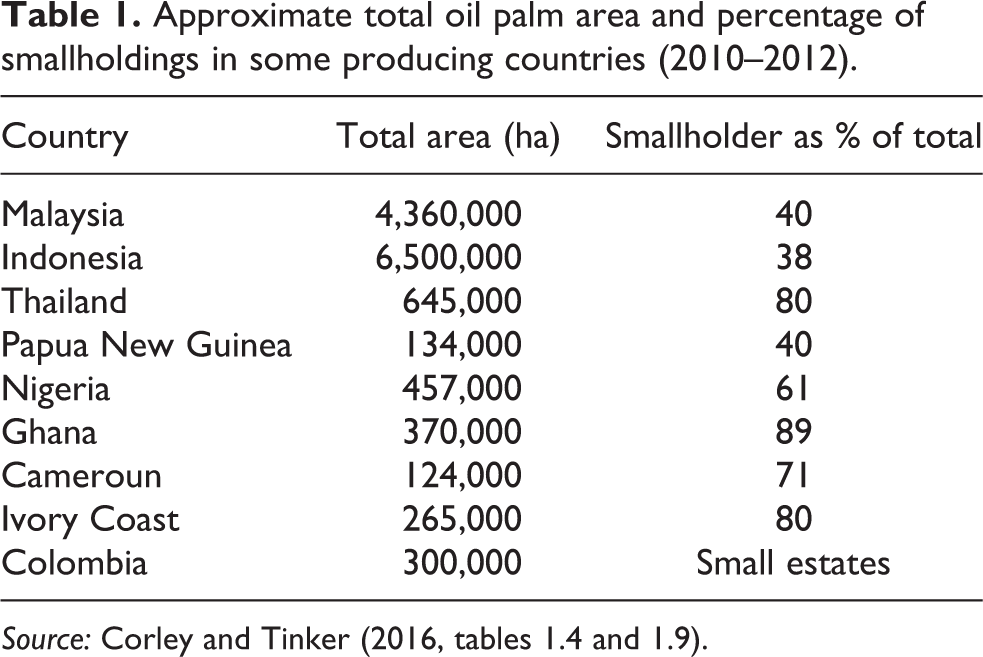
The bulk of the world’s palm oil of trade is now produced in large and small plantations, with smallholders accounting for around 50% world wide, either as independent growers or as outgrowers of large industrial plants. In some countries, smallholders even produce the bulk of the commercial crop (Table 1).
Approximate total oil palm area and percentage of smallholdings in some producing countries (2010–2012).
Source: Corley and Tinker (2016, tables 1.4 and 1.9).
Ecological profile of the oil palm
In its natural habitat, the forest zone of West Africa, the oil palm forms a stable, self-replicating component of the vegetation, from which the villagers obtain a range of valuable products. The palm also fits smoothly into local recurrent cropping systems, 4 where it forms an open, self-seeded over-storey in the food crop fields. The seedlings and young palms are protected by the famers, along with other perennials, such as timber or fruit trees. As long as the fallow vegetation is dominated by drought-tolerant shrubs (e.g. Chromolaena odorata (L) RM King and H Rob) and dicotyledonous herbs, which are less liable to be affected by bush fires, the palms cross over smoothly from one cropping period to the next. The system thus forms a fairly stable agro-forestry, as long as the cropping intensity does not cause soil degradation, which may lead to the invasion of the fallow by fire-sensitive grasses. When that happens, the seedlings of most perennials including oil palm will be destroyed by fire and disappear from the system. The vegetation then tends to a shrub savannah type. In the West African forest-savannah transition zone, for example, perennial grasses such as speargrass (Imperata cylindrica (L) Raeuschel) may intrude into the vegetation and replace Chromolaena as the dominant fallow species, in which case the oil palm will eventually succumb to dry season bush fires (Mutsaers, 2007).
The major reason for the oil palm’s huge success as a plantation crop in Asia, is its innate productive capacity, when grown under a favourable climate with high insolation rates and infrequent drought periods (Corley and Tinker, 2016; Nouy et al., 1999). Current yields of palm oil in Indonesia and Malaysia average between 4 and 4.5 t/ha and palm kernel oil around 0.5 t/ha for adult palms, while mean yields in none of the African countries exceed 2.5 t/ha palm oil. This is not just due to more favourable physical conditions in SE Asia, with less frequent moisture stress than in Africa; management factors play a major role as well, and probably the greatest (Woittiez et al., 2017). Simulated potential (radiation limited) yield of an adult crop under SE Asian conditions is more than double current average yields and yields exceeding 10 t/ha of oil are common in field trials (Corley and Tinker, 2016; Hoffman et al., 2014). Thus, the oil palm is the world’s most efficient producer of vegetable oil. The juvenile period is long, however, with the first fruit bunches appearing after 3–4 years and the crop attaining its ceiling yield after 8–10 years. Yields start declining again at a crop age of 18–25 years.
An important feature of oil palm plantations is that the processing plants can be completely self-sufficient in energy by burning part of the residues (fibres and shells) for power generation. Furthermore, the empty fruit bunches (EFBs), now usually mixed with palm oil mill effluent (POME) and boiler ash, are composted and returned to the field as fertilizer, maintaining organic matter and recycling an important part of the plant nutrients. More efficient ways of using and disposing of the various residues and generating more electric energy to feed into the local grid are still in development (Aghamohammadi et al., 2016; Corley and Tinker, 2016). A well-established and efficiently managed plantation can therefore be conducted as a semi-closed system. 5
Most commercial oil palm plantations in Africa and in Asia were originally planted on virgin forest land. The forest was cleared of all vegetation, suitable hardwood trees were sold as timber and the remaining debris was either burned or left to decay in wind rows. As the forest floor would initially be practically weed-free, palm seedlings (Figure 1) were planted directly in planting holes, without the need for tillage or planting a soil cover, unless the land was sensitive to erosion. Later, forest regrowth and pioneer plants would be regularly slashed, until shade from the mature palm canopy reduced the need for such maintenance. With time, plantations were also established in less pristine, secondary forests, or old rubber or oil palm plantations would be cleared and replanted with oil palms. Leguminous cover crops such as Pueraria phaseoloides were then often planted between the palm rows, providing both N to the crop and protection against undesirable weeds and erosion.
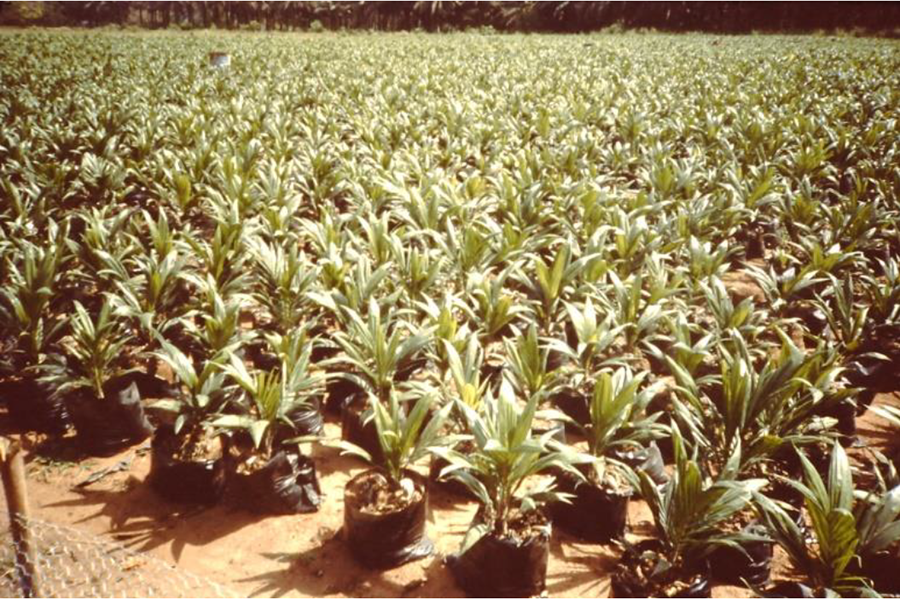
Oil palm seedlings, ready for planting photograph by the author.
The enormous expansion of oil palm plantings during the last half century, mostly on forest soil, have formed a serious environmental threat for the following reasons: Replacement of primary and secondary forest by single species oil palm plantations have strongly reduced floral and faunal diversity which is practically irreplaceable, even if oil palm growing were to be abandoned and the land ‘returned to nature’. Although a well-developed oil palm plantation provides as good a protection to the soil as the forest it replaces and binds considerable amounts of CO2, large amounts of CO2 are also released at and after forest clearing, from burning or decomposition of the vegetation and the accumulated soil organic matter.
Lack of biodiversity makes an oil palm plantation sensitive to pests and diseases which would otherwise be kept in check by naturally occurring predators or by the ‘dilution’ effect of multi-species populations (e.g. Litsinger and Moody, 1976). Chemical pest control is therefore common practice, adding to the crop’s ecological disturbance, although Integrated Pest Management (IPM) practices are gaining ground (Wood, 2002).
In Indonesia and to a somewhat lesser extent in Malaysia, the drive to further increase the area under oil palm and the shortage of suitable land for new plantations have led to the increased use of forest land on peat soil. Once drained and cleared, peat soils release large amounts of CO2 by natural oxidation, which has caused additional concern among ecologists and increasingly also among the general public. 6
Stakeholders in the palm oil industry have become keenly aware of the worldwide ecological damage of current practices and of the potential commercial impact of the consumers’ rising concern. In 2004, they therefore set up the ‘round table on sustainable palm oil’ (RSPO), an organization of producers, processors and traders in the palm oil industry, which has adopted a number of norms and criteria for responsible development of new plantings, including the banning of primary forest, steep terrain and peat soils (RSPO, 2013, 2018). So far, compliance with these criteria have been questionable.
There are other options, however, as shown in Figure 2, which depicts different vegetation types originally derived from humid forest, the oil palm’s natural habitat. All of these vegetation types have been used for oil palm plantings, with types 1–4 dominating in Indonesia and Malaysia. Over time, there have always been calls to target grasslands and degraded land (types 3, 5 and 7) instead of forests for new oil palm plantings. In fact, in some Latin American countries, especially Colombia, grasslands have generally been the predominant environment for the crop. The idea of using Imperata fields for oil palm has come up repeatedly since pre-World War II times, but without much success. These calls have grown stronger in recent times, not in the last place because of mounting criticism against current practices.
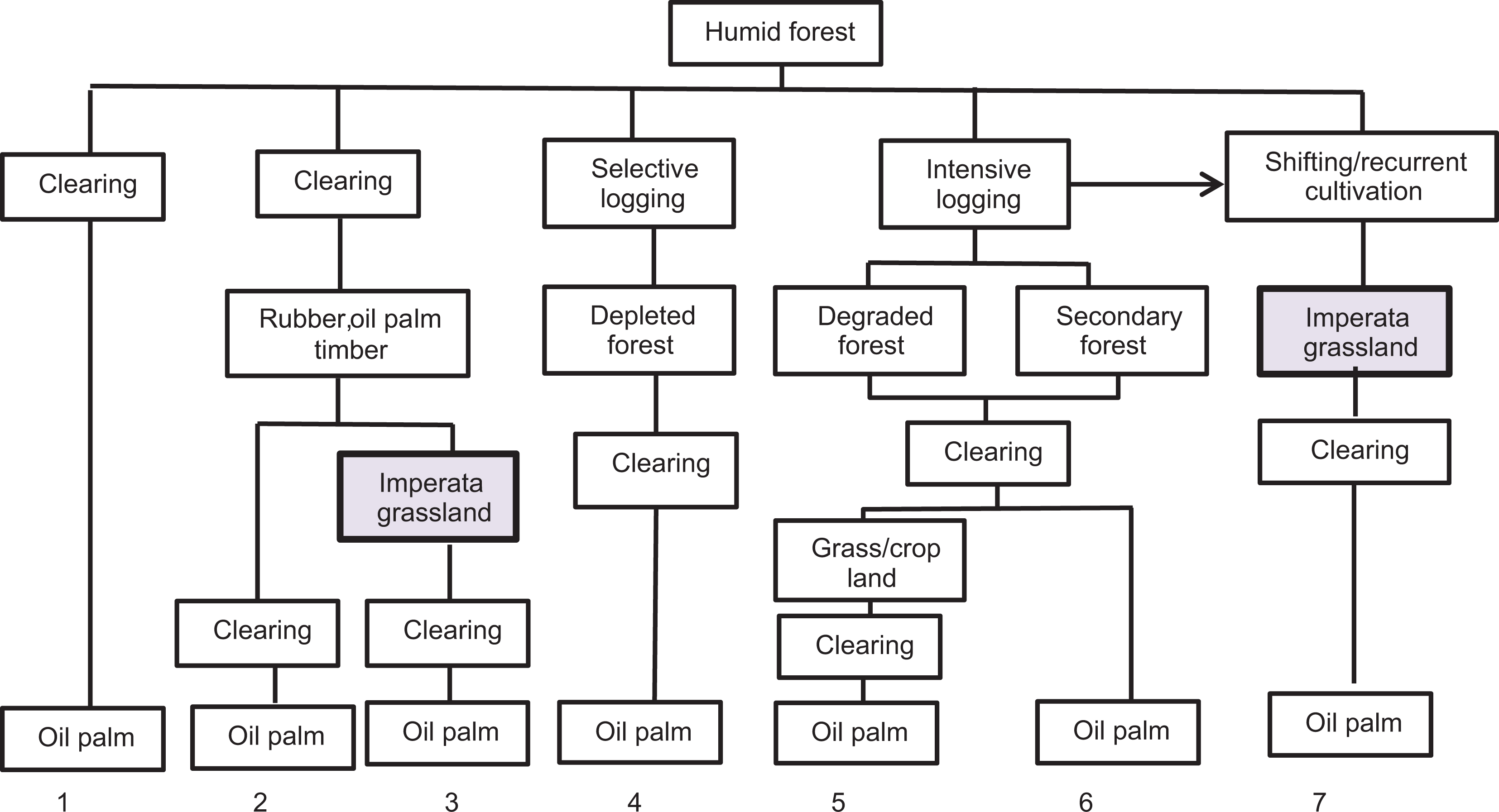
Possible land use histories preceding oil palm plantations.
Deforestation and the establishment of speargrass
When a tree plantation (e.g. of rubber, timber, or oil palm) is poorly managed, or it has grown old and is not replanted or converted to another crop, it is likely to be colonized by fire sensitive but very persistent grass species, especially speargrass or cogongrass (Imperata cylindrica (Figure 3)), making it practically impossible for the forest vegetation to reinstall itself. Such a vegetation is called, somewhat euphemistically, a ‘subclimax’, that is, a more or less stable ecological condition short of a real climax and maintained by soil degeneration or by regular fires. Speargrass, called lalang or alang-alang in Malaysia and Indonesia, has invaded tropical areas on all continents. Large alang-alang fields result when plantation crops such as rubber or oil palm are poorly managed, after deforestation for timber, or after forest clearing by small farmers for food crop growing, if the clearing is not done carefully enough to safeguard the forest’s restorative capacity (land use histories 3 and 7 in Figure 2). It is very hard to grow agricultural crops in speargrass-infested land, because of a combination of above and below ground competition, bush fires and allelopathic effects of speargrass on several plant species. Eradication by mechanical means alone is practically impossible, as the fragments of the rhizomes will rapidly develop into new plants.
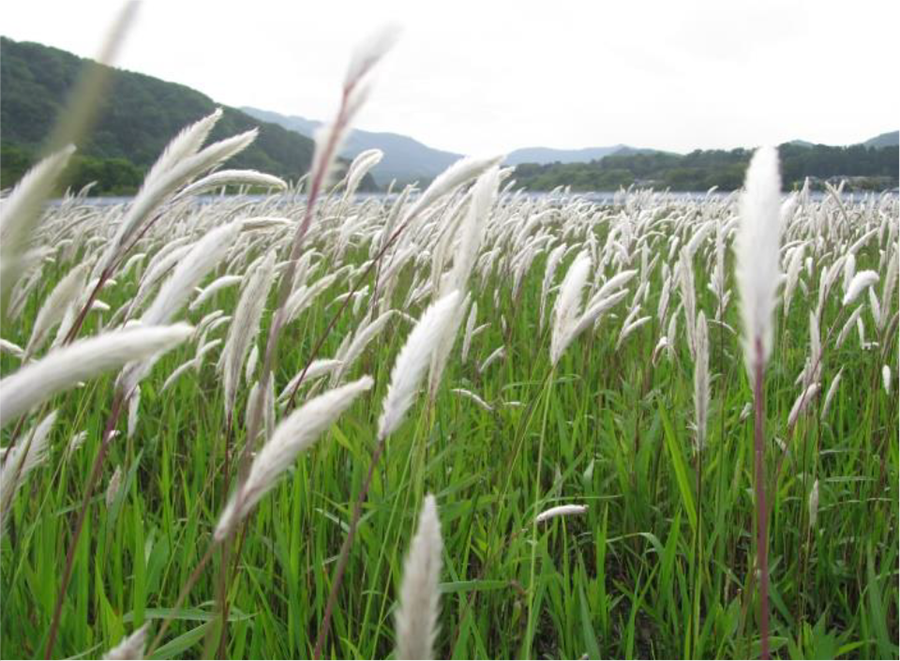
Imperata field where no agricultural crop could grow unaided (Source: Aimaimyi, 2011).
For Indonesia and India, the area colonized by speargrass, and therefore practically unsuitable for cultivation, was estimated in 1996 already at 8.5 and 8 million hectares, respectively (Garrity et al., 1996). Since then the area has probably grown further in the absence of effective campaigns (or effective and well-tested methods) to reconquer the affected areas. In several African countries, the trends are equally concerning with speargrass on the increase, threatening areas in the more humid regions (Chikoye, 2003).
In view of the increasing and justified criticism of current growing practices of the oil palm, the industry will have to find alternative, ecologically more friendly methods. By planting the crop in soils which have been degraded by previous abuse, the oil palm could be converted from a destructive into an ecologically attractive crop (Gingold et al., 2012; Koh and Wilcove, 2007). The huge ‘speargrass deserts’ in Asia, Africa and South America would fit that bill very well (e.g. Fairhurst and McLaughlin, 2009; van Heurn, 1948), but it will not be an easy job to convert them into productive oil palm plantations.
Reclaimed speargrass deserts: A potential habitat for the oil palm
The wish to recover Imperata-infested and other degraded lands for productive or ecological purposes is certainly not of recent origin. Even before the World War II, alang-alang was seen as a serious problem in Indonesia and the urgency of tackling the problem has only increased since then. There is a sizeable body of scientific literature on the reclamation of speargrass-infested soils (see e.g. Murniati, 2002), with the earliest publications from Indonesia, dating back to long before World War II (e.g. Coster, 1932; Rudin, 1935). They described mainly labour-intensive manual and mechanical control measures, but it soon turned out that a combination, or rather a succession, of creeping (leguminous) plant species were needed to keep the grass under control and create favourable conditions for the establishment of perennial crops such as rubber or oil palm (e.g. van Heurn, 1948). The perennials, once well established and sufficiently vigorous, would prevent re-emergence of the speargrass, which is intolerant to shade.
A special case is the ‘van der Meulen method’, also developed in pre-independence Indonesia (Ferwerda, 1972; van der Meulen, 1977). Van der Meulen had worked in plantation agriculture in Java and developed an apparently effective method to keep speargrass in check, consisting in a complex succession of creeping and bushy ‘auxiliary species’, 7 thus creating a favourable environment for economically interesting tree crops. In the 1950s and 1960s, van der Meulen was involved in an NGO project in Brazil where his method was tested on a real-life scale, but the results were never properly published. In the early 1970s, the Dutch press for a short while paid attention to his complaints about boycotting or at least lack of interest by the Dutch development authorities. Perhaps his personality and his unsubstantiated claims about the absorption of moisture from the air by one of his soil cover species (Centrosema pubescence) was responsible for that. In any case, his method has never been put to a further test and nothing was heard about it since.
A simpler approach was tested in a study on the potential of agroforestry to recover alang-alang infested lands in Kalimantan, Indonesia (Murniati, 2002; Mutsaers, 1999). It was found that a sequence of ploughing, herbicides, and planting of Pueraria phaseoloides as cover crop created a favourable environment for moderate shade-providing tree species, such as the candle nut tree (Aleurites moluccana) with maize as an intercrop. More work has been done since in various places about controlling or solving the speargrass problem (e.g. Friday et al., 1999; Murniati, 2002; Olorunmaiye, 2010).
The oil palm could be an excellent species to recover speargrass-infested areas, but for the fact that its initial development is slow (although not slower than most other perennials). During the juvenile phase, it would have to be protected against speargrass regrowth, in particular against the spontaneous bushfires which speargrass rhizomes can easily survive while oil palm cannot. In principle it should be quite possible to steer the oil palm safely through the dangerous juvenile stage, but it requires much attention and care. The reclamation of large speargrass areas and the protection of the young crop will require considerable investments, but the costs involved may eventually not be higher than those involved in clearing away heavy forest vegetation. It will, however, demand drastic changes in approach and appropriate means and materials on the part of the plantation managers. Several authors have stressed the feasibility and desirability to exploit speargrass-infested land for oil palm and noted that some companies already had experience with speargrass control through a combination of mechanical, chemical and biological (leguminous cover crops) methods (e.g. Fairhurst and McLaughlin, 2009). No large-scale application has been reported yet, however, either for oil palm or for other perennials.
Methods for planting oil palm in Imperata-infested land
The first step is identifying Imperata-infested areas, which are suitable for oil palm. The POTICO project, now called ‘Forests and Landscapes in Indonesia’ project, has developed criteria for the selection of degraded land for that purpose (Gingold et al., 2012), which would also apply to alang-alang fields. They include: – Land suitability, based on land cover (land with a high ‘carbon stock’ such as forest would be rejected), soil type, (no peat soil), slope, erosion risk. – Yield potential, based on elevation, rainfall, soil type, drainage, soil pH; the use of computer simulation of yield potential would be indicated here (e.g. Hoffmann et al., 2014). – Areas of sufficient size for economic mill operation. – Land ownership in view of suitability for large scale or smallholder operations or a combination of these.
Preparing alang-alang fields for oil palm requires effective measures to keep the alang-alang under control until the palms themselves can take over. During the pre- and early post-World War II years, only mechanical and biological methods were available, with the van der Meulen method as perhaps the most promising, though barely tested one. 8 With the advent of powerful herbicides, the interest in purely mechanical and biological methods has waned. The combinations of cutting or flattening the grass with a tractor-mounted roller, repeated glyphosate or izamapyr applications, and leguminous cover crops are now seen as the most effective method for oil palm estates (Fairhurst and McLaughlin, 2009). If heavy herbicide application is considered undesirable, a sequence of cover crops, rather than a single species, will still be needed to prevent alang-alang from taking over.
For adoption of oil palm planting in alang-alang fields by smallholders, an additional complication is the absence of immediate returns to the investments needed to get oil palms established 9 (cf. Murniati, 2002). Farmers will want to intercrop the young palms with food crops for immediate benefits, which may interfere with effective Imperata control. Concerted action by large plantations and smallholders would probably be needed, whereby the latter can benefit from the skills and (technical and financial) means of the former. Assistance by NGOs and environmental agencies could help, along the lines suggested by Koh and Wilcove (2007).
A thorough analysis of earlier results with (combinations of) mechanical, biological and chemical methods, followed by additional applied research will still be needed and good practical guidelines are to be developed.
Conclusions
Oil palm originated in West Africa where it continues to be an important crop, well-integrated in local customs and cropping systems. During the previous century, it has evolved worldwide into an enormously important, highly productive industrial crop, especially in SE Asia. It is cultivated both by large plantation companies and by smallholders in rural communities, which often depend to a large extent on the crop for their livelihood. Palm oil is now rapidly acquiring a negative reputation because of the destruction of primary and secondary forest for the establishment of oil palm plantations and its increased expansion rate in the last three decades. The (worldwide) contribution of new oil palm plantations to deforestation was estimated at a maximum of 5% between 1990 and 2000 and 10% between 2000 and 2010 (Corley and Tinker, 2016).
The crop’s current negative image is even leading to calls for a ban on palm oil (see e.g. Watson, 2011), which would have undesirable consequences: – Substitutes for palm oil must be found for the enormous range of products in which palm oil is an essential ingredient. – Other oil crops, such as rapeseed, soya bean or sunflower, needed to fill the gap would have an even larger ecological foot print than the oil palm (Corley and Tinker, 2016). – A large number of smallholder communities would lose their means of subsistence with no obvious replacement is sight.
During the last decade, there are signs that the industry is starting to heed the call by RSPO to avoid forest (and peat land) for new plantations (Potter, 2015). The prospects for palm oil as a biofuel, however, may lead to a new surge in oil palm plantations in forested areas, such as the Amazon forests of Brazil. The preferred road to increased palm oil production would of course be increasing the productivity of existing plantations. Although there is much scope for this, expansion of the planted area is probably inevitable. It is therefore urgent to devise ways to convert the oil palm into a crop which exploits and protects degraded land, rather than destroying more rich forest vegetation. Although alang-alang grasslands are not the only type of degraded vegetation, they are dominant in the ecologies suitable for commercial oil palm growing. The extensive speargrass areas in Asia and to a lesser extent in Africa represent a challenging opportunity for the installation of new oil palm plantations. Work remains to be done in gathering relevant data about the best combinations of mechanical, biological and chemical methods adapted to different areas, but there is already sufficient experimental evidence to undertake this challenging project in countries with both large Imperata-infested areas and an important oil palm sector (or the desire to develop one, like India). The oil palm could thereby exchange its highly negative image for one of a crop which combines a valuable product with an important ecological function: the restoration and protection of seriously damaged land.
The image of alang-alang fields converted into thriving oil palm plantations is appealing. Where once the land was paralytic, producing a pathetic amount of biomass which was destroyed by fire each year, releasing all the accumulated CO2 again, now a vigorous palm vegetation would bind considerable amounts of CO2, convert it into precious oil, with electric energy generated from the residues to run the processing plant and supply electricity to rural communities, and add crop residues to the soil to cycle nutrients and enrich the organic matter. That image, if converted into reality, could turn the oil palm away from its current pernicious path.
The oil palm industry has the means and technical skills to undertake this challenging project which can eventually culminate in sustainably produced oil for human consumption. What is needed is the will to use the available means and knowledge to test and demonstrate at a sufficiently large scale the feasibility of a new, ecologically friendly production system for palm oil, followed by its application at plantation scale. Governments and national and international organizations, as well as the food and cosmetics industry, should help by prodding estate owners to undertake this exciting project, which will eventually benefit all parties involved, not in the last place the numerous smallholders who produce close to half the world supply.
Footnotes
Author’s note
The author is a retired Farming Systems agronomist and was previous affiliated with Wageningen Agric University, The Netherlands, Agricultural College, Cameroun, International Institute of Tropical Agriculture, Ibadan, Nigeria, University of Ibadan and Nedworc Foundation, The Netherlands.
Declaration of conflicting interests
The author(s) declared no potential conflicts of interest with respect to the research, authorship, and/or publication of this article.
Funding
The author(s) received no financial support for the research, authorship, and/or publication of this article.

