




Abstract
Successful adoption of agricultural innovations depends not just on the right technology but also on markets, institutions, and policies. We illustrate this argument with four case studies of agricultural innovations in the semi-arid tropics, two with high and two with low adoption. We show that the success of both hybrid pearl millet in India and dual-purpose cowpea in Nigeria depended on identifying market demand correctly and on innovative institutions to overcome constraints in the production and delivery of improved seed. Conversely, the low adoption of improved varieties of pigeon pea in Malawi and conservation agriculture in Zimbabwe reflect uncertain market conditions, misunderstood demand and the lack of sustainable institutions for input delivery. The results highlight how variations in the enabling conditions may influence the fate of agricultural innovations.
What exactly is being transferred when science and technology are employed in development? Our answer involves a simile: what usually is implemented can be likened to a mango, a fruit which contains a solid seed pit surrounded by soft, juicy flesh. The mango seed pit is covered by a network of hairy fibres which extends into the flesh. Thus it is exceedingly difficult to separate completely the pulp from the pit of a freshly cut mango…the mango pit is comparable to a scientific/technological core of the research strategy, the fibrous covering of the pit represents a network of requirements, generated by implementing the core….
Many – perhaps most – agricultural researchers view the adoption of agricultural innovations as a question of ‘getting the technology right’. We do not wish to minimize the need for this, which is well-documented (e.g. Douthewaite, 2002). Although getting the technology right is a necessary precondition for the adoption of agricultural innovations, however, it is not sufficient. Successful adoption requires not just the right technology but also the right enabling environment in which that technology is embedded (Sumberg, 2005). Specifically, it requires the right mix of markets, institutions and policies to create the incentives for adoption. Without these preconditions, even the best designed technology may remain permanently stuck on the shelf, ‘perfected yet rejected’ (Starkey, 1986). Like a mango, it is impossible to separate the seed (the core technology) from the surrounding fibres (markets, policies and institutions).
In this article, we use the analytical framework of markets, institutions and policies to explore the adoption of agricultural innovations in the semi-arid tropics (SAT). These enabling conditions are particularly relevant for the SAT where many crops are financially unattractive for the private sector and receive less public investment because they are seen as minor crops. We assess the relevance of this analytical framework using four case studies – two of high adoption and two of low adoption (Orr et al., 2017). We have tried to determine what worked, what didn’t work, under what conditions and why. While the four case studies are not meant to be representative, they illustrate the importance of these enabling conditions and a strategic lesson for future research and development.
Context
We first set these innovations within a wider context. There is no shortage of ‘success stories’ in the SAT. Recently, the International Crops Research Institute for the Semi-Arid Tropics (ICRISAT) conducted an ex post economic evaluation of 10 agricultural innovations using the Dynamic Research EvaluAtion for Management (DREAM) model, which uses an economic surplus approach (Winter-Nelson and Mazvimavi, 2014). Reported benefits are an estimate of the benefits to adopters of the new technology, ignoring spillover effects through which producers and consumers in other areas may have been affected by the technology. These spillover benefits can be substantial. For example, the potential spillover benefits from improved groundnuts increase the total benefits by a factor of five (Mausch et al., 2013).
Table 1 lists the results. The analysis gave estimates of internal rates of return (IRR) ranging from 16% to 70%. The return on investment (ROI) values range from US$9 to over US$100 per dollar invested. The average ROI across the projects for which ex post analysis was completed is US$70 per dollar invested. The corresponding IRR is 36%. Each of these values is a weighted average with weights based on the share of total benefits attributed to each project. Higher ROIs are observed for technologies that either have had long periods under adoption, such as wilt-resistant pigeon pea and drought-tolerant groundnuts (Malawi), or have been adopted on a large scale. Due to its scale of application and its long period of use, wilt-resistant pigeon pea has generated a net present value (NPV) of US$466 million that dwarfs the other initiatives analysed here. However, an ex ante analysis for the period 2011–2020 of the economic returns to improved varieties of cowpea in Nigeria suggests potential benefits of a similar magnitude (NPV = US$489 million) (International Institute for Tropical Agriculture, 2016).
Agricultural innovations resulting in high adoption, ICRISAT, 1983–2013.a
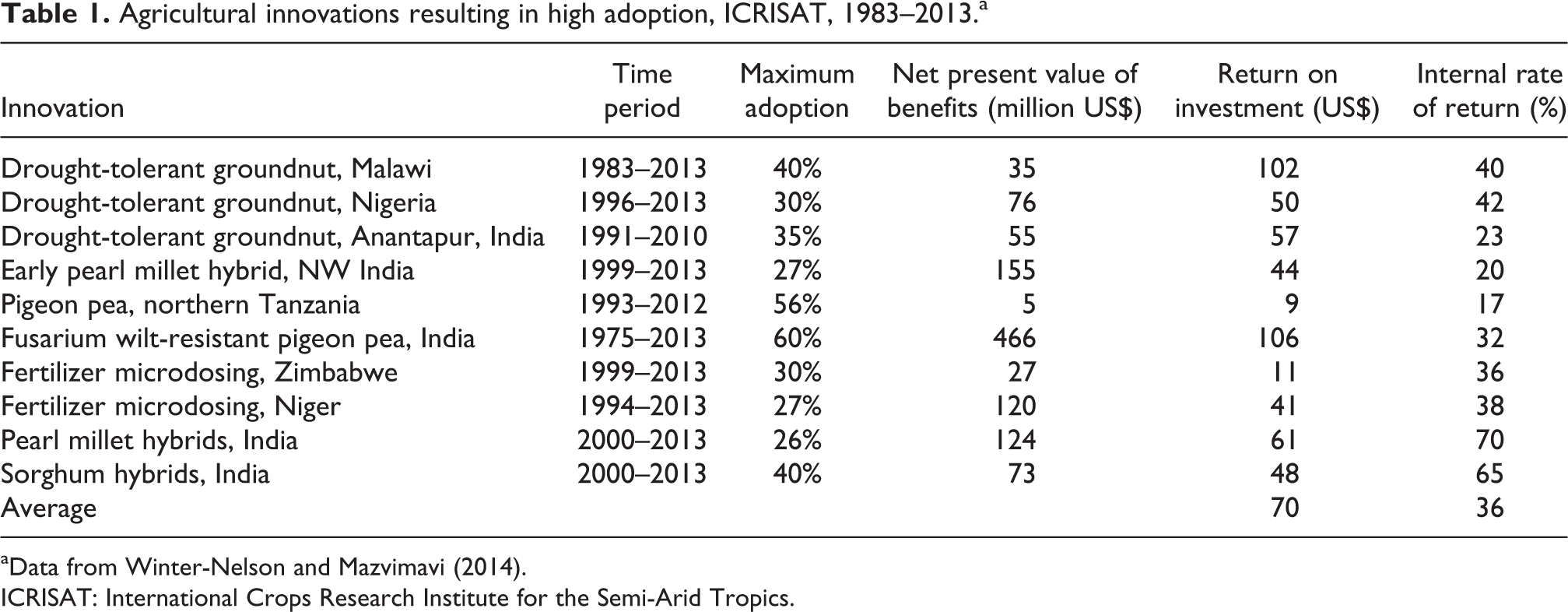
aData from Winter-Nelson and Mazvimavi (2014).
ICRISAT: International Crops Research Institute for the Semi-Arid Tropics.
Impact assessments for some of these innovations give impressive results. Adopters of pearl millet hybrids in India reported yield increases of 18% for grain and 14% for fodder in the 2000s (Kumara Charyulu et al., 2016). A meta-analysis of watershed management in India showed a mean benefit–cost ratio of 2 and IRR of 27%, with rural incomes enhanced by 58%, agricultural productivity increased by 35% and with additional environmental and social benefits (Wani et al., 2008). Microdosing (fertilizer adoption) in Zimbabwe doubled adopters’ output of cereals in Zimbabwe (Winter-Nelson et al., 2016). However, other assessments reveal limited impacts. In Niger, millet yields with microdosing were the same as for other methods of fertilizer application (Liverpool-Tasie et al., n.d.). An impact assessment of improved pigeon pea in northern Tanzania found no significant yield gains because of yield variability under farmers’ field conditions (Dalton and Regier, 2013).While these results imply that the fault lies with the technology, other factors may also be at work.
Case studies
#1. High adoption: Hybrid pearl millet in India
Since the 1960s, the area planted to pearl millet in India has contracted, but yields have tripled and production has doubled. Almost 60% of the area under pearl millet is now planted to improved varieties. This remarkable growth is due to the widespread adoption of hybrid varieties since the late 1980s. The successful introduction of this new technology is attributed to a combination of factors:
Markets
While, at the all-India level, the demand for pearl millet as a foodgrain has fallen with urbanization, higher income and changing food habits (Kumara Charyulu et al., 2014), market demand for pearl millet remains strong in semi-arid states like Rajasthan and Gujarat. Moreover, pearl millet continues to be an important staple for the poor: about 46% of pearl millet in urban India is consumed by low-income consumers. More than half of pearl millet production now finds its way to alternative uses, such as poultry feed and raw material in alcohol and food processing industries (Bhagavatula et al., 2013). Lastly, there is a growing market for pearl millet straw in urban areas close to the centres of production to meet the increasing demand from urban and peri-urban dairies. Chopped pearl millet straw is commonly traded in urban markets due to its transportability and ease of consumption.
Institutions
Hybrid pearl millet was the result of a novel partnership which shared germ plasm between ICRISAT, the private sector and the Indian national research system. Private sector participation was stimulated by the large size of the market, the fact that farmers were already used to regularly replacing seed and the continuing demand for new and disease-resistant products. ICRISAT breeders targeted a key adoption constraint – downy mildew – that led to the development of two hybrid varieties (ICMH 451 and 501) that were resistant to this disease. Private breeding companies then used ICMH 451 and 501 to develop a wide range of hybrids. In 1981, MBH-110 (pearl millet) was the first private hybrid of any crop to be officially released by the Government of India. Extra-early drought-resistant varieties were also developed. By 2007, over 80% of the seed for improved varieties originated in the private sector. More than 50 private firms market approximately 75 hybrids of pearl millet. This partnership was strengthened by the formation of the hybrid parents research consortium (HPRC) in 2000. In 2010, 25 seed companies were members of the consortium. Between 2000 and 2010, private companies developed 103 hybrids, of which 62 (60%) used ICRISAT-bred materials. About 60 (80%) of the 75 widely adopted hybrid pearl millet varieties are based on ICRISAT-bred hybrid parents (Kumara Charyulu et al., 2014).
Policies
Favourable policies included deregulation, a new seed policy and the introduction of truthfully labelled seed which cleared the way for privatization of the seed trade (Kumara Charyulu et al., 2014). Since 2013, coarse grains have been included in the public food distribution system. Theoretically, each eligible consumer is now entitled to 5 kg/month of foodgrains, at a price of INR 1 per kilogram for millets and sorghum. However, it is too early to say whether this has stimulated demand for millets. The government’s ability to procure coarse cereals at the market or support prices and supply them to the consumers at INR 1 per kilogram is proving a challenge (Kumara Charyulu et al., 2016).
# 2. High adoption: Improved cowpea in Nigeria
Nigeria is the world’s largest producer and consumer of cowpea, with 45% of world and 55% of African production. About 39% of the area planted to cowpea in Nigeria is occupied by improved varieties. Since the early 1990s, the breeding programme has focused on the development of improved dual-purpose cowpea (IDPC). Two dual-purpose varieties (IT90K-277-2 and IT89KD-288) are the most popular varieties of cowpea in Nigeria and together account for 44% of the area planted to improved varieties (Walker and Alwang, 2015).
Markets
Farmers sell both cowpea grain as food and stems as fodder. Demand for cowpea grain exceeds supply and Nigeria imports about 25% of its requirements (Langyintuo et al., 2003). However, demand for fodder has to be met from domestic supply. Dual-purpose cowpea allows farmers to combine both higher grain and fodder production in the same variety rather than growing separate varieties as they did before. Farmers report that higher income from the sale of grain and fodder is the main incentive for the adoption of IDPC. Adoption is certainly higher where farmers are closest to markets. However, the highest adopters are poorer households who have more goats/family members, suggesting that fodder to feed household livestock is a key incentive (Kristjanson et al., 2005). Income from higher yields also benefits women who process the grain into cakes for sale and sell it for seed the following season, using the additional income to save for their daughters (Tipilda et al., 2008).
Institutions
Adoption was accelerated through an innovative partnership. A new seed delivery system, involving the International Institute for Tropical Agriculture, the national research programme and local government, was developed to diffuse IDPC varieties quickly from farmer to farmer. Activities included the multiplication of breeder and foundation seed, training farmers in seed production techniques and catalysing farmer-to-farmer seed diffusion for strategic seed reserve development at household level, and forming seed growers association to establish strategic seed reserves at state level. Adoption of an improved package of practices for cowpea was promoted through farmer field schools (Alene and Manyong, 2006).
Policies
Nigeria enjoys free trade in cowpea grain, thanks to the membership of the Economic Community of West African States, which includes Niger, its main source of cowpea imports. Decentralization and the power given to state governments in Nigeria’s federal system meant that local government was closely involved in the promotion of IDPC varieties, while flexible seed policies allowed farmer organizations to grow and sell certified seed.
# 3. Low adoption: Improved pigeon pea in Malawi
After Tanzania and Mozambique, Malawi is the third biggest producer of pigeon pea in Eastern and Southern Africa (ESA). By 2016, Malawi had officially released seven improved varieties, yet the share planted to improved varieties was below 10% (Simtowe et al., 2010). By contrast, in northern Tanzania, 50% of the area planted to pigeon pea is occupied by improved varieties, 31% by the variety ICEAP 00040. In Malawi, 20 years after its release, the same variety occupies just 9%.
Markets
Market prospects seem bright. India faces a growing trade deficit in pigeon pea. This presents an opportunity for exporters, because the Malawian crop reaches Bombay before the harvest in India. Exports to India consist of whole grain, but Malawi pigeon pea is also processed into toor dal, which is exported to the Indian diaspora. To meet the needs of these markets, ICRISAT developed Kachangu (ICEAP 00040) and Mwaiwathualimi (ICEAP 00557), which have the traits liked by Indian consumers (large, round cream-coloured grains) and by processors, because they are easy to dehull.
Institutions
One explanation for the low adoption of improved pigeon pea is the absence of an effective seed delivery system. Pigeon pea seed can be recycled for 3 years without loss of vigour. This makes seed production unattractive for private seed companies, so both the production and the delivery of improved seed are left to the public sector. Yet this argument cannot explain the popularity of Mthawajuni, an unknown variety that has spread rapidly from farmer to farmer over the last 10 years and now occupies 80% of the area planted to pigeon pea in Malawi. Unlike Kachangu or Mwaiwathualimi, this variety has none of the market traits valued by Indian consumers, yet it has been widely adopted. Its popularity is attributed to its earliness and high production of fuelwood (Orr et al., 2014).
Policies
Pigeon pea grain is traded freely and there has never been an export ban. The government of India protects the domestic processing of toor dal. Consequently, exports of toor dal go to the Indian diaspora in the United Kingdom and the United States, not to India (Lo Monaco, 2003). In 2015, Indian Prime Minister Modi committed his government to buy whatever pigeon pea grain Malawi produced (without specifying the price). The government of India wants to guarantee a market for African exporters in order to discourage Indian companies from speculating in stocks and to protect the Indian consumer. However, Malawi faces stiff competition from neighbouring countries. Malawi’s exports of pigeon pea must travel 400 km by rail to Nacala, which reduces its competitive advantage over countries with their own ports, like Tanzania and Mozambique.
# 4. Low adoption: Conservation agriculture in Zimbabwe
Conservation agriculture (CA) is widely viewed as a way to improve the sustainability, profitability and resilience of smallholder agriculture in Africa. CA is based on the three principles of minimum or no mechanical soil disturbance, permanent organic soil cover through a growing crop or mulch residues and diversified crop rotations (Giller et al., 2009). The specific components of the CA system vary according to location (Corbeels et al., 2013). One particular component – microdosing or the spot application of small amounts of inorganic fertilizer – has proved popular with farmers and is numbered among ICRISAT’s success stories (Table 1). Despite promotion over two decades, however, adoption of the CA ‘package’ has been limited. The share of cropland under CA in Zambia, Kenya and Zimbabwe is less than 1% (Corbeels et al., 2013). ICRISAT and its partners have promoted CA in Zimbabwe since the mid-1990s, and this experience provides useful insights into the role of markets, institutions and policies in explaining low adoption.
Markets
Market conditions are often not in place for the adoption of CA (Corbeels et al., 2013). CA requires functioning input markets for seed, fertilizer, herbicides and planters, which are often lacking. Adoption of legumes in rotation or as intercrops also requires output markets. Without a market for the grain, farmers tend to grow grain legumes only on a limited share of their land (Giller et al., 2009). Market conditions for CA in Zimbabwe scored poorly, reflecting its fragile economy (Corbeels et al., 2013). Most CA projects create their own input and output markets, providing adopters with technical and financial support, but once this stops, the majority of farmers revert to their former crop management practices. In Zimbabwe, CA was promoted by an NGO as part of a drought relief programme, but adoption declined after 2009 with the end of the programme (Pedzisa et al., 2015).
Institutions
Contrary to expectation, the adoption of CA was not constrained by a shortage of labour, which is required for making basins and weeding. Smaller families solved this problem through an institutional innovation, pooling their labour in CA ‘labour clubs’ (Pedziza et al., 2015). One institution hindering the adoption of mulching is the widespread custom of free grazing after harvest: Farmers who wanted to use crop residues as mulch would need to protect their fields from roving livestock (Giller et al., 2009).
Policies
The policy environment is favourable because CA has attracted widespread support from national governments and aid agencies, and CA features prominently in strategic plans for the agricultural sector in ESA, including Zimbabwe (Corbeels et al., 2013).
Comparisons
The case studies share one common feature: There was nothing in the technology itself that might be invoked to explain high or low adoption. True, yield increases from CA are variable and not immediate (Giller et al., 2009). Nevertheless, CA appears to have performed well in certain farming systems, while improved pigeon pea varieties with market traits have been widely adopted in Tanzania. What distinguished these technologies were the external conditions that hindered or favoured adoption.
Table 2 summarizes the relevant features of the four case studies in terms of the analytical framework. Clearly, market demand was a key driver for adoption. Hybrid pearl millet met a growing demand for poultry feed and fodder. In the case of dual-purpose cowpea, success was the result of cleverly combining two equally valued traits into a single product that met the demand for fodder as well as for grain. By contrast, demand for improved pigeon pea in Malawi rested on an uncertain export market threatened by foreign competition. In these conditions, prioritizing market traits may not have been the most effective strategy for high adoption. Similarly, CA researchers may have mistaken the demand drivers for crop residues. In the mixed crop–livestock farming system in semi-arid Zimbabwe, using crop residues to feed livestock – which produce traction, meat, milk and manure as well as a source of ready cash – gives greater benefits than using residues as mulch to improve grain yields. A recent review of CA concluded that, while CA was potentially beneficial for some types of farmers and farming systems in sub-Saharan Africa, nevertheless, ‘under present circumstances CA is inappropriate for the vast majority of resource-constrained smallholder farmers’ (Giller et al., 2009). Given the right market conditions or a different type of demand, however, the fate of these two agricultural innovations might have been very different.
Markets, institutions and policies in adoption: Four case studies.a
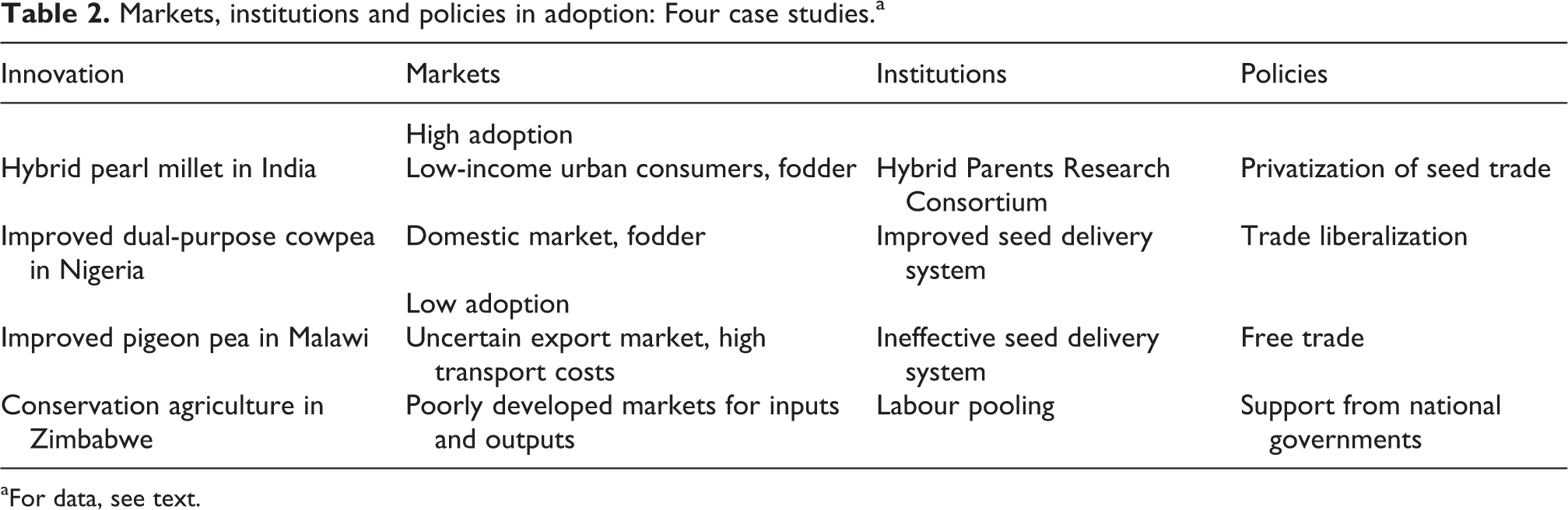
aFor data, see text.
Institutions played a critical role. Successful adoption of hybrid pearl millet was achieved by enlisting the private sector in the development and marketing of hybrid varieties to fit a range of agroecosystems. Similarly, the success of dual-purpose cowpea hinged on improving access to seed. Even so, adoption rates are still below those in neighbouring Ghana (82%) and Cameroon (71%). The problem is one of scale: The area planted to cowpea in Nigeria is 14 times greater than that of Ghana and Cameroon combined. Raising adoption rates in Nigeria above 39% will require a huge effort to improve farmers’ access to seed, and the lack of private sector involvement means that this can only be achieved by scaling out institutional changes that promote informal farmer-to-farmer exchange.
Lastly, policies were supportive. Hybrid pearl millet would not have been so widely adopted in India without privatization of the seed trade, while trade liberalization and the growth of cowpea imports spurred Nigeria to boost domestic production. However, supportive policies alone did not guarantee adoption. Although Malawi enjoys unhindered access to the global market for pigeon pea, the vagaries of this market reduce the incentive for the adoption of improved varieties with the desired market traits. Similarly, numerous endorsements by international and national bodies appear to have had little effect on the adoption of CA.
Conclusions
Successful adoption of agricultural innovations is usually attributed to getting the technology right. Certainly, this focus on technology is a prerequisite for high adoption. ICRISAT’s most successful agricultural innovations clearly addressed a key yield constraint, such as drought, disease or low soil fertility. This strategy has paid off. A selection of 10 ICRISAT interventions gave an average return of US$70 for every dollar invested. However, a closer examination of these success stories reveals that markets, institutions and policies also played decisive roles.
The markets–institutions–policy rubric is useful because these preconditions can make or break a new technology. Indeed, it is hard to imagine high adoption without at least some combination of these elements, if not all three. Success stories such as pearl millet in India and cowpea in Nigeria show they have played an important role in achieving high adoption. Similarly, the low adoption of improved pigeon pea in Malawi and of CA in Zimbabwe and elsewhere can be attributed to weaknesses in markets and institutions. While new technology must address a clearly identified constraint, researchers must also be aware that the adoption of new technology is rarely based solely on its technical merits. In particular, successful technologies require clearly identified end users, whether sale, home consumption, byproducts or some combination of these, and often depend on institutional innovations for the delivery of inputs or for access to global or national markets. Just like the mango seed pit and its surrounding fibres, a successful technology is inseparable from its enabling conditions.
Footnotes
Author’s note
The views expressed here are those of the author and should not be attributed to the organization with which he is affiliated.
Acknowledgements
The author is grateful to colleagues Kai Mausch, Arega Alene, Henry Ojulong, NKVR Ganga Rao, Eva Weltzien, D Kumaracharyulu and Alphonse Singbo for providing information and references.
Declaration of conflicting interests
The author(s) declared no potential conflicts of interest with respect to the research, authorship, and/or publication of this article.
Funding
The author disclosed receipt of the following financial support for the research, authorship, and/or publication of this article: The author is grateful to ICRISAT for funding the research for this article.