




Abstract
This article presents findings from a qualitative phenomenological study exploring the lived experience of nurses who have witnessed end-of-life dreams and visions (ELDVs) of dying patients. Using Seidman’s Three-Interview Series, conducted asynchronously via email, eight nurses from Western Massachusetts contributed six comprehensive and two partial experiential accounts. The study revealed that witnessing these deathbed phenomena was a profound experience, often accompanied by feelings of awe, humility, and a deep sense of privilege. Participants described themselves as guides during the dying process, providing emotional and spiritual support to patients and their families. Though ELDVs have been recorded for centuries, nurses often remain hesitant to share their experiences due to the lingering taboo surrounding the topic, fueled by fears of judgment and the risk of their experiences being minimized, invalidated, or dismissed.
Introduction
End-of-life dreams and visions (ELDVs) are often described as transpersonal experiences that extend beyond the archetypal image of a “spirit at the end of the bed” (Brayne & Fenwick, 2006; Lawrence & Repede, 2012). These phenomena frequently bring comfort, peace, and emotional resolution to individuals approaching death. Although ELDVs can hold deep personal and spiritual significance for the dying, they are frequently underreported. Systematic studies of these experiences have been conducted throughout the 20th century, including a survey of physicians and nurses by Osis and Haraldsson (1977). Yet despite more than a century of inquiry, little is known about how witnessing such extraordinary events influences a nurse’s professional practice, personal spirituality, and understanding of death. This omission leaves a critical gap in both empirical and conceptual nursing knowledge about ELDVs, as well as evidence-based practices for addressing them.
The most commonly reported ELDVs involve visits from deceased loved ones who provide reassurance and appear to assist the patient in transitioning to the afterlife (Santos et al., 2017). Another related phenomenon, terminal lucidity, occurs when patients, often with advanced dementia, experience a sudden return of mental clarity shortly before death, using the moment to connect meaningfully with loved ones. Children have reported ELDVs, often using language or imagery that conveys spiritual maturity, as observed by Atkinson-Ethier and Rembert (1997), and described metaphorically by Kubler-Ross (1999) as a transformation akin to “the shedding of the chrysalis into the new life of a butterfly.”
Unlike delirium, a clinical syndrome, which is marked by cognitive disorganization and impaired awareness, ELDVs are typically experienced with mental clarity and coherence (Dam, 2016; Kerr et al., 2014). Palliative care providers in England have distinguished ELDVs from hallucinations caused by medications or organic brain dysfunction, noting their emotionally meaningful and peaceful nature (Brayne et al., 2006).
The publication of Moody’s (1975) groundbreaking work on near-death experiences helped spark wider interest in non-ordinary end-of-life phenomena. Since then, researchers such as Moore and Pate (2013) have emphasized the importance of preparing nurses to recognize and validate ELDVs as meaningful components of the dying process. In a study of Canadian long-term care staff, most nurses and nursing assistants affirmed that deathbed phenomena are transpersonal, spiritually profound events that offer comfort to dying residents and their families, and significantly influence caregivers’ own beliefs about life after death (Claxton-Oldfield & Richard, 2022).
Researchers have found that patients are more inclined to share their ELDVs with nurses than with physicians or other medical personnel (Devery et al., 2015; Wholihan, 2016). Nurses, by virtue of their continual presence at the bedside, often develop strong therapeutic relationships with patients and families. These connections create safer spaces where patients may feel comfortable disclosing spiritual and death-related concerns. Additionally, nurses have reported intuitive or premonitory experiences surrounding patient death, sometimes involving dreams or inexplicable feelings that precede a patient’s passing (Brayne et al., 2008).
This study explored the lived experiences of nurses who have witnessed ELDVs in dying patients, with the aim of understanding how these encounters shape their personal beliefs, professional practices, and spiritual perspectives. Through the collection of reflective narratives, the research sheds light on the emotional and spiritual dimensions of end-of-life care. By creating a safe space for nurses to share these profound experiences, the study highlights their unique role as witnesses, guides, and compassionate caregivers during one of life’s most sacred transitions.
Methods
Design
Edmund Husserl’s (1970) descriptive phenomenology research method was employed to analyze and interpret the descriptions of the lived experiences of nurses who have witnessed end-of-life dreams and visions of dying patients. The value of Husserl’s philosophy lies in his recognition of phenomenology as a “transcendental” science that transcends the natural and psychological sciences, seeking meaning in experience (Smith, 2013). Each interview question followed Seidman’s Three-Interview Series (2013). Using Seidman’s model allows for comprehensive questioning, which contributes to a deeper meaning and understanding of the phenomenon by placing it within the context of the participants themselves and the lives of those around them (Seidman, 2006).
Sampling and Participants
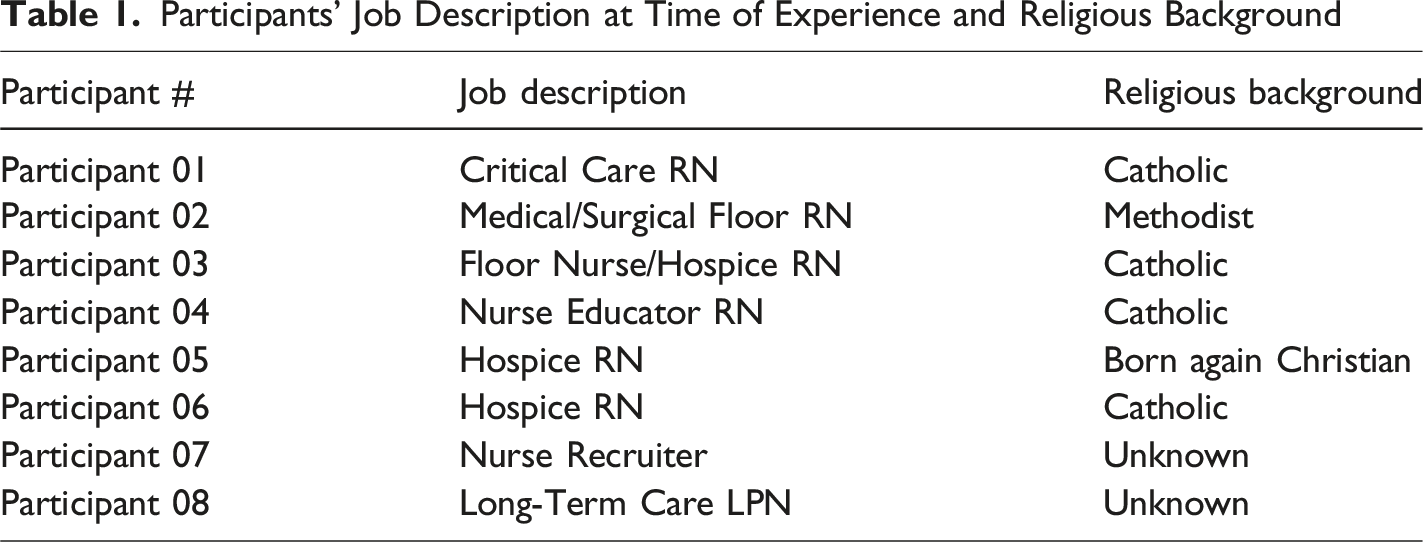
The study was conducted using convenience sampling in Western Massachusetts, USA, from November 2023 to April 2024. Inclusion criteria required that participants were licensed nurses who had personally witnessed an end-of-life dream or vision and were willing to share their experience freely. Recruitment letters were sent to three hospitals, two rehab centers, two hospice programs, and one long-term facility. Although twelve nurses initially showed interest in participating in the study, six nurses completed it, with two others contributing partial responses. Institutional Review Board approval (Note IRB #5020) was obtained from the author's institution, and written informed consent was obtained from all participants.
Data Collection Procedure
Data was collected over six months using asynchronous email interviews with semi-structured, open-ended questions. Additional questions were asked during exchanges between researchers and participants to clarify answers and encourage more in-depth responses to the question. Interviews consisted of at least two to four email exchanges per participant. One participant without computer access submitted handwritten responses, which were transcribed into a Word document. Collected data was shared with the second and third researchers through secure access. A saturation point was met based on no new themes or codes emerging, redundancy of data, a deep comprehension of the phenomenon studied, consistency with previous studies, and a feeling of confidence by the researcher and first researcher in the data collected.
Analysis
Colaizzi’s seven-step approach (1978), with a later adaptation of an eighth step, was used to analyze and interpret the data. The Colaizzi’s method, used in this descriptive phenomenological study, provided rigorous and dependable data analysis by enabling a thorough understanding of the interview responses, achieving data saturation, and clearly outlining each step to meet the study’s objective. The eight steps of Colaizzi’s analysis included reading all participants’ narratives several times. Significant statements were then extracted, coded, and meanings were formulated for each one. These meanings were organized under three categories into thematic groups, which were then synthesized into exhaustive descriptions for each of the three interviews. The repetitiveness of themes indicated that we had reached saturation. The descriptions were compiled into a statement/s that identified the core elements of the phenomenon. Participants were then asked to review and provide feedback on these findings to ensure validation. Any new insights offered by participants were incorporated into the final results (Vignato et al., 2022).
Results
Participants’ Job Description at Time of Experience and Religious Background
Themes
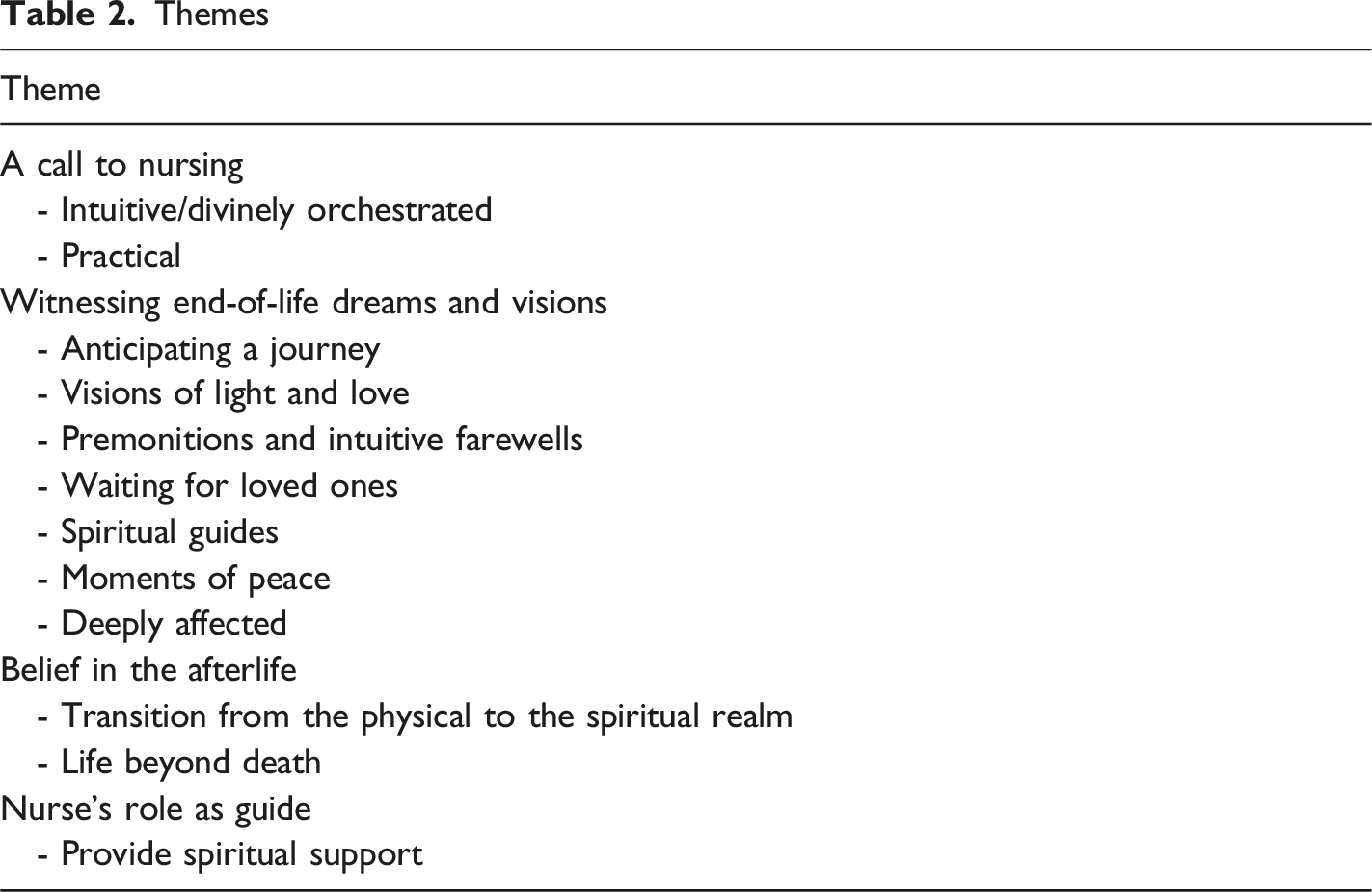
A Call to Nursing
Participants described their decision to pursue a career in nursing as shaped by a combination of personal and practical considerations. For many, the choice was not merely an occupational decision, but at times, an intuitive or even divinely orchestrated one. Participants spoke of being “chosen by nursing,” “foreknown,” or “called” by God to do this work, often at a young age. Some shared that they had been natural caregivers throughout childhood, tending to siblings, parents, or vulnerable people, instilling in them a lifelong drive to care for others.
Other participants described nursing in a more practical way as “a real job,” and “An occupation that could support myself and would always be in demand.” In one case, a participant’s father discouraged her from pursuing a career as a carpenter and directed her towards nursing, a decision that was shaped more by an external expectation vs. an internal calling.
Despite the different motivations for entering nursing, a unified thread of caring for others was evident. This caregiving instinct, along with a religious background, seemed to foster openness to ELDVs as a natural part of dying. Those who felt called to the profession often considered these phenomena not as anomalies, but as sacred opportunities to support patients through their final journey.
Witnessing End-of-Life Dreams and Visions
During the dying process, nurses often witness moments that transcend clinical understanding, such as visions, premonitions, and peaceful transitions that hint at a deeper spiritual reality.
Anticipating a Journey
Several participants described dying patients who spoke of travel as they neared death. One hospice nurse recalled an older gentleman who repeatedly stated that he “could hear the train coming” and feared missing it. The nurse and family members told the patient that “the train had arrived, and he could get on the train now.” The nurses noted, “He was able to die peacefully.” In another case, a man repeatedly stated that he needed to drive his old truck and showed terminal restlessness. “The family placed his familiar keys in his hands and told the man he could go for a drive- the man soon peacefully passed away.”
Another participant shared a case of visiting a young hospice patient in her mother’s home, and the patient suddenly stood up and anxiously announced that she had to go. The urgency and clarity of the patient’s intent to leave stunned both the family and the nurse. “Everyone was a little confused by what the patient said and tried to help her walk. The patient just sat down and took her last breath. We were all shocked by what happened.”
These incidents of patients feeling the need to travel may be related to the body’s expression that it is dying or the spirit’s imminent departure from its body.
Visions of Light and Love
Two nurses reported witnessing an ‘inner light’ around their patients. One described a woman as “very white and her face was glowing” at the time of death, while another talked about “I swear I saw a faint light in her face and her eyes with an expression of such joy and peace.”
While describing a vision of people in her room, a patient described them to the nurse as “shining.”
These accounts may suggest either a profound transformation during the dying process of a patient or the energy and presence of something otherworldly.
One nurse reflected: “I remember feeling how much love there was in the room. I just felt surrounded by it.”
Premonitions and Intuitive Farewells
The theme of premonitions appears in three of the interviews. Two recalled childhood visions of their grandmothers visiting them just before or at the time of their death. One participant noted: “That morning my uncle received a call, and we were brought back to our home, but I already knew what had happened.”
Another nurse recalled a patient who insisted she needed a “big breakfast” to meet her deceased sister. “At 11 am she was brought to therapy where she told everyone she was meeting her sister. She promptly had a massive MI [Myocardial Infarction] and passed.”
The two participants’ stories about their dying grandmothers may suggest a maternal need for the dying to say “goodbye” to their loved ones or even a heightened awareness or intuition about impending death.
Waiting for Loved Ones
A few of the participants’ stories discuss patients waiting for a loved one to arrive or leave before passing away. One of the nurses described this as common among dying patients. “They hold on and do not let go because they are waiting for a family member to get there, or they wait until everyone leaves the room.”
In the case of the nurse witnessing a grandmother waiting for her grandson to arrive, the patient displayed extraordinary strength despite her body failing during the end stage of dying. “I had an older Indian woman who was dying from kidney cancer. She had always spoken about her wish to see her grandson before he died. He was living in India during this time and arranging travel plans to see his grandmother. She was very ill at this time and was actively dying. Her feet were mottling, and her breathing was erratic & we had been unable to obtain a blood pressure, but she would not let go. She continued to be unresponsive. Her grandson arrived and ran to his grandmother telling her how much he loved her. She opened her eyes and looked at him, and within a minute, she was gone.”
Another nurse recalled that after several days caring for her dying mother, her mother encouraged her to leave for lunch. During the brief absence, her mother started to pass away and died soon after. These accounts suggest that on some conscious level, dying individuals can intentionally hang on or let go, perhaps aiming to spare loved ones or allow a final reunion.
Spiritual Guides
Several participants referenced dying patients, describing or reacting to unseen presences. These ‘guides’ were often interpreted as angels, deceased relatives, or loved ones. One nurse noted that her grandmother questioned her about “people” only she could see in the corner of the room. The grandmother was not afraid, but rather curious and confused, as no one else could see them. “I told my grandmother maybe they were angels-she just laughed.”
A participant in the Cardiac Care Unit noted a patient’s familiarity with the visions: “She looked like she grabbed someone and was hugging them, stating, “There you are.”
Another participant, who was a nurse educator, while visiting her dying sister-in-law, noted her tapping out a familiar rhythm she had shared with her deceased mother. …she didn’t seem to hear me and was looking off afar…like she was looking at someone behind me. I actually turned to look at it myself, nothing was there except a blank wall…I wouldn’t say she was alert but on a different plane of existence maybe? … Anyway, she tapped out the rhythm, all of it, I asked about her mother, no answer, not sure she even heard me, she peacefully slipped into a coma and died 2.5 h later.”
One participant noted that her patient, who was in a coma, showed signs of terminal lucidity, or an awakening. “This day however the lady suddenly smiled at something in front of her, turned her head to look up and smiled again. As the patient looked up and smiled, the AAA [Abdominal Aortic Aneurysm] let go…”
Visions by the dying patients were not always a positive experience, as one participant noted her mother responding to a vision as if she was seeing her domestically violent, dead husband. “There he is, why is he here? I believe she was talking about my father. She was very angry in her speech and became more agitated and aggressive about seeing him.”
Overwhelmingly, the visions, as participants described, were comforting, familiar, and well-received with joy and love. Participants strongly suggested that these visitors were the spiritual guides assisting the dying into the afterlife.
Moments of Peace
Despite the physical labor of dying, many patients expressed moments of tranquility in their final moments. Nurses observed the patients smiling, becoming peaceful, and at times radiating a sense of calm that deeply affected their families. “The daughter was amazed at the look of peace that appeared on her mom’s face right before she passed. The daughter was finally able to accept that her mom was at peace.”
These observations are quite paradoxical to the notion of death as the enemy of life, but may reinforce the idea that dying can be a deeply spiritual, affirming experience.
Deeply Affected
For participants and families who witnessed an ELDV in dying patients, the experience was often thought-provoking, profound, and in one case, evoked a strong visceral reaction by both the nurse and a Cardiologist. In the interview from the CCU nurse, she and the Cardiologist were holding the hand of a patient who was in imminent danger of death from a cardiac dysrhythmia not responding to medication. “She kept telling us she was not afraid to die and that she welcomed death. The patient had no family. The patient let go of our hands and was reaching out in front of her looking as if she was looking to hold someone. She looked like she grabbed someone and was hugging them, stating “there you are.” The cardiac monitor showed asystole and the patient passed…. The Cardiologist and I looked at each other and cried. We held each other after this and stated we witnessed something very amazing.”
Similar to the CCU nurse, other participants shared that witnessing an ELDV was a profound experience. “I remember feeling at peace for her, being in aww, feeling comforted by the possibility of an afterlife with God and not being alone having passed family guide us.” “Amazement, feeling of being humbled and reassurance there is something more after this life, What an incredible gift to be allowed to witness such a private moment. There aren’t words to describe the feeling. Privileged, humbled…I can’t really say.”
It may be for both these clinicians that death no longer was a clinical outcome but expanded to sacred, shared, and transcendental.
Belief in the Afterlife
From the participants’ lived experience of witnessing ELDVs, they deduced that death is a transition from the physical to the spiritual realm, a crossing over into what many referred to as Heaven or “another world.” They also described a space within the dying process where the physical and spiritual worlds intersect as patients cross over. “…My nursing experience has led me to believe that there is a spiritual world, Heaven, what you would like to call it. It may be felt more than seen perhaps, and people have a spirit side of them, a soul, whatever you want to call that. I feel when life is slipping away, you come closer to the other “world” and experience things others are not involved in except as spectators.” “I believe there is a connection with those that are passing within the physical world and the afterlife.” “The deathbed phenomenon has been explained as due to physiological changes in the body as a person is near death. But I feel there is more to these experiences than that.”
One participant believed that after a person dies, a part of them still remains with us. “The people who have passed before me are always there-in the wind, the sun, the rain-leaving signs and surprises along the way. We need to open ourselves to the moments.”
These moments deepened participants’ faith that life continues beyond death and that patients are guided or welcomed into the next world. Collectively, these experiences offered comfort, strengthened beliefs, and reframed death not as the end, but as “the next great adventure.”
Nurse’s Role as Guide
Participants discussed the theme of being a guide to patients, their families, and coworkers. The role of a nurse is not only to attend to physical comfort, but also to provide spiritual support during the transition from life to death. “I believe it is a nurse’s responsibility to help guide the patient and the family in the death experience and passing. “Nurses have the ability to make it a ‘good death’ for patients and families by providing support and comfort holistically. Being present at the end of a life can be as rewarding as being present for the birth of a life.”
Though one participant felt no qualms sharing ELDVs with patients and family members: “I feel privileged to have seen this and to have been a part of explaining my understanding of it to family members.”
Another participant was careful not to “push my belief” on the dying patient and family. “If they ask, I will share and reassure them but they need to initiate the conversation. The only times I’ve started the conversation is when I can see the terror in my patient’s face and they can’t ask the question themselves.”
Some of the participants had a protective stance when discussing an ELDV event, fearing missed opportunities for compassion and empathy. “…all nurses, regardless of their personal bias and belief need to recognize that something spiritual and physical happens to the dying that is beyond just the end of life and to be open to explore this with the patient at the level they chose to explore.” “If a family member, friend or coworker starts to make comments about nothing being there after this life, I firmly encourage them to be more open and tolerant. And not to say such things within hearing of a terminal patient.”
Another participant noted that as a guide, it is not her job to “judge” but to support even when they don’t fully understand what is happening. “I believe this experience has taught me that there are things I don’t understand but they may be meaningful to my patients and it’s not my job to judge, assume or decide, but to support any patient in their time of need, with what they need.”
Having an openness to ELDVs supports the patient’s experience, dispels fear, and fosters an environment of empathy and compassion. These themes reveal that the participants who witnessed ELDVs considered them profound experiences that deeply influenced their nursing philosophy of caring for the dying, affirming the importance of attending to both the physical and spiritual dimensions of the person as they transition into the next chapter of their greater journey.
Discussion
The findings of this study offer insight into what nurses experienced while witnessing ELDVs of the dying. The data captures their recollections, personal interpretations, and the influence these encounters had on both their private and professional lives. Overwhelmingly, participants described their experience as deeply meaningful, emotionally impactful, and affirming of their belief in the afterlife and spirituality. These findings align with existing literature, reinforcing the notion that ELDVs represent more than just anecdotal accounts (Brayne & Fenwick, 2006; Lawrence & Repede, 2012).
One of the themes to emerge was a “call to nursing.” Several of the participants described an intrinsic need to care for others and feeling “chosen” or “called” to nursing. Florence Nightingale’s own narrative described a divine calling to the service of nursing when she was seventeen (Snowden et al., 2010). A study by McKenna et al. (2023) found that the motivation of Indonesian nurses and nursing students to enter the nursing profession was primarily driven by a desire to serve others and God, personal calling, and being influenced by others. Whether driven by job stability or a divine calling, nurses in the study showed a unique caregiving posture of openness and acceptance of deathbed phenomena.
Participants all had formal religious education and frequent attendance as children in the Christian faith. As adults, though some had left the church and were disillusioned with organized religion, ELDVs were still interpreted as sacred events. These findings suggest that experience with religion early in life may foster receptivity to deathbed phenomena as something spiritual. Many participants reported that witnessing ELDVs reinforced their belief in an afterlife. These findings align with Claxton-Oldfield and Richard’s (2022) study, in which long-term care staff in New Brunswick, Canada, affirmed that ELDVs increased their awareness and belief in life after death. Nurses in our study articulated a belief that death is not the end but a passage into another life or a “next great adventure.”
The theme of travel is often seen in narratives shared on hospice websites, and previous research of dying people (Kellehear et al., 2011; Muthumana et al., 2010; Nyblom et al., 2022). Nurses in the study also recounted that patients expressed a desire to travel, reunite with deceased loved ones, or transition peacefully following visions that only they could see. We found that even without formal training, nurses instinctively fostered the dying process by verbalizing to patients that they may now board the train, drive away in their truck, or reassuring them that their family will be “okay” if they go. The participants also shared stories of dying patients reporting visions of spiritual beings, visits from dead relatives, and an announcement that they soon will be traveling with dead relatives. These narratives align with the work of Santos et al. (2017), who documented patients’ reports of encountering familiar spiritual entities that eased their transition into death.
A unique contribution of this study was the description by the participants of a transpersonal involvement in these experiences. Several nurses reported something that could be described as an emotional and spiritual synchrony with the patient or loved ones at the moment of death, similar to Moody’s (2011) concept of the shared death experience. The profound experience of the nurse and Cardiologist in the Critical Care Unit (CCU), along with the nurses who had different experiences of a visitation by their dying grandmothers, transitioned them from simple observers to a shared consciousness with the dying in death. In many documented near-death experiences, people who have died and come back speak of a profound journey into another existence without their body and filled with deep emotions of peace, love, and joy (Moody, 1975). Similarly, the nurse and cardiologist in CCU, felt deeply connected with the patient and were overcome by feelings of joy, peace, and overwhelming emotions that left them holding each other, shaking and crying. They both believed that they had witnessed something spiritual and powerful, even though the cardiologist was not religious. The nurse who was visited by her dying grandmother at the end of the bed was able to see her with a corporeal body, describing her as having a “golden aura”, even though her grandmother’s actual body lay in the hospital. Entering together into the grandmother’s transitional phase of life into death, they had a moment for the grandmother to speak one last time with her granddaughter.
The study revealed a wide range of emotions surrounding the topic of ELDVs. Much of the data discussed the emotions felt by participants who had actually witnessed the phenomenon and its impact on their personal and professional lives. At the moment of witnessing the event, nurses described patients as acting fearless, peaceful, and emanating light and love. Nurses and family members appear to embrace the emotions as they reflect on the death, even when the death is traumatic to watch, such as with the patient who bled out from an abdominal aortic aneurysm. Both the nurse and her daughter noted that she peacefully passed away, which brought them peace, helping the daughter to let her mother go.
Despite the occurrence of these events, many participants in the study hesitated to share their experiences with colleagues due to fear of judgment or dismissal. This finding is consistent with Moore and Pate’s (2013) study, which noted the stigma surrounding deathbed phenomena in healthcare settings. It was noted from the research that nurses working in hospice have an opportunity to share their stories with the team, which includes a chaplain and a physician. In contrast, nurses in acute care lack the time and necessary support to share their experiences.
Consistent with previous research, nurses in this study distinguished ELDVs from clinical hallucinations or delirium (Brayne et al., 2006). Participants described their patients as peaceful, at times alert, coherent, and focused, with moments of terminal lucidity or meaningful final gestures. Our participants interpreted the phenomena as spiritual, joyful, and indescribable, rather than pathological.
Limitations
A key limitation of this qualitative study was the lack of religious diversity among participants, including the absence of atheists. This may be attributed to the use of a convenience sample of nurses from Massachusetts, where 58% of the population identifies as Christian (Pew Research Center, 2014). Given that deathbed phenomena are often linked to spirituality and the world of metaphysics, a Christian upbringing may have influenced participants’ interpretations and/or created selection bias. As a result, this study lacked the diversity needed to explore how individuals from different religious backgrounds, or those without religious affiliations, interpret what they witness during such experiences. Although the sample size was small, the depth of the qualitative interviews yielded rich and nuanced insights into nurses’ lived experience of ELDVs.
Conclusion
This qualitative study delved into the profound experiences of nurses who have witnessed ELDVs of dying patients, exploring the personal and professional impact of these occurrences. Several of the anecdotes provided by the participants were consistent with the data found in the literature review. The study revealed that these experiences were deeply significant, often reinforcing the nurses’ beliefs in life after death and broadening their approach to nursing care at the end of life. The narratives provided by the participants were rich with themes that included their personal history, spirituality, the unique calling of nursing, the profound effect of ELDVs, and navigating the intersection of life, death, and nursing philosophy. What nurses are witnessing or experiencing with ELDVs cannot always be explained by conventional science, but may hold a deeper meaning in an expanding consciousness. Further research can enrich the data and, over time, support the integration of these findings into nursing texts and classrooms.
Footnotes
Acknowledgments
The authors would like to thank all the nurses who participated in the research and for their willingness to be vulnerable.

Ethical Considerations
The study was approved by the UMASS Human Research Protection Office and the Institutional Review Board of the University of Massachusetts Amherst, USA (IRB #5020).
Funding
The authors received no financial support for the research, authorship, and/or publication of this article.
Declaration of Conflicting Interests
The authors declare no potential conflict of interest with respect to research, authorship, and or publication of this article.