



Abstract
The global funeral economy, following advancements and innovations in virtual and artificial intelligence, has witnessed explosions in the diversification and commodification of burial services, especially bereavement and mourning rituals. This phenomenon has prompted scholars to investigate what is termed ‘affection as a service’ – technological innovations and products with affordances that allow the bereaved to reconnect posthumously with their loved ones. In this article, I examine yet another growing phenomenon: that of hired, itinerant professional mourners in Ghana. Here, I argue that by appropriating and blending a mode of cultural expression of grief with their unique style of nwomkro performances, these professional keeners have not only revived an essential tradition for the purposes of cultural continuity, but they have also commodified mourning enactments for financial gains.
Introduction
Capitalism and the expansion of commodity relations have been pivotal concepts in critical political economy since Karl Marx’s early economic writings, emphasising the transformation of goods and services, including human experiences, into marketable commodities. In the 1970s neoliberal era, commodification’s scale and scope significantly expanded with substantial growth in product and input markets, especially the commodification of land, labour, knowledge and persistent emergence of novel classifications of commodities (see Goodwin, 2018; Moore, 2011; Smessaert et al., 2020; Teeple, 2019). Within the realms of consumer practices, commodification has been identified to permeate the everyday to affect the flow of tangible goods and symbolic aspects such as culture and emotions by altering social relations and individual identities, resulting in a depoliticisation of individuals in a market-driven society (see Beck & Cunha, 2017; Osumah & Aghedo, 2011; Rotta & Teixeira, 2019; Shaw & Thomas, 2017).
Despite the extensive scholarly focus on commodification across subjects and fields, there remain complexities in defining its scope and constituents, considering the objects being exchanged (the commodity) and their intrinsic or relational value. According to Oliver and Robison (2017), for commodification to occur, there must be an interplay between commodities and people. In this case, the “physical goods and services whose value is associated with their ability to satisfy mostly physical needs” and “their connection to people and relationships, between people and the social environment in which they are exchanged” (p.1315, 1316). The authors argue that while capitalism generates a constant pressure towards commodification, it does not necessarily mean that everything will become commodified (Oliver & Robison, 2017, p. 1932). Such totalising notions of commodification undergird Derek Hall’s call for a more nuanced examination of the mechanisms through which capitalism exerts pressure to commodify. Hall (2023, 2024) contends that while capitalism engenders a persistent pressure towards commodification, it does not necessarily imply that every aspect of life will become commodified. This distinction is crucial as it challenges assumptions of capitalisms’ influence and universal applicability to all domains of existence (p.1932). Because commodifying drives may vary across historical and cultural configurations of capitalist societies, the notion of ‘universal commodification’ may be unattainable. 1 This notwithstanding, the inclusion of intangible aspects of human experiences in subsequent critical investigations of commodification, particularly how market forces alter the cultural significance, social performance, and negotiations of emotions suggests an ever-changing phase of commoditisation. In this article, I explore the commodification of grief in Ghana’s funeral sector by investigating the phenomenon of hired or paid mourners – a group of professional itinerant performers who specialise in mourning and grief enactments. 2 Using “an array of interpretive techniques” (Van Maanen, 1979, p. 520) to understand the discourses that unfold through primary and secondary interviews with one of the lead architects in this industry, I explore the context of professional mourners in African obsequies and the growing operations of Ghana’s hired keeners, where funeral-related emotions are commercialised.
Funerals and the Commodification of Emotions
Funerals constitute significant public events of memorialisation and celebration of death. They serve to honour the deceased, providing an opportunity for communities to come together and show support for bereaved families (Geschiere, 2005; Jindra, 2011; Onyibor, 2019; Parker, 2021). Given the enduring cultural relevance of funerals, many cultures, as part of their mourning rituals, enact rigorous processes of bereavement, burial, and modes of expressing grief, from the time of death through to the final rites of memorialisation (Korai & Souiden, 2017; Neimeyer et al., 2022; Parker, 2021; Platt & Persico, 1992; Selin & Rakoff, 2019). Cacciatore and DeFrain (2015) echo these complexities of bereavement and grief enactment when they assert that: “[e]veryone dies, and everyone grieves. But […] we express our grief in different ways, and we find ways to endure our sorrow over time, relying on beliefs, rituals, and socially influenced behaviours inherent in each unique individual and each unique culture” (p. v). These observations point to the universality of death, but also the paramountcy of managing mourning-related emotions in all forms of burial, as such events evoke profound emotional responses with deep cultural significance. Owing to the cultural importance of grief-related emotions, their enactment and regulation follow strict social scripts. However, over time, across cultures, the management of death-related emotions of sorrow, through lamentation, like other aspects of mortuary and funeral practices, has witnessed significant commoditisation – a diversified marketplace, a funeral service economy that packages grief and mourning enactments as commodities (de Witte, 2003; Dembek, 2016; Gedzi et al., 2020).
Commodification of emotions, especially grief, entails intricate processes of how emotions are packaged, marketed, and deployed within diverse contexts where emotions are perceived as commodities, wherein feelings can be acquired, exchanged, or controlled for social advantage. Such processes of commodification transform the essence of social interactions, often resulting in superficial exchanges that prioritise transactional dynamics or connections to the neglect of authenticity, which may lead individuals to not only perceive themselves but also adopt a commodified persona that prioritises public representations over individuality and authenticity.
Further exacerbating the commodification of funeral-related emotions has been advances in digital technology, particularly social media and artificial intelligence, which affords grieving families and individuals a means to memorialise their loved ones (Al Sheikh, 2025; Dethloff, 2019; Shohet, 2018). Social media has considerably altered mourning practices with digital images which enable the creation of virtual memorials of the deceased in ways that transcend physical boundaries and facilitate the sharing of grief across vast distances (Gibbs et al., 2015). Users employ digital images, tweets and “hashtagged tributes” (Abidin, 2022, p. 174) as digital mnemonics to curate their grief in alignment with platform norms and audience expectations. Such digital interactions facilitate a sense of community and shared understanding among individuals processing similar grief (Aguilar et al., 2024). This notwithstanding, Crystal Abidin cautions of “grief hijacking,” an attention economy where “Instagram users opportunistically participate in globally trending grieving hashtags by injecting content to redirect some of the attention to themselves” (Abidin, 2022, p. 174). Abidin’s provocation on “grief hijacking” follows from Gibson’s “parasitic opportunism”, “automated mourning” and “algorithmic mourning” which demonstrate the commodification of grief on digital platforms and the complex interplay between emotional experiences in the virtual world and market dynamics (Al Sheikh, 2025; Gibson, 2015, p. 343). Such “affection as a service” models, as Figueroa-Torres (2024, p. 9) terms it, commercialise emotional connections by positioning grief as a marketable service in the digital afterlife economy. As we shall see in the coming sections regarding African obsequies and the contract keeners of Ghana, it is this commercialisation and performativity of grief and the public display of hysterical lamentation that constitute the key provocations of this paper. Here, I argue that not only do such performances erode the sanctity of a deeply cultural and solemn moment of mourning but also their commoditisation and histrionic performances render the emotional displays questionable.
African Obsequies and the Phenomenon of Moirologist or Professional Mourners
Mourning and mourners have, since time immemorial, occupied a crucial space in African obsequies. In his monograph, detailing the history of death, dying, the dead and mortuary practices in Sub-Saharan Africa, with a focus on Ghana, John Parker (2021) reports of “formal wake[s]”, in the late 19th century, that commence with women mourners’ “hysterical lamentation” (p. 65), particularly in consanguineous bereavements where the social custom demands the expression of genuine tears. To the uninitiated, such displays of profound sorrow and grief may seem somewhat exaggerated, trivial or merely celebratory due in part to the “ability of grieving women to turn these anguished displays on and off at will” (p. 66). The distinctiveness of mourning, characterised by “noisy entanglement of grief and celebration” (p. 2), as Parker describes it, suggests an emotionally charged site where mourners lose themselves in grieving their loved ones. While such processes of coping with grief can be personal, familial or communal, they are equally deeply intertwined with social and cultural practices that encompass a rich tapestry of ancient and contemporary rituals, beliefs, and values with profound inter-generational relevance, one being the concept of a well-attended funeral.
Describing the funerals of the Akans, 3 with a focus on the Asante, in the 1950s, Nketia (1955) observed that the celebration of funerals “is regarded as a duty and no pains are spared to make it a memorable event. ‘Was it well attended”’ (Ayie no bae?) ‘Was it exciting?’ (Ayie no sòe?) Those are the kind of questions that may be asked as a test of a successful funeral”(cited in Van der Geest, 2000). Nketia’s observations continue to echo through the contemporary architecture of the funeral industry which remains impacted by redistribution of resources via transactional flows of good and services, money and people, in ways that deepen mourning rituals and funeral ceremonies (Jack et al., 2020; Mazzucato et al., 2006). From highly celebratory processions and fanfare (Bernard et al., 2020), hired pallbearers, musicians, photographers, large colour banners and billboards, including radio and television obituaries (de Witte, 2003), to fantasy or proverbial coffins (Bonetti, 2010, 2016; Jennings, 2018), it is not uncommon to find lavish obsequies that extend beyond the dead to the living with opulent display of extravagant items that reinforce the social, political, and economic status of families. Adjei et al. (2024) observe that in the Akan culture, prior to interment, “the corpse is neatly adorned with makeup, lavish clothes and fine jewellery and ornaments” for public viewing ceremonies (Adjei et al., 2024, p. 480). These burial rituals are rooted in the worldviews of bestowing final respect upon the deceased to facilitate their transition from the physical to the metaphysical realm (Jindra & Noret, 2011). Following from the provocations of Nketia (1955) and Adjei et al. (2024), it is evident Akan obsequies are grounded in ancestral veneration, particularly the belief that a person’s social standing in the afterlife is largely synonymous with the number of people who mourn their death. Such worldviews have transformed bereavement and mourning practices to levels that have occasioned families to invest heavily in teeming mourners, especially moirologists or professional keeners.
Professional mourners, keeners or moirologists often comprise a group of women who are contracted to lament and heighten the affective charge of funerals through songs, dramatic cries and other sentimental gestures. The phenomenon of professional keeners or moirologists, however, is neither specific to Akan or Asante funerals in Ghana nor is it a contemporary development. Biblical accounts of mourning women date back to the Old Testament, particularly the book of Jeremiah, where the eponymous prophet implores the mourning women to lament for the people and nation of Judah: This is what the LORD Almighty says: ‘Consider now! Call for the wailing women to come; send for the most skilful of them. Let them come quickly and wail over us till our eyes overflow with tears and water streams from our eyelids.’ (Jeremiah 9:17-18, 20, NIV)
The process of these Biblical keeners summoning others affectively to grieve for the nation is akin to funeral cortège and burial of the elite in ancient Rome where current and former slaves and musicians playing horns, flutes and trumpets are beckoned from far and near for the burial ceremony of their masters (see Bodel, 1999; Favro & Johanson, 2010; Hope, 2007). Throughout Africa, Asia (especially China, Vietnam, India and Pakistan), and the Middle East, historical accounts reveal evidence of wailing women who were paid to cry and wail at funerals and offer emotional support to the bereaved (Brophy, 2022, December 2). In a recent Facebook post by Knowledge Junction, Chinese moirologists are rumoured to earn in the region of $28,000 per annum, with potential increments that vary based on the duration of the event, customs and location (Knowledge Junction, 2025, April 28).
In the case of Ghana, Marleen de Witte (2003), exploring the business of funerals among the Asante, observes rhizomes of professional keeners in the 2000s. According to de Witte: In Kumasi it is becoming the fashion to hire mourners to come and cry at your funeral to set the mournful atmosphere required for a good funeral [emphases mine]. Certain funeral undertakers mediate between bereaved families and groups of women who ‘know how to cry’, using the appropriate words, laments, gestures and body language to express the grief of others. (p. 551)
The performances of these hired mourners heighten the emotional charge of the wakes as they lament and wail during certain stages of the burial process (Adjei et al., 2024). For instance, as the decedent is laid-in-state – a process that transforms the body into a spectacle, “a ‘showpiece’, an image of beauty and good life” (de Witte, 2003, p. 545) – these contract keeners gather around the corpse/coffin and cry, lament, and speak to the soul of the deceased directly. Since de Witte’s observation, the phenomenon has gained significance in pageantry and diversification, with the emergence of mortician intermediaries and musical troupes that offer this service in addition to performing traditional song types like nwomkro. 4
The repertoire of nwomkro, a triptych of adowa and adzewa, is one of the oldest song types in Akan funeral performances, predominantly consisting of dirges, although it occasionally includes praise songs. The nwomkro virtuosos, often adult women, seamlessly blend the grandeur of musical performances at lavish events for the wealthy with a more sombre yet equally revered duty as funeral keeners. The dual nature of this profession reflects the profound significance placed on both joy and sorrow, with the artist’s exceptional skill adeptly bridging the delicate balance between life’s joyous celebrations and its inevitable end. In recent times, however, many of the nwomkro performers have taken to paid keening, further commoditising funeral and mortuary practices which, I argue here, are not merely aimed at upholding cultural heritage but also complementing the performers’ source of livelihood. In what follows, I unpack conversations with one of the architects of this profession.
Contemporary Architecture of Professional Keeners: Unpacking the Conversations with Maame Ode
Mary Ode Boafo, affectionately known as Maame Ode, has been instrumental in the revival of not only nwomkro but also the ancient profession of keening, and has been providing this service, commercially, for the last two decades. Born in a small village, Ode is one of three surviving children, out of 10 siblings of her parents. Ode’s prodigy, as a dancer and subsequently nwonkro performer, was unearthed during the untimely passing of her father in her teenage years. She fondly recounts: The first time I performed was at the burial of my father. As young as I was, I just jumped in with the ensemble and began to dance with them. The team leader recognised my talent and so asked about me and was directed to my mother. She spoke with my mother concerning me joining the team, to which my mother responded: ‘This is her father’s funeral, so if you think she is good enough, you can have her’. Suggesting that now that my father is late, she would need a bit of help in providing for me so if that would bring some money, why not? Since then, anytime they had a performance, they’d invite me to join. The nwomkro, however, started later in class 6 when, during our school’s open day preparations, our teacher asked for those who wanted to perform adowa. I put up my hand to sing. The teacher wasn’t sure of the sort of song that a young child like me would be singing, so she asked me to demonstrate, and I sang: ‘Yee, shut your mouth, shut your mouth. Gossiping mouths, shut your mouth. You’re looking for trouble, shut your mouth. Meddling in other people’s business, shut your mouth’ [sang in Twi]. The teacher was shocked and considered me precocious. She felt the song was directed at her, so she asked if I meant to say she liked meddling in other people’s business.
5
(Frimpong-Manso, 2022, August 8)
Although Ode’s journey commenced at the periphery, as a means of survival and unburdening her single mother, she soon found her true calling with performances that offered her opportunities to develop her vocal abilities and establish her reputation. She has since honed her skills, transforming into a highly experienced and sought-after performer, known for her profound evocation of emotions through her songs and dramatisation.
Over time, Ode established her own ensemble comprising a cohesive group of performers, each with a distinct role. While Ode serves as the lead vocalist, others harmonise specific notes by contributing their own emotional depth to the sombre melodies or histrionics. The drummers provide rhythmic foundation, the heartbeat of the performance, while the instrumentalists augment the melodies, intensifying the percussive sounds and emotional impact of the moment. According to Ode: We are about 10 members and we all cry. We cry and heighten the ambience of the funeral, crying and wailing, to double down on the turnout. At times all 10 of us cry and wail, but sometimes we arrange such that only two people do the crying while the others create a tearjerker performance. We recount the virtues of the departed, their life’s journey, and emphasise the impact they’ve had on their communities. This is not just a job. I think for us Akans, or let me say Asantes because I am one, this is an important cultural thing. When people don’t turn up for your burial, it is considered shameful, so our role is important. (M. O. Boafo, personal communication, March 16, 2024).
Together, the ensemble creates an immersive soundscape that transforms funeral spaces into a sanctuary of profound reflection and emotional engagement (Figure 1).
6
Maame Ode and Her Ensemble at the Funeral of Rev. Obofuor’s Mother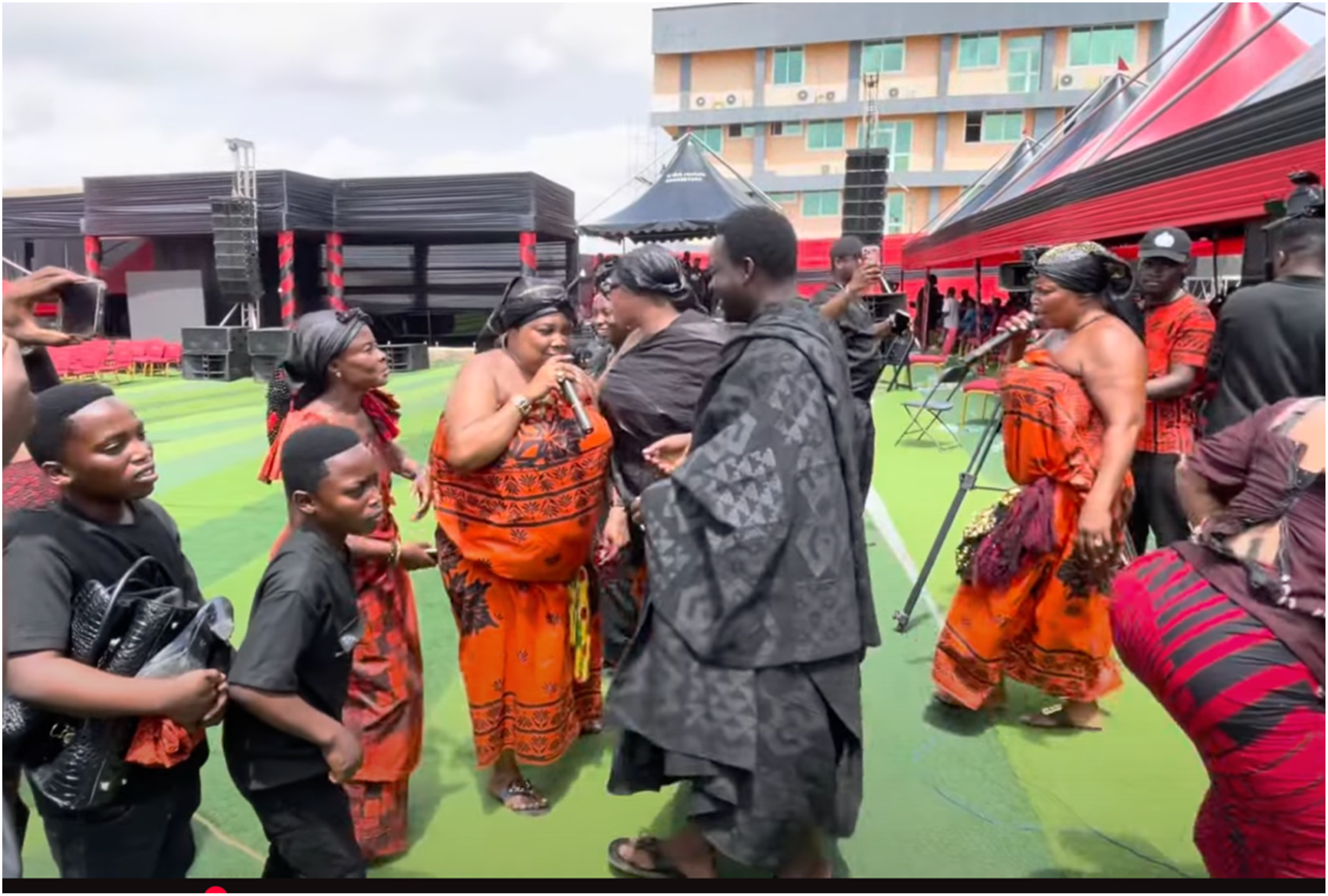
Recounting in another interview how she summons her emotions readily for her performances, Ode notes that: When you hire me to weep and mourn with your family, immediate I see the deceased laid in state, I become overwhelmed with emotions. I become sad, because with all of us on planet earth, that individual has left us/departed from our midst. So, whether I am familiar with the deceased or not, the fact that they are lifeless before me, and no longer part of the living, grief takes hold of me, I become emotional and I weep (Frimpong-Manso, 2022, August 8).
She then goes further to demonstrate with a musical performance: Buie, maame ei. Maame, whom have you left me with? Awo, I am hungry. Maame, by now you’d have cooked plantain for me to eat. Oh maame! Awo ei, Awo ei.
7
We cry like this, but in real life that is not even our mother. We do and say all these things but we are not related to the deceased. (Frimpong-Manso, 2022, August 8)
These performances are often highly ritualistic, with each note and rhythm meticulously selected to evoke specific emotions ranging from sadness to reverence. The entire cortège may at some points burst out into loud, piercing cries and wails, often interspersed with prayers, consolations, or performance of traditional dirges. With each musical number carefully curated to heighten the affective charge of the mourning process through a unique tonal cadence, almost high-pitched sounds of mourning and percussive drumming, the women express emotions that stir up tears in others to console the bereaved. Consequently, through their ability to engage the audience while simultaneously evoking the shared memory and pride of the community, their performances serve not only as a source of funeral entertainment but also as an integral component of the social fabric. Symbolically, their act of lamentation, involving different acts of weeping, crying, wailing, sobbing, and other gestures demonstrate the importance of the deceased in the community. The mechanism of the ensemble’s histrionic performances goes to validate the notion that the louder and elaborate the lamentation, the more respected and revered the deceased (Figure 2). A Member of the Ensemble at the Funeral of Ode’s Elder Brother, Image Courtesy OBTV
A Decade of Diversified Services in Mourning and Social Events
Maame Ode has, over the last decade, diversified her services from funerals to include birthdays, weddings, inauguration services, and other ceremonies of merriment. Following the diversification, she, in October 2022, established a social media presence on Facebook and YouTube to deepen her visibility and reachability, allowing her to easily market her services. With 56 video posts, Ode’s YouTube channel (Maame Ode ApuutorTv) currently has 3.41k subscribers, with a total engagement of 562,940 views.
8
As her following increased Ode’s business expanded, attracting media interviews and affluent families seeking impactful and prestigious funerary services – mostly due to the emotional depth of the ensemble’s exceptional histrionic performances, profound connection to the audience and the grieving process. When quizzed in a televised interview on why she performs mostly for the affluent, she notes: Pardon me to say, they’re the ones with the wherewithal to contract us to compose songs. Just imagine you’re not well-to-do, how can you contract us to compose songs for your mother’s funeral? Even those who want to be popular come to us to make songs that will make them viral sensations. Sorry to say, but how can the penniless who struggle to feed themselves be able to finance my studio time to compose songs for them? (Frimpong-Manso, 2022, August 8)
Considering the ensemble’s dedication to the profession, financial investment, and meticulous structure of operation, I posit that their inclusion of this niche funeral service owes its importance to the economic gains and not necessarily the cultural continuity of the tradition. Unlike dance performances that may take a couple of hours of rehearsing enactment strategies, music composition and audio-visual productions are capital intensive undertakings that require specific skills and competencies which the ensemble does not possess but would have to procure. The decision to include music composition as a product in their “affection as a service” framework, to borrow Figueroa-Torres terminology, stems from a cogent understanding of the immense benefits of music and multimodal media in funeral practices, and their enduring efficacy in evoking emotions in mourners.
Indeed, this argument is evidenced in two separate interviews in which Maame Ode underscores the commercial imperatives of the ensemble’s performances, especially how they charge for their services. With the crying, the charges vary depending on the request of the family/person and the duration of the burial (lying-in-state), whether one day or three days. If the lying-in-state is for 3 days, then expect us to be there for three days. We will weep for three days and after we look for some paracetamol to deal with our aches. We cry and weep like family members, but we are actually not part of them. (Frimpong-Manso, 2022, August 8)
She goes further to ascribe reasons for composing for the affluent, especially praise-singing and name-dropping of influential personalities in their songs. The reason for mentioning these people in my song is also a strategy. I provide for over 40 people, including orphans. The wellbeing of these orphans is the motivation for this singing, dancing and crying work. All these rich people I mention in my songs are some of my benefactors who support me to be able to take care of these people. Even recently the song about Nick Abbeam Danso caused him to come to my aid, to help me look after these orphans. Nick Abbeam Danso supported me with a lot of things/provisions that I used to take care of the orphans. He doesn’t even give me the things; he brings a carload of things for me to pick whatever I want. People like Chairman Wontumi, K. K. Sarpong, K. Badu, and Ofori Sarpong are all my benefactors. Oh yes, I am not the only person these people are supporting. They extend their generosity to all other performers and people in general.
9
(Bonsu, 2024, December 24)
Following from these assertions, it is evident that these grief-related services and products have not only transformed the act of mourning into an art form but also as a means of sustenance. Here, mourning no longer functions as a symbolic act but a capitalist venture that transcends mere ceremonial ritual; it becomes a livelihood, a crucial source of support for the team and the socially marginalised who rely on the benevolence of Maame Ode.
The argument for the team’s commoditisation of grief is further revealed when Ode affirms that: Oh yeah. It is lucrative. My late husband even realised I was making substantial money and was even proud of how I was able to manage myself, the way I dress fashionably. He was surprised that I was able to save enough money to take care of my nieces, nephews and relatives. Through this work, I have managed to rebuild and extend our family house in my hometown to three more rooms to accommodate us whenever we visit. (M. O. Boafo, personal communication, March 16, 2024)
These assertions are corroborated in another social media interview in which Ode underscores the lucrativeness of the profession: “You know where we live, each flat is 2 bedrooms, and I have 18 flats, so do the math. Most of these people [referring to the orphans and members of her team] live there rent-free” (Bonsu, 2024, December 24). With the revenue generated through this service, Ode has not only secured a decent living for herself but has also provided financial support for others under her care, fostering a sense of familial belonging and nurturing in ways that enable them to grow up with opportunities that she never had.
Despite the evidence of financial gains made from commercialising these affective services as products, especially from performing and composing songs for the affluent, Ode debunks accusations of profiting from the misfortunes of others. Instead, she describes her role as ‘singing the soul to rest’, which entails assuming the emotional burden of the decedent’s life, weaving it into a performance that evokes profound emotions in the audience by prompting tears, reflection, and remembrance.
Reflections and Concluding Thoughts
Circling back to earlier sections, particularly the interviews and their underlying arguments and attestations, as evidenced through the exploration of the phenomenon of professional keeners, three unassailable facts can be gleaned.
In the first place, the virtuosity of Ode’s ensemble and their energetic performances of nwomkro preserve the rituals, songs and customs of the Asante metaphysical outlook, traditions that are germane to the inter-generational transfer of cultural knowledge. These performers assume a pivotal role within the communal experience of life’s festivities and death’s rituals. In a culture where the boundaries between the living and the departed are often fluid, the ability to seamlessly navigate the domains of celebration and mourning becomes a highly esteemed skill. Thus, whether celebratory or mournful, the troupe’s performances serve as an embodiment of and testament to the interface between the past and the present, a connection between the living and the dead. Here, like dirges that “honour the deceased, and mourn him”, these nwomkro performances become “the last time when the deceased could be told of his ancestors, so that he can find his way to them” (Kaminski, 2014, p. 363). The duality of their performances, hence, symbolises the profound cultural and social values, myths, and historical narratives deeply ingrained in Asante culture that ensures cultural continuity.
Secondly, music functions cathartically within the context of these performances by creating an atmosphere of sacredness that supports the expression of grief. With “an identifiable music leader present to invoke and manage the mourners’ grief response” (Garrido & Davidson, 2019, p. 242), music assumes a cathartic quality that provokes the emotions of the mourners while providing momentary respite for the bereaved. The musical performances facilitate the emotional and spiritual well-being of the community by provoking tears and regulating the outpour of grief in a structured manner. The inclusion of musical composition and performances as a product in their services, especially the composition of songs for the affluent, underscores the ensemble’s understanding of the transformative power of music in managing grief. Investigating the music choices of students and academics in Western Australia’s University of Perth, Garrido and Davidson (2016) emphasise ‘tradition’ as “important to individuals in making choices for funeral music as opposed to music that is personally meaningful in that it relates to personal memories, values or beliefs” (p. 12). This way, the ensemble’s capacity to blend nwomkro and keening transcends mere artistry to encompass spiritual and cultural guide that leads individuals through the expression of cultural values and beliefs surrounding death and mourning, while processing their loss and grief. That is, through their repertoire of musical performances and histrionics, these itinerant professional keeners bring people to tears to experience one of life’s sombre moments.
Thirdly, that Ode and her team of moirologists are still in business, and other such funerary intermediaries continue to spring up, is indicative of the marketability of grief and mourning enactments as products. It reflects how capitalism transforms even deeply personal and emotional experiences into opportunities for profit, as witnessed in the broader affection as a service industry, where affect/emotion is packaged, priced and sold to customers as products and services, even within the digital and virtual realms. Likewise, judging by Ode’s pronouncements on the lucrativeness of the profession, particularly her ability to amass tangible and intangible assets, it is safe to argue that her motivation is not solely altruistic or ritualistic but also economic. Like her contemporaries (Barago, Pokua, Kofi Amakye) in the professional mourning and nwomkro performance economy, Ode and her team commercialised this service at least partly because it provides a source of income, which highlights the contemporary commercialisation and professionalization of mourning practices. In the same spirit, the persistent demand for the services of Ode and her team of moirologists suggests that there is a real emotional or social need for such services within the society. Capitalism, in this realm, responds by supplying specialised labour (like moirologists) to meet the demand, illustrating the interplay of socio-cultural exigencies and market forces in sustaining certain rituals and shaping them into professions. Thus, whiles some might find comfort in the histrionic performances of these contract mourners, I contend that by creating a need for an affective expression so personal and private, they have not only commoditised a sacred emotional experience but also robbed the bereaved off its expression in ways that further exacerbate their sorrow. By using moirologists to express emotions that the bereaved would typically have expressed, the bereaved are not only becoming emotionally dependent on these professional mourners but they also stand to experience delayed grief expression, which could lead to secondary trauma and mental health challenges.
In summation, while the commodification of grief can foster economic innovation, it simultaneously raises ethical questions pertaining to the dehumanisation of individuals, inauthenticity of emotions, and the potential erosion of cultural values. The debasement of emotions to a commodity, available on purchase by the highest bidder, could deprive societies of authentic emotional expressions of grief and exacerbate existing negative perceptions of over-prioritisation of the dead, as epitomised by the Akan proverb, abusua do funu, which denotes families’ love for corpse. Although this proverb demonstrates the linkage between the dead and the living, and the responsibility of the living towards the dead in providing a befitting ‘homegoing’, the capitalist transformations of a custom so sacred and revered could potentially, over time, depreciate its cultural essence and render it ineffectual. Most especially, if we perceive personal expression of grief as learning, a catalyst to developing emotional resilience, as conceptualised by Cristina Vionea, then we no longer can consider grieving and mourning as “an insurmountable burden” that requires the performativity of nwonkro performers and hired mourners, but instead as “a form of learning that equips us [the bereaved] to confront the void left behind by our loved ones” (Voinea, 2024, pp. 47, 49). Thus, given the mechanics of grieving by these keeners, the bereaved could confront their loss by adopting suitable strategies to express their grief instead of relying on moirologists whose primary interest in the funeral economy is capitalist oriented.
Footnotes

Funding
The authors received no financial support for the research, authorship, and/or publication of this article.
Declaration of conflicting interests
The author declared no potential conflicts of interest with respect to the research, authorship, and/or publication of this article.
Data Availability Statement
The data analysed in this manuscript, apart from the two cited personal conversations, is publicly available on YouTube as Open Access.