




Abstract
This study examines the linguistic and thematic properties of lyrics of German pop songs (N = 122) that are recommended and, therefore, likely used at funerals, on the websites of funeral homes and related services. Compared to popular (control) songs by the same artists not recommended for this purpose (N = 122), funeral-song lyrics contain relatively more second-person pronouns, more future-focused words, and more words relating to death. Funeral and control songs contain equal amounts of positive emotion words but show differences in the number of negative emotion words, specifically those that express sadness and anger. Except for differences in death-related and negative affect words, the findings are comparable to those of analyses on Dutch and English funeral songs. Thematically, funeral songs primarily focus on social connections, such as romantic relationships and the concept of continuing bonds, as well as themes related to death, sadness, and religion.
Introduction
Music is a powerful emotional stimulus and plays a key role in many funeral rituals worldwide. In addition to providing pleasure and entertainment, listening to music serves various psychological functions that help express identity, regulate emotions, benefit emotional well-being, and promote social bonding (e.g., Schäfer et al., 2013). The music used during funerals serves several of these purposes (Adamson & Holloway, 2012; Bruin-Mollenhorst, 2020; Garrido & Garrido, 2016). Considering this specific music is particularly relevant because of its potentially substantial role before, during, and after the funeral ceremony (e.g., Adamson & Holloway, 2012; Bruin-Mollenhorst, 2020; Caswell, 2012; DiMaio & Economos, 2017; Merrill et al., 2022; Viper et al., 2022). Music, in general, is a source of consolation when dealing with personal loss (Hanser et al., 2016). Active participation in the selection process of funeral songs, for example, by discussing choices before the end of life or ensuring that the deceased’s wishes are met, can be experienced as supportive and foster feelings of connectedness and consolation (Viper et al., 2022). Listening to this and other personally relevant music can help the bereaved connect with and express their feelings, reminisce, and find meaning during the grieving process (Adamson & Holloway, 2012; Dimaio & Economos, 2017). These personal associations and memories may aid the bereaved in forming and maintaining continuing bonds with the departed (e.g., DiMaio & Economos, 2017; Merrill et al., 2022; O'Callaghan et al., 2013; Viper et al., 2022), i.e., the ongoing emotional connection the bereaved experience with the deceased person (e.g., Klass & Steffen, 2017; Stroebe & Schut, 2005). Moreover, the bereaved may have spiritual experiences when listening to both religious and popular music during the ceremony (see Adamson & Holloway, 2012). Music can also have a role in novel, more public, rituals surrounding death by sharing songs and playlists on webpages or social media dedicated to the memory of a deceased person (Dilmaç, 2018). A website like YouTube can serve as such a place (see Gibson & Talaie, 2018), as bereaved individuals reminisce and share their stories of loss and grief in the response section. Lastly, music therapy can be helpful during palliative care (e.g., O’Callaghan, 1996) and mourning (e.g., DiMaio & Economos, 2017; McFerran et al., 2010; O'Callaghan et al., 2013, see also Viper et al., 2022).
Current (western) funerals are increasingly secular, tend to focus on the individual wishes of the deceased and/or bereaved, and can often be considered a celebration of the departed’s life (e.g., Adamson & Holloway, 2012; Bruin-Mollenhorst & Hoondert, 2018; Emke, 2002; Venbrux et al., 2009; Walter, 2012). The music played, including the number of songs and when they are heard during the ceremony (Bruin-Mollenhorst, 2020), is given much consideration as a means of personalization. Song selections have changed from selections mostly dictated by religious traditions to choices influenced by associations with the deceased (see Bruin-Mollenhorst, 2020; Bruin-Mollenhorst & Hoondert, 2018; Garrido & Davidson, 2016a; Parsons, 2012). Music selections can be considered a musical eulogy when representing elements of the deceased’s life (Bruin-Mollenhorst, 2020). Personalization leads to a diverse choice of songs that are in some way related to the deceased (e.g., Adamson & Holloway, 2012; Bruin-Mollenhorst, 2019, 2020; Bruin-Mollenhorst & Hoondert, 2018; Caswell, 2012; Garrido & Davidson, 2016a, 2016b; Viper et al., 2022). These are mostly pop songs, but more traditional types of music, such as religious and classical works, remain common. The distinction between worldly and religious music, however, is not dichotomous, as religious references, such as ‘heaven’ or ‘angel,’ are also present in the former (Adamson & Holloway, 2012; also see Bruin-Mollenhorst, 2019, for a discussion). Moreover, multiple songs are often played during funerals, covering several genres (Adamson & Holloway, 2012; Bruin-Mollenhorst, 2019; Caswell, 2012). A recent German survey reveals that it is common for one or more pieces of secular music, such as pop/rock, Schlager/Volksmusik, to be played during religious services (Lind & Louven, 2022). Funeral workers may not always agree with the choices made by the deceased or the bereaved, especially when requests seem at odds with religious traditions (e.g., Emke, 2002; Lind & Louven, 2022; Parsons, 2012). Given the importance of selecting ‘the right music’ for the ceremony and music’s role in grief (Adamson & Holloway, 2012; Viper et al., 2022), having a deeper understanding of popular song selections could help lower resistance to these choices.
Examples of Recurring Popular Songs Used at Funerals
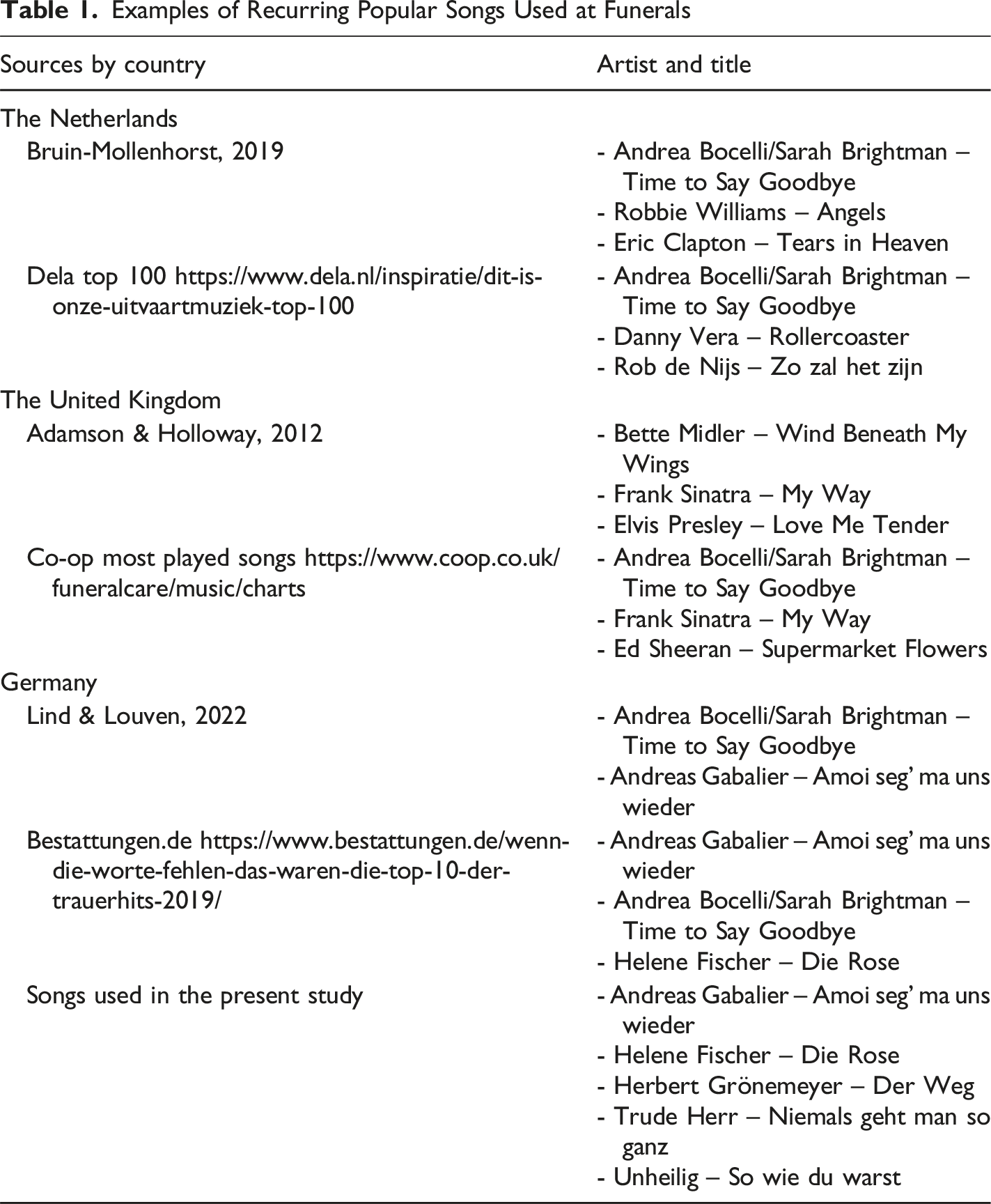
Recurring titles may partly result from recommendations made by funeral professionals based on music’s familiarity, popularity, and properties. The attributes of music, especially those of songs, are closely tied to its role in society (Mehr et al., 2018). It is thus likely that funeral music can be distinguished from music not commonly used for this purpose based on its characteristics. This hypothesis is supported by recent investigations into contemporary funeral music in several European countries (Hanser et al., 2023, 2024; Mollenhorst et al., 2016). In the present study, we investigate the lyrics of German-sung popular music that is recommended and, therefore, likely used at funerals. Our goal is to examine whether previous findings on Dutch-and-English-sung funeral music also apply to German songs or whether the latter have unique aspects. Additionally, we contribute to the present literature by investigating the lyrical themes in these songs.
Music Characteristics
Recent investigations into funeral music have revealed that it is characterized by lower valence, energy, tempo, and danceability, as well as higher acousticness compared to popular chart music in general (Hanser et al., 2023, 2024; Mollenhorst et al., 2016). This difference applies when song selections are limited to popular music (Hanser et al., 2024) and funeral music in general from Croatia, the Netherlands, and the United Kingdom (Hanser et al., 2023). Additionally, funeral music is mainly in a major mode, possibly even more so than popular chart music (Hanser et al., 2023, 2024; Mollenhorst et al., 2016). This is contrary to traditional English funeral hymns that are mostly in a minor mode (Gammon, 1988). Interestingly, differences between countries are small or absent despite considerable song variation (Hanser et al., 2023). These findings suggest that contemporary funeral music is often perceived as sad yet also calm, serene, and tender, a characteristic that applies to funeral music in several European countries.
The sadness experienced in response to music can result from musical characteristics, lyrics, personal relevance, and listening context, which may lead to several different states of music-induced sadness (Herdson et al., 2023, p. 107). In a sad mood, listeners tend to prefer music that matches their emotional state and perceive more sadness in emotionally ambiguous music (Hunter et al., 2011). This preference for sad mood-congruent music is particularly salient after experiencing an interpersonal loss (DeMarco et al., 2015; Lee et al., 2013). Listening to sad music may benefit the listener, as it may help people feel understood and acknowledged in their grief and may also help them to experience consolation (e.g., Eerola et al., 2018; Hanser et al., 2016; Lee et al., 2013; Taruffi & Koelsch, 2014; Van den Tol, 2016). Over the years, popular music has become more diverse in style and emotional qualities (Schellenberg & Von Scheve, 2012). Specifically, popular chart music has become slower and more often in a minor mode. This decrease in tempo is most substantial for major-mode songs, which suggests mixed-emotional cues resulting in more emotional ambiguity and complexity (Schellenberg & Von Scheve, 2012; also see Hunter et al., 2008 on mixed emotions). Slow music in a minor mode is commonly perceived as sounding sad and gloomy, whereas music in a major mode is associated with happiness (Carraturo et al., 2025; Hunter et al., 2008; Juslin & Laukka, 2004; Schellenberg & Von Scheve, 2012). However, the relation between mode and affect is more nuanced, especially when other musical features, person variables, and experiences are considered (see Carraturo et al., 2025 for a review). Specifically, songs in a major mode and a slow tempo are often considered tender (Juslin & Laukka, 2004) and serene (Trochidis & Bigand, 2013).
Lyrics, Linguistic Properties, and Themes
The previously reported high acoustic character of commonly used funeral music allows for a focus on the song texts (Hanser et al., 2023, 2024). Lyrics are especially relevant for sad-sounding music as they can enhance the mood of the music, more so than for happy-sounding music (Ali & Peynircioğlu, 2006; Brattico et al., 2011). Moreover, work by Fiveash and Luck (2016) suggests that the processing of lyrics is more in-depth and systematic when music is negatively valenced and more superficial when it is positively valenced. Pond and Leavens (2024) found that lyrics alone and the combination of music and lyrics of a sad-sounding song lowered mood the most, more so than just the melody. Listeners partially attributed this effect to the semantic content of the lyrics rather than to how the lyrics are sung. Lastly, like music characteristics (e.g., Schellenberg & Von Scheve, 2012), the pop-song lyrics of some genres have also become more emotionally negative over time, often addressing personal concerns (Parada-Cabaleiro et al., 2024). Despite discussion on the extent of separate effects of music and lyrics, it is clear that lyrics can contribute significantly to the emotional experience, meaning, and personal relevance of songs (Ali & Peynircioğlu, 2006; Brattico et al., 2011; Garrido, 2017; Levy et al., 2024; Parada-Cabaleiro et al., 2024; Pond & Leavens, 2024). The value that listeners attribute to lyrics for the enjoyment of sad-sounding music (e.g., Eerola et al., 2018; Van den Tol, 2016) and the experience of consolation when listening to music (Hanser et al., 2016; Viper et al., 2022) illustrates this point.
Linguistic Inquiry and Word Count software is commonly used to analyze texts, including song lyrics (LIWC; Pennebaker et al., 2015). LIWC counts and classifies words into psychologically meaningful categories using an internal, validated dictionary (Tausczik & Pennebaker, 2010). Investigations of the lyrics of self-identified sad music by Garrido (2017, pp. 24–25) revealed that, compared to happy songs, they contain fewer words that express positive emotions and fewer words in the present tense. Furthermore, sad songs had significantly more words expressing negative emotions, specifically anger and sadness. Sentiment and linguistic analysis of Dutch and English funeral song lyrics conducted using LIWC (Hanser et al., 2024), revealed that compared to control pop songs, the former contained more words expressing sadness. However, differences in positive words, present tense, and those expressing anger were absent. Overall, the funeral songs in this study had more words expressing positive emotions than negative ones. Perhaps more importantly, English and Dutch funeral-music lyrics contained a higher percentage of second-person pronouns (although this was not significant for Dutch, which had a high percentage of second-person pronouns, i.e., over 6%) and were more focused on the future than the control songs. Second-person pronouns may help listeners think of someone dear to them, especially when these words are the grammatical object in a sentence, e.g., “I will always love you” (Packard & Berger, 2020).
Regarding funeral music, Hanser and colleagues (2024) suggest that these pronouns may help convey a relationship between the bereaved and the deceased that serves as a farewell. Together with the future focus in these lyrics, they may express a form of continuing bonds (see the example above). However, this idea is based on only one study, and it is unclear whether these findings apply to other languages. Additionally, while analyses of word frequencies, sentiment, and linguistic components can provide valuable insights, this method may also result in the loss of lyrical content and meaning (Jackson et al., 2022). Thematic analysis may provide additional information on the lyrical content. For example, words related to death and religion may not be frequent in (funeral) pop songs (Hanser et al., 2024), but these few words may define a song’s meaning. It has frequently been used to investigate popular music lyrics to uncover their topics (see Christenson et al., 2019; Ruth, 2019). Themes may provide insight into what is on listeners’ minds and can reveal cultural focus or changes over time (Christenson et al., 2019; DeWall et al., 2011; Qiu et al., 2021).
Investigations reveal that popular songs are primarily focused on romantic relationships, although the percentages may vary depending on the specificity of these relationships (Christenson et al., 2019; Ruth, 2019). Regarding funeral songs, Hanser and colleagues (2024) report ‘love’ as the most frequently used word, even more so than in pop songs in general; however, the type of relationship these words express was not further investigated. Romantic involvement is likely the most common category in funeral songs, as well, but other relationships, such as family and friendship, may also be frequent. Adamson and Holloway (2012) identified themes of love, enduring relationships, loss, and support in the lyrics of secular songs used at funerals in the United Kingdom. Themes of continuing bonds have been identified in lyrics written by patients in palliative care (O’Callaghan, 1996), death is a topic in popular music (Christenson et al., 2019; Ruth, 2019), and bereaved individuals use music to (re)connect with the deceased (e.g., DiMaio & Economos, 2017; Merrill et al., 2022; O’Callaghan et al., 2013). However, to the best of our knowledge, the prevalence of themes of continuing bonds in contemporary funeral songs has remained unexplored.
Present Study
In the present study, we investigate lyrical characteristics of German-sung pop songs used or recommended for funerals. We aim (1) to replicate findings on funeral music lyrics in Dutch and English and (2) to explore the themes in funeral songs. Germany was selected because (1) there are parallels in Dutch and German popular chart music (Achterberg et al., 2011); (2) the existence of German’ most-played funeral music’-lists; (3) the availability of a German LIWC-dictionary (see below); (4) the reported similarities in values for words expressing anxiety, sadness, and anger for German-and-English-sung chart music (Qiu et al., 2021); and lastly (5) the proximity of Germany to the Netherlands. If similar patterns in linguistic components between German-sung and Dutch-and-English-sung songs emerge, this may point towards some universality in (Western-European) funeral music. This may reflect similar developments in farewell rituals and overlap in attitudes toward death and grieving (see Garrido & Davidson, 2016a), while differences may reveal country-specific aspects of these subjects.
First, we examine the linguistic properties of the lyrics within the same categories as those of Hanser and colleagues (2024). Specifically, we investigate word count, the frequency of first (singular, plural) and second-person pronouns; emotional properties (positive, negative, and discrete categories of anxiety, anger, and sadness); category words relating to family, friends, religion, and death; and time orientation (past, present, future). Given the previous findings on Dutch and English lyrics, we expect German funeral-music lyrics to contain fewer words overall, to use more second-person pronouns, to contain more words expressing sadness, and to have a greater focus on the future than control songs. No specific hypotheses for the other variables are formulated, as no differences were reported for other languages before.
Second, we analyze the themes present in funeral songs. We expect topics related to death and relationships, such as romance, family, friends, and continuing bonds, to be most important and more frequent in funeral than in control songs.
Method
Materials
Music Selection and Lyrics
Examples of the Theme ‘continuing bonds’ From the Selection of Funeral Songs
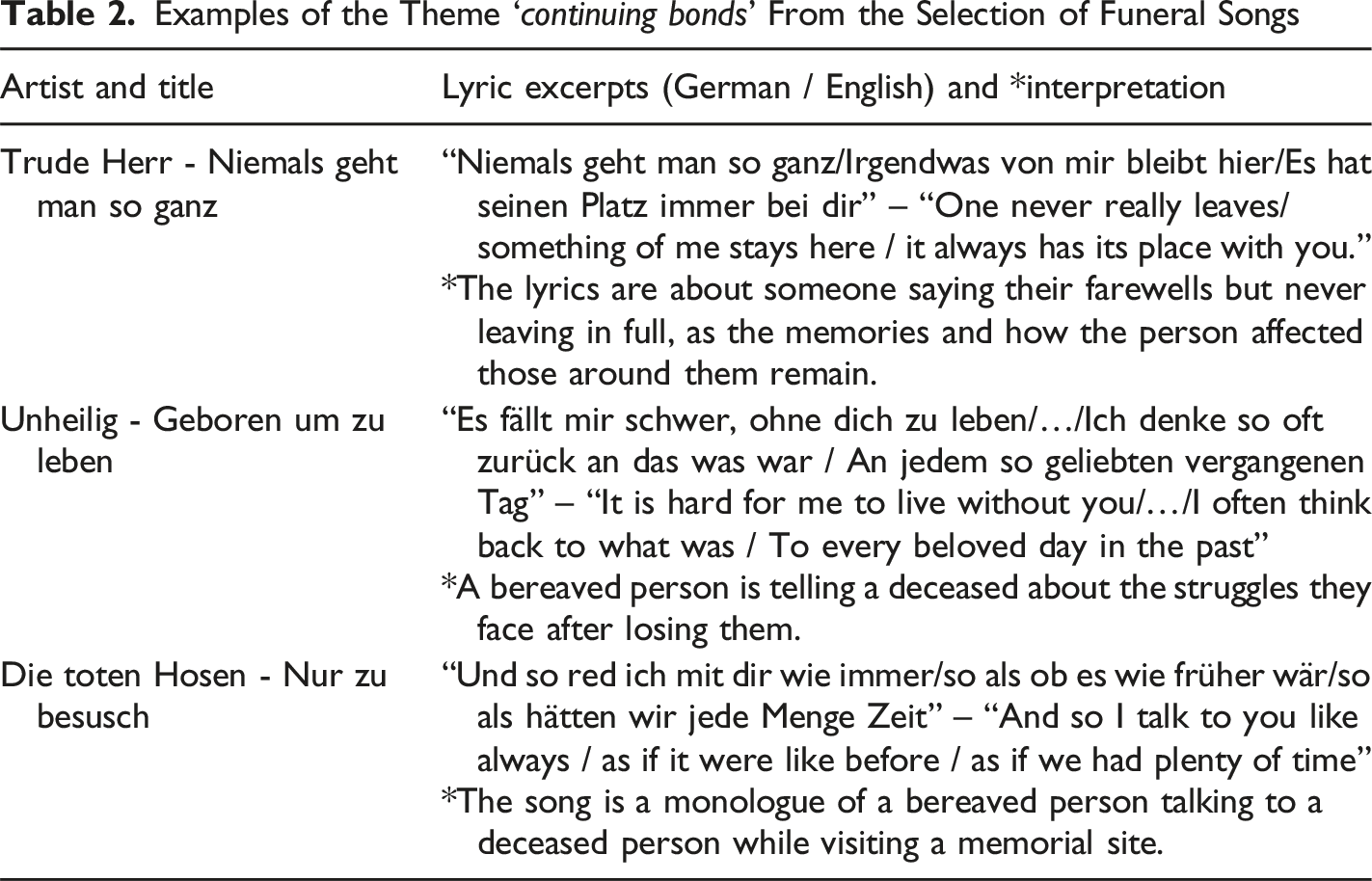
Song lyrics were retrieved from the artist website or Genius.com. Available translations in Standardhochdeutsch (standard German) were used if songs were in dialect. The second author (TL) translated the lyrics if translations were unavailable. Websites were consulted and data were retrieved between February and December 2023. All song lyrics were listened to for correctness and manually spell-checked by the first two authors before analysis using LIWC2015 (Pennebaker et al., 2015). LIWC counts words based on dictionary classifications and returns these values as percentages of the total word count (Pennebaker et al., 2015). The validated German dictionary (Meier et al., 2018) was used for analyses. The investigated categories were: word count, pronouns (first-person singular/plural, second-person), time orientation (past, present, future), emotional valence (positive, negative), discrete emotional categories (anger, anxiety, sadness; these are subcategories of the negative valence words), and specific topics (friends, family, death, religion). The total number of words were funeral = 30,992 and control = 36,103.
Statistical and Thematic Analysis
Data was analyzed with JASP Version 0.19.2 (JASP Team, 2024). Due to violations of normality, non-parametric Mann-Whitney U tests were used to compare funeral and control songs across all variables. The rank-biserial correlation is the reported effect size (small: .1, medium: .3, large: .5; Cohen, 1992; Goss-Sampson, 2024; Tomczak & Tomczak, 2014). Findings were considered significant at p
The first two authors conducted the thematic analysis. Themes consisted of 19 content categories previously used to characterize chart music (Christenson et al., 2019): relationship/love, sex/sexual desire, music/musicians, dance/dancing, good times/partying, alcohol/drugs, wealth/status, social/political issues, race/ethnicity, religion/God, the occult, personal identity, alienation/unhappiness/depression, suicide, family, friends/friendship, interpersonal hatred/hostility, violence, and death. We created an additional twentieth category for the present study: continuing bonds. Based on previous work addressing continuing bonds in music (e.g., Merrill et al., 2022; O’Callaghan, 1996; O’Callaghan et al., 2013), we defined this category as follows: references to an ongoing relationship with someone who has died or is otherwise unreachable, for example by directly addressing the deceased, recalling memories, or leaving something of oneself behind. Examples of this category are provided in Table 2. Songs could contain multiple themes. Coders did not consider extra-musical information on artists or songs. They made initial ratings for all songs based on category descriptions and subsequently discussed potential differences in interpretation for a subset of twenty songs. Both authors then reevaluated their ratings and made changes if they deemed these necessary. The intercoder agreement was calculated afterward. Kappas were high and ranged from .86 to 1.00.
Results
Lyrics Characteristics
Overview of Mean Lyrical Properties as Identified by LIWC
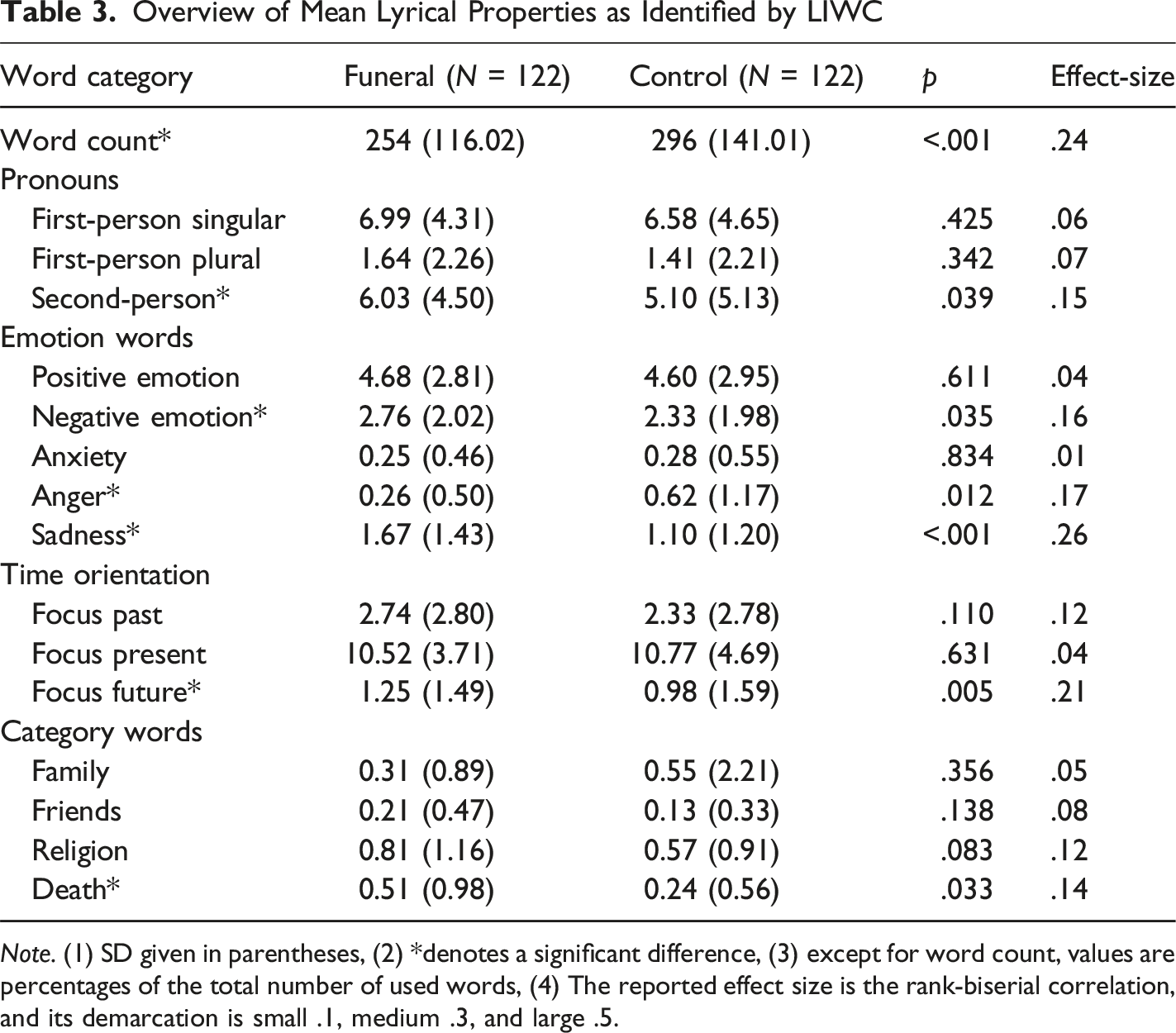
Note. (1) SD given in parentheses, (2) *denotes a significant difference, (3) except for word count, values are percentages of the total number of used words, (4) The reported effect size is the rank-biserial correlation, and its demarcation is small .1, medium .3, and large .5.
Regarding time orientation, most words relate to the present for both song categories. Words concerning the past and future are less common, but funeral songs are more future-focused than controls. Lastly, no differences are present for category words relating to family and friends. Death-related words are significantly more common in funeral music. The effect sizes are small to medium. In addition to the significant differences, non-significant trends are visible for more frequent use of first-person plural pronouns, words focusing on the past, and religious words in funeral songs.
Thematic Analysis
Percentage of Songs Belonging to 20 Content Categories for Funeral and Control Songs
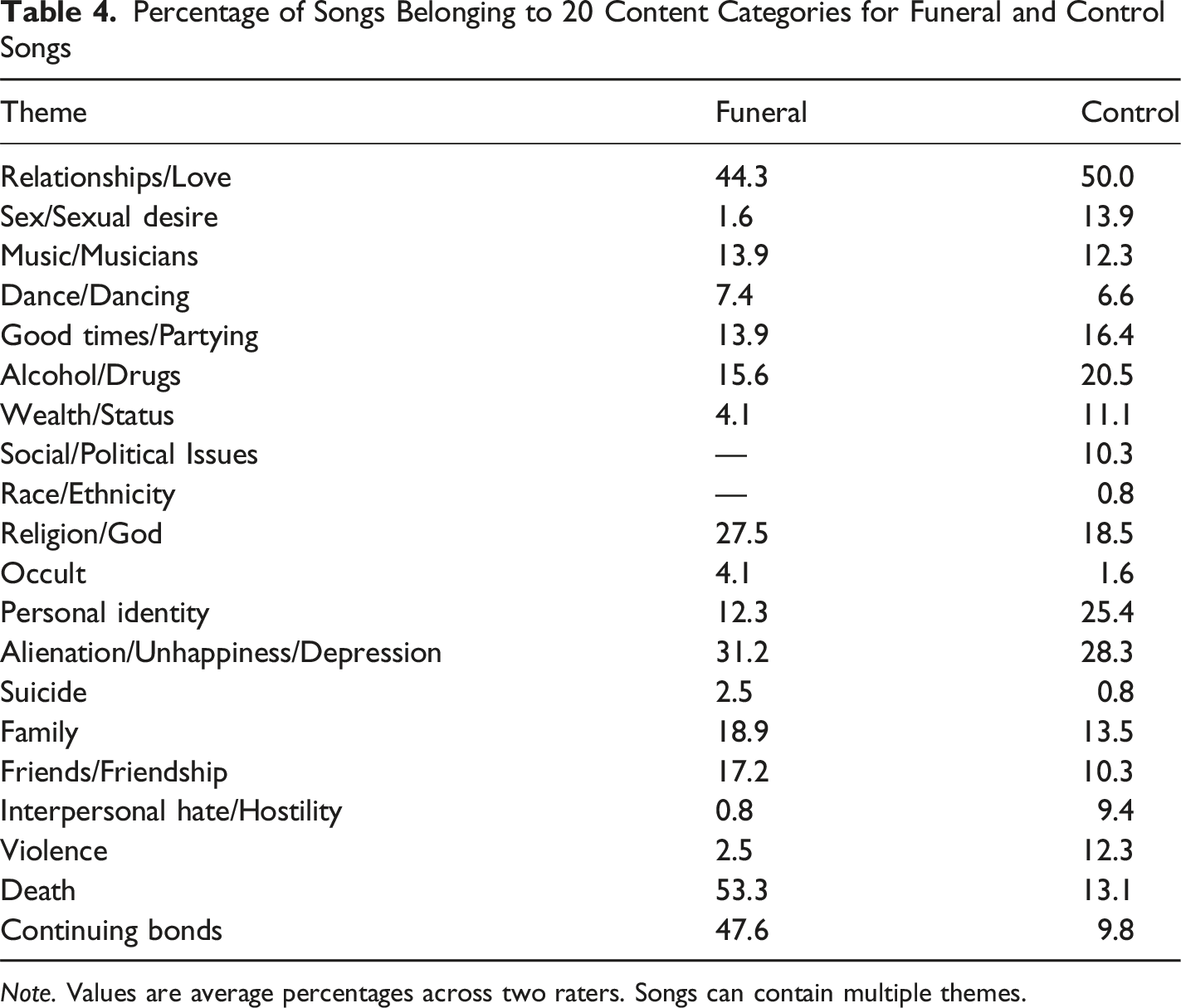
Note. Values are average percentages across two raters. Songs can contain multiple themes.
There are further notable differences between funeral and control songs for themes of sex/sexual desire, wealth/status, conflict categories, social/political issues, religion/God, the occult, personal identity, suicide, family, friends, death, and continuing bonds. Apart from romantic relationships, themes relating to social bonds are less common in control songs. In contrast, references to sex and themes related to hedonic enjoyment, political engagement, and conflict are more frequent in control songs.
Discussion
We investigated linguistic and thematic characteristics of German-sung pop songs used or recommended for funeral music in Germany. Our goals were to evaluate whether findings on Dutch and English funeral song lyrics also apply to song texts in German and to explore the themes present in funeral songs. In the current study, like English-sung texts (Hanser et al., 2024), German funeral-song lyrics contained fewer words overall. An explanation could be the previously demonstrated lower tempo of funeral songs (Hanser et al., 2023; Mollenhorst et al., 2016). Although we did not test for differences, the durations of playlists consisting of funeral songs (∼8 h) and control songs (∼7 h and 40 min) in this study differ in length. Alternatively, a hypothesis that deserves further research attention is that people (sub)consciously select music with fewer words to focus on succinct, (emotionally) relevant messages that fit the moment to avoid overstimulation and distraction.
Concerning the emotional tone, the lyrics of both song categories contained almost twice as many positive words as negative ones, and there was no difference between the groups. Additionally, contrary to previous findings, funeral music contained significantly more negative words than control music. The latter is mainly accounted for by the more frequent use of words expressing sadness, while control songs had significantly more words expressing anger. Also, contrary to expectations, category words related to death and religion (n.s.) were also more frequent in funeral songs. Concerning words related to the time orientation of the lyrics, regardless of song type, there were, on average, more present tense words than words in other tenses, and there was no difference between song categories. Moreover, there is a non-significant trend for more words focusing on the past in the funeral category, suggesting a greater emphasis on reminiscing. Lastly, words related to a future focus are, on average, the least of the time-orientation words. As hypothesized, funeral songs contained more words with a future focus than control songs.
Although some song elements, such as the increased use of negative words, specifically those expressing sadness, suggest that funeral music mainly consists of sad songs, the high frequency of positive words and the time orientations are contrary to previous findings on the lyrics of sad music (Garrido, 2017). In addition to expressing sadness and grief, the lyrics of funeral music demonstrate emotional complexity by incorporating both positive and negative emotional words. The findings partially corroborate those of Hanser and colleagues (2024). These authors also report more frequent use of positive words than negative words, increased use of words expressing sadness, and a focus on the future in funeral music compared to popular control songs. However, they reported no differences in the frequency of negative emotion words. Future studies may wish to consider whether this means that compared to English and Dutch, German funeral songs are more emotionally negative. Specific attention should be given to the ratio of positive and negative words, particularly words expressing sadness.
Like investigations on Dutch and English lyrics (Hanser et al., 2024), the LIWC analyses further revealed significantly more use of second-person pronouns in funeral than in control songs. Recent investigations into the use of second-person pronouns in song texts have shown that increased use is related to greater liking and commercial success (Packard & Berger, 2020), specifically when they are the grammatical object in a sentence. These words may help listeners think of someone important to them, and songs that remind people of significant others are more liked. This is especially pertinent to contemporary funeral music, as it can serve as a musical eulogy, where the relevance to the deceased is crucial (Bruin-Mollenhorst, 2020). As second-person pronoun use has been linked to popularity (Packard & Berger, 2020), it is likely that the song is well-known and may, for example, have been played during the departed’s personally relevant life events, such as on a first date or at their wedding. The frequent use of ‘you’ may thus contribute both to its popularity and widespread familiarity, as well as to its use at funerals. However, as funeral songs are compared to the most popular songs by the same artist, and second-person pronouns are more frequent in the former, the assumed focus on significant others may be more important. As previously suggested (Hanser et al., 2024), the combination of second-person pronouns and future-focused words may serve as the last words from the bereaved to the deceased, or vice versa, if selected by the departed, and may express a lasting relationship. It is likely that these sentences are found in the title or are part of the chorus and may thus receive a lot of attention from listeners, for example, through repetition (Bruin-Mollenhorst, 2020). Lastly, first-person plural pronouns also signify social bonds, but as in other studies (DeWall et al., 2011; Hanser et al., 2024; Packard & Berger, 2020), the use of these words is not frequent in the present sample of songs and the difference between funeral and control songs is not significant.
The thematic analysis further highlights the importance of social connections as a key topic in funeral-song lyrics. As expected, references to romantic relationships are common, remotely followed by family and friends. This is unsurprising, given that romantic relationships are overall the most common theme in pop music (Christenson et al., 2019; Ruth, 2019) and Adamson and Holloway (2012) also emphasized social connections in their analysis of popular funeral music. More importantly, almost half the funeral songs in some way express continuing bonds, an amount which is only surpassed by themes related to death. Although words related to death and religion, the latter being another relevant topic in funeral songs, are few (Table 3), these are an important, overarching theme. This demonstrates the added value of a thematic analysis (Jackson et al., 2022). Funeral songs further focus less on physical relationships and hedonic enjoyment than controls. Hedonic pleasure in funeral music is sometimes represented as a farewell party or a final toast. Lastly, sensations of alienation and unhappiness are frequent, which may express feelings of loss, although this was not significantly more pronounced than in the controls. Compared to thematic analyses of American chart music (Christenson et al., 2019), funeral songs tend to focus more on death, religion, family, and friends, and less on hedonic enjoyment.
Taken together, the linguistic and thematic attributes of modern funeral music suggest a focus on the deceased’s life, relationships, sadness, death, and religious elements. The present study quantifies and exemplifies the attributes of present-day funeral songs, which can be seen as an expression of individualization and secularization through personal song choices used in funeral rituals that celebrate the departed’s life (see e.g., Emke, 2002). The latter is demonstrated in songs that are personally relevant or otherwise associated with the deceased (Adamson & Holloway, 2012; Bruin-Mollenhorst, 2020; Viper et al., 2022). Because of their focus on death, sadness, and continuing bonds, they may serve as a musical illustration of acknowledging the end of life and the need to move on, much like a sermon: ‘It is time to bid our farewells, but the departed lives on in our hearts and memories.’ Furthermore, as illustrated by some of the examples in Table 2, song texts may portray the new reality of having lost a loved one. Fulton and Owen (1988, p. 383) noted, based on a shock rock example, ‘a morbid fascination with death’ and that death is seldomly represented as part of human existence in pop music. However, the songs considered in the present study suggest the opposite (see Table 2). Popular music comes in many forms, and it has evolved considerably since its inception. In addition to having increased use of mixed-emotional cues (e.g., Schellenberg & Von Scheve, 2012) it also deals more often with topics related to the human condition (e.g., Christenson et al., 2019; Parada-Cabaleiro et al., 2024). Moreover, the opportunity for personalization of music in funeral rites may also inspire artists to write songs for this specific purpose. The presence of lyrical references to religion could suggest a search for spirituality and symbolism, perhaps in a more personalized form than that of confessional traditions (see Adamson & Holloway, 2012; Bruin-Mollenhorst, 2019; Viper et al., 2022 for discussions). Parallels in patterns for the use of pronouns (‘you’), words expressing sadness and future-focused words between German, English, and Dutch (Hanser et al., 2024) suggest that, despite the considerable variation in songs, there is some common ground between how the language of funeral music relates to that of popular music in general. This may also hold true for the themes, though it is a shortcoming in the present work that we did not consider the themes of English-sung funeral songs. Moreover, comparing these themes between multiple languages and different countries may demonstrate whether, for example, levels of secularization are associated with religious references in songs.
Lastly, McDonald and colleagues (2022) found that emotionally negative music can enhance prosocial decision-making and feelings of empathy. Recent research suggests that various kinds of music-evoked sadness exist (e.g., Herdson et al., 2023; specifically, see the discussions on empathic sadness and sorrow). Could songs with a specific function, such as their use as funeral music, be more effective at enhancing prosocial behavior? One may wonder whether an additional, implicit function of the music played during funerals is to evoke feelings of empathy and sympathy, as well as a plea for aid while in mourning (see Huron & Vuoskoski, 2020).
Limitations
Several limitations further mark the current work. First, regarding the thematic analysis, our study, compared to others, analyzed a relatively small number of songs (see Christenson et al., 2019; Ruth, 2019). Moreover, while we investigated the most popular songs by these artists, they may not be representative of the most popular chart music. Instead, we selected songs recommended for use during funeral services, i.e., their specific function rather than their commercial success. Since control songs are by the same artists, the reported frequencies for their topics may not be applicable to popular chart music in general.
Second, since the present study is archival and based on the use or recommendation of pop songs for funerals by various websites, we have no data on how frequently our sample of songs is utilized for this purpose. Lind and Louven (2022) note that compiling a most-played list is challenging due to the wide variety of songs reported in their survey on the types of music played during religious German funeral services. However, the present methodology is like that of previous studies that analyzed the songbook of a Dutch crematorium (Hanser et al., 2023; Mollenhorst et al., 2016), which adds to the validity and representativeness of the applied method. Moreover, when people seek advice on their music choices, they are likely to encounter similar resources.
Considering these limitations, we strongly recommend follow-up studies in which associations between song choice, person characteristics, such as the age, gender, and cause of death of the deceased, the relationship between deceased and departed, and other variables, such as religion/secularization and the experience of music heard at a funeral are taken into account. Investigations that combine these variables with linguistic and thematic analyses may provide valuable insights into changes in funeral music over time and potential regional differences (e.g., Christenson et al., 2019; DeWall et al., 2011; Parada-Cabaleiro et al., 2024; Qiu et al., 2021; Schellenberg & Von Scheve, 2012). In addition, more structured comparisons of funeral music and its lyrics between diverse cultures may provide valuable insights into funeral rituals, and attitudes towards dying, mourning, and the departed. A relevant question is whether the song choice for funerals and its contents is becoming more alike with increased globalization and internet access.
Conclusion
The present study demonstrates that the patterns of lyrical characteristics in German-sung pop music used at funerals are comparable to those in Dutch-and-English-sung popular funeral music. Similar to the Netherlands, these songs often employ words that convey sadness, a mixed emotional tone, and emphasize lasting relationships through their time orientation and pronoun usage. However, German song texts contain more words related to death and more negative words compared to control songs. Future studies may investigate whether this difference has practical significance. Could it be due to, for example, the use of music specifically written for funerals or traditions or conceptions about death and dying in Germany? Analyses of the lyrics and themes of funeral songs emphasize the importance of social connections and the concept of continuing bonds. Findings contribute to the growing understanding of the role of lyrics in funeral music and suggest an overlap in word usage between several languages. This provides opportunities for hypothesis building and direct experimentation, which may contribute to the study and understanding of music’s role in mourning, as well as the broader study of music, empathy, and emotion.
Supplemental Material
Supplemental Material - Linguistic and Thematic Attributes of German Pop Songs Used at Funerals
Supplemental Material for Linguistic and Thematic Attributes of German Pop Songs Used at Funerals by Waldie E. Hanser, Tim Loepthien, Ruth E. Mark, and Ad J. J. M. Vingerhoets in OMEGA - Journal of Death and Dying
Footnotes

Funding
The authors received no financial support for the research, authorship, and/or publication of this article.
Declaration of Conflicting Interests
The authors declared no potential conflicts of interest with respect to the research, authorship, and/or publication of this article.
Supplemental Material
Supplemental material for this article is available online.
Author Biographies
References
Supplementary Material
Please find the following supplemental material available below.
For Open Access articles published under a Creative Commons License, all supplemental material carries the same license as the article it is associated with.
For non-Open Access articles published, all supplemental material carries a non-exclusive license, and permission requests for re-use of supplemental material or any part of supplemental material shall be sent directly to the copyright owner as specified in the copyright notice associated with the article.
