




Abstract
This study explores how self-related speech acts are employed in auto-epitaphs composed by tomb owners from ancient China through a grounded analysis of 18 surviving texts from the Song Dynasty. The findings identify four types of self-related speech acts, namely, self-statement, self-defence, self-praise, and self-denigration. In addition, this study further details the dynamics of auto-epitaphs in ancient China through the Motivation Model of Pragmatics (Chen, 2022). It is argued that self-statement is primarily driven by transactional motivations, aiming to preserve an accurate historical record for posterity. In contrast, self-defence, self-praise, and self-denigration are predominantly driven by interactional motivations, serving to construct a favourable and enduring public image. The findings above not only demonstrate the context sensitivity of auto-epitaphs but also call for a reconsideration of prevailing stereotypes of humility within the literati culture of ancient China.
An epitaph is traditionally defined as a brief inscription typically composed in prose or verse, intended to commemorate the deceased (Guo, 2023) and provide a succinct account of the individual’s life and accomplishments (Trix, 1999; Alshraah et al., 2024). Although epitaph has been explored universally (Crespo-Fernández, 2023; Meng, 2015), more studies are needed to map out the interactional dynamics of epitaph as an image-oriented outlet through death discourse. For example, most of the prior research focused on epitaphs composed by others, but there has been little research on how auto-epitaphs are discursively constructed. In addition, a number of studies have documented the efficacy of epitaphs from different perspectives, such as history (Chaniotis, 2004; Suh, 2023; Yu & Niu, 2025), lexicon (Song & He, 2024), syntax (Qiu, 2024; Wen, 2023), and phonology (Deng & Zhou, 2024), but they still fall short on how an insider perspective influences the language use of epitaph as death discourse. Essentially, auto-epitaph writing may be considered an aspect of anticipatory death practices, as it typically traces the individual’s life trajectory and articulates meaningful events and beliefs from a first-person perspective. In this sense, auto-epitaphs serve as a medium through which individuals project their self-image or identity prior to death, facilitating cross-temporal communication with future generations. Taking all these into account, this study will investigate how auto-epitaphs are composed through self-related speech acts as well as the underlying motivations that drive the construction of the only 18 surviving auto-epitaphs from Song dynasty, a period of significant social, economic, and cultural development, which witnessed the change that the self-awareness of the literati became noticeably stronger, reflecting a more pronounced pursuit of individual values (Tong, 2017) even before or after their death.
This paper is structured as follows. Section 2 reviews relevant literature on epitaphs and self-related speech acts. Section 3 outlines the research design, including the research questions, data collection methods, and analytical procedures. Section 4 presents the types and communicative functions of self-related speech acts identified in auto-epitaphs. Section 5 examines the pragmatic motivations underpinning these speech acts through the framework of the Motivation Model of Pragmatics (Chen, 2022). Finally, Section 6 summarises the key findings and contributions of this study.
Literature Review
Epitaphs: Definitions and Types
As a form of death discourse, epitaphs are commonly used as a universal genre of commemorating the dead across diverse lingua-cultural contexts, encoding culturally distinctive worldviews on death, remembrance and afterlife (Alshraah et al., 2024; Gao, 2019). Previous research has primarily treated epitaphs as historical documents, adopting a largely static perspective to explore their interdisciplinary significance within specific socio-cultural contexts. These studies often approach epitaphs through the lenses of history (Chaniotis, 2004; Laubry, 2009), biography (Guo, 2023), philology (Wilkerson & Brooks, 2017), and literature (Meng, 2015), encompassing various languages such as Chinese (Guo, 2023), English (Wilkerson & Brooks, 2017), Latin (Laubry, 2009), and Greek (Chaniotis, 2004), among others.
Broadly, epitaphs can be classified into two categories: those written by others and the ones composed by the deceased themselves. As for the auto-epitaphs, written from the deceased’s own perspective, they serve as reflective statements on their life journey and personal values (Lv, 1999) before their deaths. In Chinese, auto-epitaphs have attracted scholarly interest within the field of history (Zhao, 2008). During the Song Dynasty, auto-epitaphs emerged as a distinct genre, reflecting an increasing tendency toward personal introspective attitudes toward death (Lv, 1999; Tong, 2017). According to the Chinese historical records, 33 such epitaphs are recorded, 18 of which have survived to the present (Tong, 2017). While auto-epitaphs have garnered attention from scholars in the fields of Chinese history (Zhao, 2008) and philology (Lv, 1999), their pragmatic dimensions still remain under-explored, particularly with regard to their “self-orientedness” through the lens of language use.
Self-related Speech Acts: Background and Status Quo
Austin (1962) argues that language functions not merely as a conduit for transmitting information but as a vehicle for enacting social actions. Furthermore, Searle (1969) systematizes speech acts into five types: assertives, directives, commissives, expressives, and declarations. However, Searle’s classification implicitly adopts an other-oriented perspective, wherein the efficacy of a speech act is primarily contingent upon its impact on the hearer or the external world. While this framework accounts for most communicative behaviours, it overlooks self-related speech acts, such as self-praise, self-denigration, and self-defence, among others. Drawing on previous studies on self-praise (Ren & Guo, 2020) and self-denigration (Kádár et al., 2023), this study further defines speech acts directed at the self as self-related speech acts, such as self-praise, self-defence, self-statement, and self-denigration, in which the speaker explicitly targets themselves as the primary object of language use. In this regard, attention to self-related speech acts contributes to a deeper focus on how speakers negotiate social positioning, manage interpersonal expectations, maintain self-politeness, or shape self-images within specific interactional contexts (Chen, 2001).
Recent advancements in interactive ritual (Kádár, 2024) and the expansion of digital communication (Ren et al., 2022) have increasingly drawn scholarly attention to self-related speech acts. These acts are categorized into three types based on evaluative polarity: positive, neutral, and negative. First, positive self-related acts serve to reinforce a favourable self-identity, with self-praise being a prominent example. For instance, Ren et al. (2022) examine self-praise practices among Chinese Weibo users, revealing that younger individuals often employ multimodal resources, such as emojis and hashtags, to balance self-enhancement with norms of humility. Second, neutral self-related acts, such as self-defence, focus on clarifying facts and maintaining a consistent self-image. For example, Badarneh (2020) analyzes the self-defence strategies of Jordanian politicians facing corruption allegations, demonstrating how they invoke historical achievements, cultural moral orders, and national identity to reframe themselves as “innocent victims”. Third, negative self-related acts, such as self-denigration, strategically deploy self-deprecation to facilitate social coordination. In this regard, Kádár et al. (2023) illustrate how self-denigration mitigates social threats and conveys empathetic vulnerability, fostering smoother, goal-oriented communication in Chinese interactional contexts.
The studies above shed light on self-related speech acts in diverse lingua-cultures from a diverse set of perspectives. However, there are notable limitations in the prior research. First, most studies focus on a single type of speech act, overlooking the co-occurrence of multiple self-related acts with different evaluative polarities within the same context. Second, the research contexts are primarily confined to modern conversations or social media, with limited attention given to historical discourse, such as auto-epitaphs. These texts, wherein individuals summarize their lives prior to death, provide a unique context for the exhibition of self-related speech acts that are both highly intentional and ritualistically structured. In light of these, this paper delves into the use of self-related speech acts in ancient Chinese auto-epitaphs, mapping out how self-related speech acts get manipulated and motivated in a historical Chinese context.
Methodology
Research Questions
(1) What kinds of self-related speech acts are employed in auto-epitaphs of Song dynasty in ancient China? (2) What are the driving motivations underlying these auto-epitaphs of Song dynasty in ancient China?
Data Collection
This study draws on auto-epitaphs from the Song Dynasty (960–1276 CE) as the research data. The Song period is widely recognized as a transformative era in ancient China, marked by cultural prosperity and a relatively open intellectual environment (Luo, 2022). Of particular interest is the growing cultural self-awareness among the literati or Shi-class (Shi, 士), Confucian scholar-officials, who actively engaged in constructing their self-image through the practice of writing their own epitaphs. The Shi-class constitutes a core intellectual stratum in imperial China, grounded in Confucian ideology (Luo & Sun, 2022). As firsthand historical documents, auto-epitaphs offer valuable insights into the motivations of Song scholar-officials in shaping their personal identity, image, and values before their death. According to Tong (2017), only 18 such auto-epitaphs from the Song Dynasty are currently known to exist, providing a rare and invaluable window into the self-image management by these individuals.
The data for this study are collected from several Chinese academic platforms, including the China National Knowledge Infrastructure (CNKI), the National Library of China’s Ancient Text Database, and the Chaoxing Discovery System. Keywords used in the search include “self-written inscription” (自志文), “epitaph” (墓志铭), “auto-epitaph” (自撰墓志铭), and “self-expression” (自我表达). The inclusion criteria for selecting epitaphs are as follows: (1) the epitaph can be reliably traced to the Song Dynasty through credible historical sources; (2) the text is sufficiently intact to support an analysis of self-referential speech acts; (3) the epitaph either explicitly declares self-authorship (e.g., “written by Pu Yuanyou”) or such authorship is verifiable through historical documentation.
As a result, a total of 18 epitaphs meet the criteria above, with a character count of 12, 938 in total, consistent with Tong’s (2017) findings. In terms of ethical considerations, all the 18 epitaphs used in this study are drawn from publicly accessible digital databases or previously published academic sources. Therefore, the use of these data adheres fully to the academic ethical requirements (Windon & Youngblood, 2024). As our analysis focuses exclusively on the speech acts within auto-epitaphs written by the deceased, it does not involve any evaluative judgments regarding the historical figures of these auto-epitaphs.
Data Analysis
Initial Coding Scheme for Self-related Themes in Auto-epitaphs.
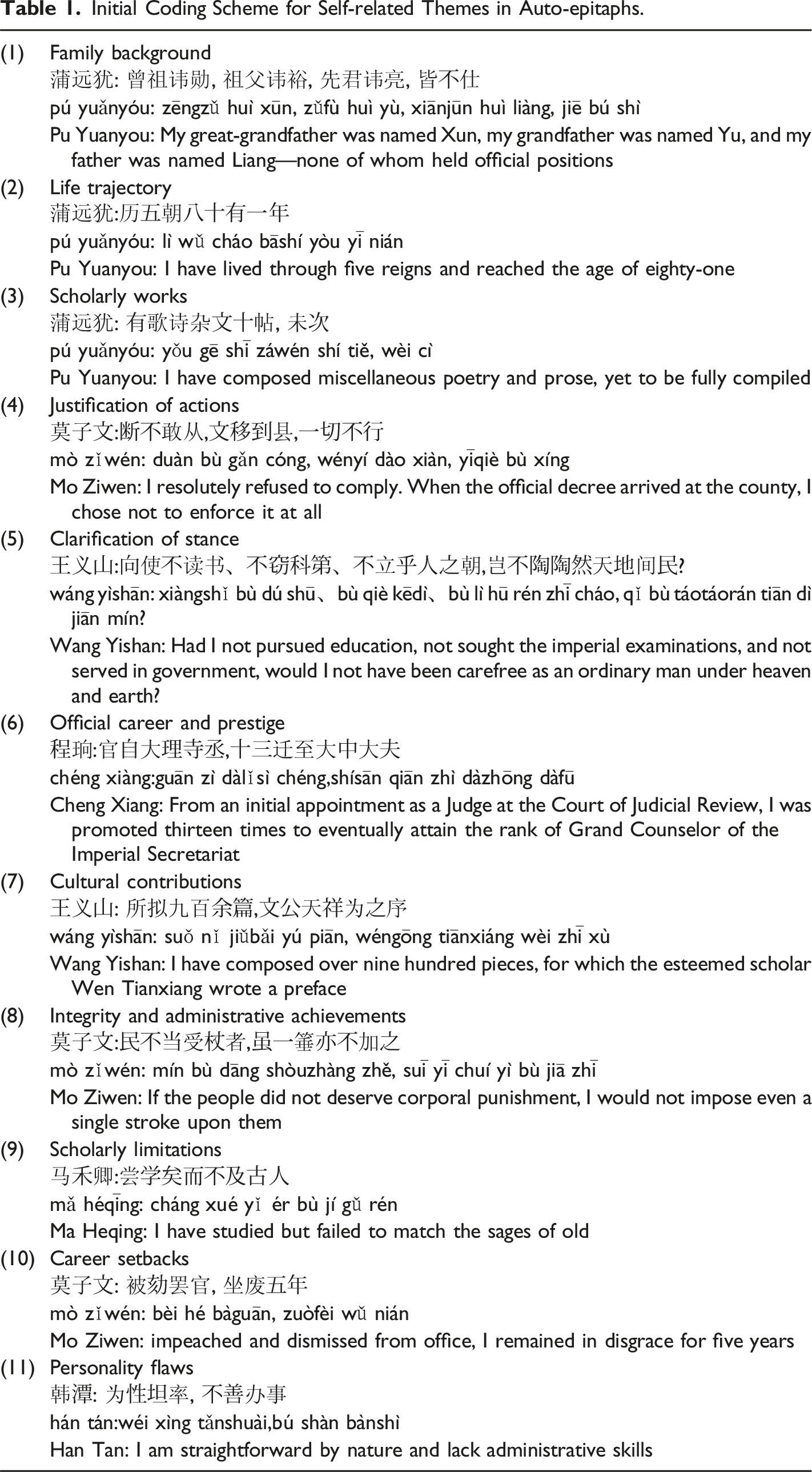
During the axial coding phase, the focus shifts to how tomb owners construct and express their self-identity through various types of self-related speech acts. At this stage, the analytical focus transitions from identifying recurring themes to categorizing the types of speech acts. Drawing on previous scholarly definitions of self-related speech acts, we categorize these instances into four types: self-statement (Witek, 2021), self-defence (Badarneh, 2020; Courtright & Hearit, 2002), self-praise (Ren & Guo, 2020), and self-denigration (Kádár et al., 2023).
First, self-statement refers to neutral self-introductions (Witek, 2021). Examples 1–3 in Table 1 illustrate the tomb owners’ accounts of their family background, life trajectory, and professional careers. Second, self-defence involves efforts to justify or rehabilitate one’s reputation (Courtright & Hearit, 2002), as seen in examples 4–5, where tomb owners defend their actions or positions. Third, self-praise refers to speech acts aimed at positively highlighting one’s status, possessions, abilities, or moral character (Ren & Guo, 2020). Examples 6–8 correspond to such expressions, focusing on the praise of official ranks, academic achievements, and personal virtues. Fourth, self-denigration entails the downplaying of oneself, family, possessions, or achievements, often in contrast to the praise of others (Kádár et al., 2023). Examples 9–11 demonstrate key topics related to self-denigration, mirroring those in the self-praise category (e.g., rank, scholarship, and moral character).
To quantify the frequency of self-related speech acts in auto-epitaphs, this study adopts the clause as the basic unit of analysis. A clause is defined here as a syntactic structure that minimally contains a subject and a predicate and expresses a single semantic proposition. This approach allows for fine granularity, as a single sentence in Classical Chinese often contains multiple self-related assertives or expressives. Moreover, using clauses as the unit of analysis helps ensure consistency in the identification and quantification of self-related speech acts.
Findings
Self-related Speech Acts in Ancient Chinese Auto-epitaphs: an Overview
Among the self-related speech acts identified in our corpus of ancient Chinese auto-epitaphs, self-statement is the most commonly observed, reflecting the conventional function of epitaphs as a means of documenting the life history of the deceased (Guo, 2023). Moreover, our analysis of 18 auto-epitaphs from the Song Dynasty reveals the presence of another three types of self-related speech acts: self-defence, self-praise, and self-denigration. To be specific, all 18 epitaphs in the dataset include self-statement, while 10 feature instances of self-defence, 7 contain expressions of self-praise, and 3 demonstrate self-denigration. These findings suggest a predominant orientation toward neutral or positive self-presentation, with self-denigration occurring relatively infrequently, which contrast with previous accounts that emphasize humility as a defining characteristic of East Asian communicative norms (Kádár et al., 2023).
Frequency of Self-related Speech Acts in Auto-epitaphs.
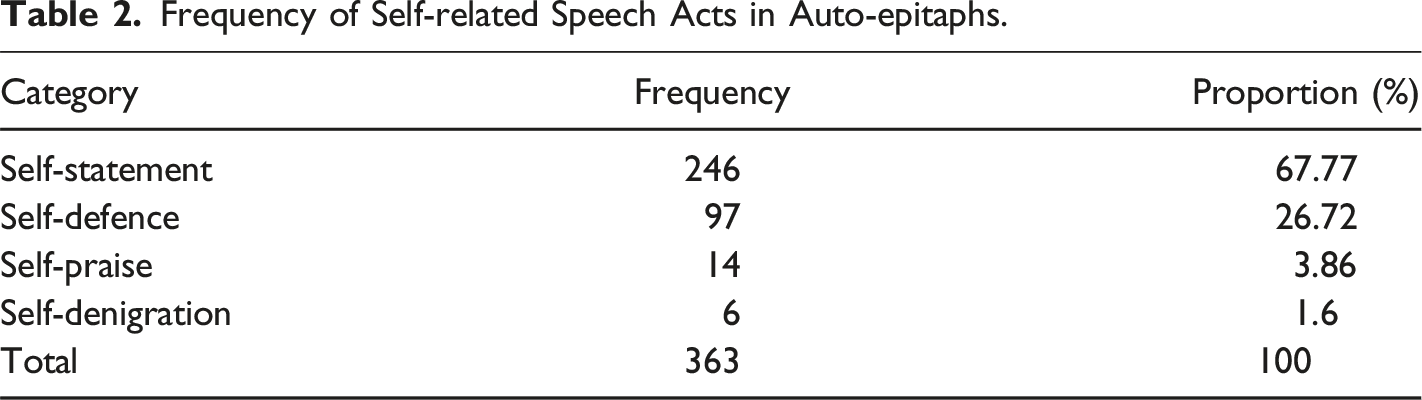
As shown in Table 2 above, self-statement constitutes the largest proportion at 67.77%, which aligns with the conventional understanding of epitaphs as a record of the deceased’s life (Guo, 2023). In contrast, self-praise and self-denigration appear far less frequently, accounting for 3.86% and 1.65%, respectively. Notably, self-defence—unlike the other three categories, which primarily focus on self-justification—emerges as the second most frequent speech act, comprising 26.72% of the instances.
Self-related Speech Acts in Ancient Chinese Auto-epitaphs: Case Analysis
Self-statement
Self-statement refers to a neutral articulation of one’s personal circumstances, intended to inform the audience about the speaker’s background and life experiences (Witek, 2021). In auto-epitaphs from the Song Dynasty, such declarations typically focus on three key dimensions: family background, life trajectory, and scholarly accomplishments. As historical records, these epitaphs enable tomb owners to document both personal and familial histories for future generations. These narratives are generally presented in a straightforward, unembellished style, lacking overt evaluative language. Through self-statement, tomb owners inscribe their identities directly into the historical record. The prominence of self-statement aligns with the epitaph’s conventional function as a biographical account of the deceased (Kuin, 2017). Example 1 serves as a representative illustration of self-statement in auto-epitaphs from the Song Dynasty.
Example 1
蒲远犹 Pú Yuǎnyóu: (1) 移集州司理参军, 梓州司理参军, 皆以亲忧不赴. yí jízhōu sīlǐcānjūn、zǐzhōu sīlǐcānjūn,jiē yǐ qīnyōu bú fù. I was transferred to serve as a judicial officer in Jizhou and Zizhou, but did not assume either position due to mourning obligations for deceased family members. (2) 服除, 了无仕宦意. fú chú, liǎo wú shìhuàn yì. After completing the mourning period, I completely lost interest in pursuing an official career. (3) 闲居, 益读书学文, 婆娑乡里者数年. xián jū, yì dú shū xué wén, pósuō xiānglǐ zhě shù nián. During my retirement, I devoted myself to reading and writing, living leisurely in my hometown for several years.
The self-statements in auto-epitaphs are primarily realized through assertives and expressives (Searle, 1969), which respectively convey factual details about the tomb owner’s life and articulate their personal attitudes. These speech acts function not only as a summation of the individual’s life journey but also as a deliberate affirmation of values aligned with Confucian ideals—namely, self-cultivation, family governance, and public service. Together, they contribute to constructing a shining image of Song Dynasty scholar-officials, with Pu serving as a typical example. In Example 1, Pu structures his narrative around two core themes: fulfilling filial piety by refusing office and retreating into a life of agrarian study. These themes shape a composite identity that blends Confucian morality with personal aspiration. Pu provides a concise yet comprehensive overview of his life. In Sentence (1), he invokes 亲忧 (filial concern) as a moral justification for declining an official appointment. In Sentence (2), he declares his withdrawal from public life following the mourning period, while Sentence (3) details his reclusive lifestyle, thereby subtly aligning himself with the ideal of detachment from worldly ambition. Functionally, the auto-epitaph satisfies the conventional expectation of recording official merit, while simultaneously reinforcing the image of a scholar who embodies both loyalty and filial piety.
Self-defence
Self-defence is a type of speech act aimed at protecting one’s reputation and social standing (Courtright & Hearit, 2002). In auto-epitaphs from the Song Dynasty, speech acts of self-defence serve to justify the contested behaviours, articulate grievances, or clarify one’s stance, thereby contributing to the construction of a morally upright persona. This rhetorical function—largely overlooked in previous studies of epitaphs—reveals a strategic use of language that extends beyond mere biographical narration. Unlike self-statement, which primarily offers factual accounts of one’s life, self-defence focuses on disputed events and the speaker’s interpretation of them. Through this, the tomb author asserts a clear moral position and seeks to reclaim narrative control over their public image.
Self-defence, therefore, represents not only the epitaph’s documentary role but also its argumentative value. In other words, it becomes a final act of self-positioning, in which the deceased attempts to influence how they are remembered after their death. Given that the auto-epitaphs have traditionally been defined as concise commemorative texts (Meng, 2015), it is striking that the frequency of self-defence accounts for 26.72% of all self-related speech acts in our data, which suggests that Song literati were deeply invested in safeguarding their moral identity before and after their deaths. Example 2 illustrates how Mo Ziwen engages in self-defence within his self-authored epitaph, offering insight into how the genre is used to assert ethical legitimacy and counter potential reputational threats.
Example 2
莫子文 Mò Zǐwén (1) 通理考满候代间,奉使王畴迎合当路意,峻行括田之令, tōnglǐ kǎomǎnhòudài jiān,fèngshǐ wángchóu yínghé dānglù yì,jùn xíng kuò tián zhī lìng. While awaiting replacement after completing his tenure evaluation as Tongli (a judicial official), Imperial Envoy Wang Chou, seeking to ingratiate himself with those in power, rigorously enforced the land survey policy. (2) 欲以嘉兴县管下上供经界苗田,强抑本县供括,作殿司天荒草荡围田,以为己功. yù yǐ jiāxīngxiàn guǎnxià shànggòng jīngjièmiáotián,qiáng yì běn xiàn gōngkuò,zuò diànsī tiānhuāngcǎodàng wéitián,yǐ wéi jǐ gōng. He attempted to forcibly reclassify tax-registered farmland in Jiaxing County as wasteland under the Palace Command's jurisdiction, fabricating land reclamation achievements through bureaucratic coercion to claim undeserved merit. (3) 子文谓此事欺君害民,断不敢从,文移到县,一切不行. zǐwén wèi cǐ shì qī jūn hài mín, duàn bù gǎn cóng, wényí dào xiàn, yíqiè bù xíng. I, Ziwen, declared that this act deceived the emperor and harmed the people; thus, I resolutely refused to comply. All related official documents sent to the county were categorically rejected.
In Example 2, Mo adopts a narrative structure of “providing background—describing reasons—explaining outcomes” to defend his actions of disobeying official orders, thereby constructing an image of himself as a righteous and people-loving official. In his use of self-defence, Mo thoroughly presents the reasons, intentions, and consequences of his disobedience. He begins with sentence (1)-(2), where he asserts the illegality of Wang’s actions, establishing a preliminary basis for the legitimacy of his own act of disobedience. In sentence (3), he further expresses his moral stance, reinforcing the justification of his actions. This illustrates that self-defence in auto-epitaphs primarily manifests through assertives and expressives. By providing background information and articulating personal moral positions, individuals construct the rationality of their actions, thereby achieving the intention of self-defence.
Self-defence, in this context, can be understood as a practice of self-image construction and a negotiation of historical evaluation within the framework of Confucian values—particularly loyalty to the ruler and love for the people (Tong, 2017). In this sense, self-defence emerges as a supplementary function to the traditional memorial and recording purposes of epitaphs, adding an argumentative vein that allows the deceased to safeguard their moral legacy.
Self-praise
Self-praise refers to the speech act in which a speaker emphasizes their personal qualities, such as appearance, wealth, skills, or titles (Ren & Guo, 2020). In auto-epitaphs, the function of self-praise is to highlight one’s political or cultural achievements while also showcasing their moral integrity. Unlike the more frequent speech act of self-statement, which offers a neutral account of one’s life, self-praise is specifically designed to construct a positive personal image, making it an inherently affirmative speech act (Tice et al., 1995). Compared to self-defence, which seeks to justify actions or defend one’s reputation, self-praise focuses more on publicly displaying one’s shining achievements and enduring virtues. Despite the strong association of Chinese culture with modesty, particularly in ritual contexts (Kádár et al., 2023), this study finds that self-praise, though quantitatively rare, is still present in auto-epitaphs from the Song Dynasty. Specifically, self-praise accounts for 3.86% of all self-referential speech acts, yet it appears in 7 out of the 18 (38.9%) auto-epitaphs analysed. Example 3 provides an illustration of self-praise in the auto-epitaph of Wang Bang.
Example 3
莫子文 Mò Zǐwén (1) 作邑三考,未尝屈于权势. zuò yì sān kǎo, wèi cháng qū yú quánshì. Throughout my three-term magistracy, I never once cowered before the powerful! (2) 民不当受杖者,虽一篦亦不加之。 mín bù dāng shòu zhàng zhě, suī yī bì yì bù jiā zhī. When commoners deserved no punishment, not even the lightest stroke of the bamboo would I inflict. (3) 此可以对越上天! cǐ kěyǐ duìyuè shàngtiān! Such is my integrity that I can proudly declare: Heaven itself bears witness!
In Example 3, Mo presents himself as an upright official who upholds justice and remains unafraid of powerful elites. In Sentence (1), he briefly summarises his resistance to the influence of the powerful, which constitutes a relatively explicit act of self-praise. In Sentence (2), he further elaborates on his integrity and moral courage by emphasising his impartiality in meting out punishments, ensuring that innocent civilians were not harmed. In Sentence (3), Mo makes a direct assertion that Heaven has borne witness to his righteousness. This bold declaration further underscores his moral rectitude and clear conscience. Such overt acts of self-praise are particularly noteworthy, as they contrast sharply with the stereotypical values of modesty traditionally associated with ancient Chinese scholar-officials (Kádár et al., 2023).
Self-denigration
Self-denigration refers to the speech act of humbling or criticizing oneself (Kádár et al., 2023). In auto-epitaphs of Song dynasty in ancient China, self-denigration typically involves downplaying, belittling, or mocking one’s scholarly achievements, career, and character. As a form of self-presentation that diminishes one’s “face”, self-denigration is often understood as a polite strategy, commonly associated with ritual contexts (Gu, 1990). While previous research generally views self-denigration as an expression of Chinese cultural rituals that align with traditional moral norms (Kádár, 2012), it is noteworthy that in Chinese auto-epitaphs from the Song Dynasty, self-denigration appears only in three auto-epitaphs, making it the rarest of the four types of self-related speech acts. Example 4 illustrates self-denigration in the auto-epitaph of Ma Heqing.
Example 4
马禾卿Mǎ Héqīng (1) 尝学矣而不及古人,尝仕矣而末及今人. cháng xué yǐ ér bù jí gǔ rén,cháng shì yǐ ér mò jí jīn rén. Though I have studied diligently, I failed to attain the wisdom of the ancients; though I have held office, I fell short of matching my contemporaries’ achievements. (2) 矫矫亢亢,似高而非高也;跛跛挈挈,似愚而非愚也. jiǎojiǎo kàngkàng,sì gāo ér fēi gāo yě;bǒbǒ qièqiè,sì yú ér fēi yú yě。 My ostentatious demeanor feigned nobility yet lacked true elevation; my halting gait mimicked foolishness but concealed genuine acuity.
In Example 4, Ma Heqing provides negative evaluations of his academic achievements, career, and character. In sentence (1), Ma compares himself to ancient figures, expressing his inadequacy in both learning and work. In sentence (2), Ma conveys his helplessness regarding his life circumstances. Ma primarily employs expressives—directly conveying self-denigration through negative self-evaluation and self-disclosure. The use of self-denigration not only helps to construct an image of humility and self-reflection, aligning with the value of modesty prevalent among intellectuals of Song Dynasty (Qiu, 2024), but also resonates with the scholar-officials’ pursuit of cultural and political accomplishments (Cheng, 2022). However, self-denigration occurs the least frequently, even less than self-praise, which prompts a reconsideration of the stereotypical image of modesty commonly associated with the ancient Chinese scholar-official class (Kádár, 2012).
Discussion
This study explores self-related speech acts in auto-epitaphs from ancient China through a grounded analysis of 18 surviving texts from the Song Dynasty. As a result, it is found that self-statement holds significantly greater importance than the other three categories. Meanwhile, self-defence occurs notably more frequently than self-praise and self-denigration, which underscores the distinctive nature of the auto-epitaph as a death discourse.
Specifically, in terms of self-statement, the tomb owner engages in objective self-presentation, fulfilling the documentary function of the epitaph. At the same time, it acts as a “balancing mechanism”, allowing the individual to acknowledge accomplishments while maintaining modesty. Moreover, the presence of the other three speech act types invites a reconsideration of the multifaceted functions of epitaphs, as well as a challenge to stereotypes of Chinese literati humility (Kádár et al., 2023). The appearance of self-defence and self-praise contrasts with conventional perceptions of Chinese scholar-officials and the epitaphic genre, pushing against the widely held views of Chinese personal virtues such as modesty and restraint. Although self-praise tends to be limited in frequency, it appears in 7 out of the 18 auto-epitaphs in the dataset, indicating that this discursive practice—despite its brevity—still deserves scholarly attention as it disrupts stereotypical assumptions about the reserved persona of ancient Chinese literati.
In contrast, self-denigration occurs less frequently than expected. This pattern may reflect the fact that the authors of these auto-epitaphs are predominantly accomplished scholar-officials who took pride in their contributions to the empire and society, embodying a profound sense of social responsibility. Overall, auto-epitaphs not only serve a documentary and literary purpose but also offer a historical lens to revisit the spiritual and intellectual image of Chinese literati.
Therefore, our findings above highlight the fact that the auto-epitaphs primarily focus on the authors’ internal perspective into life and death—such as their feelings, thoughts, personality, character, and psychological state—rather than on family history or external events. In this context, the self-related speech acts can be viewed as reflections of the authors’ inner worlds through auto-epitaphs, which can be further interpreted through the Motivation Model of Pragmatics (MMP) developed by Chen (2022, as shown in Figure 1). The Motivation Model of Pragmatics (Chen, 2022, p. 25).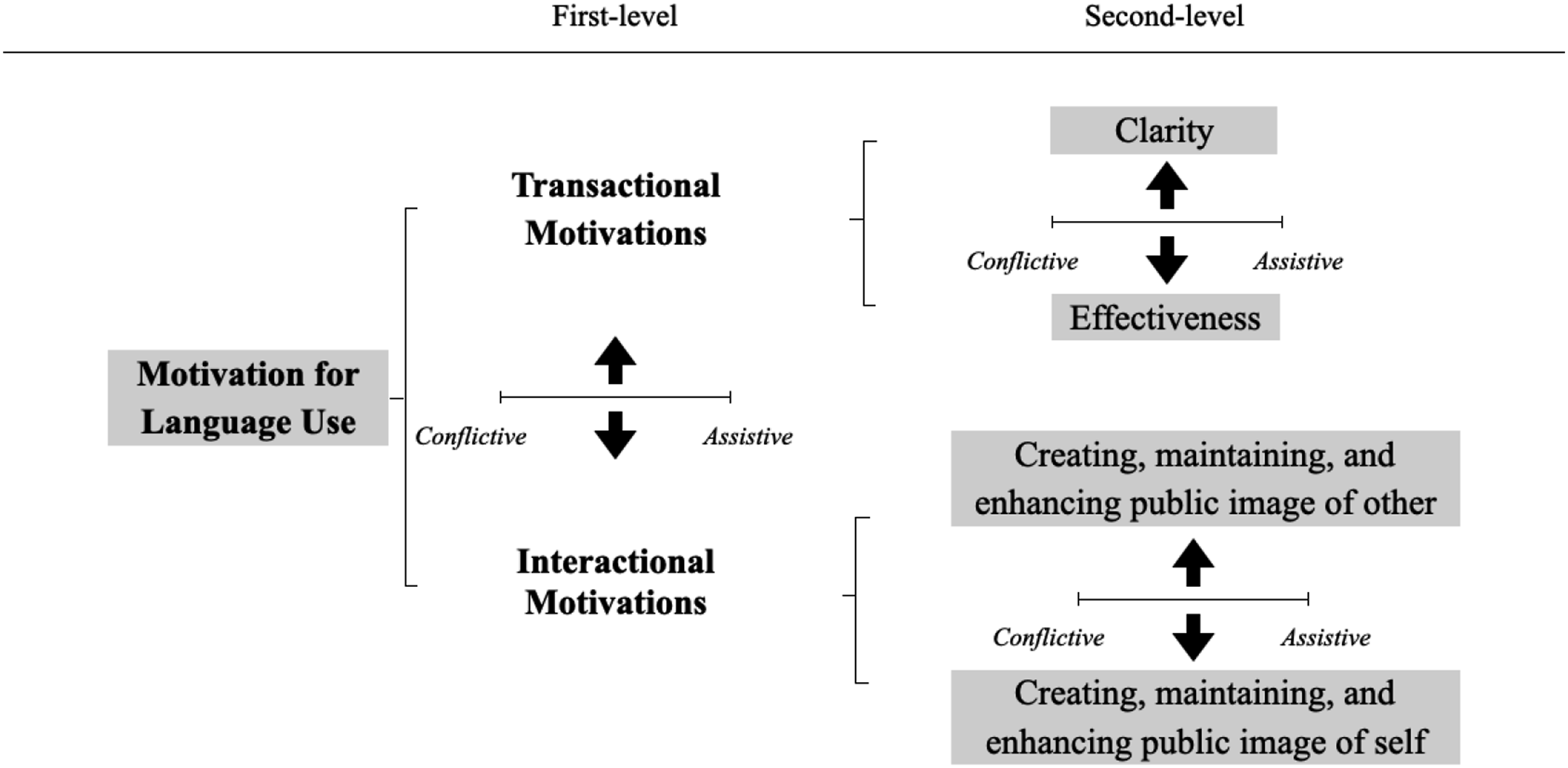
As Chen (2022, p. 25) notes, “Motivation is a deeper notion about human action, a fundamental principle of agency”. The insights derived from this study align with and contribute to understanding the motivations driving individuals to write auto-epitaphs. This interplay of motivations is decoded using the MMP framework, providing a deeper understanding of the pragmatic dynamics behind these personal inscriptions.
The Motivation Model of Pragmatics (MMP), defined as “the study of language use in context from the perspective of the motivation behind the employment of a linguistic device or pragmatic strategy” (Chen, 2022, p. 22), operates on two levels of motivation. At the first level, motivations are categorized into transactional (focused on the transmission of information) and interactional (concerned with the relationship between the speaker and hearer). At the second level, transactional motivations are further divided into “clarity” and “effectiveness,” while interactional motivations are articulated as the “maintaining of the public image” of both the “self” and the “other” (Chen, 2022, p. 22). Each motivation and its secondary components interact within a spectrum that ranges from conflictive to assistive, creating a dynamic interplay that may either result in opposition or mutual support, depending on the specific context.
Based on our dataset of auto-epitaphs of ancient Chinese in Song dynasty, we hold that self-related speech acts in auto-epitaphs, particularly through the framework of the Motivation Model of Pragmatics (MMP) by Chen (2022), provide a detailed and dynamic understanding of how individuals from the Song dynasty constructed their self-images and social identities in the context of their death. This is summarized in Figure 2 below. Pragmatic Motivations in Auto-epitaphs.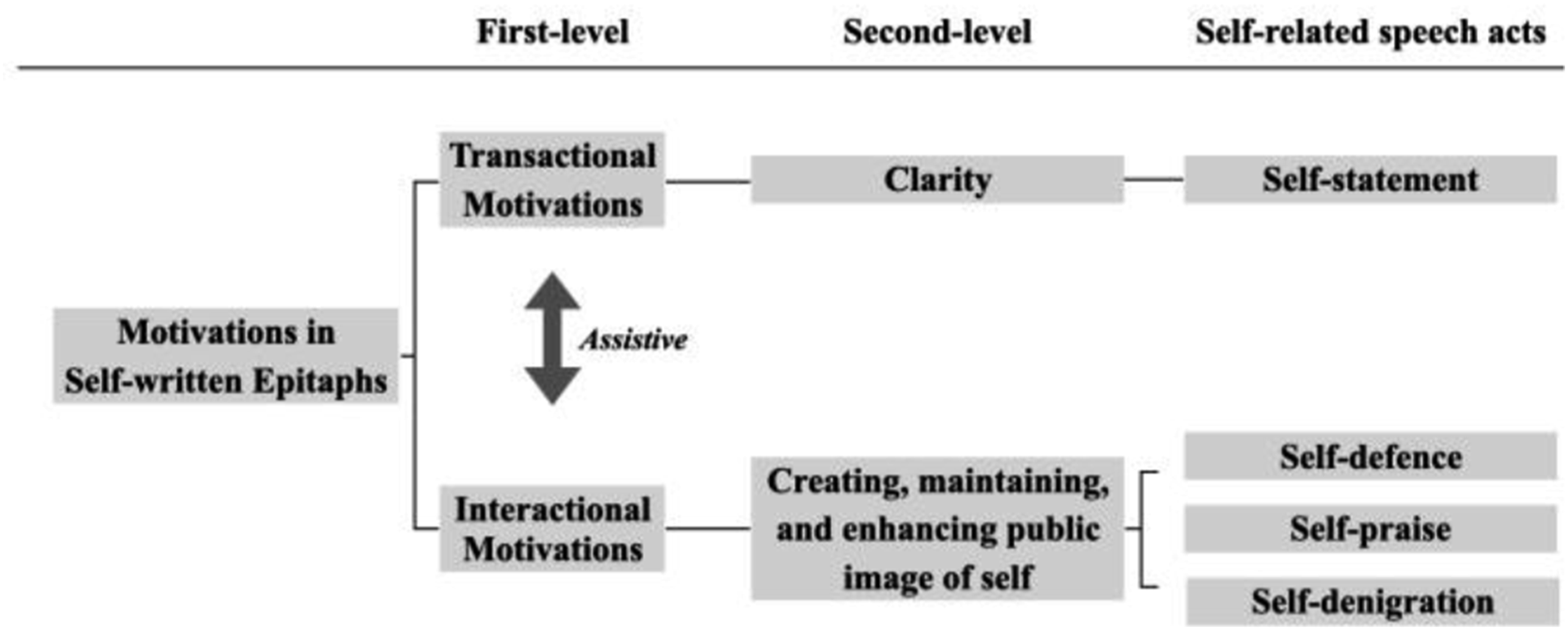
According to Figure 2 above, the self-referential language of auto-epitaphs reflects a complex interplay of motivations that illustrate not just the individual’s historical legacy but also their emotional and social world. Through the lens of MMP, the motivations of auto-epitaph writers can be understood both transactionally and interactionally, with each of which serves a different purpose in the self-presentation of the tomb owner before their death. This helps us to know better about how these self-related discourses of death balance historical documentation with personal self-expression and myth-making, creating a nuanced portrayal of the scholar-officials who authored themselves as the projector of death.
Taking self-statement as an example, it is primarily motivated by transactional goals, with the main objective being the detailed documentation of personal history. Auto-epitaphs, in this sense, function as a historical record, where the tomb owner seeks to ensure clarity and accuracy in the transmission of information on life and death. As a speech act, here self-statement serves the task-oriented function of recording key life events, achievements, and milestones for future generations. By prioritizing clarity, authors of auto-epitaphs aim to provide an account that can be easily understood and appreciated by those who come after their death (Qiu, 2024). In Example 1, Pu offers a meticulous account of the transitions in his official positions, providing reasons for each shift. This careful detailing not only serves as an informative biography but also ensures that future generations can gain a comprehensive understanding of Pu’s historical background after his death. Through self-statement, Pu captures the essence of his life journey, presenting an unembellished, factual narrative that leaves behind a legacy for posterity.
However, as we move to the other types of self-related speech acts—self-defence, self-praise, and self-denigration—the motivations behind them shift from transactional to interactional. Unlike self-statement, these speech acts go beyond mere documentation. Instead, they are concerned with managing and shaping the tomb owner’s public image held in the followers who come after their death. The interactional motivations focus on presenting the individual’s character, values, and moral stance, all while aiming to influence how they will be remembered (Lv, 1999). In Example 2, Mo employs self-defence to explain his actions in disobeying official orders. By providing detailed justifications for his actions, Mo presents himself as a righteous figure, acting out of moral conviction rather than personal gain. Similarly, in Example 3, Mo explicitly commends his steadfast moral integrity in the face of authority, which serves to reinforce his portrayal as a righteous and impartial official. In Example 4, by contrast, Ma adopts an ironic tone of self-denigration to account for a life of modest accomplishments, thereby projecting an image of personal ease and philosophical detachment. Whether through self-defence, self-praise, or self-denigration, the authors of auto-epitaphs aim not only to clarify their actions, experiences, and outcomes, but also to shape a favourable self-image in a way that aligns with the virtues they want to be remembered for.
The shift from transactional to interactional motivations in these auto-epitaphs reflects a broader evolution in the priorities of the authors. Initially, their primary focus is on providing a clear and comprehensive historical record of their lives before deaths. But as they progress in their self-expression, a noticeable shift emerges, where the authors begin to prioritize emotional connection, personal identity, and social bonds. This transition marks an important change in how these auto-epitaph writers viewed themselves as they approch to the end of life. Rather than simply documenting their lives, they begin to use their auto-epitaphs as a means of emotional and social engagement. As noted by Tong (2017), self-related expression in these texts becomes a reflection of not just personal history, but also personal feelings and emotional experiences. Over time, these scholars move from task-oriented documentation to deeper self-exploration and self-representation, which get discursively manifested in the disclosure of personal emotions and the construction of a social self-image through self-defence, self-praise, and self-denigration.
As the auto-epitaphs incorporate interactional motivations, they reflect a concern with self-presentation and public image. In these texts, the line between historical record and personal narration begins to blur. This shift can be understood through the notion of the “not-quite-deceased” figure, who is actively engaged in the process of self-mythologizing even after death (Silver, 2018). In this sense, the epitaph no longer simply functions as a static historical document, but rather as an ongoing conversation with the reader after the deaths of the auto-epitah writers, aimed at constructing a lived version of the authors. This process is especially significant because it highlights the writer’s movitation to maintain a certain level of control over how their legacy is shaped and remembered. In a sense, the auto-epitaph becomes a platform for the writers to assert their moral values, virtues, and social significance, thereby securing their place in history in a way that transcends mere factual recounting.
Besides, this integrated pattern of self-related speech acts, driven by transactional and interactional motivations, underscores a shift in how individuals reflexively position themselves within the social scenarios of their time. Early on, their primary concern may have been ensuring that their achievements and personal history are accurately recorded, so that future generations could understand and remember their contributions. However, a shift toward deeper emotional engagement has emerged gradually, which is not only about ensuring factual clarity but also about cultivating a more personal connection with the readers, disclosing personal reflections, and aligning their emotional and social values with those of the society they were in. This movement towards interactional motivations within auto-epitaphs can also be seen as a broader cultural and emotional transformation within the Song dynasty of ancient China. As scholars share their internal worlds through their auto-epitaphs, they not only aim to highlight their accomplishments but also to foster empathy and connection with their readers, which indicates a desire for recognition not just of one’s external achievements, but of one’s emotional and moral integrity as well (Tong, 2017). In other words, the self-related speech acts of auto-epetaphs in Song dynasty of ancient China suggest a concern with humanistic empathy and subjective self-awareness of the literati. In a culture where personal honour and reputation are of utmost importance, the awareness and efforts to manage one’s image—especially after death—have become an essential part of the scholarly and official ethos (Cheng, 2022; Xiao, 2019).
Moreover, this transformation in self-presentation also shows implications for how the scholar-officials’ reputations are shaped. By moving from a purely transactional mode of self-expression to a more emotionally nuanced and socially engaged one, these auto-epitaph authors are able to shape favourable public images. In this sense, self-defence, self-praise, and self-denigration become pragmatic tools for self-image management, allowing these individuals to assert their value, justify their actions, and highlight their moral virtues, even in the face of potential criticism. Just as Chen (2001) mentioned: The self-politeness strategies are crucial, as they help to secure the legacy, protect the reputation, and ensure that the authors would be remembered positively by society.
Conclusion
This study is aimed at how the self-related speech acts by tomb owners contribute to the construction of auto-epitaphs in the Song dynasty of China. The findings identify four primary types of self-related speech acts according to the descending order of frequency: self-statement, self-defence, self-praise, and self-denigration. While self-statement constitutes the core part of epitaphs, the latter three—newly identified in this study—underscore the function of auto-epitaphs as interactional discourse for self-image management. Among these speech acts, self-statement is primarily driven by transactional motivations, seeking to convey the individual’s life history to posterity with accuracy and clarity. In contrast, self-defence, self-praise, and self-denigration are predominantly interactionally motivated, serving the purpose of constructing a favourable and enduring public persona. This coexistence of transactional and interactional motivations reflects a transformation in the nature of auto-epitaphs—from static historical records to dynamic platforms for articulating moral values, personal virtues, and social status. Furthermore, the prominence of interactional motivations suggests an increasing sense of self-awareness and individualism among Song dynasty literati, prompting a reconsideration of the long-standing traditional stereotype of scholar-officials as inherently humble and reserved (Kádár et al., 2023). While the presence of self-defence and self-praise is insufficient to support a definitive claim of widespread arrogance or conceit, it nevertheless encourages further reflection on the character traits of Chinese literati in Song dynasty. Future research could seek to substantiate these findings through a broader range of historical sources. Given that this study focuses solely on auto-epitaphs from the Song dynasty, future work may expand the temporal scope to include other historical periods. Subsequent research could also investigate the extent to which these texts conform to or deviate from ritual conventions (Kádár, 2024), thereby offering further insights into the death ideology by ancient Chinese literati and beyond.
Footnotes
Acknowledgements
We gratefully acknowledge Ms Yixuan Li for her contributions to the collection and preprocessing of the epitaph data used in this study.
Declaration of Conflicting Interests
The author(s) declared no potential conflicts of interest with respect to the research, authorship, and/or publication of this article.
Funding
The author(s) received no financial support for the research, authorship, and/or publication of this article.
