



Abstract
Ninety-seven undergraduate students responded to a survey regarding their beliefs about unusual end-of-life phenomena (EOLP). Previous studies have examined beliefs about EOLP collectively (i.e., as a single entity). The purpose of this study was to examine participants’ beliefs about different EOLP separately. To that end, participants responded “yes”, “no”, or “unsure” to 36 statements about 18 different EOLP (two statements for each phenomenon). The results revealed that participants believed in some EOLP (e.g., 62% believed that pets behave strangely when their owner is about to die), disbelieved in some EOLP (e.g., 78% disbelieved that clocks and watches can stop when someone dies), and were uncertain about still others (e.g., 44% were unsure whether a dying person’s deceased loved ones will be there to collect them when they die and take them on a journey to the afterlife). Limitations are discussed and suggestions for future research are offered.
The phrase “There are more things in heaven and earth, Horatio, than are dreamt of in your philosophy”, spoken by Shakespeare’s character Hamlet, has been interpreted in different ways. One interpretation is that Hamlet is saying to his friend Horatio that unusual things, such as seeing his father’s apparition (ghost), are possible and should not be dismissed or disbelieved simply because they cannot be explained. This is an important point to keep in mind when looking at the growing volume of research on unusual end-of-life phenomena (EOLP) and their impact on the dying, their loved ones, and the people who work or volunteer with those at the end of life (e.g., Brayne et al., 2006; Claxton-Oldfield & Dunnett, 2018; Grant et al., 2020; Santos et al., 2017). Thalbourne (1982, as cited in Barbato et al. (1999)), defined unusual EOLP (referred to as parapsychological phenomena) as “physically impossible” occurrences that are “outside the realm of human capabilities” (p. 30) (i.e., beyond human understanding). In the literature, EOLP go by many other names. For example, depending on the researcher(s)/author(s), EOLP are also known as deathbed phenomena (Devery et al., 2015; MacConville & McQuillan, 2010; Santos et a., 2017), paranormal phenomena (O’Connor & Leigh, 2003), near-death phenomena (Alvarado, 2006), transcendence phenomena (Broadhurst & Harrington, 2016), transpersonal experiences (Holden, 2017), death-related sensory experiences (Ethier, 2005), nearing-death awareness (Callanan & Kelley, 2012), end-of-life experiences (Brayne et al., 2008; Fenwick & Brayne, 2011), shared death experiences (Peters, 2022), unusual spiritual phenomena at the end of life (McDonald et al., 2014), and so on (a point of confusion in the literature).
The term EOLP, which is used in this paper, includes a wide range of phenomena. Some EOLP occur before death, for example, a dying person choosing their time of death (e.g., waiting for a loved one to arrive before dying) (e.g., Doka, 2020); animals, birds or insects (e.g., black dogs, black birds or moths) appearing as omens of death (e.g., Fenwick & Fenwick, 2013); deathbed visions (e.g., a dying person seeing and interacting with deceased loved ones that are unseen by others) (e.g., Claxton-Oldfield, 2024); terminal lucidity (e.g., the brief and unexpected return of mental clarity and memory in a person with dementia or Alzheimer’s disease) (e.g., Batthyany, 2023); and strange pet behaviour (e.g., dogs howling or pawing at the door to be let in when their owner is about to die) (e.g., Fenwick & Fenwick, 2013). Some EOLP occur at or around the time of death. Examples of these phenomena include deathbed coincidences (e.g., feeling or sensing when a loved one who is not close by is nearing death or has died) (e.g., Fenwick & Brayne, 2011); emanations (e.g., a mist, haze, or shape seen leaving a person’s body when they die) (e.g., Fenwick & Fenwick, 2013); clocks and watches stopping at the time of someone’s death (e.g., Fenwick & Fenwick, 2013); electrical equipment malfunctioning (e.g., TVs and lights turning on or off by themselves) when someone is dying (e.g., Fenwick & Fenwick, 2013); changes in room temperature when someone dies (e.g., the room suddenly gets cold) (e.g., Brayne et al., 2008); a radiant light or bright glow surrounding the person’s body at the moment of death (e.g., Santos et al., 2017); and shared death experiences (e.g., a non-dying person joining in a dying loved one’s transition to the afterlife) (e.g., Moody & Perry, 2023). EOLP can also occur after death either spontaneously (e.g., a bereaved person feels or senses the presence of their deceased loved one) (e.g., Beischel, 2019) or with the assistance of a psychic medium who can communicate with the spirits of the deceased (e.g., Beischel, 2019). Past life memories would be another example of an after-death phenomenon (e.g., Haraldsson & Matlock, 2016). Finally, some people report having a near-death experience, for example, dying on the operating table only to be brought back to life again and able to describe what happened (e.g., details of their surgical procedure) while they were clinically dead (e.g., Greyson, 2021).
Several empirical studies have been conducted to investigate the frequency with which these phenomena occur. A recent systematic review of 12 studies of deathbed phenomena and other end-of-life experiences found that EOLP are not uncommon, with the frequency of these phenomena varying between 28% and 87% (Bertao et al., 2025). In addition, and of relevance to the current study, several studies have examined people’s beliefs about EOLP (e.g., Claxton-Oldfield & de Ste-Croix Killoran, 2025; Claxton-Oldfield & Richard, 2022; Fenwick et al., 2010; Hession et al., 2024; MacConville & McQuillan, 2010; Santos et al., 2017). The results of these studies reveal that EOLP are generally perceived as spiritual events. For example, in a multicentre study in Brazil which included a palliative care unit, oncology hospital, and nursing homes, most (70%) healthcare professionals considered deathbed phenomena [EOLP] to be profound spiritual events; only 18% considered EOLP to be medication- or fever-induced hallucinations (Santos et al., 2017). Seventy-four percent of Australian nurses in an acute care hospital believed that EOLP were profound spiritual events and only 18% considered EOLP to be hallucinations induced by medications or fever (Hession et al., 2024). In a 5-year retrospective study involving palliative care nurses, doctors, and end-of-life carers from two hospices and a nursing home in the United Kingdom, Fenwick et al. (2010) found that 68% of carers considered deathbed phenomena [EOLP] to be profound spiritual events, while 33% considered them to be hallucinations due to medications or fever. Seventy percent of Canadian hospice palliative care volunteers considered EOLP to be profoundly spiritual events (Claxton-Oldfield & Dunnett, 2018). In this study, 21% or less of the volunteers felt that there were medical explanations for EOLP (e.g., they are the result of a dying brain, oxygen deprivation, or drug-induced hallucinations). Similar results were obtained with staff in a Canadian nursing home, with most (64%) staff considering EOLP to be profoundly spiritual events and only 27% attributing them to drug-induced hallucinations (Claxton-Oldfield & Richard, 2022). Finally in a Canadian study involving death doulas, 85% either strongly agreed or agreed that EOLP are profoundly spiritual events; only 4% believed that EOLP are hallucinations brought on by drugs (Claxton-Oldfield & de Ste-Croix Killoran, 2025).
All the above studies examining beliefs about EOLP involved people who work in places where people die (e.g., hospitals, hospices, nursing homes, dying person’s own home). So far, only one study has examined undergraduate students’ beliefs about EOLP. In this study, Claxton-Oldfield and MacEachern (2024) found that 53% of students believed that EOLP are profoundly spiritual events; a percentage lower than those found in studies involving people who work with the dying. In the same study, 41% of students believed that there were medical explanations for EOLP (Claxton-Oldfield & MacEachern, 2024), a percentage higher than those endorsed by people who work in various end-of-life care settings (e.g., Claxton-Oldfield & Dunnett, 2018; Fenwick et al., 2010; Hession et al., 2024; Santos et al., 2017).
What all the above studies of beliefs about EOLP have in common is that they examined people’s beliefs about EOLP in general, that is, as a single entity rather than in a way that distinguishes individual phenomena. To date and to the best of our knowledge, no studies have focused on people’s beliefs about different EOLP presented separately. Therefore, the purpose of this study was to examine undergraduate students’ beliefs about different EOLP presented one at a time rather than all lumped together. A further aim of this study was to determine whether students’ beliefs about different EOLP varied by degree program (e.g., Bachelor of Science, Bachelor of Arts) and level of spirituality.
Method
Participants
Participants were 97 students (56 females, 39 males) enrolled in introductory psychology courses; 2 participants identified as other (non-binary, transgender). The mean age of the participants was 19.1 years old (SD = 2.3), with ages ranging from 17 to 33 years. Forty-nine (54.4%) participants indicated that they had a religious affiliation (e.g., Catholicism/Christianity, Judaism, Islam); 31 (34.4%) indicated “not applicable”, and 10 (11.1%) participants indicated other (e.g., atheist). Forty-six (48.4%) participants described themselves as either somewhat or very spiritual and 49 (51.6%) described themselves as not very or not at all spiritual. In terms of their degree program, 51 (53.1%) participants were Bachelor of Arts students, 33 (34.4%) were Bachelor of Science students, 11 (11.5%) were Bachelor of Commerce students, and 1 student was a Bachelor of Arts and Science student. Note. Valid percentages (excluding missing data) are reported throughout.
Materials
An online End-of-Life Phenomena (EOLP) Beliefs survey was developed for this study to examine students’ beliefs about various EOLP. The survey consisted of two parts. Part I consisted of 36 statements about 18 different EOLP (e.g., premonitions of death, deathbed visions, terminal lucidity, clocks and watches stopping at death, spontaneous after death communications, near-death experiences, past life memories). Each statement took the form of, “Do you believe …” There were two statements for each EOLP. For example, for the EOLP choosing the time of death, the two statements were, “Do you believe that it is possible for a dying person to choose their time of death (e.g., wait for a loved one to arrive before dying)?” and “Do you believe that a dying person can ‘hold on’ long enough for a significant event to take place (e.g., wedding, birth of a grandchild) before dying?” For each statement, participants were asked to respond “yes”, “no”, or “unsure.” Part II of the survey contained basic demographic information questions such as age, gender, religious affiliation, level of spirituality, and degree program.
Procedure
Ethical approval to conduct this study was received through the Mount Allison University Research Ethics Board. The participants were recruited using the online SONA survey platform. Students enrolled in introductory psychology classes were informed about how to access the SONA website and select the online survey study, if interested in participating. Participants completed a consent form followed by the EOLP Beliefs survey. The survey, which took approximately 10–15 minutes to complete, was hosted on LimeSurvey.
Results
The Numbers and Percentages of Students Who Responded “Yes”, “No”, or “Unsure” Regarding Their Beliefs About EOLP (N = 97).
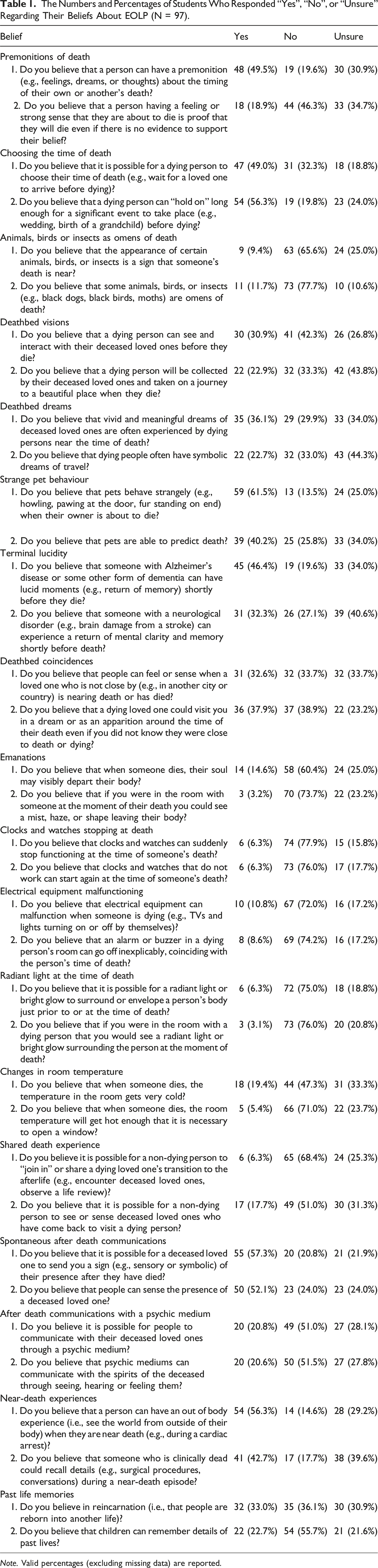
Note. Valid percentages (excluding missing data) are reported.
Forty percent or more of the participants believed the following: pets behave strangely when their owner is about to die (62%), a deceased loved one could send a sign of their presence (57%), a dying person could hold on for a particular event (56%) or until a loved arrives (49%) before dying, a person can be out of their body during a near-death experience (56%), people can sense the presence of a deceased loved one (52%), a person could have a premonition about the timing of their own or another’s death (50%), someone with Alzheimer’s disease or some other form of dementia could experience a return of memory shortly before death (46%), someone could describe details of their surgical procedure while clinically dead (43%), and pets are able to predict death (40%).
Fifty percent or more of the participants did not believe either of the statements about animals, birds or insects being omens of death, emanations, clocks or watches stopping or starting at the time of death, electrical equipment malfunctioning, radiant light at the time of death, shared death experiences, after-death communications with psychic mediums, that the room temperature gets hotter when someone dies, and that children can remember past lives. The percentages of participants not believing these phenomena ranged from 51% (a non-dying person can join in a dying loved one’s transition to the afterlife, and psychic mediums can communicate with deceased loved one) to 78% (clocks and watches can suddenly stop functioning at the time of someone’s death).
Forty percent or more of the participants were unsure about deceased loved ones coming to take a dying person on a journey to the other side (44%), dying people having dreams about travelling (44%), someone with brain damage experiencing a return of memory shortly before death (41%), and someone describing details of their surgical procedure while clinically dead (40%)
Degree Program (Arts/Commerce versus Science)
Where possible, 2 X 3 chi-square tests were conducted on the belief statements between the participants’ degree program (Bachelor of Arts/Commerce vs. Bachelor of Science) and the response categories “yes”, “no”, and “unsure.” For 28 of the 36 statements, at least 80% of the cells had an expected frequency of 5 or greater and no cell had an expected frequency smaller than 1, making the chi square test valid at a Bonferroni-corrected alpha of 0.00179. No significant chi squares were found for any of the statements.
Level of Spirituality (Not at All/Not Very Spiritual versus Somewhat/Very Spiritual)
Where possible, 2 X 3 chi-square tests were conducted on the belief statements between the participants’ level of spirituality (somewhat/very spiritual vs. not at all/not very spiritual) and the response categories “yes”, “no”, and “unsure.” For 27 of the 36 statements, at least 80% of the cells had an expected frequency of 5 or greater and no cell had an expected frequency smaller than 1, making the chi square test valid at a Bonferroni-corrected alpha of 0.00185. A significant chi square was found for the statement “Do you believe that people can feel or sense when a loved who is not close by (e.g., in another city or country) is nearing death or has died?”, X2 (2, N = 95) = 13.4, p = .0012. A post-hoc analysis analyzing 2 X 2 sub tables within the larger 2 X 3 table revealed a significant difference between the “yes” and “no” responses, X2 (1, N = 63) = 10.01, p = .0016. The proportion of somewhat or very spiritual participants who believe that this deathbed coincidence is possible differed significantly from the proportion of those who identified as being not at all or not very spiritual. Somewhat/very spiritual participants were more likely to say “yes”, while not very/not at all spiritual participants were more likely to say “no.”
Discussion
Nine of the ten EOLP statements that were believed (responded “yes” to) by 40% or more of the participants referred to the same phenomena that 66% or more of the participants (undergraduate students) in Claxton-Oldfield and MacEachern’s (2024) study had heard about or were familiar with, namely, choosing the time of death, after-death communications, terminal lucidity, strange animal behaviour, and near-death experiences. For example, 62% of the current study’s participants believed that pets behave strangely when their owner is about to die; 71% of Claxton-Oldfield and MacEachern’s (2024) participants had heard about or were familiar with this phenomenon. Fifty-six percent of the current study’s participants believed that a dying person could hold on until a significant event occurred before dying; 88% of the participants in Claxton-Oldfield and MacEachern’s (2024) had heard about or were familiar with this phenomenon. These findings suggest that some EOLP are both familiar (i.e., known) to and accepted (i.e., believed) by undergraduate students. Indeed, some phenomena, such as near-death experiences and after-death communications, are well-known to most people. For example, there are websites (e.g., the International Association for Near-Death Studies and the After Death Communication Research Foundation) and resources (e.g., books, articles) about these phenomena, plus they are frequently featured in the popular media (e.g., documentaries, YouTube videos, podcasts), all of which may lead people, including the current study’s participants, to believe that these phenomena can happen.
In the study by Claxton-Oldfield and MacEachern (2024), about one-quarter or more of the participants indicated that they had had “personal experiences” with four of the phenomena that 40% or more of the current study’s participants believed to be true - a dying person choosing the time of death (36%), after death communications (30%), strange animal behaviour (25%), and terminal lucidity (24%) (percentages are from Claxton-Oldfield and MacEachern’s (2024) study). It is possible that some of the current study’s participants may also have had first-hand experiences with these (or some of these) EOLP (e.g., experiences with family pets behaving oddly around the time of someone’ death or experiences with sick, elderly grandparents) which, in turn, may have led them to believe that these phenomena do happen. This, of course, is purely speculative.
Six of the 16 EOLP statements that were disbelieved by 50% or more of the participants in this study were ones that 40% or less of the participants in Claxton-Oldfield and MacEachern’s (2024) study had heard about or were familiar with - clocks and watches stopping around the time of death, emanations, and electrical equipment malfunctioning. For example, only 6% of the current study’s participants expressed belief regarding clocks or watches stopping at the time of a person’s death and only 26% of Claxton-Oldfield and MacEachern’s (2024) participants had heard about or were familiar with this phenomenon. Only 3% of the current study’s participants believed that they could see a mist, haze, or shape leaving a person’s body at the moment of death and only 30% of the participants in Claxton-Oldfield and MacEachern’s (2024) had heard about or were familiar with this phenomenon. In the Claxton-Oldfield and MacEachern’s (2024) study, participants also reported a lack of personal experiences with these particular phenomena. For example, only 2% of the students had personal experiences with both electrical equipment malfunctioning and emanations and only 8% reported having personal experiences with clocks and watches stopping (Claxton-Oldfield & MacEachern, 2024). Together, these findings suggest both a lack of awareness (i.e., knowledge) of and belief in these EOLP. If people are not aware of (i.e., have not heard about) these things, then they may be less likely to believe in them.
Surprisingly, however, three of the EOLP statements not believed by 50% or more of the current study’s participants were ones that 60% or more of the participants in Claxton-Oldfield and MacEachern’s (2024) study had heard about or were familiar with - changes in room temperature and brilliant white light surrounding a dying person’s body. For example, only 3% of the participants in the current study believed that if they were in the room with a dying person, they would see a radiant light or bright glow surrounding the person at the moment of death, while 62% of the participants in Claxton-Oldfield and MacEachern’s (2024) study reported that they had heard about or were familiar with this phenomenon. Note. Only 2% had had personal experience with a brilliant white light or bright glow enveloping a dying person’s body just before or at the time of their death. These findings suggest that some EOLP may need to be seen with one’s own eyes (rather than just heard about) to be believed.
Finally, several of the EOLP statements referred to phenomena not included in the 2024 study by Claxton-Oldfield and MacEachern, namely, premonitions of death, animals, birds or insects as omens of death, deathbed dreams, shared death experiences, after death communications with a psychic medium, and past life memories. Half or more of the current study’s participants did not believe that psychic mediums could communicate with the spirits of the deceased or that a non-dying person could experience the same sensations and feelings as their dying loved one. A third or more of the participants did not believe that a person could have a feeling or belief (i.e., premonition) that they would die soon, that the appearance of animals, birds or insect was a sign that someone’s death was near, or that symbolic dreams of travel are common in dying people. It would be interesting to know if the participants had heard about or were aware of any of these EOLP, even if they did not believe in them.
Given the much more stringent alpha level (i.e., Bonferroni correction due to the large number of chi square tests), only one significant difference was found when comparing the responses of the somewhat/very spiritual participants with the not at all/not very spiritual participants. Proportionally more somewhat/very spiritual participants endorsed the belief that people can feel or sense when someone they love, who is not close by, is dying or has just died. This difference was in the expected direction.
The main limitation of this study is that the participants were not asked to explain their reasons for choosing “yes”, “no” or “unsure.” Future surveys could include questions to explore the reasons behind the participants’ beliefs, disbeliefs or uncertainties about the different EOLP. Some of the EOLP included in this study (e.g., animals, birds or insects as omens of death, clocks and watches stopping) can be linked to stories, traditions and beliefs passed down as folklore or myths (e.g., the old tradition of stopping clocks in a home to mark the time of death or the folklore belief that black birds are associated with death). It would be interesting to know whether participants are aware of these folklore beliefs or myths and, if so, whether that impacted their beliefs. Future studies could address this limitation. Further studies could also examine nursing and medical students’ beliefs about specific EOLP that they may, as future healthcare professionals, encounter in their work with dying persons.
Footnotes
Declaration of conflicting interests
The author(s) declared no potential conflicts of interest with respect to the research, authorship, and/or publication of this article.
Funding
The author(s) received no financial support for the research, authorship, and/or publication of this article.
