




Abstract
The aim of this study was to describe the negative changes in the lives of working-age widow (er)s and their families caused by the death of their spouse. A descriptive qualitative approach was used. The research data was collected with an electronic questionnaire. Negative life changes after the death of a spouse included increased relationship challenges, a cooling of family relationships, and a change in self-identity. In addition, loss of support and having to provide for basic needs alone, increased responsibility for children and everyday life. The feeling of life becoming burdensome were experienced. The death of a spouse causes negative changes in different aspects of life for working-age widow (er)s and their family. The results of this study can be used to develop societal sectors services and underline the particular importance of early support and of the negative life changes that widowhood can bring.
Background
Close relationships are important to peoples mental and physical health (Sbarra, 2015). Married people have reported greater feelings of support, less stress and better well-being than single people (Diener et al., 2000; Walen & Lachman, 2000). In addition, research on young adults (18–25 years) shows that relationships provide companionship, promote health and reduce risk-taking behaviour (Beckmeyer & Cromwell, 2019; Furman & Collibee, 2014). Marriage provides security against unexpected experiences in sharing economic resources (Waite, 1995) and responsibilities and helping each other in difficult situations (Dehle et al., 2001). Therefore, losing a significant person through death is one of the most difficult experiences for a person to encounter (Shear, 2012). Grief is described as an individual and dynamic process that affects the bereaved and their life comprehensively and permanently (Hogan et al., 1996; Stroebe et al., 2001, 2007). In the lives of the bereaved, feelings and reactions related to grief manifest themselves sometimes more strongly and sometimes less strongly (Jacob, 1993). However, a deceased loved one can live on in the memories of the bereaved in a meaningful way through shared past, experiences, and memories for the rest of their lives (Dyregrov & Dyregrov, 2008). In addition to grief and longing for their spouse, widowhood involves a lot of adjustments and adaptation (Dunn, 2015).
After widowhood, life can feel unrealistic and restless, and things may not be under one’s control and the widows (er)s may become highly sensitive to perceiving everything around them (Blanner et al., 2021). Some of them may experience the death of a spouse as a relief, especially after a long-term illness (Blanner et al., 2021) or a bad relationship (Picazzio Perez Batista et al., 2019). The time and circumstances before the death of a spouse play a major role in shaping the widowed person’s life after the death of their spouse (Blanner et al., 2021). In addition, the quality of the relationship plays a role in widows’ survival, (Picazzio Perez Batista et al., 2019) and the widowed person’s needs to try to adapt to a new way of life after the death of their spouse. Thus, they have to start planning their life and future on a new basis. Widows may experience a sense of hopelessness about the future as they realise the limitations of life and become aware of their own impending death. (Chan & Chan, 2011).
For young widow (er)s, widowhood is often an unexpected event for which they are not necessarily socially, financially or emotionally prepared (Anderson et al., 2023; Haase, 2008). Working age in Finland is defined as the age between 15 and 65 years. In 2023, a total of 7325 working age persons died, of whom 4928 were men and 2397 women. In this study, working-age refer to widow (er)s aged 18–65. In Finland, the share of women in the labour force has grown ahead of men (Alho et al., 2024). After loss of a spouse, the widow (er) has the possibility to get financial support from the society (KELA, 2024) but there is no legal bereavement leave (Leysen & Wens, 2020). Widow (er)s of working-age are relatively young. Being widowed at young age affects many aspects of one’s life, when the loss of the spouse affects their finances, family roles, and working life (Anderson et al., 2023). In career theory in the transition model, becoming a widow (er), can be seen as a transition that changes the person’s role and responsibilities, that takes time for the transition to be successful, and that coping with the transition is different for each person. (Guichard & Lenz, 2005).
Widowhood is shown to be associated with mental health problems such as depression, sleep problems and anxiety, (Blanner et al., 2021; Kristiansen et al., 2019a, 2019b). Less attention has been paid to the impact on family members facing end-of-life challenges and death (Wang et al., 2024). The death of a spouse affects the whole family. Children are highly dependent on their parents for bereavement support and information about death (Menendez et al., 2020; Scott et al., 2019). At the same time, the bereaved face the challenges of being a parent to grieving children and continuing to live as a single parent (Glazer et al., 2010). Good social support contributes to well-being, especially for those who had a strong social support network prior to widowhood (Ungar & Florian, 2004).
In previous studies, the trajectory of medication use after widowhood has been explored (Maura et al., 2024). In addition, the focus has been on the prevalence of loneliness (Camacho et al., 2024; Kaishan et al., 2024), depression, anxiety, sleep problems (Blanner et al., 2021) or pain (Camacho et al., 2024) and experiences of widowhood (Chan & Chan, 2011). Research on young widow (er)s has focused on the association between the loss of a spouse with adverse health effects, such as an increased risk of chronic and acute diseases (Stroebe et al., 2017), cardiovascular diseases (Einiö & Martikainen, 2019), health changes (Kristiansen et al., 2019a, 2019b) and challenges (Taylor & Robinson, 2016). In addition, research have been made focusing on widow’s experiences (Ergün-Basak, 2024; Houston et al., 2016; Jones et al., 2019; Lamba, 2023; Lowe & McClement, 2011). Previous research has focused often on different age groups, for example, widowhood in older age, mostly over the age of 65. Research related to working-age widow (er)s are scarce, research on this age-group focus more on coping of different conditions such-as stroke (Šaňáková et al., 2024).
Qualitative studies of young widows’ experiences have been done in different countries as USA (Jones et al., 2019), Canada (Lowe & McClement, 2011), India (Lamba, 2023) and Nepal (Houston et al., 2016) Turkey (Ergün-Basak, 2024). Previous research has shown that widowhood affects the health and daily life of the widowed person, but knowledge of the negative life changes is still lacking. There is a gap in qualitative research on the negative impact of widowhood on the lives of working-age widowed persons and their families, especially from a Nordic perspective. It is therefore important, to explore this topic in order to gain knowledge that can be used to develop support and services for working-age widowed persons and their families. The purpose of the study was to describe the negative life changes caused by widowhood for working-age widows and widowers and their families, by using a descriptive qualitative approach. The following research question was sought to be answered in line with this purpose; what negative changes has the death of a spouse brought to the lives of working-age widow (er)s and their families?
Methods
The method used in this study was a descriptive qualitative approach with an inductive content analysis (Kyngäs et al., 2019). The intention of the study was to present a comprehensive summary of the phenomenon of interest without claiming any methodological roots (Polit & Beck, 2020). The data were collected using an e-form from widow (er)s of working age who had lost their spouses. This study is part of a larger study related to widowhood.
Participants
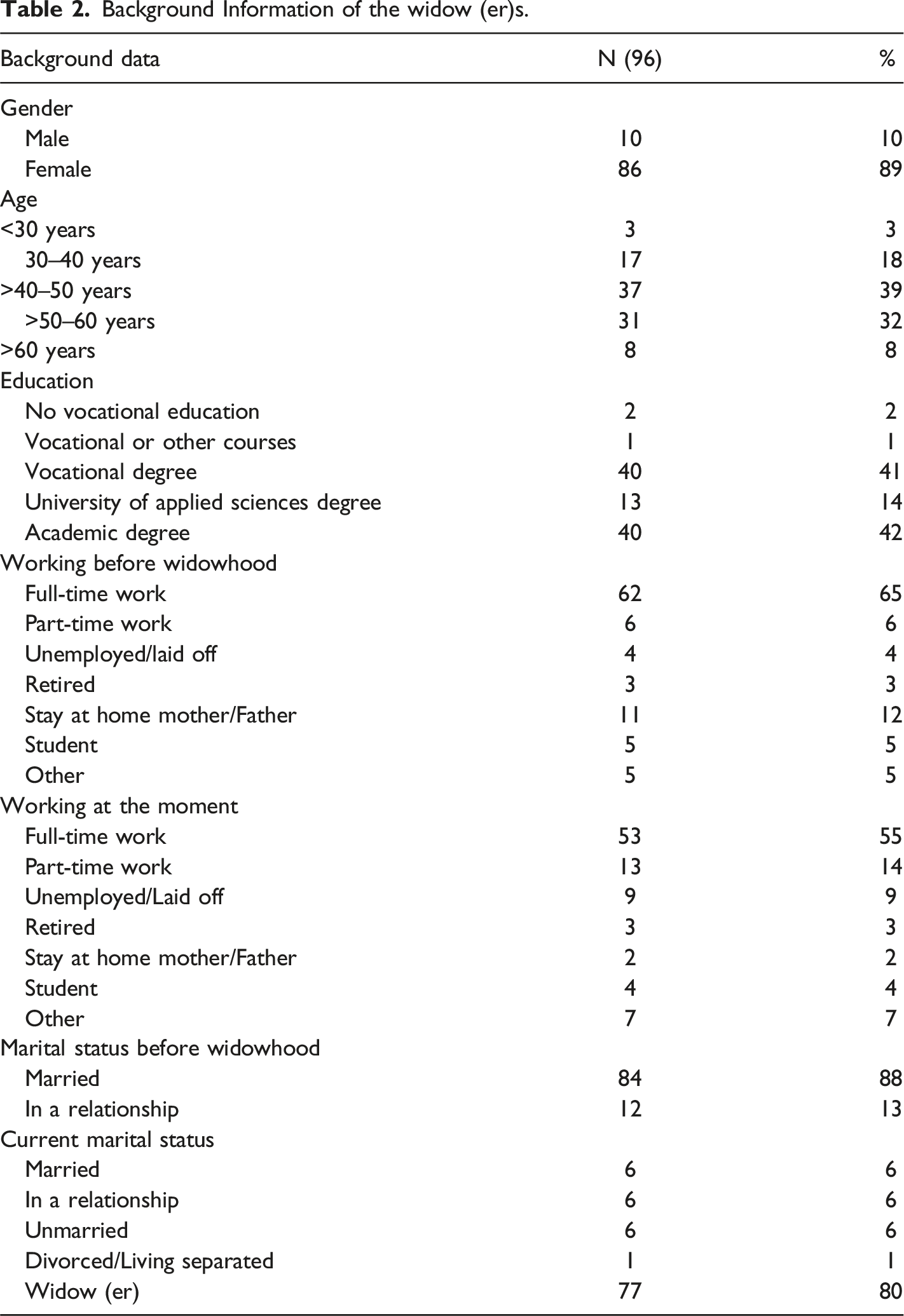
Participants were recruited by using a purposive sampling, which was chosen to find participants who are representative of the phenomenon of interest (Polit & Beck, 2020). The sampling was carried out through the webpage of the non-profit peer support association Nuoret Lesket Ry, and an email was sent to all the members of the association by the second author (ALA). The criterion for participation in the study was being widowed at working-age (18–65 years). A total of 96 eligible working-age widow (er)s participated in the survey.
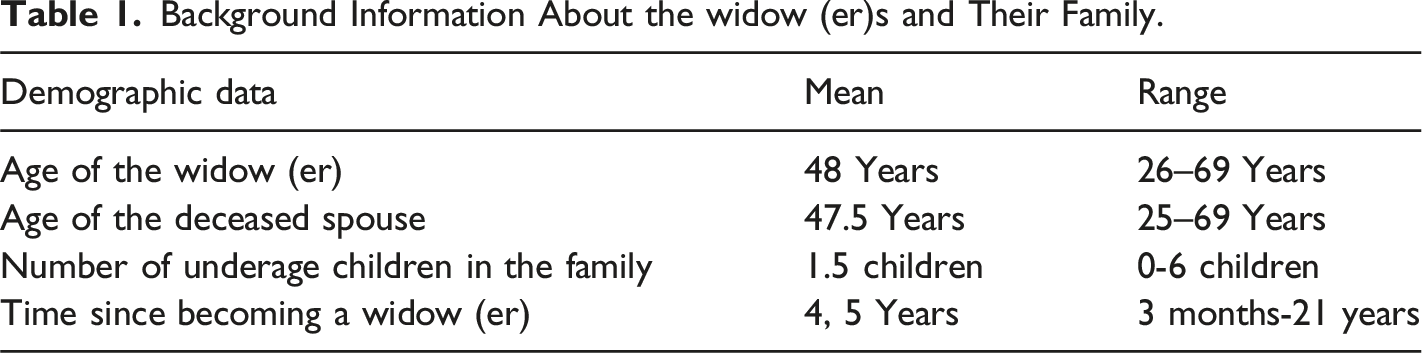
Background Information About the widow (er)s and Their Family.
Background Information of the widow (er)s.
Data Collection Tools
The data was collected by means of an electronic questionnaire, the online survey tool Lime Survey was used to collect the data. The questionnaire was preceded by a cover letter providing information about the study. The questionnaire was developed by the research team and included the demographic information and open-ended questions related to widows’ and widowers’ grief, coping, life changes and changes in working life. The demographic information was the respondent’s gender, age, basic education, employment status, health experience, and current marital status. Background information (see Table 1) about the deceased spouse was also asked. The open question analysed in this study was: What negative changes has the death of your spouse brought to you and your family’s life?
Data Analysis
The demographic information was statistically analysed by using SPSS for Windows 25. The open-ended question data was analysed using qualitative content analysis (Elo & Kyngäs, 2008). No theoretical framework was used as a starting point (Elo & Kyngäs, 2008; Kyngäs et al., 2019). The manifest content was included in the analysis, and words, sentences or phrases which constructed a meaning were used as the unit of analysis. (Elo & Kyngäs, 2008.) The analysis was carried out in four stages. First, the data were transcribed verbatim from the questionnaires into a Microsoft Word template. The researchers read through the data carefully to familiarise themselves with it. Secondly, the researchers identified expressions that corresponded to the research question. The data corresponding to the research questions were reduced to codes. The total number of reduced codes of negative life changes was 393. Thirdly, after the reduction phase, the reduced codes were grouped together based on similarities in content. In the fourth phase, the reduced codes grouped by similarities were abstracted. Reductions grouped in the same category were named with descriptive terms to subcategories. Similar subcategories were then further combined into categories and named with concepts describing the content.
Trustworthiness and the Role of the Researcher
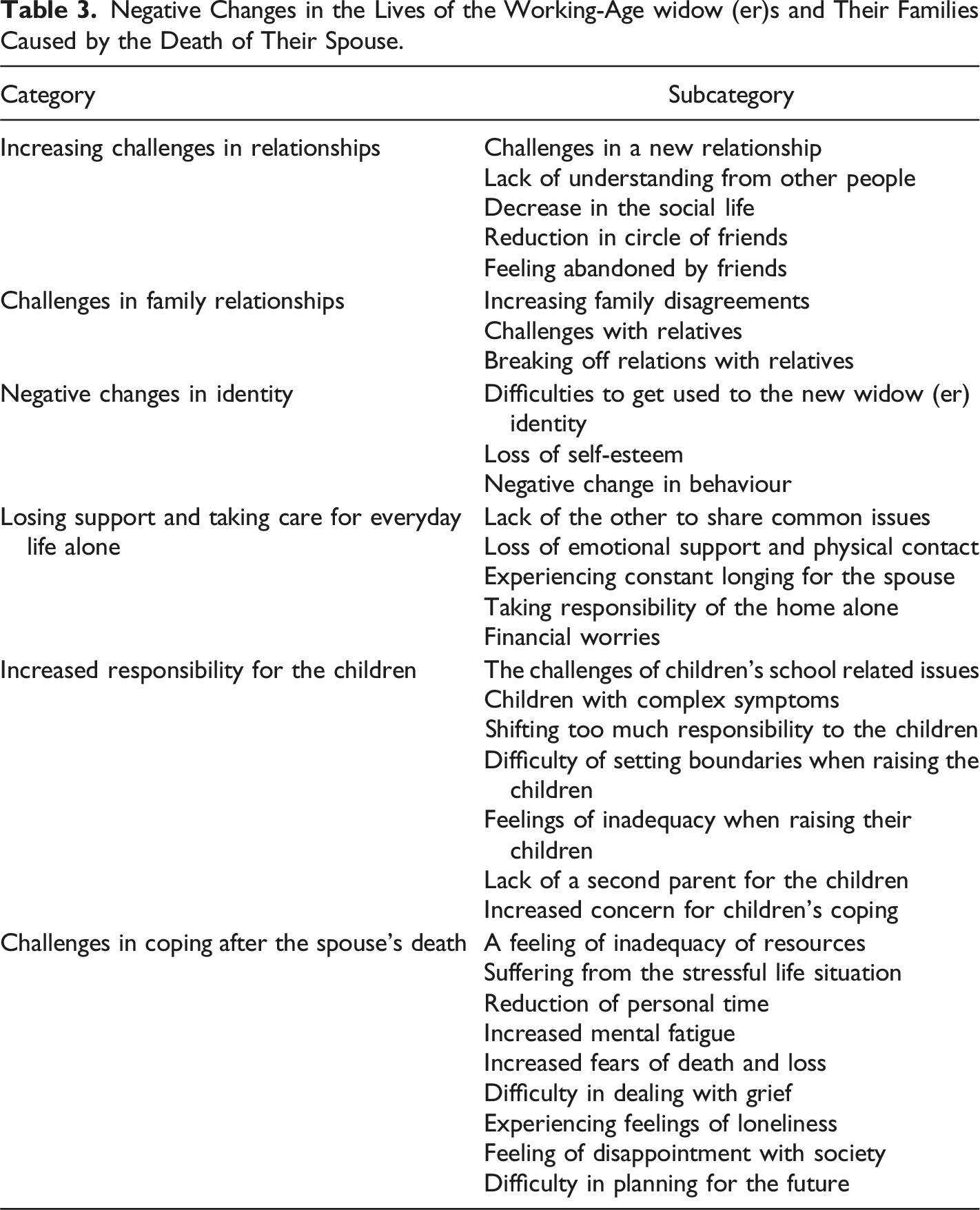
Negative Changes in the Lives of the Working-Age widow (er)s and Their Families Caused by the Death of Their Spouse.
The researchers discussed the analysis and findings throughout the analysis. The second author did the first reduction and coding of the data, the first author (MH) went through the entire process, and changes were made after discussions until a consensus was reached. No prior relationship was established between the researchers and the participants in the survey. The authors are experienced researchers and familiar with the phenomenon of interest. In terms of reflexivity, the authors are aware that this inevitably shaped all components of the research.
Results
Negative Changes in the Lives of the Widow (er)s and Their Families Caused by the Death of Their Spouse
Six categories emerged from the data, namely: increasing challenges in relationships, challenges in family relationships, negative changes in identity, losing support and taking care of everyday life alone, increased responsibility for the children and challenges in coping after the spouse’s death. Additionally, there are related subcategories that support these categories. All categories and subcategories are presented in Table 3.
Increasing Challenges in Relationships
The participants experienced “I have not been able to move on with my life in terms of, for example, being interested in finding a new partner. I just miss my spouse, and I can't imagine anyone else replacing my spouse.” (Widowed at the age of 43, response 84) “Fear in new relationships [exists] about whether that other person will also die soon - whether I dare to throw myself into this, in case I hurt myself again...” (Widowed at the age 28, response 34)
The widow (er)s described a “I've also noticed that in the car trade, for example, a lonely woman is not taken very seriously, or at least my huspand used to get things done better.” (Widowed at the age of 39 years, response 12)
The widow (er)s described a ‘I feel alone, lonely, even though I sometimes see my friends... I would like to go to festivals and events with someone to share experiences.’ (Widowed at the age of 49 years, response 96)
The widow (er)s experienced a “Friend couples have disappeared. (Widowed at the age of 43 years, response 51)
Widow (er)s described that they “Social relationships have almost completely disappeared, I have heard a lot of empty promises and wishes etc. Even with the remaining friends …. we don't communicate…, and with friends it can be months in between.” (Widowed at the age of 38, response 95)
Challenges in Family Relationships
The widow (er)s described “..the children don't communicate with each other, the youngest doesn't talk about the lost parent... I'm still trying to replace what my spouse does and that's why I can't do it sometimes because teenagers are too lazy to do anything before I get angry or cry”. (Widowed at the age of 44 years, response 83)
“There has been very little contact with relatives on the spouses's side. They themselves are not active in keeping in touch, and contact is entirely my responsibility.” (Widowed at the age of 32 years, response 26) “I can no longer care about my own parent who lives in a nursing home. (The parent) has late-onset Alzheimer's.” (Widowed at the age of 44 years, response 88)
Some of the participants described that the death of their spouse led to a “Some of my spouse’s relatives have been cut off and I am somewhat sad about this, although I have got used to it.” (Widowed at the age of 34 years, response 63)
Negative Changes in Identity
The participants described “The loss of my own identity is a painful change in that I am odd, while other acquaintances and friends remain even.” (Widowed at the age of 43, response 85)
The “My identity has taken a big hit, I feel like a freak, my self-confidence is low
A “I've become a bit blunt, maybe, because I just don't have the energy to make small talk or meet many new people. In some social gatherings (parents' evening, etc.) I'm quite quiet and an outsider”. (Widowed at the age of 37 years, response 23)
Losing Support and Taking Care of Everyday Life Alone
The participants experienced a For my part, .... the absence of another person to share things with .... We were always Us, did everything together, dog walking, bike rides, gardening. A lot changed after the spouse left. (Widowed at the age of 57 years, response 52) “My spouse was the only person in my life with whom I shared my thoughts, hopes, fears, dreams. I am mentally and emotionally lonely”. (Widowed at the age of 44 years, response 10)
The participants experienced a “There is no spouse. … The joy and positivity that a spouse brings has been lost. So has the energy the spouse brought to everyday life.” (Widowed at the age of 35 years, response 80)
The participants “Holidays are difficult - I would like to be all alone, [but] the family does not want to be left alone.” (Widowed at the age of 50 years, response 34)
The participants described an increasing “More housework and having to learn new skills....” (Widowed at the age of 45 years, response 60) “I still try to replace my spouse’s tasks …” (Widowed at the age of 44 years, response 64)
The widows also described “I can't keep my house tidy when I have to think about money all the time” (Widowed at the age of 45 years, response 9)
Increased Responsibility for the Children
The participants perceived ‘(Child) was very traumatised by the death of his father and has had difficulty coping at school.’ (Widowed at the age of 38 years, response 36) “The (child) moved back home and is unable to concentrate on studies.” (Widowed at the age of 55 years, response 50)
Some of the widows described that their “We talked a lot, we went through death and the emotions associated with it, such as sadness, fear, anger and guilt. The sadness and anger are expressed as aggression in the older child, and the guilt is expressed as self-esteem problems.” (Widowed at the age of 41 years, response 11)
Widows shared their experience of “I worry about the children when they try to help too much, and thus sacrifice their own lives for the sake of their parent” (Widowed at the age of 61 years, response 56) I am the only parent to the children, and it weighs on my shoulders… Fortunately, as the children have grown up, they have had to take on some of the tasks but even that is not quite right. (Widowed at the age of 40 years, response 12)
Widow (er)s felt that it had become more “As a single parent, you don't always have the time or energy to intervene in what your children are doing/not doing, and you have to turn a blind eye to some things. You don't always have the energy to start wrestling with teenagers.” (Widowed at the age of 46 years, response 74)
The participants described “When my (child) was going through puberty, I really wished that the missing parent had been involved in all the day-to-day activities and decisions. But in the end, others don't understand things in the same way.”(Widowed at the age of 53 years, response 14)
The “I experience inadequacy in relation to my children who are adolescents. They lack the other parent's gaze, attention and all the presence they used to get. I can't make up for it by having to deal with so many more practical things than before.” (Widowed at the age of 43 years, response 85)
The widow (er)s felt that an “I am concerned about the children's survival in the future. I am worried about how much they have suffered and are suffering from the death of their parent, and how much I have contributed to their grief by not daring to help them express their feelings or other concerns themselves.” (Widowed at the age of 44 years, response 83)
Challenges in Coping after the Spouse’s Death
The widow (er)s expressed “ ...my energy resources are often very limited and social situations with people other than a couple of significant others are exhausting” (Widowed at the age of 37 years, response 23)
“It is very hard to be the sole carer of three school-age and adolescent children. There is always a lot to do and a lot to remember, which causes stress and arguments.” (Widowed at the age of 41 years, response 55)
The participants experienced Loneliness prevents you from even trying. I was suffering from insomnia before and it just keeps on happening, especially at night when all the thoughts come into my head. (Widowed at the age of 57 years, response 3)
“I am afraid that something will happen to myself (and the children will have no one), and because of this I have even had to cut back on my own personal appointments.” (Widowed at the age of 44 years, response 36)
Their “I've been very strong at times, because I've had to deal with my own grief as well as my children's...” (Widowed at the age of 41 years, response 11)
“Distrust of health care, it's a guessing game. Distrust of the social services and their total lack of justice and understanding, only added to the pain and distress of our family. Bitterness towards society, creating pressure on an already heavy burden bearer.” (Widowed at the age of 44 years, response 64)
Compounding the Sometimes difficulty in pushing for goals in a world where anything can happen to anyone at any time. (Widowed at the age 46, response 4) “In one second, all the plans for the future that we had made together were stripped away.” (Widowed at the age 61, response 56)
Discussion
The death of a spouse was related to many negative life-changes for the working-age widow (er)s and their families. First of all, the widow (er)s expressed that their social network changed after the death of their spouse. Previous studies have reported similar findings (Dunn, 2015; Jones et al., 2019; Lowe & McClement, 2011). In addition, in this study they described challenges in relationships and felt abandoned from their friends. They expressed lack of support from friends and relatives. This finding is an important insight when, social support has been reported to protect from the negative effects of bereavement and facilitated positive adjustment in younger widow (er)s (Anderson et al., 2023). In the developed countries the life expectancy has increased and is forecasted to still improve in the future (GBD 2021 Forecasting Collaborators, 2024). When people are expected to live longer, and the context of ageing population is prevailing it may increase the feelings of unpreparedness and lack of social support in a situation where a person in working-age dies. This is particularly emphasized in sudden deaths of working-age people due to unpredictability, in which case widow (er)s have not been able to prepare for the loss, which may lead to, for example, prolonged grief disorder, post-traumatic stress disorder, or depression (Kristensen et al., 2012). It is important that professionals provide support for widow (er)s, especially as previous research has shown that although many widows were successful in developing their social support, psychological and emotional problems are common (Petrus et al., 2016).
The research results showed that the widow (er)s described a lack of confidence in the future and a fear of losing the new partner, which challenged the formation of a new relationship. This was an aspect that was less frequently addressed in previous studies. However, according to Chan and Chan (2011) widows may experience a sense of hopelessness about the future as they realise the limitations of life and become aware of their own impending death. It is very natural to contemplate and even fear one’s own death after the death of a loved one. Losing hope in life is something for which grieving widow (er)s may need professional help to avoid the negative consequences of grief, such as suicidal thoughts and actions (Stroebe et al., 2007).
Widow (er)s described negative changes in their identity and difficulties in building their new role, a finding consistent with previous research (Lowe & McClement, 2011). In the working age, the expected role was to work or look after the family and live as a couple. The loss of the spouse broke these expectations, and the widow (er) had to rebuild their roles and identity. This was seen as a negative life change and difficulties in building the new role and identity were described. Similar findings were reported in an earlier study describing the challenges of identity change for younger widow (er)s, when in society widowhood is more commonly associated with older age (Anderson et al., 2023). They also described negative behavioural changes, including increased alcohol consumption. A previous study also showed that widows increased their alcohol consumption more than the control group after the death of their spouse (Kowalski & Bondmass, 2008). These findings help to understand the challenges faced by the widowed and can help professionals to better target support to widow (er)s.
In this study losing support and taking care for everyday life alone was negative changes that the widow (er)s experienced. Surviving alone with every-day life, worries about money, and losing a partner with whom to share common moments were particularly difficult. Similar issues have also been described in earlier studies, (Bellamy et al., 2014; Picazzio Perez Batista et al., 2019) and the need for financial support has been raised as a difficult and worrying aspect (Picazzio Perez Batista et al., 2019), that should be considered by professionals, (DiGiacomo et al., 2015) especially when it has been shown that widows who had more financial worries also had more grief (Dunn, 2015).
When being a widow (er) in working-age the likelihood to also have children or ageing parents in need of assistance is bigger than in older age. The widow (er)s in this study reported challenges in family relationships, they described increased disagreements in the family and reduced or even breakdown in relationships with relatives. At the same time, they described the increased responsibility for the children or own parents in need for assistance. Previous studies show that widows who are left as sole caregivers are characterised by coping with their own grief at the same time as caring for grieving children (Werner-Lin & Biank, 2012; Yopp et al., 2015). They also described the difficulty of caring for other family members when they needed support for themselves, similar to findings of previous research (Ungar & Florian, 2004). Children who have lost a parent are at risk of poor psychological outcomes including depression, anxiety and somatic complaints (Brent et al., 2012). At the same time as widowhood may have increased the narrowing of the social safety net, it has also increased challenges to cope with responsibilities to care for children and family members. As also stated in earlier studies, the need to develop tailored support for widow (er)s in young age is important (Anderson et al., 2023). The support should take into account the individual needs of the widow (er) and the family members.
Challenges in coping after the spouse’s death was described by the widow (er)s. According to this research, widow (er)s perceived a quiet home as negative aspects. This is in line with earlier research which found that widows faced challenges, such as long time periods spent alone and a lack of things to do (Chan & Chan, 2011). In addition, in this study they described mental fatigue, loneliness and difficulties to cope with grief. Depression (Jones et al., 2019), significant negative impact on widow (er)s’ mental health (Blanner et al., 2021) and loneliness has been reported in earlier studies (Brown et al., 2018; Camacho et al., 2024; Lamba, 2023; Vedder et al., 2024). The widows in this study experienced also belittlement, as also Haase (2008) has mentioned that young widows felt they had no right to grieve as they had the opportunity to remarry and live further a long life. Also, the working-age widows described a lack of free time, which led to a reduction in opportunities to pursue their own hobbies. This should be taken into account when developing support, especially when widows who reduced their leisure activities following the death of their spouse have been reported to have more symptoms of depression than widows who continued to participate in leisure activities (Janke et al., 2008).
A significant finding in this study was the strong impact of widowhood on parenting and worrying about children and their various issues and symptoms. Consequently, it is important for health care staff to talk to widow (er)s about their support networks, and where appropriate, signpost them to services and resources where they and their children can get support. The many changes in their daily lives require multiple ways of supporting the whole family. So, health care and policy should take into account the negative life events associated with widowhood identified in this study, in order to provide widow (er)s and their families with the support they need.
Strengths and Limitations of the Study
The participants represented working-age widow (er)s, and the data were rich, which strengthens the value of the results. To our knowledge, this is the first qualitative study to explore the negative experiences of widowhood in Finland. The findings are a valuable addition to the ongoing discussion about how best to meet the needs of widow (er)s and their families. In addition, data saturation was achieved during the analysis, which can be seen as a strength of the study (Saunders et al., 2018). The research also included certain limitations. For instance, the questionnaire was answered anonymously, therefore, it is impossible to know the reason(s) why certain widow (er)s refused to answer this question. There was also no opportunity to ask widow (er)s further questions or to return the results to them for comments or corrections. Another limitation to transferability is that most of the participants were women.
Research Ethics
The subject of the study is sensitive due to the difficult life situation of the research participants. As there is little information available on the subject, the study topic was ethically justified. At the beginning of the electronic questionnaire, a cover letter explained the aim and process of the study, the voluntary nature of participation, and the confidentiality afforded to the participants and data (Bengtsson, 2016) which included that the participant could choose to withdraw from the study if they so wished. No personal data were collected in the survey, and any identifying information was anonymised. The contact details of the researcher were provided in the cover letter in case the participants wished to contact the researcher (TENK Finnish National Board on Research Integrity, 2023). Responding to the questionnaire was taken as informed consent. The study followed the principles of research ethics in regard to reliability, honesty, respect and accountability (All European Academies, 2023; TENK Finnish National Board on Research Integrity, 2023). Permission for the study was obtained from the Nuoret Lesket Ry association.
Conclusions
In conclusion, the death of a spouse causes many negative life changes for widow (er)s and their families in many different areas of life. Widow (er)s felt that their lives had become burdensome, and the death of their spouse had left them alone with a heavy responsibility for their home and children and other family members. The children displayed various symptoms related to the loss of a parent. The results of this study confirmed that the death of a spouse has a negative impact on the widow (er)’s identity, relationships, and triggers emotional problems that among other things may also hinder their coping. As a topic for further research, it would be important to investigate how working-age widow (er)’s and their families are concretely helped after the death of their spouse.
Footnotes
Acknowledgements
The authors wish to express their gratitude to all participants who voluntary gave their time for this study.
Author Contributions
Planning of the study: ALA, data collection: ALA, analysing the data: ALA, MH, writing the manuscript: MH, ALA
Declaration of conflicting interests
The author(s) declared no potential conflicts of interest with respect to the research, authorship, and/or publication of this article.
Funding
The author(s) received no financial support for the research, authorship, and/or publication of this article.
