




Abstract
This study aimed to investigate fathers’ lived experiences of stillbirth through the lens of continuing bonds and use of objects. Semi-structured interviews were conducted with six fathers who had experienced stillbirth from 20 weeks gestation. Interpretative phenomenological analysis revealed five themes: loss and continued bonds in a mother-mediated dynamic, objects as manifestations of relational and meaningful memories, exerting existence and continued connection to others, continued bond through physical presence and evolving expressions of love and fatherhood. Findings offer a novel understanding of the relationship between objects and continued bonds, where objects are seen to facilitate this bond through varying means, including physical manifestation of the deceased and representation of the father-infant relationship. The study places importance on fathers’ involvement in creating objects permeated with meaning and memories, and of validating fathers’ experiences of loss rather than considering these men merely as partners of a mother who lost their own baby.
Keywords
Introduction
Globally a baby is stillborn every 16 seconds (United Nations Inter-Agency Group for Child Mortality Estimation, 2020), leaving millions of parents facing perinatal bereavement. Definitions of stillbirth vary internationally and tend to arise from survival rates for birth at different weights or stages of gestation (Da Silva et al., 2016; Fairbairn, 2018; World Health Organization, 2020). In response to medical advancements many now campaign for updated legal definitions of stillbirth to reflect the viability of babies lost as early as 20 weeks (Fairbairn, 2018).
There is a wealth of quantitative research into the psychological outcomes of stillbirth for mothers, which tend to investigate its impact on mental health symptomology. This research indicates that bereaved mothers experience increased anxiety following stillbirth (Campbell-Jackson & Horsch, 2014), with higher rates for mothers bereaved in the last half of pregnancy up to a month post birth, compared to mothers following a ‘live birth’ (Gold et al., 2014). The research also suggests bereaved mothers experience higher rates of depression (Campbell-Jackson & Horsch, 2014; Klier et al., 2002; Wall-Wieler et al., 2018) and post-traumatic stress disorder (PTSD) (Dubenetzky, 2017; Gravensteen et al., 2013). A recent systematic review of research on the psychological outcomes of stillbirth on parents found that bereaved parents were significantly more likely to experience depression, anxiety and PTSD compared to parents following a live birth (Westby et al., 2021). However, this review included only two studies with samples including fathers, limiting the review’s implications for this population. There is a relative lack of research investigating psychological outcomes for fathers. However, research quantitatively investigating this in samples of mothers and fathers together offer comparisons of psychological impact between the two groups. Much of this research suggests that fathers experience these difficulties to a lesser extent, with lower rates of anxiety (Farren et al., 2018; Jones et al., 2019), depression (Lewis & Azar, 2015), PTSD (Christiansen, 2017) as well as lower scores on measures of psychological impact for specific loss types such as miscarriage (Huffman et al., 2015).
Importantly, a systematic review of literature on men’s health and wellbeing following pregnancy loss, suggested that although psychological outcomes seemed less intense and enduring compared to mothers, men were more likely to engage in increased alcohol and drug use (Due et al., 2017). This finding highlights an important critique of the quantitative literature previously explored; that the outcome measures used are perhaps more sensitive to the occurrence of psychological distress in women than men. Indeed, the hospital anxiety and depression scale is heavily used in the cited literature (Farren et al., 2018; Klier et al., 2002; Lewis & Azar, 2015), yet this does not measure substance use (Zigmond & Snaith, 1983) and has been suggested to have “questionable” validity in the male population (Nortvedt et al., 2006). More recently, a study found that fathers’ scores on perinatal grief measures were indicative of a high degree of grief, following loss at any stage of gestation or birth (Obst et al., 2021). This suggests that men do not ‘suffer less’, rather their distress is not captured by the mental health outcome measures utilised in this research. It is also vital to highlight qualitative findings which evidence highly emotive experiences of loss (Klier et al., 2002). Fathers report ‘holding it together’ to support their partner (Jones et al., 2019) and intense feelings of guilt, sadness, and emptiness (Aydin & Kabukcuoğlu, 2021).
Qualitative research can offer insight to the experience of perinatal loss in a way that provides evidence for or challenges dominant theories of grief and bereavement. For instance, through exploring the experiences of parents, Rando (1995) made it clear that presentations of grief that were considered pathological, such as a continued emotional connection with the deceased, were in fact highly typical for bereaved parents. This experience was first coined as ‘continuing bonds’ by Klass et al. (1996) and conceptualized the experience parents reported of an ongoing relationship with their deceased child. Contemporary bereavement theory has continued to explore this idea and continued bonds with the deceased has been increasingly recognised as central to the grief experience (Klass & Steffen, 2018). Such research offers challenge to historical theories of bereavement that suggest “grief work” as a requirement for adapting to a loss (Bowlby & Parkes, 1970) with importance placed on accepting the reality of the death, detaching from the deceased and reorganizing relationships with the living (Stroebe & Schut, 2005).
There is an abundance of qualitative evidence to support the theory of continuing bonds in mothers following perinatal loss (Field et al., 2013; Hunt, 2020; Jones, 2020; Yamazaki, 2010). Contributing to this literature is evidence for the use of objects, such as soft toys, in facilitating continued bonds. Mothers have reported talking to their baby and interacting with objects such as footprints or photographs to feel close to their child (Yamazaki, 2010). Contemporary research has also begun to consider objects collected in a grief context as transitional, with this explicit link to theory absent in previous research (Wakenshaw, 2020). Transitional objects have long been considered in children, where the attachments formed with inanimate objects facilitate a transition away from the mother (Winnicott, 1953). The use of transitional objects in bereaved parents is common and is suggested to be beneficial in coping following the loss of a child (Goldstein et al., 2020). These objects seem to facilitate the physical and emotional aspects of parenting that are missing following perinatal loss (LeDuff et al., 2017), and as such may be a manifestation of two opposing concepts: a continued relationship with the baby and a transition away from them.
Though there is emerging evidence of continued bonds and use of objects in mothers, studies investigating fathers’ experiences of object use and continued bonds are absent. In the research that does exist, fathers report bathing, holding, and talking to their baby at the time of stillbirth and talking to and about their baby long after the loss (Bonnette & Broom, 2011). This presents some evidence for the existence of continued bonds in this group. However, there is little exploration of fathers’ experiences of such continued bonds. Furthermore, fathers’ experiences of object use surrounding their loss was not explored.
The aim of this study was therefore to qualitatively investigate fathers’ lived experiences of stillbirth, through a lens of continuing bonds and use of objects. The study will address such aims by investigating three research questions: how do fathers experience relationships with their baby in pregnancy, stillbirth and following the loss? How do fathers use objects during pregnancy and post-loss, and how do these objects influence relational experiences explored in the first research question?
Method
Design
Given the personal and variable experience of stillbirth, it was important for the study design to identify themes reflecting the sample collectively and the varied experiences of each individual participant. Thus, Interpretative Phenomenological Analysis (IPA) was applied to data from semi-structured interviews. IPA is built upon idiographic phenomenology and hermeneutics; that is the exploration and interpretation of individual experience (Eatough & Smith, 2017). IPA involves in-depth exploration of how each participant makes sense of a given phenomenon (Smith et al., 2009) and strikes a balance between individual meaning making and similarities of experience across a group with a shared experience (Smith, 2004). IPA in this study will therefore give broad themes of fathers’ experiences whilst identifying nuances of this between participants.
Sampling and Participants
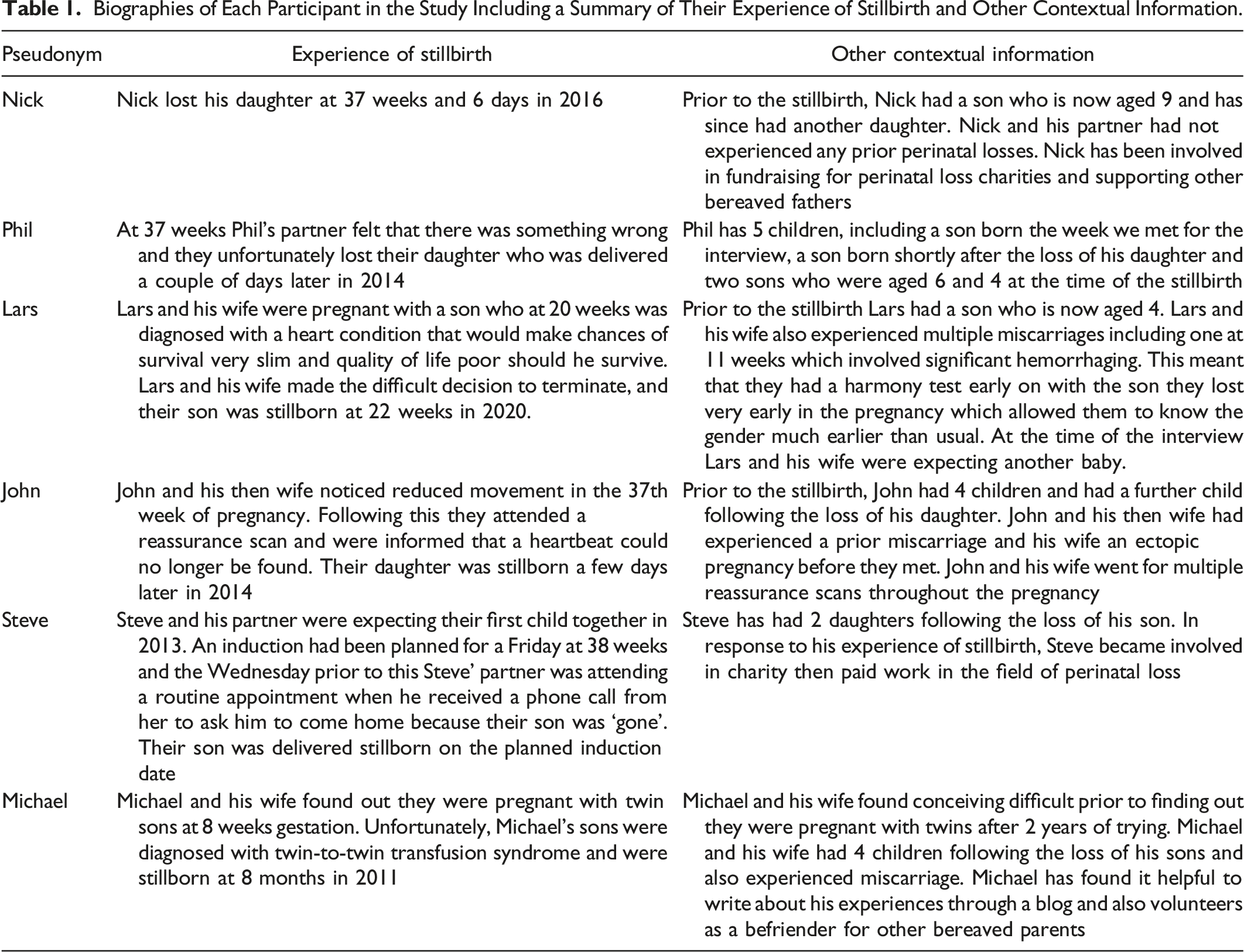
Participants were recruited following advertisement of the study through the professional social media accounts of the principal researcher and a set of perinatal loss charities that agreed to support recruitment. These charities either supported fathers’ exclusively or supported both mothers and fathers through support groups, helplines, provision of memory objects to hospitals and a facilitation of peer support with other bereaved parents. Further community organisations that support fathers, such as bereaved fathers’ football clubs or social media based support groups for bereaved fathers, were also contacted to request advertisement of the study within their networks.
Given the idiographic analyses of personal experience and inference of similarities across participants within IPA, a homogenous sample is important (Noon, 2018). It is suggested that studies should aim for a small but purposive sample who share a common experience, with typical sample sizes of 4–10 participants (Murray & Wilde, 2020). To achieve a homogenous sample, inclusion criteria specified participants must be fathers, aged 18 and above, who had experienced stillbirth from 20 weeks of gestation onwards, in the 10 years prior to interview. Fathers must also have identified as having interacted with meaningful objects, throughout this experience. In the study, meaningful objects are defined as any object collected by fathers during pregnancy or in the time following stillbirth that holds meaning to them in relation to their experience of stillbirth or their stillborn child. In recruitment materials, examples such as memory boxes, soft toys and clothes were given to aid potential participants understanding. In the present study stillbirth is defined as death after 20 weeks gestation in response to campaigns to update the definition from the current 24 weeks gestation in the United Kingdom, due to viability at this stage (Fairbairn, 2018). The cause of stillbirth was not specified, allowing participants who experienced termination for foetal abnormality. The decision to include these participants was due to a shared experience of 20 weeks gestation and the birth of a deceased baby, despite variance in cause of death. To minimise any potential distress for participants, consideration was given to the amount of time that had passed since their experience of stillbirth. Given that the psychological impact of perinatal loss lessens approximately 6 months post-loss (Klier et al., 2002; Lewis & Azar, 2015), only fathers who had experienced stillbirth six or more months prior to the interview were included, to minimize potential distress.
Biographies of Each Participant in the Study Including a Summary of Their Experience of Stillbirth and Other Contextual Information.
Data Collection
Participants completed an initial online survey to record their consent to take part and to provide anonymous demographic information. Interviews were conducted via Microsoft Teams due to the coronavirus pandemic and consequent restrictions on face-to-face contact. The principal researcher devised an interview schedule that explored fathers’ experiences of the father-infant relationship and use of objects in pregnancy, at the time of stillbirth and post-loss. Consultation on the interview schedule was sought from an academic researcher with experience in qualitative research and a clinical psychologist who is the patron of a perinatal loss charity. Follow-up questions not included in the schedule were asked where appropriate to obtain sufficient data to answer the research question. The interview schedule is provided in the supplementary material. Interviews were completed between February and August 2021 and were recorded and transcribed verbatim.
Analysis
While there are a wide variety of authoritative texts that describe the tenets of IPA (Smith & Osborn, 2008; Shinebourne, 2011; Smith et al., 2009), as well as descriptions of how to conduct IPA (Murray & Wilde, 2020; Pietkiewicz & Smith, 2014; Smith et al., 2009), there is not one universally adopted approach. In the present study, to offer a fully auditable analysis with high adherence to the principles of IPA, the guidelines outlined by Murray and Wilde (2020) were adopted.
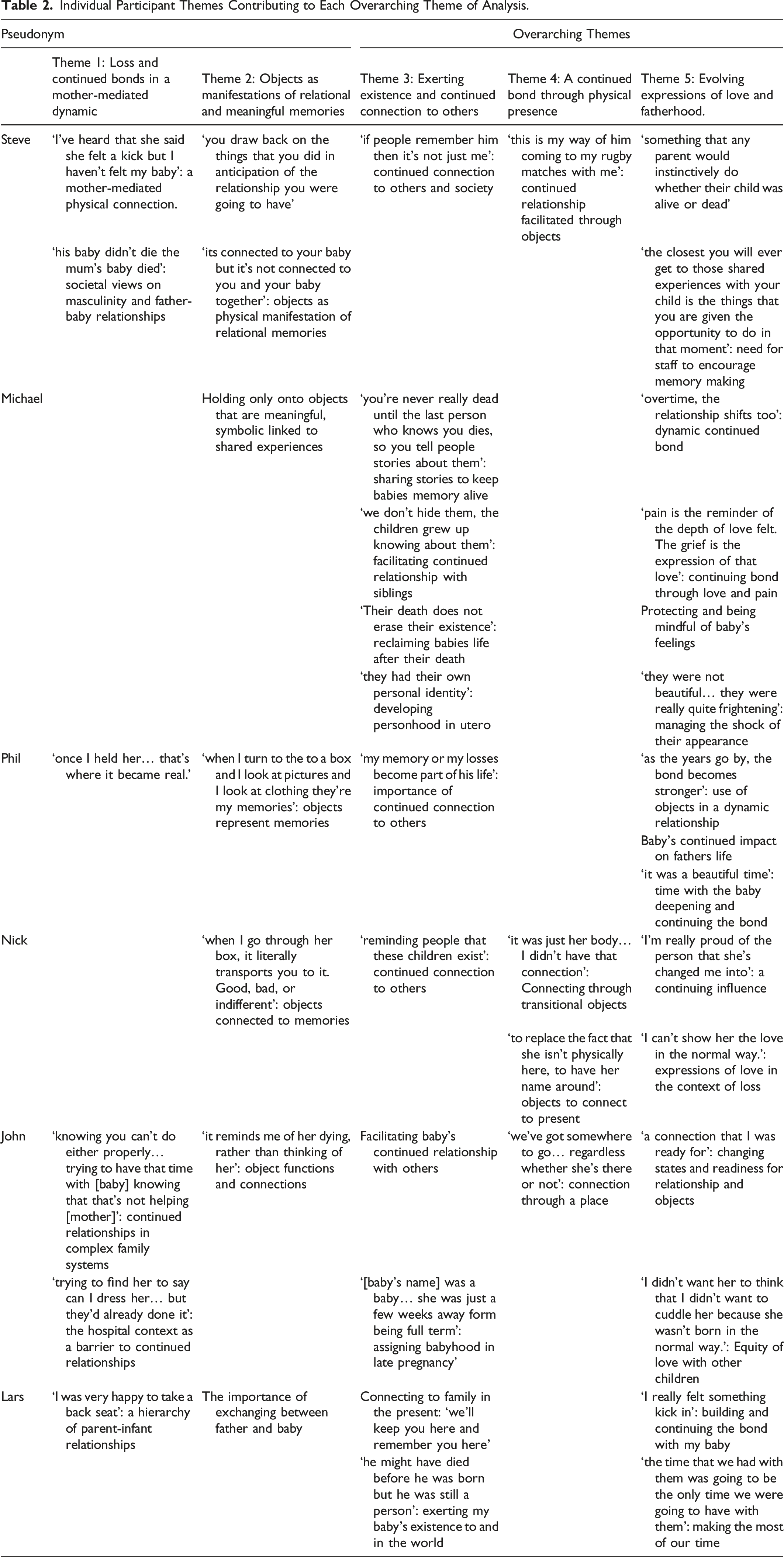
In a process by which each transcript was analysed individually, initial codes were created to summarise data pertinent to the research question without excluding meaning through simplification. Subsequently, codes were separated into small groups representing similarities of experience across the transcript. Interpretative summaries were written for each group of codes before being given a title which became a theme of the data. For the aforementioned stages of analysis, a subset of the data was analysed by the rsecond author to ensure consensus across raters and to quality appraise the analysis. This process resulted in a reappraisal of themes with a stronger focus on the research questions.
Following the analysis of each individual transcript, the resercher (first author) ‘bracketed’ any emerging themes to maintain ideography and avoid prior analysis creating bias in the analysis of further transcripts (Smith et al., 2009). The researcher did this through analysis of one transcript at a time, with a period of time between each, approaching each new transcript without looking for themes found in those analyzed previously. Consideration of the researcher’s own experiences and engagement in reflexivity was important in this process. The researcher kept a reflective and reflexive journal to pay attention to their personal experiences and how they may shape their perceptions of the data. For the researcher’s reflexivity statement please consult supplementary materials.
Individual Participant Themes Contributing to Each Overarching Theme of Analysis.
Ethical Issues
Full ethical approval for the study was obtained from the ethics committee of the authors’ host institution. Participants were informed that pseudonyms would be used, however participants in bereavement research have been found to request the use of their own or the deceased’s name in the research, citing reasons of challenging stigma or memorializing the deceased (Scarth, 2016). In this study, four participants requested their own name, or the name of their baby be used as their pseudonym. Those who requested this were sent a copy of the final set of the results and asked for their informed consent for their chosen name to be used. All other identifying information was removed.
Results
Theme 1: “His Baby Didn’t Die the Mum’s Baby Died”: Loss and Continued Bonds in a Mother-Mediated Dynamic
Most of the fathers expressed a sense of a father-infant relationship mediated by or viewed through a maternal lens. This experience was apparent in fathers’ reports of pregnancy being physically owned by the mother with family members, friends and professionals focussing on the mother-infant relationship, neglecting the presence of a relationship between the father and his baby during pregnancy, following through to the birth experience and beyond.
The fathers recounted a pregnancy in which their father-infant relationship was emotional or “theoretical” in contrast to the physical and embodied mother-infant connection. As Steve reflected, “it’s a weird one for dads isn’t it because you don’t have the same physical connection as the mums do so I think the bond isn’t quite the same”.
Steve also reflected on seminal moments in the building of a relationship with his baby prenatally that though powerful, were mediated through a physical connection with the mother: ‘‘putting your hands on your partners stomach and feeling a kick but even then that’s tangentially that’s through somebody else’‘. In this way, as Phil reflected, the first physical connection between father and infant becomes a pivotal moment: “the memories were built once I held her. For me that’s where that that’s where it became real”.
The fathers recounted their experiences in the hospital at the time of stillbirth where staff offered them the opportunity to spend time with their babies. This offer was one that for some fathers, came with complication compounded by consideration of the mother’s emotional needs. As conveyed by John: “trying to have that time with [baby] knowing that, That’s not helping [mother] right now, ‘cause of you know just how she was feeling”. John expressed conflict between supporting his wife and building a relationship with his daughter, “knowing that you can’t do either properly’‘. For John this meant that he could not dress his baby: “shortly after she’d taken [baby] away I ended up sort of running around the hospital trying to find her to say, look can I, can I dress her, but they’d already done it”.
Fathers tended to place more importance on the mother-infant relationship. For Lars, there was some conflict over whether this represented “denying” himself: I did hold him a few times and things, but I didn’t want to deprive her of time with him… I’m very much aware of whatever I was feeling you could probably times it by a thousand and she would be feeling more, which might have been denying myself, I don’t know.
In the time following their loss, most fathers conveyed a sense that their role as the stillborn baby’s father, and therefore the father-infant relationship was denied. This perceived denial of their role as a grieving father seemed related to fathers’ perceived role as a supporter to the mother, which came at the sacrifice of their own permission to grieve. Steve reflected: There’s that sense of when your baby dies, the mum is the one that grieves and the dad’s role is to look after the mum and nobody allows the dad to grieve, because that’s not his job, his baby didn’t die the mum’s baby died.
The fathers’ own as well as others’ perceptions of the fathers’ role in supporting the mother gave rise to a conflict for the fathers’ in this study. Though fathers’ seemed to take on the role of supporter and saw value in this, fathers’ also reported a denial of their grief and their role as father in this mother-mediated dynamic.
Theme 2: “It’s Connected to Your Baby but it’s Not Connected to You and Your Baby Together”: Objects as Manifestations of Relational and Meaningful Memories
All fathers in this study recounted experiences whereby particular objects held a connection with the father-infant relationship, either through an imagined future or lived memories concerning such objects. Such objects were reported by the fathers to be highly important and meaningful.
Several fathers commented on an imagined future relationship, for instance Steve reflected: “you draw back on the things that you did in anticipation of the relationship you were going to have”. Steve described buying items such as a giant teddy bear, “in anticipation of plonking your child between the legs of this bear and cuddling up and reading a story”. Similarly, Nick created a rug for his daughter during the pregnancy and reflected on this object’s connection to imagined memories: “when I was making it… I’d planned it all out… I’d already envisaged her being on it, taking photos of her on it, her physically being on it.”
For some an exchange between father and infant was important. For Lars, this was represented in a keyring where part remained with him and part was placed with his son for cremation, “the actual heart itself they put in his hand and kept that with him while he was cremated so it could well be intact in his ashes.” Others reflected on the deeply personal meaning of their collection of objects. Phil conveyed this with his memory box of poems and letters from his children to their stillborn sibling: “if I was to show them to someone else… it means nothing to them, but to me, my wife and kids, aye it means everything.”
The fathers in the study conveyed the sense that this connection between objects and memories holds particular importance in the context of stillbirth, as Phil reflected: Stillbirth is the hardest thing to take, because you have to build your own memories, likes of if someone passes away, someone who’s close to you, … you can think about them, things you’ve done with them, and you have them memories.
Subsequently, forging memories of father-infant interactions becomes significant. For some fathers involved in creating hand and footprints, such objects represented this shared experience, as Michael conveys: “We’ve got photos and handprints and ‘cause those are the stories that we shared.” Nick recounted not knowing when his daughter’s footprints were taken, “so when I see them, I love them… but it doesn’t give me a memory ‘cause I wasn’t there when they were being done.” Similarly, Steve reflected “I don’t have the experience of doing (baby’s) hand and footprints, I have his hand and footprints.” Steve conveys the impact of this lack of involvement where objects become void of meaning: “you just got home with a box that’s full of a load of stuff and it’s connected to your baby, but it’s not connected to you and your baby together.”
It is important to consider the objects that did not comfort fathers. John reflected that a teddy bear he received “mainly reminds me of her dying, rather than thinking of her.” This contrasts Steve’ experience of buying a teddy bear with his pregnant wife, conveying this as a shared memory with “the three of us.” Importantly for John his desire to spend time with his stillborn baby was cut short as she was taken way to be dressed and have footprints taken. In this way, the lack of involvement in creating relational memories may have rendered objects collected as representations of his daughter’s death rather than their relationship. John later created a ring with his daughter’s ashes, an object that holds great significance for him. In this way John created an object to represent the father-infant relationship in a similar yet distinct way to those fathers who forged meaning with objects at the time of stillbirth.
Theme 3: “Their Death Does Not Erase Their Existence”: Exerting Existence and Continued Connection to Others
All of the fathers in the study conveyed a desire for a continued bond between their baby and others. Fathers expressed desire to exert and gain acknowledgement of their baby’s existence from society and their social networks. Through this, the father-infant relationship could also be acknowledged which may strengthen the fathers’ continuing bond.
Their baby’s perceived existence is of clear importance to the fathers, as Michael expressed: “their death does not erase their existence any more than the death of one of your family members will erase their existence.” For Lars, the absence of a birth certificate was distressing: “He was about 22 weeks at that point but because he was born dead then he didn’t get registered for a birth which did, I was a bit upset about… I wanted that acknowledgement.” Lars powerfully reflected that if people were to trace his family history, his son would not be found. As such, this physical and legal manifestation of his son’s existence through the medium of a birth certificate, becomes a powerful but absent object.
This societal dismissal seemed to filter into responses from the family and friends of the fathers in the study. Steve recalls comments from his mother, “she said I am not a grandmother yet thank you very much and what she meant was I am not a grandmother to living children yet.” For Phil, the varied acknowledgement of his daughter’s existence from family and friends, caused a reorganisation of the hierarchy of his social network. Phil reflected that a friend he was previously not close to became an important figure in his life because: “every year… he’s the one that phones me’’ adding that, “my memory of my losses become part of his life.”
This sense of dismissal is at clear conflict with the fathers’ perceptions of their babies’ personhood, as Michael expressed in early pregnancy: “we wouldn’t refer to them as just like a blob or the twins, they had their own personal identity.” Lars exerted his baby’s personhood despite his death, “he might have died before he was born but he was still a person.”
Given the conflict between fathers’ perceptions of their babies’ personhood and the varying acknowledgement of this by others socially and legally, the fathers in this study sought to maintain a continued bond between their baby and family and friends. Nick conveyed his daughter’s presence around the home through objects as “a soft way of just reminding people that these children exist.” This physical exertion of the baby’s presence is also seen for Lars who expresses, “I wanted to take one of the four books out and give him that so that on the shelf we could always see that one was not there.” Though initially this may seem a reminder of his son, the gap in the set of books is rather a statement of his son’s presence through absence, a way to avoid forgetting that he is missing from the home. For some fathers, objects were used to engage their other children in a continued bond with their baby, through things like picking a present that their sibling may have liked. Michael recounts that “the children help pick out the present, what would a 10-year-old boy like?.”
Theme 4: “To Replace the Fact That She isn’t Physically Here”: a Continued Bond Through Physical Presence
This theme reflects four of the fathers’ reports of objects representing a physical manifestation of their baby. For Steve “the physical manifestation of our baby who couldn’t be here was the pinecone.” Using this object, Steve was able to continue his relationship with his son after his death by taking a pinecone with him, “he can’t come to my rugby matches with me because he’s died, this is my way of him coming to my rugby matches with me through the medium of this pinecone.” Michael felt his twin sons were represented in a teddy that his living child took on days out with him, “We said we’re going out for your brother’s birthday… so he packed the little backpack, and he packed the bears in them… for him, those bears… represented his brothers”. The experiences of Steve and Michael contrast with the experience of John who conveyed his continuing relationship with this daughter through a tree as an object positioned in a static place to visit: “we’ve got somewhere to go and regardless of whether she’s there or not… that’s kind of like somewhere where we go to see [baby’s] tree.” John interacts with this object and place in a continued relationship with his daughter, particularly on special occasions “to take flowers for her birthday or Easter or Christmas.” John recounted that his daughter’s ashes were never scattered and so are not present at this tree however, the tree is in the gardens of the crematorium where his daughter was cremated. In this way, perhaps this tree’s position represents a connection to his daughter physically, as her last position in the world before cremation.
For one father the connection to a physical object seemed to transition over time. Nick expressed an initial connection to his daughter through the creating of a rug for her during pregnancy. He characterized the rug as “kind of growing and building as she was,” suggesting this object was significantly connected to his baby. Following the birth, Nick recounted not feeling a connection with his daughter’s body: “with her body, like for me it was and it was just her body… I didn’t have, I didn’t have that connection.” In this way his daughter’s physical body is not where the father-infant relationship existed, rather it became an entity free from restricted physicality in one place. Nick describes a teddy bear that “for a while… was kind of our contact, our contact point with [baby],” suggesting that this connection had transitioned from her physical body to an object. Nick recounts interactions with this bear that mimic the interactions he may have with his daughter were she to have been born alive: “So every night we when we kiss [child] goodnight, we’d give [bear] a kiss as well.” The father reflects that over time his “contact point” with his daughter transitions to a heart shaped patch of paint left in his daughter’s room after it was redecorated: I say goodnight to [child] and go in and say goodnight to [child] and then. I just kiss my hand and touch that (green heart). Uhm and yeah, it doesn't make me sad, it's just. Is. Yeah, it's just that connection.
Though the other fathers did not recount a clear transition between “contact points”, perhaps the pinecone and tree represent a similar concept; the connection of their baby to themselves and the world through a physical manifestation of their presence. Through this physical manifestation, the fathers can continue their relationship with their baby by interacting with these objects in various ways.
Theme 5: “Over Time the Relationship Shifts Too”: Evolving Expressions of Love and Fatherhood
Present in all the fathers’ interviews, this theme captures varying expressions of fatherhood including missed opportunities for this. Objects connected to such expressions became representations of the father-infant relationship. The theme conveys the dynamic nature of the ongoing relationship with fathers expressing varying levels of closeness to their baby over time. As Michael expresses, “overtime, the relationship shifts.” These shifts in the relationship are also seen where fathers’ report salient time points where their expressions of fatherhood were strengthened or challenged.
For Lars love was expressed in an urge to protect his son both in pregnancy “when I knew that he was ill and poorly and needed protecting I suppose, I really felt something kick in” and after birth “when he was born and I saw him like that, that really kicked in again”. For Lars the urge to protect seemed strongly connected to the roles and responsibilities of fatherhood, so much so that he wrote his son a letter after his death to say, “I was sorry I couldn’t protect him like I was supposed to”. In this way, this expression of grief, and love through protection was manifested into the object of a letter.
For others this love was expressed through instinctual parenting of their stillborn baby. Steve reflected “it was my natural instinct as a dad to get some tissue paper and just block where his nose is bleeding.” Importantly this interaction is represented by the tissue which was kept: “it’s in the memory box because that tissue paper is the physical manifestation of when I wiped my sons nose when it was bleeding.” For John, fatherhood was expressed through meeting his daughter’s emotional needs: “I know it sounds daft, but I didn’t want her to think that I didn’t want to cuddle her because she wasn’t born in the normal way.” Importantly for Steve, there were missed opportunities to facilitate this expression of fatherhood, “one of my biggest regrets is that I never read him a story, because it never ever occurred to me.” Steve was also not offered the opportunity to cut the cord and reflects: “if (baby) had been born alive somebody would have asked me if I wanted to cut the cord… it’s a rite of passage for dads.”
Expressions of fatherhood continued following loss. Nick reflected on running marathons for his daughter: “the stuff I do for [baby] is… more special, I guess. ‘cause I can’t show her the love in the normal way.” Others expressed grief and love by reflecting on their baby’s impact on their lives. As Phil expressed: “how can you forget someone that’s such a big part of my life… changed me so much?”. Michael expressed the way in which he continues a dynamic relationship with his sons: Checking in with myself about that relationship 'cause I know one of the things I tend to do is… if I feel embarrassed… I would deflect with I miss my boys and I don't like doing that because… I don't want to use them as a shield’.
For some fathers there were clear moments in which the relationship shifted. For Phil this occurred at the birth of his last child, urging him to interact with the objects associated with his daughter: The bond to me felt. Strongest on Friday… I just had a new baby and it was another boy and I just it just seemed to be like a feeling for me and that actually got the box out on Friday… I just felt I had to.
For John, the relationship shifted a decade after the loss of his daughter when he felt able to create an object: “I kind of really wanted to do that with the ring, and found that, like a connection that I was ready for.” Importantly Michael reflected that his ongoing pain at the loss of his sons represented the love he continued to feel for them: “you’re simultaneously trying to avoid pain whilst welcoming it… the pain is the reminder of the depth of love felt. The grief is the expression of that love.”
Discussion
The aim of this study was to qualitatively investigate fathers’ lived experiences of stillbirth, through the lens of continuing bonds and the use of objects. IPA revealed five main themes, which will be discussed in the context of existing research and their implications for clinical practice.
Findings indicated that the fathers in this study experienced their relationship with their baby being viewed through a mother-focused lens. This is consistent with a previous review of literature on men’s experiences of pregnancy loss which found that fathers report being seen as a “partner” not a father mourning their own loss and feeling overlooked where the mother’s pain was better recognised (Due et al., 2017). Fathers described a mother-infant relationship that is seen as more important than the father-infant relationship. Fathers explored this hierarchy stressing both the strength of their father-infant bond, and a desire or pull to support the mother, at times sacrificing time with their baby. In this way, perhaps as fathers respond to this societal view and ‘deny’ themselves, family members and professionals see an outward display of a ‘lesser’ father-infant relationship, despite clear internal desires from the fathers in the study to deepen their connection with their baby.
Importantly, findings conveyed the father-infant relationship as mediated through the mother’s physical body, adding to an emerging literature exploring fathers’ prenatal attachment. Though moments in pregnancy such as feeling kicks and ultrasounds have been shown to support fathers’ building attachments (Draper, 2002; Ekelin et al., 2004), some research has suggested these experiences do not create equity between mother-infant and father-infant attachment (Harpel & Barras, 2017). The findings of the present study add a novel understanding of this, since the missing physical embodiment for fathers is unavoidable until the moment of birth and any experience in which their own attachment builds is mediated through the mother’s embodiment until this point.
This mother-mediated dynamic was also conveyed as an added complexity to the facilitation of the father-infant relationship and continued bond at the time of stillbirth. For some fathers this seemed linked to a sensed expectation of their role in supporting the mother, a finding consistent with previous research (Aydin & Kabukcuoğlu, 2021; Due et al., 2017; McCreight, 2004; Miller et al., 2019). This led some fathers to spend less time with their baby to meet the emotional needs of the mother. For others, the hierarchical placement of the mother-infant relationship in relation to the father-infant relationship meant that fathers perceived spending time with their stillborn child as depriving the mother. This is mirrored in the fathers’ reflections on societal dismissal of the father-infant relationship, consistent with a recent review highlighting the lack of social recognition of fathers’ grief in the context of pregnancy loss (Obst et al., 2020).
In contrast to the notion of a ‘lesser’ father-infant relationship and subsequent ‘lesser’ distress, the fathers in this study conveyed the deeply meaningful and relational nature of objects collected. Though the use of objects in coping with perinatal loss is evidenced throughout the literature on mothers (Testoni et al., 2020) and through the limited literature involving fathers (Thornton et al., 2020), such research tends to position the objects as symbols or mementos that bring comfort, yet the mechanisms of their value remain unclear (LeDuff et al., 2017). The fathers in this study conveyed a sense that significant objects were those permeated with memories in which they interacted with their baby either in reality or an imagined future relationship. The literature exploring the use of objects in mothers suggests that seemingly mundane objects are transformed as they are permeated with deep, personal, and individualized meaning in a way that disrupts societal narratives of grieving, for instance through exerting a stillborn baby’s existence (Fuller & Kuberska, 2020). Themes one and two of this study together offer evidence for this phenomenon in fathers, where the dismissal of the father-infant relationship is challenged with objects that represent memories of the relationship offering physical confirmation of its existence. Importantly the fathers in the study reflected on the loss of a lifetime of shared memories with their child. The fathers subsequently forged memories with their stillborn baby either immediately after birth or in the years that followed, manifesting these memories into objects. Though consistent with research in mothers of stillborn babies that positioned objects as “memory triggers” (Bremborg & Rådestad, 2013), and research in mothers and fathers that positions objects as evidence of the baby’s existence and affirmed parenthood (Thornton et al., 2020), the present study conceptually links this phenomenon to memories of the ongoing father-infant relationship.
The fathers in this study expressed a yearning to exert their babies’ existence in the world. The fathers expressed distress when their babies’ existence went unacknowledged by family and friends, supporting research that positions perinatal loss as a “disenfranchised grief,” a loss that goes unacknowledged by society (Sawicka, 2017). Such research tends to focus on the experiences of mothers, although the present study found similarities in fathers’ experiences. Crucially, a unique aspect of fathers’ experiences relates to the way in which their fatherhood remains largely unacknowledged. This can create feelings of disenfranchisement, where fathers’ positioning on a hierarchy of grief is at contrast with their internal grief experiences (Robson & Walter, 2013). This combination of experiences is positioned as “double disenfranchisement” in Obst et al.’s (2020) theoretical model of paternal perinatal grief.
In the present study, fathers seemed to challenge their positioning on a grief hierarchy through the facilitation of continued bonds between their baby and others, exerting the existence of their baby and the father-infant relationship. The fathers achieved this through use of objects. For one father, the removal of an item from a set signaled his son’s presence through absence. This is consistent with the proposed theory of “materialised absence” whereby the concept of absence is formalized through material objects (Hallam & Hockey, 2001). For others, objects in the home served to remind others of their baby’s existence. In either case, since the objects most meaningful to fathers seem linked to relational memories, the use of such objects in exerting their babies’ existence serves also to exert the existence of the ongoing father-infant relationship.
For some of the fathers in the present study, objects took on a physical representation of their stillborn child allowing the use of such objects in the facilitation of a continued bond in day-to-day life. In the adult bereavement literature, some researchers have theorized that such objects are a materialization of the deceased used as “a way of reclaiming and rehousing… the remains of a life now gone” (Gibson, 2004, p. 297). The findings of the present study evidence the use of objects in this way for fathers, who rehoused their stillborn babies through objects within the home. However, the findings further this theory by evidencing the use of this object, their “rehoused” baby, in expressions of a continued relationship with objects traveling with fathers in life activities. The findings of the present study therefore provide a novel conceptual link between objects and continued bonds, where objects facilitate continued bonds through being a physical representation of the stillborn child.
This concept of an object as a physical manifestation of the stillborn child can be further understood as transitional, where an object is used to manage the emotional toll of separation from a significant other (Winnicott, 1953). Applying this theory to bereavement can offer some explanation as to the power of objects to the bereaved. Though there is abundant evidence of the use of objects as mementos and symbols by the bereaved, evidence explicitly linking this to transitional objects is lacking (Wakenshaw, 2020). In the present study fathers interacted with objects in a way that managed the inevitable distance between themselves and their baby. The diminishing importance of certain objects over time is also seen with alternative objects or rituals taking their place, consistent with Winnicott’s (1953) theory in which transitional objects lose importance over time as the child gains safety away from the parent. For some fathers in the present study the continued father-infant relationship shifted over time, as a result of life events like the birth of a new baby or the changing emotional state and ‘readiness’ of the father to engage with the relationship and objects. This is consistent with the proposed shifts in transitional objects, in which the object facilitates separation whilst being a source of closeness in times of distress or difficulty (Winnicott, 1953). However, it is also important to consider one father’s expression that ongoing pain and grief represents the depth of love felt, with objects triggering expression of this emotion and pain. In this way, objects offer an opposing function to a transitional object through welcoming pain to remain close and express the closeness of the ongoing relationship. This raises an important consideration for the expected outcome of offering bereaved parents objects to support their grieving. Though it is clear from the findings of the present study that such objects are important to fathers and hold great personal significance and meaning, it is not clear whether the provision of such objects reduces distress and whether we should expect this or expect the facilitation of emotion and pain which represents the continuing relationship. The father-infant relationship also seemed to shift over time in relation to expression of fatherhood, through interactions linked to their roles and responsibilities as fathers. Such expressions of fatherhood in the context of stillbirth are evident in the existing research where fathers bathe and dress their stillborn babies (Bonnette & Broom, 2011). The present study adds a depth to this understanding through its link to objects, whereby the fathers held onto objects that were manifestations of this instinctual parenting. These expressions continued long after the time of stillbirth with fathers expressing love for their children in varying ways.
Clinical Implications
If replicated, the findings of the study support a range of clinical implications. In considering the immediate context of stillbirth, hospital staff are in a position to facilitate acts of fatherhood such as cutting the cord or reading a story to their baby. Subtle adaptations to the provision of objects at this time, such as involving fathers in creating them and encouraging a process of personal meaning making, rather than providing a standard set of objects, will go some way to improving fathers’ experiences of stillbirth. Furthermore, findings support the importance of hospital staff acknowledging and validating fathers as fathers grieving the loss of their child, not merely the partner of a mother who lost her baby.
Findings indicate the importance of professionals working with bereaved fathers at any point post-loss, validating the existence of the baby and the continued father-infant relationship. Importantly, one father created an object several years following his loss. If replicated this finding supports the engagement of fathers with objects at any point post-stillbirth.
Limitations and Implications for Future Research
The present study has strength in the richness it adds to the existing research regarding fathers’ deeply personal, meaningful, and relational use of objects within the context of stillbirth.
Nevertheless, the study has some limitations, particularly in the sample’s bias to white British and westernized experiences of bereavement. It is important that professionals supporting fathers experiencing stillbirth listen to and consider the fathers’ own cultural, individual, and traditional rituals and practices within bereavement (Hamilton et al., 2022). Furthermore, all fathers in the study identified as male, cisgender, heterosexual fathers. In this way, the findings are applicable to a specific population and should be considered with this context in mind.
Future research should explore the relational experiences of stillbirth and use of objects in culturally, gender and sexually diverse samples. Just as the experiences of fathers in the current study lead to feelings of “disenfranchisement,” the larger scale societal subjugation of these groups could be explored in relation to the added disenfranchisement fathers face in their bereavement. The continued bond between the baby and wider family and society was also an important finding. Future research could explore the personal meaning siblings, grandparents and other family members make of the continued relationship and use of objects.
Footnotes
Declaration of Conflicting Interests
The author(s) declared no potential conflicts of interest with respect to the research, authorship, and/or publication of this article.
Funding
The author(s) received no financial support for the research, authorship, and/or publication of this article.
