



Abstract
Face-to-face ‘Pet Bereavement Counselling’ (PBC) has been established in private practice to support bereaved animal companion owners, however, to date no research has been conducted on PBC. This study aimed to contribute to the existing knowledge base on animal companion loss and provide a preliminary research base on the potential salience of PBC. Six qualified and accredited PBC therapists were recruited and took part in semi-structured interviews. An inductive thematic analysis revealed participants’ perspectives on the acknowledgement of animal companion loss societally and within counselling professions, the diverse ways animal companion loss can impact on bereaved owners, as well as the distinctive attributes and delivery of PBC. The findings have implications for how animal companion loss is conceptualised within counselling professions, teaching and research. Future research recommendations include exploring how bereaved owners experience PBC and how mental health professionals can build upon the support provided to bereaved owners.
Terminology
Animal Companion
A defintion taken from Hewson (2014), which states ‘animals kept as companions to humans and generally of domesticated species’ (p. 103). In accordance with this definition, the term ‘pet’ is not used in the study unless specifically referring to ‘pet bereavement counselling’ (see below). It was decided to utilise ‘animal companion’ as opposed to the term ‘pet’, as it reflects the notion presented later in the Introduction that humans can form emotional bonds with their animals, characterised by companionship, reciprocity and support. Therefore, it was considered key to explicitly recognise the companionship bond when describing these human–animal relationships.
Pet Bereavement Counselling
The term used to indicate a specialised bereavement counselling service specifically addressing the time before and/or after the loss of an animal companion (Ralph Site, 2021). The acronym ‘PBC’ will be used to denote a shorthand version of ‘Pet Bereavement Counselling’ to improve readability of the paper.
Introduction
It is estimated that 59% of UK households include an animal companion (Statista, 2021), suggesting that animal companions form a part of life for many people in society. In psychological research there has been increasing recognition of the relational significance of animal companions (Blazina et al., 2011; Brooks et al., 2018), who are often referred to by owners as members of the family (American Pet Product Association, 2018; Cohen, 2002).
The significance of animal companions in potentially promoting health and wellbeing has been investigated from a range of perspectives. Animal companions may be beneficial for improving both short-term and long-term physical health, such as enhancing levels of exercise (Friedmann & Tsai, 2006; Walsh, 2009a). Regarding psychosocial wellbeing, systematic review and qualitative research findings have emphasised animal companions as a source of companionship and support, particularly where human connections were limited (Brooks et al., 2016, 2018).
Caring for animal companions’ needs may give an owner a sense of responsibility and worth in looking after another living being. Developmentally, the experience of interacting with and learning from an animal companion in childhood has been associated with increased autonomy, self-esteem and levels of empathy (Barker & Wolen, 2008).
Animal companions have been cited in literature to be ‘social catalysts’, cultivating an increase in social interaction with friends, family and in the community, which may reduce social isolation (Brooks et al., 2018; McNicholas & Collis, 2006; Wood et al., 2015). In summary, research on the meaningfulness of animal companions is extensive, however methodological issues, lack of generalisable conclusions and research focusing heavily on dog companionship are all limitations to be considered (Siegel, 2011; Wood et al. 2015).
Animal Companion Loss and Bereavement
It is estimated there are 51 million animal companions in the United Kingdom (Statista, 2020). Comparative estimates between the number of people bereaved by the death of an animal companion compared to human death suggests that every year millions of people in the United Kingdom may be experiencing animal companion loss (Hewson, 2014). As animals tend to live shorter lifespans, owners may experience multiple animal companion bereavements over their lifetime (Hewson, 2014). Death is not the only context in which an individual can experience animal companion loss. In the United Kingdom, thousands of animals are reported missing each year, as well as owners experiencing forced separation (Blue Cross, 2019; RSA Group, 2016).
Research suggests that animal companion loss can have a wide-ranging impact on bereaved owners. For some individuals, the grief response experienced following animal companion loss may be akin to that experienced following human bereavement (Reisbig et al., 2017). The bereaved owner may have lost a form of unconditional love and support, and therefore grief will hold unique meaning to the owner and may persist longer (Hunt & Padilla, 2006), as highlighted in literature on complicated grief (Adrian et al., 2009; Adrian & Stitt, 2017).
When animal companion loss is connected to other losses, such as human bereavements, it may lead to compound grief wherein grief takes on a cumulative effect (Williams & Green, 2016). The responsibility for life that owners hold may lead to profound feelings of guilt, regret and anger following loss by euthanasia (Dawso & Campbell, 2009; Dawson, 2008), or ambiguous losses such as forced separation or the animal going missing (Chur-Hansen, 2010; Walsh, 2009b).
Perceived support following animal companion loss may also affect the grieving process. It has been argued that society tends to undervalue the significance of animal companions, and therefore grief for animal companion loss can go unacknowledged or even be pathologised, known as disenfranchised grief (Cordaro, 2012; Doka, 1989). In such cases, bereaved owners may perceive their grief as socially unacceptable to express and become withdrawn and socially isolated (Packman et al., 2014).
Current Animal Companion Bereavement Support
While research into bereavement support for human loss is extensive (Hewison et al., 2019), there is comparatively little provision of evidence-based support for animal companion loss (Cordaro, 2012). This is despite the aforementioned literature suggesting that animal companion owners can experience grief or distress following their loss. Existing research has provided recommendations on how to sensitively address animal companion loss from either a theoretical standpoint or based on the author’s own clinical experiences (Dawson, 2008; Hewson, 2014; Symes, 2005). A search of UK literature revealed only one study that examined bereavement telephone support for animal companion loss (Woods, 2000), with the notable limitation that there is no more recent research into animal companion bereavement support services in the United Kingdom.
Globally, there have been a limited number of studies evaluating bereavement support telephone lines from over 20 years ago (Mader & Hart, 1992; Turner, 1997). A more recent analysis of a ‘pet loss support hotline’ in Canada (Rémillard et al., 2017) highlighted callers’ grief experiences, however similarly to Woods (2000) did not investigate how callers experienced the bereavement support itself. Anecdotal evidence from a ‘pet loss’ support group (Dunn et al., 2005) offered some insight into the meaningfulness of the animal companion bond and experiences of grief, however the evidence only briefly alluded to what had drawn bereaved owners to engage with this specialised support and did not reveal how they experienced the support group itself.
In the United Kingdom, established organisations provide telephone and email animal companion bereavement support, such as the Blue Cross (2021a), the Ralph Site (2021), and Animal Samaritans (2021). Face-to-face counselling is also available in the form of Pet Bereavement Counselling (PBC), with approximately 80 qualified and accredited therapists offering PBC as part of their private practice. It is possible for practitioners to attend Continuing Professional Development courses specifically in ‘Pet Bereavement Counselling’ from organisations such as the Blue Cross (2021b). However, the establishment of face-to-face PBC services is based on a subset of practitioners attempting to meet perceived public need (Sadgrove, 2021), as opposed to being grounded in a research evidence base.
Rationale
The lead researcher conducted a literature search of animal companion bereavement counselling support, which generated no research studies on face-to-face PBC (Appendix A). This result identifies a gap in knowledge regarding an established form of animal companion bereavement support in the UK. As PBC training programmes and services exist, it can arguably be assumed that bereaved owners are accessing PBC. However, it remains unclear what PBC looks like in practice, what is drawing bereaved owners to PBC and whether it has potential salience as a specialised form of bereavement support for animal companion owners.
Therapists offering PBC are in a position to participate in research to provide greater knowledge on animal companion loss from the perspective of a therapist who provides bereavement counselling specifically addressing animal companion loss, and of PBC’s potential benefit as a support option for bereaved owners, through exploration of what has drawn them to work in PBC and their experiences of working with bereaved owners. Engaging with practicing PBC therapists may expand understanding of how animal companion loss is addressed, which may therefore be of benefit to mental health professionals seeking to provide assistance for bereaved animal companion owners. This research may additionally further mental health professionals’ understanding of the impact of animal companion loss, and the value of providing bereaved owners with counselling support that can specifically address their needs.
From these aims, the following research questions were developed: Firstly, what draws PBC therapists to work in Pet Bereavement Counselling? Secondly, what are PBC therapists’ experiences of working with bereaved owners who have experienced animal companion loss?
Method
Study Design
Adopting a qualitative approach, the research was designed to gather rich, in-depth data from participants using open questions, allowing for diversity in individual accounts and endeavouring that the findings reflected participants’ perspectives and experiences without the limitations of closed questions (Braun & Clarke, 2013). Inductive thematic analysis is a flexible method for data analysis, allowing the researcher to identify and report patterns of meaning or ‘themes’ across a data set in a systematic way, without a prescribed theoretical framework (Clarke et al., 2015). Given that there is no existing research base on PBC, the findings needed to be derived directly from the data as opposed to being led by a theory and its assumptions. Therefore, a semantic coding approach was used, in order to create a descriptive account highlighting key emergent themes as a preliminary evidence base for PBC (Clarke et al., 2015).
Sample
Inclusion criteria required participants to be accredited counsellors or psychotherapists who offer PBC as one of their services, and who had actively worked with bereaved owners within the last year. This was to ensure that therapists worked within standards for ethical and competent practice; and that recall of their experiences was current. For the purpose of gaining informed consent (British Psychological Society (BPS), 2014), participants needed to be over 18 and be proficient in English.
Six participants were recruited, in line with Clarke et al.’s (2015) sample size recommendation for thematic analysis. The sample group consisted of five females and one male. All participants identified as White British (mean age 54.5 years). Participants were self-reported experienced PBC therapists, accredited with MNCS, BACP and UKCP respectively (mean number of years in practice 12.6 years).
Data Collection
Following ethical approval from the University of Surrey’s Faculty of Health and Medical Sciences Ethics Committee (FT-1819–105), accredited therapists listed on a pet bereavement website were approached for participation via an introductory email sent with a recruitment poster. Through an Internet search of the term ‘pet bereavement counselling’, therapists who stated that they offer PBC on their private practice website or on the Counselling Directory were also approached via the same process. The lead researcher was the main point of contact and provided participants with consent forms and study information via email. Therapists who agreed to participate were invited to arrange an interview date and location. The interviews were conducted between June and November 2019.
Written consent was obtained prior to the interview, with both researcher and participant signing the consent form (BPS, 2014). Participants gave written consent to anonymised material pertaining to themselves to be included in the research.
Interview Procedure
Semi-structured interviews were conducted face-to-face (Braun & Clarke, 2013). A semi-structured interview schedule was designed with open-ended questions, to facilitate exploration of experiences that pertain to the research questions, whilst maintaining flexibility for participants to raise topics that the researcher had not anticipated (Braun & Clarke, 2013). Participants were asked the following questions: 1) Can you tell me about what drew you to work as a Pet Bereavement Counsellor? 2) In your experience, what has drawn bereaved owners to seek out Pet Bereavement Counselling? 3) What has been your experience of working with bereaved owners? 4) Anything else you might want to tell me about your experiences that we have not included? Prompts were also designed to elicit further detail from participants (Braun & Clarke, 2013), however based on individual interview responses these were not all used in every interview. Examples of prompts developed included ‘does PBC differ from other therapy you might offer?’ and ‘what have you learnt from working with this client group/as a pet bereavement counsellor?’.
Participants were asked to provide demographic information. To maintain confidentiality, interviews were anonymised at the point of transcription, with each participant assigned a pseudonym. Participants were asked prior to the interview to not reveal identifying information about their clients, such as age, name, or animal companion name, and to anonymise any client cases they discussed by using pseudonyms.
Data Analysis
Analysis followed an inductive thematic analytic procedure as set out by Clarke et al. (2015). Each audio-recorded interview was transcribed verbatim by the lead researcher. The first step of the analysis involved actively reading through the data set multiple times and making familiarisation summary notes from each interview. In order to form the basis of patterns (themes) within the data set, each interview was semantically coded. Coding refers to identifying a piece of information in the data that is of interest to the research questions and briefly summarising the meaning of what was said by the participant. Each interview was coded twice, meaning that some codes were edited in the process. Codes that referred to similar items of interest in the data were grouped or clustered together into candidate themes, each underpinned by a key analytic point, therefore demonstrating a logical and consistent pattern of meaning within the data set. At this stage of analysis themes and sub-themes were subject to review and alterations.
Candidate themes were reviewed using Patton’s (2002) principle of internal homogeneity and external heterogeneity to demonstrate whether themes showed a coherent pattern in the data, whilst remaining distinct from one another. The data set was then re-read to review whether candidate themes reflected meanings derived semantically from participants’ accounts. The final themes were given names to capture their essence. An analytic narrative was written in relation to the two research questions, including data extracts to appropriately illustrate the analytic claims being made.
Yardley’s (2000) validity framework for qualitative research was employed in this study. To facilitate rigour and coherence, codes and emerging themes were reviewed by the second researcher. Respondent validation was utilised as a way of enhancing transparency (Yardley, 2015), and so participants were invited to give feedback on the written analysis.
Analysis
Table of Themes.
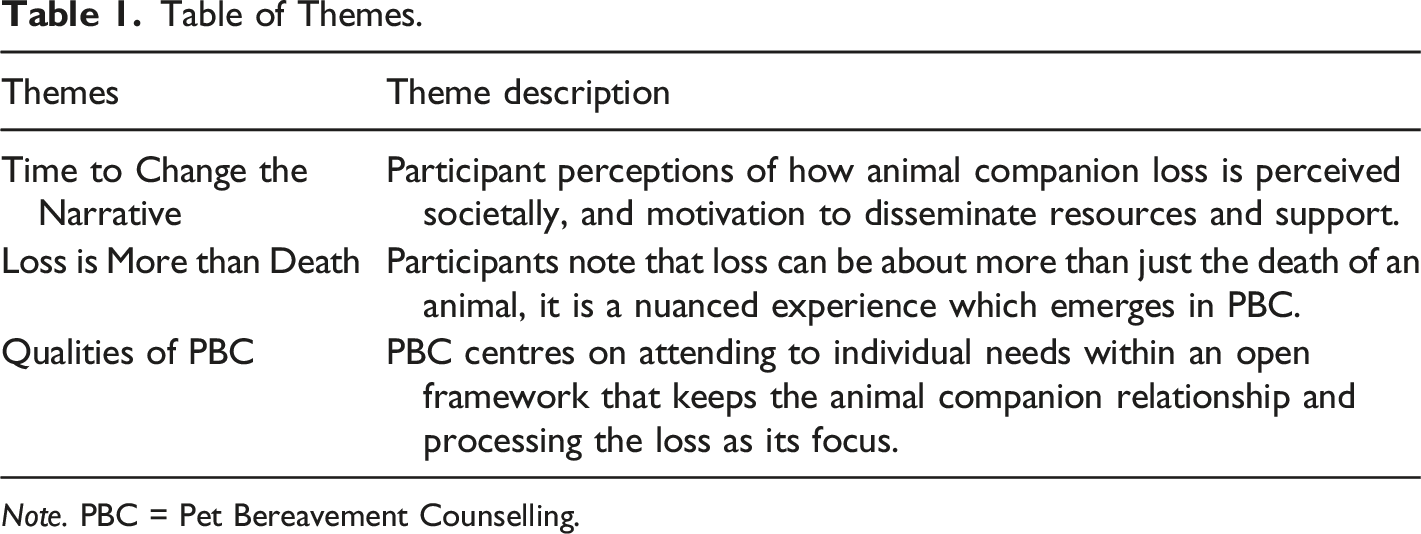
Note. PBC = Pet Bereavement Counselling.
Time to Change the Narrative
This theme captured how animal companion loss was perceived by participants from a societal and professional point of view. From these perspectives emerged what can be described as a ‘social justice’ stance towards disseminating animal companion bereavement support.
Participants reported that in their experience there are times when animal companion loss is not taken as seriously by society as it could be. There was a perception of a lack of acceptance and acknowledgement of animal companion bereavement as a normative and legitimate loss that one might grieve for, meaning bereaved owners’ experiences may go unrecognised. As stated by ‘Charlotte’, ‘mental health is becoming much more… acceptable… but I feel pet bereavement is still to catch up’, while in ‘Michael’s’ opinion ‘specifically the experience of pet loss can be overlooked a bit or overshadowed by other losses… and not given enough light’.
Five participants framed this perspective on how animal companion loss is positioned societally through comparisons to the response to human bereavement. Participants expressed a perception that society may at times not appreciate the significance animal companion loss can hold for an individual, which impacts on the response bereaved owners might receive: The main differences I see is how society accepts bereavement with pets you hear things like ‘oh well you can get another dog down the dog’s home’ or… ‘go rescue another dog’… people wouldn’t say anything like that with the loss of a friend (Elizabeth).
Following on from this, all participants reflected on how animal companion loss is located within counselling professions. Participants described how animal companion loss and PBC as a viable counselling option is perhaps not being taken into consideration by some counselling professions. Participants reflected on a lack of incorporation of animal companion loss in their psychotherapeutic training, as described by ‘Elizabeth’, ‘I don’t ever remember seeing [it] in my counselling books… I definitely didn’t have it in my initial counselling training… so that’s probably why there’s not acknowledgement of it’. Participants also described a sense that offering PBC was viewed as a niche area of bereavement work, and therefore not a desirable or necessary element of practice, ‘Sarah’ noted ‘even from my tutors when I suggested that that’s something I might like to look at they thought it was a bit fluffy… there was an element of its not real counselling’.
Participants highlighted how a lack of animal companion loss awareness in core training may then possibly affect post-training perspectives on animal companion loss, as well as the dissemination of specialised bereavement support, such as PBC. ‘Julia’ reported ‘counsellors, psychotherapists… often they’re advertising you know bereavement but… pet bereavement isn’t offered… and I think that’s something to do with it not being taken as seriously’.
On this basis, participants reflected on changing societal and professional views on animal companion loss, through the resources that they can offer. A common thread emerged among participants describing motivation to disseminate knowledge on animal companion loss. Alongside the creation of knowledge resources, such as books and webpages on animal companion loss, participants also expressed motivation to disseminate that support is available in the form of PBC, ‘Sarah’ commented on how ‘it was important that I could offer some support for people’.
PBC was posited by participants as a potential remedy to the perceived lack of understanding on animal companion loss, as ‘Julia’ described, ‘I think that’s where pet bereavement counselling has helped a lot because… you can come to this place… without any judgements on them without worrying what they’re going to say…. which sometimes out in society it’s pretty judgmental’.
Loss is More than Death
This theme captured PBC therapists’ perspectives on client experiences of animal companion loss over the course of PBC. Participants highlighted that animal companion loss entails more than just death and can be a complex and nuanced experience for bereaved owners.
Participants reported that their clients present in PBC expressing grief for their loss. From participants’ viewpoint these expressions of grief may be akin to human bereavement. It was the subjective significance of the relationship itself that was considered paramount in affecting grief. ‘Julia’ asserted that ‘I don’t feel there’s any difference between losing a pet it’s just that relationship that’s important, which is actually very similar to the loss of a human being’.
Aside from expressing grief, participants highlighted that some of their PBC clients experienced a lack of understanding from others for their animal companion loss. They recounted client experiences of expectations from others that grief should be swiftly overcome or that they should replace the animal, as described by ‘Lisa’, ‘I’ve heard my clients say things like they’re just expected to get over it or “it’s just a pet get another one”… it doesn’t really help process the loss of that pet’.
Participants noted the potential negative implications a lack of understanding and perceived dismissive attitudes may have for clients who are experiencing grief; ‘Charlotte’ reflected ‘I think that’s why people find it really difficult… and really lonely’. Potential lack of understanding from others was connected to the fact that animal companionship forms a sub-group within society; it is not a loss that everyone experiences or connects with. ‘Charlotte’ went on to say, ‘if you’re not one of the people who has pets then you won’t… necessarily understand how devastating it is… it’s very difficult to comprehend’. Participants asserted the importance of PBC in providing a therapeutic space for bereaved owners’ experiences to be validated, as some clients may not have found a safe space to talk about their loss outside of PBC, as ‘Elizabeth’ said ‘maybe they haven’t had that experience to have somebody to just sit and listen for a few moments’.
All participants highlighted that for their PBC clients, loss can be more nuanced than just the death of an animal companion, ‘Elizabeth’ succinctly summarised this point, ‘pet bereavement I think is bigger than just the actual death of an animal, it also includes other losses of an animal that gives those same grieving feelings’. The context in which the loss occurred, from natural death to forced separation, to animals going missing, was perceived to impact clients’ grieving and wellbeing. ‘Sarah’ described her work with a client whose pet went missing, ‘it’s that not knowing… if the animal is safe, is it in pain, has it been stolen… It’s that kind of horror of “I don’t know” and then… a lot of guilt comes with that’.
How clients connect animal companion loss to other aspects of life, such as relationships, for example, may become a catalyst for other issues or losses that then need to be processed, as ‘Charlotte’ described, ‘often what they’re feeling it’s… opening up other wounds… what they’ve invested in their pet is… sometimes masking other aspects of their life’.
Participants reported the loss can hold significance for their PBC clients in that it brings about change in day-to-day life, such as loss of routines and companionship, ‘Elizabeth’ reflected, ‘a pet could be anything that gives that person either companionship or a purpose… some people need a purpose to get up in the morning’. While ‘Charlotte’ denoted the impact of losing a source of unconditional love, ‘because of the unconditional-ness of… the love that they’ve lost, it can highlight how lonely they are’.
From participants’ accounts it emerged that relationships with animal companions may differ to human relationships in that owners take responsibility for the animal companion over its lifespan, therefore, including how to best approach the end of that animal’s life. ‘Julia’ reported, ‘you’ve got the dimension of euthanasia… that’s a very different dimension and what that does to people taking on that responsibility… sometimes people completely tear themselves apart… then that’s quite a big piece of work’. Five participants reported that their clients bring the dilemmas and difficulties of euthanasia into PBC, noting guilt, doubt, and regrets, as described by ‘Charlotte’ who said, ‘I’ve experienced owners who feel… incredible sense of guilt, [they] haven’t been able to say goodbye in the way they may like to have done’.
Qualities of PBC
This final theme focuses on participants’ view on what attributes of PBC render it a viable and beneficial support option for bereaved owners, as well as what sets PBC apart from other bereavement support.
Participants highlighted that bereaved owners may be drawn to seek out PBC specifically. Seeing a therapist who specialises in their presenting issue is appealing to bereaved owners, as they possibly feel the issue will be more likely understood and so are encouraged to take the step of seeking support. ‘Elizbeth’ asserted that ‘they notice online or somewhere that somebody specialises in pet bereavement, then they’re more likely to go and seek out help… because they feel that person is an expert in that area and that they understand it more’. Alongside having professional experience of working with animal companion loss, disclosing personal experiences was considered attractive for prospective clients because it demonstrated potential shared understanding and authentic empathy for the client. ‘Julia’ reflected, ‘I think it’s to do with the fact they know you understand… if you have a pet, you kind of know the relationship and how that can affect another person’.
Participants noted that other beneficial support options for animal companion bereavement exist in the form of charity telephone helplines; however, PBC was posited to be different as it offers bereaved owners face-to-face continued support from a qualified counsellor. ‘Elizabeth’ noted that ‘in charities you also have a percentage of people who are not counsellors, they are people that have gone to do a course related to bereavement… but if you’re a counsellor of course you’ve done several years of training’.
Participants noted that while PBC is focused on processing loss, as might arguably be expected in other forms of bereavement counselling, importantly in PBC the therapeutic work maintains specific focus on that human–animal relationship and its meaning for the bereaved owner. ‘Michael’ explicated that ‘you’ve always got to bring it back to the pet bereavement, it’s about recognising that this is about the pet, and this is what you’ve come for… rather than it being dissipated into a general kind of review of your life’.
In theme ‘Loss is More than Death’, participants reflected on the subjective nature of the meaningfulness of animal companion relationships and response to loss. As described by ‘Charlotte’, ‘everyone’s grief is different, and everyone’s relationship is different with… whatever pet that they’ve lost’. Participants reported that the process and direction of PBC is therefore adapted to each inherently unique client.
Participants recounted that the counselling skills they provide may not differ to other forms of counselling practice. However, noted that PBC considers the subjective meaning of the client’s animal companion relationship as well as the context of the loss. ‘Julia’ reported that ‘the work to be done is dependent on the individual so I kind of adapt the therapy according to what they need’. Thus, PBC offers a form of face-to-face counselling support that is tailored to meet individual needs, which does not take the form of a prescriptive or manualised approach.
Discussion
The aims of the research were to contribute to the existing knowledge base on animal companion loss, as well as provide a preliminary research base on the potential salience of PBC as specialised counselling support. The emergent themes highlighted participants’ social justice stance towards validating and disseminating the legitimacy of animal companion loss and the need for counselling support, which may have informed the direction of practice towards working in PBC.
The meaningfulness of animal companions has emerged as an important concept in psychological research (Blazina et al., 2011; Reisbig et al., 2017), this was reflected in our study with participants’ perception that the animal companion systemically held a meaningful place for the PBC client. Loss of daily routines and a sense of ‘purpose’ as described by participants supports the notion that animal companions may give owners a sense of responsibility (Brooks et al., 2016, 2018). Animal companions are often cited in research as providing either direct social support or acting as a ‘social catalyst’ (Brooks et al., 2018; Walsh, 2009a). Social support was not explicitly referenced by participants in our study, however, they described companionship characterised by an ‘unconditional’ nature, which suggests a unique form of support.
Previous research suggesting that grief responses following animal companion loss may be akin to that experienced following human bereavement, and in some cases are more profound (Hunt & Padilla, 2006; Reisbig et al., 2017) is supported by our study, with participants reporting PBC clients’ experiences of grief, the significance of having lost a form of ‘unconditional’ love, as well as animal companion loss becoming a catalyst for other issues. A common thread among participants’ accounts was that the context of the loss may impact on PBC clients’ wellbeing, such as the animal going missing, forced separation and euthanasia. Participants described clients’ feelings of guilt, doubt, and regrets, which supports previous literature on ambiguous loss and euthanasia (Dawso & Campbell, 2009; Dawson, 2008; Walsh, 2009b).
The notion of disenfranchised grief was reflected in the present findings (Cordaro, 2012; Packman et al., 2014; Walsh, 2009b); participants expressed that in their experience bereaved owners’ wellbeing was affected by perceived dismissive attitudes and availability of support. Interestingly, participants in our study also highlighted animal companion loss as an area of bereavement that in their experience lacks in perceived importance in counselling training and practice. Here, PBC itself and the personal and professional experience of the PBC therapist were deemed to be imperative. Participants reported that bereaved owners may purposefully seek out PBC, with the perception that PBC will provide a safe space where their loss is understood and validated.
In addition to the analysis revealing points of convergence and divergence of the research findings with existing literature, participants emphasised that the loss of an animal companion is more complex than just the death of a loved animal. Beyond grief, the context of the loss, perceived support and meaning attributed to the animal companion relationship all interplay to create a multifaceted experience of loss which is subject to individual nuances. Participants highlighted the uniqueness of the experience of animal companion loss and its meaning for the owner, and how consequently PBC is flexibly adapted to individual needs. As such, the present findings lend to a constructivist perspective for animal companion loss (Boyraz & Bricker, 2011), and suggest that researchers and practitioners be attentive to the individual nature of animal companion loss and meaning attributed to its impact.
Participants perceived animal companion loss to be located within counselling professions as an area of bereavement that perhaps remains under the radar or is lacking in perceived importance. Moreover, participants highlighted that specialised counselling support for animal companion loss is in demand but not well disseminated. These findings point to an opportunity for mental health professionals to engage in further discourse on the potential impact of animal companion loss and disseminate the availability of specialised counselling support. However, further understanding and training may be desirable for practitioners who are interested in offering PBC.
Limitations
Due to recruitment constraints uptake was arguably low. Repeating the study with a larger sample might allow for a more diverse selection of therapists to be recruited. All participants were White British; it therefore remains a question for future research whether PBC has broader cross-cultural applications. As PBC is presently only offered in private practice, this has socioeconomic implications for the demographics of PBC clients. Participants were self-selecting and may plausibly be invested in how their service is represented. Therefore, only limited conclusions can be made that the draw of working in PBC or experience of working with bereaved owners would be the same in a public health or voluntary sector context. Participants were providing a third-party account of clients’ experiences of loss, and therefore only limited inferences can be made on the direct lived experience of bereaved owners.
Future Directions
Having established a preliminary research base on PBC, we suggest a future direction for research is qualitatively exploring how PBC is experienced by bereaved owners, which may further validate experiences of animal companion loss, but also conceptualise the effectiveness of PBC.
The emergent findings on how animal companion loss is located within counselling professions, also opens opportunity for future qualitative research exploring how mental health practitioners perceive animal companion loss and locate it within their practice through focus groups (Braun & Clarke, 2013), potentially building upon the support currently provided to bereaved owners.
Given that for children the loss of an animal companion may be their first experience of bereavement (Podrazik et al., 2000), it is perhaps worth exploring the potential salience of PBC specifically for children. It is suggested that this research could be a qualitative exploration of the therapist and parents’ perceptions of the child’s PBC experience, or perhaps a case analysis (Kaufman & Kaufman, 2006).
Conclusion
PBC is an established form of animal companion bereavement support in the UK but was not grounded in a research evidence base. This study provides a preliminary understanding of the distinctive attributes of PBC and its viability in providing bereaved owners with counselling support that is specific to animal companion loss. The study also provides a detailed account of PBC therapists’ views on addressing animal companion loss, which highlight that loss is a multifaceted and nuanced experience for bereaved owners. With implications for the conceptualisation of animal companion loss in teaching and practice, these findings inform further research and add emphasis to the need to normalise and legitimise animal companion loss.
Footnotes
Declaration of Conflicting Interests
The author(s) declared no potential conflicts of interest with respect to the research, authorship, and/or publication of this article.
Funding
The author(s) received no financial support for the research, authorship, and/or publication of this article.
