



Abstract
Objective: Contemporary theories conceptualize the anniversary of a traumatic event as a trauma reminder capable of activating posttraumatic stress disorder (PTSD) symptoms. The current study uses the cognitive stress and growth model to examine this model’s usefulness in characterizing anniversary reactions. Method: Participants (N = 197) were MTurk workers who endorsed an “emotionally charged reaction on or near the anniversary of a tragic event.” They completed assessments of PTSD, posttraumatic growth (PTG), sense of control, rumination, and trauma centrality. Results: Multiple regression analyses found both anniversary-related stress and PTSD symptoms were associated with similar factors with similar magnitude across both outcomes. Trauma centrality was uniquely associated with anniversary-related PTG. Conclusions: Anniversaries marked by stress are characterized by factors similar to PTSD generally, but growth-related reactions have different correlates compared to PTG outside the reaction. These findings suggest the anniversary period may be a time of self-reflection about the event and its impact.
Anniversaries tend to mark special, positive days in one’s life, such as birthdays and marriages. Yet, for survivors of traumatic events, anniversaries can mark times when life was difficult or even tragic. A psychological response to a traumatic event’s anniversary is known as an “anniversary reaction” (AR; Chow, 2009). ARs have been documented for decades, but rigorous empirical investigation is lacking. Extant literature is yet to characterize the diversity of these reactions or document theoretical models that are useful in predicting ARs. The current study places ARs into the transformative theory framework (Tedeschi & Calhoun, 2004) and examines the correlative profile from factors of the cognitive stress and growth model (CSGM; Brooks et al., 2017) to explore the diversity of ARs.
Anniversary Reactions
Evidence of Stress Reactions
The impact of traumatic events often leads to significant psychological changes, at times cumulating in posttraumatic stress disorder (PTSD). When PTSD was introduced in the third edition of the Diagnostic and Statistical Manual of Mental Disorders (DSM-III, APA, 1980), ARs were identified as a possible symptom of PTSD. That said, ARs have been clinically documented for decades prior. Freud recorded the case of a woman who experienced, “vivid visual reproduction and expression of feelings kept to the date precisely” (Frankeil, 1994, p. 147). Physicians throughout the 1950s–70s attributed various stress-related somatic complaints to the psychological distress of an AR after ruling out other disease states (Miller, 1978). Clinicians have attributed ARs to psychological crises coinciding with trauma milestones, such as on or near the date of a singular traumatic event or the first time a repeated traumatic experience occurred. Examples include major depressive episodes (Bornstein & Clayton, 1972) and suicidal behaviors (Gabriel, 1992). These reactions have spanned different kinds of events, from bereavement (Bornstein & Clayton, 1972), to combat-related violence (Morgan et al., 1988, 1999), to birth trauma (Beck, 2006).
These case studies culminated in Morgan and colleagues’ empirical studies of Gulf War veterans, tracking ARs at two (Morgan et al., 1998) and six years (Morgan et al., 1999) after these veterans returned from war. ARs were defined in these studies as a match between the veteran’s self-reported “worst” month over the last year and the traumatic event anniversary. In both studies, the number of reported ARs was significantly more than what would be predicted by chance, and service members reporting ARs endorsed significantly more symptoms of PTSD, depression, and more psychiatric concerns than those who did not report ARs. These studies established ARs as a phenomenon to be expected in the posttraumatic syndrome and offered the theory that ARs represent exacerbated PTSD symptoms co-occurring with the anniversary of the event.
Evidence of Growth-Reactions
While previous studies have focused on the posttraumatic stress reaction to an anniversary, the aftermath of trauma is not limited to stress. In understanding ARs as a part of posttraumatic adjustment and processing, including PTG represents a more complete conceptualization. PTG is a construct that captures “positive psychological change experienced as a result of the struggle with highly challenging life circumstances” (Tedeschi & Calhoun, 2004, p. 1). Those experiencing PTG report greater appreciation for life, improved interpersonal relationships, and new life philosophies (Brooks et al., 2017).
ARs, appraised as perceived PTG, are yet to be studied formally, but anecdotal cases exist. In the Morgan studies, three veterans commented that their “best” months actually coincided with the anniversary (Morgan et al., 1998). In recent popular media, a couple who survived a mass shooting decided to get married on the specific anniversary of the shooting (Carter, 2013). The couple’s comments on the decision to marry on that date reflected PTG, such that “It was a night of terror… We wanted to change the date and, you know, make it our own” (Carter, 2013, p. 1). ARs may represent an intensified or more salient reflection of a survivor’s processing of the event, which can cause stress or inspire positive changes.
Theoretical Foundations
Chow used a classical conditioning model, historically applied to a variety of anxiety-based disorders, to understand the ARs in bereaved individuals who lost either parents or spouses (2009). Her model posited that the death of a loved one can lead to the development of a combination of trauma-related reminders in the trauma memory network. These reminders include salient memories of the date, time, and season. The cue of the anniversary-related reminders activates the traumatic memory network and catalyzes the resulting stress reaction. Integrating the inhibitory learning model (Craske et al., 2014), the association between the anniversary-cue and the traumatic event is overridden by new learning when the trauma memory is activated for those who recover from anxiety. This theory implies that those experiencing growth-related ARs have growth-promoting information in their memory network that differs from the information of those who have exclusively stress-related ARs.
The transformative theory (Tedeschi & Calhoun, 2004) posits a framework to understand the cognitive processes that predict aspects of PTG apart from PTSD. The theory states that experiencing traumatic events challenges core beliefs that define basic assumptions of how the world works. These core beliefs are reconstructed through cognitive effort that examines the impact of the events, which can lead to a sense of PTG. Research into these cognitive efforts has blossomed in the last 20 years, cumulating most recently in Brooks and colleagues’ CSGM (2017). They introduced their CSGM, delineating the cognitive schemas (representations of concepts) that can influence the rumination patterns outlined in transformative theory that inform these two outcomes in posttraumatic adjustment (2017). Based on this model, perceptions of present and future control over stressful events influence how one ruminates (continuously thinks about) the event. Intrusive rumination, or thoughts that are invasive and distressing, can become deliberate, or solution-focused, because of trauma centrality. Trauma centrality, or how integral the event is to one’s autobiographical narrative, provides a framework to make sense of the intrusive thoughts by making trauma-related pondering personally meaningful and focused.
This model is the first to connect this range of reactions, from stress to growth, in a singular, integrated model. These factors may serve as the new information and associations the inhibitory learning model posits. Further, if these two outcomes (PTSD and PTG) correlate with ARs, the model may also have translational application for characterizing ARs.
The present study examined the correlative profile of factors identified in the CSGM to test the hypothesis that anniversary-related outcomes would be statistically indistinguishable from PTSD or PTG outside the anniversary time period, which would support the exacerbation theory posited by Morgan (1998, 1999). Specifically, we hypothesized that multiple regression models would demonstrate that less present control, more trauma centrality, and more intrusive rumination would account for significant variance in stressful ARs. This correlative profile would be the same for overall PTSD. Further, we hypothesized that a multiple regression model would demonstrate that more present control, more future control, and more trauma centrality would account for significant variance in growth-related ARs. This correlative profile would be the same for overall growth.
Method
Participants
A total of 280 participants were recruited from Amazon’s MTurk. Participants who failed an attention check (n = 31), did not provide information as directed (n = 14), or provided extremely quick or homogenous answers (n = 10) were filtered out of analyses. Several participants (n = 28) took the survey during the month of their reported anniversary. We removed these participants given an expectation that the prompts, “over the last month” and “on your anniversary,” may be misunderstood. This left a final sample size of n = 197, providing ample power (1 – β = .99) to detect a medium effect size (f2 = .15) at the α = .05 level for the planned analyses. Each construct demonstrated normal distributions defined by nonsignificant skewness and kurtosis (p > .05).
Sample Demographics
Most of these 197 participants were middle aged (M = 40.86, SD = 12.12, range = 18–72) and identified themselves as White (n = 171, 86.6%), heterosexual (n = 166, 84.3%), cisgender females (n = 143, 72.6%). Many had experience in higher education, either through some undergraduate coursework (n = 44, 22.3%), earning a bachelor’s degree (n = 64, 32.5%), or seeking an advanced degree (n = 36, 18.2%). Nearly half of the sample reported earning more than $50,000 a year (n = 95, 48.2%) with some making less than $20,000 (n = 28, 14.2%). Lastly, half of the sample identified themselves as Christian (n = 99, 50.3%), and many said they were either agnostic or atheist (n = 77, 39.1%).
Procedure
This study was conducted entirely online as a Human Intelligence Task (HIT) on Amazon’s MTurk. The HIT description specified the survey was about “anniversary reactions, which is when people experience an emotionally-charged reaction during the anniversary day, week, or month because of that time’s relation to the difficult event.” From the advertisement on MTurk, participants were guided to the survey on Qualtrics. Those younger than 18 were screened out immediately. Those who did not report a history of potentially traumatic events were thanked for their time, reimbursed $.05, but told they did not qualify for the rest of the survey. Participants who completed the survey in its entirety were compensated a total of $3.00. These monies were delivered to their Amazon account via MTurk.
Measures
Trauma History Screen (THS)
The Trauma History Screen (Carlson et al., 2011) asks respondents if they have experienced any of 14 potentially traumatic events consistent with criterion A for the diagnosis of PTSD in the fifth edition of the DSM (APA, 2013). Participants respond yes or no if they have experienced a particular event, how many times that event occurred, how old they were when it first occurred, and which event was “most traumatic” for them. Participants were asked if they associated specific date with the most traumatic event they reported. They were then told that several of the following measures will ask them specifically about how they feel during their most recent AR for that identified event.
Stressful ARs
As there is no psychometrically tested measure of ARs, we adapted a well-established PTSD assessment measure, the Posttraumatic Checklist-5 (PCL-5; Weathers et al., 2013), to assess for AR-related PTSD. This 20-item scale asks how “bothersome” symptoms had been over the last month (0 = not at all and 4 = extremely). The measure has been used to make reliable and valid inferences regarding PTSD symptomology in both clinical and undergraduate student samples (Weathers et al., 2013). After participants gave the date of their reactions, they answered the 20 items off the PCL-5 with each item cueing the participant to report symptoms that occurred, “During the anniversary reaction.” We interpreted the total score from the AR specific items to infer PTSD-related symptoms during an AR time period. Internal consistency in this sample was excellent (α = .94).
ARs Marked by Growth
Like the stress-related AR, a growth-related AR measure was adapted from a previously well-established measure of PTG: The Posttraumatic Growth Inventory: Short Form. (PTGI-SF, Cann et al., 2010). The PTGI-SF has been validated across various traumatic experiences, such as survivors of domestic violence, bereavement, and serious illnesses (Cann et al., 2010). Participants rated the extent to which they experience these positive circumstances on a six-point Likert-type scale (1 = I did not experience this change to 6 = I experienced this change to a very great degree). Like the measure for distressing ARs, participants referenced each of their responses for the 10 items cueing for “During my anniversary.” Higher total scores indicated greater perceived posttraumatic growth during the AR time period. Internal consistency in this sample was excellent (α = .91).
Perceived Control Over Stressful Events
The Perceived Control Over Stressful Events Scale (PCOSES; Frazier et al., 2011) is a measure of control regarding a specific adverse event. Participants were prompted to respond regarding the traumatic event that created the AR identified. Consistent with Brooks et al.’s (2017) use of the scale, only the present and future subscales were used as past control has been shown to be unrelated to adjustment. During development, the PCOSES demonstrated convergent validity and strong test–retest reliability and internal consistency (Frazier et al., 2011). Participants endorsed statements on a scale from 0 (strongly disagree) to 3 (strongly agree). Higher total scores were interpreted as greater perceived control. Internal consistency in this sample was good for present control (α = .84) and excellent for future control (α = .91).
Event Rumination Inventory
Intrusive rumination and deliberate rumination were measured using the respective subscales on the Event-Related Rumination Inventory (ERRI; Cann et al., 2011). The ERRI has demonstrated good construct validity according to Cann et al. (2011), and reliability for both scales was considered excellent in previous studies (Brooks et al., 2017). Intrusive rumination was assessed via ten items reflecting unwanted thoughts of the aversive event; for example, “I could not keep images or thoughts about the event from entering my mind.” Deliberate rumination was assessed via ten items reflecting a deliberate attempt to make sense of the event; for example, “I thought about whether I have learned anything as a result of my experience.” For all items, participants rated agreement with the statements on a scale from 0 (not at all) to 3 (often). Participants were instructed to answer based on their experience over the last month and regarding the AR-specific event they reported at the beginning of the study. Higher total scores were interpreted as a participant having more ruminative tendencies in that particular domain. Internal consistency in this sample was excellent for intrusive rumination (α = .93) and for deliberate rumination (α = .90).
Centrality of Events
The Centrality of Events Scale (CES; Berntsen & Rubin, 2006) is a measure of the extent to which an individual feels a particularly aversive event has become integral to their identity and a major framework in understanding themselves and the world. The measure has demonstrated strong construct validity and internal consistency (Berntsen & Rubin, 2006). Higher scores on the CES were interpreted as indicating higher centrality. Participants were instructed to answer based on their experience over the last month and regarding the AR-specific event they reported at the beginning of the study. Participants answered this 20-item measure using a 5-point Likert-type scale (1 = strongly disagree to 5 = strongly agree). Internal consistency in this sample was excellent (α = .96).
Stress Outside the AR
The PCL-5 was given again at the end of the survey. The items at the first administration were randomized to hinder primacy effects. The items were also assessed for how participants felt “in the last month.” This method produced two total scores. One total score reflected PTSD symptom intensity during the AR, which was detailed earlier. The second score was assessed over the past month, reflecting reported PTSD symptom intensity and severity as originally designed by Weathers and colleagues (2013). For these data, internal consistency was excellent (α = .94).
Growth Outside the AR
A measure for overall growth was included to assess participants’ growth in the present. Such a measure is the “current standing” PTGI-CF, which was adapted from the PTGI-SF discussed earlier but assessed PTG over the last month (Kaur et al., 2017). This measure was administered near the end of the survey. Internal consistency in the current sample was good (α = .88).
Data Analysis Plan
Correlations of all Variables in Study.
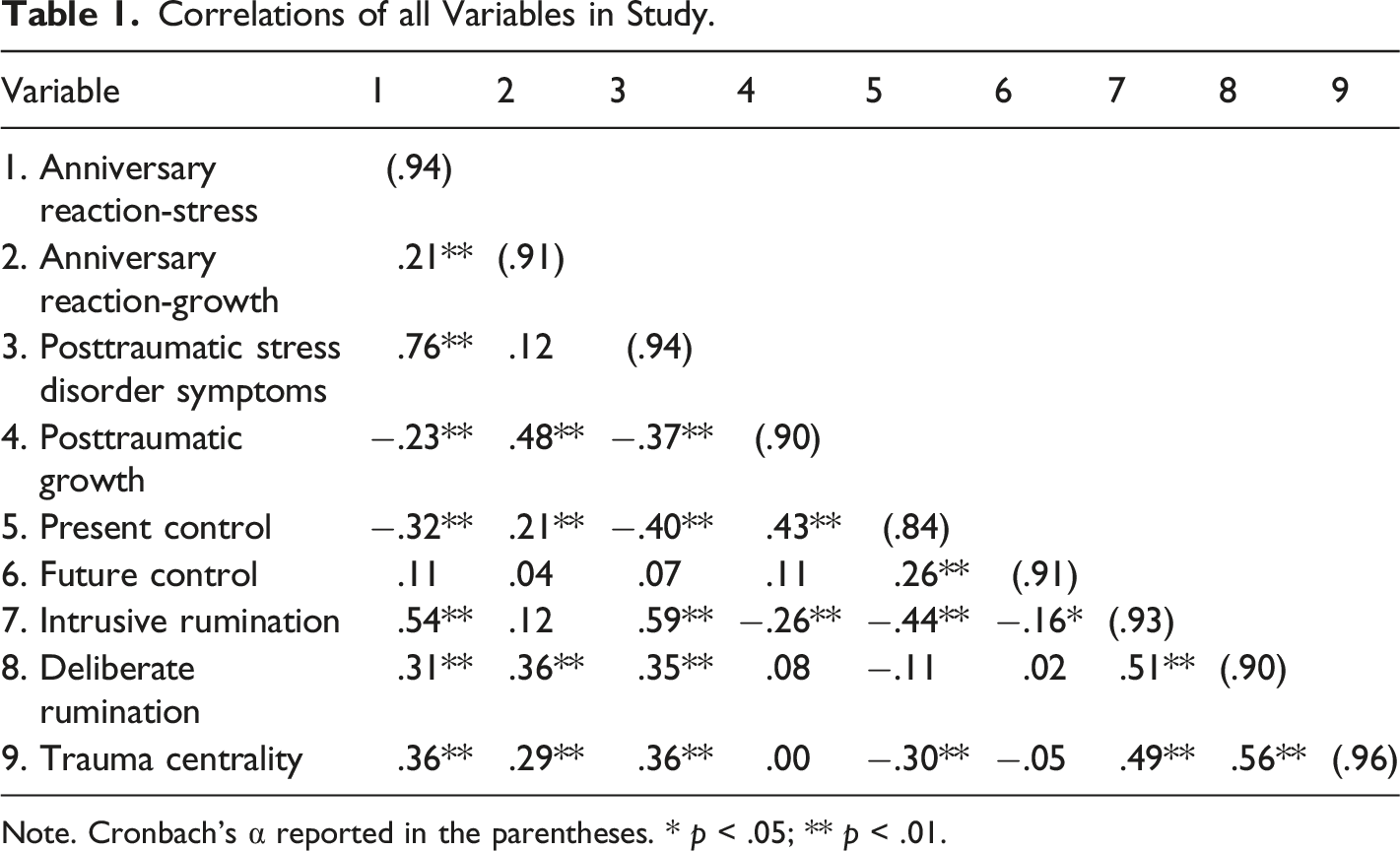
Note. Cronbach’s α reported in the parentheses. * p < .05; ** p < .01.
We compared the standardized beta weights of each significant factor via bias corrected bootstrapping. If the confidence intervals of the beta weights overlapped by more than 50%, the factors were considered statistically indistinguishable (p < .05; Cumming, 2008). For example, we would calculate the average overlapping confidence interval across stressful ARs and PTSD. We would then add this average to the lower estimate from the stressful AR data. If this sum exceeded the upper limit of the PTSD confidence interval, we determined that the intervals overlapped by less than 50%, and thus, the β weight was considered significantly different. This process was repeated for the growth-related data.
Results
Stress-Related Outcomes
Anniversary Reactions
The five predictors produced a significant model, R 2 = .36, F(5, 191) = 21.76, and p < .001. As predicted, less present control (t = −2.15, p < .05) and more intrusive rumination (t = 6.18, p < .001) accounted for significant variance. Contrary to predictions, trauma centrality failed to add significant variance to the model (t = 1.30, p > .05), and more future control evidenced a significant contribution to the model’s variance (t = 3.84, p < .001).
Posttraumatic Stress Disorder (PTSD) Symptoms
The five variables produced a significant model, R 2 = .42, F(5, 191) = 27.78, and p < .001. As expected, less present control (t = −3.50, p < .001) and more intrusive rumination (t = 6.61, p < .001), correlated to overall PTSD. Unexpectedly, future control (t = 3.52, p < .01) also added significant variance to the model, while trauma centrality did not (t = .53, p > .05).
Comparisons
Comparing β Weights Between Stressful-AR Model and PTSD Model.
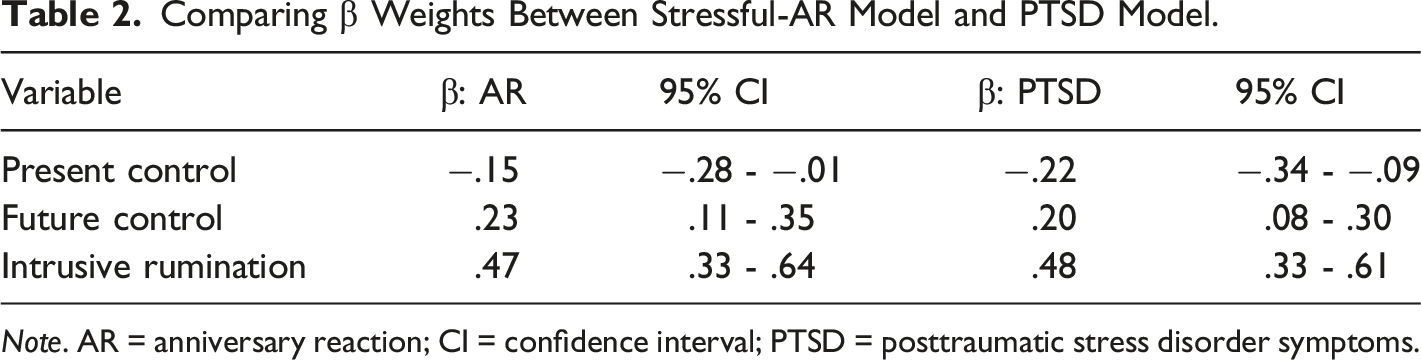
Note. AR = anniversary reaction; CI = confidence interval; PTSD = posttraumatic stress disorder symptoms.
Growth-Related Outcomes
Anniversary Reactions
The five variables produced a significant model, R 2 = .23, F(5, 191) = 11.19, and p < .001. As expected, more present control (t = 4.22, p < .001) and more trauma centrality (t = 2.79, p < .01) emerged as significant predictors of growth-related ARs. Unexpectedly, more deliberate rumination (t = 3.23, p < .01) also added significant variance in the model.
Posttraumatic Growth
The five variables produced a significant model, R 2 = .24, F(5, 191) = 12.28, and p < .001. Expectedly, present control (t = 5.31, p < .001) correlated to overall PTG. Unexpectedly, perceptions of future control (t = −0.39, p > .05) and trauma centrality (t = 1.78, p > .05) did not add significant variance in the model. Moreover, more deliberate rumination (t = 2.02, p < .05) and less intrusive rumination (t = −2.98, p < .01) unexpectedly proved significant.
Comparisons
Comparing β Weights Between Growth-Related AR Model and PTG Model.
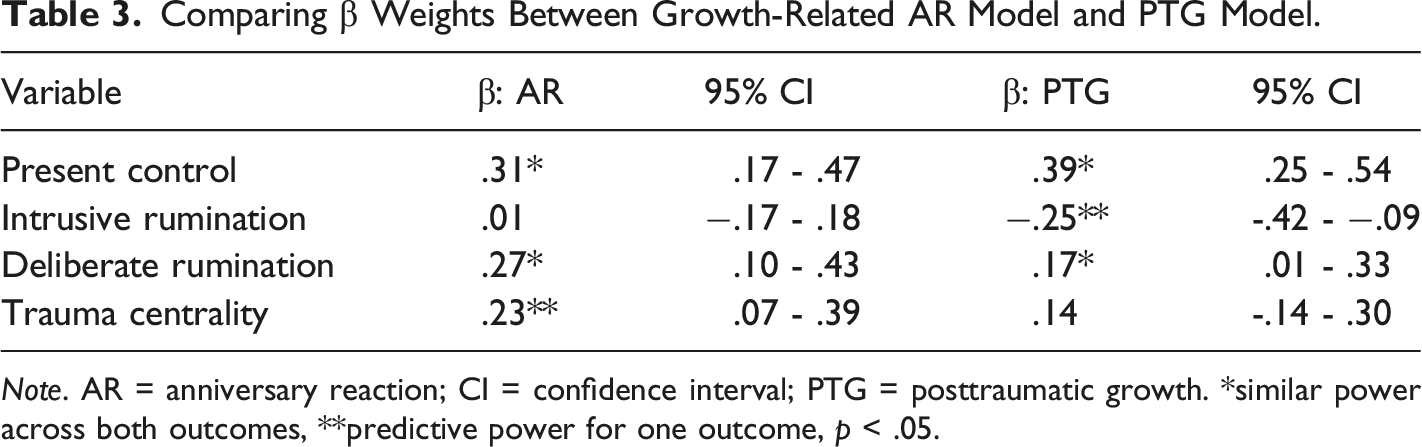
Note. AR = anniversary reaction; CI = confidence interval; PTG = posttraumatic growth. *similar power across both outcomes, **predictive power for one outcome, p < .05.
Discussion
ARs have historically been conceptualized as an exacerbation of PTSD symptoms in cued response to anniversary daterelated stimuli. We expanded this relationship to understand growth-related outcomes, and characterized these two outcomes using a prevailing model of PTSD symptoms and PTG.
Stress-Related Outcomes
Results revealed that both stressful ARs and PTSD symptoms over the last month were associated with the same factors and with very similar standardized beta weights. As expected, endorsement of feeling a loss of control over present events correlated with PTSD symptoms. Cognitive models of PTSD suggest that related anxiety is maintained by maladaptive beliefs about one’s sense of control, and enhancing the sense of being out of control increases avoidant behaviors for those with PTSD symptoms (Hancock & Bryant, 2018). This finding is also consistent with what the exacerbation hypothesis of ARs would predict.
Intrusive rumination surrounding the traumatic event also correlated with PTSD symptoms generally and during the AR. In PTSD, this kind of rumination represents thoughts that invade one’s cognitive world, shift focus to the negative thoughts and feelings surrounding the traumatic event, and ultimately maintain PTSD symptoms (Scher & Resick, 2005). In the context of ARs, it could be that the intrusive rumination measure is capturing intrusion symptoms in PTSD (criterion B) as opposed to rumination independently contributing to the syndrome. To clarify this potential confound, the analysis was re-run removing the intrusion symptoms from the PCL-5. The correlation between intrusive rumination and the new PCL-5 total score remained significant, which supports the latter interpretation that intrusive rumination may exacerbate PTSD independent of the specific symptoms. 1 Future research may expand our understanding of this relationship by getting specific details on the nature of the ruminative thoughts during both the general and specific AR time periods.
Unexpectedly, trauma centrality did not emerge as significantly predictive within the five-factor model for either outcome. Historically, trauma centrality has been strongly predictive of PTSD (Robinaugh & McNally, 2011), and that relationship was expected to generalize to stressful ARs. One explanation for this outcome is a measurement confound, in which intrusive rumination and trauma centrality were correlated such that variance accounted for by one could be due to the other and vise-versa. A post-hoc regression of the same model, but with intrusive rumination removed, found that trauma centrality was significantly and positively correlated with stressful ARs. 2 Theoretically, because trauma centrality has shown to be influenced by characteristics of the survivor (i.e., neuroticism) and the event itself (i.e., salient threat to life and interpersonal violence), there may be more factors involved in predicting stressful ARs within this relationship that are not addressable by the current results and may warrant further study.
Future control positively correlated with both stressful ARs and PTSD. This finding contrasts with the negative association present control had with both outcomes. Relationships between perceived future control and adjustment are mixed and dependent on factors uncontrolled here (Fraizer et al., 2011). In the case of traumatic events, a sense of wanting to control future adversity can be maladaptive when the events are objectively uncontrollable (i.e., bereavement). Applied to ARs, a stronger sense of future control, such as “This too shall pass,” seems to exacerbate stress in a context were the anniversary invariably comes the next year. In all, Morgan’s (1998) proposed theory suggesting that stressful ARs look very much like exacerbated pre-existing symptoms of PTSD seems supported given the highly similar correlative profiles.
Growth-Related Outcomes
Examination of the growth-related outcomes indicated that the two had slightly different correlative profiles. Regarding the similarities, deliberate rumination and present control correlated with growth for the month prior to participation and during the AR. A sense of control over one’s ability to handle stressful events has been theorized to facilitate growth after adversity. These results suggest that as people regain an appraisal of control and begin to think purposefully and deliberately about the value and meaning of the stressful experience, they may endorse growth prior to and during an AR.
Interestingly, future control was not significantly associated with either outcome. This finding may suggest that present-focused appraisals of control were sufficient to facilitate PTG and were not dependent on appraisals of future control. It also begs the question of whether cognitive processing focused on increasing present control may have some therapeutic value in increasing the likelihood of PTG. This relationship could change based on frequency of measurement and measurement over time. Until future studies test directionality, however, these interpretations remain hypotheses to be tested.
Regarding differences in the two predictive profiles, a finding unique to PTG outside, rather than during an AR was the negative correlation between intrusive rumination and PTG. This result raises the possibility that PTG could be characterized by a lack of intrusive rumination, or one may progress toward growth if present intrusive rumination is confronted and resolved. For ARs specifically, growth was correlated positivity to trauma centrality. Centralizing a stressful event (i.e., incorporating it into one’s personal identity) within one’s autobiographical narrative has shown paradoxical predictive power for posttraumatic outcomes, both stressful and marked by growth (Bellet et al., 2018). There has been subsequent inquiry about which conditions and contexts explain these counterintuitive outcomes. It has been speculated that trauma centrality signals a need to resolve conflicts in the autobiographical narrative (Bellet et al., 2018). From this perspective, centralizing one’s identity to the traumatic experience(s) can present either an opportunity or an obstacle for adjustment depending on how the micro-narratives surrounding the event are constructed into one’s overall narrative (Bellet et al., 2018). The present study found that centrality was associated with growth-related ARs, but not necessarily stressful ones, suggesting that the anniversary time can catalyze a re-examination of the traumatic event’s micro-narrative in a way that promotes growth. Future research is needed to better understand the nature and direction of the relationship, as well as potential changes in this relationship between trauma centrality and PTG over time and may benefit from exploring narratives and micro-narratives from a constructivist lens.
Limitations
Our design allowed for the detection of cross-sectional correlations but does not measure temporal sequencing and therefore does not allow conclusions to be drawn about causality. Further research is needed to ascertain the directionality of the correlations found in the present study. The study also relies on participant self-report and, in some instances, retroactive report, which makes it vulnerable to biases inherent in these procedures. Future observational and longitudinal studies will aid in further illuminating ARs. Finally, the sample lacked diversity. Demographically, most participants were White, middle-aged, cisgender, heterosexual women who had been through higher education and had higher incomes. As trauma processing is influenced by cultural experiences, a diverse sample is important in understanding how people adjust and grow through traumatic events. There was also a lack of diversity in events that caused the AR, as bereavement was overrepresented. Future studies should recruit diverse samples, both demographically and in terms of trauma history.
Conclusions and Future Directions
Anniversaries of traumatic events can prompt survivors to examine the impact of these events. This study investigated hypothesized correlates of stressful and growth-marked ARs as guided by the CSGM (Brooks et al., 2017). The present study found that a stressful AR may represent intensified PTSD symptoms, yet there were more differences when comparing the correlative patterns of growth-related ARs and features of PTG.
To fully understand the experience of an AR, the growing literature can use several methodologies in future research. Qualitative studies can illuminate the nature and types of cognitive and emotional experiences of those experiencing ARs. Longitudinal studies would clarify the directionality of the relationships delineated here. Given the results of the exploratory analyses, future research should also place ARs in a constructivist framework. These results provide a springboard for future research to examine these relationships to advance the understanding of this significant phenomenon.
Footnotes
Declaration of Conflicting Interests
The author(s) declared no potential conflicts of interest with respect to the research, authorship, and/or publication of this article.
Funding
The author(s) disclosed receipt of the following financial support for the research, authorship, and/or publication of this article: This research was funded by the Saint Louis University College of Arts and Sciences Graduate-Undergraduate Collaboration Fund.
