



Abstract
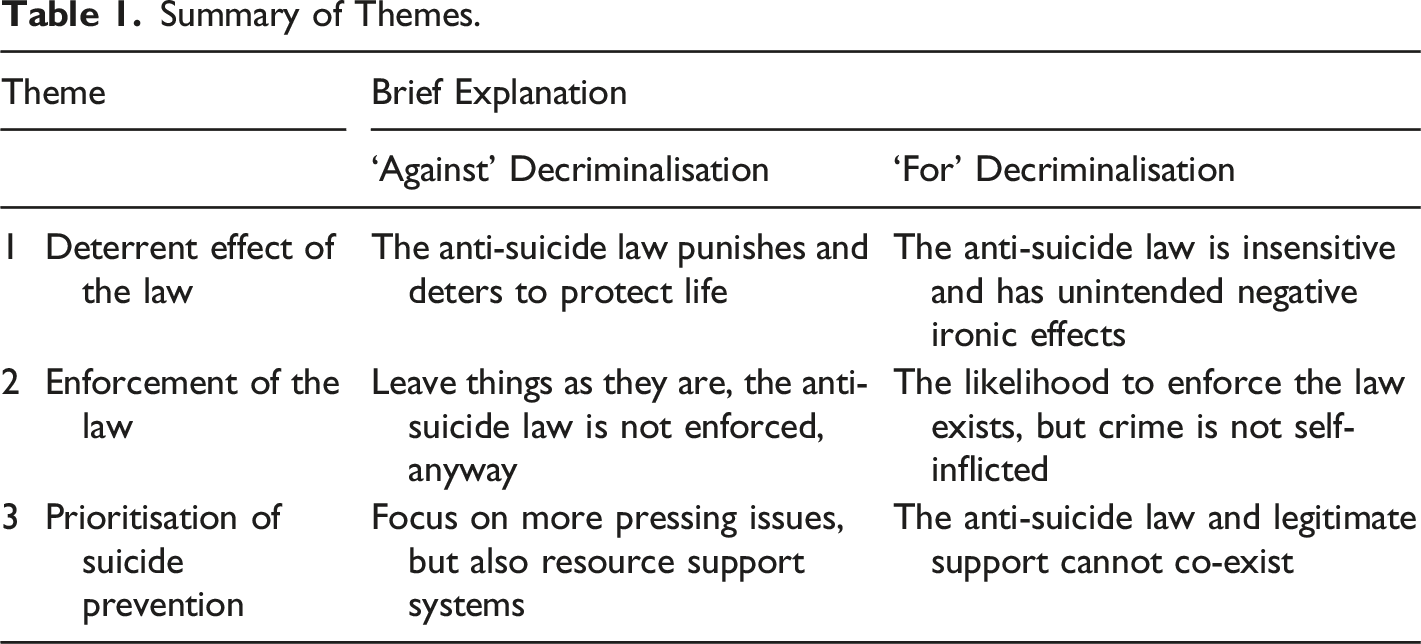
We explored the views of members of parliament (MPs) in Ghana on the call to decriminalise attempted suicide. We applied reflexive thematic analysis to Parliamentary Hansards (2017–2020) on calls to decriminalise attempted suicide in Ghana. 11 MPs shared their stance for or against the call. We developed three major themes that entailed, often, opposing views: (1) deterrent effect of the law (against: the law punishes and deters to protect life; for: the law is insensitive and has ironic effects), (2) enforcement of the law (against: leave things as they are, the law is not enforced, anyway; for: crime is not self-inflicted) and (3) prioritisation of suicide prevention (against: focus on more pressing issues, but resource support systems; for: the law and legitimate support systems cannot co-exist). The findings indicate two needs: to extend suicide literacy to Ghanaian MPs, and to initiate a public/private member’s bill on attempted suicide decriminalisation.
Introduction
A growing body of evidence suggests that laws that penalise suicide are strongly associated with increased national suicide rates (WHO, 2014). Therefore, leading scholars, the World Health Organisation (WHO), the International Association for Suicide Prevention (IASP), and other international networks of experts, including United for Global Mental Health (UnitedGMH) have recommended decriminalisation as a critical step in the formulation of national strategies for suicide prevention, particularly, in countries where anti-suicide laws exist (IASP, 2019, IASP, 2020, UnitedGMH, 2021, WHO, 2014; Mishara & Weisstub, 2016). In the past 50 years, many countries have decriminalised (attempted) suicide, thereby eliminating the fear of legal recriminations and making it relatively easier for persons experiencing suicidal crises to seek – professional – help (WHO, 2014). Thus far, attempted suicide remains criminalised in 20 countries (including Ghana), with additional 20 countries maintaining attempted suicide as punishable under the law of Sharia (Mishara & Weisstub, 2016; UnitedGMH, 2021). Some countries have kept their anti-suicide laws (most of which were inherited through colonial rule) for more than half a century (Mishara & Weisstub, 2016; UnitedGMH, 2021).
During colonial rule, anti-suicide laws were imposed on colonial territories, including those in sub-Saharan Africa (Mishara & Weisstub, 2016). Ghana’s anti-suicide law has been in force since 1960; this law was inherited from the country’s former British colonial government. Section 57:1 of Ghana’s Criminal Code stipulates that, ‘a person who attempts to commit suicide commits a misdemeanour’ (Criminal Offences Act of Ghana, 1960). Indeed, evidence shows that individuals found guilty of this law have been given hefty fines or jailed, in some cases (Adinkrah, 2012; Osafo et al., 2017). Paradoxically, the anti-suicide laws in England and Wales were repealed in 1961 (Neeleman, 1996).
Official data on suicide are not routinely collected in Ghana; where available, they are often fraught with reliability issues and poor scientific rigour. However, emerging evidence from self-report cross-sectional surveys and qualitative studies (Akotia et al., 2019; Asante et al., 2017; Osafo et al., 2015; Quarshie et al., 2020; Quarshie, Shuweihdi, et al., 2021; Quarshie & Andoh-Arthur, 2020; Simmons et al., 2021; Sweetland et al., 2019), analyses of media reports (Abdulai, 2020; Quarshie, Asante, et al., 2021; Quarshie et al., 2015) and medico-legal autopsy studies (Der et al., 2016) suggests that suicide and suicide-related behaviours remain a public health concern in Ghana. Recent crude estimates by the WHO suggest that 6.6 persons per 100,000 people (representing 177 females and 1816 males) within the general Ghanaian population died by suicide in the year 2019 (WHO, 2021b).
Thus, in keeping with the recommendation by the WHO, UnitedGMH and IASP, various stakeholders, including local suicidologists and mental health advocates have called on the Parliament of Ghana to repeal the country’s anti-suicide law. So far, two separate petitions (in 2012 and 2017) have been presented to the Parliament of Ghana, pushing for the decriminalisation of attempted suicide, while researchers continue to expand the evidence-base of the views of key stakeholders and gatekeepers to strengthen the advocacy and decriminalisation efforts. To date, the views of university students (Knizek et al., 2011; Osafo et al., 2011); health professionals, including psychologists (Hjelmeland et al., 2014; Osafo et al.,2018b; Osafo et al., 2012); lawyers and judges (Osafo et al., 2018a); community and religious leaders (Osafo et al., 2019); and police personnel (Osafo et al., 2017) have been reported. Although some participants agreed with the anti-suicide law by referencing its (potential) deterrent effects, most of the participants in these studies recommended a repeal of the law. For example, the lawyers and judges argued that persons who attempt suicide should not be seen as criminals but as patients requiring support from the healthcare system (Osafo, Akotia, Andoh-Arthur, et al., 2018), while the police personnel mostly showed a strong inclination to helping and diverting suicidal persons to mental health care, rather than arresting them for prosecution (Osafo et al., 2017). These studies are important because they are in keeping with the recommendation by the WHO and leading scholars that in the advocacy and generation of political priority for (mental) health policies, the views and voices of key political and legal actors must be considered (Shiffman & Smith, 2007; Tomlinson & Lund, 2012; WHO, 2003).
Notably, however, a critical politico-legal gatekeeper group whose views about the call to decriminalise (attempted) suicide in Ghana are conspicuously missing in the evidence-base is Members of Parliament (MPs). Therefore, the current study seeks to extend the evidence-base by exploring the views of MPs in Ghana on the call to decriminalise attempted suicide in the country. We attempt to gauge MPs’ attitudes and readiness (or otherwise) to support calls to repeal Ghana’s anti-suicide law by analysing the MPs’ comments related to (de)criminalisation of attempted suicide as captured in Ghana’s Parliamentary Hansards.
Materials and Methods
This qualitative study drew data from the Hansards of the fourth Republican seventh Parliament of Ghana (2017–2020). The Hansard is a publicly available official transcript of debates, votes and official reports of parliamentary proceedings. It is recorded in English, the official language of Ghana.
The period, 2017 through 2020, witnessed notable suicide-related issues in Ghana. For example, major media outlets reported worrying trends of suicide in the country during the period. At a point, 10 suicides (including two university students) were reported within 14 days (Peacefmonline.com, 2017). Systematic syntheses of media reports on suicide in Ghana indicate that troubling frequencies of suicide, particularly, among students and young people were reported between 2017 and 2019 (Abdulai, 2020; Quarshie, Asante, et al., 2021). Relative to previous years, more suicides were reported across the country between 2017 and 2020 – the period of the fourth Republican seventh Parliament of Ghana (Abdulai, 2020; Quarshie, Asante, et al., 2021). Notably also, anecdotal evidence suggests that during the period some MPs made statements on the floor of Parliament for the decriminalisation of attempted suicide in Ghana (Jafaru, 2017).
Part 10 (Order 72) of the Standing Orders of Ghana’s Parliament provides that: By the indulgence of the House and leave of Mr. Speaker, a Member may, at the time appointed for Statements under Order 53 (Order of Business) explain a matter of a personal nature or make a Statement on a matter of urgent public importance. Any Statement, other than a Statement of a personal nature, may be commented upon by other Members for a limited duration of time not exceeding one hour. The terms of such proposed Statement should first be submitted to Mr. Speaker. (Parliament of Ghana, 2000, pp. 48–49).
Across the period of the seventh Parliament (2017–2020), two Statements – on a matter of urgent public importance–calling for the decriminalisation of attempted suicide in Ghana were presented, one in 2017 (Parliament of Ghana, 2017) and another in 2019 (Parliament of Ghana, 2019). There were 275 MPs (females = 37; males = 238) in Ghana’s fourth Republican seventh Parliament.
In sub-Saharan Africa, MPs are expected to be accessible to their constituents, but the busy nature of their work often makes them less available for engagements outside parliamentary duties (Stapenhurst et al., 2020). This challenge of time constraint has been implicated for the reality that in some contexts, MPs may be a hard-to-reach population for research (Vis & Stolwijk, 2020), while published studies with lower response rates involving MPs are not uncommon (Alemna & Skouby, 2000; Rao et al., 2020; Sakyi, 2010). Against this backdrop, some studies have (rather) found useful the analysis of Parliamentary Hansards to help gauge MPs’ views and how they frame health issues of national and international importance such as youth mental health (Whiteford et al., 2016), HIV/AIDS and reproductive health (Muula, 2006), malnutrition (Namugumya et al., 2021), and public place restriction on smoking (Asbridge, 2004).
As shown in Figure 1, we retrieved 531 Hansards (from the official website of Ghana’s Parliament House: https://www.parliament.gh/), each in a portable document format (PDF). To identify potentially eligible Hansards, three authors (ENBQ, KOA and JA-A) systematically searched each of the retrieved Hansard using keywords, including ‘suicide’ and ‘suicidal’. We selected Hansards that explicitly mentioned suicide or suicide-related terms, but we included only those Hansards containing explicit transcripts of Statements and comments by MPs on (de)criminalisation of attempted suicide in Ghana. Guided by these criteria, only two Hansards (Parliament of Ghana, 2017, 2019) were included and analysed for this study (see Figure 1). Selection process and criteria for analysed Hansards (transcripts).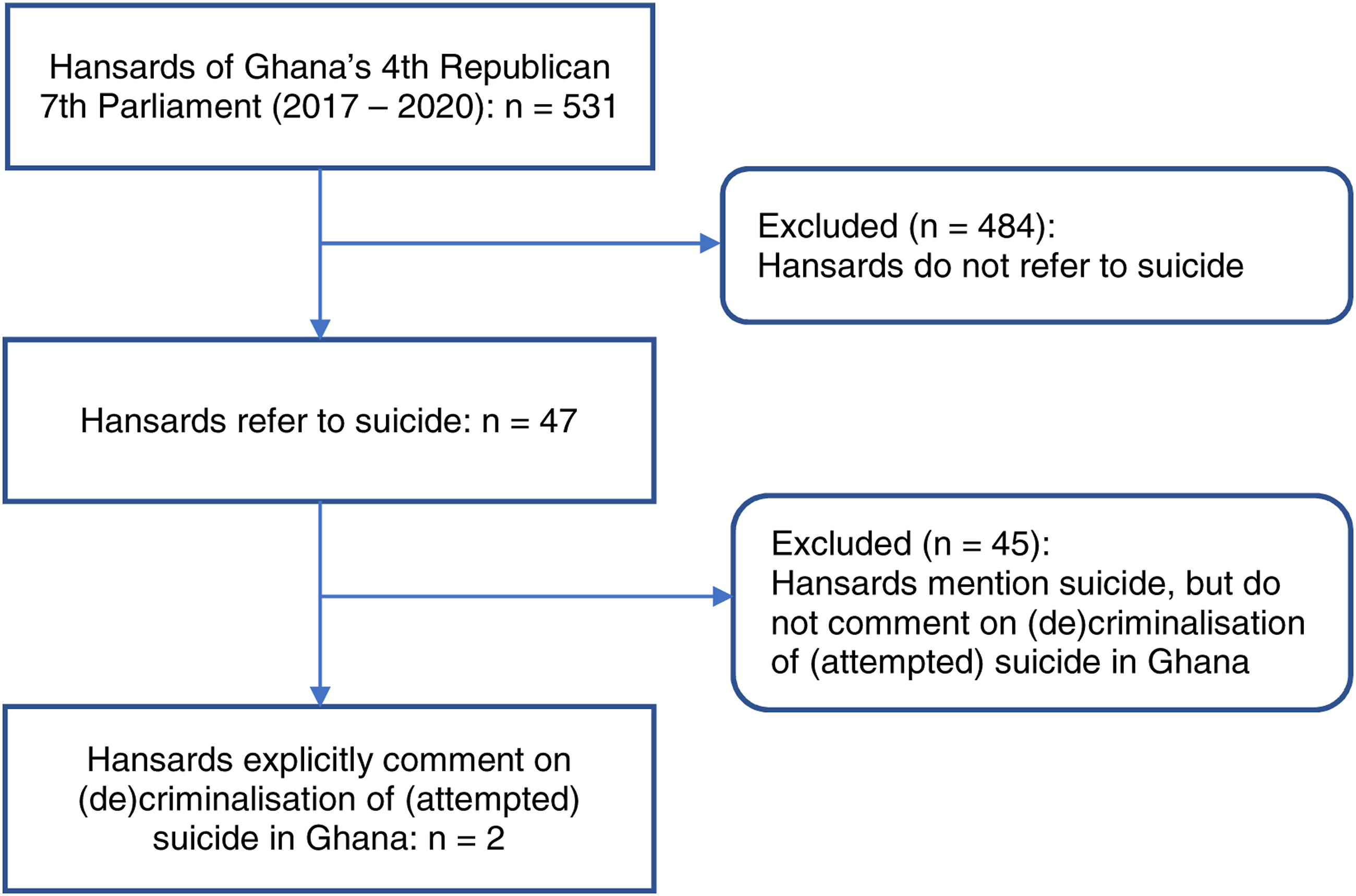
We structured and managed the data using NVivo (version 12.6). We applied reflexive thematic analysis (Braun & Clarke, 2019; Braun et al., 2019) to the Statement sections of the included Hansards. The application of this qualitative data analysis technique has been found to facilitate comprehensive, yet reflexive, flexible and less biased analysis of parliamentary debate transcripts (Mackieson et al., 2019). Reflexive thematic analysis technique identifies, analyses and reports themes (patterns) within data but also emphasises, among other values of a qualitative approach, researcher subjectivity, and the importance of engagement with, and deep reflection on data (Braun & Clarke, 2019; Braun et al., 2019). Following independent iterative close reading of the transcripts (Hansards) by each author, the major steps we followed to reflexively analyse the data aligned with the Braun-Clarke six-phase approach to thematic analysis (Braun & Clarke, 2006; Braun et al., 2019): familiarisation with the data, generation of initial codes, searching for themes, reviewing themes, defining and naming themes and report production. The analysis took place at research meetings where we maintained a continuing methodological dialogue involving all the authors.
Regarding reflexivity, we are a team of Ghanaian suicidologists, with at least 10 years of suicide prevention research and advocacy in the country. It is our wish that the anti-suicide law of Ghana be repealed. Thus, although we may be subjective and not totally neutral in interpreting the data, we grounded our interpretation heavily in the MPs’ views, in order to allow the context to shed more light on their stance regarding whether (or not) attempted suicide should be decriminalised. Also, we adopted a critical realist position in the analysis; such a position facilitates a nuanced interpretation, as the data (views of MPs) we analysed may not fully represent the MPs’ personal thoughts – they could as well be the views of the MPs’ political parties, their constituents or both.
The lack of direct human participation in this study obviated the need for ethical clearance by an institutional review board. Even though the Hansards analysed are publicly available, in reporting our findings, we have anonymised the excerpts of the MPs with pseudonyms composed of alpha-numerical designations in order to preserve the ethical position of the study. Also, we have completely anonymised the names of the MPs’ political parties and the constituencies they represented. In reporting this study, we have been guided by the community-agreed reporting standard, Consolidated criteria for Reporting Qualitative research (COREQ) guidelines (Tong et al., 2007).
Results
The 2017 Statement for decriminalisation of attempted suicide was presented by a male MP, and seven MPs (female = 1; male = 6) commented with a clear stance in support of the call to decriminalise of attempted suicide in Ghana. In 2019, the Statement for decriminalisation was presented by another male MP, but six MPs (all male) commented by stating their clear stance (for = 4; against = 2). Notably, two male MPs who supported the decriminalisation call in the 2017 Statement supported the 2019 Statement, too. Taken together, across the two Statements, 11 MPs shared their clear stance on supporting (n = 9) or opposing (n = 2) the call to decriminalise attempted suicide in Ghana.
Summary of Themes.
Deterrent Effect of the Law
This major theme relates to the opposing ideas, the anti-suicide law should be kept because it punishes offenders and serves to deter others from breaking the law, and that the supposed deterrent effect of the anti-suicide law is a myth.
Against decriminalisation: The MPs who opposed the call to decriminalise attempted suicide argued that the anti-suicide law punishes offenders and deters others from breaking the law, thereby helping to protect the lives of citizens. They adopted a moral standpoint that supports punishing wrong actions to protect the normative ethical status of the society. For example, ‘I support its [attempted suicide’s] criminalisation because… life cannot be recovered. If we do not criminalise it as a country, then we are saying that it is normal and good behaviour… Unacceptable behaviour must be punished and deterred’ (MP-2, male). This MP’s view also draws on the idea that (an attempt at) suicide does not adhere to or serve to maintain and continue life, which is irrecoverable once destroyed.
For decriminalisation: The MPs in support of the call to decriminalise attempted suicide, however, maintained that the anti-suicide law is insensitive and has unintended negative ironic effects. In a direct response to the view by MP-2 above, another MP suggested that: Our call for the decriminalisation of attempted suicide is neither an acceptance nor endorsement of a person’s desire to take his or her own life but is grounded on scientific evidence and reason. An attempt to criminalise it cannot constitute a tool for effectively dealing with it” (MP-9, male).
On the insensitivity of the anti-suicide law, an MP stated that: I find it quite interesting when somebody who has financial issues and cannot pay his rent and thus deals with himself, by attempting suicide, is fined as part of the remedy at the court. The person cannot find money to pay his rent but is being fined. If he cannot pay his rent how can he find money to pay for a court fine for attempted suicide? (MP-5, male).
Therefore, Some MPs Suggested That
Anyone who attempts suicide is crying for help. So, instead of throwing them in jail, and passing them through the criminal process, let us see that [suicide attempt] as a cry for help and use that as an intervention to give them the help that they need (MP-7, female).
Generally, the MPs who supported the decriminalisation call opposed the ‘deterrent argument’; their views revolved around four reasons, as follows: Some MPs shared a reason that the anti-suicide law provokes fear of legal recriminations and demotivates help-seeking. ‘We know that people are driven to the edge before they attempt suicide. However, because this is a crime, people do not even find it easy to approach professionals to seek help’ (MP-6, male). In the view of another MP, ‘… criminalisation discourages suicidal persons from reporting suicidal crises early enough for help’ (MP-4, male). The anti-suicide law motivates the adoption of lethal methods of suicide. The idea here is that the anti-suicide law has a (potential) ironic effect of making an attempter of suicide adopt a more lethal means in order not to survive the suicide attempt. Some MPs stated thus: ‘criminalisation of attempted suicide encourages persons who have suicidal tendencies to take every measure to ensure that they do not fail’ (MP-8). Another MP put this more candidly that ‘…somebody in that state [suicidal crisis] needs help and has to be assisted. So, if the law would punish such a person, then I am afraid that he would rather end it, so that he would not face the [legal] consequences’ (MP-11). Suicide attempt survivors should be seen as patients (victims), not as criminals. The MPs argued that persons who attempt suicide should not be punished, as they suffer from (mental health) problems requiring support within the healthcare system but not the criminal justice system. “When a person is driven to the edge of taking his life, there should be a system that could rescue him. The system could ensure that the person is not treated as a criminal, but a victim who needs support” (MP-3, male).
Another MPs suggested that ‘…we need to make sure that people who have become susceptible to suicide are taken as mental patients. It should be a condition that must be treated fairly, just like any other physical ailment, and should not be punished’ (MP-10, male). 4. The anti-suicide law is inimical to science and data. Some MPs shared the concern that the anti-suicide law militates against suicide reporting and the science of suicide prevention, as the law discourages (accurate) reporting. ‘It [criminalisation] also encourages underreporting and leads to underestimation, which is not good for planning for suicide prevention’ (MP-9, male).
Between the two groups of MPs, it seemed those who supported criminalisation and the ‘deterrence argument’ dismissed or ignored the (personal) reasons a suicidal person might have for their attempt at suicide. However, the MPs who favoured the decriminalisation call (but opposed the deterrence argument) appeared to consider and reference the reasons for an attempted suicide and the meaning the attempt might hold for the suicidal person. Relatedly, it is also notable that in both Hansards analysed, some MPs who favoured the decriminalisation call (but opposed the deterrence argument) described suicidal persons in specific medicalised terms – for example, ‘mental patients’, ‘victims of a psychological condition’ and ‘attempted suicide as a neurotic expression of the need for help’ (Parliament of Ghana, 2017, 2019).
Enforcement of the Law
This major theme addresses the concern about whether (or not) the anti-suicide law is enforced at all, which could warrant decriminalisation or otherwise.
Against decriminalisation: MPs who argued against the call to decriminalise attempted suicide maintained that Ghana should leave things as they are, as the anti-suicide law is not enforced, anyway. The MPs observed that although the anti-suicide law exists, it is not enforced by the responsible state agents (e.g. police, prosecutors, lawyers and judges). An MP shared his experiential view thus: I have done 30 years in law practice now. Even during my younger days, I do not remember that I heard or saw somebody prosecuted for attempted suicide. I think that in everyday jurisprudence, it is not one of the things that any prosecutor is interested in (MP-1, male).
MP-1 argued further that the Ghanaian society is sympathetic towards persons experiencing suicidal tendencies, including attempt survivors. In the view of the MP: “Ghanaians generally sympathise with people who attempt to commit suicide. Growing up, those people in the small communities actually helped. The victims are taken to informal counsellors” (MP-1, male).
Thus, in the views of the opposing MPs, it is needless to decriminalise attempted suicide because the anti-suicide law has never been enforced. In their view, no suicide attempt survivor has ever been taken through the criminal justice system and punished. What remains unclear, though, is whether keeping the law still makes the Ghanaian society sympathetic towards suicidal persons, even in the eyes of other non-Ghanaian societies.
For decriminalisation: The supporting MPs raised three concerns against the ‘enforcement argument’. First, considering that suicide is generally an individual act, the MPs shared the view that, essentially, the anti-suicide law appears to be partly premised on a goal to prevent an individual from committing a crime against themselves. To the MPs, a crime is not self-inflicted: under normal circumstances, a person does not engage in a criminal act against themselves. Therefore, this could perhaps be the reasoning that discourages legitimate state agencies from enforcing the anti-suicide law. ‘One cannot commit a crime against himself, and that is why invariably, it [the anti-suicide law] is hardly prosecuted. We should not leave it to be the same in our books’ (MP-3, male).
The next concern is that although the anti-suicide law is generally not enforced, the potential to enforce it still exists. An MP shared this concern thus, ‘Even though it is rare that somebody would be prosecuted for attempted suicide, the police and the other security agencies that are aware that it could be punished are likely to act on it’ (MP-7, male).
The third concern sought to contest the idea that the Ghanaian society is sympathetic to persons who attempt suicide. The contesting view is that repealing the anti-suicide law rather represents a more critical proof that the Ghanaian society is compassionate to persons who attempt suicide. An MP was of the view that ‘we should remove it [the anti-suicide law] from our books, so that everybody would know that we are a compassionate society…We should decriminalise suicide cases and show that we are a truly compassionate society’ (MP-8, male).
Prioritisation of Suicide Prevention
The two Statements calling for the decriminalisation of attempted suicide showed the concerning increasing trends of suicide at the time and the need to prioritise prevention efforts in Ghana (Parliament of Ghana, 2017, 2019). These evidence and suggestions were not disputed by the MPs. However, the MPs had contrasting views regarding the consideration of decriminalisation of attempted suicide as a suicide prevention priority.
Against decriminalisation: MPs opposing the decriminalisation call suggested the focus to be on more pressing issues of the country, while resourcing supporting systems to help suicidal persons. Put differently, this group of MPs maintained their position that the anti-suicide law should be kept, but the government should resource and strengthen supporting systems to help persons experiencing suicidal crises: There are some matters that should be allowed to lie… What I suggest we do is to pretend that it [the anti-suicide law] does not exist. This is because truly, that is how we have looked at it in the past few years. We should rather focus on more pressing things. […] I have heard [a former chief psychiatrist] complain often, but I also know that he is heavily overburdened with the psychiatric cases that are before him. It would probably be ideal to facilitate and give such people [suicidal persons] formal counseling, as would be desired (MP-1, male).
While the view shared by MP-1 above appears laden with candid observations but also with somewhat dismissive attitudes towards suicidal persons (e.g. that there are more important mental health problems in the country other than attempted suicide), a critical question that arises is whether it is (legally) possible for the state to facilitate support services for suicidal persons, while the anti-suicide law is in force.
For decriminalisation: Interestingly, the MPs who supported the call to decriminalise attempted suicide maintained that the anti-suicide law and the provision of legitimate support to suicidal persons cannot co-exist. They argued that in the first place, the anti-suicide law is not pro-help-seeking, ‘I would still want to emphasise that we take steps to decriminalise suicide attempts so that people who have attempted it are counselled, helped and sent to the appropriate places for treatment’ (MP-5, male).
Secondly and more importantly, the supporting MPs were of the view that the anti-suicide law, while in existence, does not create a legitimate environment for the government to set up structures or commit to resourcing suicide preventive efforts. The ‘Criminalisation of suicide does not encourage the Government to commit funds for suicide research and preventive programmes to curb the rate in the country’ (MP-11, male). Another MP summarised the two points thus: ‘I believe decriminalising this [attempted suicide] would give Government the opportunity to help, and also give the opportunity to people not to be shy of the need to approach professionals to seek help’ (MP-6, male).
Discussion
Of the 11 MPs who commented (with a clear stance) on the two Statements presented to parliament calling for the decriminalisation of attempted suicide in Ghana, nine supported the call while two MPs opposed it. There is no published quantitative survey from Ghana on the views of specialised groups or lay persons regarding the call for decriminalisation of attempted suicide. However, like the current study, most participants in previous qualitative studies from Ghana have supported the decriminalisation call: university students (Knizek et al., 2011; Osafo et al., 2011), health professionals (Hjelmeland et al., 2014; Osafo, Akotia, Boakye, et al., 2018; Osafo et al., 2012), lawyers and judges (Osafo, Akotia, Andoh-Arthur et al., 2018a), community leaders (Osafo et al., 2019), and police officers (Osafo et al., 2017). The views of both groups of MPs in the current study were elaborated along three lines: deterrent effects of the law, enforcement of the law, and prioritisation of suicide prevention.
The reasoning that the anti-suicide law should be kept because it has a deterrent effect draws from a deontological ethical position that (attempted) suicide is unacceptable because it breaches the natural rule of self-preservation. The law makers who favour this position also appear to adhere to the ‘parens patriae principle’ – the principle that the state has the lawful duty to protect citizens who are unable to help or protect themselves. Perhaps, to these law makers, the state’s ‘parens patriae’ powers must be constantly evoked (through the enforcement of the anti-suicide law) to punish offenders, in order to reform the offenders’ behaviours but also to deter citizens from engaging in similar or same unlawful acts that threaten individual and collective existence. Although some participants in previous qualitative studies from Ghana (Knizek et al., 2011; Osafo, Akotia, Andoh-Arthur, et al., 2018; Osafo, Akotia, Boakye, et al., 2018; Osafo et al., 2019; Osafo et al., 2017; Osafo et al., 2011; Osafo et al., 2012) have similarly advanced the deterrent effects argument in support of their stance against the decriminalisation call, it appears the recent increasing trends of (attempted) suicide being reported from Ghana (Abdulai, 2020; Akotia et al., 2019; Der et al., 2016; Quarshie et al., 2015; WHO, 2021b) bring the supposed deterrent effects of the law into question.
The MPs who (opposed the deterrent effects argument but) favoured the decriminalisation call indicated that the anti-suicide law provokes fear of legal recriminations and demotivates help-seeking, motivates adoption of lethal methods to attempt suicide, and the anti-suicide law is inimical to science and data related to suicide and suicide prevention. These strands of reasoning are supported by science and recent evidence reported by leading scholars, IASP, UnitedGMH and WHO (IASP, 2019, IASP, 2020, UnitedGMH, 2021, WHO, 2014, WHO, 2016; Mishara & Weisstub, 2016). Furthermore, the recommendation by this group of MPs that suicide attempt survivors should be seen as patients but not as criminals is arguably helpful and encouraging. This finding is not entirely surprising as a recent qualitative study involving lawyers and judges of superior courts in Ghana has also found that persons who attempt suicide should be viewed as patients requiring care and support from the mental health system but not as criminals (Osafo, Akotia, Andoh-Arthur et al., 2018a). However, it is important to acknowledge that describing persons experiencing suicidal crises in terms that exude medical or pathological undertones provides an incomplete and a less balanced view (Andoh-Arthur & Quarshie, 2021; Hjelmeland & Knizek, 2017; Pridmore, 2015; Sara, 2015). Suicidal behaviours are multicausal and complex (WHO, 2014), so limiting the description of suicidal behaviours to mental disorders, inadvertently, favours only narrow prevention efforts at the expense of broader, population-level strategies.
Also, even though specific evidence on the connection between the anti-suicide law and means/methods of suicide is lacking from Ghana, recent studies have reported the use of (potentially) lethal methods by both attempt survivors and suicide decedents (Abdulai, 2020; Akotia et al., 2019; Der et al., 2016; Quarshie, Asante, et al., 2021; Quarshie et al., 2015;Quarshie et al., 2020). Authors of these studies have suspected the anti-suicide law to have played a role in the choice of suicide methods by some participants. Consistent with the recommendation by the WHO and IASP, our view is that repealing the anti-suicide law will represent a bold systemic effort at discouraging suicide attempt in Ghana, while encouraging help-seeking and making Ghana a compassionate society towards persons experiencing suicidal crises.
The view by the opposing MPs that the anti-suicide law should be kept as the law has never been enforced comes across as an uninformed position. Contrary evidence from Ghana shows that several individuals have been arrested, prosecuted, found guilty of the anti-suicide law and given hefty fines or jailed (Adinkrah, 2012). In fact, first-hand accounts of police officers, lawyers and judges in Ghana suggest that offenders of the anti-suicide law are still passed through the criminal justice system and occasionally punished, if found guilty (Andoh-Arthur & Quarshie, 2021; Osafo et al., 2018a; Osafo et al., 2017).
The interesting finding (which is also unique to this study, relative to previous studies) that the anti-suicide law and the prioritisation of suicide prevention cannot co-exist is also encouraging. This evidence supports the view by the WHO and IASP that in order to ensure a comprehensive national response for suicide prevention, countries must review their legal provisions related to suicide and suicidal behaviours (IASP, 2020; WHO, 2014). The implication is that the existence of the anti-suicide law has the potential to impede any meaningful commitment by the government to put in place resource-supportive structures for citizens experiencing suicidal crises.
Implications and Limitations
By and large, whereas the views of the MPs who supported the decriminalisation call were consistent with research, the conservative and arguably less mental health literate views of the MPs who opposed the decriminalisation call indicate that there is a need to extend evidence-based suicide prevention literacy programmes to MPs in Ghana. Here, a key local stakeholder, like, the Centre for Suicide and Violence Research (CSVR) could consider designing targeted suicide literacy training and capacity-building programmes for MPs as they have done for police officers, lawyers and judges in the country (WHO, 2021a). However, a critical limitation of drawing data from the Parliamentary Hansards is that it may not be possible to neatly determine if the views shared by the MPs were their own, those of their constituents or the views of the political parties they represent. Also, a Statement on a matter of urgent public importance presented to Ghana’s Parliament cannot be commented on by MPs for more than one hour. This implies that in the current study, only a few MPs who were able to catch the eye of the Speaker could comment and share their stance within a limited time frame on the decriminalisation call – in our case, only 11 (4%) out of the 275 MPs commented on the Statements. This limitation also challenges the chances of obtaining more diverse views by different MPs. Relatedly, this study is based on only the two Statements presented between 2017 and 2020; this limits the general data corpus or volume of views informing our analysis and conclusion. Thus, although it may be daunting (due to the busy nature of MPs’ work), future studies could consider recruiting MPs directly to solicit their (personal) views on the call to decriminalise attempted suicide in Ghana.
Conclusion
Considering that most of the MPs (9 out of 11) providing comments on the call to decriminalise attempted suicide in Ghana have a supportive and empathic stance, perhaps there is now a need for a private member’s bill or a public bill to provoke a full-fledged parliamentary plenary debate towards a revocation of the anti-suicide law in Ghana.
Footnotes
Declaration of Conflicting Interests
The author(s) declared no potential conflicts of interest with respect to the research, authorship, and/or publication of this article.
Funding
The author(s) received no financial support for the research, authorship, and/or publication of this article.
