



Abstract
This study examines the role of general news media consumption during COVID-19 in aggravating mental health and suicide risk in the US population. In a sample of U.S. adults (N = 5,010), we investigated how mental health, COVID-19 health beliefs, and general news consumption influenced the odds of suicidal ideation using hierarchical logistic regression models. Both worsening mental health overall and specifically in regard to COVID-19 increased suicidal ideation. Perceived susceptibility to COVID-19 infection did not increase suicidal ideation, yet higher levels of COVID-19 self-efficacy reduced suicidal ideation. Overall news consumption did not affect suicidal ideation, but media-specific post-hoc analyses revealed that TV news watching decreased suicidal ideation as much as high levels of COVID-19 self-efficacy decreased suicidal ideation. Furthermore, online news consumption increased suicidal ideation as much as worsening mental health overall increased suicidal ideation. Further implications are discussed.
The COVID-19 pandemic is rife with stressors (e.g., social isolation, economic downturn) that can worsen mental health and increase suicide risk by way of activating suicidal ideation (Santini et al., 2020). Clearly, effective suicide prevention efforts are critically needed. Typically, some of these efforts are placed within and disseminated through the larger media environment. In doing so, they must compete for attention with other, at times conflicting, messages in the media environment in order to effectively reach the target audience (Wakefield et al., 2010). What is often lacking is a thorough understanding of how the media environment itself influences suicide risk, and thus subsequent media-based efforts to prevent suicide.
Guiding frameworks such as social cognitive theory (SCT) (Bandura 1986) and cultivation theory (Gerbner & Gross, 1976) emphasize that individuals’ beliefs and behaviors are mutually influenced by the totality of news media engagement. A large body of literature has examined these effects in the context of suicide, but with inconsistent results. The news media have found to have both a protective influence on suicide risk in the population, effectively decreasing suicide risk (i.e., Papageno effect; Niederkrothentaler et al., 2010), but also a negative influence on suicide risk, triggering increases in suicides in the population (i.e., Werther effect; Niederkrotenthaler et al., 2020).
Understanding the influence of the news media on mental health and suicide risk is particularly important during COVID-19 for two primary reasons. First, news media consumption in the population is high because the news media can fulfill important societal functions by providing timely information, educating the public about health threats, and communicating with at-risk individuals (Vastermann et al., 2005). Second, individuals in the population are more vulnerable to mental health threats and suicidal ideation during times of heightened stress (CDC, National Center for Health Statistics, 2020). Both factors may amplify effects of the news media on individuals’ beliefs and behavior during COVID-19 (Weitzer & Kubrin, 2004). The presence of depression or anxiety symptoms typically predispose individuals to interpret news media reports through a negative cognitive filter (negativity bias; Scherr et al., 2021), which may lead to conclusions that COVID-19 infection is guaranteed and that there is nothing one can do about it, thus worsening symptoms and potentially increasing suicide risk (Hertel, 2002). Whereas most existing suicide prevention efforts are practical at face value, they are often not based on empirical evidence (Ftanou et al., 2017). Additional knowledge about the specific predictors of suicide risk during the COVID-19 pandemic could inform effective and timely suicide prevention efforts. Thus, the primary goal of this study was to increase understanding of the unique predictors of suicidal ideation (as an indicator of suicide risk) during the COVID-19 pandemic in order to inform avenues for well-targeted suicide prevention efforts.
The Current Study
This study examined the relationships between symptoms of depression and anxiety, suicidal ideation, negative health beliefs about COVID-19, and consumption of general news media during the COVID-19 pandemic. We hypothesized that scoring higher on indicators for symptoms of depression and anxiety would show an increase in suicidal ideation (H1). Furthermore, we hypothesized that negative COVID-19 health beliefs (COVID–19-related anxiety, perceived COVID-19 susceptibility) would also be associated with an increase in suicidal ideation (H2). On the other hand, we also hypothesized that positive COVID-19 health beliefs, that is, the perceived self-efficacy of finding help for COVID-19 should one get infected would be associated with lower levels of suicidal ideation (H3). Finally, we included a research question to examine whether and how participants’ general news media consumption during the COVID-19 pandemic would be associated with suicidal ideation (Research Question1).
Method
Sample and Procedure
A cross-sectional online survey of a total sample of N = 5,001 U.S adults was administered by the survey company Lucid in June 2020. Individuals were sampled through Lucid’s survey platform following a standardized, double opt-in procedure for becoming a panel member and to participate in specific surveys. Individuals were on average 44.5 years old (SD = 16.92), 50.3% were female, and 59.2% were non-Hispanic White (59.2%). Most participants older than 25 years indicated that they had earned a Bachelor’s degree or higher (42%), were currently employed (53.2%), and earned an income between US$50,000 and 99,999 (28.5%) in the past 12 months. Data collection was completed in June 2020. The study protocol has been approved by the lead institution’s IRB board (IRB protocol number IRB2020-0402D).
Measures
Suicidal Ideation
Suicidal ideation was assessed with the 25-item Adult Suicidal Ideation Questionnaire (ASIQ) (Reynolds, 1991). Designed to assess suicidal thoughts both among clinical and non-clinical populations, the ASIQ determines the frequency of suicidal thought patterns within the last month (e.g., “I thought it would be better if I was not alive”) on a 7-point scale from 1 = never to 7 = almost every day. A principal component analysis was conducted with all ASIQ items using Promax rotation in order to determine the number of factors based on parallel analysis. This procedure compares different factor solutions for the collected data against identically structured, random data and determines a final optimized factor solution based on these comparisons. Based on this analysis, we utilized one single factor for the ASIQ that explained 75.52% of the observed variance in suicidal ideation (KMO = .994; Bartlett’s test, p < .001). Following Reynolds (1991) suggestions, all items were transformed into a reliable summated suicidal ideation score (M = 48.79, SD = 35.77, Cronbach’s α = .99). Importantly, a clinical cutoff point for summated scores greater than 30–31 has previously been identified as indicator for high levels of suicidal ideation and suicide risk for which clinical evaluation is suggested (Reynolds, 1991; Fu & Yip, 2007). We used the scores > 30 cutoff as our primary outcome variable; this measure differentiates between people with lower (= 0) versus higher (= 1) suicidal ideation.
Depression
We assessed depression symptoms using the well-established PHQ-9 scale (Kroenke et al., 2001). The nine questions assess the frequency of depressive symptoms for the last 2 weeks with items such as “little interest or pleasure in doing things,” “moving or speaking so slowly that other people could have noticed or so fidgety and restless that you have been moving a lot more than usual” and “feeling bad about yourself or that you are a failure or have let yourself or your family down.” Answer options for each item included 0 = not at all, 1 = on several days, 2 = more than half the days, and 3 = nearly every day. A principal component analysis with Promax rotation in conjunction with a parallel analysis was then applied to all nine items to identify the number of underlying components for the PHQ-9. The final solution suggested a one-factor solution that explained 62.06% of the observed variance in depression scores (KMO = .942; Bartlett’s test, p < .001). We transformed all items into a summated score index ranging from 0 to 27 (M = 7.77, SD = 7.07; Cronbach’s α = .92), with higher scores indicating higher severity of depressive symptoms.
Pre–COVID-19 Generalized Anxiety (GAD-7)
Pre–COVID-19 generalized anxiety symptoms were assessed using a well-established brief inventory (GAD-7; Spitzer, Kroenke, & Williams, 2006). We instructed participants to think about a 2-week time frame before the COVID-19 pandemic without considering the influence of COVID-19. All other original wording for this measure remained the same. For example, we asked participants to assess the frequency with which they had experienced “feeling nervous, anxious, or on edge,” “trouble relaxing,” “becoming easily annoyed or irritable” on a scale from 0 = not at all, 1 = several days, 2 = more than half the days, to 3 = nearly every day. A principal component analysis (Promax rotation; parallel analysis; variance explained: 74.72%, KMO = .946; Bartlett’s test, p < .001) suggested that all items loaded on one single factor, thus, we computed a summated score that ranged from 0 to 21 with higher values being reflective of higher severity of anxiety symptoms (M = 6.29, SD = 6.20; Cronbach’s α = .92).
COVID-19 Anxiety
We used the same GAD-7 measure but adapted items to address the influence of COVID-19. Specifically, participants were told to think “about the COVID-19 pandemic” when answering questions, such as whether they had been “bothered by any of the following feelings RELATED to the COVID-19 pandemic.” Similar to the global anxiety measure, the COVID-19 anxiety measure also yielded a one-factor solution (Promax rotation; parallel analysis; variance explained: 75.86%, KMO = .945; Bartlett’s test, p < .001). The summated COVID-19 anxiety scores (range: 0–21; M = 6.38, SD = 6.25) had good internal reliability as indicated by Cronbach’s α = .95. Both pre–COVID-19 generalized anxiety scores and COVID-19 anxiety scores were strongly correlated, r = .83, p < .001.
COVID-19 Perceived Susceptibility
We assessed how susceptible participants thought they were to getting infected with COVID-19 using the three items “I believe that I am at risk for getting infected with COVID-19,” “it is likely that I will get infected with COVID-19,” and “it is possible that I will get infected with COVID-19.” The three statements were assessed on a 7-point Likert scale from 1 = strongly disagree to 7 = strongly agree. Since the three items showed good internal consistency as indicated by Cronbach’s α = .87, we transformed the items into a mean composite measure (M = 3.83, SD = 1.57) with higher values being indicative of a stronger perceived susceptibility to COVID-19.
COVID-19 Self-efficacy
We assessed whether individuals would “feel confident that [they] could seek medical help for COVID-19 if [they] thought they had it” on a 7-point Likert scale from 1 = strongly disagree to 7 = strongly agree. Responses showed that individuals were mostly confident that they could seek medical help for COVID-19 if they thought they had it (M = 5.35, SD = 1.64).
General News Consumption
Finally, we asked participants about their general news consumption. We assessed how frequently, on average in any given week, they would “watch the news on TV,” “read the news in a newspaper,” “listen to news on the radio,” “read the news on the Internet,” or “discuss news with family and/or friends.” Items were assessed on a 5-point Likert scale from 1 = never, 2 = rarely, 3 = sometimes, 4 = often, to 5 = always, which yielded a composite measure for total general news consumption that showed acceptable internal reliability (M = 3.21, SD = .92, Cronbach’s α = .77).
Results
Descriptive Statistics
In this sample, we detected increased suicidal ideation among 2418 participants (52%) based on the >30 cutoff point suggested by Reynolds (1991) and others. At the same time, self-reported depression symptoms were, on average, on the lower end of the depression symptom severity spectrum (M = 7.77, SD = 7.072, range 0–27). Both pre–COVID-19 generalized anxiety symptoms (M = 6.29, SD = 6.20; 95%-CI [6.11, 6.46]) and COVID–19-specific anxiety symptoms (M = 6.38, SD = 6.25; 95%-CI [6.20, 6.56]) yielded similar mean scores as indicated by overlapping 95% confidence intervals. On average, perceived COVID-19 susceptibility was moderate in this sample (M = 3.83, SD = 1.57; range 1–7) and COVID-19 self-efficacy scores fell above the scale midpoint (M = 5.35, SD = 1.64, range: 1–7). Participants’ general news consumption across all media channels and news sources (i.e., TV, newspaper, radio, online, family and friends) was, on average in any typical week, higher than the scale midpoint (M = 3.21 (SD = .92; range 1–5).
Zero-order correlations and descriptive statistics.
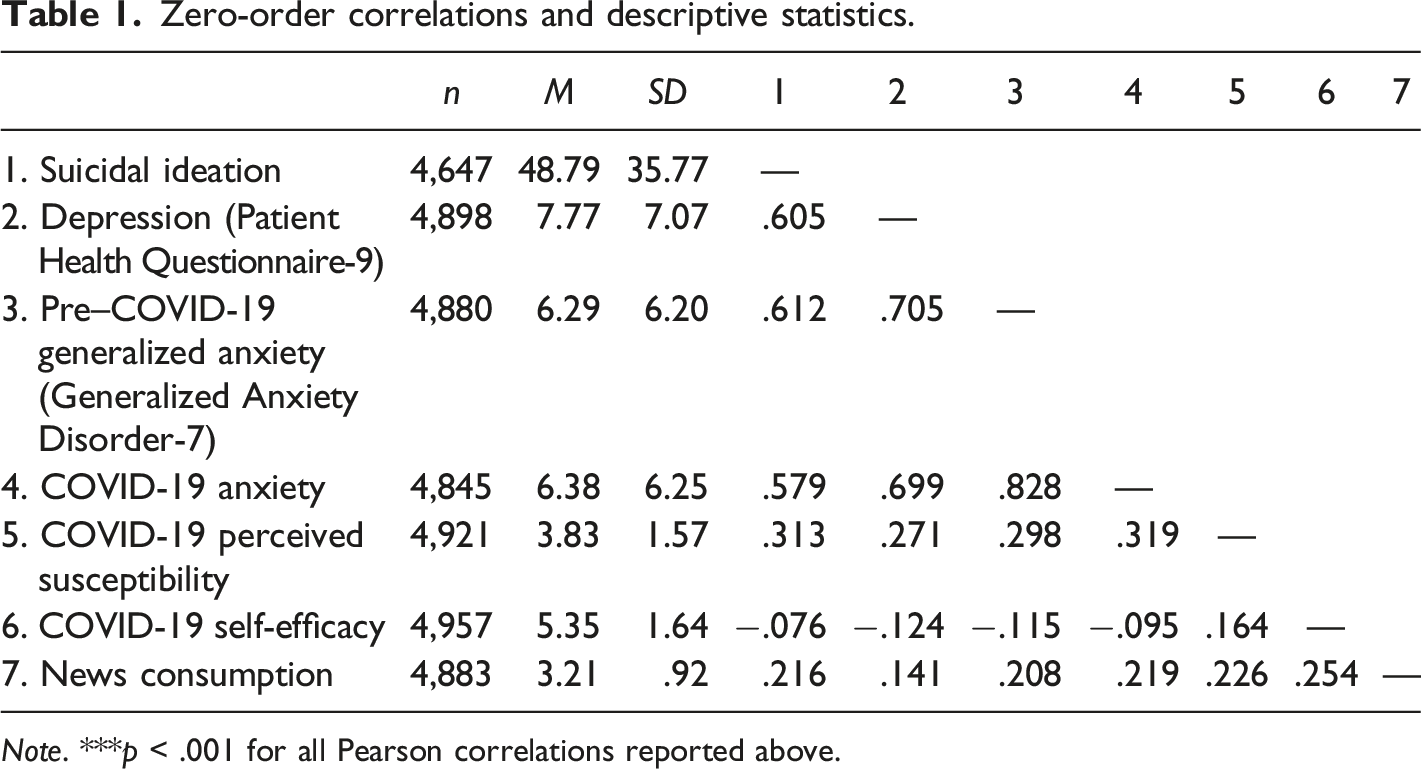
Note. ***p < .001 for all Pearson correlations reported above.
Predicting Suicidal Ideation
Hierarchical logistic regression predicting suicidal ideation a .
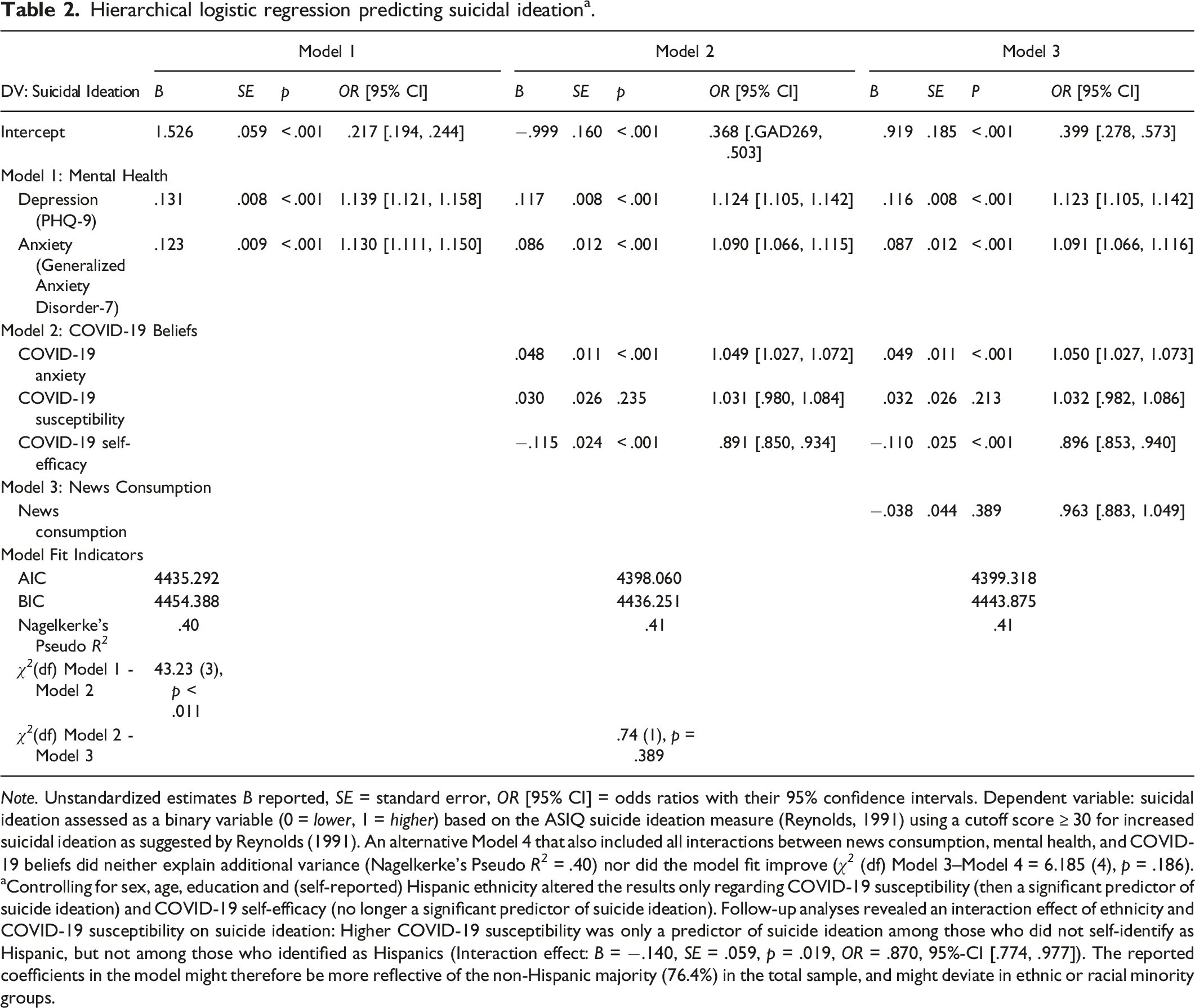
Note. Unstandardized estimates B reported, SE = standard error, OR [95% CI] = odds ratios with their 95% confidence intervals. Dependent variable: suicidal ideation assessed as a binary variable (0 = lower, 1 = higher) based on the ASIQ suicide ideation measure (Reynolds, 1991) using a cutoff score ≥ 30 for increased suicidal ideation as suggested by Reynolds (1991). An alternative Model 4 that also included all interactions between news consumption, mental health, and COVID-19 beliefs did neither explain additional variance (Nagelkerke’s Pseudo R 2 = .40) nor did the model fit improve (χ 2 (df) Model 3–Model 4 = 6.185 (4), p = .186).
aControlling for sex, age, education and (self-reported) Hispanic ethnicity altered the results only regarding COVID-19 susceptibility (then a significant predictor of suicide ideation) and COVID-19 self-efficacy (no longer a significant predictor of suicide ideation). Follow-up analyses revealed an interaction effect of ethnicity and COVID-19 susceptibility on suicide ideation: Higher COVID-19 susceptibility was only a predictor of suicide ideation among those who did not self-identify as Hispanic, but not among those who identified as Hispanics (Interaction effect: B = −.140, SE = .059, p = .019, OR = .870, 95%-CI [.774, .977]). The reported coefficients in the model might therefore be more reflective of the non-Hispanic majority (76.4%) in the total sample, and might deviate in ethnic or racial minority groups.
Analyses showed that each of the three incremental blocks made a significant contribution to the overall model, explaining about 40% of the observed variance in increased suicidal ideation. In the final model, more severe symptoms of depression (OR = 1.123 [95% CI: 1.105, 1.142]), anxiety (OR = 1.091 [95% CI: 1.066, 1.116]), and COVID–19-specific anxiety (OR = 1.050 [95% CI: 1.027, 1.073]) were all significantly associated with an increase in suicidal ideation. On the other hand, higher levels of COVID-19 self-efficacy were associated with a decrease in suicidal ideation (OR = .896 [95% CI: .853, .940]). Perceived COVID-19 susceptibility (OR = 1.032 [95% CI: .982, 1.086]) and general news media consumption (OR = .963 [95% CI: .883, 1.049]) were not associated with suicidal ideation. Notably, the final model correctly predicted 73.45% of cases with increased suicidal ideation (n = 1629), and 80.02% of the cases without increased suicidal ideation (n = 1662). The accuracy of our predictive model was .766, the specificity was .800, and the sensitivity was .734.
Our findings support H1 and H3. H2 was partially supported (COVID–19-specific anxiety was associated with an increase in suicidal ideation, but COVID-19 susceptibility was not associated with an increase in suicidal ideation). Regarding RQ1, overall general news media consumption was not associated with suicidal ideation.
Post hoc Analysis: Differential Media Influences on Suicidal Ideation
Our measure for overall general news media consumption included a wide range of news media outlets (i.e., TV, radio, newspapers, Internet) and news sources (i.e., friends and family). To account for possible differences, we tested associations with suicidal ideation separately for each news media outlet and news source. To do this, we replaced the composite measure assessing overall general news media consumption with its five separate items. The final model explained 42% (Nagelkerke’s Pseudo R2) of the observed variance in suicidal ideation (AIC = 4370.842, BIC = 4440.860) and correctly predicted 73.81% of the cases with increased suicidal ideation and 79.97% of the cases without. The new model did not differ substantially from the previous one (accuracy = .768, specificity = .800, sensitivity = .738), but did allow for more nuanced comparisons between general news media outlets and news sources. Specifically, exploratory hierarchical logistic regression models showed that TV news-watching was significantly associated with a decrease in suicidal ideation (OR = .828 [95% CI: .774, .886]), while online news consumption was associated with an increase in suicidal ideation (OR = 1.103 [95% CI: 1.025, 1.188]). Reading newspapers (OR = 1.061 [95% CI: .993, 1.134]), listening to radio news (OR = 1.013 [95% CI: .944, 1.087]), and discussing the news with friends and family (OR = .978 [95% CI: .899, 1.064]) was not associated with an increase or decrease in suicidal ideation.
Discussion
Significant environmental stressors, such as the global COVID-19 pandemic, can aggravate the primary predictors for suicide (Santini et al., 2020). We conceptualized depression and anxiety as primary predictors for suicidal ideation, but sought empirical clarification on the positive and negative influences of COVID-19 health beliefs and general news consumption. Over half of participants in this nationally representative sample reached a threshold of suicidal ideation for which further clinical evaluation is typically recommended. This is a novel finding, as evidence of rising suicide rates in the later stages of the COVID-19 pandemic, when personal protective factors (e.g., resilience) are likely depleted, are only slow to emerge. Interestingly, average depression scores were on the lower end of the spectrum in this sample, suggesting that a lack of severe depression symptoms alone does not necessarily reduce suicide risk. Suicide risk is a complex phenomenon that increases or decreases due to a multitude of protective and risk factors, thus, suicide prevention in the context of COVID-19 should be a critical public health priority now and in the immediate future (McIntyre & Lee, 2020).
This study confirmed that well-established indicators for poor mental health, such as symptoms of depression and anxiety, were associated suicidal ideation in the population during COVID-19 (Beck, 1976; Gotlib & Joormann, 2010). Adding to the knowledge base, we also found that high levels of COVID-19-specific anxiety were also associated with increased suicidal ideation. High levels of self-efficacy (i.e., feeling capable of seeking medical help should one get infected with COVID-19), on the other hand, mitigated these associations and acted as protective factor against suicidal ideation. Unfortunately, levels of self-efficacy among individuals at risk for suicide tend to be low (Tahmassian & Jalali Moghadam, 2011).
Both of these aggravating (COVID-19 anxiety) and protective (self-efficacy) factors of suicidal ideation are likely made salient by the news media (Garfin et al., 2020). We found that treating general “news media use” as one global concept regardless of media type did not yield meaningful findings. Probing further, our post-hoc analyses revealed that similar to other stressors of suicidal ideation, the news media can have both protective or aggravating influences, depending on the type of news media consumption. Specifically, we found that higher consumption of TV news was associated with a significant decrease in suicidal ideation whereas higher consumption of online news was associated with a significant increase in suicidal ideation. This finding aligns with other research that recently revealed the negative consequences of online news consumption during COVID-19, particularly due to the high prevalence and circulation of misinformation (Pew Research Center, 2021). It is plausible that this misinformation heightens symptoms and suicidal ideation among those affected by anxiety and depression. We thus concur with the recommendation of the World Health Organization (2017) and suggest the use of COVID–19-specific guidelines for media reporting. Online news sources should also better educate about COVID-19 and help increase self-efficacy beliefs, particularly during times of significant environmental stress (Gadarian et al., 2020).
Limitations
We based this report on cross-sectional, self-report data that cannot establish cause-and-effect relationships and are prone to recall bias in the answers provided. Due to the complexity of mood disorders and predictors of suicidal ideation, results regarding the predictive power of negative COVID-19 health beliefs should be interpreted with caution until sufficient replication studies exist both within the United States and beyond. Self-reported media use measures can be biased and should be interpreted with caution.
Conclusion
This study confirmed that suicidal ideation is high in the US population during the COVID-19 pandemic. Suicidal ideation is particularly high among those who experience higher levels of depression and anxiety (both pre–COVID-19 generalized anxiety and COVID–19-specific anxiety) but higher levels of self-efficacy (i.e., feeling capable of seeking medical help for COVID-19 should one get infected) mitigated suicidal ideation to some extent. Differential influences of media news consumption revealed that TV news consumption decreased, whereas online news consumption increased, (McIntyre & Lee, 2020) suicidal ideation in the population.
Footnotes
Declaration of Conflicting Interests
The authors declared no potential conflicts of interest with respect to the research, authorship, and/or publication of this article.
Funding
The authors disclosed receipt of the following financial support for the research, authorship, and/or publication of this article: This work was supported by the Texas A&M Triads for Transformation (grant number 246477).
