



Abstract
Fear is a fundamental response in the face of a life-threatening pandemic, such as COVID-19. To assess COVID-19-related fear, the Fear of COVID-19 Scale (FCV-19S) has been recently developed and validated in many countries across the globe. The current study aimed to adapt the FCV-19S into German and to examine its psychometric properties. Participants (N = 866) were asked to complete the FCV-19S, report their perceived risk of contracting the virus, and their willingness to comply with mask wearing. Confirmatory Factor Analysis supported both a two-factor structure (emotional and somatic fear) and a more parsimonious one-factor model. Among demographic variables, only female gender was positively associated with the FCV-19S. Moreover, the measure was associated with increased risk perception and compliance with mask wearing. Results suggest that the FCV-19S has good psychometric properties in German and can be used in future work.
Introduction
The novel coronavirus (COVID-19, also known as Severe Acute Respiratory Syndrome Coronavirus 2 [SARS-CoV-2]) pandemic poses an unprecedented challenge to the world’s population (Lipsitch et al., 2020). So far, more than 245 million confirmed COVID-19 cases have been reported worldwide, with more than 4.9 million deaths in over 192 countries (JHU, 2021). A variety of protective measures have been instigated to contain the virus, including social distancing, hygiene, and widespread testing (World Health Organization, 2020). However, rising infection rates and the recent discovery of new and potentially more contagious COVID-19 variants are increasingly unsettling society (Schimmenti et al., 2020).
The burden of the COVID-19 pandemic includes economic, political, social, and psychological effects. COVID-19 exposes social inequalities, leading certain social groups (e.g., minorities) to become distrustful, suspicious, or fearful of the government (Iskander, 2020; Oyarzun, 2020). Indeed, previous research has shown that people differ in how they make sense of the virus (Koon et al., 2021) and, hence, the nature of their fear can be quite multifaceted. People’s concerns, for example, may include fear of contagion, fear of illness, or fear of losing their freedoms due to movement restrictions and public health measures (e.g., quarantine). Simply put, COVID-19 is “a guy we don’t know” (Hardy, 2020, p. 657).
Fear of being infected by COVID-19 is highly present (i.e., coronaphobia; Asmundson & Taylor, 2020). From a psychological perspective, fear constitutes a basic emotional reaction to a potentially deadly virus and can be both adaptive and maladaptive (for a recent review, see Coelho et al., 2020). On the one hand, fear of COVID-19 is associated with increased public health compliance in response to the pandemic (e.g., social distancing; Harper et al., 2020). 1 Yet, on the other hand, fear of COVID-19 is also associated with higher levels of psychological distress (Lee, 2020a, 2020b; Taylor et al., 2020). Thus, for clinicians and healthcare providers, there is a need to have a valid and reliable instrument to assess individual differences in fear of COVID-19 (Asmundson & Taylor, 2020; Taylor et al., 2020).
Following this important call, Ahorsu et al., 2020 developed the Fear of COVID-19 Scale (FCV-19S). The FCV-19S demonstrated a one-dimensional structure, was internally consistent, and construct valid. Initially developed in a sample of 717 Iranians, a large number of translations and psychometric evaluations have been published so far in different samples using both classic (e.g., confirmatory factor analysis) and probabilistic (e.g., Rasch analysis methods) test theory (Sakib et al., 2020; Stănculescu, 2021). Adaptations of the scale include Russian (Reznik et al., 2020), Japanese (Masuyama et al., 2020), Arabic (Alyami et al., 2020), and Hebrew (Bitan et al., 2020). In Europe, the FCV-19S has been adapted to Spanish (Martínez-Lorca et al., 2020), Italian (Soraci et al., 2020), Norwegian (Iversen et al., 2021), and Polish (Pilch et al., 2020). Germany is the most populous country in Europe but has no valid instrument for assessing fear of COVID-19. Therefore, the overarching aim of the current study was to introduce the German version of the FCV-19S and to further evaluate its psychometric properties.
Aside from a translation and cultural adaptation of the FCV-19S, we also aimed to shed more light on recent structural ambiguities surrounding this instrument. This allows us to address an important issue that has thus far been neglected in most previous studies: a systematic comparison of the factor structure proposed for the FCV-19S. Noteworthy, the majority of studies investigating the FCV-19S support its one-dimensional structure (for a discussion, see Pakpour, Griffiths, Chang, et al., 2020). Importantly, there is also evidence that this one-dimensional structure is invariant across countries (Lin et al., 2021). Nevertheless, there are also some concerns with the internal structure of the measure. More precisely, researchers, in order to obtain a satisfactory model fit, needed to correlate residuals between items (Alyami et al., 2020; Soraci et al., 2020). This led several authors to the differentiation of a competing structural model, which operationalized fear of COVID-19 as consisting of two factors, one of which involves emotional fear reactions and the other somatic expressions of fear (e.g., Bitan et al., 2020; Huarcaya-Victoria et al., 2020; Moreta-Herrera et al., 2021; Reznik et al., 2020). These two factors, however, are usually highly correlated (i.e., ρ > .80; Iversen et al., 2021), which questions the utility of their differentiation. In agreement with this, the two-factor structure is assumed to lack a supporting theoretical background (Pakpour, Griffiths, Chang, et al., 2020; Pakpour, Griffiths, & Lin, 2020). Thus, within the current study, we also sought to contribute to the ongoing discourse on the factor structure of the FCV-19S.
The Present Study
The COVID-19 pandemic is currently a major challenge for the healthcare systems of numerous countries. Worldwide there are not only economic and political consequences associated with the pandemic, but also mental health consequences (e.g., fear). In German-speaking countries, however, there has been a lack of a measurement instrument that specifically captures the construct of fear of COVID-19. To fill this fundamental research gap, the purpose of this study was to translate and validate the FCV-19S among German-speaking individuals. To further help resolve the existing ambiguities regarding the factor structure of the FCV-19S, we compared the one- and two-factorial model, trying to assess which best represents the structure of the German version. In addition to examining the factorial validity of the instrument, we also aimed to assess its reliability, as well as to evaluate its association with demographic and pandemic-related variables (see below). Our study allows a better understanding and explaining of corona-related fear and associated psychological effects. This knowledge can help researchers and professionals to provide support for people coping with mental health problems in the context of the pandemic and beyond.
Method
Compliance with Ethical Standards
All procedures performed in studies involving human participants were in accordance with the ethical standards of the institutional and/or national research committee and with the 1964 Helsinki declaration and its later amendments or comparable ethical standards. Informed consent was obtained from all individual participants included in the study.
Participants and Procedure
Data were collected between April 2020 and January 2021 as part of a larger, ongoing COVID-19 project. 2 A total of 866 German-speaking individuals were recruited via advertising on social networking sites, institutional mailing lists, or blogs to participate in an online survey. The inclusion criteria were being over the age of 18 years and having fluency in the German language. As an incentive, they were given the option to enter a lottery or—for psychology students—course credit. After consenting to participate, participants completed the materials described below, along with some additional measures that were unrelated to the current study’s research question. The survey was administered in German using SosciSurvey, a professional online survey platform (www.soscisurvey.de; Leiner, 2019).
Materials
Demographics
Participants were asked to report their gender, age, level of education, and occupation.
Fear of COVID-19
Fear of COVID-19 was measured using the Fear of COVID-19 Scale (FCV-19S; Ahorsu et al., 2020). The FCV-19S consists of seven items that assess the level of fear related to COVID-19. A sample item: “I am most afraid of coronavirus-19” (1 = strongly disagree, 5 = strongly agree). For the purpose of this study, the FCV-19S was translated into German by a native English speaker, then back translated, and compared to the original English version. See Appendix A for the German version of the scale. A sum score was computed, with higher scores indicating higher fear of COVID-19.
Perceived risk of COVID-19
Perceived risk of contracting COVID-19 was measured using a single-item measure (Harper et al., 2020). This item was rated on a 7-point scale (−3 = low-risk, 0 = medium-risk, 3 = high-risk). For the purpose of this study, we recoded the scale to range from 1 (low-risk) to 7 (high-risk). Higher scores indicate greater perceived risk of contracting COVID-19.
Compliance with mask wearing
Compliance with mask wearing during the COVID-19 pandemic was measured using a single-item measure (0 = no, 1 = yes): “I regularly wear a mask in public spaces (e.g., when shopping or in local traffic).” Importantly, while the study was conducted mask wearing was already made compulsory.
COVID-19 status
COVID-19 status was assessed using two questions: “I am currently (as of today) confirmed to have COVID-19” (0 = no, 1 = yes, 2 = not confirmed, but I suspect that I have it); “I was once demonstrably ill with COVID-19 at an earlier time and have since recovered” (0 = no, 1 = yes, 2 = not demonstrably, but I suspect that I have had it).
Analytic Plan
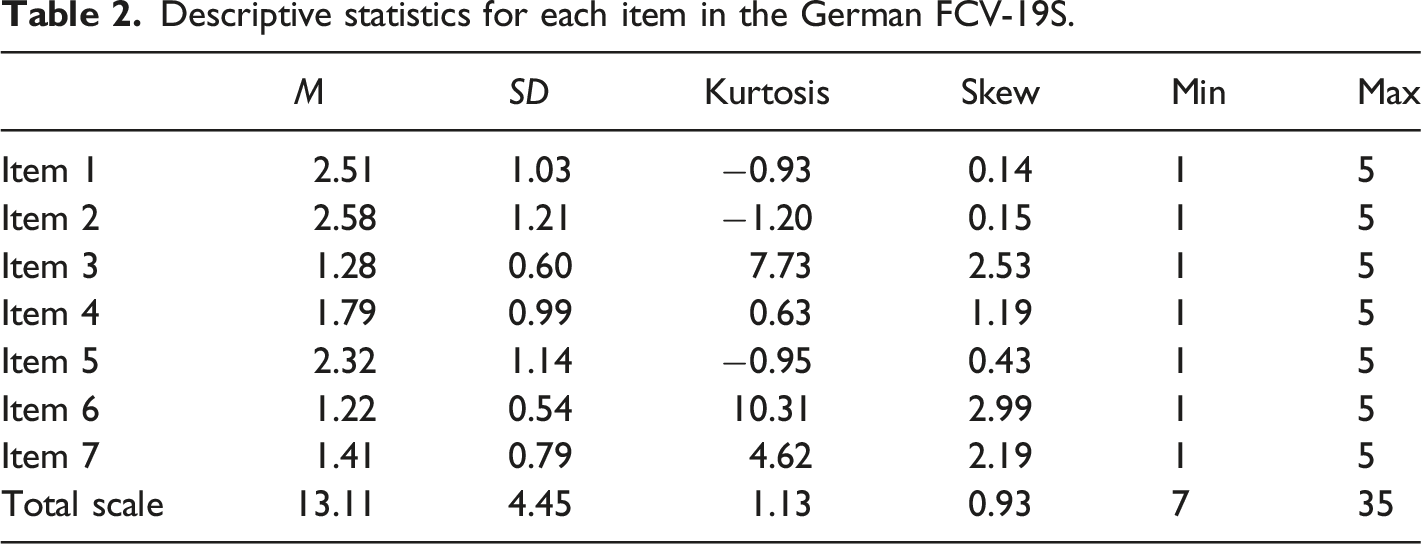
To assess the factorial validity of the FCV-19S, we conducted a confirmatory factor analysis (CFA). Although the items of the measure comprise five response categories and could be potentially interpreted as continuous data (Rhemtulla et al., 2012), previous research (e.g., Winter et al., 2020) and our own data (see Results section) demonstrated that the answers on these five categories are skewed. Therefore, when calculating the CFA, we used polychoric, instead of Pearson’s correlation matrix as an input file. Consequently, we used the Weighted Least Squares with Means and Variances Adjusted (i.e., Mplus WLSMV) estimation method.
To evaluate model fit, we relied on standard recommendations, which suggest that the estimates should be at least > .95 for CFI and < .08 for RMSEA (Schermelleh-Engel et al., 2003). However, as the measurement model of the FCV-19S comprises only few degrees of freedom, we interpreted RMSEA with caution, as it tends to produce artificially high estimates in such models (Kenny et al., 2015). As we used estimation for categorical data, we also report the Weighted Root Mean Square (WRMR), which indicates a good-fitting model when its value is below 1 (DiStefano et al., 2018).
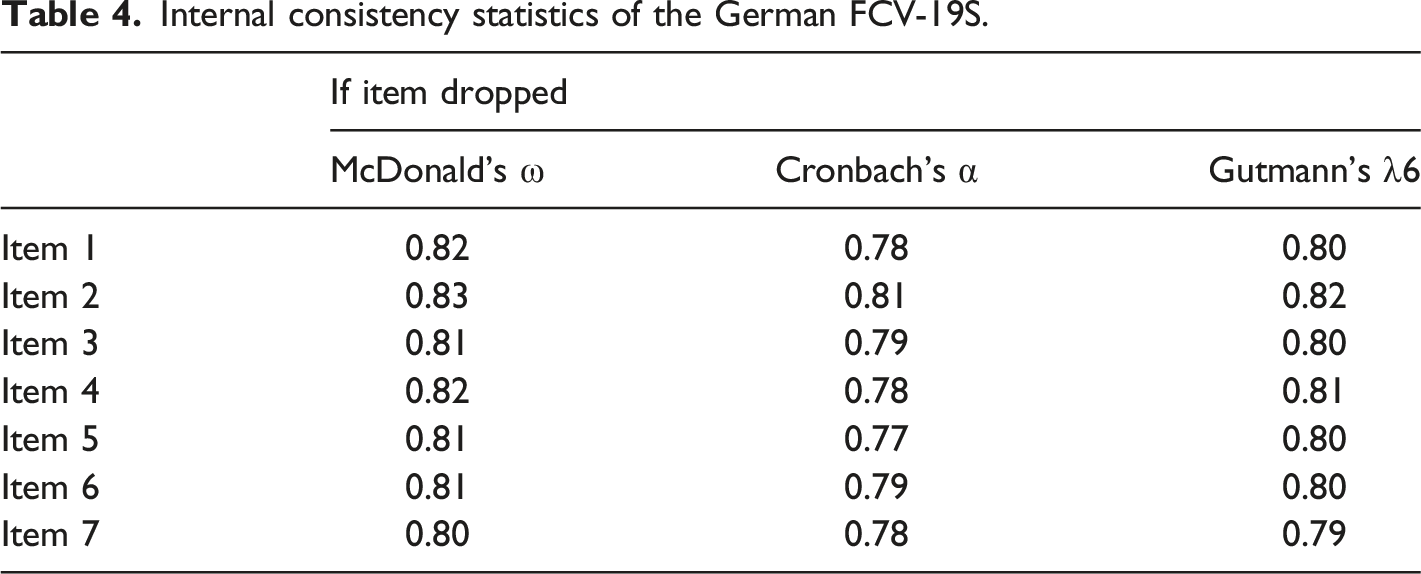
Two nested models were evaluated: Single factor (i.e., one-dimensional), loaded by all items, and two factors (i.e., two-dimensional), where the first factor (i.e., emotional fear) was loaded by items 1, 2, 4, and 5, and the second factor (i.e., somatic fear) was loaded by items 3, 6, and 7 (Bitan et al., 2020). To assess which model fit the data better, we evaluated the approximate fit indices (i.e., CFI, RMSEA, WRMR) and also conducted a χ2 test for nested models (Bollen, 1989). A significant result of this test informs that there are meaningful differences between the models. To assess internal consistency in a more robust manner, we provide three different indices, that is, McDonald’s ω (total), Cronbach’s α, and Gutmann’s λ6. Moreover, we estimated composite reliability based on standardized factor loadings and error variances (Raykov, 1997). Finally, to provide initial evidence of concurrent validity, we examined the relationship between the FCV-19S and demographic variables, risk of contracting COVID-19, and participants’ compliance with mask wearing.
Results
Participant Characteristics
Participant characteristics.
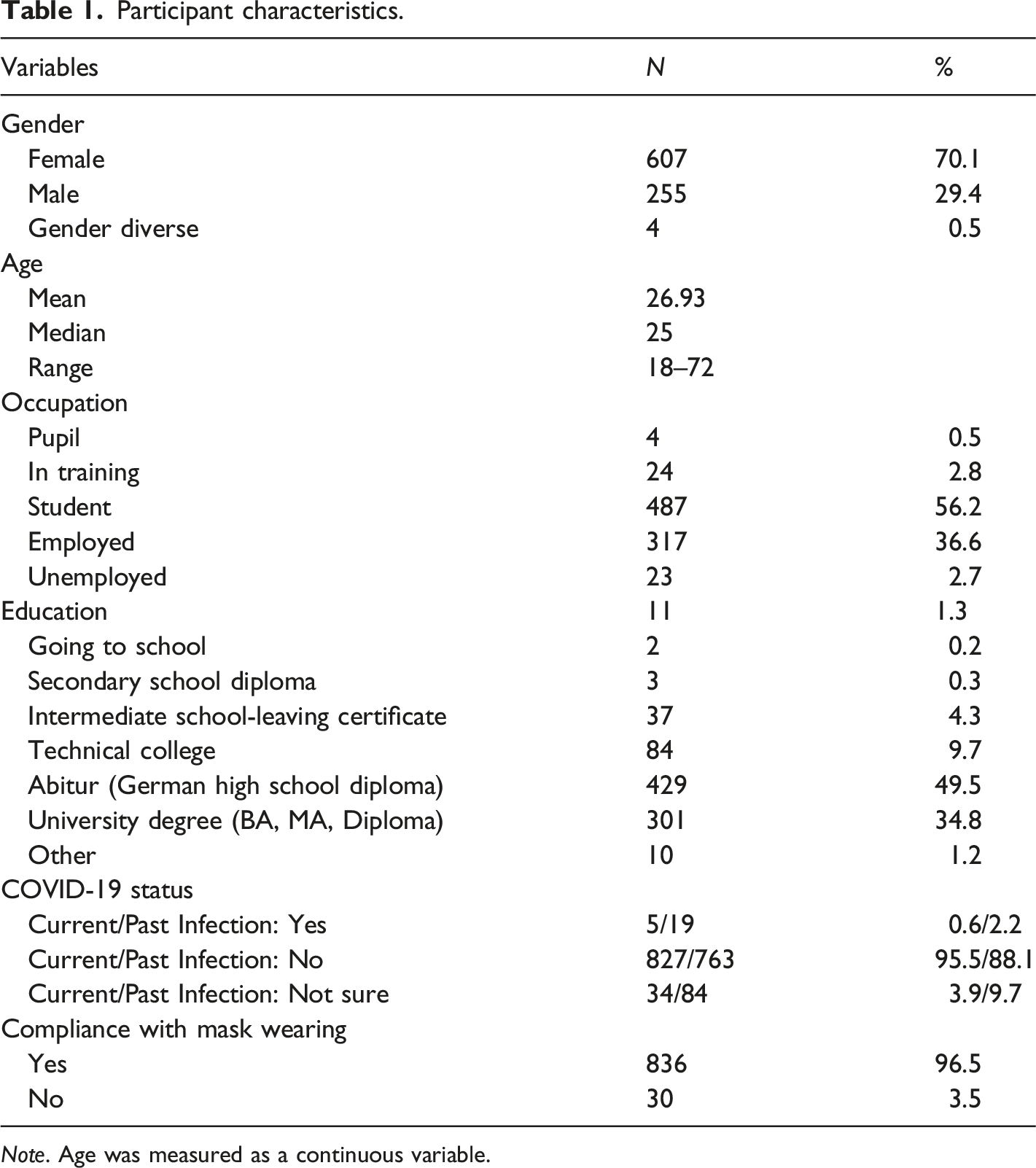
Note. Age was measured as a continuous variable.
Descriptive Statistics
Descriptive statistics for each item in the German FCV-19S.
Factorial Validity of the German Fear of COVID-19 Scale
Standardized factor loadings of the one-factor and two-factor models of the German FCV-19S.
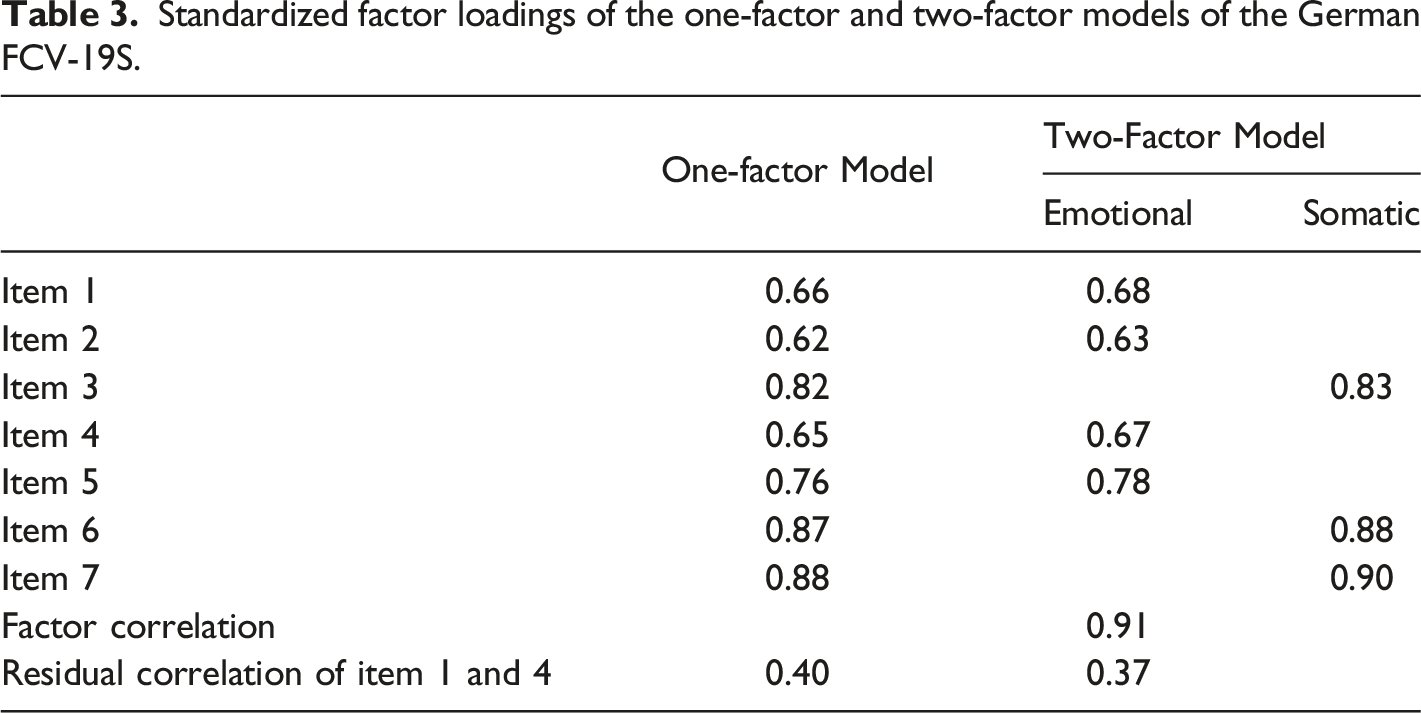
The two-factorial model provided a better fit to the data than the one-factorial model, both according to the test for nested models (χ2(1) = 20.72; p < .001) as well as according to differences in the approximate fit indices. However, the correlation between latent factors was very high (i.e., > .90) and, hence, clearly above the threshold of indistinguishability between factors (i.e., ρ < .80; Combs, 2010; Gray, 2017; Rojas & Widiger, 2014). Thus, for parsimony and because the two factors are difficult to separate, we proceeded with the one-factor solution.
Internal Consistency of the German Fear of COVID-19 Scale
Internal consistency statistics of the German FCV-19S.
Demographic Differences of the German Fear of COVID-19 Scale
Next, we proceeded to examine group differences on the FCV-19S total score across demographic variables. We found a significant main effect of gender (F [2, 863] = 10.76, p < .001, ηp2 = .024), with female participants (M = 13.56, SD = 4.49) reporting higher rates of fear than did male participants (M = 12.04, SD = 4.18), t = 4.64, SE = .33, Cohen’s d = .346. Regarding education and occupation, no significant effects emerged (all ps ≥ .098).
Concurrent Validity of the German Fear of COVID-19 Scale
Finally, to provide initial support for the concurrent validity of the German FCV-19S, we examined its relation with regard to self-perceived risk of contracting COVID-19 and compliance with mask wearing. Fear of COVID-19 was significantly positively correlated with reported risk (r = .19, p < .001; Spearman’s rho = .21, p < .001), indicating that those who reported more fear believed themselves to be more at risk of contracting COVID-19. Moreover, fear of COVID-19 was significantly positively related to compliance with mask wearing (r = .09, p = .007; Spearman’s rho = .10, p = .003), indicating that mask wearers reported more fear than non-mask wearers. According to Gignac and Szodorai (2016), these effect sizes can be interpreted as small to medium and are typical for individual differences. Finally, we examined whether these relationships hold when controlling for current or past COVID-19 status in a partial correlation analysis, which was indeed the case (all ps ≤ .016).
Discussion
The current study aimed to evaluate the psychometric properties of the German adaptation of the FCV-19S. When we tested a two-factor model of emotional and somatic fear, results from CFA revealed that it actually fit the data better than the one-factor model. However, because the two factors were excessively highly correlated (ρ = .91), we decided to stay with the one-factor model. It is worth noting that we obtained satisfactory fit indices when one pair of residuals was allowed to covary. Internal consistency estimates for the unidimensional model were adequate. Among the demographic factors, only gender was associated with higher fear of COVID-19, with female participants reporting more fear than did male participants. An initial examination of the concurrent validity suggested that greater perceived risk of contracting the virus and wearing face masks were related to increased fear of COVID-19.
Placing the German FCV-19S in the Literature
Our results provide further evidence for the reliability and validity of the FCV-19S, demonstrating sound psychometric properties in a German-speaking sample. Although some previous studies suggested a two-dimensional model (Bitan et al., 2020; Huarcaya-Victoria et al., 2020; Moreta-Herrera et al., 2021; Reznik et al., 2020), we concur with the (co-) developers of the FCV-19S that argued for a one-factor solution (Pakpour, Griffiths, Chang, et al., 2020; Pakpour, Griffiths, & Lin, 2020). First, from a methodological vantage point, the suggested two factors share 82.81% of their variance (.91 × .91 × 100%), which is above the threshold of indistinguishability between factors and suggests a single underlying construct (Combs, 2010; Gray, 2017; Rojas & Widiger, 2014). Second, from a theoretical vantage point, the two factors lack a clear conceptual rationale (Pakpour, Griffiths, Chang, et al., 2020). Future studies that explore the two factors in greater detail might provide more evidence to support their utility, although the results of our study are in favor of the unidimensional solution. Future studies could use this information to assess the response patterns using Item Response Theory.
An examination of the relationship between fear of COVID-19 and different demographic variables revealed that female participants reported more fear than male participants. This finding is highly consistent with prior validation studies of the FCV-19S (Bitan et al., 2020; Reznik et al., 2020), suggesting greater psychological vulnerability in women during the current pandemic (Broche-Pérez et al., 2020). Moreover, fear of COVID-19 was positively related to perceived risk of contracting the virus. This finding agrees with previous work reporting positive relationships between subjective risk perception of contracting COVID-19 and the FVC-19S (Coelho et al., 2020; Harper et al., 2020). More broadly, it is also consistent with research showing that individuals with high-risk diseases demonstrate more fear (Kohler et al., 2021). Regarding compliance with mask wearing, we found that those wearing masks on a regular basis report more fear of COVID-19 than those who do not comply with mask wearing regulations. This finding is reminiscent of Coelho et al. (2020) who also reported that fear of COVID-19 may motivate more preventive COVID-19 behaviors, thereby mitigating the spread of the virus. Given the small portion of non-mask wearers (n = 30; 3.5%) and the fact that mask wearing became mandatory during data collection, however, these results should be interpreted with caution.
Theoretical and Practical Implications
Our study has important implications for research and clinical practice. The FCV-19S is a self-assessment tool that is increasingly used internationally. By making the widely popular FCV-19S applicable to the German context, researchers can conduct further cross-cultural studies comparing fear of COVID-19 among different populations across the world. This information could be used to more thoroughly understand mental health issues or other problems that arise from fear of COVID-19. From a practical perspective, the German FCV-19S can be used as a screening instrument in everyday clinical practice due to its brevity and comprehensibility. As such, individuals with a high fear of COVID-19 can be identified at an early stage. If necessary, intervention measures could be initiated that aim to reduce perceived threats of COVID-19. Before use in clinical practice, the scale should be evaluated in more detail in future studies.
Strengths and Limitations
The current study has three notable strengths, including the large sample size, the use of CFA to reaffirm the psychometric properties of the FCV-19S, and the control for COVID-19 status. At the same time, some limitations should be acknowledged. First, among several ways to examine validity, only demographic and pandemic-related variables (i.e., self-reported risk of contracting the virus and compliance with mask wearing) were examined in addition to factorial validity. While this is consistent with previous studies (e.g., Broche-Pérez et al., 2020; Doshi et al., 2020; Reznik et al., 2020), future research should more thoroughly scrutinize the convergent, discriminant, and also predictive validity to expand the nomological network of the FCV-19S. Second, this was a cross-sectional descriptive survey. As such, causality cannot be concluded from our analyses. For example, an open question is whether fear increases self-perceived risk or vice versa. Third, the majority of the participants was young, female, and highly educated, which might limit the generalizability of our findings. Future studies with more heterogeneous clinical or community samples would be desirable.
Conclusion
To conclude, our findings provide promising support for the psychometric soundness of the German version of the FCV-19S. With seven items, the FCV-19S is an economical, reliable, and valid instrument that can be confidently used among German-speaking populations. Hopefully, the FCV-19S will be used by researchers using different samples, as well as additional pandemic-related variables, thereby leading to a greater understanding of psychological factors which influence fear during these challenging times.
Footnotes
Declaration of Conflicting Interests
The author(s) declared no potential conflicts of interest with respect to the research, authorship, and/or publication of this article.
Funding
The author(s) received no financial support for the research, authorship, and/or publication of this article.
