



Abstract
This study explores sense of presence (SOP) as an important feature of continuing bonds (CB) in the context of normal grief. A community sample of widows (N = 51) filled in a multidimensional grief questionnaire and a depression scale. A moderate positive association between sensing the deceased husband´s presence and cognitive and emotional impairments emerged. A positive relationship between SOP and guilt was found only if the influence of religiosity was controlled for statistically. There were no significant associations of SOP with long-lasting positive reactions to loss, such as personal growth and increase in sensitivity for others. Widows with clinically relevant depression indicated a stronger SOP than those with lower depression scores. These differentiated findings may stimulate the elaboration of an extended conception of grief beyond the focus on clinically relevant impairments
Keywords
More than 20 years ago, Klass et al., 1996 anthology initiated a paradigm shift that had a significant impact on grief research and practice. In contrast to the idea of relinquishing the attachment to the deceased by ‘grief work’, ethnographic observations had shown continuation of the inner representation of the deceased (Klass, 1992–93; Silverman, et al., 1992). In spite of concern about its empirical foundation (Stroebe & Schut, 2005), the new perspective of the continuing bonds (CB) model turned out not to be a 9 days’ wonder (see Klass & Steffen, 2018). Meanwhile, it has been adopted even by psychoanalysts (Hagman, 2001). However, because of conceptual inconsistencies and controversies, the model is still being developed.
The CB model posits that ‘the bereaved remain involved and connected to the deceased, and that the bereaved actively construct an inner representation of the deceased that is part of the normal grieving process’ (Silverman & Klass, 1996, p. 16). CB can be considered a coping strategy and, as is the case with coping in general, there are functional and dysfunctional strategies. Right from its introduction, the CB model raised the issue of its adaptiveness. Studies have shown that certain types of CB are associated with good adjustment to the experience of loss, whereas other types of CB are accompanied by poor adjustment (cf., Root & Exline, 2014, for an overview). This differential effect seems to be dependent on the research method, qualitative studies indicating that CB are perceived as fostering the bereaved´s well-being (Normand, et al., 1996; Nowatzi & Grant Kalischuk, 2009), whereas quantitative studies have demonstrated increased distress (Field et al., 2003, 1999; Field & Friedrichs, 2004). Given the multidimensional structure of both CB and grief, the effects of CB on grief reactions still remain to be explored in detail. The present study aims at providing additional findings by focussing on sense of presence as one important aspect of CB and by considering both negative and positive reactions to the loss of one’s husband in German widows based on a reanalysis of an existing data set.
CB are a phenomenon with multiple facets, the most prominent of which are keeping the memory of the deceased person alive and feeling his or her influence on one’s own life (for a more detailed collection of CB expressions see Root & Exline, 2014). At a conceptually higher level, three models have emerged. The two-factor model put forward by Field and his colleagues (Field & Filanosky, 2010; Ho et al., 2013) proposes an internalized and an externalized type of CB, the former involving positive memories and the influence of the deceased while recognizing that these are merely mental representations, the latter involving illusionary and hallucinatory experiences of the deceased that make the finitude of the loss doubtful. This conceptual distinction is the basis of the Continuing Bonds Scale (CBS; see below). The three-factor model (Scholtes & Browne, 2015) is an extension of the two-factor model by the dimension ‘transference’, which represents the realization of the deceased’s wishes, taking on his or her habits, values and/or interests, visiting places he or she enjoyed and being in the deceased’s room. In the authors’ view, transference is a form of externalized expression of CB. As far as we can see, the three-factor model has been only validated for bereaved parents. Finally, in an exploratory qualitative study of Chinese bereaved persons, Fong and Chow found three thematic clusters that form the VAS model of CB experience (Fong et al., 2018), namely Reflecting in Value (V), Expressing through Actions (A) and Experiencing in Sensation (S). On a preliminary basis, sensations seem to be predictive of stronger grief symptoms, actions are associated with weaker depression, while values seem to have no predictive power.
A conceptual as well as an empirical issue is that of similarity versus distinctness of CB and grief, which is principally comparable to the controversy about the distinctness of depression from grief (Wittkowski & Scheuchenpflug, 2021). Using CB variables such as those measured with the CBS as predictors and grief symptoms as criteria implies that the two belong to more or less independent areas. We do not follow this line of reasoning. Rather, we conceive CB as ‘an intrinsic aspect of grief’ (Schut et al., 2006, p. 764). Therefore, our interest is on the relationships between important grief reactions, sense of presence (SOP) being one only recently recognized in bereavement research. Moreover, we do not pay attention to (mal)adaptation to loss and, consequently, not to complicated grief (CG). This study provides data from a non-clinical sample because SOP as an important feature of CB was discovered in the context of normal grief.
Within the spectrum of CB experiences, SOP deserves special consideration (see Conant, 1996; Field et al., 2005, 1999; Marwit & Klass, 1994-95). According to Corr & Doka, 2019, SOP is one of five ways through which bonds to the deceased are maintained. In a kind of restauration of the former relationship, the aim of physical reunion is abandoned in favour of a representation of permanent psychological proximity that, in turn, may create the positive emotional effects of a secure relationship and, in the end, well-being. As a result of their qualitative study with bereaved persons, Steffen and Coyle (2011) conclude: ‘Benefit-finding […] emerged as linked with the feeling that the loss was partially reversed or reduced. This constituted a sense of presence in absence rather than a denial of death […]. The majority of participants seemed to find benefit in the continuing bond with the deceased and talked about an interactive and mutual relationship in the here and now […]’ (p. 603). Clearly, the SOP of the deceased as described here is to be distinguished from hallucinatory experiences.
There are two theoretical approaches that can be useful in predicting and, to a certain degree, in explaining the function of continuing-relinquishing the bonds with a deceased person. The first of them, the Two-Track Model of Bereavement (TTM; Rubin, 1981, 1999) proposes one dimension of response that covers how the biopsychosocial functioning is affected by the loss experience. The second dimension is concerned with how bereaved persons maintain and transform their bond to the deceased. Combining the perspectives on functioning and on relationships within one model enables researchers and clinicians to determine the effect of CB (track II) and (mal)adaptation (track I). The second approach is the attempt by Stroebe et al. (2010) to integrate the Dual Process Model of Coping With Bereavement (DPM; Stroebe & Schut, 1999, 2010) and Mental Representation Theory (Boerner & Heckhausen, 2003). Considering five attachment styles, the Integrative Model of Continuing Bonds and Bereavement Adaptation shows the way to identify healthy and unhealthy bonds. The authors maintain that all the constructs postulated in the model ‘can be operationalized and subjected to further empirical scrutiny’ (Stroebe et al., 2010, p. 267). They also note, however, that ‘there is no measure that directly assesses mental representations of the deceased as conceptualized here’ (Stroebe et al., 2010, p. 267).
Two questionnaires for the assessment of CB have been developed. The Continuing Bonds Scale (CBS; Field et al., 2003; Field & Filanosky, 2010, in its second version) consists of two subscales, the a-priori structure of which was confirmed by factor analysis (oblique rotation). The internalized subscale with 10 items and an alpha of 0.92 addresses the ongoing influence that the inner representation of the deceased has on the bereaved´s daily life. The externalized CB subscale is composed of six items (α = 0.73) that cover illusionary and hallucinatory experiences with the deceased (e.g., hearing the deceased´s voice, feeling his or her physical touch). The externalized CB mean scores deviate substantially from the normal distribution. After a transformation for normality had been performed with the externalized CB subscale, the two subscales correlated r = .50. Field et al. (2013) also used a comprehensive interview-based CB measure that included open-ended enquiries to yield qualitative information.
The Two-Track Model of Bereavement Questionnaire (TTBQ; Rubin et al., 2009) contains 70 items that are rated on a 5-point Likert scale. Two of the five scales can be seen as relevant in the CB context. The Close and Positive Relationship to the Deceased scale (8 items, α = 0.85) addresses both the pre-loss relationship with the deceased and its ongoing nature, including features of the soothing presence of the relationship post-loss. The Conflictual Relationship with the Deceased scale (6 items, α = 0.75) emphasizes negative aspects of the relationship, combining pre-loss and post-loss indications of difficulty. A common feature of these three psychometric instruments for the assessment of CB is that, in varying degree of specification, they address the sense of the deceased´s presence. The present study is based on a reanalysis of a large sample of bereaved persons used to construct a German instrument to measure grief multidimensionally. One subscale of the questionnaire is consistent with the concept of ‘sense of presence of the deceased’.
Findings on the relationships between CB and grief symptoms in widows are inconsistent. Recovering memories of the deceased and use of his or her possessions were moderate predictors of concurrent but not of later distress (Boelen et al., 2006), whereas other studies showed an association with higher grief intensity on the long run up to 5 years post-loss (Field et al., 1999, 2003). Although most of these studies used the CBS, they also used a global score of CBS that incorporates the internalized and externalized subscales. In a sample of Chinese widows and widowers, Ho et al. (2013) found both internalized and externalized CB positively correlated with grief symptoms. Treating CB specifically as a coping strategy, it was positively linked with impaired mood shortly after the loss, but was associated with high mood after more time since loss had passed (Field & Friedrichs, 2004). In sum, as Currier et al. (2015) note, ‘evidence suggests that although CBs of a more abstract and security enhancing sort can [be] adaptive, the more sensory-based, concrete expressions of such bonds […] tend to be associated with poorer adjustment’ (p. 203).
There is consensus that the cognitive, emotional and behavioural reactions to the loss of a significant attachment figure is a multidimensional phenomenon comprising features such as insecurity/fear, yearning, despair/hopelessness, depression, guilt, anger and disorganization. Besides these impairments, a neutral aspect is worth mentioning, namely the ongoing relationship of the bereaved with the lost person. Moreover, with increasing time since loss, the inner growth of the bereaved person is to be considered a possible grief reaction (see Frantz et al., 2001).
Important co-variables in the study of the relationship between CB and grief reactions are religiosity, time since loss and attachment style. As to the first one, bereaved mothers who expressed comforting CB experiences also showed a higher degree of spirituality (Field et al., 2013). Chinese spouses who indicated a formal religion showed weaker externalized CB than those without religion (Ho et al., 2013). In individuals bereaved of a parent or a friend, time since loss was negatively correlated both with internalized and with externalized CB (Field & Filanosky, 2010). Moreover, research suggests that a secure attachment to one’s spouse is predictive of a positive ongoing relationship with the deceased, whereas an anxious attachment is associated with stronger grief symptoms (Ho et al., 2013; Waskowic & Chartier, 2003). However, at least in cases when a relative or a good friend had died, attachment-related insecurity can moderate the adaptiveness of an ongoing connection to the deceased (Currier et al., 2015). Overall, data on the influence of these co-variables are still sparse, especially if bereaved spouses are concerned.
The aim of the present study is to provide differentiated findings on the relationship between SOP and negative (i.e., cognitive and emotional impairments, feelings of guilt) as well as positive grief reactions (i.e., personal growth, increase in empathy) in widows. Because our present knowledge does not allow the formulation of well-founded hypotheses, our research was guided by the following study questions: (1) In what way is a sense of the deceased husband’s presence associated with the expression of cognitive and emotional impairments and with feelings of guilt? (2) In what way is a sense of the deceased husband’s presence, after a longer period of bereavement, correlated with personal growth and with an increase in empathy? (3) In what way is the sense of the deceased husband’s presence linked with depression?
Answering these questions using data from a sample of German widows, we statistically controlled for religiosity and time since loss.
Method
Participants and Procedure
Participants were 51 women ranging in age from 21 to 84 years (M = 57.2; SD = 12.2) who were bereaved of their husbands, as part of a larger sample of bereaved German adults. In the sample of widows, 78.4% identify themselves as ‘believer’; 58.8% report protestant, 21.6% roman catholic, 19.6% no confession. Participation in a bereavement group was answered in the affirmative by 62.7% of the sample, whereas 37.3% received some kind of psychotherapy. The most frequent mode of death reported is illness (82.4%). All other options in the questionnaire (accident, suicide, unknown and natural death by old age) were each selected by two participants (3.9%). The age of the lost person ranges from 21 to 83 years (M = 57.9; SD = 13.8).
Data were collected from August 2008 through October 2010 partly via the Internet. Participants responded voluntarily, anonymously and without payment or other form of gratification. Qualitative responses/remarks on the whole show a positive-feedback concerning the survey.
Instruments
Wuerzburg Grief Inventory
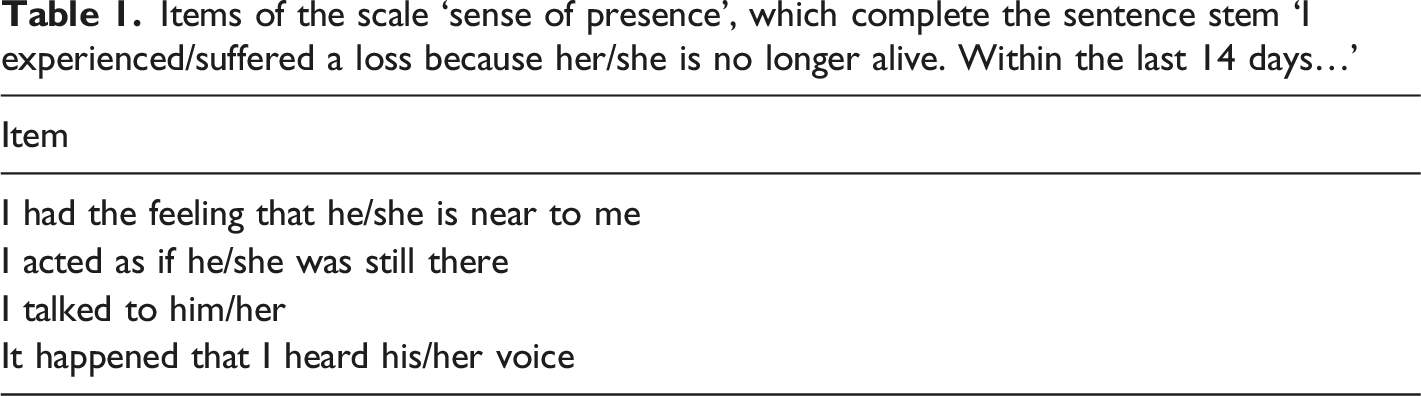
Items of the scale ‘sense of presence’, which complete the sentence stem ‘I experienced/suffered a loss because her/she is no longer alive. Within the last 14 days…’
General Depression Scale-Short Version
The General Depression Scale (Hautzinger & Bailer, 1993) is the German adaptation of the Center for Epidemiological Studies Depression Scale (CES-D; Radloff, 1977) that was specifically designed for use with non-clinical populations. Its short version (GDS-S) consists of 15 items. In the present sample, the internal consistency α is .91.
Results
Association of Sense of Presence with Negative Reactions to Loss
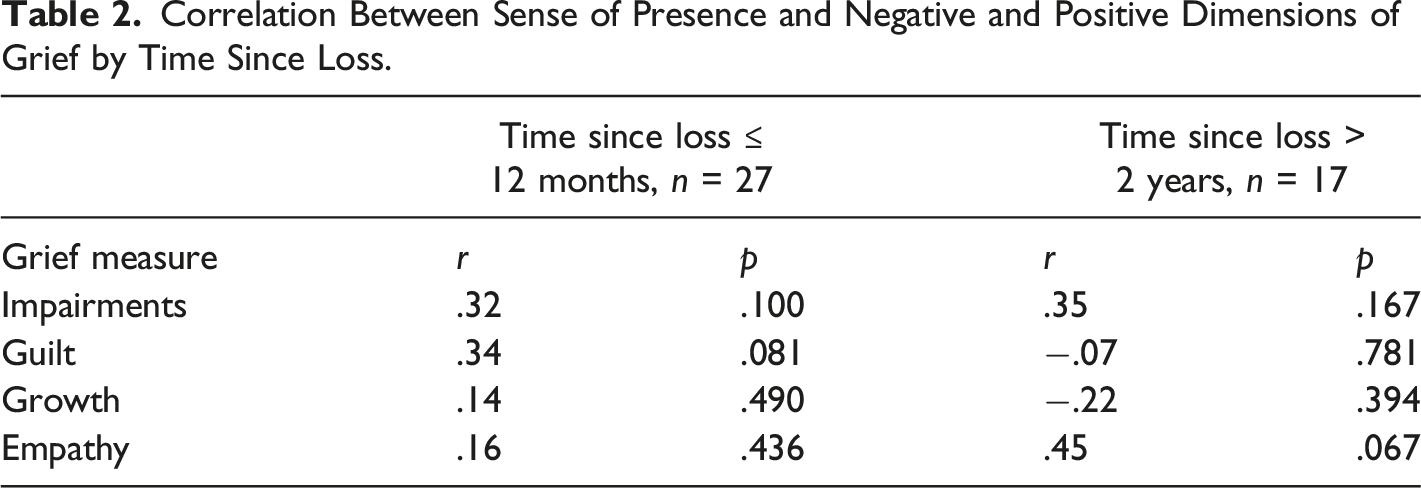
To examine the relationship expressed in study question 1, in the first step, we computed zero-order correlations between the subjects’ scores on SOP with IMPAIR and GUILT. Overall, SOP correlated significantly and positively with impairments (r = .34, p = .015), but not significantly with feelings of guilt (r =.26, p = .067). For the subset of 40 widows who identified themselves as ‘believer’, correlations were r = .30, p = .063, and r = .21, p = .185, respectively. For the nine participants identifying themselves as ‘non-believer’ correlations were .44 and .55, respectively, and not significant. Partial correlations, controlling for religiosity/believer, were r = .34, p = .019 between SOP and impairment and r = .31, p =.030 between SOP and guilt.
Correlation Between Sense of Presence and Negative and Positive Dimensions of Grief by Time Since Loss.
Association of Sense of Presence with Positive Reactions to Loss
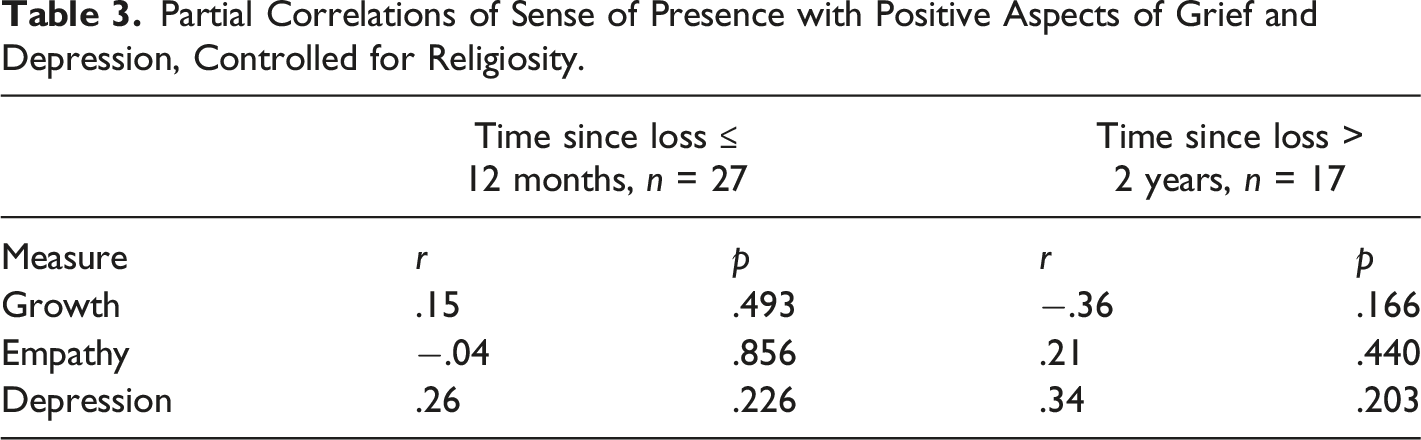
Partial Correlations of Sense of Presence with Positive Aspects of Grief and Depression, Controlled for Religiosity.
Association of Sense of Presence with Depression
SOP scores neither correlate significantly with depression (r = .27, p = .056) in the complete sample, nor in the subsamples with recent losses (r = .25, p = .203), nor losses more than 2 years ago (r =.30, p =.244). This pattern does not change if religiosity is controlled for in addition to time since loss, see Table 3.
Mean Scores of Measures of Grief for Subgroups of Widows (With/Without Clinically Relevant Depressive Symptoms According to GDS-S Score).
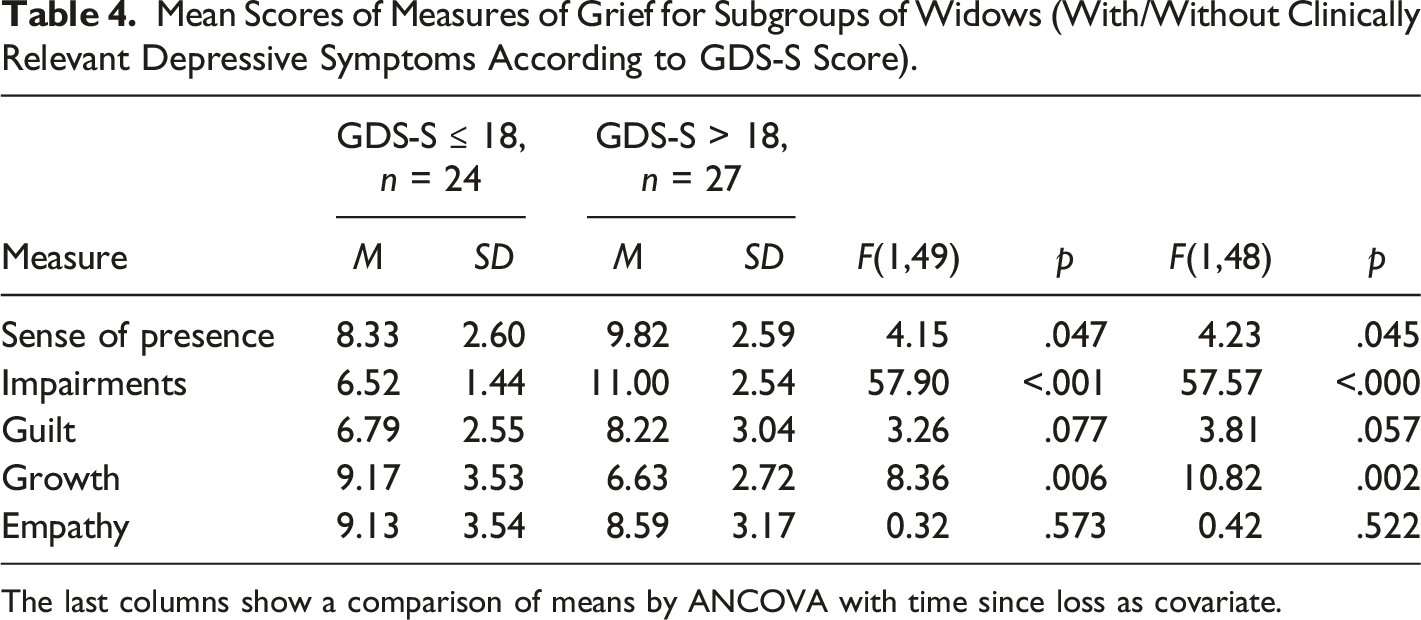
The last columns show a comparison of means by ANCOVA with time since loss as covariate.
Discussion
Our aim in conducting this study was to explore a conception of grief that includes SOP as an important component of CB. In our sample of widows, we found a moderate positive association of sensing the deceased husband’s presence with cognitive and emotional impairments. Widows who had the impression of their dead husbands’ nearness also reported symptoms of deterioration in thinking and feeling irrespective of both the duration of their mourning and of their religiosity. Feeling guilty may be considered a specific feature of grief-related impairments. We found a positive relationship between SOP and guilt only if the influence of religiosity was controlled for statistically. In other words, only if the confounding effect of religious belief was statistically removed from guilt, the relationship with SOP reached significance. As outlined in the introduction, to the best of our knowledge, there are no findings in the literature that could be referred to in support or in contrast to ours.
In our sample of widows, we did not find any significant associations of SOP with positive reactions to loss such as personal growth and an increase in sensitivity for others. As a tendency, however, the relationship of SOP with growth was different depending on time since loss. Widows who had been grieving up to 1 year showed a (weak) positive association of SOP and growth, whereas, in widows who had been grieving for more than 2 years, the relationship was negative. As far as the increase in empathy is concerned, the association with SOP is substantially stronger (although still not significant) in the longer-grieving widows compared to those in the first year after the loss of their husbands. Thus, the effects of SOP on grief reactions may depend on time after bereavement. If religiosity is controlled for, the direction of the association reverses from slightly negative to moderately positive. Stated differently, there seems to be a confounding effect of religious belief that moderates the relationship between SOP and increase in empathy in addition to the effect that is exercised by time since loss. Again, we do not see comparable findings from the literature to deepen the discussion.
We did not find a significant relationship between SOP and depression if the full range of intensity was considered. In contrast, if only widows with an elevated depression score that indicates clinical relevance were selected, a significant positive association emerged. Depressive widows in need of clinical intervention indicated a slightly stronger SOP than widows with lower depression scores.
Beyond the answers to our research questions, this study demonstrates the influence of both time since loss and of religiosity as important co-variables of the relationship between SOP and various components of grief and thereby confirms findings from different populations (cf., Field et al., 2013; Field & Filanosky, 2010; Ho et al., 2013).
A major limitation of this study is its small sample size. Correlation coefficients on the basis of data from less than 60 participants are generally looked at with doubt because of the potential strong influence of outliers. However, inspection of the scatter plots revealed no outliers. Moreover, readers should be aware that the wording of the SOP items in this study leaves open the question concerning the kind of CB that has been assessed: internalized or externalized? For example, none of the items refers to memories indicating an internalized (presumably healthy) relationship and excluding (presumably unhealthy) hallucinations. On the other hand, one can hardly conclude from the SOP scale that the widows in our sample ‘brought their husbands into the present, sometimes without realizing it, by taking on tasks, roles, and personal qualities of their husbands’ (Conant, 1996, p. 194).
In addition, the present data all relied on self-report questionnaires that may have inflated the correlations due to common method variance – a phenomenon well known in personality research and nearly impossible to avoid. Finally, because we did not employ a mixed-method approach, we do not have qualitative data on the kind of relationship, that is, on the widows’ style of attachment to their deceased husbands. Nevertheless, the present findings are empirically based estimations of the relationships between SOP and various components of grief. Differentiated as they are, they are suited to stimulate further explorations of an extended conception of grief in which sense of presence holds a prominent place.
Footnotes
Declaration of Conflicting Interests
The author(s) declared no potential conflicts of interest with respect to the research, authorship, and/or publication of this article.
Funding
The author(s) received no financial support for the research, authorship, and/or publication of this article.
