




Abstract
John Bowlby’s attachment theory has made a lasting contribution to scientific understanding of the nature and the impact of close interpersonal bonds, tracing their influence from early childhood through adulthood and into bereavement. The experience of separation and loss featured powerfully in Bowlby’s account of the causes of mental health difficulties. He acknowledged many sources for his ideas. However, one potential intellectual force, namely, that of the eminent philosopher Bertrand Russell, is missing. The association between Bowlby and Russell is highlighted in this essay to illustrate how a monumental theory may emerge from ideas already around during a particular historical period. Scientific and personal features of their lives are explored to shed light on possible influence. Commonalities between their propositions about attachment are described as well as pertinent biographical details. Questions whether Bowlby was aware of Russell’s writing on this topic and reasons why Russell’s ideas were not acknowledged are considered.
Introduction
Attachment theory has been described as one of the most profound and creative lines of research in 20th-century psychology, a theory attributable in large part to the work of John Bowlby (e.g., 1969/1982, 1973, 1980). It is a theory of interpersonal relationships, though not a general one; it focuses specifically on behavior when threatened or separated from persons to whom one is closely bonded. The apparently simple (and perhaps now readily accepted) exposition by Bowlby that separation from one’s primary caregiver in childhood could be of such impact as to cause potentially lasting damage was sensational at the time he first wrote about it, back in the mid-20th century. It is a scientific approach not only of fundamental theoretical interest but also of immense practical application. For example, after a slow start, it has become a guiding force in clinical practice for the treatment of complications in grieving among bereaved people. A basic fascination about the theory—one which also made it remarkable when first published—lies in the fact that it can explain health difficulties which are not originally caused by physical or medical conditions: simply being harshly separated from (or bereaved of) a close person can cause mental and physical health problems (even—though rarely—mortality from a broken heart).
Where did Bowlby’s ideas come from? The topics of attachment and separation occupied him all his life, with origins in early childhood. His personal separation experiences were impactful, particularly the departure from the family household of his nursemaid, Minnie, who primarily raised him until he was nearly 4 years old. This separation he later described as one as tragic as the loss of a mother. Furthermore, he was sent to boarding school at a very young age (he was only 7 years old). Then came the impact of his work with troubled young people early in his career (he interrupted medical studies to work with them), which was also deeply formative in the development of his ideas about attachment and separation. His more formal interest is often traced to a commission to write a report for the World Health Organization, published as Maternal Care and Mental Health (1951, rewritten as the best-selling Penguin book Child Care and the Growth of Love, 1953). He identified the importance of a close, warm, continuous relationship between mother and young child and the damaging effects of separations such as those during a child’s hospitalization or evacuation. Who inspired him? Bowlby was a man of great scholarship who had close contact with many other intellectuals of his time. The scientific forces that influenced him came from diverse fields, including psychoanalysis, developmental psychology, cybernetics, information processing, and ethology. In formulating the biological origins of these processes, he incorporated the contributions of Darwin and the European ethologists as well as U.S. comparative psychologists. He collaborated closely with his colleagues Mary Ainsworth and Colin Murray Parkes among others to derive basic tenets of attachment theory. Parkes, for example, was a driving force in the extension of attachment theory to understanding phenomena consequent to bereavement, also in adulthood. Bowlby searched with others to develop a framework to understand the mother–infant relationship, for example, through multidiscipline seminars which he led at the Tavistock Clinic. These and many other sources of inspiration become evident—awe-inspiringly so to me—on reading Bowlby’s work. Importantly, ideas compatible with attachment theory principles were already around at the time of his early writings; Bowlby paid special homage to the work of Donald Winnicott, who wrote about emotional development, stressing the unique role of the mother figure. It is evident that Bowlby recognized, acknowledged, and clearly cited the work of numerous persons while remaining convinced that he himself was uncovering novel scientific truth in developing attachment theory.
Given the importance of attachment theory, given the scholarship of John Bowlby, and given his embeddedness among other leading researchers of his time, it came as an enormous surprise to find a close predecessor, a famous figure, and well-known author, writing on attachment and separation/loss and yet to realize that this was someone, to the best of my knowledge, who was not cited by Bowlby at all. The discovery came about in a serendipitous way. Bereavement researchers like myself are interested in love as well as loss, happiness, and sadness. We need to understand both sides of the coin for, as commonly acknowledged, grief is the price we pay for love. So browsing through a secondhand bookshop, I picked up Bertrand Russell’s The Conquest of Happiness, written in 1930. It was apparently one of the most famous popular philosophy books ever written, we are told it sold three million copies in the first 4 years. There is a chapter within this monograph on Affection, and within this chapter, one finds descriptions of a number of fundamental propositions resonant with attachment theory. For the first time, to the best of our knowledge, John Archer and I discussed this work of Russell as a potential origin of modern ideas on love and loss in our broader review of attachment theory forerunners (see Stroebe & Archer, 2013). Here, I want to highlight Russell’s writing particularly as a potential force behind attachment theory and to bring it more closely to the attention of those interested in death, dying, and bereavement. There are remarkable features about this particular, potential historical connection, both regarding concordance in their attachment theoretical propositions and with respect to parallels in their personal histories. The fascination for me lies in the remarkable similarities yet total contrasts in the works and lives of these two men, something which got lost in our broader scientific review.
It is important to note that it is not my intention to argue that Bowlby should have cited Russell. For one thing, as will become clear, their objectives were completely different (to say nothing of their respective academic styles): Russell’s being to examine the roots of (un)happiness, Bowlby’s to examine the relationship between parental care and mental health. The originality and impact of Bowlby’s work, his immense contribution, remain unquestioned. Rather, this is a historical quest; the intention is to place his monumental work in the context of thoughts that were around at the time by elaborating on a possible, unexpected source.
Indications of Influence
Table 1 illustrates parallels between attachment theory propositions and Russell’s ideas on the (attachment) roots of well-being and happiness. There are a number of commonalities, but basically, both Bowlby and Russell maintain that the nature of attachment to the primary caregiver and associated childhood experience are central to well-being, separations can be harmful. Three features illustrate the similarities. First, the fundamental necessity of security: the notions of security of attachment, the secure base, the impact of the caregiver’s attachment pattern on the formation of attachment in the young child, and all core elements of attachment theory resonate with Russell’s earlier reasoning. Second, the consequences of insecurity: Bowlby’s and Russell’s views on the protective role of secure and hazards of insecure attachment, both in childhood and for later well-being, as well as for personality development, also resonate. Third, the recognition of attachment orientations: There is notable correspondence in postulations about secure and insecure (dependent) attachment styles as well as notions of concordance between caregiver and child in style, continuity of style across the life span, and even in claims that style of attachment influences the nature of a romantic relationship elaborated by attachment theorists subsequent to Bowlby. It cannot be said that attachment theory principles were worked out at all precisely in Russell’s writing (e.g., regarding attachment styles; negative effects of affectional deprivation)—the very nature of his endeavor precluded this (he described them as remarks inspired by common sense). But the basic principles summarized earlier and illustrated in Table 1 are reflected in his writing, just as they are fundamental to attachment theory.
Attachment Theory Propositions and Russell’s Formulations.
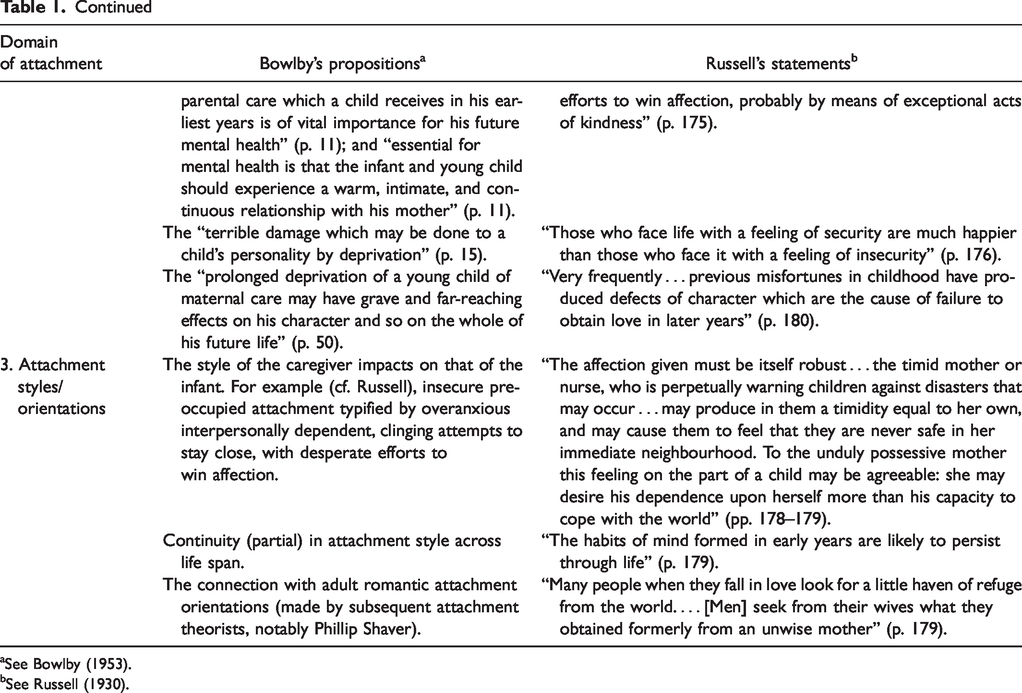
aSee Bowlby (1953).
bSee Russell (1930).
Likelihood of Impact
How likely is it that Bowlby knew of these ideas of Russell? There are quite a few clues as to possible mutual awareness (though of course that does not indicate attachment idea influence, in and of itself). Some parallels in their personal lives, common intellectual heritage, and geographic proximity come to light, but then again, so do vast differences between them which may have weighed as counterinfluences, as also illustrated next.
It seems safe to say that Bowlby would have known of Russell’s life and work in general and possibly to have come across him personally. Russell was a generation older, but both were born (Russell in 1872; Bowlby in 1907) into renowned upper-class British families. Russell inherited the title of Lord (Earl) from his grandfather, while Bowlby’s father was a baronet, an eminent surgeon. Such privileged family backgrounds alone at that time in British history would have increased the likelihood of awareness or acquaintance. Furthermore, one might expect (reciprocal) influence because both men themselves became eminent, respected leaders of British society, even world renowned. Russell received a Nobel prize in 1950. He was deeply concerned about social issues and world affairs, one with close contacts in the government, of whom he was sometimes outspokenly critical (and vice versa). He outraged the more staid sections of society through his moral statements (e.g., advocating sex before marriage). Likewise, Bowlby was highly influential and acclaimed not only within academic circles but also beyond, extending to societal/political levels. He had enormous impact on the whole psychology of human relationships as well as considerable social influence from his early work onward. So the two men had not only intellectual curiosity but also concern with societal affairs in common.
Whether personal similarities drew them together is a matter for speculation. Both endured early childhood separations, but while Bowlby’s took the form of early separation from his primary caregiver and extended periods away at school, Russell was orphaned, suffering the death of his parents by the time he was four (his older sister also died when he was very young). Shortly after being placed in the care of his grandparents, his grandfather died as well. Biographers have surmised that these experiences had lasting influences on both of their lives and work, leading them to write on affection and attachment. But by all accounts they were very different people, Russell at times troubled or tempestuous, Bowlby possessed of an inner calm, though each was dedicated to intellect and independent-minded. Their biographers bring these contrasts home to us. Clark (1975) described Russell as follows: [T]he quintessential man, the bundle of contradictions passionately dedicated to intellect, at times carrying the rational argument to irrational extremes, the natural-born emotional adventurer for ever hampered by orphaned youth and too early marriage … [A] man of epic proportions, struggling through a lifetime beset with frustration and near-disaster; in youth the constitutional sceptic, in old age the sometimes splendid figure with courage never to submit or yield. (pp. 9–10) A … capacity to reconcile divergent elements is to be found in his personality which, although remarkably coherent and consistent, contained many contradictory aspects: reserved, yet capable of inspiring great affection; quintessentially “English” and yet thoroughly cosmopolitan in outlook; conventional in manner yet revolutionary in spirit; … an explorer of the psyche who mistrusted the purely subjective; … an enfant terrible who was always slightly formal. (pp. 30–31).
Could there have been other causes for antipathy, potentially preventing Bowlby from acknowledging Russell’s ideas? They differed drastically in a major domain of their lives, namely, in their attitudes to war (the World Wars being very present in lives of their times). Russell had been imprisoned for being a conscious objector and an outspoken protestor of national acclaim against the Vietnam War. By contrast, Bowlby had attended Dartmouth Naval Academy, volunteering and serving in the Second World War. On the other hand, empathy regarding societal matters seems likely. Both Bowlby and Russell became actively involved in education, particularly for disadvantaged young people and in matters demanding social change. For example, their views on solitary hospitalization of children tallied. In this context, Bowlby could have been aware of another force at play in Russell’s life. It was clear that Russell’s wife, Patricia, held strong opinions about hospitalized children separated from their parents, a view obviously in line with her husband’s (he was also an adoring, deeply concerned father) and a main theme of Bowlby’s in his early writings, as noted earlier. She had been asked (but refused until nighttime) to leave her sick 7-year-old son alone in hospital. This incident led her to publish a moving (actually horrifying) letter in The Lancet in 1945, describing his (mis)treatment during her absence, vehemently opposing the visiting rules of hospitals, arguing that when children are patients, a member of their family should be allowed to stay with them whenever possible. We are told that the letter (and a subsequent one) was subject to considerable public discussion and debate (cf. van der Horst, 2011). Again, it is not unlikely that it came to Bowlby’s notice (van der Horst, 2011, mentions the letters in his monograph exploring the roots of attachment theory, though while pointing out that Patricia was Bertrand Russell’s wife, he did not refer to the latter’s work).
Conclusions
I have shown evidence of quite close conceptual parallels between Russell’s ideas on attachment in The Conquest of Happiness and Bowlby’s thinking. I have shown that they thought along similar lines. I have shown features of a unique, unexpected embeddedness in the lives of these two giant figures. However, while Russell made attachment-related propositions available in the public domain, there was no elaboration by him of these ideas. There is disparity between noting that something is likely to be the case and regarding it as sufficiently important to spend years of one’s life working out the consequences through scholarship and research.
To what can one attribute the absence of reference to Russell in Bowlby’s work? From the connections that I have illustrated earlier, one can assume that Bowlby was aware of Russell’s work in general. But what about his writing on happiness and ideas on attachment? If he read it, and this seems likely, the ideas seem close enough to his own to have resonated. And Bowlby was generous in acknowledging others’ contributions to his thinking. So why not? Perhaps the answer lies in nature of the claims, as suggested earlier, which were suppositions, based on common sense, inspired by Russell’s own experience and observation. Perhaps van der Horst (2011) put a finger on it: Bowlby took evidence from other fields and investigators, but he melded it into a coherent theory. Constantly rewriting and polishing his manuscripts, he incorporated other people’s ideas into this framework. Whereas he always gave them credit initially, after a while these new ideas blended into his own. It was this eclectic approach that would eventually become Bowlby’s trademark. (pp. 158–159)
Footnotes
Acknowledgments
The author would like to thank Colin Murray Parkes for his comments on the topic of this article, which supported the main argument (personal communication, August 5, 2019).
Declaration of Conflicting Interests
The author declared no potential conflicts of interest with respect to the research, authorship, and/or publication of this article.
Funding
The author received no financial support for the research, authorship, and/or publication of this article.