




Abstract
To comprehend grief, we need knowledge about the range of diverse reactions incorporated within it. While scientists have documented the phenomena and manifestations following the loss of a loved one in quite some detail, poets can add to our understanding by portraying these vividly, bringing the feelings to life. In this article, I map the array of grief reactions identified in scientific investigations. I then go on to give short, selective illustrations from poetry, ones that have enhanced my own understanding of grief. These choices are naturally influenced by my own preferences; I include those that I find personally appealing and evocative of the multifaceted manifestations of grief. My aim is to demonstrate the value of artistic representation for scientific comprehension.
Keywords
Give sorrow words. The grief that does not speak whispers the o'er fraught heart and bids it break. Shakespeare (1564–1616), from Macbeth Grief, keep within and scorn to show but tears, Since joy can weep as well as thou, Disdain to sigh, for so can slender cares, Which but from idle causes grow. John Danyel (1564–1626) No, don't stop writing your grievous poetry. It will do you good, this work of your grief. Keep writing till there is nothing left. It will take time, and the years will go by. Douglas Dunn, on his wife's death, from the poem December in Elegies (1995)
Light griefs can speak; great ones are dumb
Seneca (4 B.C.–A.D. 65) from Hippolytus, Act II, Scene 3
The Background to My Preoccupation With Grief Poetry
I would like to say up front, in giving a little historical background to my fascination: In general, poetry was never a strong interest of mine. I struggled with its dominant presence in the final-year English Literature curriculum at high school many years ago, grappling to remember lines and understand meanings, longing just to be able to read the assigned classic books. It was not until much later, early in my career as a bereavement researcher, that my eyes were opened to the value of poetic renditions. We were busy writing our monograph Bereavement and Health (Stroebe & Stroebe, 1987), and I was reviewing the research literature for the section examining phenomena and manifestations associated with grief and grieving. Although descriptively comprehensive and ostensibly accurate (they tallied quite well with each other), none of the existing accounts seemed to capture the essence of emotional reactions to bereavement in any profound, soul-moving manner. Nor was it necessarily the basic aim to be vivid—the intention of the scientific accounts was rather to inventorize the range of responses and document their incidence and prevalence among the bereaved. Nevertheless, as the Chinese poet, Li Ch'ing Chao (1084–1151) asked: How can the one word “sorrow” paint what sorrow is?
In contrast to the scientific sources, the literary ones I came across in exploring the literature certainly did seem to convey the harrowing nature of grief and grieving: What better describes the broken-hearted reaction—the scientifically evidenced notion that one can die of grief following the loss of a loved person—than the epitaph (by Sir Henry Wotton, on the death of Sir Albert Morton's wife): He first deceased, She for a little tried, To live without him, Liked it not and died. So in time, I came to appreciate that the exquisite, succinct poetic renderings conveyed a depth of emotional experience untapped in scientific accounts. I would even go so far as to say that the best of our poets reveal the living, dynamic force that we know to be characteristic of grief but find so hard to put into words. In my view, then, there is also scientific value in the underlying messages conveyed by the poets, in their representations of grief and even—turning to scientific language—as sources of hypotheses (giving us propositions that we can test in carefully controlled, empirical research studies).
Thus, I began to explore the poetry shelves in the old bookshops of the United Kingdom, coming across the great elegies such as those of Gray, Milton (Lycidas being one of those struggled with at school, as was Shelley's Adonais—could it be these early readings sowed the seed of current interest after all?), Rilke and Whitman. I was struck into silent contemplation by Tennyson's In Memoriam, written as it was over many grief-stricken years, following the death of his close friend Arthur Hallam, fellow poet and student at Trinity College, Cambridge. I went on to collect some beautiful volumes by individual poets for very little money (there being a lot on offer but apparently not so much market then for second-hand volumes of poetry). Could I find lines that would illuminate the richness of the grief experience behind the lists of its manifestations? That interest motivated systematic searching and sifting. My collection of selected poems grew apace, and there were no comparable anthologies of grief poetry available then in the early 80s (just as shelves of books on death, dying and bereavement were nonexistent). So I compiled and offered my collection to Penguin Books, who responded enthusiastically at first, but later wrote to say that poetry anthologies were out, commissions suspended, no longer selling, and with apologies and the consoling words that this was “a genuinely interesting project,” they turned me down with the advice to go elsewhere. Then came Faber—they had a book of love poems, so why not grief, I reasoned, and offered them my selection, with the comment that I'd be happy to alter my choices on their advice. This fell on very deaf ears, with a reluctant, eventual response (after much prodding from me) that it would take a literary person to select such a collection and that “piecemeal tinkering” (yes, their exact, humiliating words—never to be forgotten) would not mend matters. The lesson was well taken though, and I tried a couple of times to get a literary-bent colleague or friend to join me as coeditor on this project. It somehow did not work out (perhaps they felt as Faber did), so I have been left for decades with my extensive, private collection of favorite poetic renderings of grief and grieving.
In the meantime, many grief poetry anthologies have appeared and even been critically reviewed (Bowman, 2007). The variety is great, from those focusing on contemporary poems (Hall, 2014), to those including poems for reading at funeral services (Watson, 2004), to those selecting grief poems following war loss, including one of First World War poetry exclusively by women (Reilly, 1981). Long after its first publication, I also came across a wonderful, comprehensive anthology of the literature of mourning, covering poems, diaries, letters, journals, autobiographies, and fiction (Moffat, 1982/1992), one which takes the reader through the seasons (not stages—more on those later) of grieving. Selections of the poems in such anthologies sometimes overlap a little with mine, but also differ in content, and some of the entries speak to me, some do not. However, the existence of these alternative collections further discouraged me from pursuing the idea of publishing an anthology myself. Furthermore, there are easily accessible sources on Internet sites, including those of bereavement-specific associations such as Cruse Bereavement Care, who have a small section “Bereavement Poems – Anthologies.” There is no need any more to share the collection compiled by a nonliterary person.
The Decision to Write This Article
Nevertheless, perhaps it was the feeling of unfinished business, combined with a firm belief (not proof!) that grief poetry (or prose, for that matter2) can help one understand this complex emotional syndrome, that stirs me to write about the poetry of grief in this article. I won't (dare to) offer my collection, but rather start from my scientific stance, outlining what we have learnt through others' and our own research about the manifestations of grief, and go on simply to illustrate some of the main phenomena with excerpts from the poems, ones that appeal to me and aid my understanding of emotional reactions to the loss of a close person.
So, my aim in this article is to illustrate how I have found browsing through the works of the poets, ancient or modern, valuable (my preference is for the traditional, as you will see). My endeavor is paralleled by those of others: It is evident that some (by no means all, of course) bereaved people reach out to literary sources in their grief, for example, to capture the nature of what they are feeling personally during bereavement, and through these portrayals, perhaps come to realize that their feelings resonate with the experience of others, affirming what is happening and reducing confusion and bewilderment (as novelists' personal memoirs may also serve to do). Furthermore, integration of the arts in general in grief therapy programs has been well established, based on the understanding that the arts can contribute to healing, providing a tool for teaching (cf. Bowman, 2017), notably promoted by the contributions of Sandra Bertman (e.g., 1999). My undertaking is more specific: to demonstrate that poetic renditions can complement scientific descriptions, and that they may be of added value, for example, to those in the bereavement field in capacities such as teachers, clinicians, and researchers.
Grief Reactions: Scientific Formulations
Bereavement and Grief
Reactions to Bereavement. (Adapted from Stroebe et al., 2007).
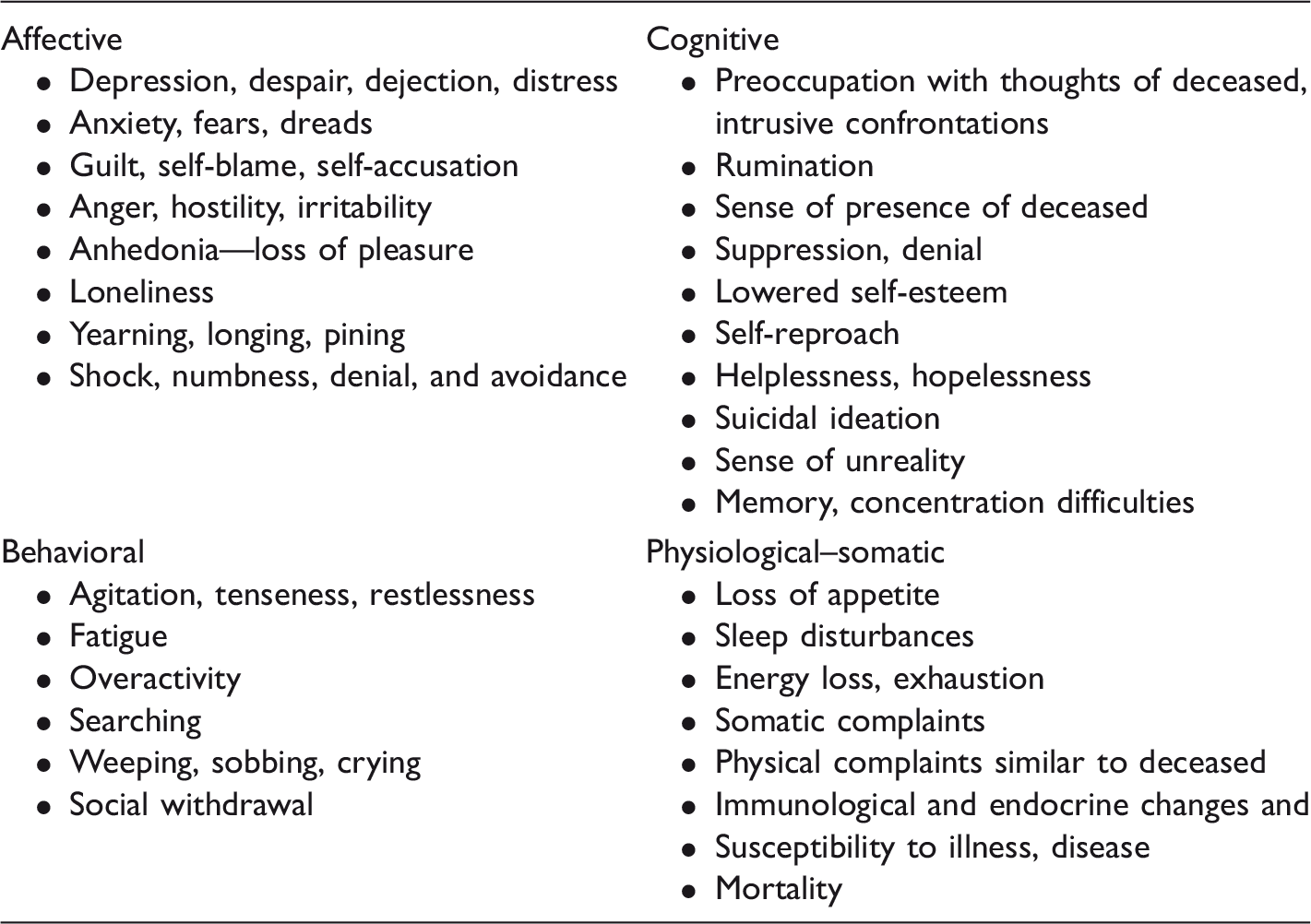
Table 1 is an oversimplification in many respects. To list a few of the main ones: There is certain uniformity (a researcher's task includes looking for patterns) but there are also vast individual differences in reactions to bereavement; it has to be understood that specific reactions vary from person to person, which may have to do with the particular circumstances (e.g., varying according to the nature of the death or personal characteristics and the relationship to the deceased). In line with the fact that it is a complex emotional syndrome (cf. Averill, 1988), it also needs to be understood that not all bereaved persons manifest all of the listed reactions. Furthermore, some reactions are more typical in certain cultures than others (e.g., some societies do not permit overt expression of grief, or time-limit it, while others encourage outpourings of sorrow, cf. Rosenblatt, 2013). And some reactions are time related, appearing more frequently at certain durations following the death than others (e.g., shock and numbness are frequent early on, while somatic complaints may take longer to emerge). By contrast, feelings of distress and depression extend over a long period, recurring frequently, and only gradually abating during a period of months or even years. Reactions such as yearning, longing and pining come and go, and wax and wane over the course of time, there is nothing totally linear about it. Some have described the course of grief as a roller-coaster (another metaphor of course, something also quite typical for the poets). So we have to capture the complex process of grieving—the ways that bereaved persons go about dealing with their loss, the strategies of coping, and the changing manifestations of grief that also occur. There is nothing static about it either (though looking alone at Table 1 may give this impression). Scientific accounts do cater for such dynamic components as well, and these are taken into account in theoretical descriptions of the coping process (for review, Stroebe, Schut, & Boerner, 2017a). As we shall see, the poets capture fluctuations in reactions to bereavement too.
Another surprising feature of grief is the opposing nature of some of the reactions, such as anger and apathy, weight loss and weight gain, removing versus treasuring possessions of the deceased. Some bereaved persons strive to retain the tie to the deceased, while others attempt to break the bonds and move on with life. There is both looking back to the past and the times together (with consoling memories or ruminative regrets, guilt feelings, etc.) and looking forward (worrying about or planning for life without the presence of the loved person). Some bereaved persons (and poets) focus on profound sorrow while others express relief and hope. There is indeed both need to talk about one's loss and to avoid talking about it, to accept and deny the reality of the death. Laughter may mingle with sorrow, relief with regret.
Taken together, such patterns illustrate how difficult it is to describe normal grief and grieving, but to make it more difficult still, there are also various complicated forms of grief, from which a minority of bereaved people suffer. In the words of Zisook et al. (2014) grief can go awry, with definitions of complicated grief focusing on deviations in intensity and duration compared with normal responses to be found in a particular culture (cf. Boerner et al., 2016). However, for current purposes, the distinctions between normal and complicated forms are not dwelt on—it is enough to know that extreme reactions can be harrowingly troublesome and likely to need professional help (see Stroebe, Schut, & van den Bout, 2013).
There is also clearly overlap and interaction between the affective, cognitive, behavioral, and physiological or somatic categories of Table 1 (e.g., crying is both affective and behavioral); the divisions are basically just to give some clarity and feel for the scope of reactions—at the risk of making grief look neat and tidy, which as we all know, it is not. A further caveat: The focus here is on individual, intrapersonal reactions, whereas grief cannot be said to be experienced solely on one's own or without external influences. For example, one may grieve with family, friends, colleagues, and others who have suffered the same loss (see Stroebe & Schut, 2015); there are associated interpersonal components to grief and grieving (e.g., one's personal way of coping is influenced by others, who may admonish one—as do the poets cited above—to hold in or express feelings). Indeed, the definition of grief given earlier includes a social dimension which we do not see directly addressed in Table 1 (although it is reflected in “social withdrawal”). As I will illustrate later, the poets pick up social themes too. In sum: Reactions are much more complex than portrayed in Table 1.
Scientific Descriptions: The Example of Loneliness
How do scientists describe grief reactions, that is, beyond the categorization presented earlier? This can be illustrated using one of the reactions, namely, loneliness (and we shall see shortly how these representations are complemented in poetic renditions). Loneliness has been established as a familiar and quite commonly experienced reaction, with over half of widowed persons in one sample experiencing loneliness after 7 months (Shuchter & Zisook, 1993). It is a critical feature of grief, in the sense that it can cause other difficulties: Recent research has shown loneliness to be a gateway symptoms, it leads to the development of further depressive symptoms in bereavement (cf. Fried et al., 2015). Loneliness has also been highlighted as a risk factor and predictor of detrimental mental and physical health consequences of bereavement (see Fried et al., 2015, p. 6, for brief review). So what precisely is loneliness, according to the scientific literature? Specialists Peplau and Perlman (1982) defined it as “the unpleasant experience that occurs when a person's network of social relationships is deficient in some important way, either quantitatively or qualitatively” (p. 4). We ourselves described loneliness specific to bereavement as “Feeling alone even in the presence of others, and periodic bouts of intense loneliness, notably at the times when [the deceased person] would have been present (evenings, weekends) and during special events that they would have shared” (Stroebe & Stroebe, 1987, p. 10). Shuchter and Zisook (1993), reviewing what is known about the nature of normal grief, described how, following spousal loss … the reality of being alone and the intensity of one's loneliness emerge and, over time, become a powerful force. The loneliness is both specific for the spouse who has died—accompanied by the yearning and pangs of grief—but also general for the companionship role that increasingly the spouse may have played. Often, the loneliness becomes more severe, or even initially manifests itself, after the first several months of bereavement. (p. 30)
More recently, loneliness was included by Shear and colleagues among their set of DSM criteria for complicated grief—though not by proposers of other sets—as “frequent intense feelings of loneliness or as if life is empty or meaningless without the person who died” (see tabulations by Boelen & Prigerson, 2013, pp. 92–93; American Psychiatric Association, 2013). The related reactions of yearning and pining feature more prominently in some accounts. Interestingly, among the poets, reactions of loneliness and yearning seem to go hand-in-hand, are enmeshed, possibly exacerbating each other, as we shall see.
As evidenced through this example of loneliness, scientific accounts of the nature of grief—complex syndrome that it is—catalogue and compress reactions to the loss of a loved one, all in ways that provide needed information about the type and scope of reactions. However, they hardly give a sense of what it is like to go through this experience. For understanding at the latter level, we can turn to the arts, and in this case, to poetry.
Poetic Renditions of Grief Reactions
How do poetic portrayals of grief complement scientific accounts? To illustrate, I have selected examples from my unpublished anthology of grief poetry, supplemented with poems found more recently. These poems were composed across many centuries, with perhaps a preference and over-sampling on my part toward the age of romanticism. Nearly all the poems were originally written in English. My coverage here has necessarily been restricted to lines of poetry, either short portrayals from complete or extracts from longer poems displaying grief-related thoughts and feelings. In this section, I cluster the poems according to reactions documented in scientific accounts, ones that the poets in my view convey vividly. Actually, the reactions selected are ones where my colleagues and I have ourselves conducted research (perhaps we saw these as particularly critical features), so forgiveness for the over-citation to our own articles is asked for of readers. Clearly other reactions than those labeled later are also evident in the sampled poems, and undoubtedly, those perceived depend on the eye of the beholder. Some reactions are not illustrated at all (e.g., anger or rage, cf. Dylan Thomas's Do not go gentle into that good night). Finally, it will become evident that, although I have clustered them, there are no such clear boundaries within the poetic accounts, diverse reactions are portrayed.
Missing the Loved One
Loneliness, yearning, and despair
To revisit the reaction illustrated above in scientific accounts: Loneliness is wonderfully well portrayed by the poets. Sorrow and yearning (with pining and longing) and despair are so closely entwined with loneliness that, not surprisingly, some of the passages express feelings of despair, sorrow, yearning, and other related emotions too.
To start with Emily Dickinson (1830–1886): I would love to include more of her poems, to me she conveys the very essence of grief, but a few examples of her work must suffice. As illustrated next, she put her talent to expressing deep grief-related feelings compellingly, in very few words—with the last couplet below transporting one into her desolate world:
My life closed twice before its close—
It yet remains to see
If immortality unveil
A third event to me.
So huge, so hopeless to conceive
As these that twice befell. Parting is all we know of heaven, And all we need of hell. Thus sung Orpheus to his strings, When he was almost slain, Whilst the winds, soft murmuring, Answered all his woes again:
Ah, dear Eurydice, he cried;
Ah, dear Eurydice-and so he died. Ah, dear Eurydice the echoing winds replied. I cannot say what loves have come and gone,
I only know that summer sang in me
A little while, that in me sings no more. A grief without a pang, void, dark and drear, A drowsy, stifled, unimpassioned grief,
Which finds not natural outlet of relief
In word, or sigh, or tear.
Dark house, by which once more I stand
Here in the long unlovely street,
Doors, where my heart was used to beat
So quickly, waiting for a hand,
A hand that can be clasp'd no more—
Behold me, for I cannot sleep,
And like a guilty thing I creep
At earliest morning to the door.
He is not here; but far away
The noise of life begins again,
And ghastly thro' the drizzling rain
On the bald street breaks the blank day.
Heartbreak, loss of the will to live
Perhaps too sentimental for some tastes, but I find this following illustration of heartbreak by William Barnes (1801–1886) quite beautiful, grappling with the ongoing presence yet absence of his wife; the last two lines evidencing his diminished will to live. Continuing ties to the deceased, with overriding preoccupation, as well as gaunt loneliness echo through these lines of his poem entitled Sonnet too:
In every dream thy lovely features rise;
I see them in the sunshine of the day;
Thy form is flitting still before my eyes
Where'er at eve I tread my lonely way;
In every moaning wind I hear thee say
Sweet words of consolation, while thy sighs
Seem borne along on every blast that flies;
I live, I talk with thee where'er I stray:
And yet thou never more shalt come to me
On earth, for thou art in a world of bliss,
And fairer still—if fairer thou canst be—
Than when thou bloomed'st for a while in this.
Few be my days of loneliness and pain
Until I meet in love with thee again. Perhaps some day the sun will shine again, And I shall see that still the skies are blue, And feel once more I do not live in vain, Although bereft of You.
Perhaps the golden meadows at my feet
Will make the sunny hours of Spring seem gay, And I shall find the white May blossoms sweet, Though you have passed away. Perhaps the summer woods will shimmer bright, And crimson roses once again be fair, And autumn harvest fields a rich delight, Although You are not there.
Perhaps some day I shall not shrink in pain
To see the passing of the dying year, And listen to the Christmas songs again, Although You cannot hear. But, though kind time may many joys renew,
There is one greatest joy I shall not know
Again, because my heart for loss of You
Was broken, long ago. The night has a thousand eyes,
And the day but one;
Yet the light of the bright world dies
With the dying sun. The mind has a thousand eyes,
And the heart but one;
Yet the light of a whole life dies
When love is done.
Soe well I love thee, as without thee I
Love Nothing. If I might chuse, I'd rather die
Than bee one day debarred thy company.
… to the God who cut your life short, pray
That he as early to your sight restore me
As from my own he swept you far away.
Thoughts and Dreams Relating to the Deceased Person
Preoccupation with thoughts of the deceased
Remembrance is receiving more scientific attention these days, as the role of autobiographic memory processes emerge as critical in adaptation to bereavement (cf. Eisma et al., 2015). Earlier scientific accounts were less specific but also pointed to preoccupation, rumination, and working through memories of the deceased as integral to the process of coming to terms with loss. In his poem Sorrow, D. H. Lawrence (1885–1930) illustrates the way that memories can unexpectedly be linked with current experience, bringing back grief:
Why does the thin grey strand
Floating up from the forgotten
Cigarette between my fingers,
Why does it trouble me?
Ah, you will understand;
When I carried my mother downstairs,
A few times only, at the beginning
Of her soft-foot malady,
I should find, for a reprimand
To my gaiety, a few long grey hairs
On the breast of my coat; and one by one
I watched them float up the dark chimney.
The impact of dreams of the deceased
Dreaming of the deceased, including those of the person's continued presence in life, is not atypical in bereavement, and in some cases, dreams are disturbing (cf. Wright et al., 2014). I think that the power of dreams has been understudied by bereavement researchers in general (and dreaming of the deceased is not itemized in Table 1). A few examples from poetry suffice to show how disquietingly significant these may be (though some have been found to be comforting, as shown by Wright et al., 2014).
I already included William Barnes' Sonnet, as an expression of loneliness and lack of the will to live, and this is also a poem starting with a clear rendition of the power of dreams. The agony of the realization that one has only dreamed that the loved one is still alive has also been put so succinctly by John Milton (1608–1674), in his sonnet On his Deceased Wife:
Methought I saw my late espoused Saint
Brought to me like Alcestis from the grave, Whom Jove's great son to her glad husband gave, Rescued from death by force, though pale and faint.
Mine, as whom washt from spot of child-bed taint
Purification in the old Law did save,
And such, as yet once more I trust to have
Full sight of her in heaven without restraint, Came vested all in white, pure as her mind.
Her face was veiled; yet to my fancied sight
Love, sweetness, goodness, in her person shined
So clear, as in no face with more delight. But O as to embrace me she inclined, I waked, she fled, and day brought back my night.
There, where the sun shines first
Against our room,
She train'd the gold Azalea, whose perfume
She, Spring-like, from her breathing grace dispersed. Last night the delicate crests of saffron bloom, For this their dainty likeness watch'd and nurst, Were just at point to burst. At dawn I dream'd, O God, that she was dead, And groan'd aloud upon my wretched bed, And waked, ah, God, and did not waken her, But lay, with eyes still closed,
Perfectly bless'd in the delicious sphere
By which I knew so well that she was near, My heart to speechless thankfulness composed.
Till 'gan to stir
A dizzy somewhat in my troubled head–
It was the azalea's breath, and she was dead!
Interpretations Relating to the Self, One's Feelings and Beliefs
Guilt
One example—so brief yet so sensitively capturing the feeling of guilt that many of us experience as time goes on (e.g., when we overlook an anniversary: a birthday, or the date of the death)—is given in these lines from Emily Brönte's (1818–1848) Remembrance: Have I forgot, my Only Love, to love thee,
Severed at last by Time's all-wearing wave?
Surprised by joy—impatient as the Wind
I turned to share the transport—Oh! with whom
But Thee, long buried in the silent tomb,
That spot which no vicissitude can find?
Love, faithful love, recalled thee to my mind—
But how could I forget thee? Through what power, Even for the least division of an hour,
Have I been so beguiled as to be blind
To my most grievous loss!—That thought's return
Was the worst pang that sorrow ever bore, Save one, one only, when I stood forlorn,
Knowing my heart's best treasure was no more;
That neither present time, nor years unborn
Could to my sight that heavenly face restore.
At first you did not love enough
And afterwards you loved too much
And you lacked the confidence to choose
And you have only yourself to blame.
“If only” cognitions
Regrets can go hand-in-hand with guilt, with associated reactions such as wishful thinking and the more problematic “counterfactual thinking” (“the generation of imagined alternatives to actual events,” Fleming & Robinson, 2001, p. 657. These reactions take the form of “If only I had done such and such, then s/he would still be alive,” which can lead to complications in the grieving process). The longing words of Alfred Lord Tennyson in Lines from Maud (the opening lines of the poem and somewhat further on) reflect feelings that I think will be familiar to many bereaved readers: Oh! that ‘twere possible, After long grief and pain,
To find the arms of my true-love
Round me once again!
***
A shadow flits before me -
Not thou, but like to thee.
Ah God! that it were possible
For one short hour to see
The souls we loved, that they might tell us
What and where they be.
Grief, spirituality, and religion 4
Tennyson's closing words in his Lines from Maud above touch on the idea of an afterlife, raising the question about the impact of religion or spirituality on grief. Such beliefs do not really belong as separate entities within the list of grief reactions in Table 1 (though one can feel anger toward or blame God; bereavement may indeed impact negatively—or positively—on one's beliefs). Rather, from a scientific perspective, spiritual meaning and religious beliefs are important to study because they have to do with ways of coping with the death of a close person. For example, there are good reasons to argue that being able to turn to God or to believe in reunion in heaven help some (not other) persons to come to terms with their bereavement (Stroebe, 2004). However, sound scientific evidence examining the links between such beliefs and (mal)adaptation is still remarkably lacking (cf. Wortmann & Park, 2008).
It is evident browsing through poetic renditions, that some of the poets included already above sought solace in religion; the notion of being able to continue the bond and become reunited in heaven, sometimes accompanied by the wish to die, has been illustrated in the words of de Camoëns, Drayton, and Milton, for example. To this, I would like to add Emily Dickinson's firm expression of belief that she will be reunited with her loved one in the afterlife: The grave my little cottage is,
Where “Keeping house” for thee
I make my parlor orderly
And lay the marble tea. For two divided, briefly, A cycle, it may be,
Till everlasting life unite
In strong society.
The physical burden of grief
It may not be the stuff of poetic renditions of grief to cover the physiological-somatic reactions, as in the fourth compartment of Table 1, but the enormous burden, the exhausting nature of grief, is graphically displayed by Edward Hirsch (1950-) in his elegy Gabriel, written after the death of his son. He mentioned that the part of his poem excerpted here was one of particular importance to him (interview with Alec Wilkinson in The New Yorker, 2014, August 14th):
5
I did not know the work of mourning
Is like carrying a bag of cement
Up a mountain at night
The mountaintop is not in sight
Because there is no mountaintop
Poor Sisyphus grief
I did not know I would struggle
Through a ragged underbrush
Without an upward path
Because there is no path
There is only a blunt rock
With a river to fall into
And Time with its medieval chambers
Time with its jagged edges
And blunt instruments
I did not know the work of mourning
Is a labor in the dark
We carry inside ourselves
Though sometimes when I sleep
I am with him again
And then I wake
Poor Sisyphus grief
I am not ready for your heaviness
Cemented to my body
Look closely and you will see
Almost everyone carrying bags
Of cement on their shoulders
That's why it takes courage
To get out of bed in the morning
And climb into the day
The Grieving Person Surrounded by Others
Reaction to consolation
I noted that one of the limitations of Table 1 was the focus on the intrapersonal reactions, when in fact grief has interpersonal components too, pointing out that one does not experience grief in total isolation. For example, the difficulty in helping the bereaved was brought to light in a classic study by Lehman, Ellard, and Wortman (1986). It is hard for those in the network of people surrounding a grieving person—even those who are trying hard and well intentioned (wanting to support the bereaved person as best they can)—to actually get it right. The impact of others on one's grief is evidenced in James Russell Lowell's (1819–1891) words from After the Burial, written following the death of his child. These lines bring home the limits to the help that we can give to the bereaved: Your logic, my friend, is perfect,
Your moral most drearily true;
But, since the earth clashed on her coffin, I keep hearing that, and not you. Console if you will, I can bear it,
‘Tis a well-meant alms of breath;
But not all the preaching since Adam
Has made Death other than Death.
Comparison with (nonbereaved) others
It is possible that the loneliness of losing a loved person is aggravated by the contrast with the ongoing, normal lives of others (seeing couples when one has become widowed; families when one has lost one's child) as Amy Lowell (1874–1925) depicts in From one who stays:
How empty seems the town now you are gone!
A wilderness of sad streets, where gaunt walls
Hide nothing to desire; sunshine falls
Eery, distorted, as it long had shone
On white, dead faces tombed in halls of stone.
The whir of motors, stricken through with calls
Of playing boys, floats up at intervals;
But all these noises blur to one long moan.
What quest is worth pursuing? And how strange
That other men still go accustomed ways!
I hate their interest in the things they do.
A spectre-horde repeating without change
An old routine. Alone I know the days
Are still-born, and the world stopped, lacking you.
Grief in families
The huge effort that is needed to cope with ongoing demands (restoration-oriented coping, in our scientific terminology, Stroebe et al., 2017a) as well as dealing with the death of the loved person him- or herself is depicted by Edna St. Vincent Millay in her poem Lament: Listen, children: Your father is dead.
From his old coats
I'll make you little jackets;
I'll make you little trousers
From his old pants.
There'll be in his pockets
Things he used to put there,
Keys and pennies
Covered with tobacco;
Dan shall have the pennies
To save in his bank;
Anne shall have the keys
To make a pretty noise with. Life must go on,
And the dead be forgotten;
Life must go on,
Though good men die;
Anne, eat your breakfast;
Dan, take your medicine;
Life must go on;
I forget just why.
Time and Change
The course of grief
The poets depict the range of time-related reactions from those experienced shortly after loss, to those more familiar after longer durations, as illustrated in the following subsections. But first, I would like to share the opening and closing lines of Linda Pastan's (1932-) The Five Stages of Grief, in which she likens grief reactions to staircase ascension, referring to the assumed five stages in Kübler-Ross's DABDA—denial, anger, bargaining, depression, acceptance—model. Many researchers in the bereavement field have alerted professionals and lay people to the dangers of assuming that one should follow such stages; our colleagues and we ourselves have provided critical reviews (cf. Doka & Tucci, 2011; Stroebe, Schut, & Boerner, 2017b). It is heart-warming to see our skepticism echoed in these excerpts from Pastan's poem. In the short space of the last few lines of her poem, Pastan more vividly expresses than we have managed in far more space, to hammer home the notion that the stages do not—and must not be expected to—apply generally to bereaved persons, that to suppose this can have a devastating impact:
The night I lost you
Someone pointed me towards
The Five Stages of Grief. Go that way, they said,
It's easy, like learning to climb
Stairs after the amputation.
***
Acceptance. I finally reach it. But something is wrong. Grief is a circular staircase. I have lost you.
Numbness, shock, and denial
These reactions are typically associated with the early days following the loss of a loved one (cf. Bowlby, 1980). Thomas Hardy (1840–1928) portrays the sudden change of life circumstances following a death, in these lines from The Going: Never to bid goodbye, Or lip me the softest call,
Or utter a wish for a word, while I
Saw morning harden upon the wall,
Unmoved, unknowing
That your great going
Had place that moment, and altered all.
The Bustle in a House
The Morning after Death
Is solemnest of industries
Enacted upon Earth—
The Sweeping up the Heart
And putting Love away
We shall not want to use again
Until eternity. Thus long my grief has kept me dumb:
Sure there's a lethargy in mighty woe;
Tears stand congealed and cannot flow, And the sad soul retires into her inmost room. Tears for a stroke foreseen afford relief. But unprovided for a sudden blow,
Like Niobe we marble grow
And petrify with grief. I had not known, in friendly life attached,
That death cleaves suddenly yet leaves two legs
That both still bear their weight, two legs still matched
And walking still among the ashen dregs. I had not known that the body bore so much, That so bereaved it still could walk and thrive: I had not known that, with no sense of touch, An individual could stay alive. They dressed us up in black,
Susan and Tom and me;
And, walking through the fields
All beautiful to see,
With branches high in the air
And daisy and buttercup,
We heard the lark in the clouds, —
In black dressed up. They took us to the graves, Susan and Tom and me,
Where the long grasses grow
And the funeral tree:
We stood and watched; and the wind
Came softly out of the sky
And blew in Susan's hair, As I stood close by. Back through the fields we came, Tom and Susan and me, And we sat in the nursery together, And had our tea. And, looking out of the window,
I heard the thrushes sing;
But Tom fell asleep in his chair, He was so tired, poor thing.
In Summer and in Winter I shall walk
Up and down
The patterned garden paths
In my stiff, brocaded gown.
The squills and daffodils
Will give place to pillared roses, and to asters, and to snow.
I shall go
Up and down, In my gown. Gorgeously arrayed, Boned and stayed.
And the softness of my body will be guarded from embrace
By each button, hook, and lace. For the man who should loose me is dead, Fighting with the Duke in Flanders, In a pattern called a war.
Christ! What are patterns for?
After great pain, a formal feeling comes—
The Nerves sit ceremonious, like Tombs—
The stiff Heart questions was it He, that bore,
And Yesterday, or Centuries before?
The Feet, mechanical, go round—
Of Ground, or Air, or Ought—
A Wooden way
Regardless grown,
A Quartz contentment, like a stone—
This is the Hour of Lead—
Remembered, if outlived,
As Freezing persons, recollect the Snow—
First—Chill—then Stupor—then the letting go—
Looking for the positive
Not surprisingly, researchers have found that as time goes on, positive emotions tend to appear or become more often experienced. It is evident, though, that Table 1, which was intended to span the whole duration of the acute grief period, listed only negative emotions. Have we neglected positive reactions incorporated in grief 8 ? There are some reasons to argue that this may be the case. Although we need—first-and-foremost I would argue—to understand the negative reactions which cause problems (in order to provide appropriate help), positive reactions may be integral to the adaptation process. It has now been documented that, even during the most harrowing days of acute grieving, bereaved persons may seek balance by focusing on positive aspects, despite all that they have lost, and that this actually gives them strength to carry on. The power of such positive thinking has even been built into one of the foremost models of coping with bereavement, namely cognitive stress theory (see Folkman, 2001). Others have pinpointed the phenomenon of positive growth and its salutary impact on adjustment to bereavement (for review: Michael & Cooper, 2013). So how are positive feelings reflected among the poets?
I interpret the following lines by Edmund Spenser (about 1552–1599) as a ray of hope—finding positive meaning in devastating loss: One day I wrote her name upon the strand, But came the waves and washèd it away: Again I wrote it with a second hand, But came the tide, and made my pains his prey.
Vain man, said she, that dost in vain assay
A mortal thing so to immortalize;
For I myself shall like to this decay, And eke my name be wipèd out likewise.
Not so (quod I); let baser things devise
To die in dust, but you shall live by fame;
My verse your virtues rare shall eternize, And in the heavens write your glorious name: Where, when as Death shall all the world subdue, Our love shall live, and later life renew. Remember me when I am gone away,
Gone far away into the silent land;
When you can no more hold me by the hand, Nor I half turn to go yet turning stay.
Remember me when no more day by day
You tell me of our future that you plann'd:
Only remember me; you understand
It will be late to counsel then or pray.
Yet if you should forget me for a while
And afterwards remember, do not grieve:
For if the darkness and corruption leave
A vestige of the thoughts that once I had,
Better by far you should forget and smile
Than that you should remember and be sad.
Here it is three years since my grandmother died
-That old woman-there at her funeral, Parents and friends, everyone was in tears, From sadness that was bitter as it was real.
Alone I wandered through the house, bewildered
Rather than shocked; after, when I drew near
To her coffin someone did complain of me
Finding me neither beside myself nor in tears. Noisy sorrows are quickly over and done: Many other emotions, three years later,
Complete change-whether for good or ill-
Have washed the memory of her from their hearts.
I, only I, dream on and weep for her
Often; three years later, taking strength
From the passage of time, like letters cut on bark
Her memory, too, deepens as time lengthens.
Closing Words
The poets have spoken for themselves, and I have already added comments linking their verses to academic sources. Having selected loneliness to set the stage for this enterprise, I would like to end with a coupled theme, namely, ongoing ties (the related area of research on continuing bonds was pioneered by the late Nigel Field; for review: Field, 2008). I do so with a personal touch, including the closing lines with which my daughter Katherine and I gave tribute following our own bereavement in: Portrait of Lizzie, Sister and Aunt (unpublished). We noted: This poem has been chosen to close our album, because it depicts a continued connection, an ongoing bond, an abiding sense of the presence of a deceased loved person. It was written in 1932, in the United States, by Mary Elizabeth Frye, inspired by the plight of a young German Jewish woman who, because of political unrest, could not return to Germany, to her mother who was ill. When her mother died, the heartbroken young lady told Frye that she had had no chance to “stand by my mother's grave and shed a tear.” Frye was moved by these words to give expression to her own reflections: Do not stand at my grave and weep. I am not there. I do not sleep. I am a thousand winds that blow. I am the diamond glints on snow. I am the sunlight on ripened grain. I am the gentle autumn rain.
When you awaken in the morning's hush
I am the swift uplifting rush
Of quiet birds in circled flight. I am the soft stars that shine at night.
Do not stand at my grave and cry;
I am not there. I did not die.
Footnotes
Declaration of Conflicting Interests
The author(s) declared no potential conflicts of interest with respect to the research, authorship, and/or publication of this article.
Funding
The author(s) received no financial support for the research, authorship, and/or publication of this article.