



Abstract


Grading is a nearly universal experience for school music educators. Depending on the grade level or context, this could include assigning students a percentage, letter, number, or descriptor that corresponds with a predefined level of achievement or understanding. However, although grading is largely an assumed aspect of schooling, 1 there are several consequences resulting from traditional grading practices.
Author and educator Alfie Kohn argues that grading has three main problematic effects: (1) reducing students’ interest in the process of learning, (2) reducing students’ preference and capacity for challenging learning tasks, and (3) reducing the depth and quality of students’ thinking. 2 Although grades can function as a form of extrinsic motivation for some students, they can also constrain students’ intrinsic motivation and their desire and curiosity for knowledge. Grading potentially incentivizes students to only engage in learning opportunities that they believe will result in a high grade and therefore limits their willingness and capacity for risk-taking, creativity, and critical thinking. To counter these problematic effects, I offer an alternative music education grading approach rooted in the “ungrading” movement.
What Is Ungrading?
Ungrading is an assessment approach that deprioritizes grades and reprioritizes learning. 3 It is not a single set of practices or strategies but rather a collective set of principles and values that offer an alternative way of thinking about music assessment. 4 Ungrading can foster creativity and risk-taking because when students are not graded, they are no longer concerned with how their learning might be unfairly objectified and quantified. Students are actively encouraged to take risks in both what and how they learn in an ungrading approach, which, in turn, can foster curiosity rather than conformity. When the threat of grades is removed, students become intrinsically motivated by their love of music and the joy of learning.
Importantly, ungrading does not simply mean adapting grading practices to fit within traditional music education models. It represents a paradigm shift that necessarily influences all aspects of music curriculum and pedagogy. 5 For example, foundational to ungrading is centering student power and agency. This almost certainly means enacting more student-centered and culturally sustaining pedagogies that honor students’ diverse cultures, musics, and ways of knowing. 6 Additionally, because of the centrality of self-reflection in the process of learning, ungrading requires trusting students to make critically informed judgments about their learning, which undoubtedly requires an aspect of music educators giving up control. 7 Finally, ungrading emphasizes the importance of constructive feedback in fostering authentic dialogue and meaningful learning.
How to Ungrade?
Before outlining how I enact ungrading, I will briefly describe my teaching context. I am a music educator specializing in guitar in the popular music tradition for grades 7–12. Like most public school educators, I am required to document overall grades on report cards according to governmental and institutional policies. However, these policies do not specify exactly how I must determine grades. It is within this fissure that ungrading becomes possible.
Although my teaching context may be unique, the following ungrading practices can be transferred to other contexts. Researcher Jesse Stommel argues that “there are lots of possible paths toward ungrading, and smaller experiments can be just as fruitful as larger ones.” 8 Therefore, whether teaching six students in a chamber choir, sixty students in a concert band, or 600 elementary students over the course of a week, I encourage music educators to experiment with some (or all) of the following as appropriate given the contextual nature of music education.
Shared Commitments and Responsibilities
I do not grade any of my students’ learning. Instead, I begin each course by engaging students in a critical discussion of how we can prioritize learning over grades. Utilizing the “contract grading” practice within ungrading, 9 I invite students to choose the final grade they would like to receive on their report card (Figure 1). Once students choose their final grade, we try our best not to discuss grades for the rest of the course. This is difficult for many students because grading has become so ingrained in their perceptions of schooling. Yet, in time, students begin to appreciate the freedom and flexibility they have over their learning when they are engaging without fear of a bad grade.

Sample Grade Agreement
This shared commitment is predicated on several responsibilities we both agree to uphold. For students, this includes (a) actively engaging in all aspects of the learning process, (b) completing all learning opportunities to the best of their abilities, and (c) positively contributing to the learning environment. These responsibilities are only a starting point for teaching, learning, and assessment possibilities. They are also intentionally broad and explicitly subjective to allow for flexibility in their application because what “counts” as demonstrating ability, active engagement, and contributing positively is dependent on students’ diverse abilities. Determining whether a student upholds their responsibilities is a collective and ongoing process enacted through regular check-in conversations. If a student upholds their responsibilities throughout the course, then the grade I record on their report card is the grade they chose at the beginning of the course. If I believe that a student is not upholding their responsibilities, I do not penalize them with a low grade. I instead engage them in dialogue so that we can collectively address the barriers or challenges they may be experiencing. This is a constructive approach built on mutual accountability that better facilitates student learning and success.
Students are not the only ones with responsibilities in this ungrading approach. My responsibilities shift from grading toward an emphasis on (a) providing meaningful and constructive feedback that is timely and regular; (b) facilitating a collaborative, supportive, and equitable learning environment; and (c) prioritizing student power and agency. I invite students to provide me with regular feedback regarding how I can improve my own teaching to better support their learning. This posture diminishes the traditional hierarchy between students and teachers, and although unequal power dynamics will always be present, this approach affords students more ownership of their learning process and environment.
Student-Centered Learning
Because ungrading prioritizes meaningful learning opportunities, student-centered learning is foundational to my pedagogy. This approach directly confronts the fear that students will stop trying and no longer put in effort if we remove grades. As psychologists Richard Ryan and Edward Deci state, humans “are active, inquisitive, curious, and playful creatures, displaying a ubiquitous readiness to learn and explore, and they do not require extraneous incentives to do so. . . . It is through acting on one’s inherent interests that one grows in knowledge and skills.” 10 Practically, this means I place a significant emphasis on musics and genres of interest to students. It also means spending more time on independent practice during class wherein students are encouraged to focus on a music learning area of interest to them. This student-centered approach allows learners to engage with meaningful and relevant musics, genres, and techniques without worrying that their diverse interests might negatively influence their grade.
We also co-construct learning experiences premised on critically and creatively engaging with and through music. This might include analyzing song lyrics; studying the social, cultural, and historical contexts of various musics, musicians, and genres; or working on songwriting and composition projects. For example, when I invite students to research an influential guitarist of their choosing, I encourage them to demonstrate their learning in a way that is personally meaningful and to provide me with specific assessment criteria. As a result, I receive a variety of presentation formats, such as slide decks, essays, podcast episodes, videos, posters, and original music compositions, each with unique assessment criteria they would like feedback on. This approach encourages creativity, risk-taking, and deep and meaningful learning by affording students ownership of their own learning without worrying about the grade.
Playing Check-Ins
I have monthly “playing check-ins” for each student to demonstrate their learning and growth in a one-on-one format. These check-ins are opportunities for students to perform either a song we are learning as an entire class or something they are learning independently. I encourage students to always think about what specific areas they are trying to improve to develop their metacognitive skills. When we sit down for our monthly check-in, I ask them to provide me with several explicit assessment criteria they would like targeted feedback on. In the guitar context, students might ask for feedback on their right-hand picking technique, left-hand fretting technique, note accuracy, tone, tempo, rhythm, phrasing, or dynamics (but not all of them at once, lest my feedback become unfocused). I then target my feedback during the check-ins toward the learning area of interest to the student.
Perhaps unsurprisingly, many students still ask at the end of the check-in, “So what grade did I get?”—demonstrating once again how inculcated they are into a mode of schooling that privileges grades over learning. This check-in process ensures that my formative assessment via feedback affords students the opportunity to learn and grow in areas that are relevant and meaningful to them. It also fosters students’ intrinsic motivation, risk-taking, and joy of learning without relying on the punitive nature of grades and their reliance on extrinsic motivation.
Self-Assessment
Self-assessment is central to my ungrading practice. In addition to daily informal invitations to self-reflect, there are two formal self-assessment opportunities. This includes a midterm and a final reflection paper where students reflect on their learning journey, including areas of growth and possible improvement (Table 1). Students regularly share in their reflection papers how much they appreciate not being graded and how they are more willing to take risks and creatively engage in the learning process. They also often share how they “never thought it was possible to do school without grades” and, as a result, openly wonder in their papers at what other taken-for-granted aspects of school they are subject to.
Sample Reflection Questions
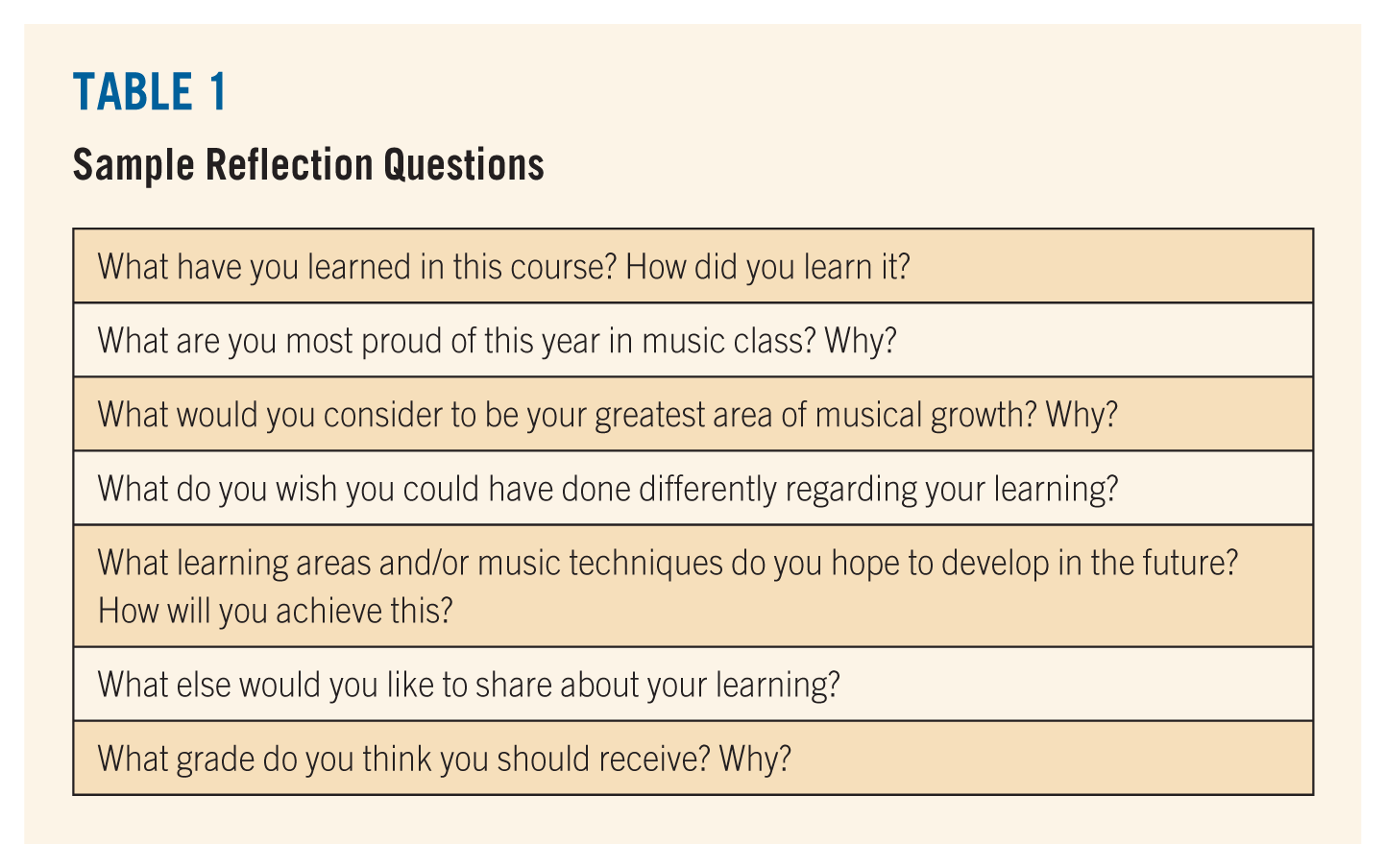
The final reflection question asks if the grade chosen at the beginning of the course should remain the same or be raised or lowered. Although I make it explicit to students that I reserve the right to change their grade, it is incredibly rare that I lower a student’s grade below the grade they chose, and only after multiple conversations with the student. In my experience, students consistently demonstrate profound thoughtfulness, candidness, honesty, and integrity in their responses. In fact, students can sometimes be their own harshest critics and give themselves a low grade because they do not feel they deserve a high grade or because they made mistakes and were not “perfect” along the way. However, learning is not about being perfect. I therefore use my professional judgment to raise grades in scenarios where students are overly critical of themselves. Ultimately, this reflection process develops students’ critical thinking and metacognitive skills, both of which are fundamental in fostering students as empowered, lifelong learners.
Closing Thoughts
Traditional grading practices are largely understood as a natural and inevitable part of schooling. 11 But just because grades are an expectation does not mean that we cannot critically and creatively reimagine our grading practices. Although ungrading in the music classroom requires immense courage because it challenges the status quo, I believe it offers students a more meaningful and empowering mode of assessment not premised on the specter of grades but on the joy of learning.
