




Abstract
ChatGPT is emerging as a formidable asset for music educators, poised to enhance student engagement, refine assessment methods, and automate repetitive tasks related to music teaching. The core of this perspective revolves around the use of custom prompt templates that support individualized and reflexive teaching practices. The broader implications of artificial intelligence (AI) integration in music education are discussed, emphasizing the potential to redefine conventional pedagogical and administrative practices. While acknowledging the uses of AI, it is crucial to center ethical considerations, such as data privacy and biases, ensuring that integration remains student-centered, inclusive, and supportive.
Photo of Jacob Holster courtesy of the author

Teaching music involves navigating a complex array of administrative and pedagogical tasks, each requiring individual attention and time. This complexity deepens when considering the personal and environmental influences each student brings to their musical education. These influences can shape how a student perceives the value of their musical tasks and, by extension, how engaged they are in learning. More specifically, these factors include the value students associate with their tasks (measured in terms of interest, attainment, utility, and cost) 1 and their inherent psychological needs, such as autonomy, competence, and relatedness. 2 Although these specific concepts are important, they are few among the various considerations essential to forming a comprehensive picture of a student’s learning experience. 3
In the face of these multifaceted challenges, there is a growing need for innovative solutions that not only address the administrative complexities that come with being a music teacher but also facilitate personalized learning experiences for music students. One promising avenue is the integration of advanced language models, like Open- AI’s ChatGPT, into music education. These models offer the potential to free up cognitive space for pedagogical tasks by handling administrative responsibilities and enabling the personalization of content to adapt to individual abilities and ignite interest in music learning activities. In this article, I explore practical applications of ChatGPT in music education, focusing on how this tool can augment teaching practices to create a more automated, individualized, and responsive learning environment through insights into prompt engineering, ethical considerations, and exploration of use cases.
Understanding AI: The New Reality of Language Models
Artificial intelligence (AI) is a term that often falls victim to misinterpretation. It is critical to recognize that there is a broad spectrum of AI, encompassing everything from reactive AI, such as IBM’s chess-playing Deep Blue that emerged in the late 1990s, to the chatbots that are available today, and finally, to the concept of artificial general intelligence (AGI), which is typically depicted in films as having self-awareness and consciousness. This article focuses on advanced language models rather than fully autonomous or self-aware intelligence. These models, trained on vast data sets, generate text that mimics human language by predicting the probability of a word given its context in a sentence. However, their intelligence is reflective of their training and not an inherent understanding or consciousness. For instance, text provided by generative pretrained transformers, or GPTs, often seems intelligent but can be inaccurate or incomplete—a phenomenon sometimes referred to as AI “hallucination.” 4 Despite the appearance of intelligence, these tools cannot replace the understanding and expertise of a human music teacher.
Prompt Engineering with ChatGPT
OpenAI’s platforms, ChatGPT and ChatGPT Plus, are based on GPT models available at chat.openai.com. The subscription-based ChatGPT Plus uses the GPT-4 model, which surpasses its predecessor ChatGPT by achieving human-level performance in various benchmarks, including scoring in the top 10 percent on a simulated bar exam, whereas ChatGPT scored in the bottom 10 percent. 5 To interact with these models, a user types requests, also known as “prompts,” as instructions or questions into the user interface, serving as a starting point for the AI to generate relevant responses. Strategically crafting these prompts—a process some call “prompt engineering”—is essential when interacting with GPT models. Recent updates allow for the ability to upload, analyze, and convert text, image, audio, and video files within fine-tuned specialized static models called “GPTs.” 6
Despite limited existing literature on AI use in music education, skillful prompt engineering opens numerous possibilities. For instance, prompts such as “Generate a detailed discussion activity on the evolution of jazz music” can lead to engaging student-friendly discourse. Word choice can influence the level of detail in responses; for example, prompts with phrases like “step-by-step” can simplify complex concepts for learners or “forget everything I said except for . . . ” can help refine the focus of the prompt. 7 Furthermore, GPT-4’s ability to engage in metalevel discussions about its thought processes is a unique feature that educators can use to both improve output (e.g., “take your feedback and rewrite your response”) and guide students and teachers alike through self-reflection and metacognitive processes. 8 It is important to note, however, that the quality of AI-generated responses depends significantly on the precision of prompts and a vigilant approach to verifying content.
Building prompt engineering skill extends beyond just specificity, precision, and iterative fine-tuning. It encompasses a broader spectrum of strategic elements that educators can leverage to enhance AI’s role in music education. By providing clear contextual cues in prompts, educators can guide the AI toward more accurate and relevant responses. For example, “Create a rhythm exercise for a seventh-grade student focusing on syncopation” is more likely to elicit a suitable response than a more generic request for a rhythm exercise. Furthermore, specifying desired presentation styles, such as a “letter to parents,” “step-by-step guide,” or “bullet-point list,” can support the usefulness of the output. It is also important to acknowledge the limitations and ethical considerations related to the use of the models. These include the “knowledge cutoff” of the models, which means their responses may not reflect the very latest developments or events, and the associated ethical implications, including privacy, data security, and the responsible application of AI-generated content.
ChatGPT Use Cases in Music Education
The following use cases of ChatGPT in music education stem from specific needs observed in my teaching environments. However, these AI tools can adapt to the diverse and unique needs of different teachers ranging from drafting emails to parents, to writing funding requests, to crafting cover letters for new positions. As such, I encourage the reader to consider these as starting ideas for experimentation rather than ultimate outcomes that represent technological capability.
Assessment and Feedback Enhancement
Assessment and feedback in music education are critical tools that guide student learning and personal growth. 9 In line with these strategies, assessments might be transformed from grading tools to supportive learning mechanisms. By acknowledging students’ individuality, motivations, and life circumstances, assessments and feedback become integral components of a music education curriculum that supports each student’s unique development. 10 Education researchers John Hattie and Helen Timperley presented a model of effective feedback that rests on three essential questions: Where am I going? How am I going? Where to next? 11
Flexible Goals and Student Choices
Echoing the guiding question “Where am I going?,” flexibility in setting learning objectives is crucial. Using GPT-4, educators can design versatile learning targets and prompts that respect students’ agency while ensuring core musical competencies. For instance, a general music teacher might prompt GPT-4, “Generate a range of flexible learning targets for a unit on rhythm in secondary general music, allowing for individual student exploration and creativity while focusing on core rhythm concepts.” This prompt created the following objective, among many others: “Students will analyze popular music pieces from different genres to identify and describe prominent rhythm patterns and their impact on the overall musical texture.”
Personalizing Feedback
To tackle the second guiding question, “How am I going?,” GPT-4 can be instrumental in devising personalized feedback that recognizes the unique choices and problem-solving strategies of students. This can be achieved through a focus on process-level and self-regulatory feedback, which encourages learners to engage more deeply with the process of learning with varying levels of instructor support. 12 Consider a rehearsal setting where a music teacher aims to provide specific feedback for a student who performed a jazz improvisation piece. The teacher could prompt GPT-4, “Generate process-level and self-regulatory feedback prompts for a student who performed a jazz improvisation piece, focusing on their unique interpretive choices, technical skills, and areas for improvement.” In response, GPT-4 might propose the following feedback prompts for the teacher to share with students in rehearsal, and the teacher might adapt instructive responses from these outputs.
These prompts might be useful for preservice and early career music educators who are hoping to develop habits of specificity and relevance in their informal assessment approaches. Concurrently, both novice and expert teachers might share these prompts and learning processes with students to guide them in providing personalized feedback to themselves and others. This choice might allow students to delve into their own decision-making processes and understand how to both self-regulate their improvement and engage in a supportive and constructive classroom culture of assessment.
Developing Assessment Rubrics
Addressing “Where to next?,” GPT-4 can help create rubrics that articulate varying degrees of success. These rubrics can outline the intersections of subjective processes and problem-solving skills with target learning outcomes, providing a clear picture of potential growth paths for students. For instance, an ensemble teacher could prompt GPT-4 with the following:
Design a rubric to assess a high school choir’s performance, focusing on the vocal blend, rhythmic accuracy, intonation, and expressive interpretation. Create four performance levels and describe the expected qualities and characteristics for each element at each level. Ensure the rubric provides clear criteria and allows for a comprehensive evaluation of the choir’s abilities in these areas. Make sure the levels are the columns.
Preparing Music Materials and Resources
GPT-4 offers valuable assistance to music educators by providing customized materials, such as musical examples, exercises, worksheets, and lesson plans, that cater to the specific needs of their students. For instance, when planning a music composition unit, a teacher can utilize GPT-4 to generate composition exercises that offer students a range of prompts, musical structures, and techniques to explore. Additionally, GPT-4 can generate worksheets, activity lists, and study materials that reinforce key concepts and skills in music theory, ear training, sight-reading, and music history, to name a few. For instance, a teacher aiming to engage students in the composition process within a general music class could input the following prompt: “Generate a detailed table outlining composition exercises for beginner students. The table should include information on the musical elements each exercise covers, its learning outcome, the difficulty level, suggested duration, materials needed, and tips for implementation.” Table 1 presents an example output from this prompt.
Hypothetical Sequence of Composition Exercises for Beginning Students
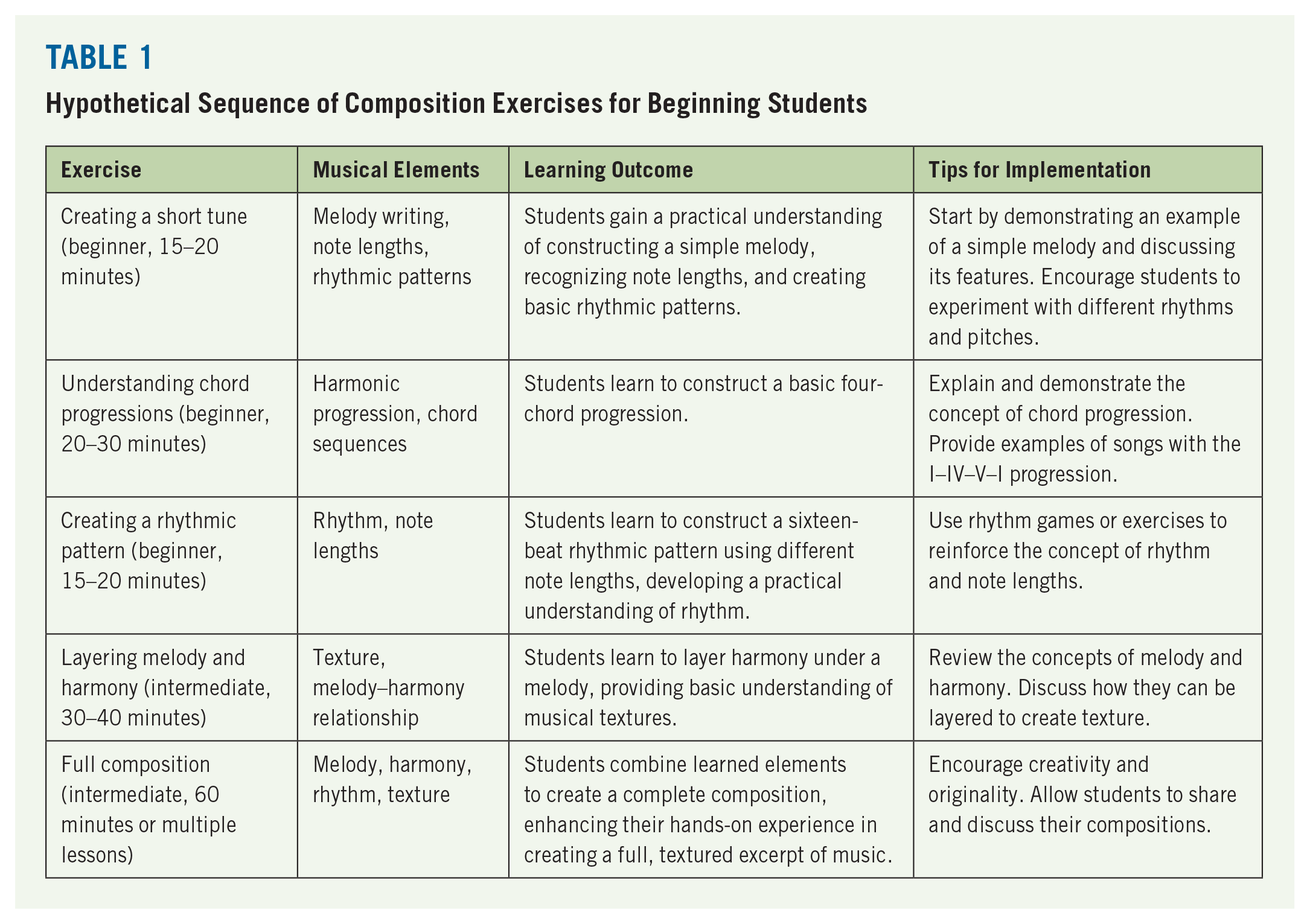
Given this output, a teacher could further customize the resources to suit a specific class or activity. For example, in refining the materials for the understanding chord progressions exercise, the teacher could prompt GPT-4, “Generate a worksheet for beginning students focused on constructing a basic four-chord progression in G Major, with step-by-step instructions and guided practice exercises.” This specific prompt ensures the resource aligns closely with the unique learning needs and objectives of the class.
Generating Clear Instructions
Clear instructions are vital for coordinating actions that support music classroom objectives.
13
Using GPT-4, educators can quickly create detailed instructions for everyone involved in event planning. For instance, consider a scenario where a band director needs to organize a concert with forty-six wind students and ten percussionists, with the gymnasium setup starting at 4:45 p.m. for a 7:00 p.m. performance due to basketball practice after school. The director might input the following:
Generate a detailed plan for directors to support organizing a concert with specific details: 70 students, four rows of chairs, and setup starting at 4:45 p.m. Also make a document for student helpers to set up the stage with four rows (eight, twelve, sixteen, ten). Then make a document for students who are not helpers regarding call times, locations, and other expectations.
GPT-4 will respond by providing a step-by-step plan that outlines the necessary actions for everyone involved and the arrangements required for a successful concert setup. These outputs can then be refined into a comprehensive handout, ensuring that students have a clear understanding of their roles and responsibilities. This approach not only contributes to a more seamless and successful concert experience but also frees up bandwidth for directors to focus on other aspects of the event, allowing them to allocate their capacity and attention more effectively.
Incorporating Students’ Musical Interests into Lessons
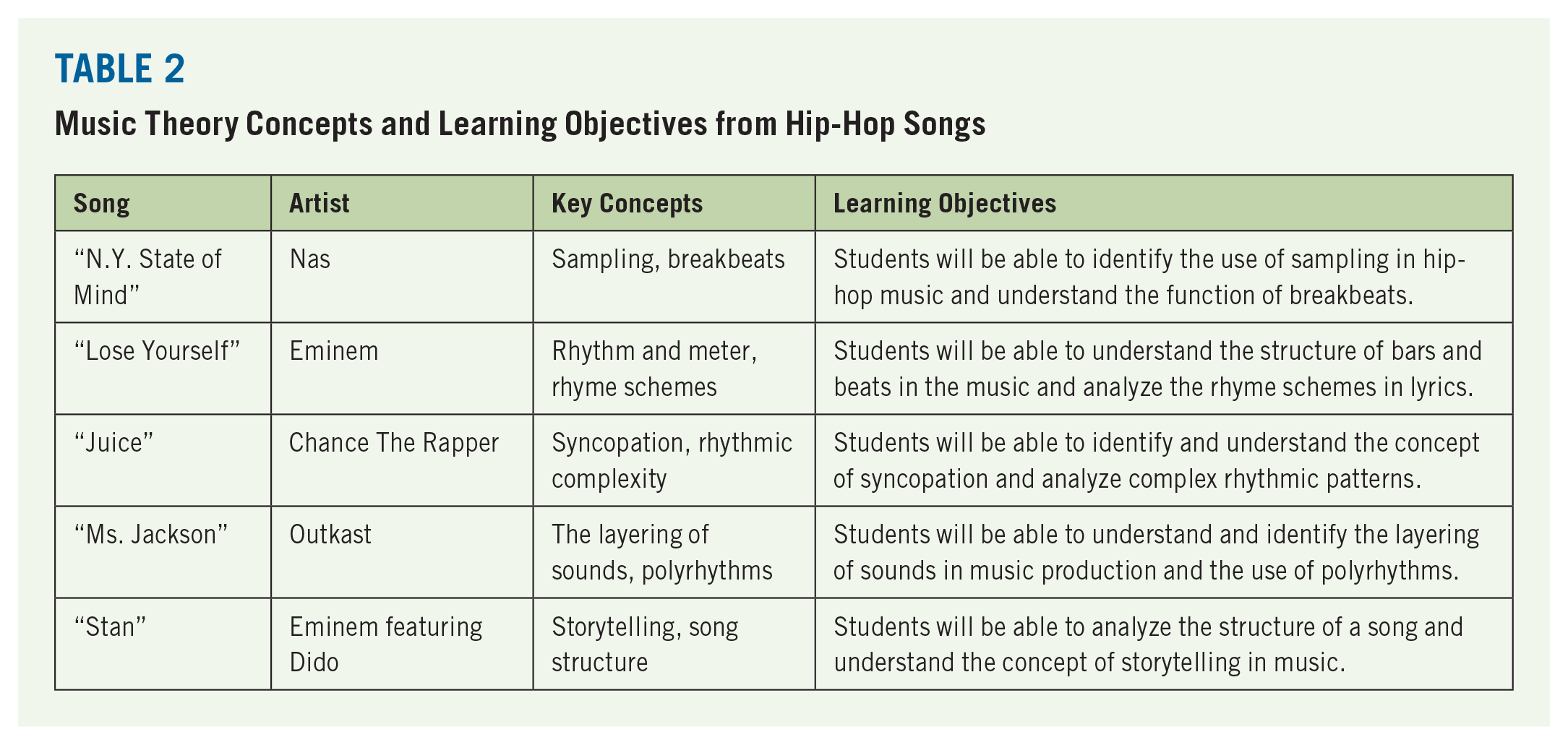
Boosting engagement can be achieved by weaving students’ musical interests into the curriculum. This is because students tend to value tasks more when they align with their interests. 14 Here, GPT-4 comes into play by helping generate genre-specific song lists to aid in teaching musical concepts. For example, if a general music teacher wants to teach music theory concepts to high school students who are enthusiastic about hip-hop, GPT-4 can be prompted to generate a list of hip-hop songs suitable for this purpose. This approach not only makes the lessons more interesting and useful but also addresses the students’ need for autonomy if the teacher were to take their preferences into account. In this case, the teacher might prompt GPT-4 with the following: “Generate a list of five hip-hop songs suitable for teaching music theory concepts. For each song, provide the artist, the key music theory concepts, and a learning objective for students that begins with ‘Students will.’ The learning objectives should relate to the key music theory concepts.” Table 2 shows an example output from this prompt. Compared to googling for a list of hip-hop songs, which may result in time-consuming searches through numerous resources of varying relevance, GPT-4 provides a targeted list of songs based on the specific prompt, which streamlines the process and creates a more focused, context-sensitive teaching resource.
Music Theory Concepts and Learning Objectives from Hip-Hop Songs
Gamifying Learning
Gamification represents a strategy that can enhance the appeal and utility of learning and music performance tasks. 15 Consider a middle school music teacher intending to make learning musical scales more engaging. They could prompt GPT-4 to design a “choose your own adventure” game centered on this topic. The game could create a more rewarding and intrinsically motivating experience for students than more traditional learning formats. By scaffolding challenges where they confront sequentially more difficult scales, students can experience a growing sense of competence. Additionally, the choose-your-own-adventure format allows students to make choices in their learning journey, further promoting a sense of autonomy and self-determined learning. The prompt to GPT-4 in this instance might be “Design a choose-your-own-adventure game for learning musical scales with progression rewards.”
In response, GPT-4 might provide a comprehensive outline for such a game. This game aims to achieve two key learning objectives. First, it endeavors to enhance the student’s ability to identify and play a variety of musical scales, measurable through the levels they complete in the game. Second, it promotes independent decision-making, with progression in the game reflecting their ability to apply critical thinking in musical contexts. An example output from this prompt is presented in Figure 1.
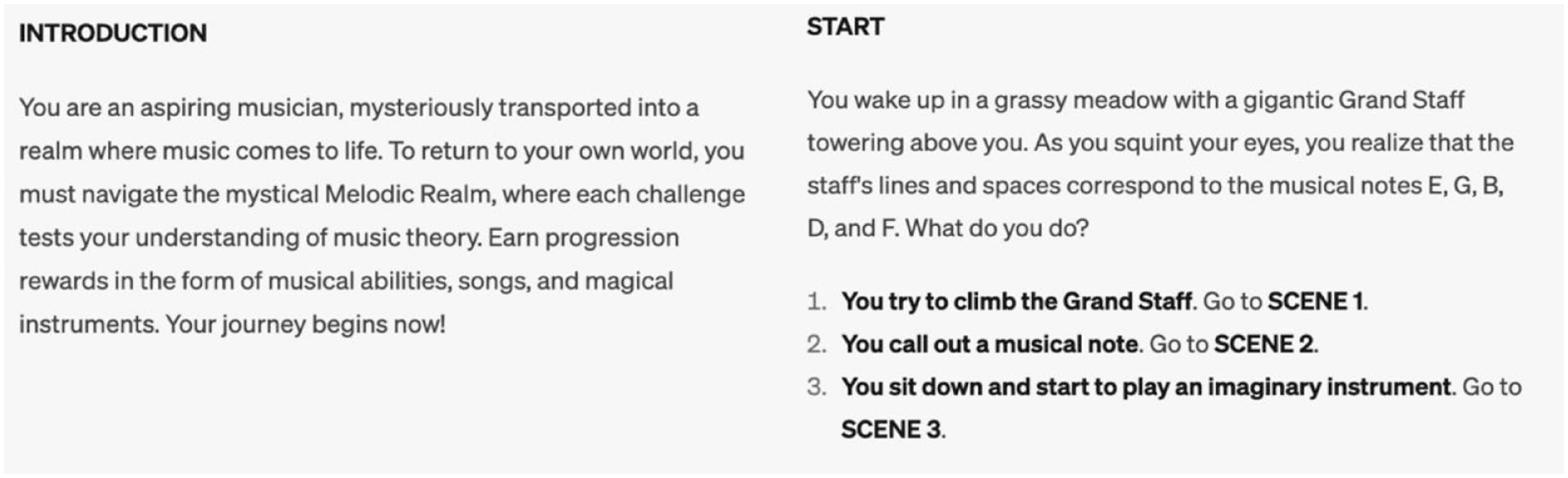
“Choose Your Own Adventure” Game Excerpt
Ethical Considerations and Potential Limitations
As we explore the potential of AI language models in music education, it is essential to address ethical considerations and limitations. First, educators must ensure student data privacy and security when using AI models like GPT-4. It is crucial to comply with data protection regulations and implement appropriate safeguards to protect sensitive student information, which is stored by OpenAI upon user input. Additionally, because AI models are trained on trillions of data points, our digital cultural artifacts might reflect significant biases. By adopting use of these technologies, educators also inherit a responsibility to be vigilant in monitoring and mitigating biases that may emerge in AI-generated content, ensuring that the materials provided to students are inclusive, accurate, and free from discriminatory language or representations.
It is also important to recognize AI’s limitations in music education. Although GPT-4 is a powerful tool, it does not possess the human qualities of empathy, intuition, and adaptability that are crucial in music instruction. Music education involves more than just the transmission of information; it requires building relationships, fostering creativity, and nurturing the development of musical ability and expression. Therefore, although AI can enhance certain aspects of music education, it should complement and support the role of music educators rather than replace them. Concurrently, AI platforms’ outputs are only as good as their inputs. Even still, the output might not include every known aspect of a subject, limiting the scope of the platform’s knowledge.
Although the focus of this article centers on the potential of GPT-4 in music education, it is essential to acknowledge the broader implications of AI models and their impact on the artistic community. In doing so, teachers and researchers should participate in conversations concerning the training of these models, the ethical considerations surrounding the use of data downloaded from the internet without consent during the model-training process, and the questionable applications witnessed within the artistic landscape (e.g., Marvel’s decision to use AI-generated art for the opening credits of Secret Invasion). 16 These considerations underscore the necessity for a cautious and comprehensive exploration of AI generation within a capitalist society, especially in terms of artists’ and music teachers’ income generation and the preservation of their creative autonomy.
Recognizing the limitations of AI, GPT or otherwise, including its lack of human qualities such as empathy and adaptability, reinforces the crucial role of music educators in fostering creativity, nurturing relationships, and developing musical abilities. By embracing these ethical concerns and understanding the broader implications and near future directions of AI models, we can navigate the educational landscape with discernment, ensuring that AI tools like GPT-4 effectively complement and enhance the role of music educators and artists rather than supplanting them.
Conclusion
Ultimately, no matter the stage of technology, an important goal will be to create an environment where teachers and students can use AI tools responsibly to perform, explore, compose, and express music in novel ways. By doing this, music education might remain dynamic, continuously evolving with emerging technological norms. In these envisioned spaces, routine tasks could be managed by AI, freeing teachers to focus on the more nuanced and inherently human aspects of music education. Integrating AI into music education, however, requires careful consideration of ethical concerns and AI limitations. Educators should maintain an active role in guiding, evaluating, and supplementing the outputs generated by AI models, ensuring the educational experience remains student-centered, inclusive, and supportive. Moreover, through thoughtful integration and responsible use, AI can serve as a valuable ally in shaping the future of music education praxis.
Footnotes
Acknowledgements
The author acknowledges the unique intersection of human and machine intelligence in this article and the implications for academic authorship while maintaining ultimate responsibility for the final product.
Disclaimer
This article was generated through a collaboration with OpenAI’s GPT-4 model, which utilized the author’s personal corpus of academic writing. Approval for this AI-assisted methodology was obtained from the Academic Editor. Throughout the creation of this article, the AI model was used to develop an outline and recommendations based on common music teacher concerns and the author’s personal experiences.

Jacob Holster (