



Abstract
What does effective feedback look like in the music classroom? In this article, we explore a prominent perspective on feedback proposed by scholar John Hattie and his colleagues and then provide practical examples for application in music contexts. We begin by defining what feedback is and then explore what makes it effective and provide strategies for teachers to develop more effective feedback skills. Using this understanding of what makes feedback effective for learners, teachers can help students be active partners in the learning process and to achieve their goals with greater musical understanding.
Photo of Nicholas Matherne by Amy Jackson

Photo of Jennifer Blackwell by Brian Kavolius-Matherne

“Very good,” the teacher tells my section after a run-through of measures twenty-five to forty-eight, before turning to the next section in the ensemble. After they perform the same measures, the teacher says, “You all need improvement on this section. There are many wrong notes.” Then, without pausing, she says, “Let’s all begin together at measure forty-nine.” We continue through the rehearsal until it is time to leave, and our teacher says, “Make sure to practice your parts before next class” before we head out the door.
When I arrive home, my mother asks me about my day and specifically “How did your performance quiz go? Is there anything specific you need to work on this week?” Thinking for a moment, I reply, “I don’t know,” and that is the honest truth.
So often in music education, teachers provide students with information throughout the class that we say is “feedback.” But without a practical definition and understanding of the concept, information provided as feedback is often quite confusing or uninformative to students. 1 Although on the surface the teacher has affirmed the performance of a group that was prepared and explained to a less prepared section that they needed to improve, the teacher has not provided the necessary information for students to make effective use of the feedback. For students to learn from feedback, it has to be something on which they can take immediate and specific action. The purpose of this article is twofold: to provide a more meaningful definition of exactly what constitutes effective feedback and to provide strategies for implementing effective feedback in the music classroom.
What Is Feedback?
The purpose of feedback should be to help learners move from their current abilities to more advanced skills, abilities, or understandings. By their definitions, both feedback and assessment are essential teaching concepts for this discussion:
Although feedback and assessment are interrelated concepts, they are different in that an assessment does not necessarily provide the learner with information about how to improve. For example, a student might get a B on a playing test that uses a rubric that highlights their achievement for that day, but the grade does not necessarily tell the student how to improve or identify their progress over time. Thus, some form of assessment is necessary to provide feedback, in that one must assess what to give feedback about, but feedback encompasses more than just the assessment itself. Now that we have working definitions for these important terms, we turn to a prominent perspective on feedback to help frame how feedback can be effectively applied in music contexts.
Visible Learning
One of the most prominent figures in education studying feedback is John Hattie, a professor in the Graduate School of Education at Australia’s University of Melbourne, who proposed a way of thinking about teaching that he calls visible learning. 4 The central goal of this approach is to make student learning visible—meaning that we can see, hear, or otherwise understand learning—to both teachers and students in real time. Examples of visible learning in a music classroom might be to ask students questions to check for understanding of a musical concept, to compare a recording from the previous class to today’s performance, or to demonstrate a tricky rhythm they just learned. By making teaching and learning visible while it is happening, students learn to become increasingly self-aware and independent, which is an important component of becoming lifelong learners who can identify their own challenges and devise solutions. The central idea of this approach is to think about teaching primarily in terms of its impact on the student’s ability to see their learning, with feedback as an essential learning process for making learning visible. Hattie’s visible learning framework encompasses more than the feedback process, but for the purposes of this discussion, we focus on how the visible learning approach impacts implementation, understanding, and student use of feedback.
Feed-Back, Feed-Up, and Feed-Forward
Hattie and his English colleague Shirley Clarke, an expert in formative assessment, have defined three forms of feedback that can be useful in understanding the variety of perspectives we can take in the feedback process, known as feed-back, feed-up, and feed-forward. 5 Feed-back addresses the question “How am I doing?” by comparing a learner’s current performance with previous performance. For example, a teacher might identify improvements in the intonation of an ensemble to highlight the difference between one rehearsal trial and the next. Feed-up seeks to answer the question “Where am I going?” and is focused on what the student can do right now and compares that with their next target. For example, feed-up might involve identifying the next practice goal for a piece of music the student is learning. Finally, feed-forward focuses on “Where to next?” by providing strategies that can be used to reach a goal. According to Hattie and Clarke, 6 feed-forward (as opposed to feed-back or feed-up) is particularly desired by students because it focuses on the future. This emphasis on past, present, and future can help teachers think about how their feedback can be used by their students (see Figure 1 for examples of each of the three forms of feedback).
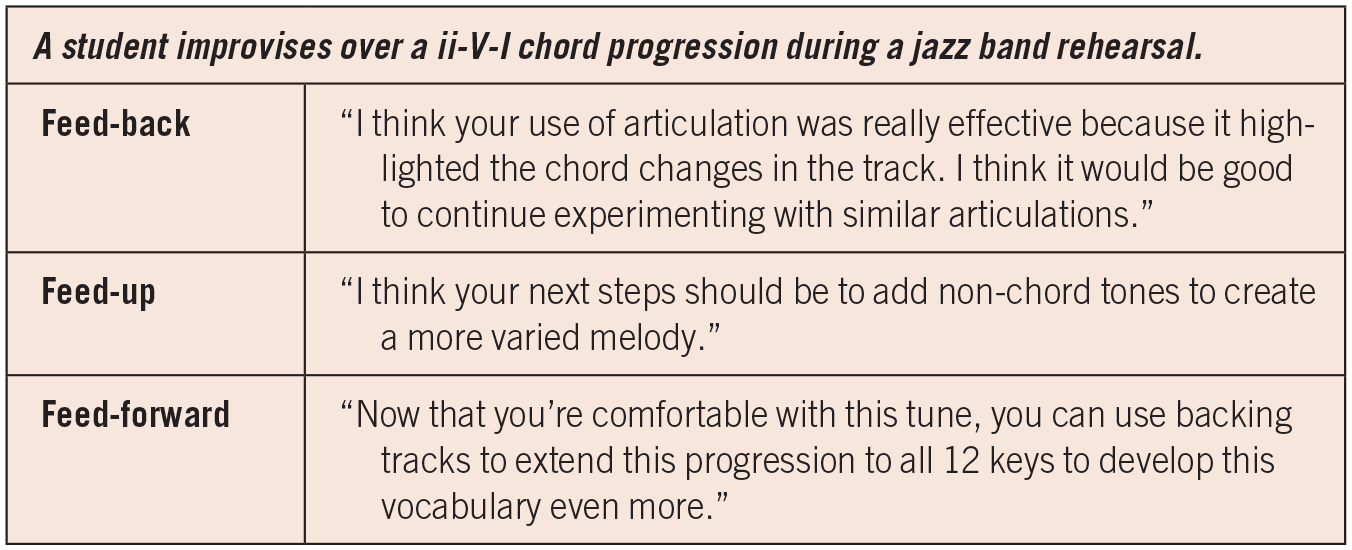
Examples of Feed-Back, Feed-Up, and Feed-Forward
Although it may seem that feed-up and feed-forward seem similar, the important takeaway here is about perspective: Whereas feed-back focuses on what has been accomplished in relationship to past abilities, feed-up and feed-forward are focused on goals, both those that can be accomplished now (feed-up) and those that can be accomplished in the future (feed-forward) when the student is equipped with appropriate strategies for reaching those goals.
Using Feedback to Set Goals
So, if the goal of feed-up and feed-forward is to set goals for student achievement, how can these forms of feedback be used to set goals? One of the most commonly known approaches to goal setting is the SMART goal, which provides a framework for creating a successful goal. The acronym SMART (Specific, Measurable, Achievable, Relevant, and Time-Bound) guides the goal setter with a set of necessary criteria for achieving a goal. 7 Because effective feedback (or feed-forward, as mentioned previously) provides students with strategies to achieve a learning goal, it is important to make sure that the goals targeted comprise all aspects of an effective goal.
In music teaching, it is important to evaluate the musical information provided through activities such as playing tests, discussions, and compositions and then use that assessment to set learning goals for the students.
8
For instance, if a student hands in a draft composition that has met all of the criteria on a provided checklist (e.g., sixteen bars, 4/4, appropriate number of beats in each bar, etc.), then the feedback should acknowledge these successes and then provide new goals for the individual student; this might be to perform the piece on their instrument and to experiment with different interpretations and then add dynamics and articulations to augment the already composed music. The written feedback might look something like this:
This is a great first draft! You’ve achieved all the assigned criteria. What might take this to the next level is adding specific dynamics and articulations. Take a listen to melodies in compositions that you think are effective and then experiment with at least two different dynamic and articulation choices in your own melody that we can discuss in the next class.
In this feedback, the teacher has both acknowledged the student’s successes and provided information on “where to next” (feed-forward), giving the student concrete information on how they can continue to develop their musical ideas.
What Can We Give Feedback about?
There are essentially three broad areas about which we can give or receive feedback: tasks, the processes of learning, and student’s self-regulation. 9 Task feedback involves giving the learner information about how they have performed a specific task, be it a playing test, a theory exam, or a composition. At the task level, feedback is focused on the outcome in the moment and is typically the most common type of feedback that students receive. Task-level feedback might include identifying incorrect fingerings, asking a student to count the beats in a specific measure of a composition (highlighting five beats in a 4/4 bar), or telling them that a chord was spelled incorrectly.
Process feedback refers students to the sequence of learning, including how students can identify problems in their learning and the strategies that are available to them. Feedback on process helps students to develop the skills to be independent learners over time. Process feedback might include identifying issues in a student’s practice strategies or asking how they made decisions about dynamics in a composition.
The process of setting goals and monitoring, assessing, and adapting one’s own learning process as needed is referred to as self-regulation. Self-regulation has been studied in a number of musical contexts, particularly when learning to practice effectively.10–14 Within Hattie’s framework, self-regulation feedback provides students with information about how they are adjusting and adapting as they become more self-regulated over time. 15 This kind of feedback is focused on helping students to be independent and is often sought by learners rather than given by teachers. Guiding questions for self-regulation feedback might include: What learning goals have I achieved in this piece? How can I do a better job of practicing this tricky measure? Self-regulation feedback tends to happen as students become more independent and proficient at musical tasks, so teachers can help prepare them to ask these kinds of questions by providing ample process-level feedback during the learning process (see Figure 2).
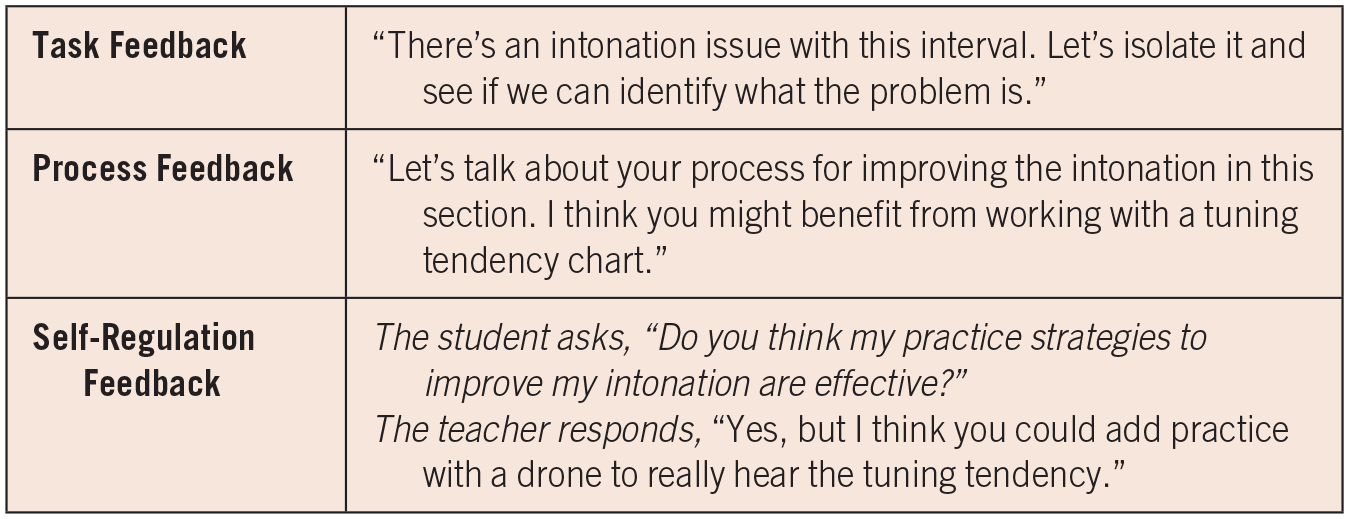
Examples of Task, Process, and Self-Regulation Feedback
Actionable Feedback
No matter what the feedback is addressing (be it task, process, or self- regulation), one of the most important components of feedback in the visible learning framework is that it must be actionable by the person receiving the feedback. 16 Consider again the aforementioned composition feedback, which set a SMART goal for the student. Because this feedback provided both an understanding of the current level of achievement (feed-back) and information about successful models (feed-up) and the next steps (feed-forward), the student knows what actions to take. There is a specific set of tasks to undertake to respond to the feedback and to make progress toward the new goal. Without providing the next steps, the student may not understand how to move from their current level to the desired level or may not have the necessary practice strategies to develop their skills appropriately. For example, if a student is struggling to produce a characteristic tone in their passaggio, non-actionable feedback might be something like “There’s an issue with your tone,” whereas the actionable feedback might be something like “Your tone is inconsistent throughout this part of your range. Let’s review the correct technique to help improve your consistency.”
Timeliness
The timeliness of the feedback is essential to its effectiveness, although teachers should reconsider stopping to provide feedback at every mistake (instead of ending at a sensible stopping point). 17 As a teacher, it is important to ensure that students understand the connection between their performance and the feedback they receive if they are to understand the connection to where the student should be going next. When teachers provide feedback in a timely manner and with time provided to action the feedback, students are able to engage with the information they receive, and teachers are able to provide time for them to become a part of the feedback process. 18 Thus, it is a good idea not to always stop for the mistakes, but teachers should also not backload the feedback in the last portion of a class period when students do not have adequate time to utilize the feedback with teacher support. For example, students need feedback while they are preparing for performance evaluations, not just on the performance evaluation itself; by providing feedback during the learning process, students can take action to improve their playing prior to an assessment.
Feedback Problems and Myths
The Feedback Sandwich
One of the most common misconceptions regarding feedback is the utility of the “feedback sandwich” (e.g., “You have a very nice sound! You need to improve your intonation. I enjoyed your interpretation.”) to help students be receptive to critical feedback. This method has been criticized for inauthenticity and questions of effectiveness19,20 and is often used as a crutch when teachers lack the tools necessary to provide meaningful feedback. Rather than coming up with a positive (or vaguely positive) attribute of student performance, teachers should express critical evaluation such that it does not target students personally but instead articulates an honest appraisal of the performance alongside tools for future learning and improvement. Research has suggested that effective feedback is goal- or task-directed, specific, and neutral 21 ; by approaching feedback as relatively neutral information provided for improvement, rather than criticism, and delivering it in a neutral tone, students view feedback as an opportunity to learn. 22 Consider the intonation example at the beginning of this section. More effective feedback might simply provide an honest but neutral appraisal: “The intonation in this performance did not account for the tuning tendencies of different notes on the instrument but could be improved by playing this section slowly with a tuner.”
Some “Feedback” Is Not Feedback
Although it is often said without thinking, “good” after cutting the group off is not meaningful feedback. Hattie argues that comments must be actionable to serve as feedback, meaning that if the student does not have something to do in response to the “feedback,” it is not feedback at all. 23 Although “good” certainly fits the bill of “information” provided to students, simply saying “good” after a run-through does not provide students with useful, actionable information. Consider what was good and what could be improved or adjusted. Without providing specifics to the student, “good” simply dilutes the relevant feedback teachers provide and serves as filler language that is likely ignored by students. Think of what could be said instead to serve the desired purpose. If filler language is truly what is desired, consider, “thank you” as a way of acknowledging the work students have put forth, without providing evaluative feedback. Or if a compliment on the performance is warranted, consider being more specific as to ground students’ understanding of what exactly was “good” and against what past achievement or possible future benchmarks the evaluation is based.
More Is Not Always Better
At the end of a music class, a teacher might easily believe they have been effective in communicating learning information to their students because they have provided constant feedback. However, teachers have to consider the issue of cognitive overload, in which the student receives so much information that they cannot process it in a meaningful way. 24 Although providing information on student achievement is an important educational goal, it is important to provide feedback that specifically assists in making learning (or misunderstandings) visible to the student. Nonessential feedback may dilute the power of the necessary feedback provided to students, distracting them from what is most important. For example, although dynamics are important, if the goal of the lesson is to have students listen and adjust pitch to play in tune as an ensemble, the information about successful or unsuccessful dynamic changes may overshadow the important feedback the teacher provides on intonation. Additionally, Hattie 25 argues that although teachers may believe they have given feedback, the better metric is how that feedback is received.
How Feedback Is Received
As University of Texas at Austin Music Professor Robert Duke highlights in his book, Intelligent Music Teaching, 26 feedback can function differently for learners than it was intended by the person giving the feedback. For educators, this means that if there is not a way to see how the student understands or uses the feedback, it is virtually impossible to know if the feedback has the desired effect. Checks for understanding of feedback might include observing the student using the feedback right away, asking a question that assesses their understanding, or providing a transfer task that puts the feedback to use in a new context. There are also several important factors to consider in how teacher-to-student feedback is delivered. For instance, although the feedback sandwich may not be the healthiest option, teachers would benefit from considering how often they provide criticism compared with support of successful performance. If students receive only information they perceive as criticism or only compliments, it may temper the way in which they interpret the information they receive, resulting in either ignoring or being surprised by later changes. This relates to issues of trust and classroom climate because although pure praise is ineffective as feedback, 27 if the students believe they are being harshly judged by a teacher they feel is unfair, they are less willing to accept feedback. 28 Also, consider the wording of the feedback provided and what the possible and probable interpretations might be; based on their individual experiences and associations with the words used, students may interpret the information differently than intended. For instance, consider the word “fine.” Depending on the context, this word might mean good, so-so, or of high quality; when students hear that they did a “fine job” at some aspect of performance, they may not understand it the way it was meant, and therefore, consideration must be taken about word choice and tone of delivery.
Person Feedback
Additionally, it is important to consider the perceived object of feedback. 29 All too often, the way that feedback is phrased does not target the learning or the task being attempted but instead targets the person. Consider two siblings building a sandcastle at the beach: One sibling does not use enough water to hold the sand together, and consequently his tower does not hold shape. The other sibling says to him, “You’re not good at building sandcastles.” This feedback is related to the task, but it is not about the task; it is about the person doing it. As such, no useful information is conveyed about how to improve, and they likely feel badly about the situation because their sibling targeted them with a personal judgment. These types of comments, which target the learner personally rather than the way in which the task is accomplished, are considerably less valuable or effective than feedback that provides information to correct mistakes and address skill development. 30 Feedback that is both supportive and about the task could be better phrased, “Try using more water in your sandcastle. It might help the shape stay together.” In this scenario, the sibling knows what went wrong and what adjustment is needed without a negative evaluation placed on their abilities and, therefore, is better able to accept and implement the feedback. Similarly in music, if a teacher suggests that a section is “not good” at high notes or vibrato, the students are less likely to understand the necessary steps to improve, instead developing a negative self-view based on the comments. The more effective feedback emphasizes what the specific challenges there are for the technique and how to overcome these challenges; for instance, “The high notes are flat. Try crescendoing and focusing your air to hit these notes more effectively.”
Note that there is often confusion between feedback and praise, but it is important to remember that praise is not feedback if it does not include actionable information or if it is directed at the learner as a person. Although learners tend to enjoy and seek praise, 31 praise is rarely a means for improving learning. So, although praise can be important for developing rapport with students, it is not feedback, and positive feedback must provide direction for student learning. 32
Strategies for Teachers
Use Student-Friendly Language
As musicians trained in Western music through university music traditions, sometimes the vocabulary that we use can mystify music students of all levels. Using student-friendly language levels the playing field and allows students to use the feedback we provide meaningfully. 33 Consider how a young student might respond to the following: “This section was weak. Play it more like a romantic opera!” versus “The dynamics and articulation were too subtle in this section. Let’s play louder, with more front on the notes.”
The first example was both vague in the assessment and relied on knowledge of nineteenth-century opera composers to convey the point. Although there is value in explaining this era of music to students, if the groundwork is not there, then students are left guessing at what the teacher means. Comparatively, the second iteration conveys the same essential knowledge (or at least one interpretation of it) but is specific and uses the words that a young player might have heard before.
Always Think Action
As mentioned previously, effective feedback lets students know what to do with the information they receive on their performance. 34 It is essential that teachers’ feedback be action-oriented and provide students with a clear roadmap to achieve their learning goals. The difference between “These notes are out of tune, and you need to fix it” and “These notes are out of tune. Refer back to your tuning tendency chart and alternate fingerings to find ways to adjust the pitch” is enormous. Teachers can use feedback to help students to develop a repertoire of effective strategies to employ when problems arise, which will support their musicianship and allow them to problem solve in their own practice.
Provide Room for Student Feedback
As we mentioned in our opening, feedback is most effective when students are engaged in a dialogue about their learning, and teachers are not always the most effective source of feedback. This means providing space for students to respond to feedback to clarify or perhaps to provide feedback about the way that the teacher is providing feedback so that the group is able to move together toward the learning target more efficiently, which Hattie calls student-to-teacher feedback. 35 For example, establishing a classroom culture where students know that questions are welcomed allows them to identify when they are confused about an idea, which provides the teacher with feedback about their teaching, about the clarity of their instructions, or about where they might add additional instructional support to make ideas clearer. It also might mean providing opportunities for students to provide thoughtful feedback to their peers, adding additional perspectives to the learning process. For instance, teachers might design formative check-ins in which students provide peer feedback in advance of a summative assessment. 36 Creating an environment in which students feel comfortable seeking clarification, expressing their opinions or understanding, and asking questions is vital in being able to provide feedback that students receive and feel comfortable actioning both inside and outside of the classroom.
Revisiting Feedback in the Music Classroom
Reflecting on these strategies, let us now return to our opening scene:
“Thank you,” the teacher tells my section after a successful run-through of measures twenty-five to forty-eight. Continuing, she says, “Good job getting down all the notes and rhythms. For the next rehearsal, let’s add in the dynamics. The reference recordings do an excellent job of making good dynamic contrasts. Take a listen to the recording and then practice making a big difference between the piano and forte.” The next section performs, and the teacher says, “There are still several wrong notes in this passage. When you’re practicing at home this week, start slow and steadily increase the tempo to build the technique. I’ll take another listen next rehearsal to check in on our progress. Does anyone have a question?” A student asks what else they can do other than playing slowly because they’ve tried that and haven’t improved as much as they would like. The teacher says, “Try chunking the passage into smaller sections to practice before putting it all together. Does that make sense? [Student nods.] Now, let’s all begin at measure forty-nine.” The teacher writes the goals for each section on the board, and then we continue rehearsal. When it is time to leave, our teacher says, “Next class, we will be putting measures twenty-five to forty-eight together as an ensemble. Your practice plan should include the work that we’ve discussed, which you can copy from the board.” When I arrive home, my mother asks me about my day and specifically, “How did your performance quiz go? Is there anything specific you need to work on this week?” Thinking for a moment, I reply, “It went really well! Next week, we’re adding in the dynamics. I’m going to go listen to the piece in my room and then practice for a little while before dinner.” I write out my plan and then start practicing.
Footnotes

Notes
Nicholas Matherne (