




Abstract
Leopard attacks on human beings is common in Uttarakhand which is an area of national conservation. The objective of this study is to examine the pattern of injuries and circumstances to encourage ways of reducing such conflicts. There were eight deaths from leopard attacks brought for autopsy to the mortuary between January 2019 and August 2020. Incidents occurred mostly in a forest close to human settlements. One tourist was among the male victims, the remainder of whom were women carrying out household duties near the forest. Leopard attack injuries present in the head and neck were ante-mortem, with abdomen, buttocks and limbs post-mortem. People living at the border of protected areas need alternative means of support to enable them to avoid using forest resources, tourists must be warned to avoid wandering in the area.
Introduction
Human–wildlife conflicts are not uncommon. They are aggravated by the fragmentation and loss of animal habitat area due to the development of or reduction in size of protected areas. Uttarakhand is known for its conservation of rare and endangered animal species, including the common leopard (Panthera pardus), tiger (Panthera tigris) and the Asian elephant (Elephas maximus). Leopards and elephants have been reported as causing extensive loss of lives and properties in India in the last few decades. 1 Even though leopard attacks are common in this area of national conservation, reports on autopsy studies are not. Our study was conducted to examine the pattern of injuries and circumstances with a view to introduce better strategies to reduce human–animal conflict.
Materials and methods
The study was conducted in the Department of Forensic Medicine and Toxicology, AIIMS Rishikesh, Uttarakhand, India, to look at the data of eight leopard attack victims between January 2019 and August 2020. Autopsies followed standard procedures. Other details were collected from inquest reports, family members and eyewitnesses. Data obtained from observations presented in the study were approved by the institutional ethics committee of All India Institute of Medical Sciences, Rishikesh.
Observations
The age (years), sex (M – male, F – female), locality (domicile), month and predator information of the victims in the study are presented in Table 1.
General and predator information.
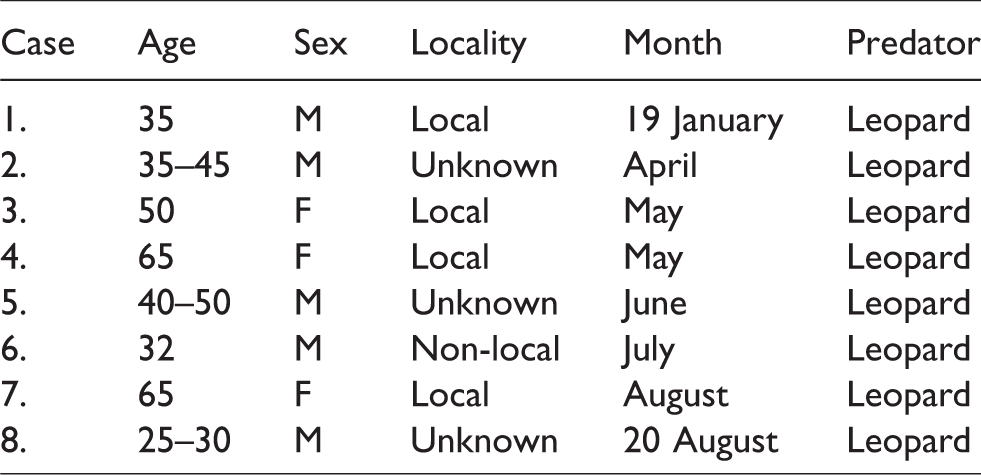
Out of eight victims three were female and five male. Most incidents occurred near forest areas close to human dwellings. The women were attacked when going into the nearby forest to collect household materials between 9 am and 11 am. The time the male victims (two mentally disturbed beggars, a tourist, a local pujari and one who was unidentified) were attacked was unknown. Injuries suffered were abrasions, lacerations, puncture wounds and fractures noted on the bodies. Lacerations and puncture wounds in the head and neck were ante-mortem with extensive injuries of neck tissues including torn muscles (eight cases), jugular-carotid vessels (five cases), trachea and oesophagus (three cases) and fractures of cervical spines (one case). Injuries with missing bulk of soft tissues exposing bones present in abdomen, buttocks and limbs were inflicted post-mortem. In one case, there was a missing left hand, toes and bulk of soft tissues from limbs exposing the bones with no neck injury.
Discussion
The leopard is considered the most powerful cat next to the jaguar when comparing its size, and a more skilful hunter than lions and cheetahs. 2 It often kills more than it needs to satisfy hunger. 2 Mostly, it strikes at the nape or side of the neck of its victims and kills very quickly. 3 The sturdy canines of the leopard can penetrate deep, including osseous tissue. The proprioceptors present in teeth and jaws make them sense its contact with osseous tissue that helps adjust position and grip intensity during bites. 4 The leopard is the most adaptive of cats and can occupy a diverse range of habitat, from unspoiled protected forest to the edges of towns and villages. 5 This adaptability created an overlap of shared space with humans. It has increased conflicts near human settlement where agricultural land has been converted into secondary forests for conservation purposes in this region where people follow traditional gender roles with women typically involved with farming and domestic duties. Therefore, women from the families frequently go into the forest to collect fodder for their animals or firewood which makes them vulnerable to leopard attack as happened here. Nabi et al. 6 found extensive injuries in the head and neck tissues, comparable with this study. The nature and types of injury we noted indicate that the attack was predatory with the animal first attacking the head and neck area to kill or incapacitate its victim before extracting a lump of flesh to feed on from the area where soft tissues are abundant. The absence of injury in the head and neck area suggests that the victim lost consciousness after an unexpected confrontation. These findings also indicate that the leopard started extracting the soft flesh to feed on after completely incapacitating its prey. The non-fatal nature of attacks in other regions on humans tends to suggest defensive rather than predatory behaviour. 7 The leopard normally feeds on other animals, not human beings. 8 Once it tastes human flesh, it may show an exclusive preference for this. 9
As the region is famous for spiritual pilgrimages, nature and wildlife, tourists visit throughout the year, as did the beggars who depended on hand-outs. While the young non-local tourist was careless or unaware he could be at risk, the mentally disturbed beggars roaming around alone left themselves exposed as targets.
The research has limitations, as the cases in this study were only from the under-jurisdiction area of the region, with mentally disordered beggars being two of the victims.
Conclusion
The conservation of endangered megafauna is at the cost of human lives in this region where people live on the edges of protected areas. Those who lost lands and livelihood to such schemes need to be rehabilitated and supported by the distribution of alternate fodder and fuel without the need to enter the forest. Women's economic liberty would boost a family's income and prevent them from attacks. As the region is famous as a wildlife tourist destination, an effective and dedicated warning network is needed to provide information about the dangers to tourists who expose themselves to confrontations with animals and would prevent such incidents.
Footnotes
Authors’ contribution
All authors have contributed to, mutually discussed, read the various drafts and agreed to the final submitted version.
Declaration of conflicting interests
The author(s) declared no potential conflicts of interest with respect to the research, authorship, and/or publication of this article.
Funding
The author(s) received no financial support for the research, authorship, and/or publication of this article.