




Abstract
Psychopathy has been empirically associated with various forms of antisocial behavior including sexual assault. In fact, the lack of empathy characterizing psychopathic offenders may facilitate the perpetration of more extreme violence. This systematic review aims to explore the relationship between psychopathy traits in male adult sex offenders and the increase in recidivism risk for any type of reoffence, with a special focus on sexual recidivism. From an initial sample of 757 articles related to the topic, only 14 were selected from the current literature at the end of the inclusion process. Each of these assessed the relation between psychopathy traits (measured by PCL-R) and recidivism risk in male sex offenders (age > 18), providing an effect size (quantitative findings). The results of their analysis agree with the currently available literature: the presence of psychopathic traits in sex offenders would seem to correlate with an increased risk of recidivism of general but non-sexual. Furthermore, almost half of the included works highlighted a positive relationship between psychopathy and violent reoffences. However, the limited availability of studies and the unevenness in their results indicate the need to expand future research in this direction.
Introduction
The correlation between personality traits and social dangerousness still represents a salient topic in modern crim inology and the line between stigma and evidence is often unclear. Considerable research has been conducted to identify factors that predict overall criminal recidivism. 1 Personality disorders or deviant sexual preferences seem useful for long-term risk assessment and are critical for assessing lasting changes (e.g. treatment outcome); furthermore PCL-R scores, particularly combined with a measure of sexual deviance, are potentially relevant to sex re-offender risk. 2 Our systematic review fits into this panorama to explore the relationship between psychopathic traits in male adult sex offenders and the increase in recidivism risk.
Psychopathy has been empirically associated with various forms of antisocial behavior, the most serious of which result in crimes of homicide (e.g. sexual, serial, and mass murder), sexual assault, kidnapping, and other forms of predatory criminal behavior. 3 From an exhaustive study conducted by Robertson and Knight, 4 it can be inferred that PCL-R facets correlate with different aspects of violence; specifically while non-sexual violence correlates primarily with the Antisocial facet and secondarily with the Interpersonal and Impulsiveness facets, sexual violence correlates only with the Affective facet. Otherwise, a study by Sohn et al. 5 found that Affective facet showed the strongest effect size (Cohen's d = 0.53; percent change in odds = 22.6%) in predicting violent recidivism.
Psychopathic offenders exhibit a profound lack of empathy, which may facilitate the perpetration of more extreme violence against the victim. In addition, thrill-seeking seems to be an important motivation for criminal behavior (including sexual offending) in psychopathic offenders. Some research 6 has highlighted how caregivers’ relational failure in the attachment system is closely related to the dysfunctional transmission of basic interpersonal self-regulation skills to the child, which in turn may represent a risk factor for the manifestation, once he becomes an adult, of problems in the expression of affectivity, aggression, fantasies, and sexuality, as can be observed in many cases of psychopathy, sadism, or paraphilia. 7 A study by Gregory et al. 8 shows that in psychopathic individuals there is a difficulty in learning from punishment, which is the reason why a psychopath may not be able to benefit from a rehabilitation program. According to these authors, psychopathic violent offenders have abnormalities in the areas of the brain related to learning behavior that will lead to punishment, this would lead to the inability to succeed in learning from the experience resulting in the risk of that maladaptive behavior being re- enacted. The body of literature on psychopathy treatment has found that psychopathic offenders often respond poorly to treatment, exhibit low motivation, show little improvement, and have high rates of attrition.9–11 Results indicate that treatment of adults shows low to moderate success, while treatment of young people appears to be more promising. 12 Hobson et al. 9 also found that the interpersonal and affective characteristics of psychopathy (i.e. Factor 1) are particularly associated with behaviors that interfere with treatment. Some research has even suggested that inappropriate treatment approaches may hurt psychopathic offenders. 13 A study by Langton et al. 14 found that among sex offenders with PCL-R scores of 25 or higher, those with ratings reflecting a more negative response to treatment relapsed sexually more quickly than others.
In light of these considerations and through a systematic review of the current literature, our purpose was trying to answer the following question: does the presence of psychopathic traits in adult male sex offenders increase the risk of any type of re-offence? Furthermore, can psychopathy be considered a good predictor of sexual recidivism?
Method
Identifying studies for the systematic review
The literature search was conducted in PubMed and Scopus databases, independently by the authors G.M. and M.C. Different keywords were used to capture as many studies as possible: ((“Psychopath*”) OR (“PCL-R”)) AND ((“rapist”)) OR (“sexual violence”) OR (“predator”) OR (“sexual recidivism”) AND (“risk assessment”). As of 9 March 2022, these searches yielded a total of 757 articles. After duplicate records that appeared in both databases were removed from the list, 718 articles remained. Reports that mentioned women or adolescents or a sample of psychiatric patients in the title were excluded before screening.
The authors G.M. and D.F. read separately (330 G.M.; 280 D.F.) the abstracts of all 610 remaining articles. Of these, 546 studies were excluded (e.g. for the presence of women or minors in the sample or to have different purposes compared to our work) while 64 articles were deemed eligible for full-text review. The authors G.M., L.A., D.F. analyzed them to define the final inclusion. Each author read every article independently, agreeing on the inclusion/exclusion decision except in two cases (articles with poor/defective sample definitions). These disagreements were resolved by discussion with the authors M.C. and E.F., who decided to exclude the two papers mentioned above. So, at the end of the including process, 14 studies were selected.
Figure 1 summarizes the full inclusion process of studies. 15
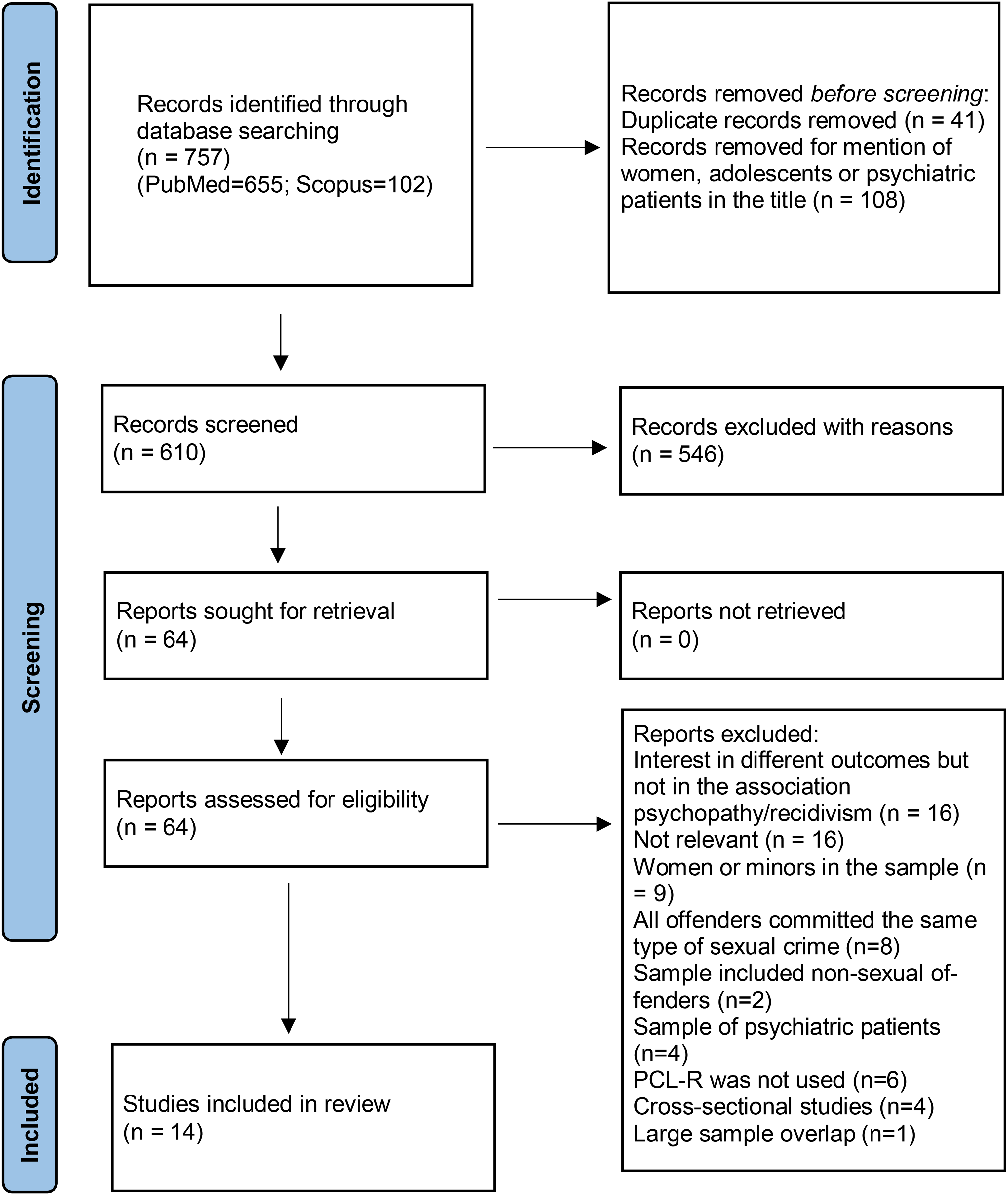
PRISMA 2020 flow diagram.
Determining eligibility
Each study included in this review assessed the relation between psychopathic traits (measured by PCL-R) and recidivism risk in male sex offenders.
The term “sex offender” is used in this paper to indicate any person who has at least committed a crime of sexual nature during his life.
Only studies conducted on male adult sex offenders, age >18, were included.
Studies in which psychopathy was measured in offenders with mental retardation were excluded. In order to ana lyze comparable results, only longitudinal studies, conducted on a general population of treated male sex offenders, who had committed heterogeneous types of crimes, were included.
The STROBE Statement checklist was used to assess the quality of each study. This checklist consists of 22 items that should be included in cohort studies.
As reported in the literature, some categories of sex offenders (e.g. rapists) show a higher rate of recidivism than others (e.g. pedophiles). For this reason, to compare similar samples, studies that analyzed a particular subtype of sex offenders (e.g. exclusively pedophiles) were excluded. Since we were interested in considering the general population as a sample, studies conducted on a specific group of psychiatric patients (with a diagnosis of schizo phrenia, bipolar disorder, major depression, ADHD, PTSD, substance/alcohol abuse, and other personality disor ders) were excluded. Comorbidities between psychopathy and mental illness/other personality disorders in the general population nevertheless are possible and did not represent an exclusion criterion in this review.
At the end of the including process, only studies that have provided quantitative findings (p-value) were included: case studies, reviews of existing research, qualitative research, and dissertations were excluded.
Results
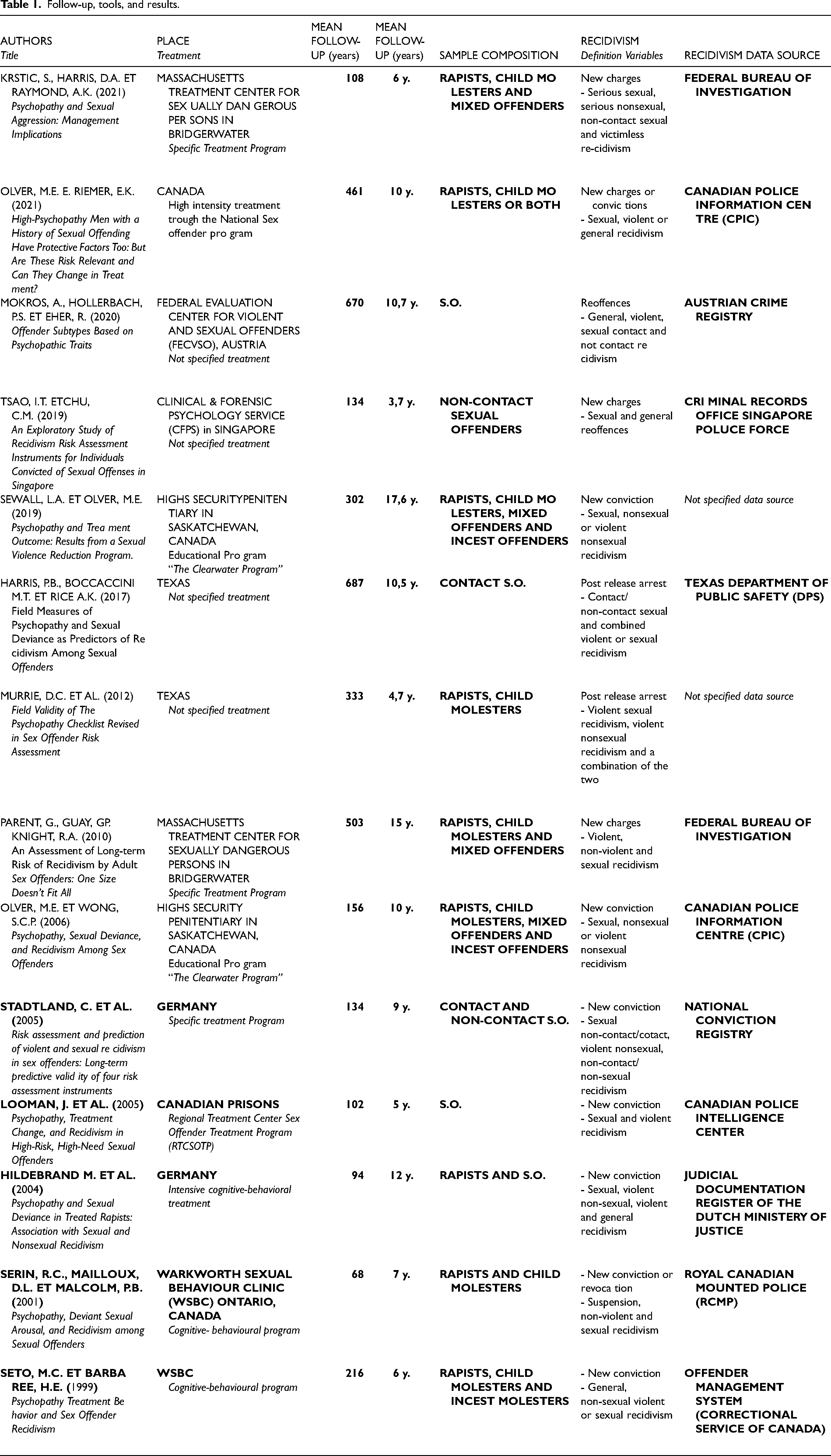
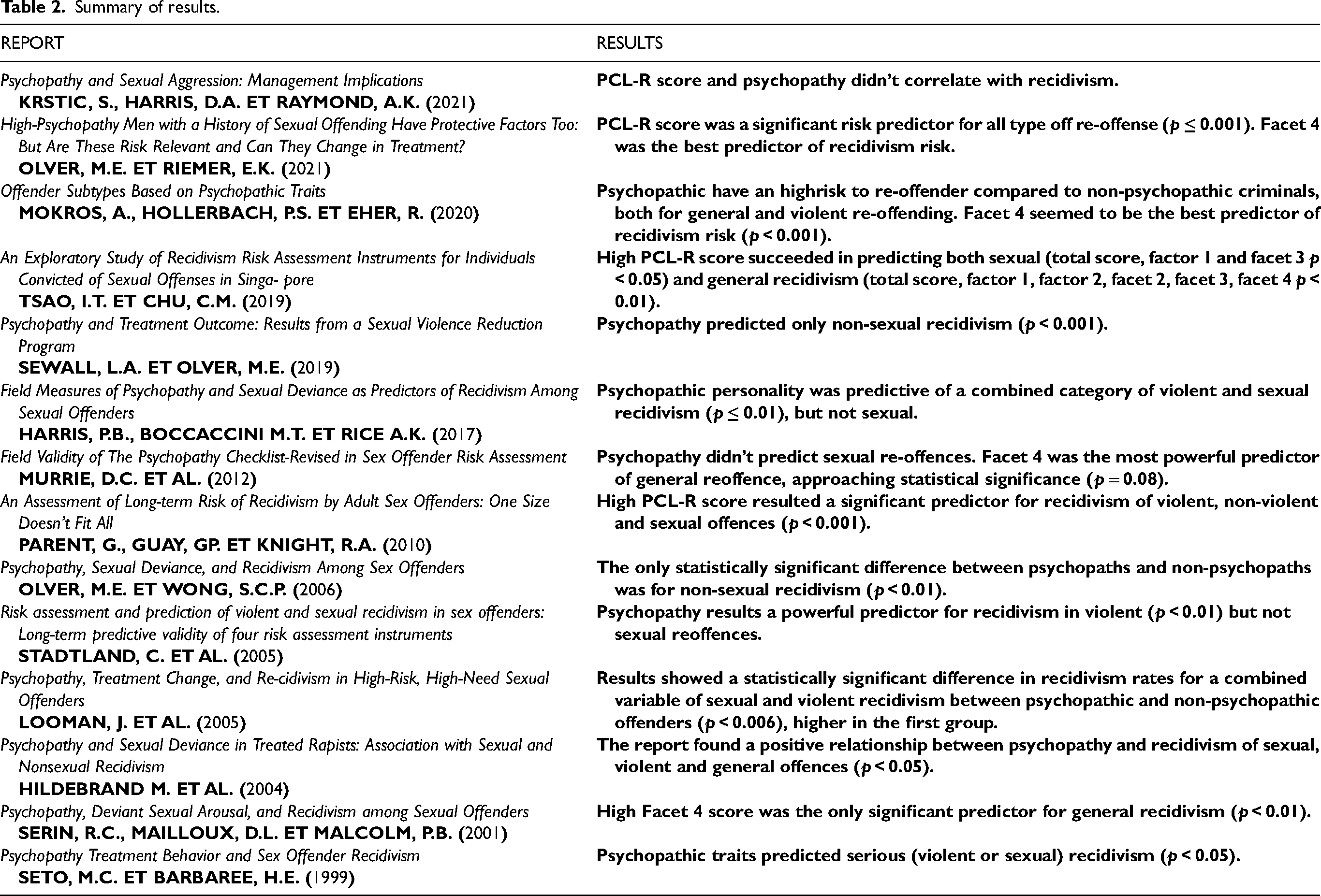
Additional information about follow-up, tools, and results are summarized in Table 1. A summary of the results is available in Table 2.
Follow-up, tools, and results.
Summary of results.
In all studies:
psychopathic traits were assessed by PCL-R subjects underwent re-educational or cognitive-behavioral treatment samples were retrospectively or prospectively followed-up after release to determine recidivism rates recidivism data (defined according to the cases as any new arrest, conviction, instance or charge) were obtained from official regional or national sources (e.g. criminal records office). the STROBE checklist for longitudinal cohort studies was followed.
From the studies included in the review it was possible to find a correlation between psychopathy and recidivism, in response to the research question.
The results can be summarized as follows: psychopathy can be considered a good predictor of general but not sexual recidivism. Specifically, facet 4 was found to be the best predictor of general recidivism in four out of the total studies.16–19 Furthermore, most of the included works highlighted a positive relationship between psychopathic traits and violent reoffences.19–24
Five papers aimed to examine the validity of risk assessment instruments in predicting recidivism. In the study conducted between 1959 and 1984 by Parent et al., 21 psychopathy was significantly associated with the recurrence of violent, non-violent, and sexual crime (p < 0.001).
Surprisingly, in a subsequent work conducted on subjects involved in the same program, 25 a statistically signif icant correlation between psychopathy and recidivism (of any type) was not shown.
In the third study conducted by Tsao et al., 26 high PCL-R scores predicted both sexual (total score, factor 1 and facet 3 p < 0.05) and general recidivism (total score, factor 1, factor 2, facet 2, facet 3, facet 4 p < 0.01). Murrie et al. 16 found that PCL-R score was not a statistically significant predictor of sexual recidivism. Facet 4 (Antisocial) was the most powerful predictor for reiteration of general criminal behavior, approaching statistical significance (p = 0.08).
In the last paper considered, Stadtland et al. 22 showed that psychopathic traits could predict recidivism in vio lent (p < 0.01) but not sexual reoffences.
Four works had the purpose to evaluate the influence of a specific treatment on recidivism risk. In the study by Sewall and Olver 27 completion of treatment was shown to be a protective factor against recidivism among both psychopaths and non-psychopaths.
There was no statistically significant difference between psychopaths and non-psychopaths for the recurrence of sexual offenses. Instead, the difference between the two groups was statistically significant for recidivism in non- sexual offenses (p < 0.001). Also, in the results obtained by Olver and Wong, 28 PCL-R total score and Factor 2 were statistically significant measures in predicting non-sexual recidivism risk (p < 0.01).
In the study conducted by Looman et al., 23 the analysis of the results revealed a statistically significant difference (p < 0.006) in the recidivism rates in a combined variable of sexual and violent recidivism between psychopathic and non-psychopathic criminals (highest in the first group). The reduction in the level of risk between pre- and post-treatment was assessed through indexed scales (VRAG and STATIC-99) and has been identified as a protective factor for relapse among psychopaths. Lastly, Seto and Barbaree 29 only found a correlation between high PCL-R scores and serious (violent or sexual) re-offenses (p < 0.05).
Three studies had the aim to evaluate the association between psychopathy and sexual deviance with recidivism risk.
According to the results of the work done by Harris et al., 20 psychopathic traits predicted a combined category of violent or sexual recidivism (p ≤ 0.01), but not sexual re-offenses. Paraphilia and the characteristics of the crime were not associated with a higher risk of recidivism. Surprisingly, the combination of psychopathy and a high level of sexual deviance (number of sexual offenses committed) was statistically associated with a reduction (not an increase) in the recidivism risk.
In the study conducted by Hildebrand et al., 24 between 1975 and 1996, a positive relationship between psychopathy and re-offense for sexual, violent, and general crimes (p < 0.05) was found. A statistically significant correlation was highlighted between total PCL-R score and factor 1 and recurrence of sexual offenses and between total PCL-R score and factor 2 and non-sexual and violent recidivism. Furthermore, subjects showing the coexistence of psychopathy and sexual deviation re-offended more frequently and earlier than psychopaths without sexual deviations and non-psychopathic criminals with/without sexual deviations.
Previously, Serin et al. 17 found that the only statistically relevant factor associated with the risk of re-offense was Facet 4 score (p < 0.01). Sexual offenders with a higher level of sexual deviance and psychopathic traits had a greater risk of general recidivism than non-psychopaths with low sexual deviance.
Two studies had different aims than those listed above, therefore they will be discussed separately.
Olver and Riemer published a follow-up study 18 aimed to examine the association of psychopathy and protective factors to recidivism. The protective factors investigated were 17 including secure attachment in childhood, intimate relationships, financial management and life goals. High PCL-R scores were associated with the re-offense of all types of crime (p ≤ 0.001). Facet 4 (antisocial) was the most important predictor of recidivism. Despite this, psychopaths with multiple protective factors (measured by SAPROF: Structured assessment of protective factors for the risk of violence) did not show an increased risk of recidivism compared to non-psychopathic subjects.
Mokros et al. 19 determined whether dividing psychopathic offenders into subgroups (based on the PCL-R score) provided additional information on the risk of recidivism. All psychopathic subgroups have a high risk to re-offend compared to non-psychopathic criminals, both for general and violent re-offending. According to the results, Facet 4 (Antisocial) seemed to be the best predictor of recidivism risk (p < 0.001).
Discussion
Most of the findings emerged from our review point in one direction: it appears that psychopathic individuals, who have committed at least one sexual offense in their lives, are more prone to general or violent recidivism than non-psychopathic offenders.18–24,26 Although there is no unanimous agreement on the results analyzed,18,21,24,26 an elevated PCL-R score, which correlates with the presence of psychopathic traits, would not instead appear to be significantly associated with the risk of sexual recidivism, being a poor predictor of the same.
A bias to consider is inherent in the concept of the “dark number”: for multiple reasons, including many related to judgment and social stigma (of both the abuser and the victim), the number of individuals who sexually offend or sexually re-offend is not truly known. As suggested in the literature to predict the risk of sexual recidivism it might be useful to combine the measurement of psychopathy with that of sexual deviance. 2 However, even concerning this aspect, discordant results emerge from the studies we analyzed: while the association between psychopathy and sexual deviance was found to be predictive of recidivism in the studies conducted by Hildebrand et al. 24 and Serin et al. 17 it was surprisingly correlated with a reduction in risk in the study of Harris et al.. 20 This suggests the need to investigate this further in subsequent studies. In the results found by Kristic et al., 25 the presence of elevated psychopathic traits did not correlate with recidivism of any type of crime; in the study conducted by Seto and Barbaree, 29 psychopathy seemed instead to correlate more with the severity of recidivism (violent or sexual) than with recidivism itself. At last, the authors Olver, Wong, and Sewall27,28 found a positive relationship only between psychopathy and non-sexual recidivism. The inhomogeneity of these results could depend on the different sample sizes, the choice of the authors to use a PCL-R cut-off for the diagnosis of psychopathy of 25 or 30, the type of treatment received during incarceration and the duration of follow-up.
A very poor conviction rate has been found for some offenses as well as a very low base rate for sexual offending on making assessments, which are findings that could be explored in future research. Another open question con cerns the impact of having a high PCL-R score on likelihood of identification (e.g. assessing whether subjects with high scores likely to be more closely monitored). In this regard, a further criterion that could have limited the results of the present review is the choice to consider studies having used only the Psychopathy Checklist Revised, which would seem to measure one of the most explanatory and generalizable risk factors identified to date, but which is also less suitable as a specialized risk instrument, for the assessment of which the use of Level of Service Inventory-Revised is indicated more appropriately as highlighted by Hemphill and Hare. 30 In fact, in their study PCL-R seems to be more useful in helping to identify low-risk offenders while LSI-R is more accurate in identifying high-risk offenders. As reported in the current literature,31–34 the risk of general violent recidivism appears to be greater in rapists than in other sex offenders. In several studies16–19 a corre lation emerged between Facet 4 (Antisocial) score, part of Factor 2, and the risk of recidivism of violent or general crime. Factor 2 is commonly associated with a deviant lifestyle, mainly characterized by poor behavioral control, promiscuity in sexual behavior, impulsiveness, and irresponsibility; Facet 4 concerns the sphere of antisociality, which would prevent the individual to adapt to the ethical and behavioral standards of his socio-cultural commu nity of belonging. These findings corroborate with the current scientific literature, specifically with a relevant study conducted by Robertson and Knight, 4 in which non-sexual violence seems to correlate primarily with Facet 4, while sexual violence correlates only with Facet 2. Contrary to our results, in which this correlation was not found, recent study 5 found that Affective facet showed the strongest effect size (Cohen's d = 0.53; percent change in odds = 22.6%) in predicting violent recidivism.
Martin Hildebrand et al.’s 24 study has also highlighted a correlation between PCL-R total score, Factor 1, and the presence of recidivism of sex crimes. Factor 1 reflects several emotional and interpersonal characteristics considered fundamental in psychopathy, such as the lack of empathy, which leads psychopaths to be unable to empathize with others and analyzes another nuclear characteristic that is the absence of guilt. This association could be further investigated in future studies because it seems that subjects with higher scores of Factor 1 are more prone to commit violence with extreme coldness and rationality, such as sexual abuse of the victim, without feeling remorse, which would help to reflect on what was inflicted on the victim and learn, so, from their experi ences.
Considering the results and the heterogeneity of the associations between personality characteristics and type of recidivism, it is possible to hypothesize that the basis of these differences may be the influence of some protective factors. Olver and Riemer 18 investigated the presence of 17 protective factors in psychopaths relating to socio-economic status (e.g. employment, financial management) and interpersonal relationships (e.g. intimate relation ships, social network). According to their results, psychopaths with multiple protective factors did not show an increased risk of recidivism compared to non-psychopathic subjects.
Likewise, in the study conducted by Leung et al., 35 some variables were identified in psychopathic individuals with a sex offender history that served as protective factors (e.g. being older at the time of release, fewer offenses committed, and being married) for recidivism of a serious offense. These findings suggest that despite the high risk of recidivism among psychopaths, these individuals have also positive variables that can be worked on and improved, such as during an individualized re-education intervention or by offering stable support and resources. Moreover, after release, the subject's reintegration into society should be encouraged from a working and economic perspective.
Limitations
Some limitations of this study bear mentioning. First, these findings are not globally generalizable since the papers considered come mainly from North America, Canada, and Europe, hardly any studies from Asia, except for one study from Singapore (this is due to limited availability of Asian studies in the current literature). In this regard, another aspect to highlight is the choice to include only studies where the subjects had committed sexual offenses of heterogeneous type: the results could change if a specific subtype of sex offenders was analyzed (e.g. only rapists or only pedophiles). Moreover, the inclusion of studies that used a different cut-off for the assessment of psychopathy and not having discriminated the sample by type of treatment received (re-educational or cognitive- behavioral), together with the partial overlap of the sample in some of the studies analyzed, represent the main limitations of our review. A further limitation to underline is the use of different definitions of recidivism (e.g. any new charge or new conviction) by the authors because sexual recidivism rates can change considerably when the criterion is defined differently. In addition, a meta-analysis study should be performed to determine the statistical significance of these results. Another criterion that may have limited the results is the choice to consider studies that have used only the Checklist-Revised on psychopathy, optimal for the generalized risk assessment identified but less suitable as a specialized risk assessment tool.
Conclusion
The decision to conduct a systematic review of the literature allowed the authors to report and compare the most recent and relevant studies with respect to the topic of interest, enabling the reader to have a clear and summarized idea of the current scientific findings on the subject. Defining psychopathy and its correlation with the risk of crime and recidivism is still an open challenge for modern criminology. The results of this review agree with the currently available literature: the presence of psychopathic traits in sex offenders would seem to correlate with an increased risk of recidivism of general but non-sexual offenses. Furthermore, considering the general risk of recidivism a positive relationship between psychopathy and violence behaviors seems to be confirmed by our findings. In fact, almost half of the included works highlighted a positive relationship between psychopathic traits and violent reoffences.19–24 Specifically, Facet 4 (Antisocial) appeared to be the best predictor of violent recidivism. This should be considered in both clinical and forensic practice whenever a high score in the Antisocial Facet is found during the administration of the PCL-R.
The results of this study provide new insights into the ways in which psychopathy correlates with a higher rate of general and/or sexual recidivism. Indeed, although our findings confirmed what has been established in most available studies, on the other hand, made it possible to speculate that underlying the discrepancies emerged might be the influence of certain protective factors18,35 such as socio-economic status, interpersonal rela tionships, or sex offender history. In our opinion, this represents an interesting starting point for future studies. Our work was based on reading and comparing the 14 most relevant studies on the topic of interest, which were also found to meet the scientific quality criteria of the STROBE Statement Checklist. This contribution provides the current state of the literature with a systematic synthesis of the most relevant scientific findings. In addition, it was decided to provide the reader with as many elements as possible for a better understanding of the conflict ing findings as well as insights that could be translated into the object of future research. These reflections are the product of comparing our work with further works on the subject, which, although not part of the sample of studies included, have been equally viewed and reported.
The limited availability of studies and the unevenness in their results indicate the need to expand future research in this direction. Future studies should move towards making the results generalizable, thus considering studies from other countries in order to make the sample as representative of the population as possible. It might possibly be helpful to analyze specific subcategories of sex offenders (e.g. only rapists or only pedophiles) and variables that might explain why subjects with more severe psychopathy are more prone to general recidivism than sexual recidivism seems (e.g. sexual deviance; childhood attachment style; interpersonal relationships; parental educa tional style; socioeconomic level). In conclusion, understanding whether there are common personality characteristics among individuals who tend to re-offend is essential for the development of specific treatments aimed at prevention and social rehabilitation. This study leads to important implications for both academic and forensic practice; offering insights for further research that could be interested in the aspects we have neglected (which are exposed in the limitations above) and furthermore pointing out the absence of a relevant correlation between psychopathy and sexual recidivism. These results allow us to highlight the importance of focusing attention on elements of a different nature for the prediction and containment of sexual recidivism in forensic practice. Our study lays the groundwork for future researchers interested in further investigating the issue of treatment for psychopathic individuals (or more generally the association between crime and personological aspects). Such research represents the foundation for the construction of targeted treatments, the effectiveness of which would depend on the safeguarding of measurability, multidisciplinary, and multi-professionality criteria. Certainly, the interest in sex offenders will persist in the coming years. Indeed, legal development is constantly evolving, especially regarding sex offenses, so future empirical studies will have to keep pace with any legislative changes.
Footnotes
Authors' Note
Dr Emma Flutti is also affiliated with the Department of Human Neuroscience, Sapienza University of Rome, Piazzale Aldo Moro 5, 00185, Rome, Italy.
Declaration of conflicting interests
The author(s) declared no potential conflicts of interest with respect to the research, authorship, and/or publication of this article.
Funding
The author(s) received no financial support for the research, authorship, and/or publication of this article.

Correction (October 2023):
Article updated to include an Author's Note since its original publication.