



Abstract
We present two studies examining the factors that lead speakers to produce elliptical responses to requests for information. Following Clark and Levelt and Kelter, experimenters called businesses and asked about their closing time (e.g., Can you tell me what time you close?). Participants provided the requested information in full sentence responses (We close at 9) or elliptical responses (At 9). A reanalysis of data from previous experiments using this paradigm shows that participants are more likely to produce an elliptical response when the question is a direct request for information (What time do you close?) than when the question is an indirect request for information (Can you tell me what time you close?). Participants were less likely to produce an elliptical response when they began their answer by providing a yes/no response (e.g., Sure . . . we close at 9). A new experiment replicated these findings, and further showed that elliptical responses were less likely when (1) irrelevant linguistic content was inserted between the question and the participant’s response, and (2) participants verbalized signs of difficulty retrieving the requested information. This latter effect is most prominent in response to questions that are seen as very polite (May I ask you what time you close?). We discuss the role that the recoverability of the intended meaning of the ellipsis, the accessibility of potential antecedents for the ellipsis, pragmatic factors, and memory retrieval play in shaping the production of ellipsis.
1 Introduction
Elliptical sentences convey a complete meaning despite not overtly expressing one or more sentence elements. Elliptical sentences include short answers to questions (1) and requests for clarification (2), among many other types of utterance:
(1) A: Who went to the movies with you last night?
B:
(2) A: Didn’t she like the movie?
B:
Elliptical sentences occur frequently in speech. Fernández and Ginzburg (2002) report that ~10% of the utterances in a sample of dialogue transcripts from the British National Corpus (Burnard, 2000) are elliptical. Van de Weijer’s (2001; cited in Ginzburg & Kolliakou, 2009) study of dialogue in a single family suggests that ~30% to 40% of their utterances were elliptical. Elliptical sentences represent a non-trivial portion of the sentences encountered in dialogue. As such, any serious theory of language processing needs to explain both the comprehension and production of elliptical utterances.
Beginning with Gunter (1963), linguists and psycholinguists have explored several dimensions of elliptical sentences. One prominent question concerns the syntactic representation of ellipsis. Some argue that elliptical sentences have syntactic form akin to that of full sentences, where some of the syntactic form is not expressed (e.g., Merchant, 2004). In example (1), the reply Jane is taken to have a complete syntactic form: Jane went to the movies with me, where the italicized portion of the sentence is not overtly spelled out. Others argue that elliptical sentences do not have an unexpressed syntactic form (e.g., Ginzburg & Sag, 2000; Jacobson, 2016). Jacobson (2016) proposes that questions and elliptical answers (such as (1)) represent a single linguistic construction, where the “missing” part of the elliptical answer is understood by virtue of its connection to the preceding question. Another prominent area of research concerns the comprehension of elliptical sentences (e.g., Martin, 2018; Parker, 2022; see Phillips & Parker, 2014, for a review). Consider the sentence Maureen bought something at the store, but she didn’t tell me what. Understanding the phrase she didn’t tell me what requires retrieving the content of the elided phrase (what
Whereas there is a large body of literature examining the syntactic representations and processing of elliptical sentences, there has been comparatively little attention paid to the factors that lead speakers to produce elliptical sentences in the first place. Experiment-based studies examining the production of ellipsis are rare (but see Clark, 1979, for one example) and theories of language production (e.g., Chang et al., 2006; Levelt, 1989) generally do not address the processes that would lead a speaker to choose an elliptical or full-sentence response. The studies reported here take a step toward filling this gap. We explore the conditions under which speakers produce elliptical responses to direct and indirect requests for information: when asked Who went to the movies with you last night?, why does the speaker respond Jane rather than Jane went to the movies with me?
Our paper is organized as follows. We begin by introducing the RAMP (recoverability, accessibility, memory retrieval, pragmatics) framework to guide our approach to elliptical responses to requests for information. RAMP is not intended as a detailed theory of ellipsis production; rather, it is a framework for thinking about the concepts that have been identified as potentially important in licensing the use of ellipsis in the context of question answering. We acknowledge that elliptical answers to requests for information are but one of many types of ellipsis, 1 and there is some question as to whether all types of ellipsis are generated by the same mechanisms (e.g., Li, 2014). Whereas some of the RAMP principles are likely to apply to a range of ellipsis types, it is possible that some of our proposals will not apply to ellipsis universally. We continue by discussing evidence that points to the potential utility of the RAMP concepts in understanding responses to questions. We then discuss two studies that examine the production of elliptical responses to requests for information in an experimental setting (Clark, 1979; Levelt & Kelter, 1982 Experiment 3). Next, we report two new studies replicating and extending the main findings from Clark (1979) and Levelt and Kelter (1982). We conclude with some thoughts on the broader implications of our results.
1.1 The RAMP framework
The RAMP framework suggests that four broad principles can guide our understanding of why speakers produce elliptical responses to requests for information: recoverability, accessibility, memory retrieval, and pragmatics. The claim that recoverability, accessibility, and pragmatics affect the production of ellipsis is not new to this framework. Indeed, they are foundational ideas in the study of ellipsis (e.g., Clark, 1979; Ginzburg & Sag, 2000; Hankamer & Sag, 1976; Jacobson, 2016; Merchant, 2004). As far as we can tell, the memory retrieval aspect of this framework is a new proposal.
Recoverability is a key idea in the study of ellipsis. It captures the idea that the use of elliptical forms depends on the ability of interlocutors to recover the elided content of the ellipsis (e.g., Ginzburg & Sag, 2000; Hankamer & Sag, 1976; Merchant, 2004). Elliptical utterances are potentially ambiguous. On its own, the utterance Nine could mean many things. Nonetheless, when asked What time do you close?, the answer Nine is not ambiguous because the elided content (
Accessibility is related to recoverability. Accessibility captures the idea that memory factors may affect an interlocutor’s ability to recover elided content. In our preceding example, the elided content of the answer Nine should be easily recoverable from the preceding question. That is, the elided content is both recoverable and accessible. Accessibility may be reduced by factors that are known to affect memory retrieval. For example, the distance between the ellipsis site and the antecedent material (e.g., Martin & McElree, 2011) and the match between the cues available at the ellipsis site and potential antecedent material (e.g., Martin & McElree, 2009, 2011; Parker, 2022) have been shown to affect comprehenders’ ability to recover the antecedent material needed to interpret different elliptical constructions. Production evidence for the role of accessibility in the use of ellipsis comes from Levelt and Kelter (1982). Levelt and Kelter (1982) called businesses and asked What time do you close? Participants were more likely to generate an elliptical response when they were allowed to respond to the question immediately (Experimenter: What time do you close? Participant: Nine.) than when the experimenter delayed their response by inserting extra linguistic content after the question (Experimenter: What time do you close,
A question that arises when considering the role of recoverability and accessibility in the production of ellipsis is whether the effects of these variables are egocentric or partner-centered (see Barr & Keysar, 2006, for a discussion of egocentric vs. partner-centered language use). From the egocentric perspective, the speaker considers recoverability and accessibility from their own perspective (Can I recover the antecedent of the ellipsis?) and decides to use an elliptical form (or not) on that basis. From the partner-centered perspective, the speaker considers whether their partner will be able to recover the information required to understand the ellipsis and decides to use an ellipsis (or not) on that basis. A full resolution of this issue is beyond the scope of the current project. Nevertheless, the extant literature seems to suggest that whereas speakers are often egocentric in designing their utterances, there are cases where speakers will more explicitly consider their audience when preparing to speak (e.g., Barr & Keysar, 2006; Galati & Brennan, 2010; Keysar et al., 1998). We expect that the recoverability and accessibility will show a similar pattern in the production of elliptical sentences.
Pragmatics provides another avenue for understanding the use of ellipsis. One pragmatic factor that may affect the production of ellipsis is politeness. Politeness applies both to the question that is asked and to the response that is given. On the question side, certain kinds of questions are considered to be more polite than others (Clark & Schunk, 1980). For example, May I ask you what time you close? is a more polite way to request information than Do you want to tell me what time you close?. On the answer side, elliptical responses are considered less polite than full sentence responses (Clark & Schunk, 1980). Politeness Theory (e.g., Brown & Levinson, 1987) suggests that speakers choose their questions and responses in such a way as to manage potential gains and losses to their (and their partner’s) social face. For example, a request for information is an imposition (I am asking you to do something for me), and acknowledging a likely obstacle to fulfilling the request is a means of balancing out the imposition (acknowledging the obstacle gives your partner a potential way to avoid the request; see Francik & Clark, 1985; Gibbs, 1986). Participants may select elliptical or full sentence utterances in response to the politeness of the question. Participants should tend to choose the less-polite elliptical response when addressing less-polite request types and tend to choose full sentence responses when addressing more-polite request types.
A second pragmatic factor that may affect the use of ellipsis is a general preference for efficiency in communication. Gibson et al. (2019) argue that language users are under pressure to convey their messages efficiently (i.e., as simply as possible, while still allowing the listener to recover the intended meaning). Inspired by information theory, Gibson et al. (2019) further argue that linguistic communication involves transmitting information across a noisy channel (i.e., a transmission channel that can be corrupted or contain errors). For example, an utterance can be difficult to hear because of ambient noise, and can contain different sorts of disfluencies and speech errors. Approaches to ellipsis have been developed based both on the idea of language as a noisy communication channel (e.g., Bergen & Goodman, 2015) and on different sorts of efficiency constraints on language use and processing (e.g., Nykiel & Hawkins, 2020; Schäfer et al., 2021). For example, Bergen and Goodman (2015) argue that listeners’ awareness that language is a noisy channel of communication licenses the inferences needed to recover the meaning of an elliptical response. Schäfer et al. (2021) suggest that a desire to maintain an optimal flow of information in the communication channel (avoiding being overly informative or underinformative) explains some aspects of the use of ellipsis. For example, when asked Who did you go to the movies with last night?, the underlined part of the response
Memory retrieval is the final aspect of the RAMP framework. Memory retrieval refers to the ability of the speaker who is answering the question to retrieve the answer to the question that was asked. At the outset, we note that memory retrieval is distinct from the accessibility factor that we discussed earlier. Whereas accessibility refers to the ability of the speaker and listener to recover the antecedent content necessary to interpret the ellipsis, memory retrieval refers to the ability of the speaker to generate the content of the elliptical answer itself. When asked What time do you close?, an elliptical response (Nine) requires memory retrieval (retrieving the fact that the closing time is nine o’clock) and accessibility (retrieving the fact that the question was about the closing time). A speaker might therefore succeed on both memory retrieval and accessibility (as in the example above), might succeed on one and fail on the other (e.g., accessing the elided content from the question, but not remembering the closing time itself), or might fail on both counts.
Our proposal for how memory retrieval may affect the production of elliptical responses to requests for information is as follows. Language production is an incremental process (e.g., Brown-Schmidt & Konopka, 2015; F. Ferreira & Rehrig, 2019; V. S. Ferreira & Dell, 2000). Speakers do not fully plan their utterances before speaking. Rather, speakers tend to start (and continue) their utterances with information that is accessible to the production system (e.g., V. S. Ferreira & Dell, 2000). When asked What time do you close?, the answer (Nine) is retrieved from memory and becomes accessible for production. Speakers are expected to begin speaking quickly when it is their turn (e.g., Levinson & Torreira, 2015). A speaker who has retrieved the answer (Nine) is positioned to generate the answer, and is therefore in a position to make an elliptical response. A speaker who has not yet retrieved the answer to the question is not positioned to generate an elliptical response. The speaker, therefore, needs to start their response in some other manner. They may begin by saying uh . . .or um . . . to signal a delay in retrieving the answer (e.g., Clark & Tree, 2002). They may also begin by recasting the question as the beginning of their reply (e.g., What time do you close? would become We close at . . . ). Finally, the speaker might begin by repeating an elongation of the preposition from the question (e.g., Aaaat . . .). 2 Each move allows the speaker to begin their turn while buying time to retrieve the answer to the question. If the speaker chooses to recast the question, it forces a full sentence response.
Although we have discussed them separately, it should be noted that recoverability, accessibility, memory retrieval, and pragmatics are not mutually exclusive explanations for participants’ choice of elliptical responses. It is possible, and perhaps likely, that each factor has a role to play in determining whether participants generate an elliptical response, and that these factors interact as speakers work to generate their responses.
1.2 Prior studies: Clark (1979) and Levelt and Kelter (1982)
The RAMP framework is supported by theoretical and empirical work in linguistics and psycholinguistics (e.g., Hankamer & Sag, 1976; Levelt & Kelter, 1982; Nykiel & Hawkins, 2020; Schäfer et al., 2021). Much of the empirical support for the RAMP principles come from language comprehension experiments (e.g., Martin & McElree, 2011), rating studies (e.g., Nykiel et al., 2022; Schäfer et al., 2021), and corpus analyses (e.g., Nykiel, 2015, 2017; Nykiel & Hawkins, 2020), though there have been a smaller number of experiments eliciting production of elliptical forms (e.g., Lemke et al., 2022). This previous work has value in illuminating the constraints involved in the use of ellipsis. Nevertheless, it is our sense that experimental studies eliciting the production of elliptical and full sentence responses to requests for information under more controlled conditions are necessary to fully test the RAMP framework and begin thinking about how to incorporate these ideas into broader theories of language production (e.g., Chang et al., 2006). We are aware of only two prior experimental studies that present data on the production of elliptical responses to requests for information: Clark (1979) and Levelt and Kelter (1982).
Clark (1979) reports a series of experiments that examine how people respond to requests for information. An experimenter made phone calls to businesses and requested information through direct or indirect requests. Examples (3), (4), and (5) are typical examples drawn from these studies:
(3) What time do you close tonight? (conventional, direct question)
(4) Could you tell me what time you close tonight? (conventional, indirect question)
(5) Would you mind telling me what time you close tonight? (non-conventional, indirect question)
The interpretation of direct requests is transparent. It is straightforward to determine that the speaker wants the requested information. Indirect requests come in the form of a literal yes/no question. Could you tell me what time you close tonight? can be answered with a yes or no. Indirect requests also have a non-literal interpretation—the speaker does not want to know if you can tell them the answer; the speaker wants the answer itself. Indirect requests can be conventional or non-conventional. Conventional indirect requests anticipate the primary obstacle that the respondent may face when formulating a reply (Francik & Clark, 1985; Gibbs, 1986). When calling a business to ask about their closing time, the respondent would be expected to provide the requested information. The primary obstacle to answering the question would be whether the respondent knows the answer. Could you tell me what time you close tonight? anticipates this obstacle and is therefore a conventional indirect request in this context. Conventional indirect requests are often transparent in meaning—the listener can easily determine that the speaker intends to get the requested information, not the answer to the yes/no question. Would you mind telling me what time you close tonight? is a non-conventional indirect request. The question anticipates an obstacle that is not appropriate for this context (the question implies that the speaker may not want to provide the information, which is unlikely since providing the information is the respondent’s job). Non-conventional requests are less transparent than conventional indirect and direct requests, as there is some uncertainty about whether the speaker intends the yes/no question or the indirect request (or both) to be addressed (Clark, 1979). As Clark (1979) notes, addressing indirect requests is therefore more complex than addressing direct requests. Whereas there is a single question to address in answering a direct request, speakers responding to an indirect request need to decide whether to address the direct yes/no question (answering Yes), the indirect request for information (answering We close at 9), or both (answering Yes . . . we close at 9).
Clark’s (1979) main purpose was to determine the factors that lead speakers to respond to the direct yes/no component of indirect requests rather than simply responding to the indirect request for information. Among the factors he identifies are the conventionality of the request (conventional indirect requests lead to fewer direct yes/no answers), the transparency of the request (more transparent indirect requests lead to fewer direct yes/no answers), and the plausibility of the literal interpretation of the indirect request (implausible interpretations lead to fewer direct yes/no answers). Nonetheless, Clark (1979) also examined the pattern of elliptical responses in each of his experiments.
Clark (1979) presents two main findings in his participants’ ellipsis pattern. Speakers are more likely to produce an elliptical response to questions that are conventional (direct questions or conventional indirect questions) and therefore have transparent meanings. Across several experiments, participants answered conventional, transparent questions with ellipsis about 75% of the time; they answered non-conventional, less transparent questions with ellipsis about 20% of the time. Clark (1979) further reports that elliptical responses are more common when the speaker’s response contains only the requested information (e.g., replying to What time do you close tonight? with 9 o’clock). When the speaker replies with a response to the yes/no question in addition to the requested information (e.g., replying to Could you tell me what time you close tonight? with Yes . . . we close at 9), the answer is more likely to be a full sentence.
Recoverability and accessibility may explain why conventional, transparent requests are more likely to elicit an elliptical response. The participant (i.e., the person answering the question) should reliably determine the intended meaning of the conventional, transparent requests (recovery of the elided content), and the temporal proximity of the question should make the elided content available to the participant when preparing her answer (accessibility of the elided content). For non-conventional, less-transparent requests, the intended meaning is less certain (i.e., less reliably recoverable) resulting in fewer elliptical responses. Recoverability and accessibility also explain the dynamics involved in responses that address the yes/no component of indirect requests (Sure . . . we close at 9 o’clock). By addressing the yes/no question, the participant indicates that they have recovered the literal meaning of the request. The literal meaning is therefore recovered and accessible when the participant generates their initial response. Accordingly, Clark (1979) reports that responses to the yes/no question are virtually always elliptical (e.g., saying Yes rather than Yes I can). Clark (1979) further speculates that the work involved in responding to the yes/no question may make the content of the indirect request more difficult to recover or access for the comprehender (in this case, the person answering the phone). As such, participants are less likely to use an elliptical utterance to provide the requested information when they begin their response answering the yes/no question.
Levelt and Kelter’s (1982) Experiment 3 provides further evidence for the importance of accessibility in the selection of elliptical responses. Following Clark’s (1979) method, an experimenter called businesses and asked either At what time does your shop close? or What time does your shop close?. The purpose of the experiment was to examine structural priming effects—would participants be more likely to use a preposition in their answer (At 9 o’clock vs. 9 o’clock) when the preceding question also contained a preposition? Levelt and Kelter (1982) found evidence for structural priming (see Chia et al., 2019, 2020 for replications). They also explored patterns of elliptical responding in the experiment. When the experimenter asked (At)What time do you close? and gave the participant the chance to respond immediately, 95% of the responses were elliptical. When an additional clause was added to the end of the question to delay the participant’s response (e.g., (At)What time does your shop close, since I have to come into the town especially there for, you see?), 78% of the responses were elliptical. Placing linguistic content between the question and answer presumably makes the recovery and/or accessibility of the content that licenses the ellipsis more difficult. Doing so reduces the odds of generating an elliptical response.
1.3 The current study
Clark (1979) and Levelt and Kelter (1982) report findings that are consistent with the RAMP framework defined earlier. As there is little experiment-based research on the production of elliptical responses to requests for information, the studies reported here are designed to replicate and extend these initial observations. We have several reasons for doing so. First, as the relevant findings come from single papers published over 40 years ago, it would be useful to begin our exploration of ellipsis by establishing that the critical findings can be reproduced. Second, it is worth noting that both Clark (1979) and Levelt and Kelter (1982) had a single experimenter collect all of their data. Chia and Kaschak (2022a) collected data using the same phone-call method, and report that their experimenters showed reliable individual differences in their elicitation of structural repetition effects from their partners (see also Chia et al., 2019). Chia and Kaschak’s (2022a) observation suggests that some caution may be in order when considering the generalizability of phone call data collected by a single experimenter. At the very least, finding that the same patterns hold across a wider range of speakers will provide more confidence in the conclusions that can be drawn from these studies. Finally, neither Clark (1979) nor Levelt and Kelter (1982) examined how potential variables of interest might interact with each other in shaping the production of ellipsis; their focus tended to be on interpreting how single variables (delaying the participant’s answer; answering the yes/no component of an indirect request) affect rates of ellipsis production. We examine these interactions as well as the additional memory retrieval factor, and as such our study provides a richer look at the phenomena of interest.
Our replication and extension of Clark (1979) and Levelt and Kelter (1982) is aimed at shedding light on the factors that lead speakers to generate elliptical responses to requests for information. Our specific goals are to (1) replicate and extend both Clark’s (1979) and Levelt and Kelter’s (1982) main findings on patterns of ellipsis production; (2) assess the RAMP proposal (inspired by Clark, 1979, and others) that recoverability, accessibility, and pragmatic factors such as politeness drive patterns of ellipsis production; and (3) assess the novel claim that success in retrieving the answer to the question that is asked affects ellipsis production.
2 Experiment 1: reanalysis of Chia and Kaschak (2022a) and Chia et al. (under review)
We begin with a re-analysis of the data reported in Chia and Kaschak (2022a) and Chia et al. (under review). In both studies, experimenters called businesses and asked (At) What time do you close? (direct, conventional request), Can you tell me (at) what time you close? (indirect, conventional request), or May I ask you (at) what time you close? (indirect, non-conventional request). Like Clark (1979), the experiments used direct questions, conventional indirect questions, and non-conventional indirect questions (our questions are parallel to examples (3), (4), and (5) above). The experiments also manipulated whether the questions used the preposition at or not to study structural priming. Chia and Kaschak’s (2022a) study was aimed at demonstrating that there are reliable individual differences in the extent to which experimenters elicit structural priming from their partners. They found that such differences exist, and are reliable across time. Chia et al. (under review) designed their experiments to determine whether structural priming is stronger from direct requests than from indirect requests. They found evidence for a weak difference in priming across the question types.
We expected that the results of our reanalysis would replicate the main aspects of Clark’s (1979) results. Specifically, we expected to see more elliptical responses to the direct What time . . . ? and conventional indirect Can you . . . ? questions than to the non-conventional indirect May I . . . ? question. We also expected to see fewer elliptical responses when participants began their responses by answering the yes/no component of the indirect requests. These results would serve both as a high-powered replication of Clark’s (1979) results (Clark’s total sample size across 5 experiments was 950; the current data set has > 43,000 participants), as a generalization of the original findings to a broader range of speakers, and as further support for the potential role of recoverability, accessibility and pragmatic factors in the generation of ellipsis.
In addition to replicating Clark’s (1979) results, we looked at the participants’ responses for evidence that they were having difficulty retrieving the answer to the question (e.g., saying uh . . . or Let me see . . . at the beginning of the response). As discussed above, memory retrieval difficulties may make an elliptical response less likely because (1) the answer that would form the basis of the ellipsis is not available for production and (2) the time pressure to begin a response to the question forces the participant into generating a disfluency (e.g., uh or um) or a sentence frame (Our closing time is . . . ) to buy additional time to retrieve the needed answer. The latter move forces the participant away from generating an elliptical response.
2.1 Method
2.1.1 Participants
Across the studies reported by Chia and Kaschak (2022a) and Chia et al. (under review), we collected data from 43,943 participants. We excluded 638 participants from the sample based on the coding of their responses (see below), leaving a final sample size of 43,305.
2.1.2 Procedure
Chia and Kaschak (2022a) report data from 40 experimenters who made 990 phone calls each to any type of business across the United States. Most calls were made to restaurants. Experimenters made 396 calls asking (At)What time do you close?, 396 calls asking Can you tell me (at) what time you close? (Indirect, Conventional) and 198 calls asking May I ask you (at) what time you close? (Indirect, Non-conventional). The calls were evenly split between the prepositional (using at) and non-prepositional versions of the questions. Experimenters called each business, greeted the participant, asked the designated question, transcribed the participant’s response (noting the presence of pauses and disfluencies such as uh or um), and ended the call. Chia and Kaschak (2022a) provide a complete description of the study methodology. Chia et al. (under review) report data from 3 experiments using 20 experimenters. Experimenters asked Can you tell me (at) what time you close? or May I ask you (at) what time you close? in two of the experiments, and (At) what time do you close? or Can you tell me (at) what time you close? in the remaining experiment. Other than the specific questions that were asked and the number of phone calls made by each experimenter, the method for these experiments was identical to that used by Chia and Kaschak (2022a; see also Chia et al., 2019, 2020, and Chia & Kaschak, 2022b). The data from both studies were collected between June 2020 and November 2021.
2.1.3 Coding
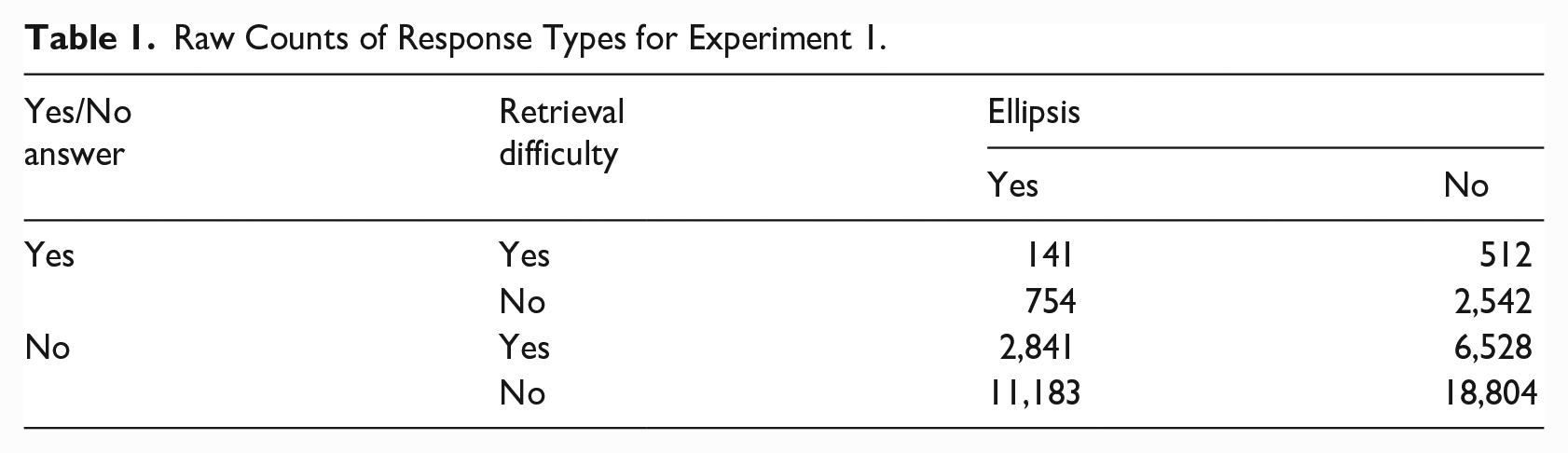
The participants’ responses were coded along three dimensions. Responses were coded as full sentences or elliptical responses. A response was considered a full sentence if the requested information (the closing time of the business) was presented with a subject and main verb (e.g., We close at 9, We’re open until 12, 9 is our closing time). All other responses were considered elliptical. We also coded whether the participant answered the literal, direct component of the indirect questions. They were considered to have done so if they provided an affirmative or negative response to the direct yes/no question that was asked prior to providing the requested information (e.g., Sure . . . we close at 9; I sure can! We’re open until 9). Finally, we coded for evidence that the participant was not able to immediately retrieve the answer to the question that was asked. We looked for several indicators of retrieval difficulty: the production of a disfluency (uh . . . , um . . . ), repetition of the question as a retrieval cue (e.g., Time we close . . . What time do we close . . . ?), or direct statements indicating retrieval issues (Let me see . . . , I need to check on that . . . ). Finally, trials in which the participant did not answer our question, or did not indicate a closing time (e.g., We never close) were coded as “other” responses and discarded from the analysis (n = 638). Table 1 presents a break-down of these responses based on the three coding variables described above.
Raw Counts of Response Types for Experiment 1.
2.2 Results
All analyses reported in this manuscript were conducted using the glmertree package 0.2-0 (Fokkema et al., 2015) in R 4.2.2 (R Core Team, 2021). The data and code used for the reanalyses are available on the Open Science Framework (project link: https://osf.io/uqj6t/; data: https://osf.io/zsmhd; code: https://osf.io/xj3s9). For the critical analyses predicting rates of elliptical responses, we converted the log odds of significant effects to d following the procedure of Borenstein et al. (2009). The d values are listed in the tables along with the mixed models regression results.
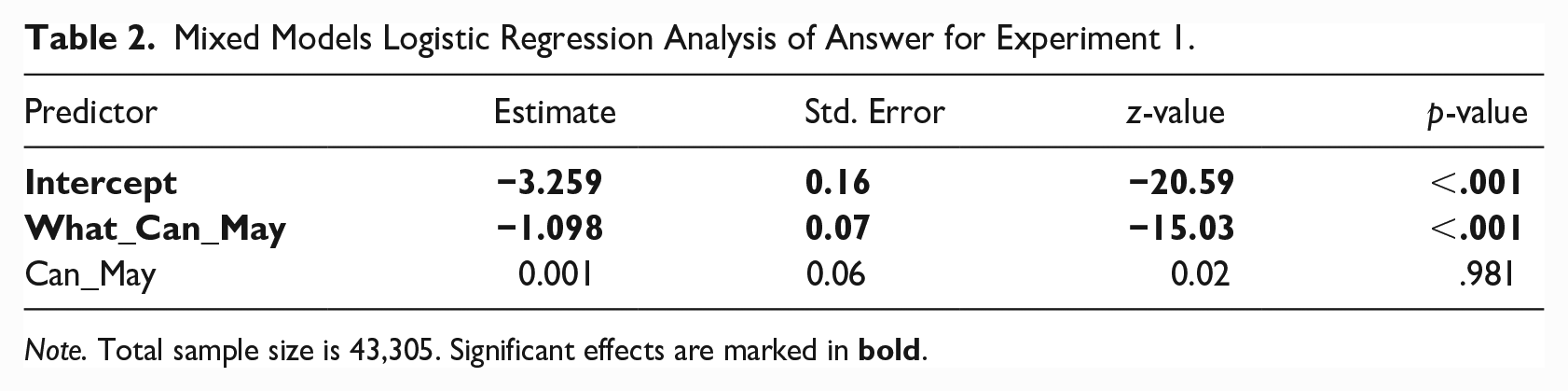
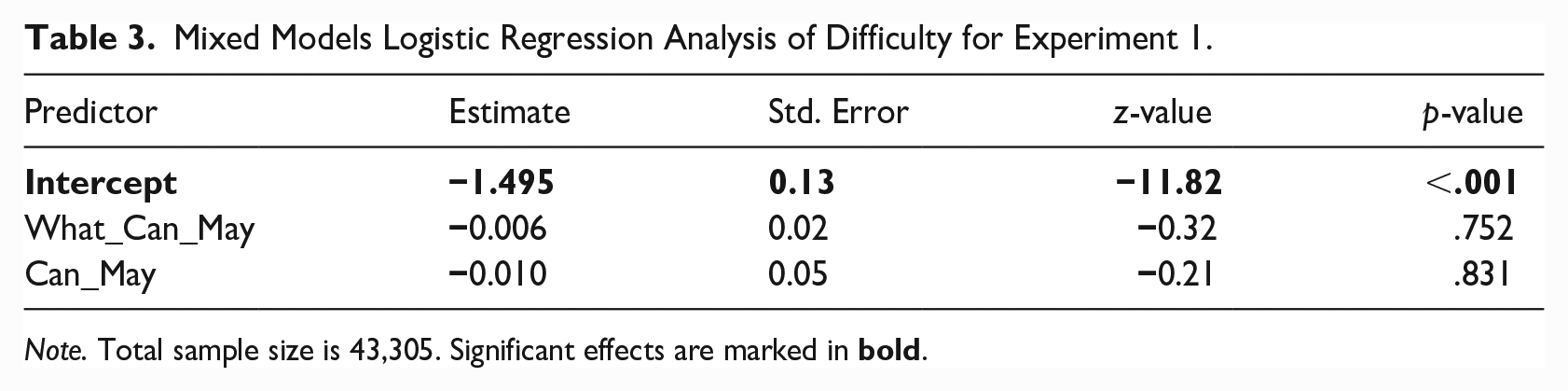
The first step in our analysis was to assess whether both the rate at which participants answered the yes/no question before providing the closing time of the business and the rate at which participants showed signs of retrieval difficulty differed across question types. We analyzed each variable with a mixed models logistic regression (Answer, coded as: answered the yes/no question = 1, did not answer the yes/no question = 0; Difficulty, coded as: 1 = retrieval difficulty, 0 = no difficulty). The difference between question types was coded with two orthogonal contrasts: What time . . . ? vs. Can you . . . ? and May I . . . ? (coding: What time . . . ? = 2, Can you . . . ? and May I . . . ? = -1; this contrast compares direct and indirect requests), and Can you . . . ? vs. May I . . . ? (coding: Can you . . . ? = -1, May I . . . ? = 1, What time . . . ? = 0; this contrast compares conventional and non-conventional indirect requests). The models included Experimenter as a random factor, and random slopes of both contrasts across Experimenter. The analysis of Answer is presented in Table 2, and the analysis of Difficulty is presented in Table 3.
Mixed Models Logistic Regression Analysis of Answer for Experiment 1.
Note. Total sample size is 43,305. Significant effects are marked in
Mixed Models Logistic Regression Analysis of Difficulty for Experiment 1.
Note. Total sample size is 43,305. Significant effects are marked in
Participants provided yes/no answers before reporting the closing time for their business following all question types. Although the direct question (What time . . . ?) does not pose a yes/no question, participants occasionally began their answer to these questions by saying Yes or Sure (or something similar). Such responses were rare (~ 1% of responses) and may reflect a mishearing of the question. Participants were more likely to provide a yes/no answer when responding to the indirect requests (Can you . . . ? and May I . . . ?) than when responding to direct requests (What time . . . ?; see Figure 1). The rate of answering the yes/no question did not differ between indirect request types. The lack of difference between the conventional and non-conventional indirect requests conflicts with Clark’s (1979) results, where participants were more likely to answer the yes/no question when responding to non-conventional requests than when responding to conventional requests. After presenting the rest of our analyses, we discuss possible reasons for the discrepancy between our results and Clark’s (1979).
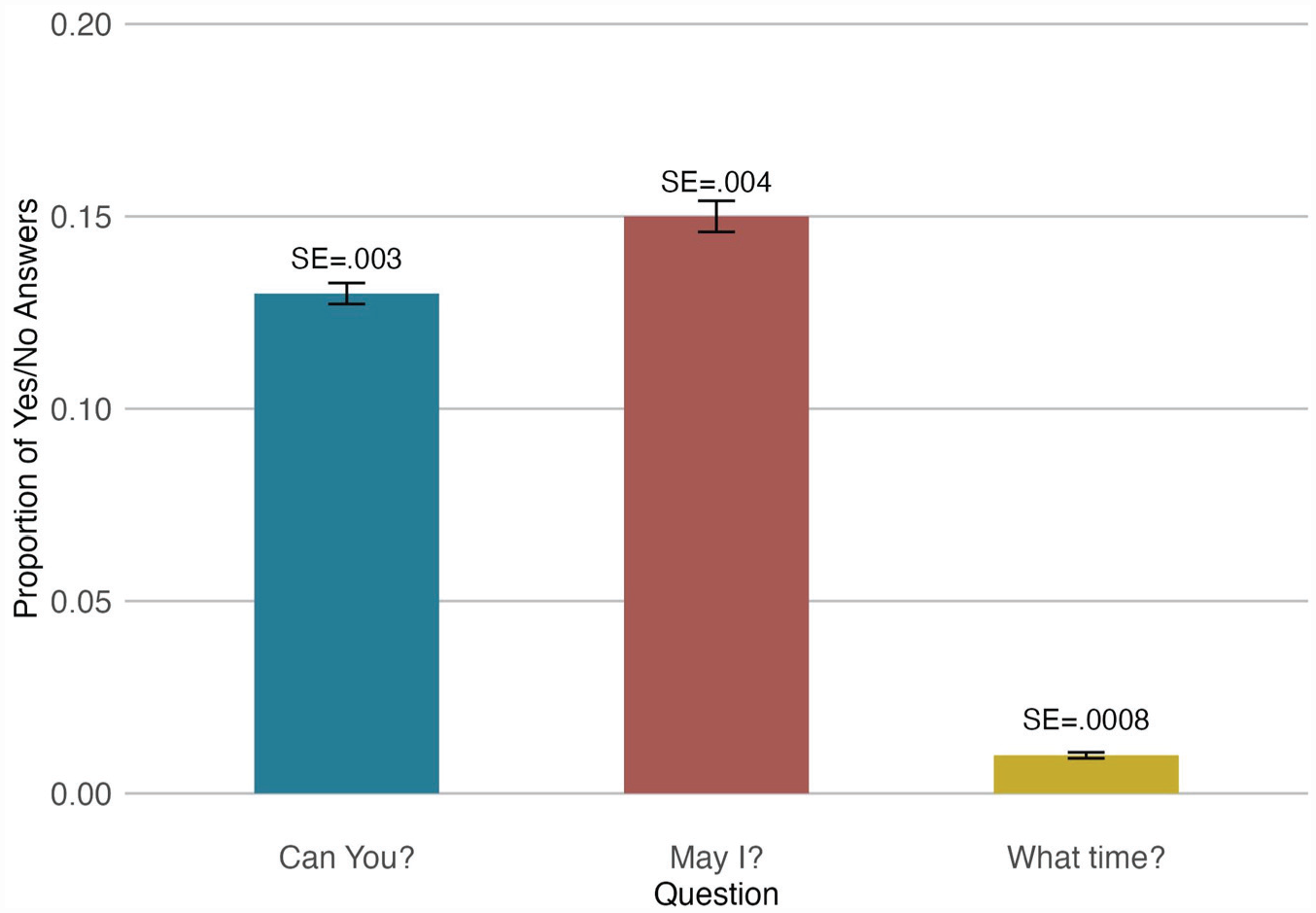
Proportion of Yes/No answers as a function of question type in Experiment 1.
Participants showed signs of retrieval difficulty following all question types (see Figure 2). The rate of these difficulties did not differ across question types (see Table 2), suggesting that the form of the question that was asked did not greatly affect participants’ ability to recover the answer.
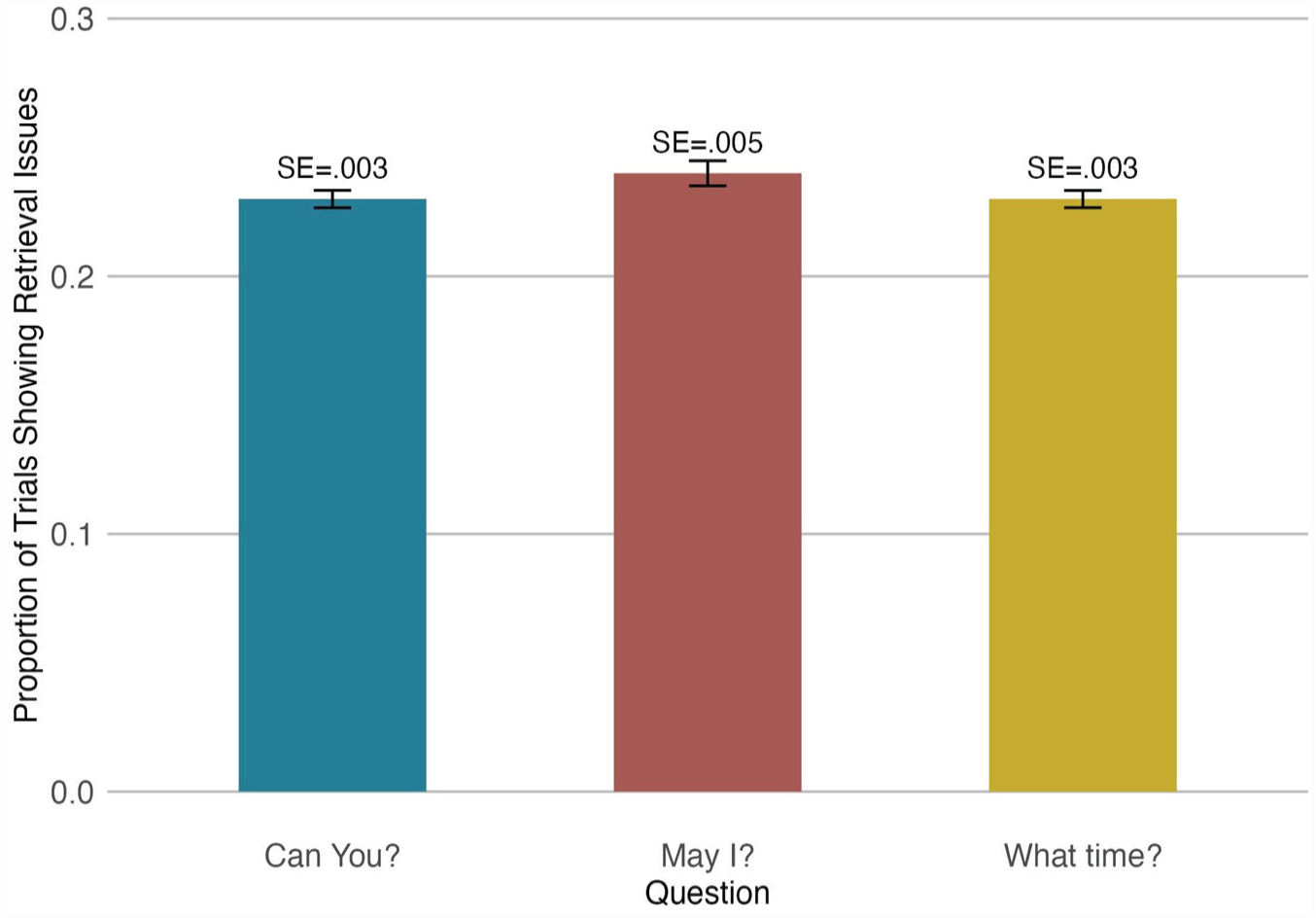
Proportion of responses denoting retrieval issues by question type in Experiment 1.
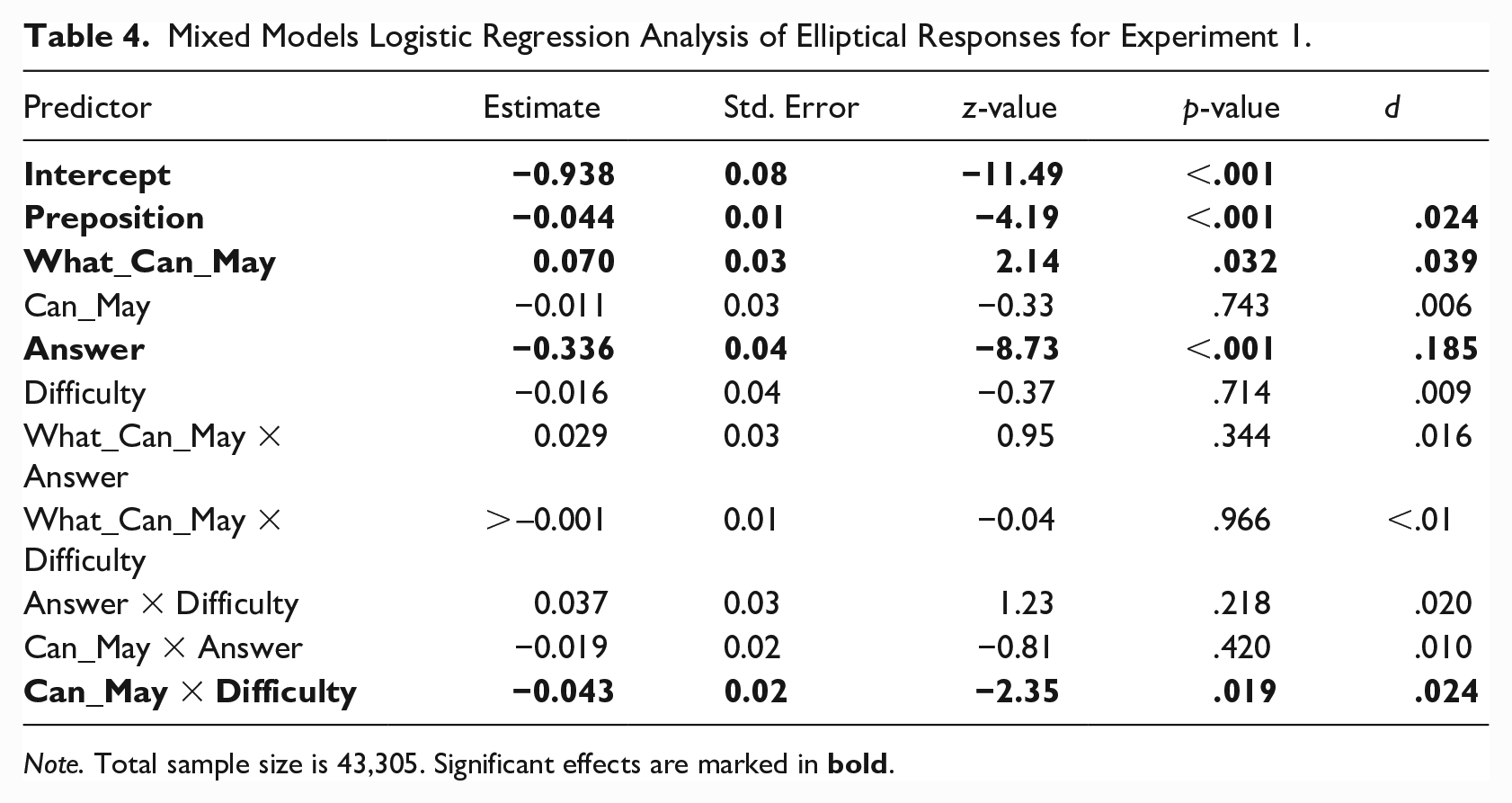
The final step in our analysis was to assess whether the odds of producing an elliptical response (Ellipsis; coded as: 1 = elliptical response, 0 = full sentence) was predicted by Question Type (two contrasts coded as in the previous analyses), Answer (coded as: 1 = answer the yes/no question, -1 = did not answer the yes/no question), Difficulty (coded as: 1 = retrieval difficulty, -1 = no retrieval difficulty), and Preposition (coded as: 1 = question included preposition at, -1 = question did not include preposition). We included Preposition as a predictor because Chia et al. (2020) report that participants were more likely to produce a full sentence response when the question contained a preposition. We also included two-way interactions between Answer, Difficulty, and the Question Type contrasts. We did not include interactions with Preposition or higher-order interactions because these predictors were not statistically reliable when included in the analysis, suggesting both that the presence of a preposition in the question did not affect the patterns observed for the other predictors and that there were no complex interactions among the predictors in our dataset. In addition, we used the Variance Inflation Factor (VIF) function from the car package 3.1-1 in R (Fox & Weisberg, 2019) to identify whether any predictors were causing collinearity issues. We used VIF > 10 as our removal criterion. No predictors were removed on this basis. Finally, the model included Experimenter as a random factor, and random slopes for the What time . . . ? vs. Can you . . . ? and May I . . . ? contrast, the Can you . . . ? vs. May I . . . ? contrast, and Difficulty across Experimenter. The model would not converge with further random slopes. The results of this analysis are presented in Table 4.
Mixed Models Logistic Regression Analysis of Elliptical Responses for Experiment 1.
Note. Total sample size is 43,305. Significant effects are marked in
Participants were more likely to produce an elliptical response to the direct question (What time . . . ?) than to the indirect questions (Can you . . . ? and May I . . . ?; p = .032). The rate of ellipsis did not differ between conventional and non-conventional indirect requests. This pattern is not entirely consistent with Clark (1979), who showed that What time . . . ? and Can you . . . ? questions elicited equal rates of elliptical responses and more elliptical responses than May I . . . ? questions. Participants were less likely to produce an elliptical response when they began their response by providing a yes/no answer (p < .001; see Figure 3). This finding replicates Clark’s (1979) results. Finally, participants were less likely to generate an elliptical response when the question contained a preposition (M = .33) than when it did not (M = .35; p < .001). This finding replicates Chia et al.’s (2020) result.
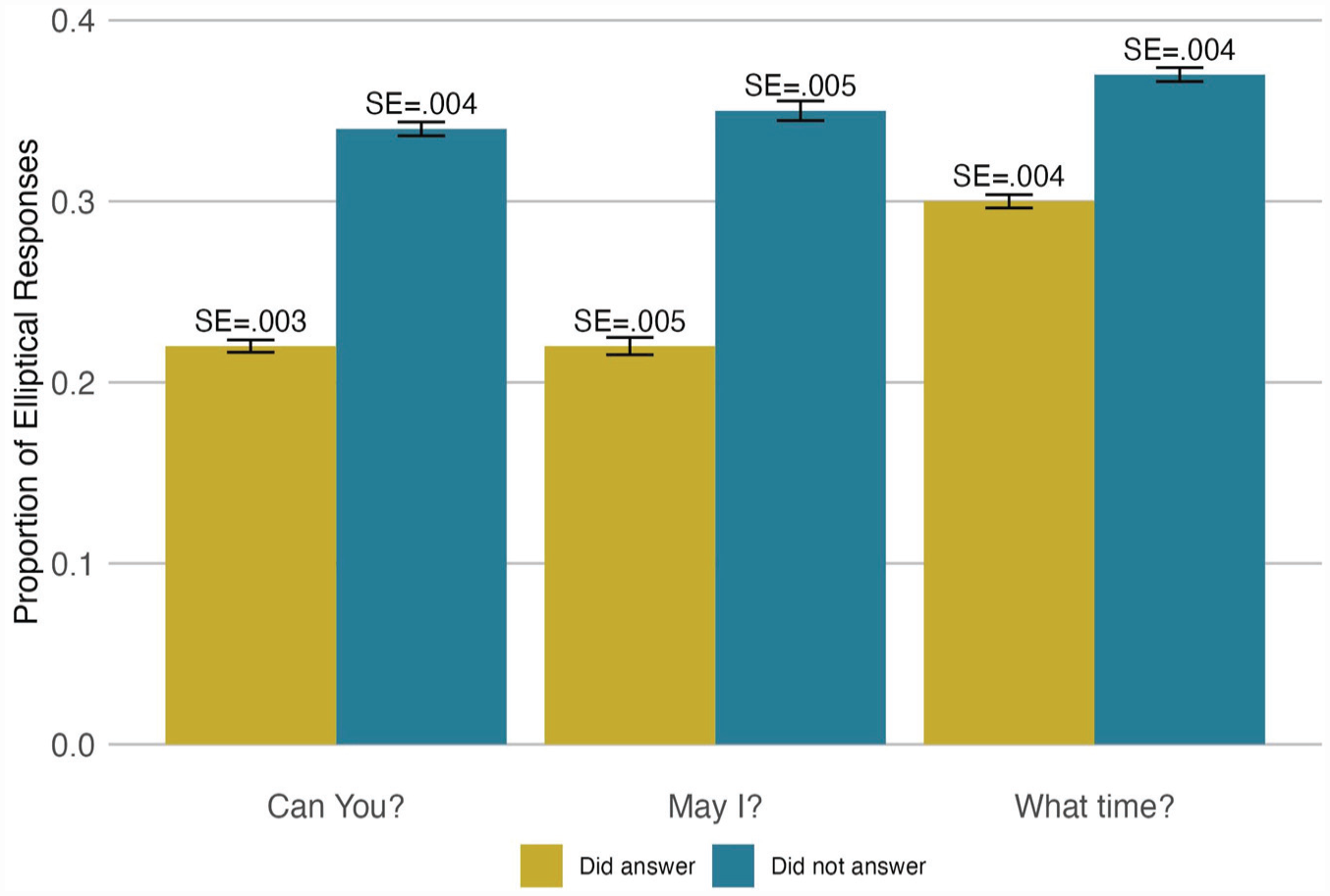
Proportional of elliptical responses across question types and Yes/No responses in Experiment 1.
The analysis revealed a significant interaction between the Can you . . . ? vs. May I . . . ? contrast and Difficulty (p = .019). We conducted two post hoc analyses using mixed models regression on subsets of our data to explore the interaction. One model analyzed the data for trials on which the Can you . . . ? question was asked, and the other analyzed the data for trials on which the May I . . . ? question was asked. The analyses included Difficulty as a predictor, Experimenter as a random factor, and the random slope of Difficulty across Experimenter. For the May I . . . ? questions, there was a significant effect of Difficulty (estimate = -0.14, p < .001, d = .08), with participants being more likely to produce an elliptical response when they did not verbalize signs of retrieval difficulty (M = .35) than when they did verbalize signs of retrieval difficulty (M = .27). The same trend was found for the Can you . . . ? questions (no retrieval difficulty: M = .34; retrieval difficulty: M = .29), but this pattern was not significant (estimate = -0.04, p = .37, d = .02).
2.3 Discussion
We set out to replicate Clark’s (1979) two main findings on the production of elliptical responses to requests for information. Clark (1979) reported that participants were less likely to use an elliptical response to convey the requested information (in this case, the closing time of the business) when they began their answer with a yes/no response. The same tendency was present in our data. As discussed earlier, the effect of the yes/no response on ellipsis production is consistent both with an account of ellipsis based on recoverability and accessibility (e.g., the work of producing the yes/no question makes the elided content of the indirect request less accessible) and with an account based on politeness (e.g., answering the yes/no question is a polite move, and participants follow this up with a more-polite full sentence response).
Clark (1979) further reported that direct requests and conventional indirect requests elicited similar rates of elliptical responses, and more elliptical responses than non-conventional requests. We partially replicated this finding. Like Clark (1979), we found that direct requests elicit more elliptical responses than non-conventional indirect requests. Unlike Clark (1979), our data show that conventional indirect requests elicit elliptical responses at a rate akin to that of the non-conventional request rather than the direct requests. The pattern is echoed in our analysis of the rates at which participants generated yes/no responses as part of their answer, where conventional and non-conventional indirect requests elicited similar rates of yes/no responses. Clark (1979) showed a difference between these question types.
We do not have a definitive explanation for why our conventional indirect requests elicited responses akin to non-conventional indirect requests rather than behaving like direct requests (as reported by Clark, 1979). One possibility is based on Christianson et al.’s (2001) good enough approach to language comprehension. The good enough approach holds that most people’s default comprehension strategy is to develop a fast, shallow interpretation of the linguistic input. Applied to the current situation, the good enough approach would argue that the participants did not attend closely to the precise content of the indirect requests. They may have recognized that an indirect request was made (explaining why the indirect requests elicited different responses than the direct requests) while ignoring the finer-grained differences between indirect request types. Interestingly, Clark (1979) notes a similar phenomenon in his experiments, where participants responded to questions such as Would you mind telling me what time you close? by saying Sure . . . we close at 9 instead of Not at all . . . we close at 9. In this case, participants recognized the indirect request form (as demonstrated by their yes/no answer) but answered inappropriately (In a literal sense, Sure means that they do mind providing the information). Although the data run counter to our predictions, it is our sense that an explanation of the sort offered here could be accommodated by an approach to ellipsis production based on recoverability, accessibility, and politeness. The participants were able to recover elided content, the content was accessible (explaining the presence of ellipsis in the participants’ responses), and politeness was considered (explaining the difference between direct and indirect requests); however, both the meaning that was recovered for the indirect requests and the judgment of politeness the participant made for the indirect requests may have been different than what we expected.
There are other possible explanations for the discrepancy between Clark’s (1979) results and ours. Compared to our studies, Clark (1979) used a wider range of conventional and non-conventional requests and requested a wider range of information from businesses. The diversity in his items may have helped to draw out the differences between conventional and non-conventional requests. Furthermore, Clark’s (1979) data were collected by a single experimenter, but 60 experimenters contributed to our data collection. Chia and Kaschak (2022a) demonstrate that there are reliable individual differences in the strength of the structural priming effects elicited by experimenters in this paradigm, and it may be that similar experimenter-level variation is also affecting the elicitation of ellipsis in our data. Finally, our data were collected ~ 40 years after the publication of Clark’s (1979) article. It is possible that cultural shifts explain some of the discrepant results. It is interesting to note that the overall rate of ellipsis production in our data is lower than in Clark’s (1979) data (e.g., Clark reports ~ 75% ellipsis for direct and conventional indirect requests; our data has < 40% elliptical responses for every request type), suggesting an overall higher level of politeness in our participants. Whether this difference is due to cultural changes or some other factor remains to be seen.
We coded the participants’ responses for evidence of memory retrieval difficulties. It appears that the effect of retrieval difficulty on the rate of elliptical response production depends on the type of question that is asked. Participants were generally less likely to produce an elliptical response when they verbalized signs of retrieval difficulty, but this effect was stronger for May I . . . ? questions than Can you . . . ? questions. This finding suggests that the effect of retrieval difficulty may be modulated by politeness, with the effect being stronger for the more polite May I . . . ? question than the less polite Can you . . . ? question. Although more needs to be done to understand the effect, it is interesting to note that signs of retrieval difficulty such as saying uh or um appear to have a social function (e.g., Clark & Tree, 2002; Smith & Clark, 1993). It may be that verbalizing signs of retrieval difficulty is a polite conversational move (acknowledging that the speaker is taking the question seriously despite not having an answer yet), and speakers may follow up this polite move by generating a more-polite full sentence response. This tendency may be especially strong when the speaker is responding to a question that is perceived as particularly polite (as in the case of May I . . . ?).
3 Experiment 2: politeness and accessibility
The re-analysis of Chia and Kaschak (2022a) and Chia et al. (under review) confirmed many of Clark’s (1979) observations about the production of elliptical responses. Where our results differed from Clark’s (1979), the discrepancies may be accommodated by a refinement of our conceptions of recoverability, accessibility, and pragmatic factors such as politeness. The next step in our exploration was to conduct an experiment using the same phone-call methodology as in our first study. The experiment was designed to address two issues. First, we attempted to take another look at the role that the politeness of our questions played in shaping the odds of participants generating an elliptical response. As in our first study, we called businesses, greeted the employees, and asked What time do you close? or May I ask you what time you close? Based on the ratings provided in Clark and Schunk (1980), we considered that May I ask you . . . ? would be perceived as highly polite, and What time . . . ? would be perceived as neutral on a politeness scale. We included one additional question, Do you want to tell me what time you close? Clark and Schunk (1980) suggest that this question would be perceived as impolite. If participants match the politeness of their response to the politeness of the question, we expect that they will produce few elliptical responses to May I . . . ? (the most polite question = the most full sentence responses), more elliptical responses to What time . . . ? (less polite question = more elliptical responses), and the most elliptical responses to Do you want . . . .? (least polite question = most elliptical responses). At the same time, if indirect requests cause recovery/accessibility issues (see earlier discussion), we expect that both May I . . . ? and Do you want . . . ? will result in the production of fewer elliptical responses than What time . . . ? (similar to our previous analyses).
The experiment addressed a second issue. Levelt and Kelter (1982) report that placing linguistic content between the experimenter’s question and the participant’s answer reduces the odds of generating an elliptical response. The effect can be explained through accessibility, where processing the additional linguistic content reduces the accessibility of the antecedent needed to license an elliptical response. Some of our question-answer trials were conducted as in the previous studies—experimenters asked a question and gave the participant an opportunity to respond. On other trials, the experimenters added additional linguistic content between the question and the participant’s response. Half of these trials used linguistic content that provided a clarification on the question (e.g., What time do you close?
3.1 Method
3.1.1 Participants
Experimenters made phone calls to 592 participants. The data from 14 of these participants was excluded from the sample because they generated responses categorized as “other,” leaving a final sample of 578 participants. Data were collected in June and July 2022.
3.1.2 Procedure
The project was approved by the IRB at Florida State University. Nine experimenters were trained to collect data for this project. They were instructed to call businesses of any kind anywhere in the United States and ask about their closing time. As in Experiment 1, most calls were made to restaurants. Experimenters used one of three questions: What time do you close? (direct request, neutral politeness), May I ask you what time you close? (non-conventional indirect request, high politeness), or Do you want to tell me what time you close? (non-conventional indirect request, low politeness). Each question was asked in one of three extra linguistic content conditions: none (experimenter did not add any content to the end of the question; participant answered immediately), clarification (experimenter followed the question by saying Today, I mean, clarifying what closing time the participant should report), or irrelevant. For the irrelevant content, the experimenter generated a short comment or compliment based on the business called (e.g., saying I love your fries! or Your coffee is great! when calling a restaurant). The experimenters called each business, greeted the participant, and asked one of the 9 questions that resulted from crossing the 3 question types with the 3 linguistic content types. The experimenter transcribed the participant’s response, thanked them, and ended the call.
3.1.3 Coding
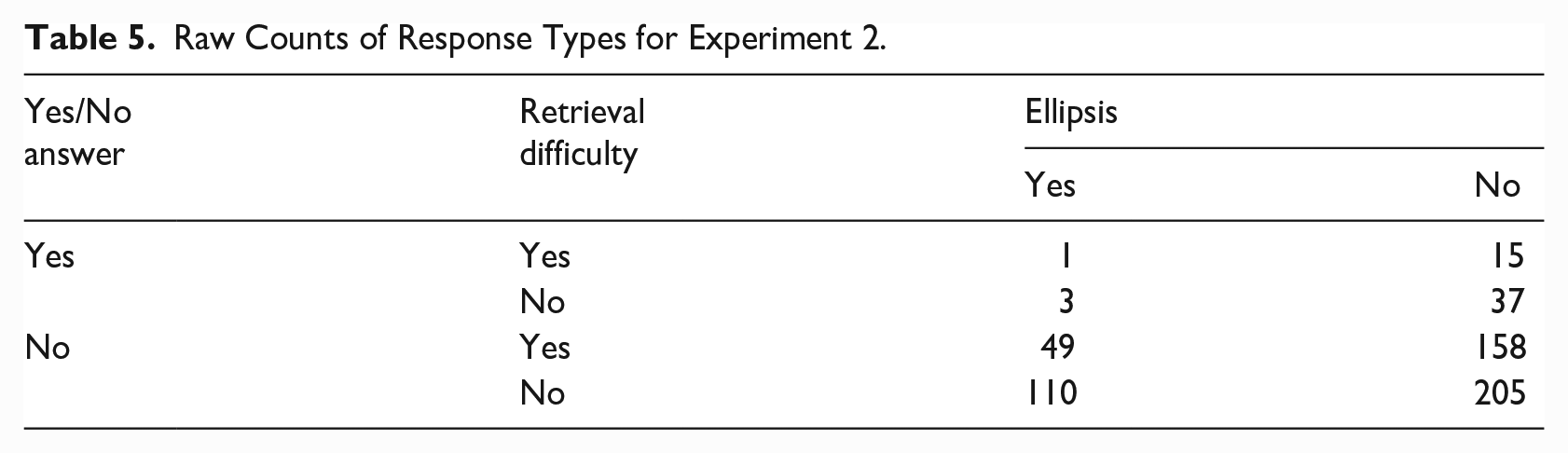
The participants’ responses were scored using the same procedure specified for coding the responses evaluated in our reanalysis of Chia and Kaschak (2022a) and Chia et al. (under review). The number of participant responses categorized as elliptical, answering the yes/no question, and showing signs of retrieval difficulty are presented in Table 5.
Raw Counts of Response Types for Experiment 2.
3.1.4 Data analysis
We conducted three analyses of the participants’ responses. The first was a logistic regression that examined our binary coding of the participants’ answers to the yes/no question (Answer; 1 = answered the yes/no question, 0 = did not answer the yes/no question). The odds of producing an answer to the yes/no question was predicted by Question Type (Direct, Polite Indirect, Impolite Indirect) and Linguistic Content (None, Clarification, Irrelevant). Question Type was represented with two contrasts. Direct vs. Indirect compared the direct question (coded as 2) to the two indirect questions (coded as -1). Polite vs. Impolite compared the Polite Indirect question (coded as 1) to the Impolite Indirect question (coded as -1; the direct question was coded as 0). Linguistic content was represented with two contrasts. None vs. All compared the condition with no additional content (coded as 2) to the conditions with Clarification (coded as -1) and Irrelevant (coded as -1) content. Clarification vs. Irrelevant compared the Clarification condition (coded as 1) to the Irrelevant condition (coded as -1; no additional content coded as 0). Our second analysis used the same format as the first, except that our dependent measure was Difficulty (1 = participants showed signs of having difficulty retrieving the answer to the question; 0 = participant showed no signs of difficulty).
The final analysis used a logistic regression to predict the log odds of generating an elliptical response (1 = elliptical response, 0 = full sentence response) based on Question Type (represented with the Direct vs. Indirect and Polite vs. Impolite contrasts described above), Linguistic Content (represented with the None vs. All and Clarification vs. Irrelevant contrasts described above), Answer (1 = answered the yes/no question, -1 = did not answer the yes/no question), and Difficulty (1 = participant showed signs of retrieval difficulty, -1 = participant did not show signs of retrieval difficulty). The model also included two-way interactions between specific Question Type and Linguistic Content contrasts and both Answer and Difficulty (see Table 8). Models containing a more extensive set of two- and three-way interactions suffered from collinearity issues. Like for the reanalysis, we used the VIF function to identify problematic interactions. Our removal criteria (VIF > 10) was consistent with the first study, and led to the removal of three 2-way interactions involving Answer and the contrasts coding Question Type and Linguistic Content. We used logistic regression for these analyses (rather than mixed models logistic regression) because the inclusion of Experimenter as a random factor in our models led to singular model fits. The data and code used for the analysis of these data are available on OSF (data: https://osf.io/gcrx5; code: https://osf.io/aqkgv).
3.2 Results
Our first analysis examined whether the type of question that was asked and the presence of additional linguistic content after the question affected the odds of participants providing a yes/no answer before indicating the closing time of their business. The results of the logistic regression are presented in Table 6. The only significant predictor was the contrast between direct and indirect questions (p < .001). As expected, participants were more likely to provide a yes/no answer to indirect questions than to direct questions (seeFigure 4).
Logistic Regression Analysis of Answer for Experiment 2.
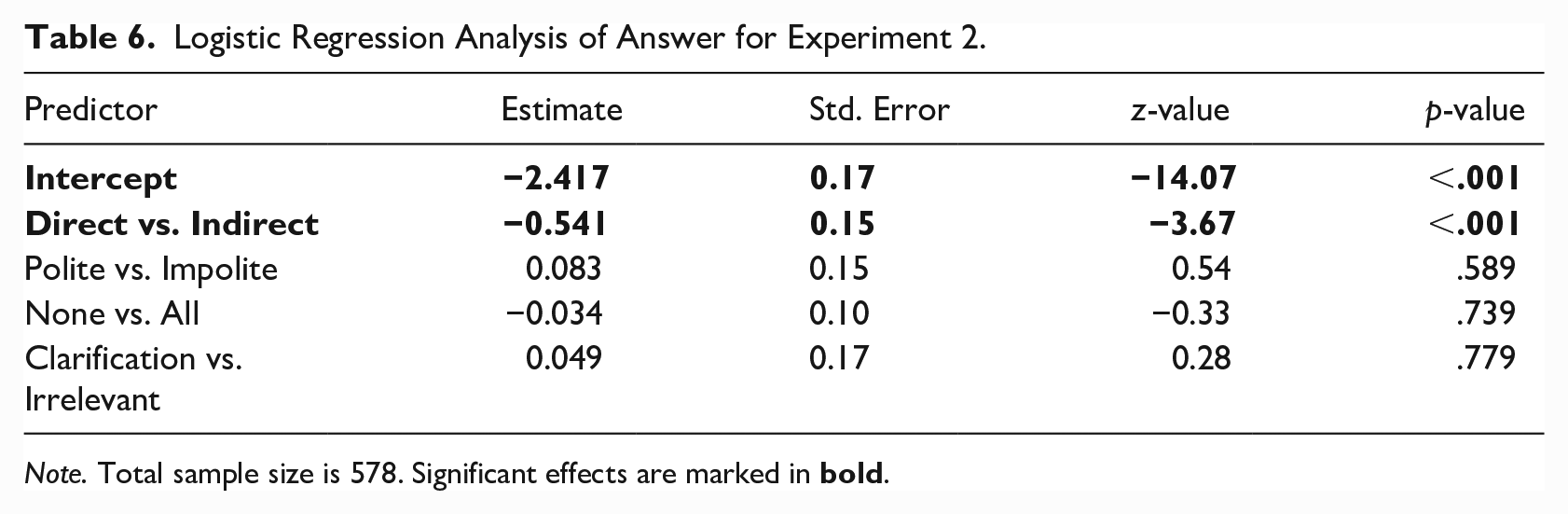
Note. Total sample size is 578. Significant effects are marked in
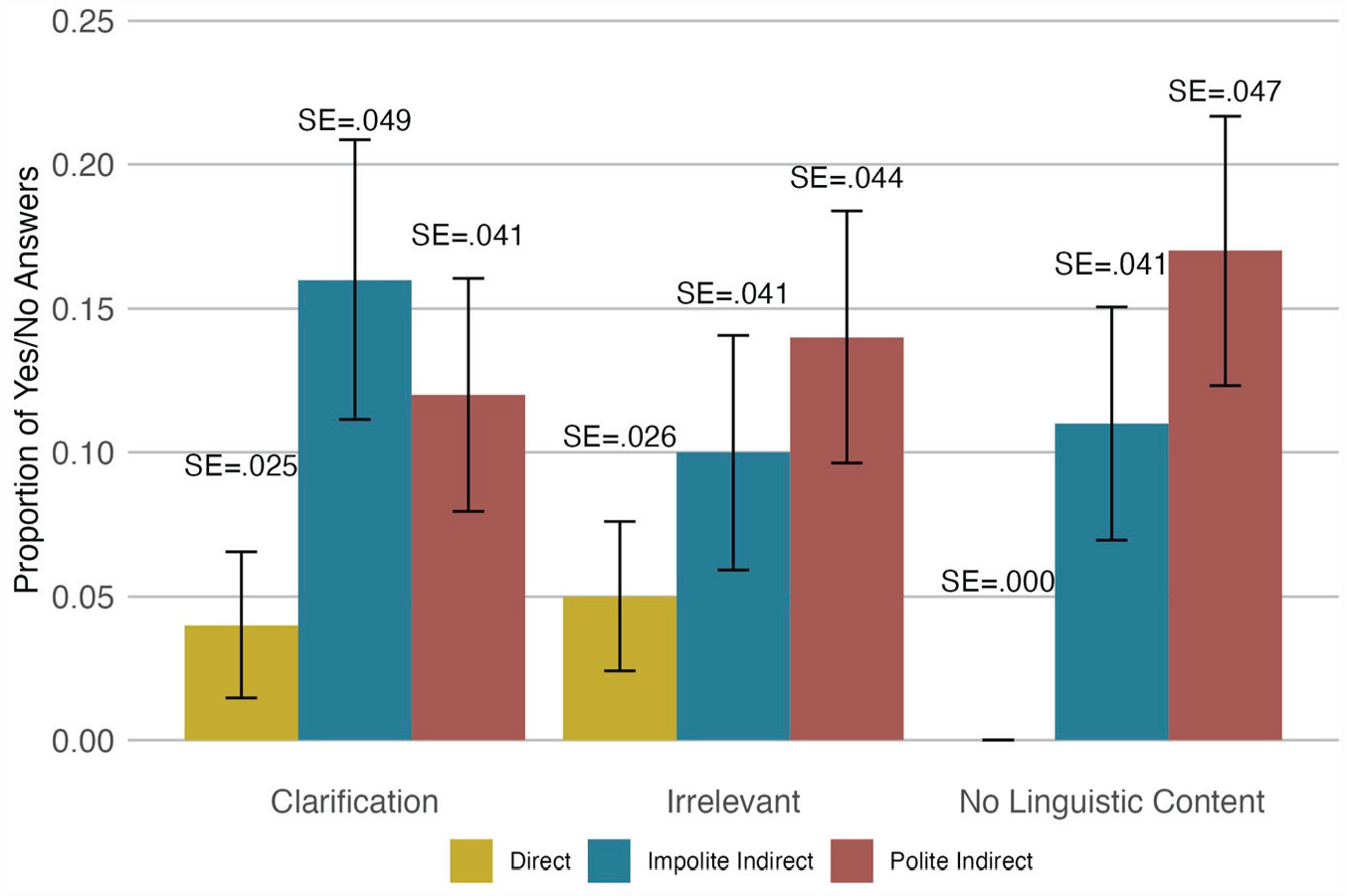
Proportion of Yes/No answers as a function of question type in Experiment 2.
The results of the logistic regression of Difficult are presented in Table 7. The only significant predictor was the contrast between the clarification and irrelevant linguistic content, where participants were more likely to generate signs of retrieval difficulty when the question was followed by irrelevant content than when it was followed by a clarification (p < .001). The contrast of None vs. All was marginally significant (p = .076), but an examination of the means in Figure 5 suggests that the effect is almost entirely driven by the difference between the Irrelevant condition and the other two conditions.
Logistic Regression Analysis of Difficulty for Experiment 2.
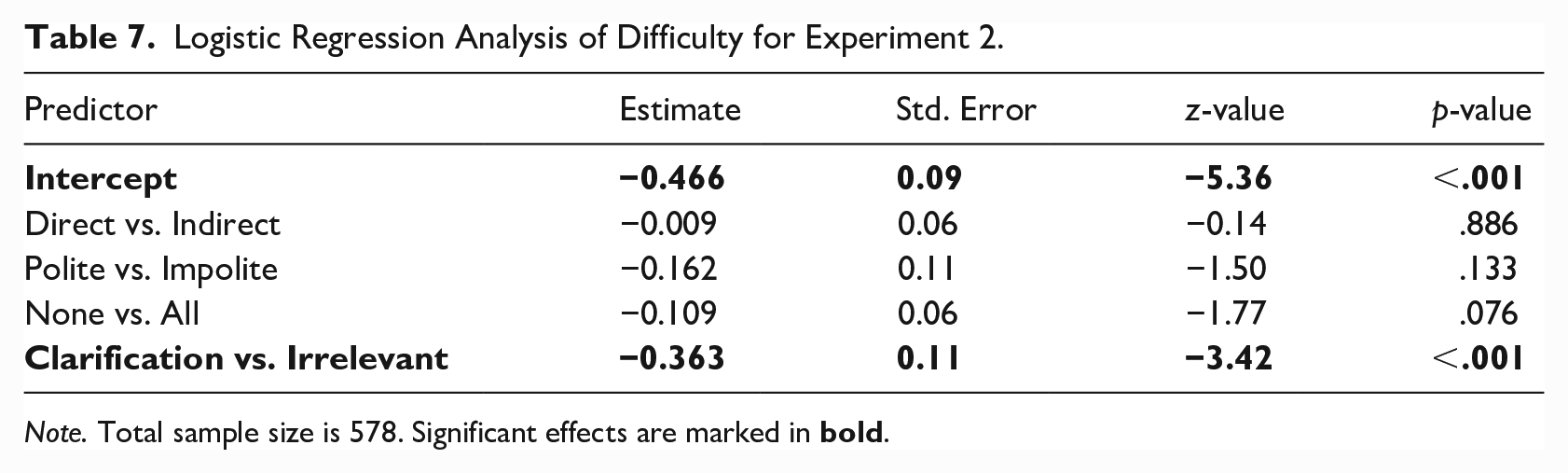
Note. Total sample size is 578. Significant effects are marked in
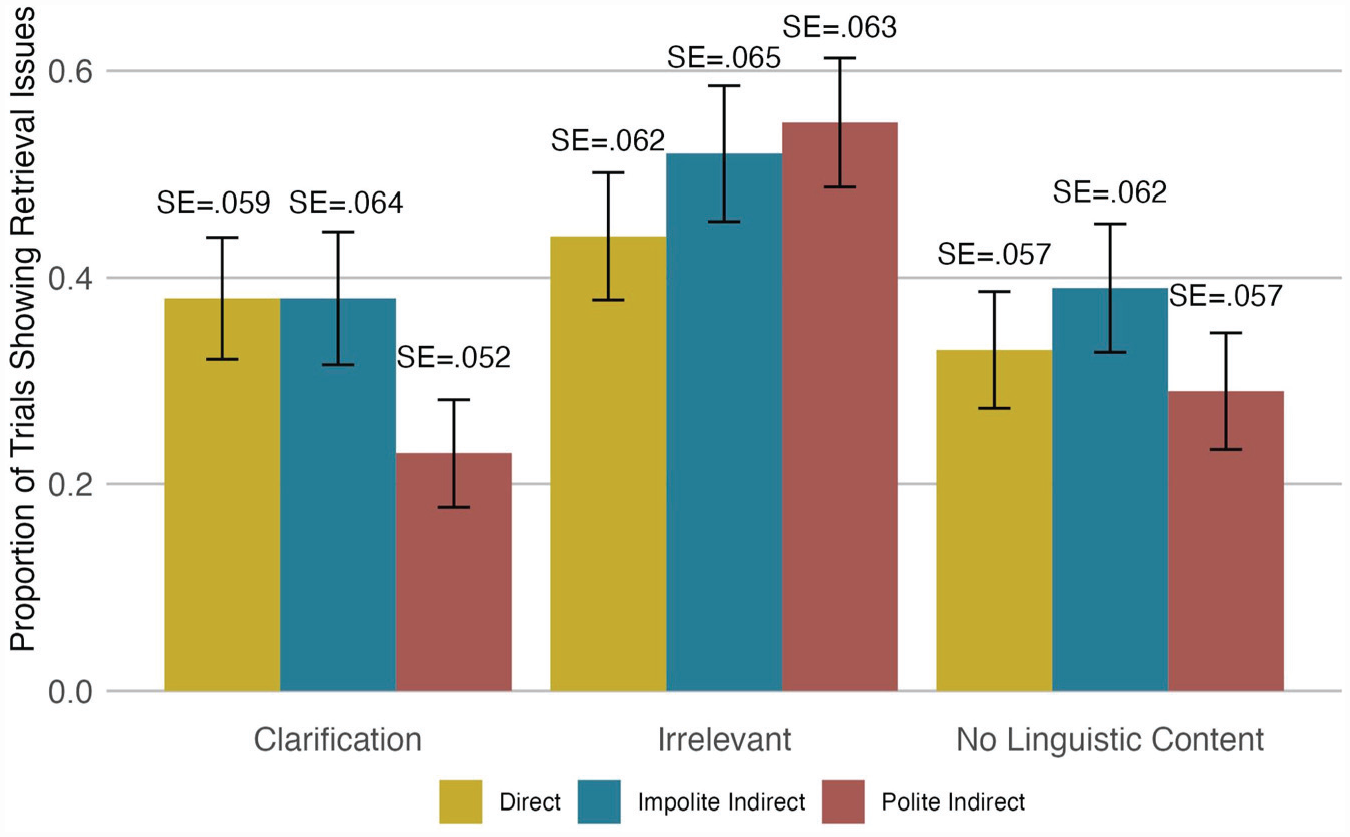
Proportion of responses denoting retrieval issues by trial type in Experiment 2.
The analysis of participants’ pattern of elliptical responses is presented in Table 8. As in our previous analyses, the effect of Answer was significant (p = .001). Participants were less likely to provide the closing time of their business with an elliptical utterance when they began their answer with a yes/no response. The effect of Difficulty was also significant (p = .012). Participants were less likely to generate an elliptical response when their answer suggested evidence of difficulty retrieving the requested information. Finally, the Clarification vs. Irrelevant contrast was significant (p = .008). Participants were less likely to produce an elliptical response when the experimenter generated irrelevant linguistic content between the question and the participant’s answer than when the experimenter followed up their question with a clarification (see Figure 6).
Logistic Regression Analysis of Elliptical Responses for Experiment 2.
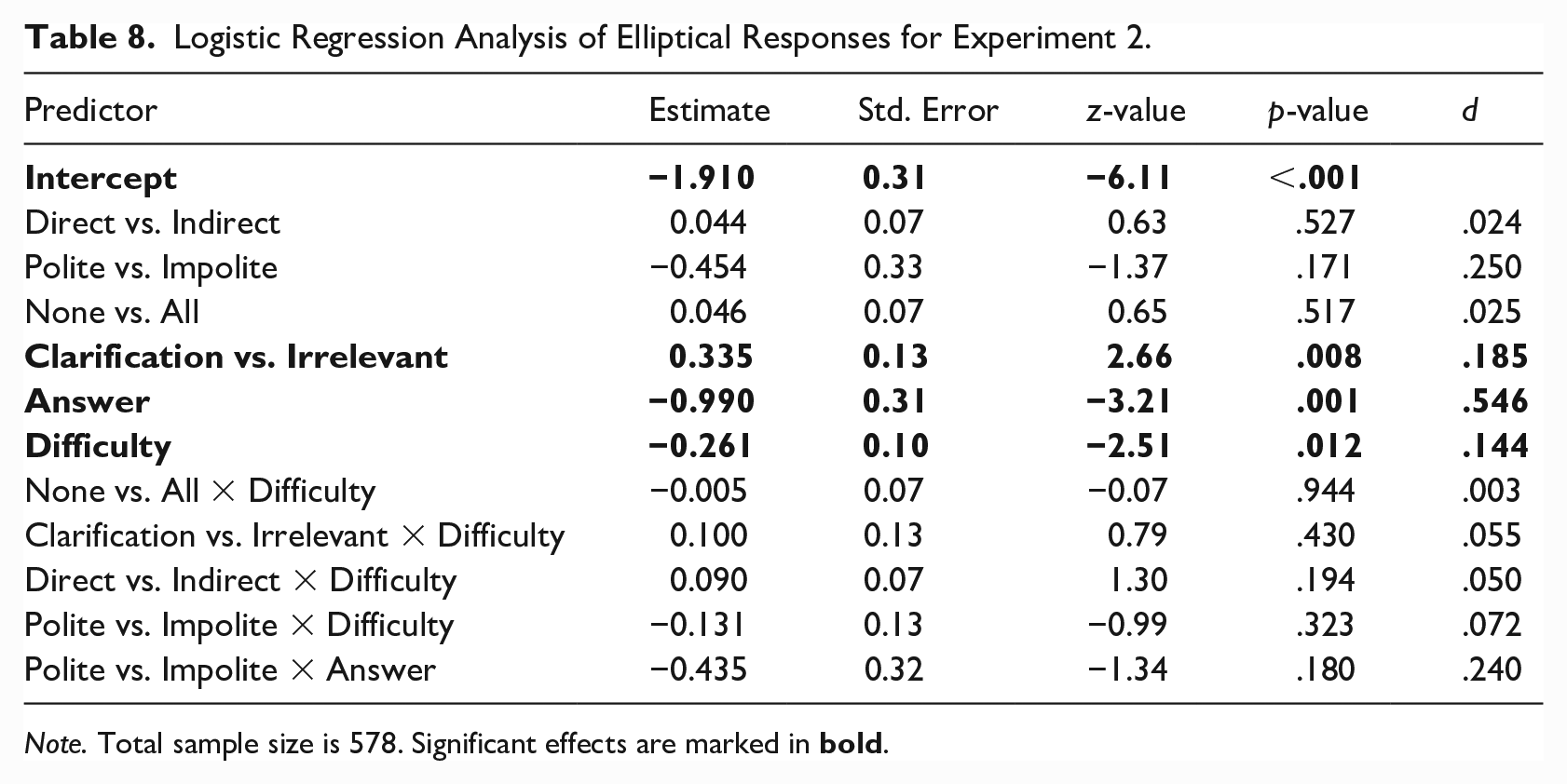
Note. Total sample size is 578. Significant effects are marked in
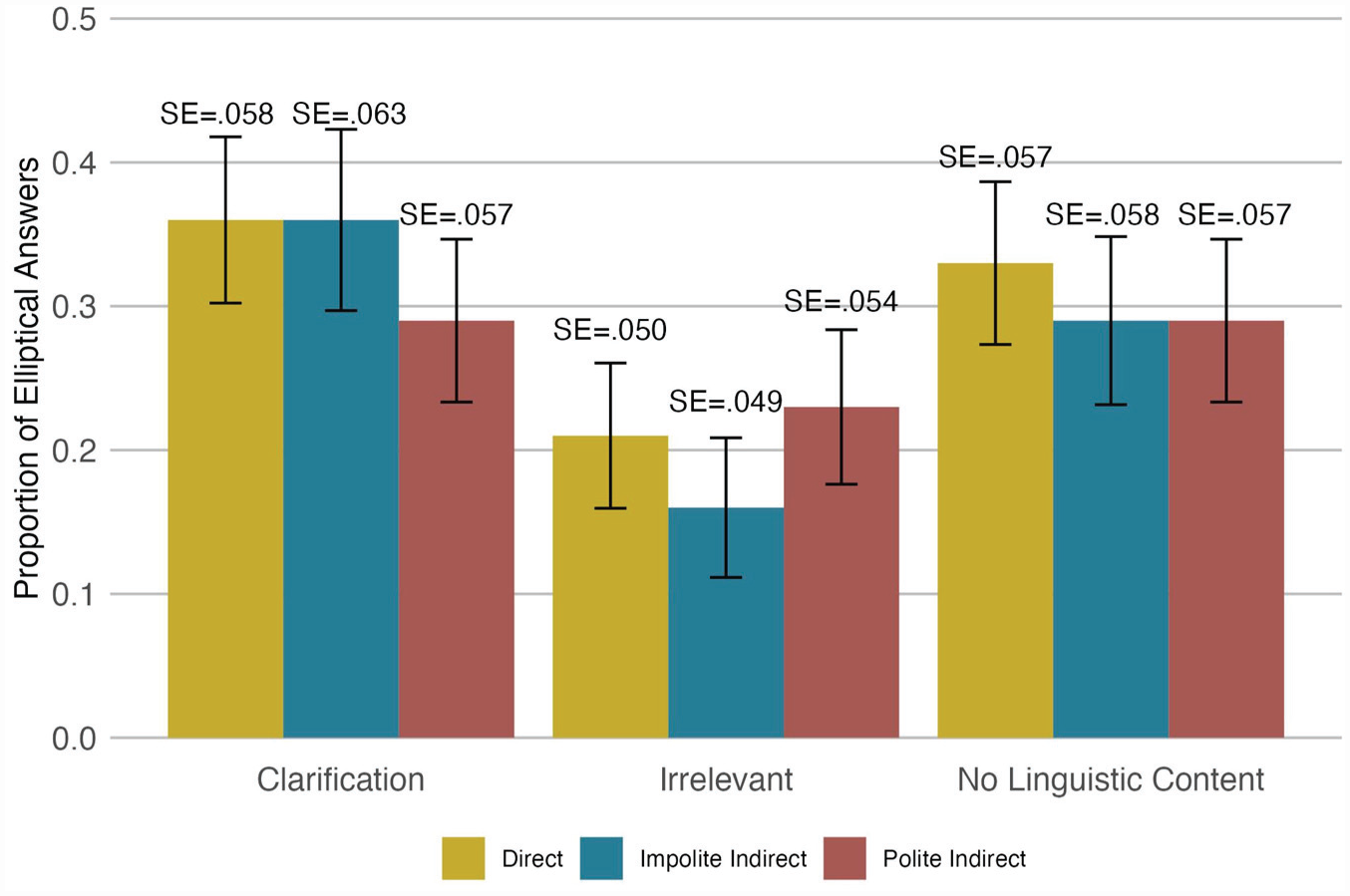
Differences in elliptical answers across linguistic contexts in Experiment 2.
3.3 Discussion
Our experiment had several important results. Replicating both Clark (1979) and the reanalysis of Chia and Kaschak (2022a) and Chia et al. (under review), participants were less likely to disclose the closing time with an elliptical utterance when they began their answer with a yes/no response. The methodology of these studies makes it difficult to determine whether the Answer effect is best explained by accessibility or politeness. Nevertheless, the Answer effect appears to be a persistent and robust finding.
The experiment showed an effect of Difficulty. Participants were less likely to produce an elliptical response when they showed signs of having difficulty retrieving the requested information. The effect of Difficulty may reflect the incremental nature of language production. When participants are unable to immediately retrieve the requested information, they are not positioned to begin their response with the requested information and are therefore not positioned to produce an elliptical response. Having said that, the claim that there is an effect of Difficulty is qualified by the fact that we did not observe this effect in Experiment 1. An important difference between Experiments 1 and 2 is that the analyses of Experiment 1 included random effects and slopes, whereas the analyses of Experiment 2 did not. It may be that the effect of Difficulty varies by Experimenters (testing model fits using the ANOVA function in R shows that the random slope of Difficulty across Experimenters makes a significant improvement in model fit), and the absence of random effects in the Experiment 2 analysis allows the Difficulty effect to appear.
Collinearity issues prevented us from testing the interaction between Question Type and Difficulty. Nevertheless, the data from this experiment showed the same pattern as Experiment 1. We conducted separate logistic regression analyses predicting the odds of generating an elliptical response based on Difficulty for the May I. . .? and Do you. . .? trials. The effect of difficulty was statistically reliable for the more-polite May I. . .? question (no retrieval difficulty: M = .33; retrieval difficulty: M = .16; estimate = -.479, p = .012, d = .26), but not for the less-polite Do you. . .? question (no retrieval difficulty: M = .30; retrieval difficulty: M = .22%; estimate = -.208, p = .234). The evidence across our studies thus suggests that the effects of verbalizing signs of retrieval difficulty may have an explanation rooted in politeness.
We found that placing irrelevant linguistic content, but not a clarification, after the question reduced the odds of the participant generating an elliptical response. The finding replicates Levelt and Kelter’s (1982) results and provides a demonstration of the role of accessibility in shaping the choice between elliptical and full sentence responses. The irrelevant information likely forced the participant to think about something other than the question that was asked, making the content of the question less accessible and an elliptical response less likely. The clarification also put linguistic information between the question and answer, but this content kept the participant focused on the content of the question and therefore did not affect the odds of producing an elliptical response. Our conclusions about the effects of the additional linguistic content are qualified by the fact that we did not carefully balance the length and nature of the clarification and irrelevant content—the clarification was the same for all participants, but the irrelevant content was different across participants because it needed to be tailored to the individual businesses that were called. Furthermore, the clarification itself was elliptical, raising the possibility that the clarification could have primed the participants to generate elliptical responses more frequently than they might have done otherwise. Nevertheless, the fact that our irrelevant content condition result replicates the effects of Levelt and Kelter’s (1982) irrelevant content strengthens our confidence that this aspect of our results (if not the difference between the clarifications and irrelevant content) is reliable.
Contrary to our expectations, rates of ellipsis production were not affected by the nature of the question that was asked. The pattern of data observed in Experiment 1 is present in this experiment—direct requests lead to more ellipsis (30% ellipsis) than indirect requests (polite = 27%, impolite = 27%)—but the pattern was weak and not statistically reliable. The different indirect request types elicited almost identical rates of ellipsis production (as in the previous analysis). Whereas participants’ choice of elliptical vs. full sentences responses may be affected by the distinction between direct and indirect requests, the choice is not affected by the level of politeness in the question itself. If politeness affects the production of elliptical responses, the effect may reside in the politeness of the respondent rather than in the politeness of the person asking the question. As discussed earlier, the split between direct and indirect requests may be accommodated by a version of the accessibility hypothesis.
4 General discussion
Our project was aimed at understanding the factors that lead speakers to make an elliptical response to direct and indirect requests for information. The specific goals of the work were to (1) replicate and extend both Clark’s (1979) and Levelt and Kelter’s (1982) main findings on patterns of ellipsis production, (2) assess the RAMP proposal (inspired by Clark, 1979, and others) that recoverability, accessibility, and pragmatic factors such as politeness drive patterns of ellipsis production, and (3) assess the novel claim that success in retrieving the answer to the question that is asked affects ellipsis production. We discuss each issue in turn.
Our replication of Clark’s (1979) findings produced mixed results. We replicated the effect of Answer observed by Clark (1979). Both of our data sets showed that participants were less likely to produce an elliptical utterance when they began their response with a yes/no statement. Clark (1979) also showed that conventional indirect requests behaved similarly to direct requests, and differently from non-conventional indirect requests, in eliciting elliptical responses. Both Experiments 1 and 2 showed that indirect requests of all types—conventional and non-conventional, more polite and less polite—elicited similar rates of ellipsis, and that the indirect requests generally elicited fewer elliptical responses than direct requests. One explanation for our results is that participants were not closely attending to the nuances of the questions; they recognized the indirect (as opposed to direct) question form but did not make further distinctions based on politeness. Such behavior would be consistent with a good enough approach to language comprehension (e.g., Christianson, 2016; Christianson et al., 2001; F. Ferreira, 2003), which holds that comprehenders default to a fast, shallow interpretation of linguistic input. We acknowledge that good enough processing cannot fully explain the difference between our results and Clark’s (1979), as we would still need to explain why our participants used a good enough strategy and Clark’s (1979) did not. It is possible that the (limited) set of questions used in our study, cultural norms, the wider range of experimenters used to ask questions, and the nature of our questions (asking about the hours of the business) lent themselves to good enough processing, and that at least some of the broader set of questions used by Clark (1979) and the wide range of information requested from businesses (closing times, interest rates, prices of specific products, acceptance of credit cards) did not. Further investigation will be required to resolve this issue.
It is widely held that elliptical responses are made when the content of the antecedent is recoverable (e.g., Clark, 1979; Hankamer & Sag, 1976; Nykiel & Hawkins, 2020) and the elided content is accessible (e.g., Martin & McElree, 2011). Our studies did not put the claim about recoverability to a stringent test, as the elided content should have been easily recoverable in every situation that we tested. Nevertheless, we believe that participants’ responses to our indirect requests highlight the need to consider what exactly is recovered when dealing with more complex utterances. For example, recovering the literal, yes/no interpretation of the indirect request would seem to be necessary for the participant to begin their response with a yes/no answer, as these answers are almost always elliptical.
Accessibility provides an explanation for three aspects of our data. First, accessibility can explain the difference in rates of elliptical utterances between direct and indirect questions. Indirect requests require the listener to consider two interpretations (the direct yes/no question and the indirect request), at least under some circumstances (e.g., Clark, 1979; Gibbs, 1986; Ruytenbeek, 2017). The additional processing complexity that comes with considering the two interpretations and deciding which one to address (including the possibility of addressing both interpretations) may make the elided content for a potential elliptical response less accessible. Second, accessibility may explain the effect of Answer seen in both of our studies. When participants respond to the yes/no question before providing the requested information, they put linguistic content (and processing work) between their ascertainment of the question’s meaning and the production of the utterance with the requested information. The additional content and processing work make the antecedent less accessible, leading participants to generate more full sentence responses after the yes/no answer. We acknowledge that the current data do not allow us to distinguish between an accessibility account of the effect of Answer and an account based on politeness—answering the yes/no question is more polite, and a more-polite full sentence response follows the yes/no response. This issue requires further investigation. Third, accessibility provides an explanation for our finding that whereas irrelevant linguistic content between the question and answer leads to fewer elliptical responses (replicating Levelt & Kelter, 1982), clarification content between the question and answer does not. The irrelevant content distracts participants from the scope of the question (e.g., commenting on your admiration for a restaurant’s fries shifts attention away from the question about the closing time), making the elided content for a potential elliptical response less accessible. The request for clarification keeps the focus on the requested information and does not affect accessibility to the same degree.
Our results provide support for the recoverability and accessibility components of the RAMP framework. Our results do not provide consistent support for the role of pragmatic factors in shaping the use of ellipsis, particularly in the case of politeness. We manipulated the politeness of our requests in both studies. The results of the reanalysis are partially consistent with the politeness hypothesis, as the more-polite indirect requests were associated with greater odds of the participant generating a more-polite full sentence response. The lack of difference between the conventional and non-conventional indirect requests in the reanalysis is not consistent with a politeness account. Experiment 2 also showed that the impolite and polite indirect requests elicited an equal number of elliptical responses, a finding that would be unexpected from a politeness perspective. On the other hand, we did find that the effect of Difficulty was strongest following the May I. . .? questions, suggesting that the politeness of the question may have effects outside of directly influencing the production of elliptical responses.
Earlier, we discussed the possibility that our participants were using a good enough strategy to interpret our questions, and that this might explain the lack of difference between our different indirect requests (conventional and non-conventional, polite and impolite). To the extent that good enough strategies are commonplace for language users (e.g., Christianson, 2016), it may be that politeness on the part of the requester is not a reliable way to affect the rate of elliptical responding in contexts such as the ones tested in our studies. The participants were employees interacting with a (potential) customer, and as such they would be expected to be polite as a default. It is possible that this polite default reduced the effects that politeness on the part of the experimenter would have on their responses. As a final point, we note that we did not assess politeness on the part of the participants, and it is possible that the participant’s desire to be more (or less) polite may be an important driver of the choice between elliptical and full sentence responses.
Our final goal was to assess the claim that difficulty retrieving the requested information would push participants toward the production of more full sentence responses. We found tentative support for this hypothesis. Participants were less likely to generate an elliptical response when they verbalized signs of retrieval difficulty (e.g., beginning their response with an uh or um), but this effect was only reliable when the verbalization of retrieval difficulty was in response to the highly polite May I. . .? questions. We provisionally interpret the effect in terms of politeness. Verbalizing signs of retrieval difficulty can be seen as a polite conversational move (e.g., Clark & Tree, 2002; Smith & Clark, 1993), and speakers may follow this polite move by providing an answer using a more-polite full sentence. The tendency to generate a more-polite full sentence may be strengthened when the speaker is responding to a question that is perceived as especially polite (May I. . .?; Clark & Schunk, 1980). We acknowledge that the assessment of the retrieval difficulty hypothesis was limited by the nature of our research paradigm. Retrieval difficulty was only inferred when participants generated a verbal indicator of the difficulty, and it is likely that this indicator of difficulty is not sensitive enough to capture all cases where retrieval difficulty occurred. Pending further results with more incisive research methods, we draw the provisional conclusion that retrieval difficulty may have some role in shaping the decision to generate an elliptical response, and that this role may depend on other factors surrounding the interaction.
Theories of language production (e.g., Chang et al., 2006; Levelt, 1989) do not generally approach the question of when or why elliptical responses would be chosen over full sentence responses. Nevertheless, we believe that the effects of accessibility and retrieval difficulty reported here are consistent with the broad view that language production is an incremental process (e.g., V. S. Ferreira & Dell, 2000). Speakers begin their utterances with content that is currently available for production, and when responding to a request for information an elliptical utterance is only possible when the requested information has been retrieved and is available for production at the beginning of the utterance. If the answer is not available, or the elided content necessary to support the ellipsis is not accessible, an elliptical response is less likely. How this general observation is incorporated into formalized theories of language production depends in part on the further assumptions that are made about elliptical responses to questions. For example, Merchant (2004) argues generating an elliptical response requires generating syntactic structure that is not expressed overtly. Theories of production would need to incorporate machinery to generate (but not express) elements of sentence structure. Other researchers (e.g., Ginzburg & Sag, 2000; Jacobson, 2016) propose that question-answer pairs form a single syntactic construction, and that no unexpressed syntax is generated. Theories of production typically consider the generation of single utterances, and as such they would need to be extended to consider representations that potentially span multiple utterances.
Our results also have implications for psycholinguistic approaches to ellipsis production. Psycholinguistic approaches generally view the selection of elliptical responses as the result of efficiency principles (e.g., Bergen & Goodman, 2015; Nykiel & Hawkins, 2020; Schäfer et al., 2021). It is our sense that these accounts would capture the basic fact that our participants generated elliptical responses to requests for information. For example, when answering a question such as What time do you close?, saying We close at. . . to begin the response is not informative or efficient. The beginning of the response could therefore be eliminated to generate a more efficient, elliptical utterance (e.g., Schäfer et al., 2021). Nevertheless, we do not think that extant psycholinguistic accounts currently provide a full explanation of our results. The accounts generally do not consider pragmatic factors such as politeness, and would not be able to explain the politeness effects observed here. That is not to say that efficiency-based psycholinguistic accounts could not be extended to incorporate the influence of pragmatic factors. As one illustration, Thompson et al. (2015) argue that the preferred way to answer what they call specifying questions, which seek a specific piece of information (e.g., What time do you close?), is to make a short (elliptical) response. Conforming to the preferred response type in these contexts could be considered an example of efficiency in language use, and thereby fall under the scope of efficiency-based accounts. Working out the details of how preferences, politeness, and other such pragmatic factors can be analyzed as examples of efficiency in language use will be an important direction for theoretical development in this area.
We set out to take steps toward understanding the factors that shape when participants make elliptical responses to requests for information. We found consistent evidence that participants are less likely to report the requested information in an elliptical response when they began their utterance with a yes/no response (replicating Clark, 1979). We also found that inserting irrelevant content between the question and answer reduced rates of elliptical responding (replicating Levelt & Kelter, 1982). We found weaker evidence that indirect requests lead to fewer elliptical responses, and that memory retrieval issues lead to fewer elliptical responses. There is clearly more work that needs to be done to understand the mechanisms behind each of these observations. We hope that our findings encourage others to explore this under-studied aspect of language production.
Footnotes
Acknowledgements
We thank the many experimenters who collected data for these studies. We also thank Vic Ferreira for the helpful discussions about the production of elliptical sentences.
Funding
The author(s) received no financial support for the research, authorship, and/or publication of this article.
