




Abstract
Irony comprehension involves understanding implicit attitudes communicated on top of the explicit, literal meaning. Because of the double-binding stemming from the explicit–implicit incongruity, irony is assumed to be cognitively taxing when communicated in the native language (NL), and even more so in the foreign language (FL). Prior studies investigating irony comprehension in the FL indicated that irony may be processed with similar speed and accuracy in the foreign and the native language, and that irony comprehension efficiency in the former might be lower. Building on these findings, this study investigates if the tasks participants perform when reading irony in their FL affect the efficiency of irony comprehension. We invited 150 advanced Polish users of English to take part in one of two tasks. Participants were asked to read 3- to 5-sentence-long-scenarios, ending in literal (Literal Praise, Literal Criticism) or ironic comments (Ironic Praise, Ironic Criticism) and to either (1) make true/false judgments (T/F task; N = 83), or to (2) judge the emotional value in emotive decision task (EDT; N = 67). A full spectrum of verbal irony employed to communicate ironic praise and criticism, and their literal equivalents: literal praise and literal criticism, was tested. A three-way mixed ANOVA with 2× Valence (Praise, Criticism), 2× Mode (Literal, Ironic) as within-subject repeated-measures, and 2× Task (True/False, Emotive Decision) as a between-subject independent measure, revealed that efficiency of irony comprehension was differently modified by the two tasks. Therefore, we argue that irony comprehension in English as a foreign language is task-constrained.
1 Introduction1.1 Irony comprehension: linguistic competence in the foreign language
Foreign language research on irony processing has been focused on comparing the speed and accuracy of irony detection when bilinguals operate in their native relative to their foreign language. The available evidence on how bilinguals comprehend irony in their respective languages is scant, yet it shows that once one has mastered the concept of ironicity, irony comprehension in the foreign language resembles rather than differs from the irony comprehension in the native language. Specifically, bilinguals may understand irony as efficiently (fast, accurate) as in their native language, or slightly less efficiently (slower, less accurate) as long as the foreign language command is at advanced/proficient level. For instance, Bromberek-Dyzman and colleagues in a range of studies investigated whether reading irony for comprehension in Polish–English bilinguals takes more time, and generates more errors than in the participant’s foreign relative to their native language. Bromberek-Dyzman et al. (2010) asked proficient Polish users of English to read and judge whether the target sentences in three-sentence story-frames communicated approval (literal praise), or disapproval (ironic criticism) in both Polish (native language) and English (foreign language). They used a self-paced procedure to allow for the strategic processing of the communicated intended meanings, and found no differences for irony processing between the tested languages. Advanced Polish users of English were as fast and as accurate in judging irony in Polish and English alike. Irony was processed longer, and elicited more errors than the literal meanings in both languages, though.
In a follow-up study, Bromberek-Dyzman and Rataj (2016) used the same set of experimental stimuli and the same task (Emotive Decision Task) to test latency and accuracy rates in a timed response protocol (speed vs. accuracy trade-off) and found that participants made more errors in response to ironic than to literal comments in both languages, yet more errors were reported for irony in the foreign relative to native language. Although the less efficient irony comprehension as indicated by the error increase, was a corollary of speed-accuracy trade-off, and was expected, it still indicated that in a timed response condition, irony comprehension was more cognitively demanding, and the processing demand increased in participants’ foreign language. Bromberek-Dyzman (2014) further investigated written irony comprehension in Polish–English bilinguals using varying input pacing conditions, and found similar response times and accuracy rates in the two tested languages. The presented results showed that advanced users of English were comparably fast and accurate in processing ironic content in both their languages when they were reading ironic messages.
A slightly different pattern of results was reported recently by Ellis et al. (2021) who tested a group of mixed-proficiency Chinese students of English. Relative to the control group of English native speakers, Chinese students of English were less accurate and slower in irony comprehension when judging the written scenarios for whether the comment sentences were communicating positive or negative meanings. Yet, these results as the authors argue are partly due to lower proficiency level, and also quite limited exposure to communicative irony use, as is typical for the formal schooling context of English acquisition in the tested participant population.
Next to reading irony for comprehension, English as a foreign language research has also examined irony comprehension when participants were listening to irony. For example, Cheang and Pell (2011) asked native monolingual speakers of English and Cantonese to listen to utterances expressing either sincere or sarcastic remarks, and to judge them for sincerity or ironicity. The results showed that participants succeeded in identifying sarcasm only in their native language, and failed to tell sincerity from sarcasm when they listened to it in the foreign language. Peters et al. (2016) also asked native and nonnative (Arabic) users of English to listen to three-sentence-story-frames and judge them for sincerity/sarcasm. The results showed that participants did much better determining sarcasm in their native relative to the foreign language. The authors argued that native and nonnative users of English relied on the prosodic cues to different degrees. Specifically, Arabic users of English relied on the prosodic cues to irony to much lesser degree. As a result their comprehension strategies for telling sarcasm from sincerity were less successful in the foreign language context.
Shively et al. (2008) examined irony comprehension in bilingual learners of Spanish for whom Spanish was the second language. Participants were exposed to irony in audio-visual modality when they were watching films. The authors report that the ability to recognize irony from the auditory and visual cues improved as the proficiency level and experience with the target language increased. They found support for more efficient irony recognition based on the audio-visual cues only for the more advanced learners in this study.
In a recent study, Antoniou and Milaki (2021) tested auditory (listening) and visual (watching) irony comprehension in a group of bidialectal Greeks for whom Cypriot Greek was acquired in a manner resembling the first language acquisition, that is, through informal, social interactions, and Standard Modern Greek, was acquired through formal schooling, which is typical for foreign language acquisition. Participants listened to or watched short interactions featuring ironic and non-ironic meanings, and were asked to rate how sincere or ironic were the contents presented (when 1 = indicated very sincere and 7 = indicated very ironic). They report faster irony processing for the more bidialectal individuals, that is, those who used the formally acquired dialect more frequently. They also report that ironic interpretations were processed as fast as literal meanings in some experimental conditions.
Bromberek-Dyzman et al. (2021) tested irony comprehension in unbalanced proficient Polish users of English in there modalities of irony reception. Participants were asked to either read, listen to, or watch ironic interactions in Polish (native language) and English (foreign language) and decide whether the target comment was mocking. Irrespective of the language, bilinguals in this study excelled in identifying irony in the audio-visual modality, rich in ironic cues, and irony recognition was least efficient, that is, least accurate, in the textual modality, which was deficient in irony prompting cues. This study overall reported that advanced bilinguals who have mastered the concept of irony, comprehend irony in both their languages quite similarly, albeit the efficiency of comprehension was moderated by the modality of irony reception.
Overall, the results so far obtained predominantly for irony comprehension in English as a foreign language, but also for other less tested foreign languages, such as Greek or Spanish, indicate that irony may be processed (1) with speed and accuracy comparable to the native language, provided that comprehenders are advanced/proficient users of English (e.g., reading proficiency), and they access irony through audio-visual channel (Antoniou & Milaki, 2021), or read the scenarios in a self-paced manner (e.g., Bromberek-Dyzman, 2014; Bromberek-Dyzman et al., 2010); (2) slower and less accurately in the foreign relative to the native language, when they read the scenarios and make judgments in limited time (e.g., Bromberek-Dyzman & Rataj, 2016); or (3) less efficiently in the foreign language when comprehenders are less proficient in the tested language and read (e.g., Ellis et al., 2021; Shively et al., 2008), or listen to ironic scenarios (e.g., Peters et al., 2016).
1.2 Irony comprehension: cognitive strategies
Next to questions about linguistic mechanisms, comparing irony comprehension in the native relative to foreign language, there are questions about cognitive mechanisms underpinning irony comprehension in the foreign language. Specifically, do bilinguals when interpreting irony in their foreign language strive to determine what is meant by what is said (e.g., Grice, 1975; Sperber & Wilson, 1986, 1995), which is a complex act of interpretation. Or, do they perform simpler interpretation acts, such as determining whether what was said was : (1) sincere or ironic (e.g., Peters et al., 2016), or whether it was (2) prizing or criticizing (e.g., Dews & Winner, 1995).
Prior studies exploring cognitive mechanisms of irony comprehension in monolingual populations have predominantly focused on comparing how people process literal versus ironic meaning (for a review, see Gibbs & Colston, 2007). This line of research has so far provided inconclusive results showing that irony comprehension might be more cognitively demanding, that is, taking longer to process (e.g., Giora et al., 1998, 2007; Giora & Fein, 1999) and it may be less cognitively demanding, that is, taking less time to process than the literal meaning (e.g., Gibbs, 1986; Ivanko & Pexman, 2003). Similar results have also been observed for irony comprehension in bilingual populations (e.g., Antoniou & Milaki, 2021; Bromberek-Dyzman, 2014; Bromberek-Dyzman et al., 2021). It seems reasonable to assume that interpreting irony in the foreign language, bilinguals first of all are interested in determining the communicative intention, that is, whether the message is meant as a compliment or criticism, or whether it is meant sincerely, or ironically, rather than whether it communicates literal or non-literal meaning. These questions enquiring into cognitive mechanisms of irony comprehension, and in particular, whether the cognitive strategy comprehenders adopt to perform a task may moderate the speed and/or the accuracy with which they process irony in the foreign language, remain to be investigated.
1.3 Irony comprehension: tasks
A range of tasks has been employed to investigate irony processing in individuals when they were operating in their native languages. For instance, true/false task (T/F; for example, Gibbs, 1986; Schwoebel et al., 2000), lexical decision task (LDT, for example, Giora et al., 1998, 2007; Giora & Fein, 1999), emotive decision task (EDT; for example, Dews & Winner, 1999; Schwoebel et al., 2000), and reading for comprehension (e.g., Filik & Moxey, 2010; Gibbs, 1986; Giora et al., 2015; Ivanko & Pexman, 2003 [Experiment 3]). To determine whether ironic meaning comprehension gets facilitated by the contextual cues, boosting expectation for irony Gibbs (1986) used a combination of reading and T/F comprehension tasks to compare latency patterns for a range of ironic (praise, criticism) and literal (praise, criticism) comments. The results showed faster responding to ironic comments in contexts cuing ironic meaning relative to contexts that did not cue ironic meaning. Interestingly, the study also found that when participants were asked to only read the scenarios and the time of reading was measured, they needed the same amount of time to read ironies and their literal equivalents. When they were asked to make T/F judgments, they needed less time to make judgments for ironic than for the literal comments. These results suggest that the speed of irony comprehension depends on the (un)/availability of contextual cues, and the task, that is, reading, versus making T/F judgments.
Dews and Winner (1999) used two versions of EDT to test literal and ironic praise and criticism. In two experiments, they commanded participants’ attention either to the intended evaluative meaning (Experiment 1), or to the literal evaluative meaning (Experiment 2). When participants’ attention was focused on the intended evaluation (Experiment 1), both types of ironic meanings were processed longer than the literal ones. In addition, negative evaluative comments took longer to comprehend than the positive ones. When participants’ attention was anchored on the literal evaluative meanings, they took longer to judge the evaluative tone of literal meaning in utterances used ironically than when used literally. These results indicated also that the speed of irony comprehension depended on whether the participants’ attention was directed to intended evaluative meaning (Experiment 1) or the literal evaluative meaning (Experiment 2).
In a follow-up study, Schwoebel et al. (2000) used a T/F task to measure how much time it took participants to read, and comprehend literal and ironic praise and criticism. They found that ironic criticism took longer to process than did literal praise, though they shared identical target sentence meaning. In case of ironic praise and literal criticism (identical literal meaning)—no differences were observed: literally negative meanings generated similar latency patterns.
These results might be taken to indicate that when comprehenders advanced irony to perform different tasks in their native language, irony comprehension speed varied with the tasks. Namely, EDT (Dews & Winner, 1999) and T/F task (Schwoebel et al., 2000) generated partially divergent response patterns for the literal and ironic (critical irony) meaning.
Although a range of tasks has been used to study irony in the native language, the tasks themselves have not been systematically compared as a potential source of variability in irony processing. Yet, by asking participants to respond to different tasks may influence decision making patterns, that is, facilitated or delayed processing of ironic meanings in task-related manners.
2 Present study
2.1 Aim
Building on prior studies testing irony processing in the foreign language and showing that irony comprehension may generate similar response time and accuracy patterns in the native and the foreign language, we aim to examine whether cognitive strategies comprehenders adopt to perform a particular comprehension task, will moderate the speed and/or accuracy with which they process irony in the foreign language. At the same time, this study does not aim to test whether the examined tasks differently moderate irony comprehension in the native and foreign language, but focuses exclusively on testing if tasks affect irony processing in participants’ non-native language. This study, therefore, sets to explore whether the task, next to such factors as the level of foreign language proficiency (e.g., Ellis et al., 2021; Shively et al., 2008; Tiv et al., 2021), modality of comprehension (Antoniou and Milaki, 2021; Bromberek-Dyzman et al., 2021), or the amount of processing time (Bromberek-Dyzman 2014; Bromberek-Dyzman et al., 2010; Bromberek-Dyzman & Rataj 2016) is a factor modulating irony comprehension in the foreign language.
For this aim, we asked foreign users of English to perform the following two tasks: (1) T/F task and (2) EDT. These two tasks seem a reasonable choice, as they (1) were often used to study irony processing, and (2) reflect real-life comprehension strategies comprehenders adopt to arrive at the intended communicative meaning. Rather than focusing on whether the speaker is using literal or non-literal meaning, hardly a concern in making sense of communicative intentions in verbal interactions, people care to know whether the speaker’s intends to (1) praise or criticize them (EDT), or whether (2) the speaker means what she says: is sincere, or means not what says (T/F task), that is, is ironic.
Specifically, we test whether performing these two tasks, participants would attend to (1) the truth-conditional content in the T/F task, and (2) the evaluative content in EDT, which would be reflected in task-related response latencies and accuracy rates. If our participants adhered to task-specific cognitive strategies, such as when focused on assessing whether the speaker is sincere or ironic (does she mean what she says), they would cling to the truth-conditional value of the meaning, and when figuring out whether what was said was meant as criticism or praise (does she praise or criticize me), they would prioritize the evaluative value of the communicated meaning, then the response patterns for these two tasks should differ systematically. Hence, in this study, we test these task-related hypotheses in relation to foreign users of English, with the goal of advancing our understanding of cognitive mechanisms underpinning irony comprehension in English as a foreign language.
2.2 Predictions
Based on prior studies, testing task effects at word (e.g., Kazanas & Altarriba, 2016; Kousta et al., 2009) and sentence level (e.g., Egidi & Gerrig, 2009; Ludtke & Jacobs, 2015) we predict that EDT and T/F task will modulate irony processing in different manners. Namely, we expect that when participants perform emotive decisions and judge the ironic and non-ironic comments as communicating either praise or criticism, or when they judge the comments for whether they communicate truth or falsity, different response patterns will be observed.
For the T/F task, which prompts participants to decide whether what was said, or meant was true or false, we predict that both literal meanings: literal praise and literal criticism will be processed faster, and more accurately than irony (ironic praise, ironic criticism). This prediction stems from the social experimental psychology research showing that affective congruity (here literal praise, literal criticism) is processed faster and more efficiently (less errors) than incongruity (here praising irony, critical irony; for example, Colston, 2002; Fazio et al., 1986).
In EDT, which directs participants’ attention to the evaluative meaning, we predict that positively valenced target comments: literal praise and ironic criticism (identical literal meaning) will be processed faster, and more accurately than the negatively valenced literal meanings: literal criticism and ironic praise (identical semantic meaning). The ground for this prediction stems from the positivity offset/negativity bias paradigm showing that negative content takes more time to respond (slower speed), and more effort (lower accuracy) to process (negativity bias) than does the positive content (positivity offset; for example, Cacioppo & Berntson, 1999; Hinojosa et al., 2020; Kauschke et al., 2019).
As for the within-irony distinction, we expect ironic praise to be processed longer, and produce higher error rate than ironic criticism irrespective of the task. This hypothesis stems from several sources. First, praising irony (blame for praise; negative irony) is the less frequent brand that employs literally negative meaning to implicitly impart praise, and was found to be processed longer and less efficiently than the more frequent ironic criticism (e.g., Dews & Winner, 1999; Dews et al., 1995; Gibbs, 1986). As ironic praise is less frequently used in verbal interactions (e.g., Bruntsch & Ruch, 2017; Kreuz & Link, 2002), it is also less expected, and therefore is processed less fluently (Gibbs, 1994; Utsumi, 2000). Also, due to its reduced communicative expectancy, ironic praise tends to be misinterpreted as a critical comment, with its negative literal meaning taken at face value (e.g., Bromberek-Dyzman, 2014).
2.3 Stimuli
The stimuli set used in this study was adopted from Schwoebel et al. (2000) study (courtesy of Ellen Winner). The full set comprises 96 experimental scenarios, 48 ironic: 24 ironic praise, 24 ironic criticism; 48 literal: 24 literal praise, 24 literal criticism. Each scenario features 3- to 5-sentence-long story-frames. Half of the scenarios (48) end with literal comments, producing literal praise (24; positive literal meaning), and the other half with literal criticism (24; negative literal meaning). Half of the ironic comments communicate ironic criticism (positive literal meaning, negative ironic meaning: 24), and the other half ironic praise (negative literal meaning, positive ironic meaning: 24).
2.4 Validation studies
Prior to the experimental study, two tests were administered on the original set of stimuli (Schwoebel et al., 2000) to (1) make sure that the foreign users of English are familiar with the vocabulary used in the set; (2) ascertain that in an off-line condition (no time limits imposed) foreign users of English recruited from the target population grasp irony.
2.4.1 Familiarity test
The goal of the familiarity test was to make sure that foreign users of English are familiar with the key words. Participants included 30 students of the Faculty of English (Mage = 23.6; range = 23–26; 21 women, 9 men), who reported that they have been studying English for 13.7 years on average. They were asked to assess their familiarity of the keywords (target adjectives) on a 7-point scale. The results of the familiarity test showed high level of familiarity with all the keywords (M range = 6.10–7.0) except for the word “flunk,” which received a significantly lower score on the familiarity scale (M = 2.93). The word was replaced with a more familiar equivalent (“screw up”). That is the only modification of the original set of stimuli (Schwoebel et al., 2000).
2.4.2 Ironicity test
The goal of the ironicity test was to check if ironic comments were understood as ironic. In total, 26 students of the Faculty of English participated in this test (Mage = 23.8; range = 23–26; 29 women, 7 men). They reported that they have been studying English for 13.4 years on average. Each participant responded to 32 experimental stories out of 96 stories. One participant saw only one version of each story. Participants’ tasks were to rate the ironicity of the target sentences on a 4-point Likert-type scale (where 0 stands for non-ironic, 3 stands for very ironic). This scale (1) tested if participants identify all ironic comments as ironic (never choose 0), and (2) measured the perceived ironicity of the ironic comments. The results demonstrated that participants recognized all ironic stories as ironic, and all the non-ironic stories as non-ironic, thus indicating that in the off-line condition respondents successfully differentiated between irony and non-irony. In addition, this test showed that stories featuring ironic praise were rated significantly lower on the ironicity scale (M = 2.45, SD = 0.348) than stories featuring ironic criticism (M = 2.76, SD = 0.273; t(25) = 3.13, p < .01), indicating that participants found ironic praise to be less ironic than ironic criticism. This result supports the predominant view that ironic praise is a less frequent, and also a less prototypical type of irony, and as such may be more effortful to process than ironic criticism.
Both validation studies confirmed that the original set of stories was : (1) comprehensible for the tested population of Polish users of English, (2) ironic stories were recognized as ironic, (3) ironic praise was perceived as less ironic than ironic criticism. Based on that, we decided to put the original set of 96 experimental stories to test in this study. In addition, 24 distracter stories conveying literal meanings with a humorous tinge, were used to make sure that each participant was exposed to twice as many literal as ironic statements. The aim of the distracters was to (1) reflect the ubiquity pattern of irony usage in natural conversations (cf. Gibbs, 2000), and to (2) preclude participants’ from getting into an ironic mode of thinking (Gibbs, 1994), which tends to get induced with irony frequency increase.
Each experimental story had an ironic and non-ironic version. Two versions of each story were produced by altering one phrase of the story so that the final comment was either ironic (praise, criticism) or literal (praise, criticism). Stories were approximately the same length, 3–5-sentence each, followed by a final, target comment. One version of each story together with distracters was presented to each participant. Two lists of stories were formed to guarantee that each participant responds to each story only once. As a result each participant was exposed to 72 stories in total: 48 experimental stories: 24 ironic (12 × ironic criticism, 12 × ironic praise), 24 literal (12 × literal praise, 12 × literal criticism), and 24 distracter stories. The order of stories presentation per participants was randomized. The distracter stories were non-ironic, but their length and syntactic structure matched the experimental stories.
Sample stories: (1) ironic criticism: A new professor was hired to teach philosophy. The professor was supposed to be really sharp. When Allen asked several questions, the professor offered naive and ignorant answers. Allen said: T/F: Allen thinks the professor is smart. EDT: Is the comment praising/critical? (2) literal praise: A new professor was hired to teach philosophy. The professor was supposed to be really sharp. When Allen asked several questions, the professor offered incisive and knowledgeable answers. Allen said: T/F: Allen thinks the professor is stupid. EDT: Is the comment praising/critical? (3) ironic praise: Steve’s statistics professor had a reputation for giving really difficult exams and refusing to curve the grades. The first exam he gave was a breeze and everyone finished long before the hour was up. Steve said: TF: Steve thinks the exam was difficult. EDT: Is the comment praising/critical? (4) literal criticism: Steve’s statistics professor had a reputation for giving really difficult exams and refusing to curve the grades. The first exam he gave was really hard and no one finished before the hour was up. Steve said: T/F: Steve thinks the exam was easy. EDT: Is the comment praising/critical? (5) distracter: Phoebe has been a vegetarian for her entire life, but when she gets pregnant with the triplets she feels compelled to finally start eating meat. Hardly a day passes without her eating a huge raw steak. She says to her friend Rachel: T/F: Rachel thinks the triplets in her womb like meat. EDT: Is the comment praising/critical?
3 Method
3.1 True/False task
3.1.1 Participants
In total, 83 Polish users of English volunteered to participate in the T/F task. All participants were graduate students of the Faculty of English, Adam Mickiewicz University, Poznań. They were all native speakers of Polish, highly advanced in English (CEFR C1/C2 level). The ratio of female to male participants was 58 (F) to 25 (Mage = 22.8, range = 21–25). Participants signed informed consent forms and received partial course credit for their participation. The data were collected at the Language and Communication Laboratory, Faculty of English (Adam Mickiewicz University, Poznań), and was designed and run with the use of E-Prime 2.010 software.
3.1.2 Procedure (T/F Task)
Participants were informed that the purpose of the experiment was to investigate the comprehension of written conversations in English. They were seated in front of computers and assigned to one of the two lists of stories. Prior to the experimental session, participants took part in a practice session to get accustomed with the experimental procedure, and the task they were to perform. To proceed to the experimental session, study participants had to score at least 75% correct answers in the T/F task. If they scored below 75% threshold of accuracy, the practice session had to be retaken. Three participants had to retake the session before they could initiate the experimental session. The entire experimental session lasted approximately 45 minutes per person.
Participants were asked to read short stories describing communicative interactions between two interlocutors, and after each story respond to a T/F comprehension question. Stories were displayed in black font (Helvetica, 18) against a white background, positioned centrally on-screen. Participants were cautioned to read each story carefully, and make sure that they understood it. No time limit was imposed. Participants pressed spacebar when they have finished reading. When spacebar was pressed, a subsequent sentence/phrase was displayed. The final, target sentence of each story appeared one phrase/word at a time. Target sentences were divided into three units. This part was no longer self-paced. Time display limit was calculated individually for each unit, depending on the number of words. The formula was 400 ms multiplied by the number of words. Immediately after the last part of the target sentence has disappeared, a T/F question was displayed. The question remained on-screen for a limited time, also calculated by the 400 ms × the number of words formula. When the question disappeared, participants saw the response screen with TRUE/FALSE prompts displayed laterally on-screen (examples of T/F questions in Sample Stories table). Participants’ task was to register their decisions as quickly as possible. Decisions were indicated by pressing one of two dedicated response keys (if true—press x, if false press y). The response time window was limited to 1800 ms. Any response beyond this time window was considered a time-out error. The response time was measured with the onset of the response screen featuring the T/F prompts. Half of the participants were assigned to experimental list 1, and half to experimental list 2 (to avoid double priming). The number of responses to affirmative and negative target sentences was counterbalanced within participant. Within each list, each participant responded to equal number of affirmative (N = 24; for example, Alan thinks the professor is smart) and negative experimental target sentences (N = 24; for example, Allen thinks the professor is stupid). The same principle was used for the distracter set to keep the balance between affirmative (N = 12) and negative sentences (N = 12). The correct answer to half of the T/F questions was true, and for the other half, it was false. The experimental procedure controlled also for participants’ handedness by counterbalancing this factor between participants.
3.2 Emotive decision task
3.2.1 Participants
In total, 67 Polish users of English volunteered to participate in EDT. All participants were undergraduate and graduate students of the Faculty of English, Adam Mickiewicz University, Poznań, and all were highly advanced in English (CEFR: C1/C2). The ratio of female to male participants was 46 (F) to 21 (M) (Mage = 22.8, range = 21–25). The data were collected at the Language and Communication Laboratory, Faculty of English (Adam Mickiewicz University, Poznań), and was designed and run with the use of E-Prime 2.010 software.
3.2.2 Procedure (Emotive decision task)
The stimuli set and the procedure in the EDT were the same as in the T/F task. There were two differences, though. In the EDT, participants’ job was to judge whether the target sentences communicated praise or criticism. Participants were cautioned to make the respective decisions taking into account the entire story, and not merely the final comment sentences. Also, the response time window in this task was limited to 1,500 ms. A shorter response window was used as participants responded to one and the same question throughout the experimental session, unlike in the T/F task, where the question differed for each trial. When the response screen was presented, participants saw prompts at the bottom corners of the screen: “PRAISING,” “CRITICAL,” and were to respond through clicking the dedicated keys (i.e., for PRAISING click x, for CRITICIZING click y). Half of the time, the correct answer was “PRAISING,” and half of the time it was “CRITICAL.” Each participant was presented with equal number of praising and critical comments. Half of the participants were assigned to experimental list 1 and half to experimental list 2. The experimental procedure controlled also for participants’ handedness as a between-subject factor.
4 Results
4.1 Experimental design
The data in the study were : (1) response latencies and (2) accuracy rates. All data cleaning procedures and statistical analyses were performed in RStudio (v.1.0.143). Response time (RT) and response accuracy data were subjected to 2 (valence: praise, criticism) × 2 (mode: literal, ironic) × 2 (task: true/false, EDT) repeated-measures (RM) ANOVAs (afex library; Singmann & Kellen, in press). Valence and mode were coded as within-subject independent variables; task was coded as a between–subject independent variable. Response time analysis was based on the correct trials only. Responses faster than 200 ms and falling outside the value of 1.5 interquartile range (IQR) in each condition were discarded from further analyses. This resulted in discarding 127 out of 3,064 observations (4.1%) in the T/F task, and 58 out of 2,343 (2.4% of data) in the EDT. Significance values for pairwise comparisons were corrected for multiple comparisons using the Bonferroni correction. Wherever applicable, the Greenhouse-Geisser correction for violation of sphericity was applied. In such cases, the original degrees of freedom are reported with the corrected p value.
4.2 Response time (RT) data
We found a main effect of mode, F(1, 139) = 16.23, p < .001,
Two 2-way interactions were significant. The 2× (valence) and 2× (mode) interaction was significant, F(1,139) = 150.67, p < .001,
The 2× (task) and 2× (mode) interaction was also significant: F(1, 139) = 6.78, p < .001,
Critically, we found a significant three-way interaction between 2× (task), 2× (mode), and 2× (valence), F(1,139) = 74.53, p < .001,
Between-mode pairwise comparisons for criticism revealed that in EDT ironic criticism, M = 456, 95% CI = (423, 489) was responded to faster than literal criticism, M = 602, 95% CI = (569, 435); t(277) = −9.03, pbonf < .001, whereas pairwise comparisons for praise in EDT showed that literal praise, M = 459, 95% CI = (426, 492) was processed faster than ironic praise, M = 628, 95% CI = (595, 661); t(277) = 10,45, at pbonf < .001. Between-mode pairwise comparisons for criticism revealed that in T/F task literal criticism, M = 508, 95% CI = (476, 540) was responded to faster than ironic criticism, M = 534, 95% CI = (502, 566); t(277) = 1.73, at pbonf < .09, and pairwise comparisons for praise in T/F task likewise showed that literal praise, M = 480, 95% CI = (448, 512) was processed faster than ironic praise, M = 560, 95% CI = (529, 593); t(277) = 5.40, at pbonf < .001. Between-valence pairwise comparisons for irony in EDT showed that ironic criticism, M = 508, 95% CI = (476, 540) was responded to faster than ironic praise, M = 628, 95% CI = (595, 661); t(278) = −11.15 at pbonf < .01, and similarly, pairwise comparisons for irony in T/F task also showed that ironic criticism, M = 534, 95% CI = (502, 566) was responded to faster than ironic praise, M = 561, 95% CI = (529, 593); t(278) = −1.88 at pbonf < .061. Between-valence pairwise comparisons for literal stimuli in EDT showed that literal praise, M = 459, 95% CI = (426, 492) was responded to faster than literal criticism, M = 602, 95% CI = (569, 635); t(278) = 9.28, at pbonf < .001, and again pairwise comparisons for literal scenarios in T/F task showed that literal praise, M = 480, 95% CI = (448, 512) was also responded to faster than literal criticism, M = 508, 95% CI = (476, 540); t(278) = 1.96, at pbonf < .05. For a graphical representation of the interaction, see Figure 1.
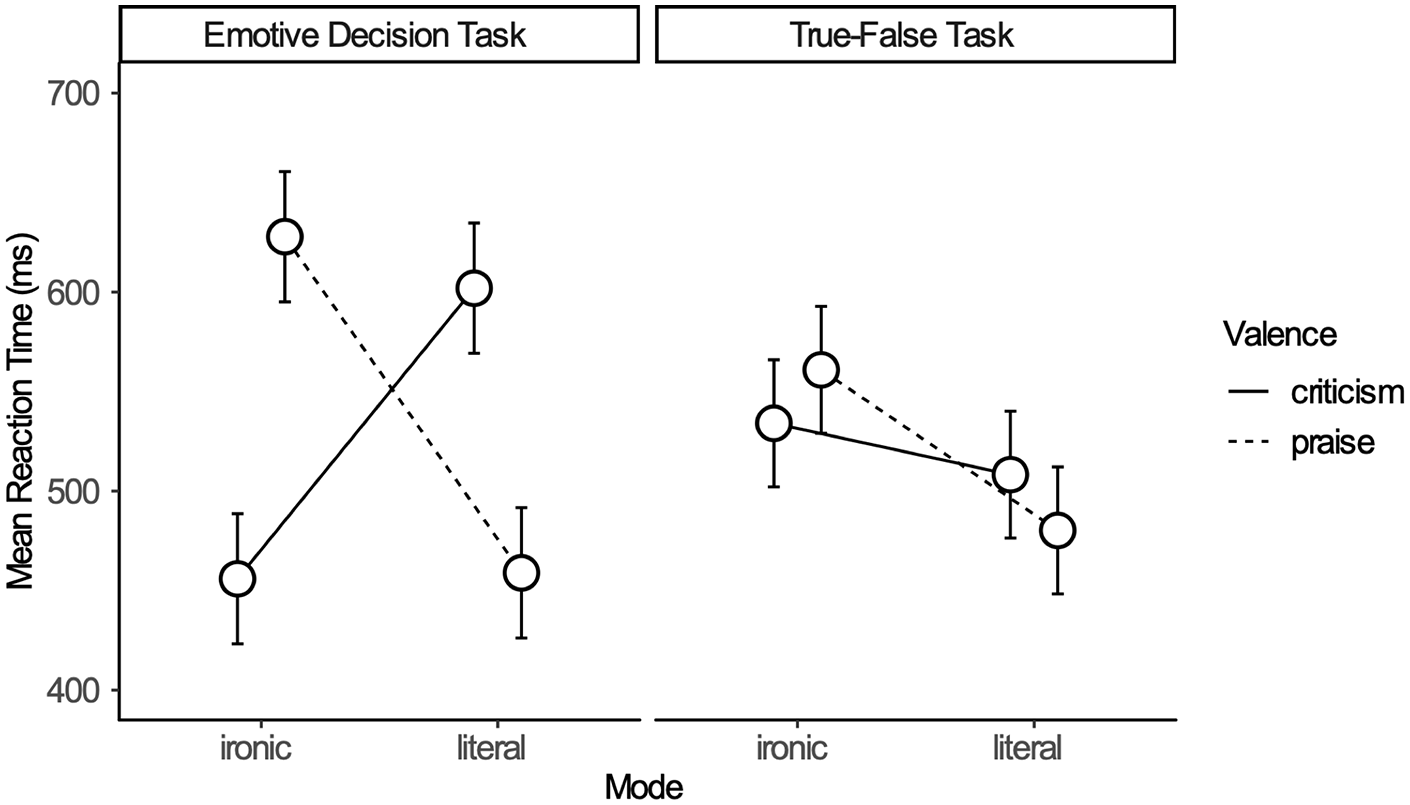
Mean response times (in milliseconds) to literal and ironic scenarios in T/F and EDT.
4.3 Response accuracy (ACC) data
We found a main effect of mode, F(1,148) = 33.88, p < .001,
Two 2-way interactions were significant. The 2× (task) and 2× (valence) interaction was significant, F(1, 148) = 9.00, p < .003,
The 2× (mode) and 2× (valence) interaction was also significant, F(1, 148) = 100.87, p < .001,
We also found a significant three-way interaction between 2× (task), 2× (mode), and 2× (valence), F(1, 148) = 71.37, p < .001,
Between-mode pairwise comparisons showed that in EDT ironic criticism, M = 86, 95% CI = (80, 92) produced higher accuracy than literal criticism, M = 78, 95% CI = (73, 83); t(211) = 2,20, at pbonf < .02; and literal praise, M = 84, 95% CI = (79, 90) revealed higher accuracy than ironic praise, M = 55, 95% CI = (50, 60); t(211) = −8,43, at pbonf < .001. In T/F task between-mode pairwise comparisons for criticism showed that literal criticism, M = 88, 95% CI = (84, 93) produced higher accuracy than ironic criticism, M = 76, 95% CI = (71, 81); t(211) = −3.89, at pbonf < .02; and similarly pairwise comparisons for praise showed higher accuracy for literal praise, M = 85, 95% CI = (80, 90) than for ironic praise, M = 69, 95% CI = (65, 74); t(211) = 4.91, at pbonf < .001.
Between-valence pairwise comparisons showed that in EDT ironic criticism, M = 86, 95% CI = (80, 91) generated higher accuracy than ironic praise, M = 55, 95% CI = (50, 60), t(291) = 13.51, pbonf < .001, and in T/F task, likewise, ironic criticism, M = 76, 95% CI = (71, 81) revealed higher accuracy than ironic praise, M = 69, 95% CI = (65, 74); t(291) = 3.30, at pbonf < .001. Between-Valence pairwise comparisons showed higher accuracy for literal praise, M = 84, 95% CI = (79, 80) than for literal criticism, M = 78, 95% CI = (73, 83) in EDT, t(291) = −2.93, at pbonf < .003, whereas in T/F task, the difference between literal praise and literal criticism was insignificant, revealing similar accuracy rates (p = .08). For a graphical representation of the interaction, see Figure 2.
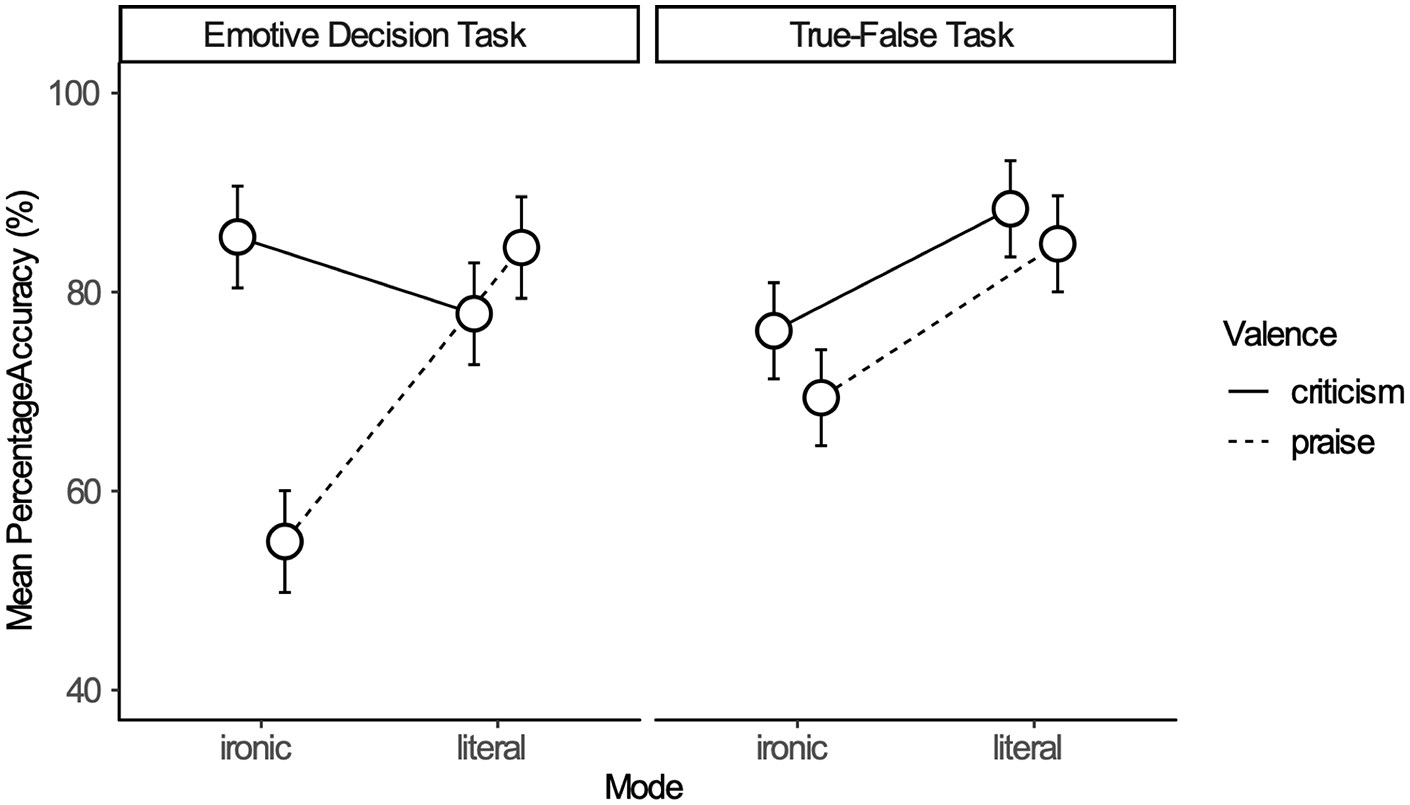
Mean accuracy rates (%) for literal and ironic scenarios in T/F task and EDTs.
5 Discussion
In this study, we tested whether the tasks influenced the speed and accuracy with which participants made decisions on the ironic and non-ironic meanings in English as their foreign language. We asked Polish users of English to perform two tasks: T/F task and EDT, each commanding attention to different aspects of ironic meanings. In the T/F task, we asked participants to decide on the truth/falsity of what was said/meant. To perform this task efficiently, individuals needed to focus on the truth value of the says/means distinction, and disregard the evaluative significance of the stimuli as task-irrelevant. In the EDT, participants were asked to decide whether the communicated meanings were praising or critical. Hence, in this task, participants needed to focus on the emotional value of the comments and disregard the truth-conditional meaning. We found that the speed and accuracy with which participants responded to ironic and non-ironic meanings varied systematically with the tasks.
Performing the T/F task, individuals responded faster and more accurately to literal meanings (literal praise, literal criticism) relative to ironic meanings. This pattern of results demonstrates that when focusing attention on the truth value of the comments, participants needed more time to respond to ironic comments, and their decisions were less accurate relative to literal comments. This facilitated processing of literal meanings and slower processing of irony concurs with prior studies testing irony comprehension in the native language context. For instance, Giora and Fein (1999), and Giora et al. (1999, 2007), investigating differences between critical irony and literal praise (identical target sentence) found longer response latencies for irony than for the literal meanings. The same pattern of results was also reported by several studies testing irony comprehension in the foreign language (e.g., Bromberek-Dyzman et al., 2010; Bromberek-Dyzman & Rataj 2016; Ellis et al., 2021; Shively et al., 2008) in the foreign language context.
Performing EDT, participants responded faster and more accurately to comments communicating positive emotional value, that is, literal praise, and ironic criticism (identical target sentence) relative to negative value, that is, literal criticism, ironic praise (identical target sentence). These patterns of results are consistent with Bromberek-Dyzman (2014) study which tested written irony in foreign users of English, and a range of studies testing irony in the native users of English (Dews & Winner, 1999; Gibbs, 1986; Schwoebel et al., 2000). On a more general level, these results also support prior findings showing advantageous processing of positive, and hindered processing of negative stimuli across a range of tasks (e.g., lexical decision task, EDT, emotive Stroop task) at a word level (e.g., Algom et al., 2004; Estes & Adelman, 2008; Kazanas & Altarriba, 2016; Kousta et al., 2009; Martin & Altarriba, 2017), and at a sentence level (e.g., Egidi & Gerrig, 2009; Ludtke & Jacobs, 2015). These results are also in line with the electrophysiological evidence showing : (1) facilitated processing of positively valenced stimuli: positivity offset, and (2) hindered processing of negatively valenced stimuli: negativity bias (e.g., Cacioppo & Berntson, 1999).
We also report distinct processing patterns observed for the two brands of irony, that is, critical and praising irony. Namely, we found that participants’ responses to critical and praising irony varied in speed and accuracy between the tasks. While in the T/F task participants responded slower and less accurately to both types of irony relative to literal meanings, in EDT participants’ response patterns varied for the critical and praising irony. Namely, critical irony was processed faster and more accurately than praising irony, indicating that ironic praise was more effortful, that is, took longer to respond and generated more errors relative to ironic criticism (cf. Dews & Winner, 1999; Gibbs, 1986). This finding is in line with the prototypicality claims positing that critical irony as a more frequent, and more expected irony brand is processed faster than the less frequent one (e.g., Kreuz & Link, 2002). This result points to the need to explore critical and praising irony as two distinct species of non-literal meaning rather than one generic brand, irony.
Theoretical accounts of irony often posit that the nature of irony is to communicate through incongruities—explicit/implicit, literal/non-literal, or praise for blame/blame for praise (e.g., Barbe, 1995; Booth, 1974). Carrying incongruities as crucial components of communicative meaning, irony by default is assumed to require more cognitive effort, that is, longer processing relative to literal meanings, which are free from incongruities (cf. Colston, 2002). The results we report for the T/F task are in line with the claims on the more effortful processing of irony, as participants responded longer and with lower accuracy to ironic relative to non-ironic meanings. Yet, the results we report for the EDT suggest that incongruity was not a determining factor when Polish users of English judged ironies for the evaluative intent (praising, criticizing). When making emotive choices, individuals needed more time to judge criticism relative to praise. Interestingly, they responded faster and more accurately to literal praise and ironic criticism (identical target sentence) relative to literal criticism and ironic praise (identical target sentence). This shows that meanings communicating positive attitudes either explicitly (literal praise) or implicitly (ironic criticism) regardless of incongruity (ironic criticism) were faster to judge than meanings communicating negative attitudes either explicitly (literal criticism) or implicitly (ironic praise). This finding might be taken to indicate that it was not so much ironic meaning that was more effortful to process, but rather the socially challenging attitude, that is, criticism.
Overall, the results we report show that foreign users of English used different cognitive strategies for comprehending irony in the task that demanded telling the (1) truth from falsity, and (2) praise from criticism. In the T/F task, participants were more efficient in literal meaning comprehension. When, however, comprehenders conceptualized the message as carrying primarily the evaluative import (EDT) they were more efficient (faster, more accurate) processing the positive relative to negative meanings. These findings show that when foreign users of English were reading ironic and non-ironic comments the speed and efficiency of the processing depended on how they conceptualized the aim of comprehension, that is, to judge the sincerity of the message (true or false), or the attitude behind it (praise or criticism). We, therefore, argue that the tasks determined the comprehension strategies participants adopted. This novel finding extends the foreign language research on irony by showing that efficient irony comprehension might be modulated by the task.
The current results might also be taken to alleviate the conflicting findings observed in prior studies showing that irony may be processed faster (Bromberek-Dyzman, 2014) and/or slower (Bromberek-Dyzman et al., 2010; Bromberek-Dyzman & Rataj, 2016) than non-irony. These discrepant patterns reported for irony comprehension in the foreign language context may have resulted from, among other possible causes, task-related comprehension strategies participants needed to pursue to perform these tasks. Based on the present results, we argue that in making sense of irony, either literal/non-literal or praising/criticizing content might take priority, and drive irony computation. Yet, which one prevails may depend on the adopted comprehension strategy.
In view of the prior studies showing that native and foreign users of a language may rely on a set of similar (e.g., Antoniou & Milaki, 2021; Bromberek-Dyzman et al., 2021) or different cues (e.g., Cheang & Pell, 2011; Peters et al., 2016) when making sense of ironic meanings, future studies should verify if the response time and accuracy patterns obtained in this study for advanced Polish users of English would be replicated for different groups of bilinguals, for example, bilinguals with different levels proficiency in their foreign or second languages, and for different tasks. Also, as this study examined student population of Polish users of English, future studies should examine how different age groups of foreign users of English comprehend irony in a selection of tasks. Finally, this study tested how tasks influence irony comprehension exclusively in the foreign language, therefore future studies should investigate if tasks moderate irony comprehension patterns differently in the native and foreign language of bilinguals.
6 Conclusion
In this study, we demonstrate that irony comprehension in foreign users of English was modulated by the comprehension strategy they adopted to perform the task at hand. While irony was processed longer than non-irony in the T/F task, in the EDT critical comments carrying negative evaluative meanings took longer to process relative to positive evaluative comments. Therefore, we posit that the cognitive strategy one adopts to interpret irony is task-related, and we argue that the efficiency (i.e., speed and accuracy) of irony computation is not entirely irony per se specific, and as such inherent in the concept of ironicity, but also depends on the comprehension strategy a comprehender adopts. Whether comprehenders rely on the same cognitive strategies when interpreting irony in their native and foreign languages, remains to be tested.
Footnotes
Data availability statement

Funding
The author(s) received no financial support for the research, authorship, and/or publication of this article.