



Abstract
A phenomenon called “repetition reduction” can increase articulation rate in adults by facilitating phonetic and motor processes, which indicates flexibility in the control of articulation rate. Young children, who speak much slower, may not have the same speech motor flexibility resulting in the absence of the repetition reduction effect. In this study, we tested whether spontaneous repetitions of young children are produced with a faster articulation rate than their original utterances. Twelve monolingual English-speaking children were observed at four time points between 2;0 and 3;0 years of age. A significant increase in articulation rate and syllable count was found using multilevel models for all utterances over the 1-year period. At each time point, however, the repeated utterances were produced significantly faster than the original utterances even though the content and syllable count differed minimally. Our findings conform to the pattern of adult studies suggesting that a “naturistic” form of repetition reduction is already present in the speech of children at 2;0 years. Although certain aspects of speech motor control are undergoing rapid development, existing motor capability at 2;0 already supports flexible changes in articulation rate including repetition reduction.
1 Introduction
Articulation rate is a complex product of coordination between thought conceptualization, lexical access, and syntactic and phonetic encoding that unfolds during articulation (Levelt, 1992; Levelt et al., 1999). The developmental sequence of articulation rate shows it increases rapidly from the onset of speech into adolescence with continuing but slower increases into the adult age span (Amir & Grinfeld, 2011; Duchin & Mysak, 1987; Hall et al., 1999; Jacewicz et al., 2009; Verhoeven et al., 2004; Walker & Archibald, 2006; Walker et al., 1992). Although there is no general or specific theory of articulation rate, it is thought to be constrained by factors like gender and dialect (e.g., Byrd, 1994; Jacewicz et al., 2009; Quené, 2008) along with linguistic and cognitive demands related to the intent of the speaker and speaking context (e.g., Dell et al., 1997; Dromey & Benson, 2003; Green et al., 2000; Jacewicz et al., 2010; Nip & Green, 2013; Rodd et al., 2020; Tasko & McClean, 2004; Walker & Archibald, 2006; Walker et al., 1992). One phenomenon, called “repetition reduction,” appears to show that articulation rate is adjusted automatically when a speaker is prompted to repeat an utterance (e.g., Jacobs et al., 2015; Lam & Watson, 2014). Upon repetition, the duration (vowel or word duration) is decreased compared to the original utterance. In other words, articulation rate increases when a speaker repeats an utterance. Numerous studies demonstrate repetition reduction in adult speakers (Fowler, 1988; Fowler & Housum, 1987; Jacobs et al., 2015, 2020; Kahn & Arnold, 2012; Lam & Marian, 2015; Watson et al., 2009) in which repeated words (target words) have a shorter duration than novel words (prime words). Repetition reduction is a robust phenomenon being present in sentence recall tasks (Shields & Balota, 1991), reading tasks (Baker & Bradlow, 2009), picture naming tasks (Kahn & Arnold, 2015; Lam & Watson, 2010; Vajrabhaya & Kapatsinski, 2011), and in more spontaneous tasks including event description (Jacobs et al., 2015; Lam & Marian, 2015; Lam & Watson, 2014) and narration (Fowler, 1988; Fowler et al., 1997). Our objective was to test whether repetition reduction is present in early speech development during spontaneous repetitions, which could indicate if young children are already able to vary articulation rate.
Although repetition reduction has been attributed to multiple factors, a parsimonious explanation is that it occurs through the accessibility and predictability of information (Wonnacott & Watson, 2008). This means that previous production of the target word primes future processing at the phonetic, auditory, and articulatory levels, thereby making the word easier and quicker to reproduce (Gahl et al., 2012; Jacobs et al., 2015; Kahn & Arnold, 2012, 2015; Lam & Watson, 2014; Levelt, 1992). Repetition reduction is distinguished from the typical connotation of articulatory reduction that consists of articulatory undershoot, reduced prominence, sound deletion, or less clear pronunciation in casual speech compared to formal speech. While certain aspects of these articulatory adjustments likely contribute to the reduced duration reported in repetition reduction studies, repetition is the effective stimulus for the shortening of the repeated utterance. Although speakers can vary their articulation rate deliberately to accommodate the speaking context (e.g., Miller et al., 1984; Quené, 2008), perhaps in terms of a “cognitive gait” (Rodd et al., 2020), the increase in rate for repetition reduction is considered more automatic (e.g., Gahl et al., 2012; Jacobs et al., 2015; Lam & Watson, 2014). The faster rate of the repeated utterance follows from previous preparation of phonological representations for the original production that facilitates speech motor production (Jacobs et al., 2015).
During early language development, children commonly repeat words, phrases, and complete sentences during spontaneous speech (Keenan, 1975). These repetitions become more prolific and refined until approximately 3;0 years of age when they decrease in frequency (Keenan, 1975; Kuhl & Meltzoff, 1996). While repetition may benefit speech and language development in terms of rehearsing complex language sequences and motor practice, the exact contribution remains debated (Kuhl, 2007). The limited time window in which children produce repetitions provides an opportunity to examine whether this form of repetition reduction exists in spontaneous context, that is, a naturistic form of repetition reduction. We hypothesize that if the articulation rate (syllables/s) of spontaneously imitated utterances is faster than the self-produced original utterances, then repetition is being facilitated by previous production in children as young as 2;0 years. In terms of advancing speech motor theory, testing whether young children can produce spontaneous repetitions more rapidly than the original utterances could reveal that speech motor priming facilitates repetition even in early development (Jacobs et al., 2015; Kahn & Arnold, 2012).
Changes in speech production for repeated words have been demonstrated in early ages (Walker & Archibald, 2006; Wonnacott & Watson, 2008). Four-year-old children were found to produce spontaneous sentences with greater acoustic prominence, also known as accent placement, on prompted words than on novel words, suggesting adult-like sensitivity to the discourse of more accessible versus new information (Wonnacott & Watson, 2008) even though the articulation rate of prompted words did not change. In addition to prompting single word repetitions, structured repetition has received attention of the researchers. Structured repetition is a prompt produced by another speaker in which a child repeats a model utterance produced by another individual. In their longitudinal study of children from 3;0 to 5;0 years of age, Walker and Archibald (2006) compared the articulation rate of spontaneous speech, automatic speech (nursery rhymes), repetition of an examiner’s speech, and imitation of self-initiated sentences. The repetitions and automatic speech produced by these children were faster than spontaneous speech at 3;0, 4;0, and 5;0 years of age. This suggests multi-word utterances can be produced faster than the original elicitation.
Repetition reduction in younger children could potentially be supported by flexibility in articulation rate control, suggested by the studies on preschool children between 2;0 and 5;0 years of age (Hall et al., 1999; Tendera et al., 2019; Walker & Archibald, 2006; Walker et al., 1992). The developmental studies of articulation rate (see Tendera et al., 2019) used a broad array of speech tasks (i.e., picture description, storytelling, open-ended questions) that showed variability in articulation rate, but none compared spontaneous utterances versus unsolicited repetitions. On the contrary, children under 3;0 have limited ability to repeat utterances when asked to repeat single or multiple syllables as rapidly as possible—maximum repetition rate (MRR). At 2;0 years, fewer than 50% of children were able to repeat single syllables and most were not able to reproduce prompted monosyllabic sequences (Diepeveen et al., 2019). Most other MRR studies have assessed children over 3;0 and have found that this ability continues to develop in speed and accuracy up to 7 years old and perhaps older (Scott Yaruss & Logan, 2002). Considering that children under 2;6 have even slower articulation rates, we predict their speech system is less flexible and consequently will not support repetition reduction (e.g., Grigos et al., 2005; Redford, 2015).
There are only a handful of longitudinal and cross-sectional studies that address early articulation rate development (see Tendera et al., 2019, for discussion). Articulation rate develops slowly being less than 3.0 SPS (syllables per second) at 2;0 and gradually increasing to approximately 4.5 to 5.5 SPS in adulthood (Chon et al., 2013; Jacewicz et al., 2009). In each developmental study, considerable variation in articulation rate was apparent across different speaking tasks, such as under the non-spontaneous conditions, for example, repetitions of utterances of various lengths and complexity (Walker & Archibald, 2006) and automatic speech tasks such as nursery rhymes or rehearsed repetitions (Walker & Archibald, 2006). The variation in articulation rate across tasks such as spontaneous speech versus reading in these studies can even exceed age-related differences. Testing for a capacity to vary articulation rate depending on speaking context in children under 3;0 years is also theoretically important for understanding developmental speech motor control.
Biological sex differences in the articulation rate of preschool and early school-age children has been previously discussed as a potential factor in speech motor development (e.g., Amir & Grinfeld, 2011; Amster, 1984; Olson & Koetzle, 1936; Robb et al., 2004; Ryan, 1992; Sturm & Seery, 2007; Tsao et al., 2006; Tsao & Weismer, 1997; Walker & Archibald, 2006; Walker et al., 1992). However, only three studies reported differences (Olson & Koetzle, 1936; Ryan, 1992; Walker & Archibald, 2006). The prominent reports of differences are from Ryan (1992) who reported the articulation rate of preschool girls was faster than preschool boys, while Olson and Koetzle (1936) suggested that boys between ages 3;10 and 4;9 spoke faster than girls. The longitudinal study by Walker and Archibald (2006) found that boys spoke faster in imitated speech at the age of 4;0 and in automatic speech conditions at 5;0. However, there were no differences between boys and girls for repeated utterances. Potential sex-related differences that could influence repetition reduction and articulation rate variation in early development need to be analyzed alongside other speech and language abilities.
We used a longitudinal design to test whether repetition reduction of spontaneous repetitions was present in children between 2;0 and 3;0 years, which differs from previous developmental articulation rate studies that used either structured repetition (Walker & Archibald, 2006) or randomized sets of target words embedded in short phrases (e.g., Lam & Watson, 2014). We compared the articulation rate of spontaneous utterances with self-repetitions produced after a brief interval based on transcribed recordings from naturalistic play conditions at 4 time points. We expected the speech production capability of the children would develop over the 12-month period as indicated by faster articulation rates and longer utterances for both the original and repeated utterances. Based on the MRR findings (Diepeveen et al., 2019), we predicted that repetition reduction would not be present at 2;0 years. Instead, significantly faster rates for the repeated utterances will only appear as the children approach 3;0 years, suggesting a gradual emergence of the flexible speech skills required for repetition reduction.
2 Method
2.1 Participants
The 12 participants (6 female) are a subset of the typically developing monolingual, English-speaking children from the Growth of Tense project at the University of Illinois at Urbana-Champaign (NSF; Rispoli & Hadley, 2009; see Hadley et al., 2013, for details of the participant group). Of the 42 typically developing children in Hadley et al. (2013), 12 participants were initially selected based on having scores from the MacArthur–Bates Communicative Development Inventories: Words and Sentences (Fenson et al., 2007) between the 16th and 84th percentile and on having at least 10 grammatical declarative sentences at 2;0 years (see Tendera et al., 2019, for details). Their broader speech samples included numerous self-repetitions that are the focus of the current study, which did not include the 10 grammatical utterances reported in Tendera et al. (2019).
2.2 Procedures
The children and their parents participated in a 1-hour play session at the Applied Psycholinguistics Laboratory at the University of Illinois, Urbana-Champaign. The first appointment at 2;0 years was followed by similar sessions at 2;6, 2;9, and 3;0 years. The play sessions began with a standard set of toys that included a kitchen set, a farm set, a Winnie-the-Pooh Bear, blocks, and age-appropriate puzzles. In the first 30 minutes of each session, parents and children were told to play as they would at home. In the second half-hour of each session, the dyad was joined by a research assistant whose primary role was to broaden the topics of conversation in the sample by periodically introducing new toys with semi-structured play scenarios such as giving baby dolls a bath or putting them in a crib, putting a “Potatohead” doll together or playing with wind-up toys. The entire session was recorded to CD and DVD. For details of the transcription procedures and the reliability statistics for these language samples, we refer to Hadley et al. (2013).
2.2.1 Speech sample selection
The estimation of average articulation rate was based on 10 pairs of original utterances accompanied by matching unsolicited repetitions solely produced by the child. Examples of analyzed utterance pairs include “I need more” (original utterance), “I need more” (repetition); “He does sit on it” (original utterance) “she does sit on it” (repetition). At the later time points, children produced longer utterances than at 2;0 and showed increasing complexity within the utterances. To control for possible length-of-utterance effects on articulation rate (see Pindzola et al., 1989; Walker et al., 1992), only utterances with 2 to 7 words were included. Repetitions were considered either exact matches of the original or highly similar utterances that differed by one word at most. Each utterance included in the corpus was a syntactically organized combination with at least two content words and a verb, but could be questions, imperative or declarative utterances. The repetition had to be produced either immediately after the compared or following a maximum of one unrelated utterance after the original utterance. Any utterances with unintelligible speech (such as “I need XX”), interruptions by other speakers, imitation of a caregiver’s utterance, a disfluency, or a pause exceeding 250 ms were excluded.
2.2.2 Speech sample processing
Ten utterances that met the selection criteria were coded in the original transcript to guide the extraction of samples from the audio record as discrete wav files corresponding to a single utterance (see Tendera et al., 2019; Wondershare Software). A noise reduction algorithm included in the Audacity Software was used to increase the signal-to-noise ratio (Mazzoni & Dannenberg, 2000). To ensure the noise reduction did not compromise the clarity of the speech sample, five samples from two different participants were compared with and without noise reduction. Each sample started with a vowel (e.g., “I like pizza”), a stop consonant (e.g., “Pig need bath”), or a fricative (e.g., “that goes there”). In each case, two raters agreed that (a) noise reduction did not compromise the perceptual clarity or number of syllables and (b) that the start and end points (see below) of the samples on a spectrogram could be more readily identified on the samples with noise reduction. After the speech samples were preprocessed, the onset and offset points of speech production for each utterance were manually marked on an oscillogram while concurrently viewing a wide-band spectrogram (PRAAT, Boersma & Weenink, 2007). The difference between the two time points corresponds to the duration of an utterance. The number of syllables was counted by two trained lab assistants whose native language is American English. The syllable count was based on the actual number of syllables realized in the acoustic sample (e.g., “gonna”—two syllables) rather the canonical orthographic form (e.g., “going to”—three syllables).
2.3 Measures
2.3.1 Articulation rate
Following our previous study (e.g., Tendera et al., 2019), the number of syllables in each utterance was divided by the duration between speech onset and offset to give articulation rate at each time point.
2.4 Reliability
Dependent t-tests were used to compare a random selection of 20 samples of syllable counts per utterance and duration (seconds) from each rater. There were no differences between raters for either syllable count or duration: syllable count: t(19) = 1.02, p = .58, and duration: t(19) = 1.13, p = .23. Point-by-point agreement in syllable count and duration between the two raters were also estimated by Pearson correlation coefficients, which exceeded .95 for each measure and were significant (p < .0001 for each measure). Given these high reliability estimates, the average value of the two raters for each measure was used for subsequent determination of the dependent variables.
2.5 Data analysis
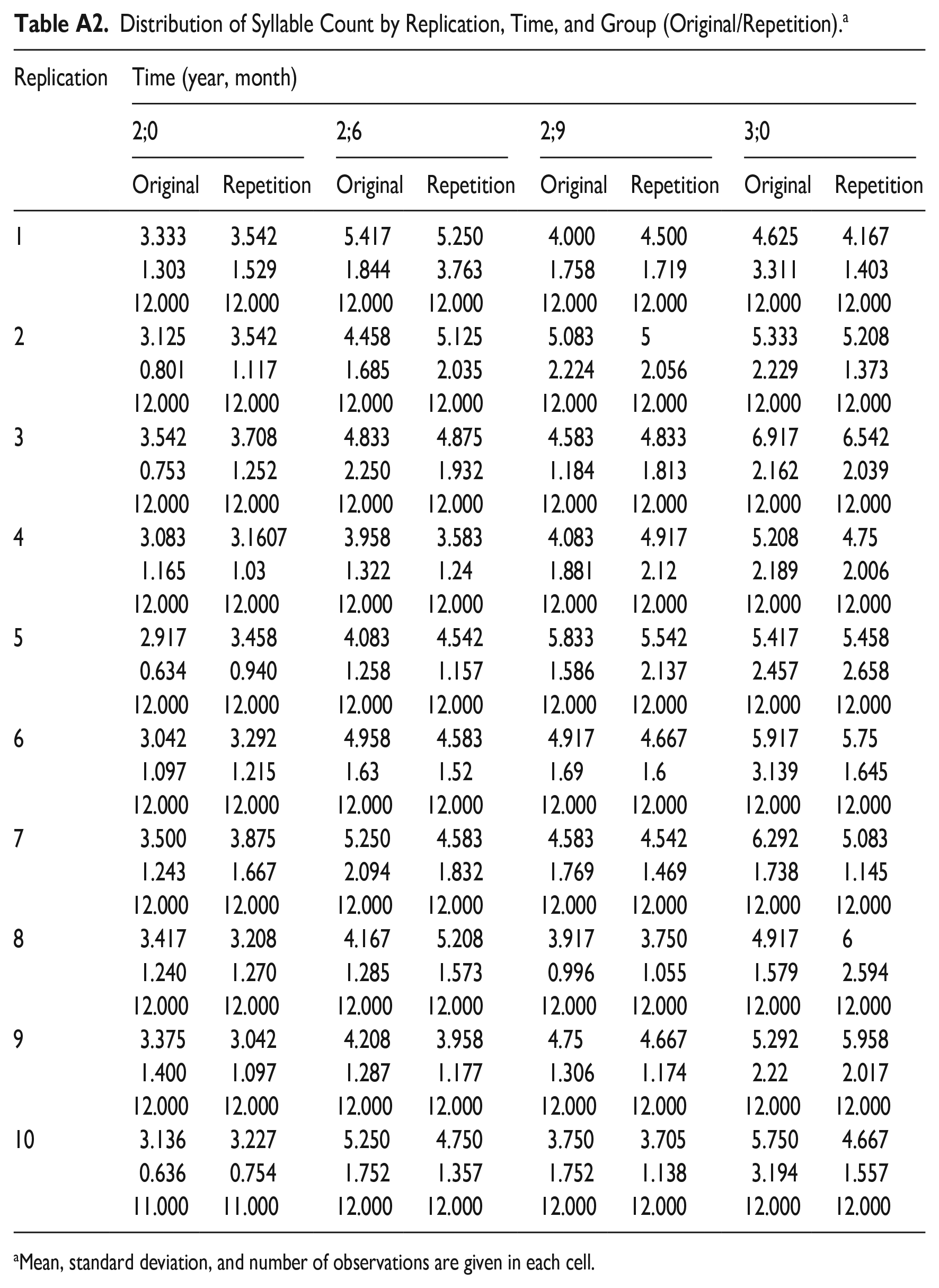
Descriptive data for articulation rate and syllable count by replication, time, and group (original/repetition) are listed in Tables A1 and A2 of Appendix A. A dichotomous variable (group) was defined to distinguish the original utterances (group = 0) and their repetitions (group = 1). A dichotomous variable was also defined to indicate biological sex (boys = 0, girls = 1). Independent multilevel models (MLM) were used to investigate the longitudinal pattern of articulation rate and syllable count (Singer & Willett, 2003), with the first level describing the within-subject change over time in the outcome variables (i.e., articulation rate). This approach is similar to that of Quené and colleagues (2008) to model between- and within-speaker variation in speech tempo. Data from the full set of utterances were included in the statistical models rather than aggregates (i.e., means). Syllable count was included as a fixed effect in the MLM for articulation rate to control for the potential confound of variations in utterance length. Time was coded as nonlinear in months (24, 30, 33, 36) and was rescaled by subtracting 24 to move the baseline to 0 and simplify the interpretation of the MLM. The second level described between-subject variation (e.g., in the original utterances) and the third level described between-replication variation. Initially, a simple variance component model was fitted to identify within-subject, between-subject, and between-replication variation in the outcome variables. Due to minimal variation between-subjects and between-replications, the group variable was considered a fixed effect in the MLM. Biological sex was included as a fixed factor in the MLM following Tendera et al. (2019). A random slope and a fixed effect were considered for linear time at the subject level to allow for between-subject variation in the linear relationship between time and syllable count. Quadratic and cubic time were considered as fixed effects in the MLM to allow for nonlinearity in the time course. (Ignoring these terms could compromise the fit of the data.) Statistical significance of the interaction effects between the fixed effects in the MLM was examined and any significant interactions were retained in the final model. Consequently, the shapes of the average trajectories for articulation rate depended on the coefficients for the linear, quadratic, and cubic time variables, whereas shapes of the average trajectories for syllable count depended on the coefficients for the linear, quadratic, and cubic time variables and their interactions with sex. The final MLM for articulation rate is shown here:

The final MLM for syllable count is shown below:
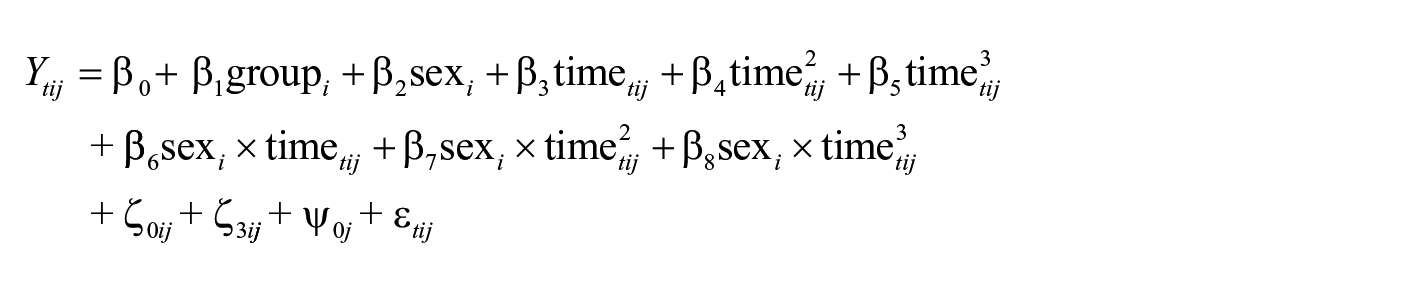
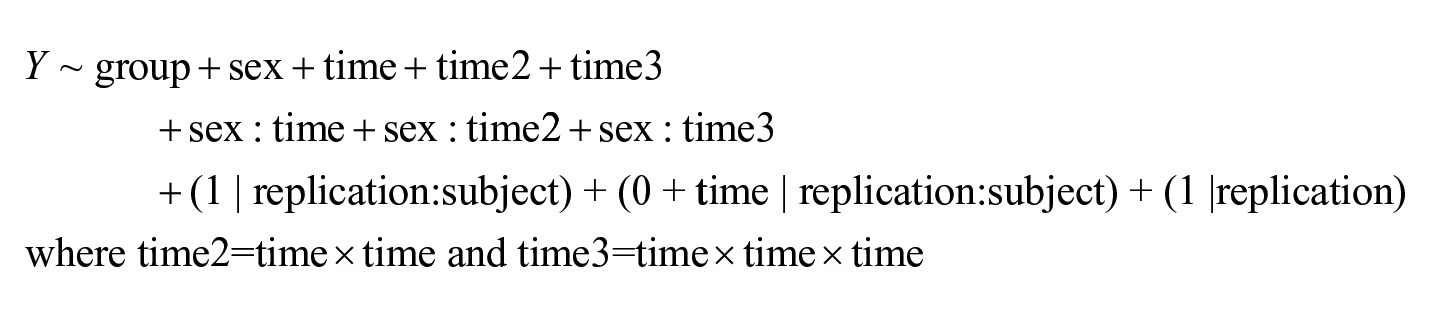
where t = 24, 30, 33, 36; i = 1, 2, . . ., 12; j = 1, 2, . . .,10; ζ0ij and ψ0j are the random intercepts at level 2 and level 3, respectively, ζ3ij is the random slope for time at level 2, and ε tij is the residual at the level 1. Ytij indicates the measurement of articulation rate or syllable count at time t for child i and replication j. time tij indicates the time point at which the dependent variable (Y) was measured for child i and replication j. For both dependent variables (articulation rate and syllable count), covariance between ζ0ij and ζ3ij was not significant and was assumed to be independent. Wald tests were used to test the statistical significance of the fixed effects, and likelihood ratio tests were used to test the significance of the random slopes and the interactions between the fixed effects. The predicted trajectories of articulation rate and syllable count for the original utterance and repetition groups were plotted separately for boys and girls. Syllable count was fixed at the overall average value for plotting the trajectories of predicted articulation rate. Statistical analysis was conducted using the mixed command in the statistical software, STATA 15. (StataCorp, 2017. Stata Statistical Software: Release 15. College Station, TX: StataCorp LLC.). The final MLM for articulation rate based on lme4 syntax (Bates et al., 2015) in R (Ver. 1.4.1103) is given below:

The final MLM for syllable count based on lme4 syntax (Bates et al., 2015) in R (Ver. 1.4.1103) is given below:
3 Results
3.1 Articulation rate
The average articulation rate of the original utterances increased from 2.77 SPS at 2;0 years to 3.39 SPS at 3;0 years (Figure 1(a)). There was a corresponding increase in the articulation rate of the repetitions from 3.05 SPS (2;0 years) to 3.81 SPS (3;0 years). An increase for both utterance types was not observed between each time point, but there was a clear increase between 2;9 and 3;0 years. Repeated utterances were produced more rapidly than original utterances across the time points. As per Figure 2(a) and (b), the articulation rate of boys and girls both show overall increases across time for both utterance types. Although descriptively there appears to be considerable variation over time, the articulation rate of boys was faster than girls.
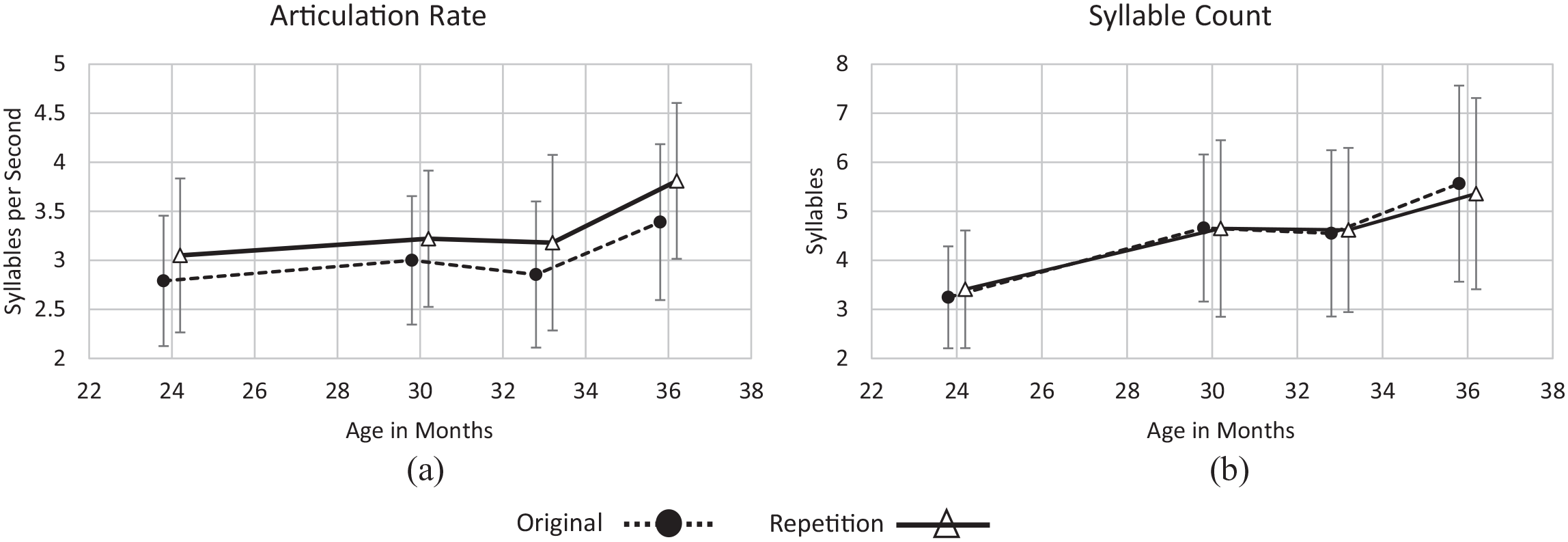
The distribution of articulation rate (a) and syllable count per utterance (b) at the four time points are illustrated with separate lines for original utterances and their repetitions. The error bars indicate between-subject standard deviations.
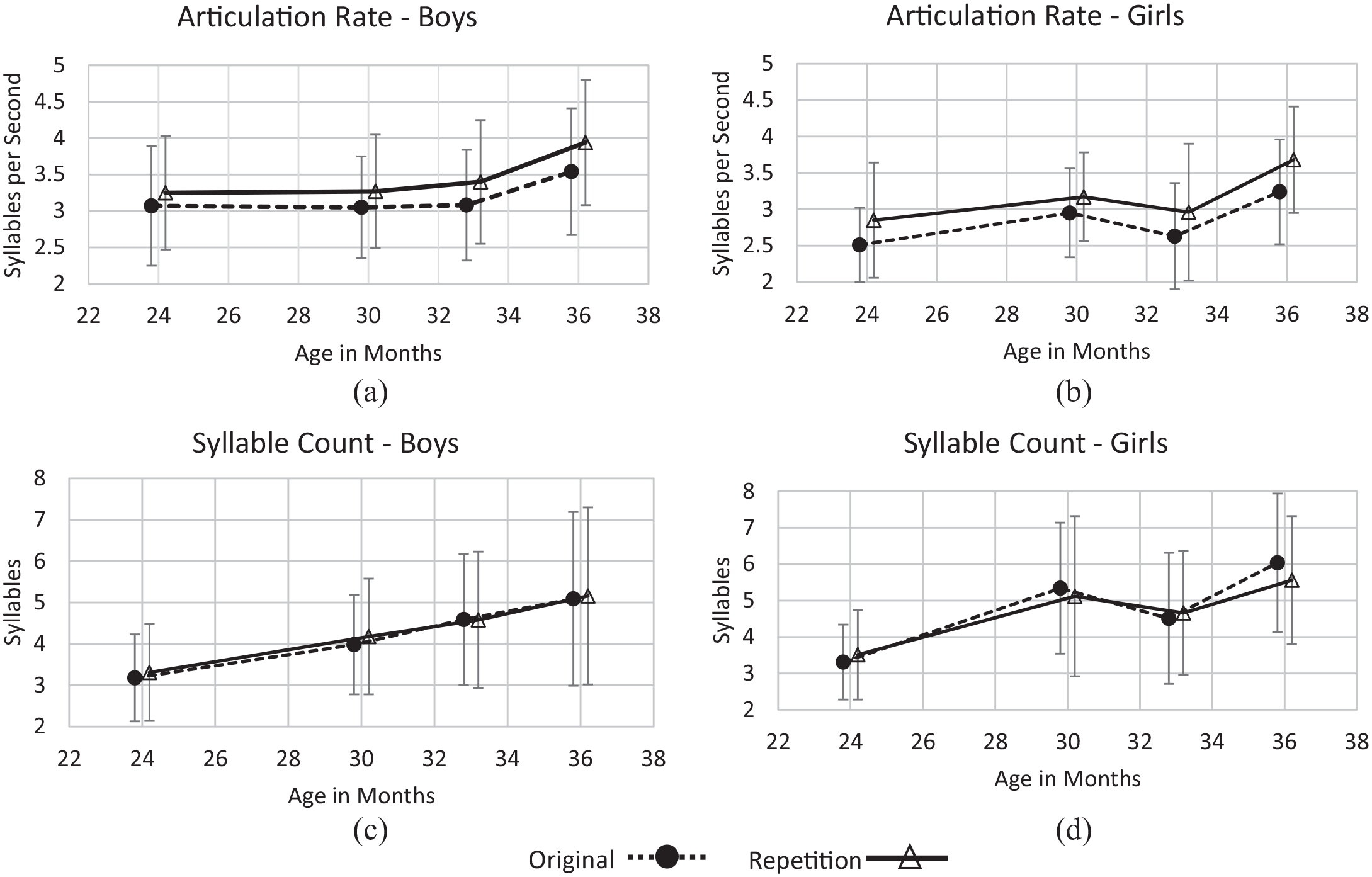
The distribution of articulation rate (a and b) and syllable count per utterance (c and d) for boys and girls at the four time points are illustrated with separate lines for original utterances and their repetitions. The error bars indicate between-subject standard deviations.
In the final MLM for articulation rate, the factors of group, syllable count, and sex along with linear, quadratic, and cubic time were significant (Table 1). A nonlinear trajectory provided the best fit for the articulation rate of both utterance types in the final MLM. The likelihood ratio test for the inclusion of a random slope for the time variable at the subject level was not significant so the random slope for time was not retained in the final model. As per the random effects shown in Table 1, the variation within children was greater than the variation observed between subjects and between replications. There was a significant difference in average articulation rate between original and repeated utterances at baseline (2;0 years). The interactions between the group factor and the linear and nonlinear time variables were not significant in the final MLM indicating the differences between the two utterance types was maintained over time after adjusting for syllable count, sex, and time (Figure 3(a) and (b)). There were no significant interactions between group and syllable count or group and time in the final MLM.
Results From the Multilevel Model for Articulation Rate (Syllables/s) and Syllable Count Between 2;0 and 3;0 Years.
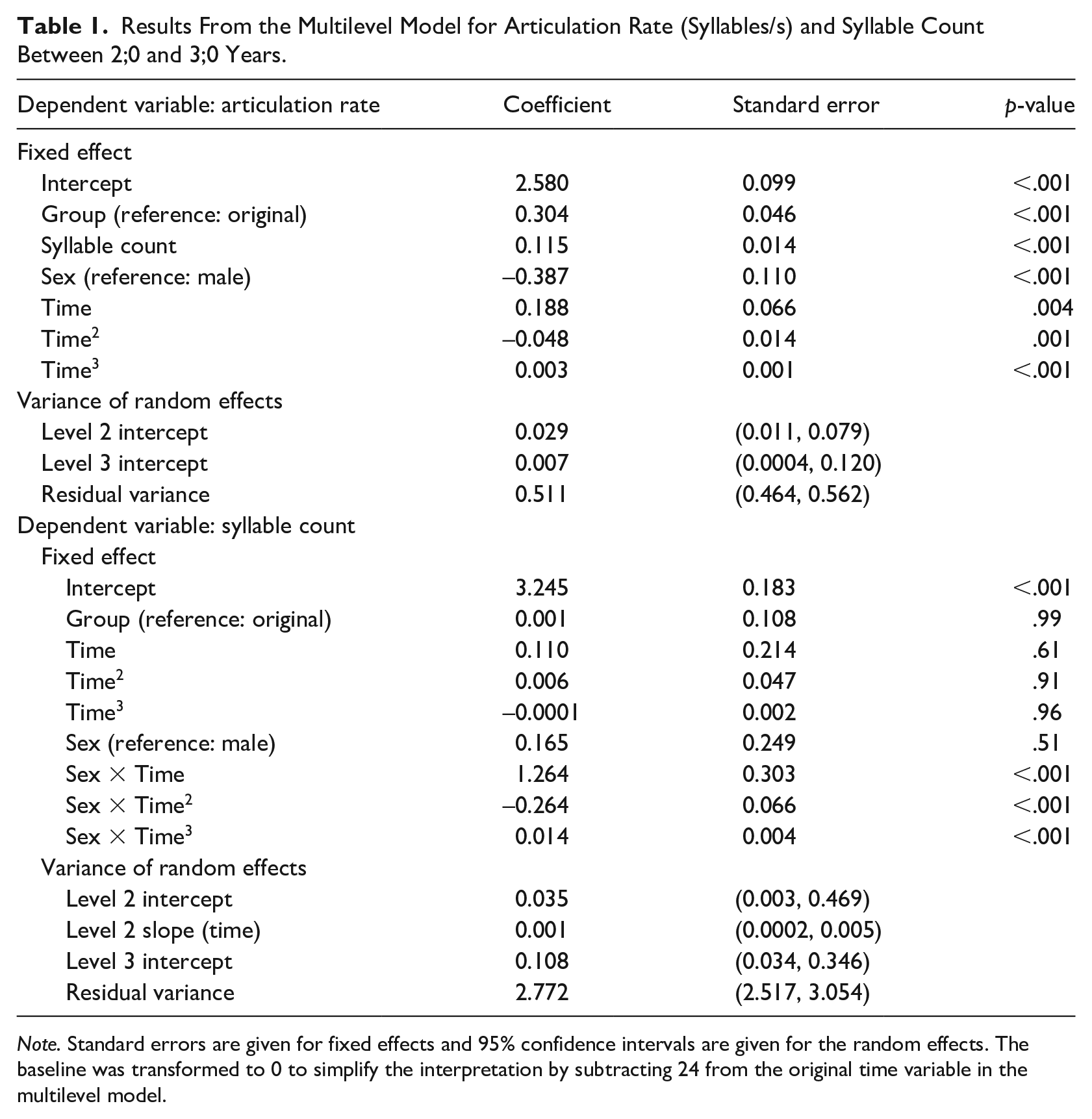
Note. Standard errors are given for fixed effects and 95% confidence intervals are given for the random effects. The baseline was transformed to 0 to simplify the interpretation by subtracting 24 from the original time variable in the multilevel model.
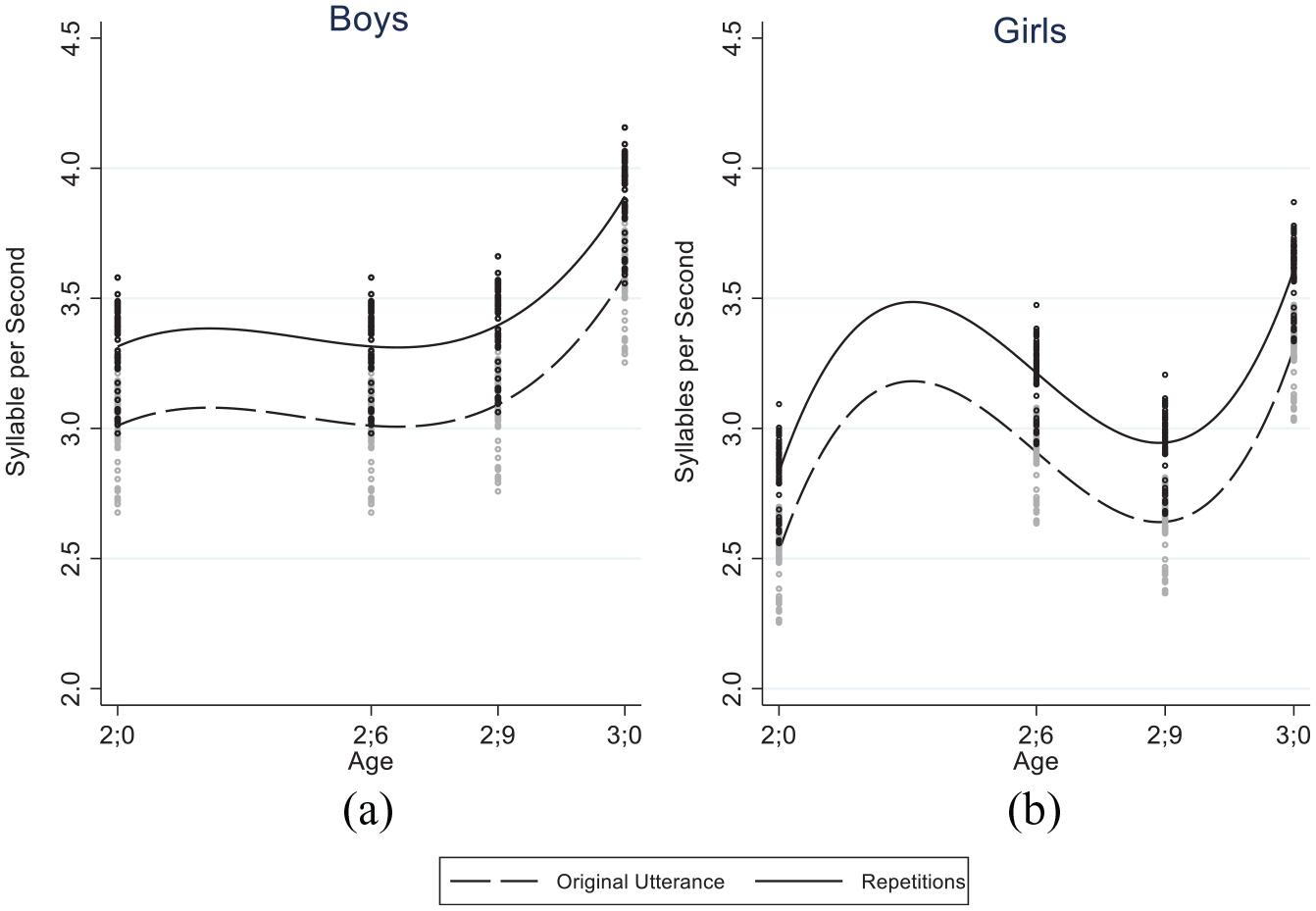
The predicted average trajectories from the multilevel model for articulation rate of original utterances and their repetitions are plotted for boys (a) and girls (b). Gray circles indicate individual observations of original utterances. Dark squares indicate individual observations of repeated utterances.
The average articulation rate of boys was significantly higher than girls at baseline. No significant interactions between group and sex were observed indicating there were no significant sex-related differences in the articulation rate of the two utterance types. As shown in Figure 3(a) and (b), there was an increase in the modeled trajectory from 2;0 to 2;6, followed by a decrease between 2;6 and 2;9 and a subsequent increase from 2;9 to 3;0 for boys and girls.
A sensitivity analysis was conducted to examine the influence of the 12 participants on the observed sex differences in the articulation rate. In the sensitivity analysis, a cross-validation of MLM was carried out by fitting 12 MLMs leaving out one speaker at a time to examine the statistical significance of sex differences in the observed results. Sex differences in articulation rate were significant in all the 12 MLMs indicating the observed sex-difference in a robust finding despite the small sample.
3.2 Syllable count
The repeated utterances corresponded almost identically in length and syllable composition to the originals. As shown in Figure 1(b), the mean utterance length increased from 3.24 syllables per utterance to 5.36 syllables per utterance between 2;0 and 3;0 years. As per Figure 2(c) and (d), the syllable pattern for both boys and girls showed overall increases in syllable count for original utterances and repetitions.
In the MLM for syllable count, the quadratic and cubic time factors, along with the interaction effect between cubic time and sex, were significant indicating that a nonlinear trajectory provided the best fit for syllable count. The likelihood ratio test for inclusion of a random effect for the time variable was significant (p = .04) so the random effect was retained in the final model. As per the random effects shown in Table 1, within-subject variation was greater than between-subject and between-replication variation. The modeled trajectories for syllable count were identical and overlapping for original and repetition utterances (Figure 4(a) and (b)). There were no significant interactions between group and time or between group and sex in the final MLM.
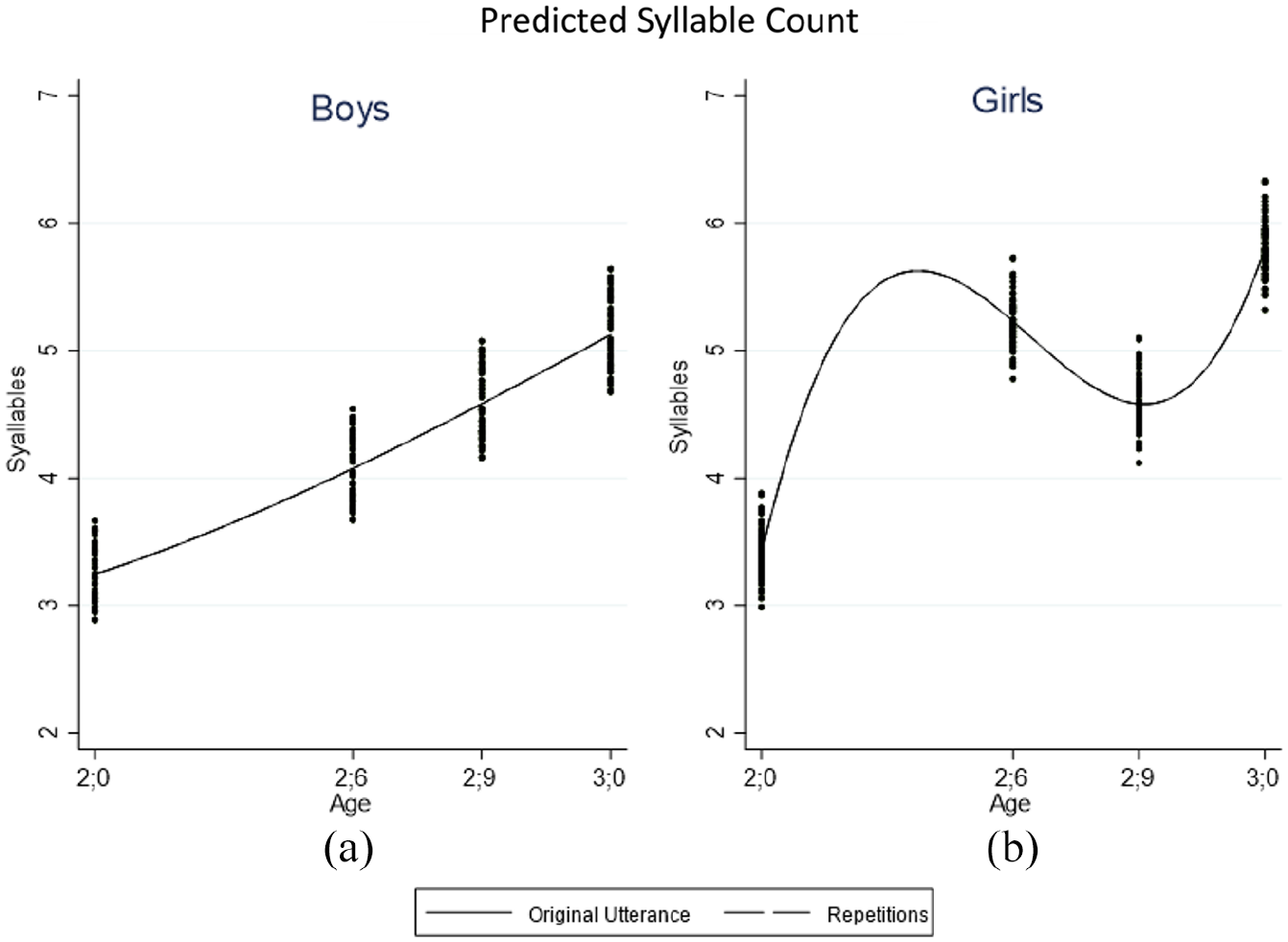
The predicted average trajectories from the multilevel model for syllable count of original utterances and their repetitions are plotted for boys (a) and girls (b). The predicted trajectories of both utterance types along with the predicted individual observations are highly similar and are shown to overlap.
The average syllable count of girls was significantly higher than that for boys at baseline (2;0 years). The interactions between sex and the linear and nonlinear time variables were significant indicating that the rate of change in syllable count differences between boys and girls varied over time after adjusting for the group factor in the MLM. As shown in Figure 4(a) and (b), the modeled trajectory of syllable count for boys was almost linear, whereas the trajectory for girls was nonlinear with a pattern that resembled articulation rate (Figure 3(b)).
4 Discussion
In this longitudinal study, we predicted a naturistic form of repetition reduction would contribute to a faster articulation rate for repeated utterances compared to the original utterances, but this difference would only appear at later time points. We also expected the articulation rate and length (syllable count) of all utterances would increase over this 1-year period in preschool children. Overall, the articulation rate of the original utterances and repetitions increased significantly from 2;0 to 3;0 years with repetitions being consistently produced faster at each of the four time points. The repeated utterances differed minimally from the originals while utterance length in syllables increased significantly over time. It appears that speech production went through active development over this period, but repetition reduction was already present at the earliest age and the degree of reduction remained similar at each time point.
We did not attempt to study aspects of articulatory reduction using a phonetic approach that could have focused on the acoustic and kinematic properties of sounds and syllables. As these spontaneous samples varied broadly in content, a consideration of the whole utterance was more appropriate. This approach is therefore more exploratory in nature and needs to be followed by designs that control for utterance type and presentation format. Our purpose was to test if repetition reduction is present and when it emerges in spontaneous repetitions. In the following sections, we consider the capacity for repetition reduction in young children followed by discussing the relevance of the findings for understanding articulation rate development.
4.1 Repetition reduction in preschool children
We tested whether speech production is facilitated by repetition in terms of faster articulation rate that could conform to the studies showing repetition reduction in adults (e.g., Jacobs et al., 2015; Kahn & Arnold, 2012). The children exhibited spontaneous repetitions that were consistently produced at faster articulation rates by the children at 2;0 years of age and at every subsequent time point. The degree of repetition reduction did not interact with the predictors in the MLM, meaning it did not depend on utterance length, biological sex, or age over this critical age range for language development. The consistent reduction was also maintained over 1 year even with overall increases in articulation rate and syllable count. The unique contribution of our study, despite the small sample, is a demonstration that consistent reduction occurs in very young children who regularly employ repetition.
Spontaneous repetitions in the speech of young children potentially have a supporting role for early speech and language acquisition (Kuhl, 2004; Kuhl & Meltzoff, 1996), by functioning as a form of paired learning. Through frequent repetition, a child may learn to recognize and practice new language structures (Locke, 1997; Schwab & Lew-Williams, 2016). There are no directly comparable studies of repetition reduction in children using a spontaneous conversation context. In Walker and Archibald (2006), children repeated a familiar phrase after a model produced by the experimenter, which was then compared to spontaneous speech. The rate of the structured repetitions was faster than spontaneous speech in these 3- and 6-year-old children. These results resemble speech repetition studies of adult samples in which repeated productions were articulated with shorter duration (Fowler, 1988; Fowler & Housum, 1987; Jacobs et al., 2015; Lam & Marian, 2015; Watson et al., 2009).
Our findings contrast with the MRR studies (MRR) that reported inconsistent performance in 2-year-old children (Diepeveen et al., 2019), indicating repetition ability may not be fully consolidated. The nascent phonological and speech mechanisms in children around 2;0 may support effective spontaneous repetition, but formal elicitation of rapid imitation like the MRR task may still exceed the attention and working memory resources of children in this age range (Scott Yaruss & Logan, 2002; Wit et al., 1993). Once over 3;0 years, children begin to perform better on MRR tasks (Diepeveen et al., 2019; Williams & Stackhouse, 2000) which could also allow for more formal investigation of repetition reduction, even though the capacity is present already.
In adults, repetition reduction has been attributed to various factors, but recent discussions propose a priming of auditory, phonological, and phonetic processing as having a primary role in facilitating a reduction in speech duration (Adams & Gathercole, 1995; Jacobs et al., 2015). When repeating, speakers access a previously formed or primed utterance for direct articulation (Gahl et al., 2012) so there are no extra/additional cognitive or language processing demands allowing for an increased articulation rate. Jacobs et al. (2015) showed that only overtly produced words led to repetition reduction, whereas silent mouthing did not result in reduction (Jacobs et al., 2015). The authors argued that the repetition reduction effect could be mediated by auditory feedback that helps to retain an auditory trace of the information, which is used by phonological and phonetic processes to execute faster speech. However, repetition reduction does not depend solely on auditory feedback. Jacobs et al. (2020) showed that auditory masking of a speaker’s overt speech production did not eliminate repetition reduction. They hypothesized that speakers can access other forms of sensory feedback, such as somatosensation or overlearned feedforward processes to prime the target word. It is not clear how and if repetition reduction occurs in young children as a study of the mechanism is outside the scope of this study. It is highly probable that repetition reduction in children and adults is due to similar facilitation of production mechanisms, but young children could be more dependent on intact auditory feedback.
Another consideration is that spontaneous repetition in young children could function as a motor practice mechanism (Caruso & Strand, 1999) in which spontaneous repetitions allow for more accurate speech motor performance with an accompanying increase in articulation rate (Schulz et al., 2001). Walsh et al. (2006) observed the articulation rate of nonwords increased after the first attempt at articulation in 9- to 10-year olds, which was interpreted as a practice effect. A similar view was given by, who found that children under 2;0 years of age had faster articulation rate as their familiarity with previously articulated words increased. On the contrary, the reduction in articulation rate reported here occurred after singular repetitions of novel phrases during play. A single production of an utterance is difficult to reconcile with a motor practice effect, much less motor learning, which leaves a priming effect or facilitation as a more likely explanation.
Future studies require more formal designs to test repetition reduction in young children, which should be possible as these designs often utilize basic picture naming. Another important extension of this observational format will be to compare whether repetitions of a caregiver’s speech (child-directed speech) are also spoken more rapidly than self-generated speech (Schwab & Lew-Williams, 2016). Our findings are relevant to theoretical considerations as the speech motor priming that facilitates repetition reduction is already present at 2;0 despite the relatively slow articulation rates at this age.
4.2 Articulation rate development
Articulation rate is the articulatory outcome of sequencing speech units generated by covert time-dependent processes of thought conceptualization, lexical access, and syntactic, phonological, and phonetic encoding (Levelt, 1992; Levelt et al., 1999; Miller et al., 1984). Nonetheless, speech motor and language processes are not the sole determinants as the realized articulation rate of a speaker is demonstrably influenced by cognitive processes, being potentially set by different cognitive gaits to suit the speaker’s intent and context (Dell et al., 1997; Dromey & Benson, 2003; Green et al., 2000; Jacewicz et al., 2009, 2010; Nip & Green, 2013; Rodd et al., 2020; Tasko & McClean, 2004; Walker & Archibald, 2006; Walker et al., 1992). The articulation rate of adult speakers also depends on the task (speaking vs. reading), age, biological sex, and even dialect (Jacewicz et al., 2009; Verhoeven et al., 2004). In typical development, articulation rate increases gradually and reaches an adult-like distribution in middle to late adolescence (e.g., Kent & Forner, 1980; Kubaska & Keating, 1981; Nip & Green, 2013; Tingley & Allen, 1975).
The third year of life is an important maturational stage for the speech and language mechanisms that support articulation of speech sounds and articulation rate (Redford, 2015). During this time, children become sophisticated grammar-users who are able to build longer utterances to effectively communicate an idea (Bock & Levelt, 1994; Rispoli et al., 2009). Moreover, speech motor skills become more refined and allow for faster and more precise articulatory movements (Green & Wilson, 2006; Nip & Green, 2013). Our findings, which demonstrated that children spoke faster and with longer utterances, might be interpreted as a symbiotic development of language and speech motor capacities.
We reported previously that the articulation rate of a single utterance type (active declarative sentences or ADS consisting of at least a subject and verb) increased significantly over this 1-year period in the same children (Tendera et al., 2019). In this repetition study, a wider variety of utterance types were surveyed with all utterance types (including the original and repeated utterances) showing a significant increase in rate over time. This supports the general observation that articulation rate increases over time for all utterance types, but this interpretation is complicated by the nonlinear growth patterns (see below). Another interesting difference between the two studies is that the utterances in the current study were produced at faster rates than the ADS of the first report. This difference could indicate that ADS were more difficult to formulate than the varied questions and informal utterances of the current language sample. A relationship between cognitive demand and articulation rate is important for understanding how language demands impinge on speech production. From another perspective, the variation in articulation rate from the slower ADS to the faster repetitions demonstrates these children are already demonstrating considerable flexibility in articulation rate that, in turn, could have made repetition reduction possible.
Our observed average articulation rates at the youngest age (2;0 years) was 2.7 SPS, which approximates the only other report of articulation rate in children under 3;0 by Amster (1984), who reported a rate of 2.87 SPS. Amster (1984) analyzed all spontaneous productions, which broadly resembles the current language sample and could account for the correspondence. At the last time point (3;0 years), the average articulation rate increased to 3.40 SPS, which approximates the cross-sectional study by Walker et al. (1992). Therefore, the articulation rates in this longitudinal study correspond to the literature and provide a broader picture of young children’s articulation rate development and capability.
In addition, articulation rate did not depend on utterance length in this sample of utterances between 2 and 7 words. This range of utterance lengths still allowed for considerable variation in articulation rate within and across time points. Although anticipatory shortening (e.g., Lindblom & Rapp, 1973) results in slower articulation rates for short utterances versus longer utterances, utterance length variations in rate did not influence the presence or degree of reduction. It remains possible that utterances longer than 7 words could change this articulation rate pattern, but such longer utterances might only be present at the later time points or older ages.
An unexpected finding that is harder to reconcile with Tendera et al. (2019) is the nonlinear trajectory of articulation rate development. The MLMs of the first study were linear, which was the first report to show how articulation rate changes over time in children under 3;0; however, the best-fit MLMs of the current study were nonlinear. There was an increase in articulation rate from 2;0 years and followed by a decline between 2;6 and 2;9, and a consistent increase until 3;0 years in both girls and boys. This nonlinearity did not result from significant interactions with the other factors. Although we previously posited that linear articulation rate development was important (Tendera et al., 2019), there is clearly more to be understood. The nonlinearity could be partly attributable to the variety of utterance types in this sample. In Tendera et al. (2019), only one utterance type was studied, whereas the current study included a wide range of utterances including imperative statements, questions, and varied combinations of grammatical or nongrammatical productions. The different utterance types could have varying developmental trends that produce a nonlinear pattern of growth when combined. Even though nonlinear growth in articulation rate has been suggested previously when articulation rate did not increase in a longitudinal sample of older children, the experiment did not have enough time points to evaluate growth models (Walker & Archibald, 2006). By following articulation rate (and syllable count) over 4 time points, we identified potential for nonlinearity in early AR development. Different development trajectories (linear and nonlinear) imply complex influences on articulation rate development. It is crucial to acknowledge these findings of nonlinearity are based on a small sample size so further study with larger groups of children is warranted. Our results along with the aforementioned studies demonstrate that preschool and school-age children can alter articulation rate when repeating real words and nonwords, which suggests an early capacity for repetition reduction lies within a flexible speech motor system.
4.3 Syllable count
The increase in articulation rate was accompanied by increases in utterance length over the observation period. This is expected from most accounts of early language development and was discussed in Tendera et al. (2019). Longer utterances illustrate an expanding speech and language capacity for varied utterances, including the more challenging ADS of the previous study (Tendera et al., 2019). The range and degree of change in syllable count was similar to our previous report (Tendera et al., 2019); however, this variation and change in utterance length did not interact with the degree of repetition reduction. The most prominent difference relative to Tendera et al. (2019) are the significant interactions between time and sex that are illustrated by the linear trajectory that provided the best fit for boys while a nonlinear fit was indicated for girls. This contrasts sharply with Tendera et al. (2019) where a linear fit was found for both sexes. These differences in trajectory could mean there are multiple influences on utterance length, including motoric and linguistic factors, and that utterance length should be studied alongside articulation rate. A nonlinear trajectory could also result from the variety of utterance types that were included in the current sample of repeated utterances (e.g., ADS, questions, imperatives), each of which could have different developmental trajectories, whereas the linear fit in Tendera et al. (2019) have resulted from focusing exclusively on grammatical declarative sentences. However, utterance variation would only account for the nonlinear pattern of the girls. The developmental implications of linear versus nonlinear growth in utterance length remain unknown, but the variation and degree of change in length calls for more detailed study specific to utterance type. Acoustic duration of the utterances was not explicitly reported herein, but it could be considered an important variable for future work along with collection of larger and longer samples over an extended time period. Although these interactions between syllable count and sex are empirically and theoretically interesting, we again acknowledge they are based on small samples and are interpreted cautiously.
4.4 Sex differences
Significant differences between the male and female children were found that followed the pattern of our previous study. The males spoke more rapidly at each time point while the female participants produced longer utterances (Tendera et al., 2019). These findings are supported further by the sensitivity analysis. Sex differences in articulation rate have been reported in some but not all studies of children (e.g., Amster, 1984; Walker & Archibald, 2006; Walker et al., 1992). A general interpretation of the current findings is that the participants were the same as our previous study, so their articulation rate and syllable count differences extended to different utterance types. This does not preclude hypotheses that meaningful developmental differences in articulation rate or utterance length are related to sex. Indeed, studies of adults report that men tend to have a faster articulation rate than women (Jacewicz et al., 2009; Verhoeven et al., 2004), even though these differences might not be realized perceptually (Quené, 2007). While acknowledging the limitation of our small sample, the findings suggest that subtle sex differences in articulation rate could arise in early development.
5 Conclusion
The presence of significant reduction demonstrates young children already have flexibility in articulation rate control even as articulation rate increases rapidly from 2;0 to 3;0 years old. Understanding how repetition reduction is accomplished in children is still a challenge for future research. The growth of articulation rate across the 1-year period for different utterance types, from active declarative sentences to repetitions, emphasizes the expanding speech production capacities of preschool children. Replication studies with more children and larger language samples are particularly warranted to assess whether the patterns of growth in articulation rate are linear or nonlinear.
Footnotes
Appendix A
Distribution of Syllable Count by Replication, Time, and Group (Original/Repetition). a
| Replication | Time (year, month) | |||||||
|---|---|---|---|---|---|---|---|---|
| 2;0 | 2;6 | 2;9 | 3;0 | |||||
| Original | Repetition | Original | Repetition | Original | Repetition | Original | Repetition | |
| 1 | 3.333 | 3.542 | 5.417 | 5.250 | 4.000 | 4.500 | 4.625 | 4.167 |
| 1.303 | 1.529 | 1.844 | 3.763 | 1.758 | 1.719 | 3.311 | 1.403 | |
| 12.000 | 12.000 | 12.000 | 12.000 | 12.000 | 12.000 | 12.000 | 12.000 | |
| 2 | 3.125 | 3.542 | 4.458 | 5.125 | 5.083 | 5 | 5.333 | 5.208 |
| 0.801 | 1.117 | 1.685 | 2.035 | 2.224 | 2.056 | 2.229 | 1.373 | |
| 12.000 | 12.000 | 12.000 | 12.000 | 12.000 | 12.000 | 12.000 | 12.000 | |
| 3 | 3.542 | 3.708 | 4.833 | 4.875 | 4.583 | 4.833 | 6.917 | 6.542 |
| 0.753 | 1.252 | 2.250 | 1.932 | 1.184 | 1.813 | 2.162 | 2.039 | |
| 12.000 | 12.000 | 12.000 | 12.000 | 12.000 | 12.000 | 12.000 | 12.000 | |
| 4 | 3.083 | 3.1607 | 3.958 | 3.583 | 4.083 | 4.917 | 5.208 | 4.75 |
| 1.165 | 1.03 | 1.322 | 1.24 | 1.881 | 2.12 | 2.189 | 2.006 | |
| 12.000 | 12.000 | 12.000 | 12.000 | 12.000 | 12.000 | 12.000 | 12.000 | |
| 5 | 2.917 | 3.458 | 4.083 | 4.542 | 5.833 | 5.542 | 5.417 | 5.458 |
| 0.634 | 0.940 | 1.258 | 1.157 | 1.586 | 2.137 | 2.457 | 2.658 | |
| 12.000 | 12.000 | 12.000 | 12.000 | 12.000 | 12.000 | 12.000 | 12.000 | |
| 6 | 3.042 | 3.292 | 4.958 | 4.583 | 4.917 | 4.667 | 5.917 | 5.75 |
| 1.097 | 1.215 | 1.63 | 1.52 | 1.69 | 1.6 | 3.139 | 1.645 | |
| 12.000 | 12.000 | 12.000 | 12.000 | 12.000 | 12.000 | 12.000 | 12.000 | |
| 7 | 3.500 | 3.875 | 5.250 | 4.583 | 4.583 | 4.542 | 6.292 | 5.083 |
| 1.243 | 1.667 | 2.094 | 1.832 | 1.769 | 1.469 | 1.738 | 1.145 | |
| 12.000 | 12.000 | 12.000 | 12.000 | 12.000 | 12.000 | 12.000 | 12.000 | |
| 8 | 3.417 | 3.208 | 4.167 | 5.208 | 3.917 | 3.750 | 4.917 | 6 |
| 1.240 | 1.270 | 1.285 | 1.573 | 0.996 | 1.055 | 1.579 | 2.594 | |
| 12.000 | 12.000 | 12.000 | 12.000 | 12.000 | 12.000 | 12.000 | 12.000 | |
| 9 | 3.375 | 3.042 | 4.208 | 3.958 | 4.75 | 4.667 | 5.292 | 5.958 |
| 1.400 | 1.097 | 1.287 | 1.177 | 1.306 | 1.174 | 2.22 | 2.017 | |
| 12.000 | 12.000 | 12.000 | 12.000 | 12.000 | 12.000 | 12.000 | 12.000 | |
| 10 | 3.136 | 3.227 | 5.250 | 4.750 | 3.750 | 3.705 | 5.750 | 4.667 |
| 0.636 | 0.754 | 1.752 | 1.357 | 1.752 | 1.138 | 3.194 | 1.557 | |
| 11.000 | 11.000 | 12.000 | 12.000 | 12.000 | 12.000 | 12.000 | 12.000 | |
Mean, standard deviation, and number of observations are given in each cell.
Acknowledgements
Research reported in this publication was supported by the National Science Foundation Grant BCS-082251 awarded to the second author (M.R.). The content is solely the responsibility of the authors and does not necessarily represent the official views of the National Science Foundation. The authors thank the children and their families who participated in this research and the graduate and undergraduate students and specifically Bridget Maloney at the University of Illinois at Urbana-Champaign who assisted with data collection and data preprocessing.
Funding
The author(s) disclosed receipt of the following financial support for the research, authorship, and/or publication of this article: Research reported in this publication was supported by the National Science Foundation Grant BCS-082251, awarded to the second author (M.R.). The content is solely the responsibility of the authors and does not necessarily represent the official views of the National Science Foundation.
