




Abstract
Thematic-role assignment is influenced by several classes of cues during sentence comprehension, ranging from morphological exponents of syntactic relation such as case and agreement to probabilistic cues such as prosody. The effect of these cues cross-linguistically varies, presumably reflecting their language-specific robustness in signaling thematic roles. However, language-specific frequencies are not mapped onto the cue strength in a one-to-one fashion. The present article reports two eye-tracking studies on Hungarian examining the interaction of case and prosody during the processing of case-unambiguous (Experiment 1) and case-ambiguous (Experiment 2) clauses. Eye fixations reveal that case is a strong cue for thematic role assignment, but stress only enhances the effect of case in case-unambiguous clauses. This result differs from findings reported for Italian and German in which case initial stress reduces the expectation for subject-first clauses. Furthermore, the sentence comprehension facts are not explained by corpus frequencies in Hungarian. After considering an array of hypotheses about the roots of cross-linguistic variation, we conclude that the crucial difference lies in the high reliability/availability of case cues in Hungarian in contrast to the further languages examined within this experimental paradigm.
1 Introduction
Thematic role assignment is an essential part of sentence comprehension. Several morphosyntactic cues, such as case, person/number agreement and linearly determined argument positions, encode syntactic functions (e.g., subject and object) that are mapped onto thematic roles (e.g., agent and patient) in conjunction with the valency of the verbal head. Another array of cues, such as animacy, contextual properties, and prosodic structure motivate inferences about thematic roles, based on regularities in discourse. The present article examines the interplay between case and prosody in thematic role disambiguation in Hungarian by means of two eye-tracking experiments (case-unambiguous and case-ambiguous noun phrases (NPs)). Case is a reliable cue for syntactic functions in an agglutinative language such as Hungarian. The role of prosody is less straightforward, but it has been shown to influence thematic role disambiguation in various languages, including Hungarian.
The contribution of prosody to syntactic processing is manifold (Carlson, 2009; Cutler et al., 1997). Prosodic prominence attracts attention and facilitates speech processing (Cutler & Foss, 1977). Pitch accents and boundary tones are informative for prosodic phrasing, reflecting properties of the constituent structure (Fodor, 1998). Crucially, several studies show that prosody contributes to the disambiguation of thematic role ambiguities (Carlson, 2009). But, how does prosody contribute to thematic-role assignment? To the exception of some tonal languages such as Massai that express case through tone (Dryer, 2013), prosodic events do not signal particular syntactic functions, but rather they depend on the interplay of constituency and information structure (Féry, 2017; Ladd, 2008). Since topics and foci correlate with syntactic functions in discourse, it is reasonable to examine the question whether the impact of prosody on thematic role assignment is mediated by information structure.
Empirical research on the relationship between information structure and syntactic functions has discovered two apparently contradictory trends, namely the “focus-to-object” and the “topic-to-object” mapping. Studies on speech comprehension show that initial foci are mapped onto objects. Weber et al. (2006b) compare two prosodic structures of German main clauses with case-ambiguous initial arguments. They report that if the nuclear stress falls on the verb, the initial (non-focal) NP is interpreted as a subject such that anticipatory fixations are directed more frequently towards the patient than towards the agent character. However, when the initial NP is stressed, anticipatory gazes to the agent increase, indicating that the stressed initial NP is more frequently interpreted as an object. Grünloh et al. (2011) compared German case-marked and case-ambiguous transitive clauses with two intonational patterns: a flat intonational pattern; a prosodic structure with a high pitch accent within the stressed syllable of the initial NP (that signals focus in German). A first experiment shows that initial sentence stress enhances the processing of case-marked OVS sentences (German speaking children, average 4–10 years old). In a second experiment, the initial focus was supported by an appropriate context (involving contrast). The findings show that the contrastive interpretation of the initial NP (supported by the context and the prosodic realization) enhances its interpretation as an object. Read et al. (1980) report another result mapping focus to objects in globally ambiguous wh- questions in Dutch. When the non-wh-argument of a case ambiguous question is de-accented, it is more likely interpreted as a subject than when it is accented. In these studies, the stressed NP is mapped onto an object constituent, suggesting a “focus-to-object” inference in sentence comprehension. In terms of information structure, this mapping is not surprising, since typically subjects are the topic of the utterance while objects belong to the focused partition (Du Bois, 2003; Lambrecht, 2000).
A further line of research reports a correlation between fronted objects and topics. Kaiser and Trueswell (2004) track the eye gaze behavior of Finnish speakers and report that initial subjects are contextually unrestricted, while initial objects invoke anticipatory looks to a new referent. Weskott (2003) shows that German object-first sentences are easier to process if the object contains given information (Experiment 3). Experiments with prosodic manipulations show that the subject-first preference (i.e., the expectation of an unmarked SV(O) order), is reduced through contrastive stress on clause-final arguments in Italian and German (Bates et al., 1982; MacWhinney et al., 1984). The implication of these findings is a “topic-to-object” mapping, which can also be theoretically motivated: whenever the given-first principle applies (Chafe, 1976; Clark & Haviland, 1977), the expectation of a subject-first bias decreases.
The contradiction between the “focus-to-object” and the “topic-to-object” mapping is only apparent. The results of these studies imply that the information structural functions (topic and focus) are not associated with syntactic functions (subject and object) in a one-to-one relationship. The languages at issue have a subject-first preference that applies across contexts. Focusing or topicalization are discourse triggers that license optional constituent fronting, in other words a deviation from the preferred order. Whenever a focus or a topic is encountered at the beginning of the utterance (either established through the context or signaled by prosody), the comprehender assumes that a deviation from the otherwise preferred subject-first order is contextually licensed. This view fits better to the data, since the available empirical findings involve a reduction of the subject-first bias when the initial argument is either a topic or a focus, and not necessarily that an object-first order is preferred over a subject-first order.
This reasoning is expected to apply to any language that shares these properties: subject-first preference in word order; left peripheral positions for topics and foci. However, some puzzling findings are reported for Hungarian, which has exactly this typological profile. MacWhinney et al. (1985) examined clauses with object NPs without an accusative suffix (which is not grammatical in Hungarian). They compared pragmatically neutral sentences to sentences with a preverbal focus and found that NFOCVN comes with an SVO bias, while NNFOCV has a bias towards OSV; in both cases, the focus is mapped onto the subject and not onto the object—as expected. The challenging question is why cross-linguistic differences appear in an inference from information structure to thematic-role assignment.
The first aim of the present study is to examine the effects of case marking and prosodic prominence in on-line comprehension, by means of eye-tracking data that provide incremental evidence about speakers’ expectations through anticipatory eye fixations. The effects of these cues will be first examined in case-unambiguous clauses (Experiment 1); in a second study we shall examine the role of prosody in the disambiguation of locally ambiguous clauses (Experiment 2). Since previous studies report that prosodic cues have unexpected effects in Hungarian (MacWhinney et al., 1985), we need to examine word order preferences in discourse, since preferences in speech comprehension may reflect particular discourse preferences in this language.
The relevant grammatical aspects of Hungarian are outlined in Section 2. Section 3 presents a corpus study on left peripheral arguments in focus and topic positions examining the likelihood of subjects and objects in order to clarify which expectations may be motivated by regularities in discourse. Based on this background, we examine the effects of case and prosody in two eye-tracking studies. The first study establishes the effects of case and prosody on the comprehension of unambiguous clauses; see Section 4. The second study examines whether prosody has an influence on the anticipatory eye gaze behavior in locally ambiguous clauses; see Section 5. The results of the experiments are generally in line with the findings reported in MacWhinney et al. (1985). The relevance of our results as well as their consequences for understanding the interaction of thematic role cues are discussed in Section 6.
2 Hungarian: grammatical background
This section outlines the relevant aspects of Hungarian grammar focusing on accusative case marking, word order, and prosodic structure. In Hungarian, nominative case is expressed by a zero exponent, which means that there is a markedness asymmetry between the unmarked nominative case and further cases marked by suffixes. Accusative case is coded by the suffix -t “
(1)
1
a. Itt van a könyv. here is “Here is the book.” b. Olvas-om a könyv*(-et). read- ‘I read the book.’ c. Itt van a könyv-em. here be.3 “Here is my book.” d. Olvas-om a könyv-em(-et). read- “I read my book.”
Hungarian is a language with a relatively flexible word order. The most extensive corpus study on Hungarian word order is reported by Kas et al. (2016), based on the Hungarian National Corpus (Oravecz et al., 2014). The word order frequencies in Table 1 reveal a general preference for subjects to precede objects in discourse: with V-medial configurations, SVO is (507,759/157,031 =) 3.2 times as likely as OVS, with V-final clauses SOV is (374,178/117,373 =) 3.2 times as likely as OSV, and with V-initial clauses VSO is (98,015/68,739 =) 1.4 times as likely as VOS. These frequencies are in line with the subject-first bias in V-medial and V-final clauses that is reported by previous studies on Hungarian sentence comprehension (MacWhinney et al., 1985; Pléh, 1981).
Word order frequencies (Kas et al., 2016, p. 369).
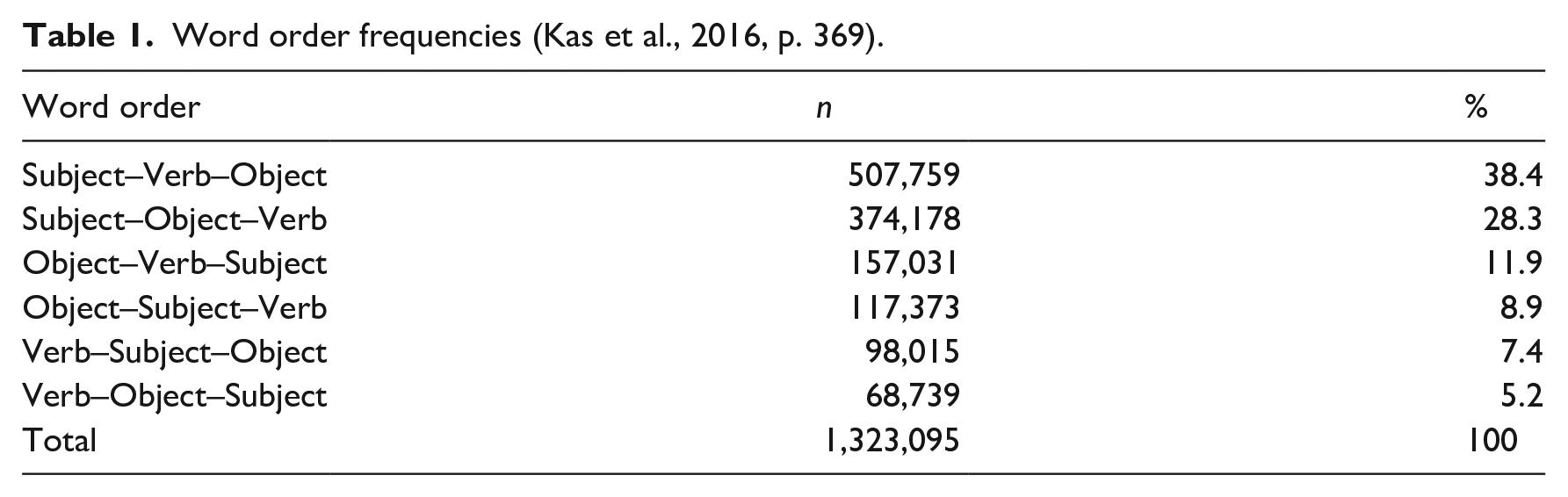
The basic word order of Hungarian is VSO; see illustration in (2a). Postverbal arguments are underspecified for information structure, while preverbal arguments either occupy the focus or the topic position (É. Kiss, 1998, 2008; Surányi, 2010). Hence, despite their frequency in discourse (Table 1), word orders with preverbal arguments are not pragmatically neutral and therefore analyzed as derived orders. The focus position is immediately preverbal and can host subjects, objects, further arguments or adjuncts; see illustration in (2b) for subjects. Foci attract the finite verb, such that the verbal particle (ki “out” in the examples below) is stranded in the postverbal domain. 2 Topics are sentence-initial (topics can only precede foci if both types of left-peripheral configuration are available). The distinction between focus and topic is reflected in the linearization of the particle and the verb (É. Kiss, 1998). While the particle follows the verb in the focus construction in (2b), it precedes the verb in the topic construction in (2c).
(2) a. Ki-nyit-ott-a János a könyv-et. out-open- “János opened the book.” b. [János]FOC nyit-ott-a ki a könyv-et. János open “JÁNOS opened the book.” c. [János]TOP ki-nyit-ott-a a könyv-et. János out-open “As for János, he opened the book.”
The examples in (2) demonstrate that the order of the verb and the verbal particle offers an unambiguous cue for the discourse function of the left peripheral constituent. A further correlated cue is the placement of the nuclear accent. Hungarian is a language with initial prominence at different levels of the prosodic constituency. At the word level, word stress generally falls on the first syllable (to the exception of some phrasal compounds; Varga, 2002). At the sentence level, prosodic prominence is always initial within the phonological domain of an intonational phrase. In the absence of left peripheral constituents, the left edge of the intonational phrase encompassing the predicate is aligned with the verb or the verbal particle (if available), which thus bears the nuclear stress of the clause, as in (3a). A left-peripheral focus phrase is part of the intonational phrase that encompasses the predicate and bears the intonational nucleus; see (3b). Topic phrases crucially differ: they form an intonational phrase on their own, while the comment is encompassed by a separate intonational phrase; see (3c). Both intonational phrases have a phonological head (a stress on the first syllable), while the nuclear stress of the sentence falls on the intonational phrase of the predicate, in other words, on the verb (Szendrői, 2001, 2003; Varga, 2002). Crucially, the discourse function of left peripheral constituents (topic or focus) is unambiguously expressed by the placement of nuclear accent and equally applies to whatever constituent (subjects, objects or further arguments and adjuncts).
(3)
3
a. ( * )ι ki-nyit-ott-a János a könyv-et. out-open- “János opened the book.” b. ( * )ι [János]FOC nyit-ott-a ki a könyv-et. János open- “JÁNOS opened the book.” c. ( * )ι ( * )ι [János]TOP ki-nyit-ott-a a könyv-et. János out-open- “As for János, he opened the book.”
Summing up, the following grammatical properties of Hungarian will be relevant for interpreting the role of case, prosody and order in speech comprehension:
(4) a. Reliability/availability of case cues The case cues are highly reliable (constant across nouns) and almost always available – to the exception of limited constructions as in (1c–d). b. Bias for subject-initial orders Subject-initial orders are more likely than object-initial orders; see Table 1. c. Nuclear stress and focus If the nuclear stress of the prosodic domain encompassing the predicate falls on a left peripheral constituent, this constituent is focused; see (3b).
3 Left peripheral arguments in corpus
The findings in various languages that an initial focus reduces the subject-first bias in speech comprehension (see summary in Section 1) can be accounted for by the cross-linguistic preference for subjects to serve as the topic of the utterance (Du Bois, 2003; Lambrecht, 2000). Since speech comprehension studies on Hungarian report a subject bias for foci (MacWhinney et al., 1985), it would be interesting to know whether this phenomenon relates to particular preferences in discourse. Hungarian distinguishes topics and foci by morphosyntactic means—as seen in (2)—which offers the possibility to identify the discourse function of left peripheral constituents. The cross-linguistic preferences predict a subject-bias for left peripheral topics in comparison to left peripheral foci. In order to test whether the speech comprehension facts reflect some discourse preferences that are particular to Hungarian, we examined left peripheral configurations in clauses with a transitive verb and two overt arguments–as in (5)—in the Hungarian National Corpus (Oravecz et al., 2014).
(5) Discourse function of the left peripheral argument (NP1)
a. Topic: [NP1] TOP Part V NP2; cf. (2c) b. Focus: [NP1] FOC V Part NP2; cf. (2b)
We extracted the configurations illustrated in (5) with the 24 transitive verbs that were used in the experimental studies presented in Section 4 in order to draw inferences about the expected behavior in the eye-tracking studies. The corpus queries contained combinations of the 24 verbs in the 3rd person singular (present and past) with verbal particles. The sample targeted 20 tokens of the particle+V order in (5a) and 20 tokens of the V+particle order in (5b) for each verb. The examined dataset is restricted to main declarative affirmative clauses (hence, excluding imperatives and interrogatives, and clauses with negation). We queried combinations of each verb with several particles, starting with the most frequent particles and proceeding with less frequent particles up to collecting 20+20 tokens exhibiting the properties in (5). The basis was the list of particles by H. Tóth and Patloka (2009), sorted by their frequency in the Hungarian National Corpus (n in million tokens; queried on June 15, 2018): meg “
(6) Discourse function of the left peripheral argument (NP1) a. NP1 topic and subject a mamá-juk meg-véd-i ők-et “their mom protects them” b. NP1 topic and object pár-já-t meg-véd-i az állat partner- “the animal protects his partner” c. NP1 focus and subject egy új-abb csoda-gyerek bűvöl-i el a sakk-világ-ot “a d. NP1 focus and object a politikus portré-já-t fest-i meg a művész “the artist paints
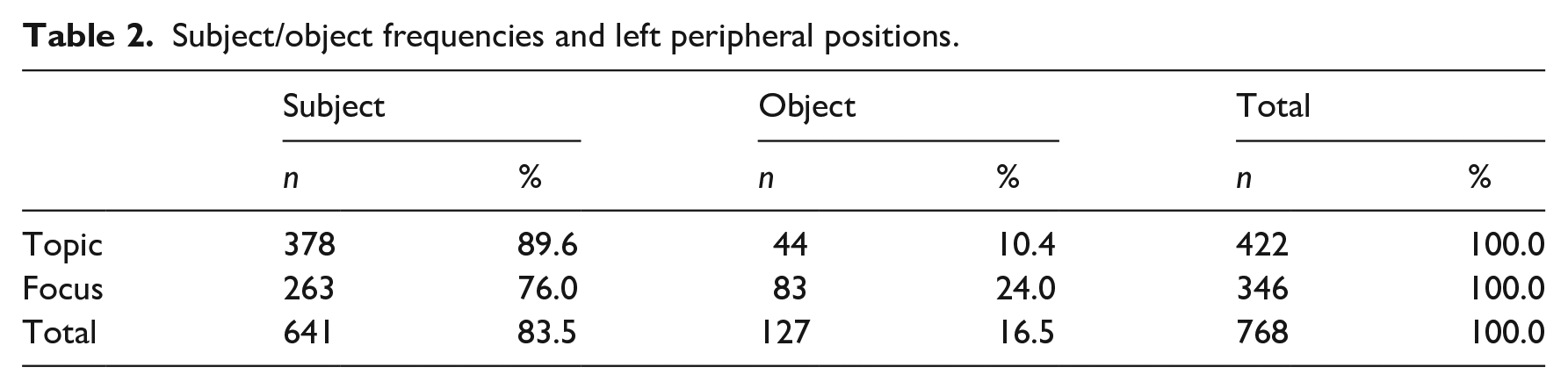
The targeted total of 20 valid tokens was not reached with all 24 verbs (four verbs in the condition with a preverbal topic and nine verbs in the condition with a preverbal focus had less than 20 valid tokens; furthermore, the verb sprézi “sprays” does not occur with particles in the corpus). The results of the corpus study are presented in Table 2, showing that the discourse function (topic vs. focus) has an impact on the relative frequency of syntactic functions: objects are more likely in the focus position (24.0%) than in the topic position (10.4%).
Subject/object frequencies and left peripheral positions.
A generalized linear mixed-effects model on the likelihood of left peripheral objects (contrast coded as: 0 = subject, 1 = object) with discourse function as fixed factor (contrast coded as: 0 = topic, 1 = focus) and the verb stems as random factor (intercept and slope with the fixed factor) reveals that the impact of
In sum, the corpus frequencies confirm the general bias for initial subjects in XVY orders (see SVO vs. OVS in Table 1) and show that object fronting is more likely with foci than with topics. Hence, if information structure influences thematic role assignment during speech comprehension, the corpus frequencies predict the following bias, that may modulate the general preference for subject-initial orders in (4b):
(7) “Focus-to-object” bias
A left peripheral focus is 2.3 times as likely as a left peripheral topic to be an object; see Table 2.
4 Experiment 1: case and stress
Experiment 1 examines whether case and prosody have an effect on processing thematic roles in Hungarian. This experiment should establish the effects of sentence comprehension on eye gaze behavior with case-unambiguous sentences.
4.1 Method
4.1.1 Participants
Twenty-four monolingual native Hungarian adults participated in the experimental study (18 females, six males; age range: 19–29 years; average 22.2; all right-handed; either uncorrected vision or corrected to normal, no sight impairments; speakers with prior knowledge of psycholinguistics research methods were excluded). Recordings took place at the University of Debrecen, Hungary. Participants freely offered informed consent (written) and were paid 3000 Hungarian Forint for their participation.
4.1.2 Material
The visual material was adopted from Kröger (2019), who used clipart images to assemble simple scenarios in a series of studies within the visual-world paradigm. All scenes contained three animal characters (see Figure 1), whereby two of them performed identical actions affecting their neighboring character (see Knoeferle et al., 2005 for a previous study with this experimental manipulation). Hence, the middle character was involved in two events (as agent and patient, respectively), while the two peripheral characters were involved in a sole event, either as agents or as patients. All experimental prompts started with the middle character, which is ambiguous between an agent and patient role; see (8). After mentioning the ambiguous character, the peripheral characters are possible targets (see Knoeferle et al., 2005 and Kröger, 2019 for previous studies with the same manipulation). The choice of a target depends on the cues for thematic role disambiguation. For instance, when comprehending an SVO sentence, the target after processing the subject was the patient character (character on the left in Figure 1), while in OVS sentences, the target was the agent. This design offers on-line evidence for the thematic role assignment that the comprehenders assume at the critical time region (Knoeferle et al., 2005). In the stimuli design, we avoided situations with stereotypical connections between animals (e.g., cat and mouse) or between animals and actions (e.g., dog and barking). In order to outbalance the effect of left–right asymmetries, two series of the same pictures (left-mirrored and right-mirrored) were used in the experimental sessions. This stimulus design differs from designs that involve a distractor character that is excluded by the selectional properties of the verb (see, e.g., Sauppe, 2016).
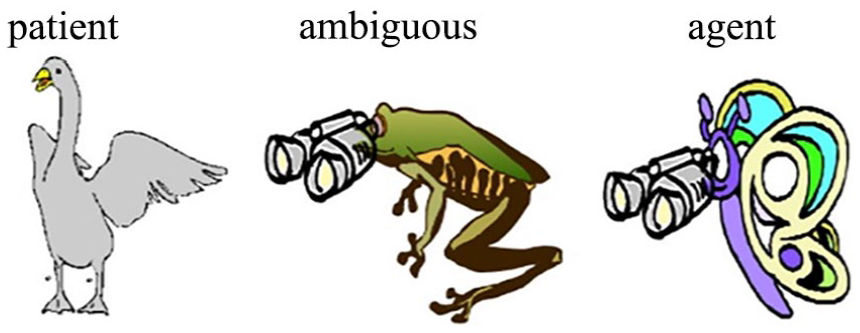
Visual stimulus (left-mirrored).
The experiments were based on a 2 × 2 factorial design with the factors
Factorial design of experiment 1 (underlined: nuclear stress are underline).
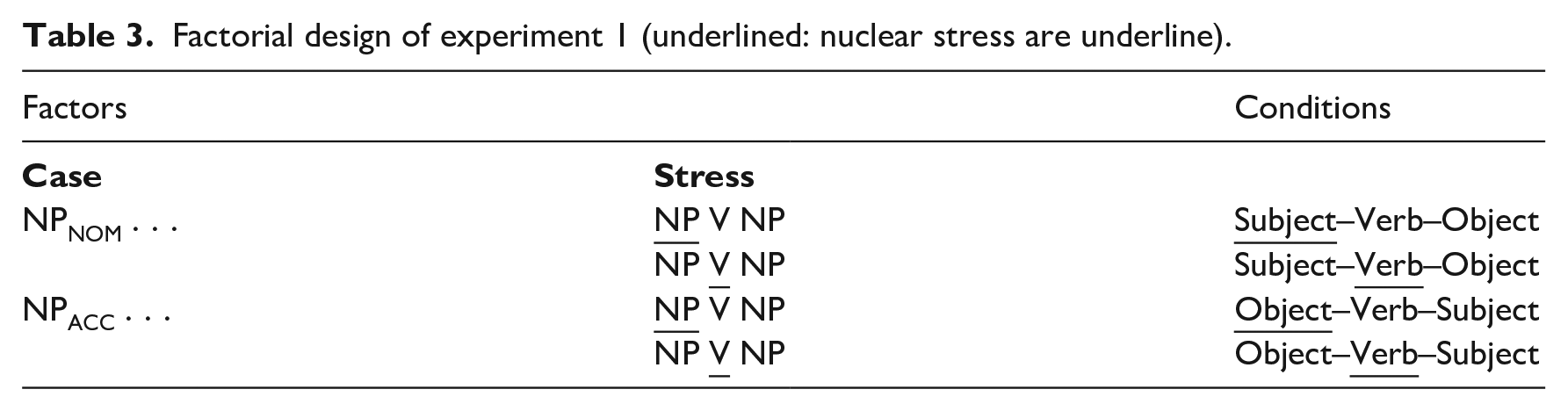
The presented utterances contained an initial NP, a verb and a temporal adverb followed by a second NP. The factor
(8) a. NPNOM V NPACC (SVO) A béka néz-i mindjárt a libá-t. “The frog watches soon the goose.” b. NPACC V NPNOM (OVS) A béká-t néz-i mindjárt a lepke. “The butterfly watches soon the frog.”
The factor
The experimental material contained utterances with intonational nucleus on the verb (NP
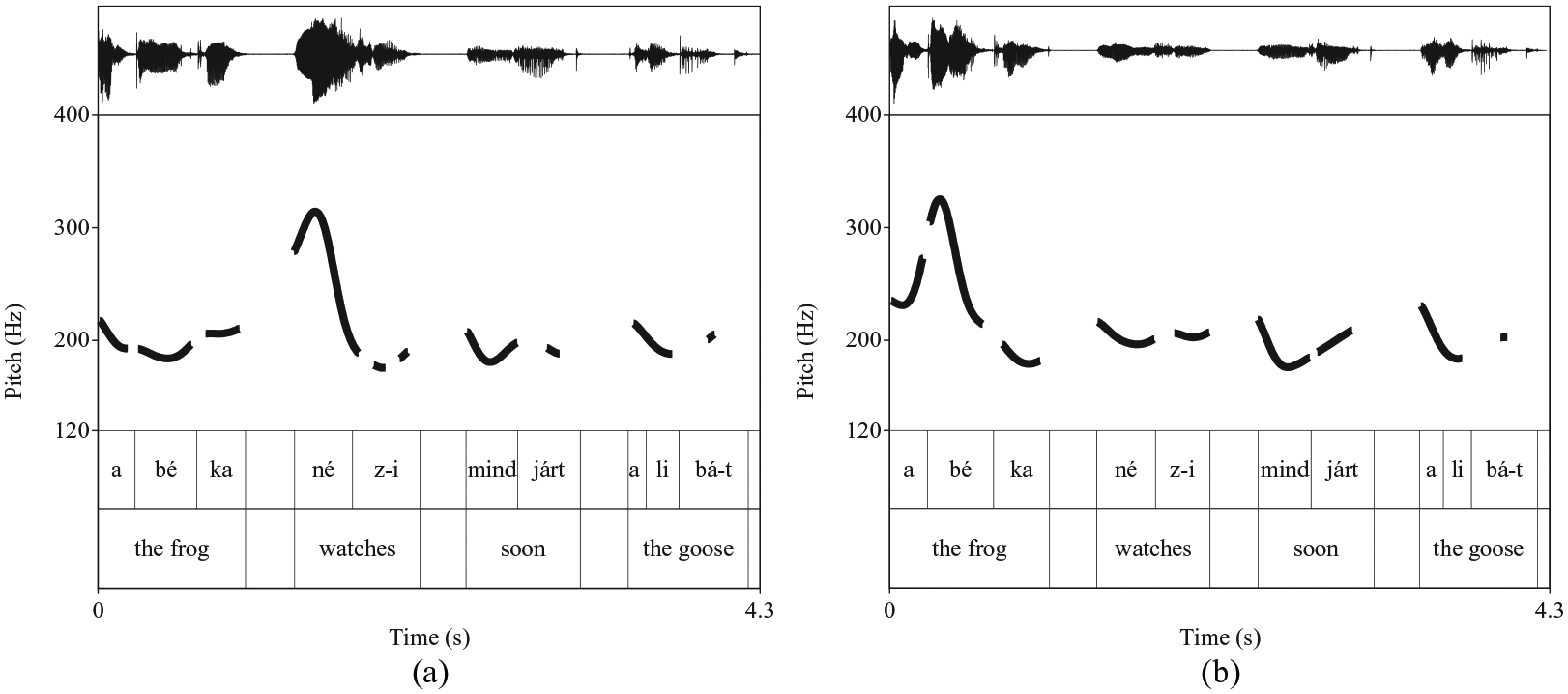
Illustrative fundamental frequency (F0)-excursions; see morphemic transcription in (8): (a) S
The F0-excursions illustrated in Figure 2 were consistently used in the recordings, as shown by the median values of the entire stimulus set in Figure 3. Pitch measurements were obtained from the sound files by means of a Praat (Boersma & Weenink, 2019) script written by the authors, which extracted the timing of onsets and offsets of each word and average F0-values of five equal intervals for each syllable. The F0-values in Hz were converted into semitones with a reference value of 50 Hz: fsemitones = 12(log2.fHz/50) (Grice et al., 2007; Nolan, 2003). Each excursion in Figure 3 presents the median values of the stimuli recorded for an experimental condition (24 items). In order to observe the intonational properties across words of different syllabic length, Figure 3 only presents the F0-values of the first and the last syllable of the lexical categories (nouns, adverbs, and verbs). The pitch excursion of stressed syllables is very similar; depending on the level of
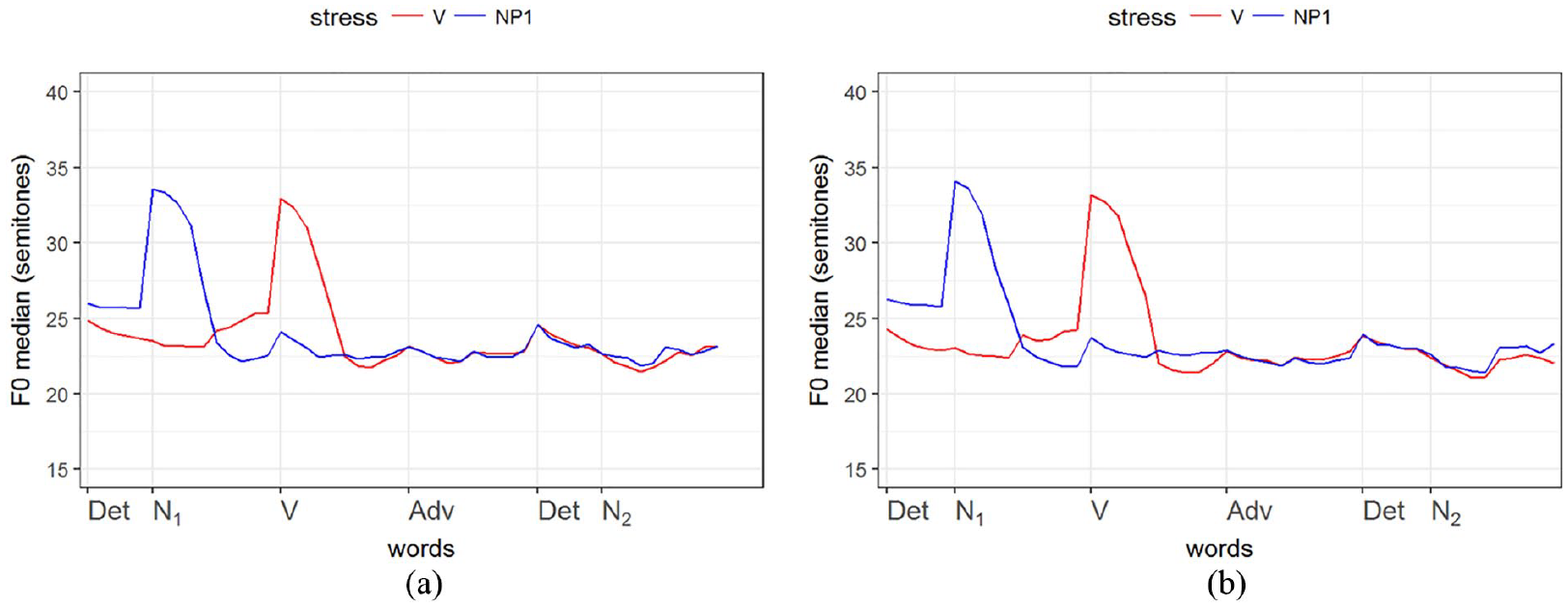
Median fundamental frequency (F0)-excursions of the stimuli (Experiment 1): (a) SVO; (b) OVS.
The F0-values in Figure 3 show that the prosodic realization of the stimuli is highly consistent. Their prosodic properties correspond to the prosodic realization of Hungarian utterances as reported in speech production: topics are mostly deaccented, foci almost always bear a falling accent, while the verb is almost always deaccented after an initial focus (Mády, 2015). Deaccenting of topics is one among the possible realizations of initial topics, while the presence of a falling accent at the initial syllable of the verb following a topic phrase is the dominant pattern in speech production data (Genzel et al., 2015). Hence, these stimuli represent the prosodic effects of information structure in careful speech, certainly having less variation than spontaneous realizations. The consistent realization is expected to enhance the comprehension of the assumed discourse function (topic vs. focus).
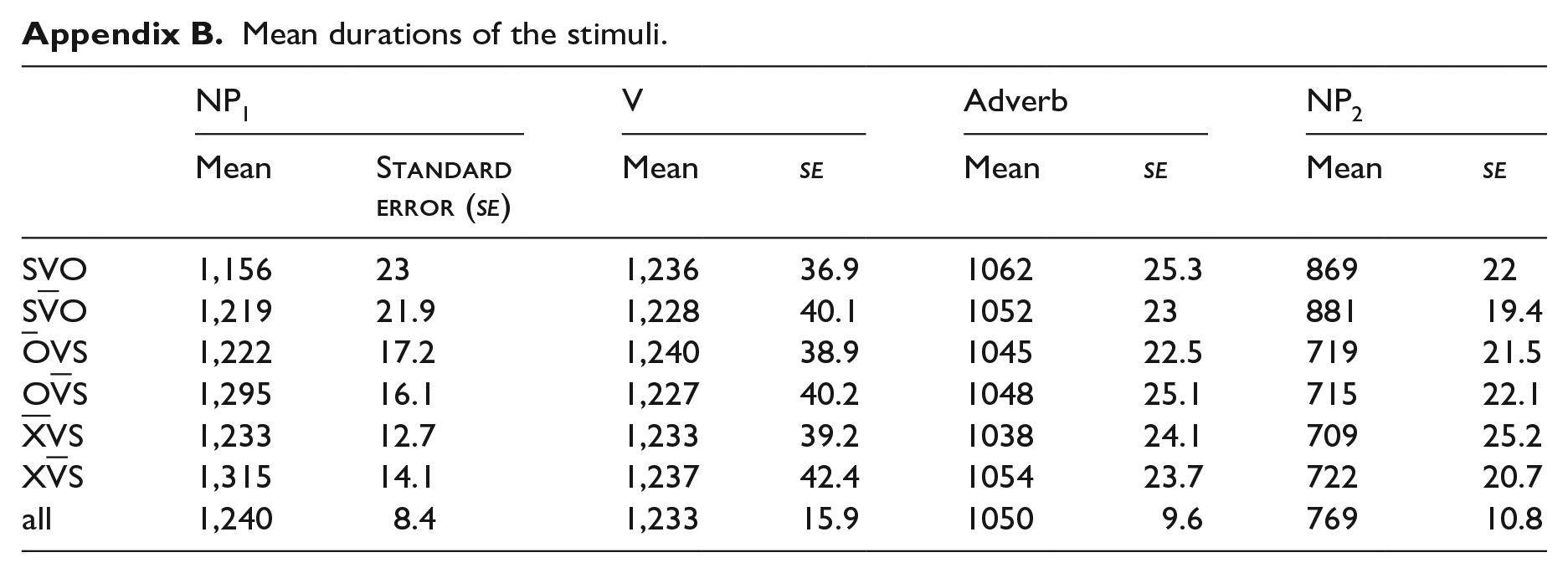
The duration means (Appendix B) reveal some variation between conditions: (a) the average duration of subjects (nominative) is shorter than the average duration of objects (accusative), since the former are bare stems and the latter have an accusative suffix; compare duration of NP1 in
The experimental conditions in Table 3 (
4.1.3 Predictions
The critical time region for tracking comprehenders’ expectations starts from the time point in which NP1 has been processed and holds until the onset of NP2 (Kamide et al., 2003; Knoeferle et al., 2005). Since case is expressed by suffixes, the case of NP1 can only have reflexes on processing after the offset of NP1, which is followed by a 300 ms break. Eye movements towards mentioned entities start within a time interval of 100–200 ms (Altmann, 2011; Allopena et al., 1998) after the critical acoustic signal; anticipatory fixations require additional processing which is expected to result in longer latencies. Hence, anticipatory fixations motivated by processing the case of NP1 are roughly expected to appear with the verb onset.
The treatments of this experiment are expected to be informative for the effects of
At the morphological level, the nominative case is the inflectional default, since it is identical to the bare stem in Hungarian—the accusative case is the non-default option, marked by a suffix; see (1a–b) in Section 2. The non-default case (accusative) is expected to have a stronger impact on attracting the attention of comprehenders than the default case (nominative) (see Longenbaugh & Polinsky, 2016).
With respect to the range of possible constructions, an accusative NP1 implies a transitive verb and a nominative argument, while a nominative NP1 can form a complete sentence already with an intransitive verb. Hence, up to the time point that the verb is processed, an initial accusative is expected to have a stronger impact on the visual search for a further argument than an initial nominative. This prediction follows from the view that comprehenders anticipate the minimal possible syntactic structure at each time point in sentence processing (see minimality/distinctness principle in Bornkessel-Schlesewsky & Schlesewsky, 2009 or “least effort principle” in Fodor, 1998). At the time point that the comprehender has processed the verb, the minimal structure is necessarily transitive, that is, either case of the NP1 predicts the presence of a further argument.
The placement of nuclear stress on the preverbal constituent is a cue for focus; see (4c). Left peripheral foci are more frequently objects than left peripheral topics; see (7). Hence, a stressed initial NP may modulate the expectations from the preferred subject-initial word order in Hungarian. In the critical time region, the expected effect of
Besides the experimental manipulations, the expected results may be influenced by further factors that have been shown to influence speech comprehension. The preferred word order in Hungarian predicts a bias for subject-initial clauses; see (4b). Previous studies on languages with a preference for subject-initial orders have shown evidence for a subject-first bias in comprehension even with case-marked initial accusatives (see German in Kamide et al., 2003).
Finally, agents attract attention in visual depictions of events (Cohn & Paczynski, 2013) and the preference for fixations to the agent holds independently of the expected word order (Sauppe, 2016). These observations led to the conclusion that fixations are driven by the semantics of the verb rather than by the syntactic preferences for particular word orders (Sauppe, 2016). In the critical time region of our experiment, the comprehenders have already processed NP1 and are expected to perform anticipatory fixations to a further role filler of a transitive event. This time region is comparable with the time region after processing the first argument in a V-initial language, in which case fixations are oriented towards the not yet mentioned role filler (the agent in a VOS order or the patient in a VSO order). Hence, the predictions of the bias from the preferred word order and of a semantically-driven role anticipation are conflated in our design (see Sauppe, 2016 for a discussion of this conflation in V-medial orders in general).
4.1.4 Procedure
Participants were seated in a quiet room in front of a display and an eye-tracker camera. They were instructed to place headphones on for the experiment, and to observe the picture scene on the screen, to listen to the audio stimuli and to answer a follow-up question after each item. Visual stimuli were presented through the Experiment Builder (by SR Research EyeLink). Once the participants read the instructions, they pressed a key on the keyboard to start the experiment. At the beginning of each trial, a fixation cross in the middle of the screen was presented for two seconds. The visual stimulus appeared on the screen and the audio stimulus started 2000 ms later. Each experimental session started with three trial practice sentences, followed by the actual study. On average, an experimental session lasted 20 minutes.
4.1.5 Data analysis
Eye gazes were tracked by an EyeLink 1000 at 500 Hz sampling rate (viewing was binocular, but only the right eye was tracked). Fixations to three interest areas corresponding to the three characters were recorded with the EyeLink Data Viewer tool, starting from the time point of the appearance of the visual stimulus (2000 ms before the audio stimulus) and up to 500 ms after the offset of the audio stimulus. Starting and end time points of eye fixations on the interest areas were further processed in R, version 4.0.2, for the creation of descriptive summaries, visualizations, and statistical analyses (R Core Team, 2020). Word regions of the verbal stimuli differ in duration; see 4.1.2. Therefore, the eye-tracking data were time-normalized in order to be comparable across trials (see Sauppe, 2016). Fixation data were grouped for time bins of 100 ms in the time-normalized data. 6 For each bin we calculated the empirical logit with an adjustment factor e = 0.5 (Agresti, 2002; Barr, 2008).
The recorded eye fixations form a polytomous variable: fixations on the agent and patient role fillers; fixations on the middle (ambiguous) character; fixations outside the characters. These data were converted into two dichotomous variables reflecting the nesting of these areas of eye fixation with respect to the questions at issue (Barr, 2008; Knoeferle et al., 2005). In a first step, we collapsed the fixations on agents and patients into a single group and calculated their relation to fixations in all interest areas (including the middle character). In the critical time region after NP1 and up to NP2, fixations on the peripheral characters are informative for the time course of the visual search for role fillers. In a second step, we calculated the relation between fixations on the agent and fixations on the patient, which is informative for the exact role filler (patient or agent) that is anticipated in the critical time region.
The fixation data were fitted by linear mixed-effects models, following the procedure recommended by Barr (2008) and Mirman (2014); run by the function lmer, package lme4, version 1.1-23 in R (Bates et al., 2015). The analysis was based on a quasi-logistic linear model with the empirical logit of fixations as dependent variable, calculated for time bins of normalized 100 ms. Since each participant was exposed to each item once, the empirical logit can be only calculated for subjects and items separately (within a time bin), which requires two analyses (by subjects/by items) (Barr, 2008; Mirman, 2014). 7 For the analysis of fixations on role fillers, the empirical logit was computed with the sum of fixations on the peripheral characters, divided by the sum of fixations to the middle character within the same time bin and logarithmized with an adjustment factor e = 0.5 (Agresti, 2002), following the usual practice in the analysis of fixation data in the visual world paradigm (Arai et al., 2007; Carminati & Knoeferle, 2013). The empirical logit for fixations on the agent was calculated with the sum of fixations on the agent over fixations on the patient within the same time bin.
The fixed effects of the linear model were the factors of interest (
The significance of the factors of interest was estimated with the LLTs comparing a model with the effect at issue and a model without this effect. These tests cannot be computed for effects nested in a significant interaction effect, since the components of an interaction cannot be dropped for model comparison. Whenever an effect is only significant in one of the random-factor analyses (by subjects or by items), we calculate a mint′ value, based on the t-values of the individual analyses: (t1×t2)/(t1+t2) (see minF′ in Raaijmakers et al., 1999).
4.2 Results
4.2.1 Visual search for role fillers
The time course graph in Figure 4 shows the empirical logit of looks to the role fillers (see subsection 4.1.5). Fixations on role fillers decrease during NP1, since the speakers increasingly fixate the ambiguous character during its mention by NP1. In the critical time region between the onset of the V and the offset of the adverb, fixations on role fillers increase, which is the expected effect of anticipatory behavior. The final increase of the looks to the role fillers after the onset of NP2 is not part of the anticipatory behavior, since the one or the other role filler is mentioned by NP2 (Knoeferle et al., 2005). Crucially, the results reveal an effect of
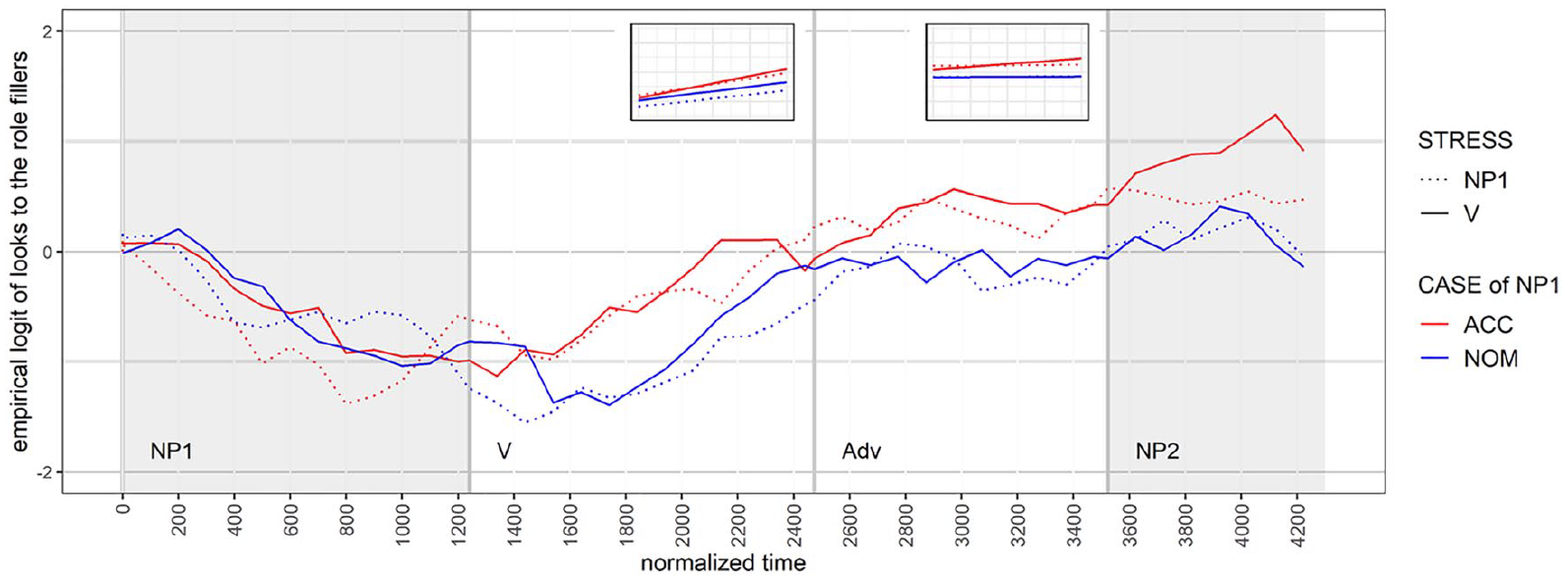
Case unambiguous clauses: fixations on role fillers (non-shaded area: critical time region for anticipatory fixations; miniature graphs: coefficients of the linear model).
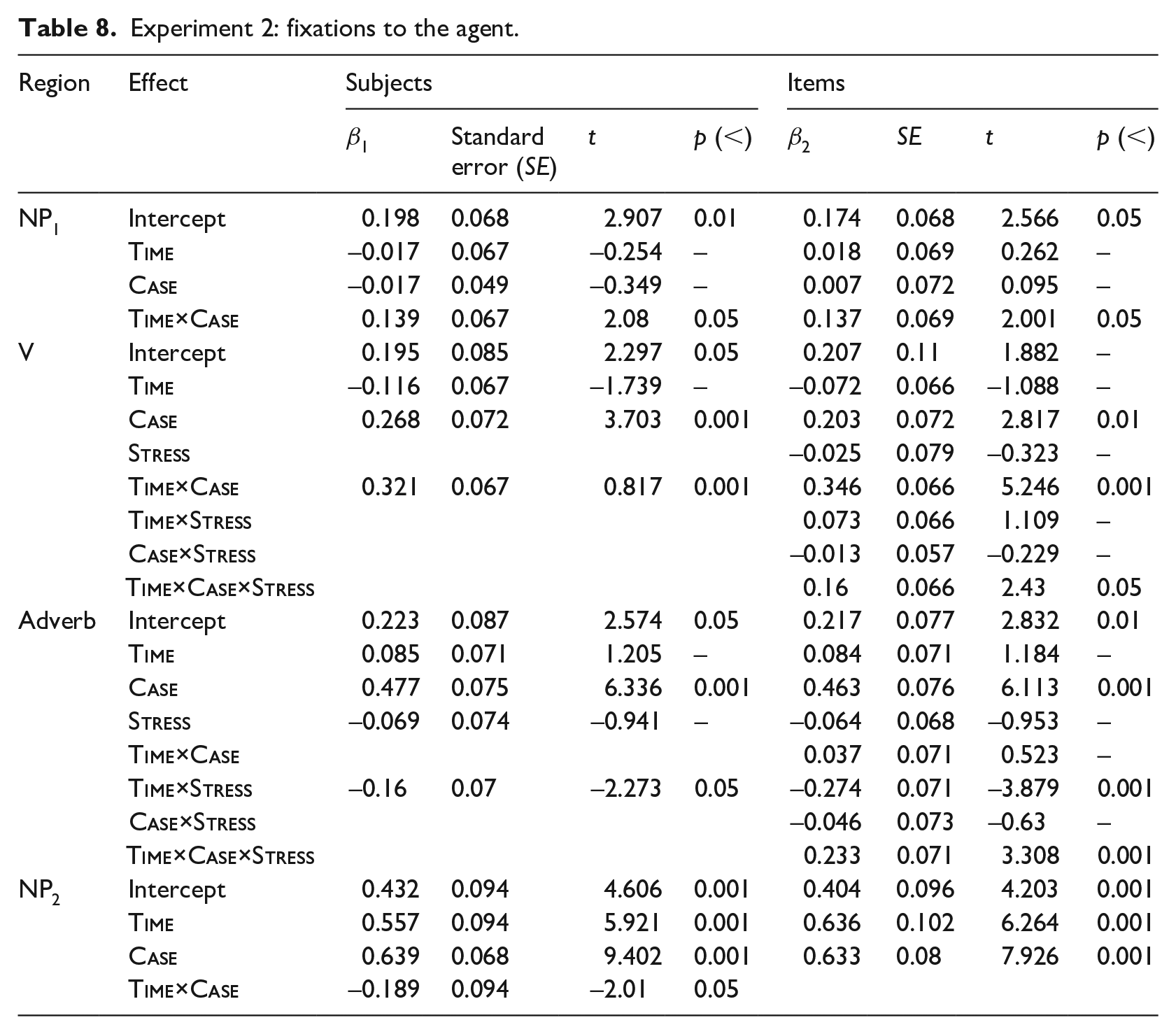
In the verb region, the linear mixed-effects model with the maximal fit contains a significant effect of
4.2.2 Role anticipation
The time course graph in Figure 5 shows the empirical logit of looks to the agent over patient (since the verbs of this experiment are active, the agent is always the subject). The increase of looks to the patient after an initial nominative and the increase of looks to the agent after an initial accusative is evidence for anticipatory fixations. Since the case suffix is the final segment of NP1 (which is 300 ms before the verb onset), effects of case are expected to appear not earlier than by the verb onset. Interestingly, an initial stress has an impact on the gaze behavior depending on case, enhancing looks to the agent in the accusative-first order and looks to the patient in the nominative-first order during the early adverb region.
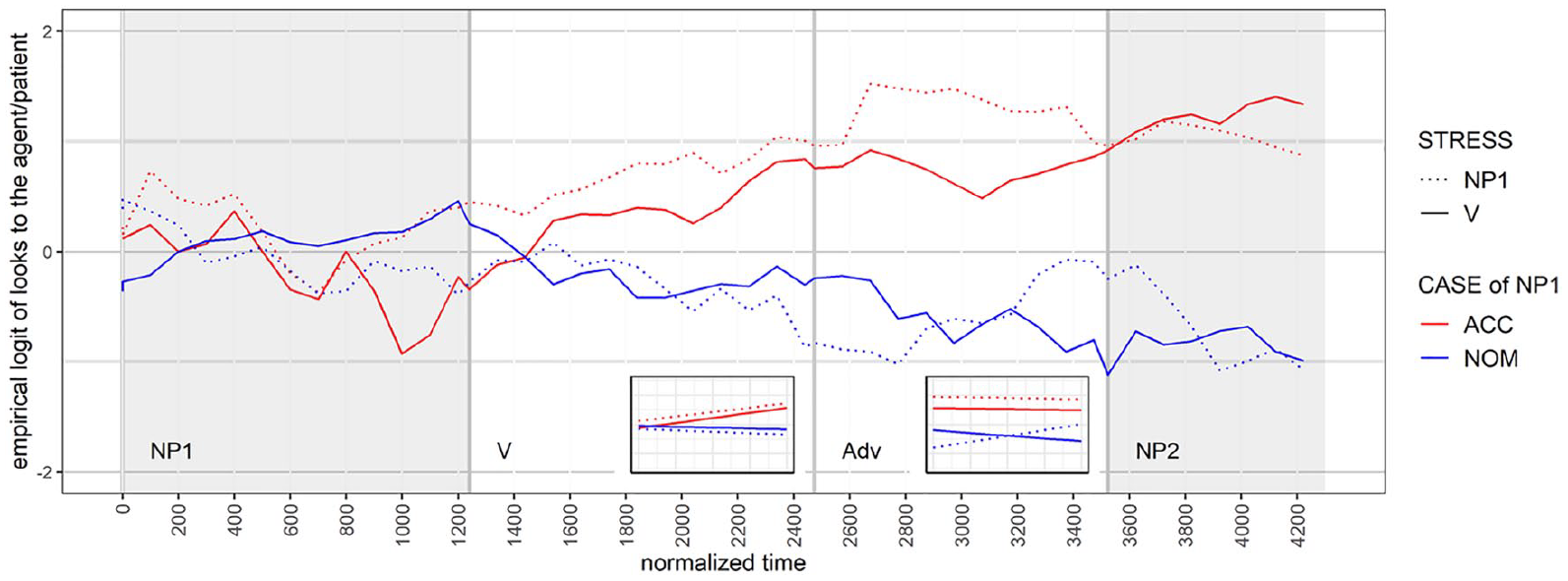
Case unambiguous clauses: fixations on the agent (vs. patient) (non-shaded area: critical time region for anticipatory fixations; miniature graphs: coefficients of the linear model).
The linear mixed-effects models on the empirical logit of agent fixations reveal an interaction of
4.3 Discussion
The results of the visual search for role fillers (see Figure 4 in subsection 4.2.1) reveal an asymmetry between nominative and accusative case, which is also reported for eye tracking data in other languages (see Finnish in Kaiser & Trueswell, 2004); see predictions in subsection 4.1.3. This asymmetry is accounted for by the fact that accusative is a non-default case as well as by the fact that processing an accusative case invokes the expectation of a nominative, while an initial nominative may be part of a minimal complete clause without a further argument (see minimality account in Bornkessel-Schlesewsky & Schlesewsky, 2009). However, the main effect of
The findings from role anticipation (see subsection 4.2.2) contain interaction effects between
Our results do not display a significant intercept in the verb region (see Appendix C, Table 6), that is, fixations are driven by
The comparison between the effects of
Finally, fixations to the agent increase with stressed nominatives in the late adverb region rendering a cross-over effect with unstressed nominatives. This effect does not follow from the predictions presented so far. We speculate that fixations to the agent reach a ceiling effect early in the adverb region, followed by fixations to the alternative character up to the onset of NP2, which refers to the patient character. Note that the fixations to the agents in the adverb region are slightly decreasing with stressed accusative NP1, which is the mirror image of the effect of the nominatives.
5 Experiment 2: case ambiguity and stress
Experiment 1 established a baseline for the role of case and prosody. The aim of Experiment 2 is to examine the role of prosody on the incremental thematic role assignment with locally ambiguous sentences. The visual material, the procedure, and the method of data analysis used in Experiment 2 were identical to Experiment 1; see subsections 4.1.2, 4.1.4, and 4.1.5, respectively.
5.1 Method
5.1.1 Participants
Twenty-four native speakers (16 females, eight males; age range: 19–28; age average: 22.04; all right-handed; either uncorrected vision or corrected to normal, no sight impairments; speakers with prior knowledge of psycholinguistics research methods were excluded). None of the participants of this experiment had participated in Experiment 1. Recordings took place at the University of Debrecen, Hungary. Participants freely offered informed consent (written) and were paid 3000 Hungarian Forint for their participation.
5.1.2 Material
The factorial design contained the factors
Factorial design of experiment 2 (the constituents bearing the nuclear stress are underlined).
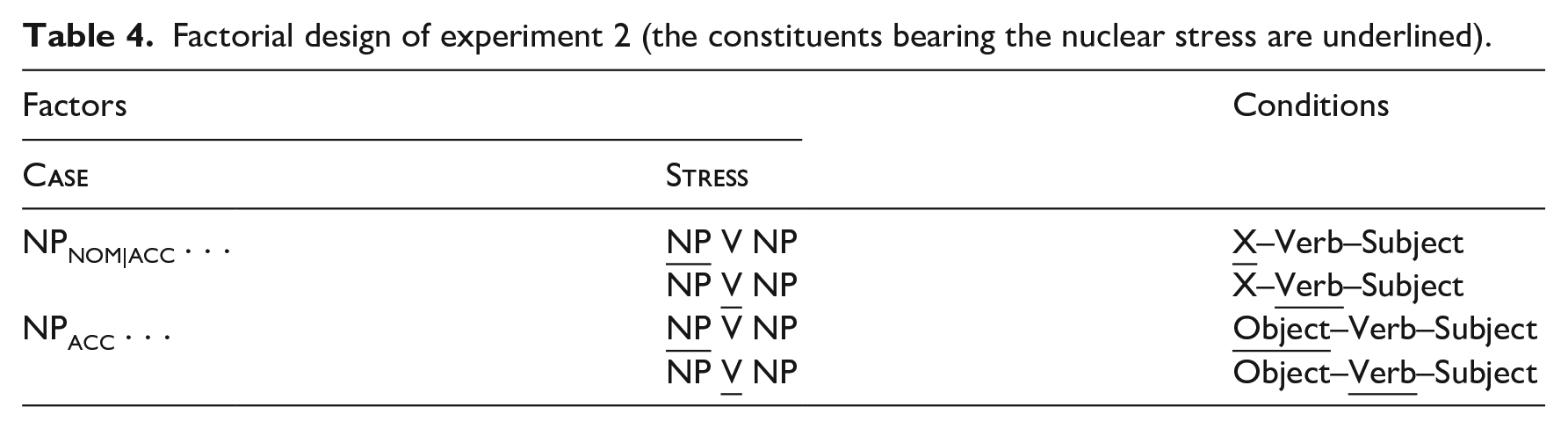
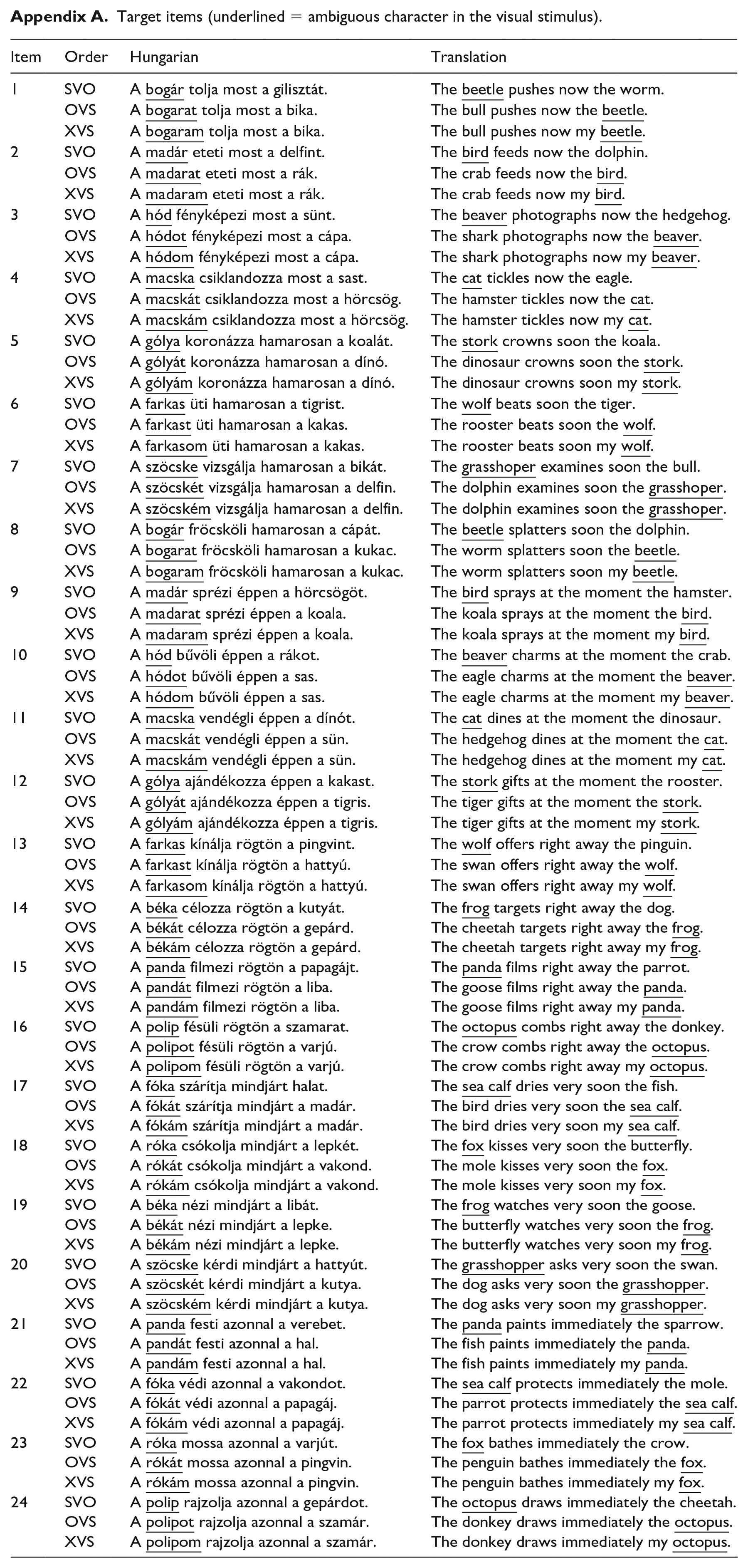
The OVS utterances in Experiment 2 were the same as in Experiment 1; see (8b). Nominative/accusative ambiguity in the XVS level was implemented through possessed nominals of the 1st person singular, as in (9) (see listing of the items in Appendix A/XVS); compare (8), see also discussion in Section 2, (1c). 9
(9) NP1NOM|ACC . . . A béká-m néz-i mindjárt a lepke. “The butterfly watches soon my frog.”
The OVS recordings of Experiment 1 were also used in Experiment 2 (see subsection 4.1.2); the XVS utterances were performed with the same intonational pattern. Figure 6(a) illustrates an XVS utterance with initial stress. The high target of the intonational nucleus is aligned with the stressed syllable of the initial noun; compare SVO in Figure 2. The median excursions of the XVS stimuli in Figure 6(b) are very similar to the median excursions for SVO/OVS utterances in Figure 3 (see procedure for the extraction of the measurements in subsection 4.1.2). All further properties of the material (visual stimuli, fillers, and distribution in lists) were identical with Experiment 1 (subsection 4.1.2). Altogether, we evaluated (24 speakers × 24 items =) 576 trials.
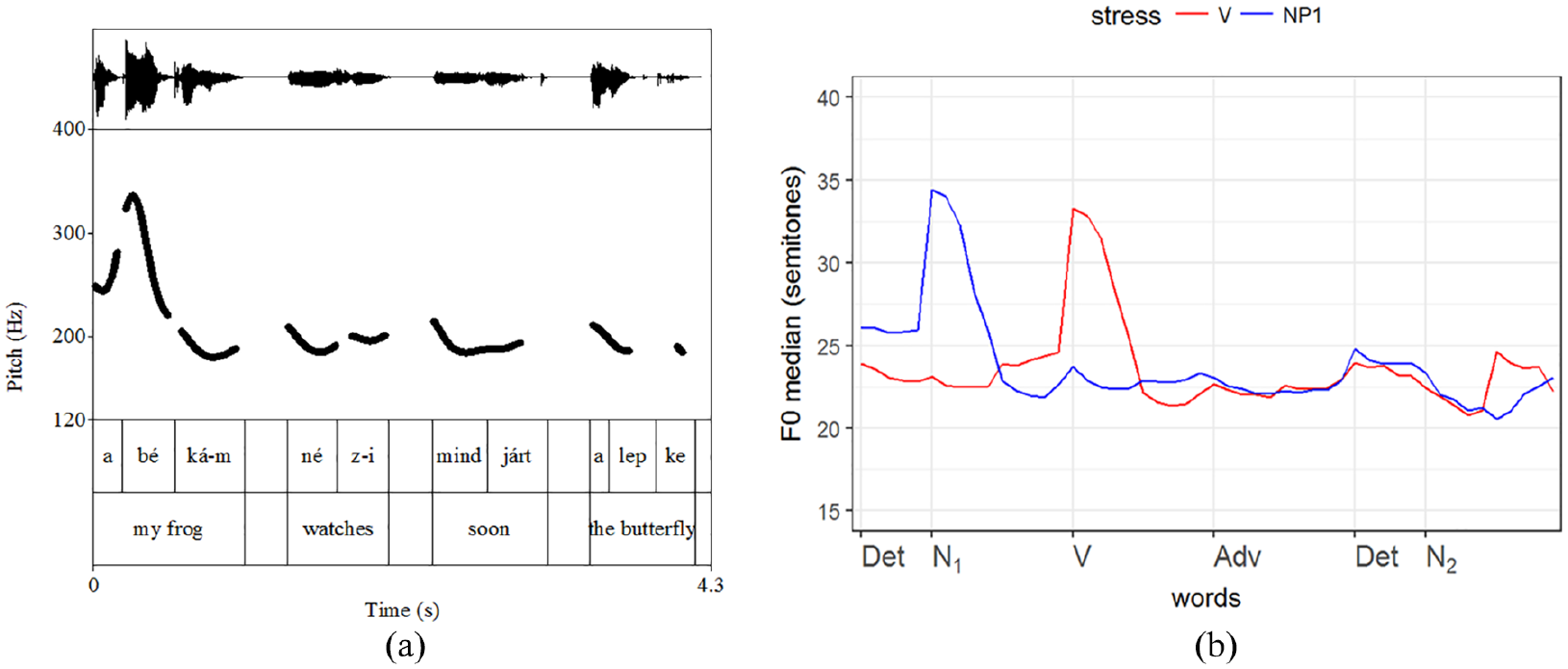
Fundamental frequency (F0)-excursions of XVS utterances; see morphemic transcription in (9): (a) illustrative
5.1.3. Predictions
The OVS conditions are expected to replicate the pattern in Experiment 1, so we expect to find anticipatory looks to the agent after processing NP1. A case-ambiguous NP1 (XVS) is expected to be interpreted by default as a subject, since the SVO order is 3.2 times as likely as OVS in Hungarian (Table 1). The corpus frequencies in Section 3 (Table 2) predict that the subject-first bias will be weaker with foci than with topics. We did not find such a bias with case-unambiguous NPs in Experiment 1, but if prosodic cues are activated to resolve ambiguity, we expect to find effects of stress with case ambiguous NPs.
5.2 Results
5.2.1. Visual search for role fillers
Figure 7 presents the time course of fixations on role fillers in Experiment 2. The effect of
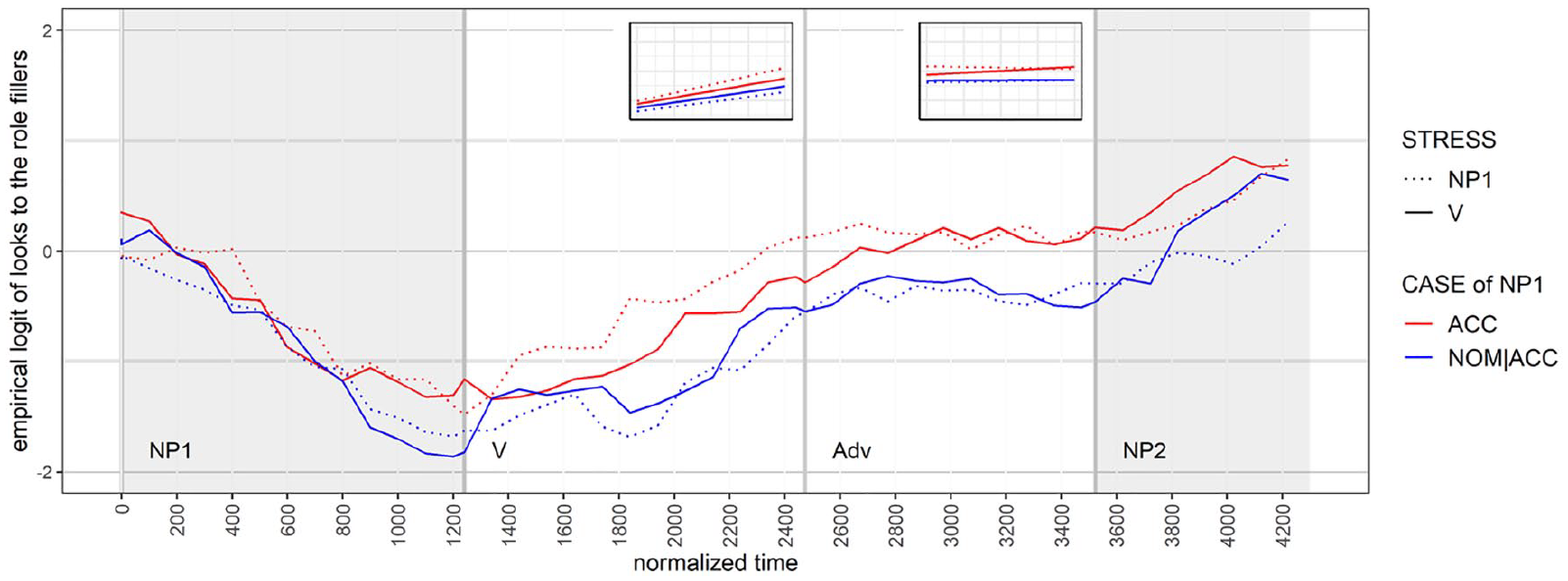
Case ambiguity of the initial NP: fixations on role fillers (non-shaded area: critical time region for anticipatory fixations; miniature graphs: coefficients of the linear model).
Within the verb region, the linear mixed-effects models of maximal fit (by subjects and items) contain a significant interaction between
5.2.2 Role anticipation
Figure 8 shows the time course of fixations on the agent versus patient. Accusative-initial sentences show a clear incline towards the agent. The fixations curve of ambiguous-initial sentences shows a fall of the looks to the agent starting around the middle of the verb region (at 1900 ms). The difference between accusative-first and ambiguous-first utterances starts later than in Experiment 1 (roughly 700 ms after the onset of the V). Furthermore, the gaze behavior with ambiguous-first sentences is very close to the 0 level of the log odds (equally frequent fixations on both role fillers) with a slight preference towards the patient starting later in the verb region (around 2200 ms from the sentence onset). Until the end of the adverb region, looks to the patient are more frequent, which suggests that the comprehenders assume an initial nominative NP. This assumption is revised in NP2, which triggers an increase of the fixations on the mentioned role filler (agent), starting around 300 ms after the onset of NP2.
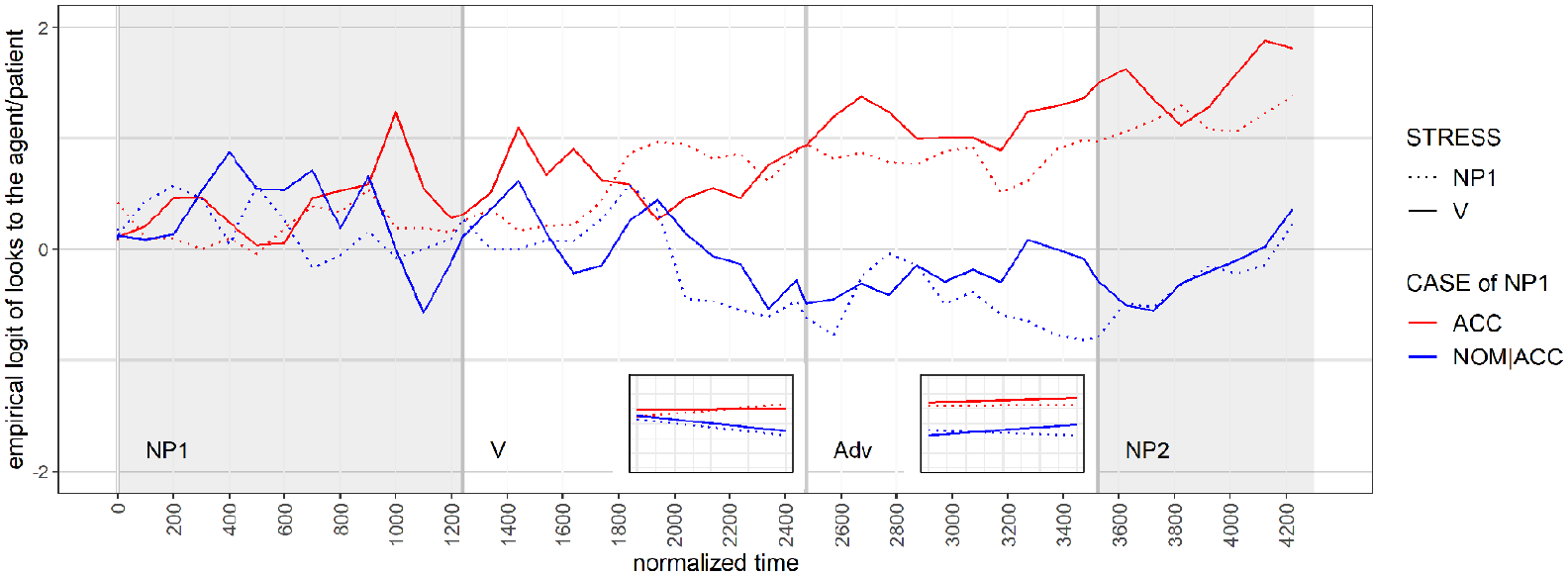
Case ambiguity of the initial NP: fixations on the agent (vs. patient) (non-shaded area: critical time region for anticipatory fixations; miniature graphs: coefficients of the linear model).
The gaze behavior in the verb region results in a significant interaction effect between
5.3 Discussion
The visual search for role fillers in the verb region shares in common with Experiment 1 that the non-default case has a stronger effect on anticipatory behavior than the zero-marked NP1 (which is a nominative in subsection 4.2.1 and case-ambiguous with possessive constructions in subsection 5.2.1). This is reflected in the main effect of
The findings from role anticipation (subsection 5.2.2) reveal an interaction between
Anticipatory effects start later with case-ambiguous NPs: the averaged fixations show a tendency towards the patient (below the 0 level) in the late verb region (compare with subsection 4.2.2), which may reflect the uncertainty in processing NP1 in the absence of a case cue. Studies on other languages show that case ambiguity is not a sufficient condition for a delay in anticipatory fixations. For instance, Knoeferle et al. (2005) and Zhang & Knoeferle (2012) report that case-ambiguous initial NPs in German are associated with an increase of anticipatory fixations on the patient (revealing a subject interpretation of NP1) starting early within the verb region. Hence, the delay of the anticipatory fixations in Hungarian XVS clauses (compared to the early reaction obtained in Experiment 1) cannot be explained by ambiguity alone. However, German has been shown to have a strong SVO bias in comprehension that is even attested with initial accusatives, which is not the case for Hungarian; see discussion in subsection 4.3. The present difference is a further instance of the same phenomenon: the bias of the preferred word order has a stronger effect in resolving case ambiguities in German than in Hungarian. The typological difference that may be the source of this difference is discussed in Section 6.
In the adverb region, the significant effect of
6 General discussion and conclusions
The presented experiments offer evidence for the relative strength of case, stress, and word order as cues for thematic role assignment in Hungarian. In an agglutinative language with highly reliable and almost always available case suffixes, case is the most reliable cue when it comes to thematic role assignment (Bates et al., 1982), as has been already shown for Hungarian (MacWhinney et al., 1985). Our studies confirm these findings in on-line comprehension. Processing a clause-initial nominative increases the anticipatory fixations on the patient and a clause-initial accusative leads to more fixations on the agent, while the rate effect (
Furthermore, our data reveal a difference between cases, reflecting their markedness asymmetry. In both experiments, the visual search for role fillers increases earlier with marked case (accusative) than with bare nominals (nominative in Experiment 1 or ambiguous in Experiment 2), resulting in a significant effect of (10) Marked case has a stronger impact on visual search than unmarked case.
The preferred word order in Hungarian predicts a bias for initial subjects in speech comprehension; see (4b). In the absence of case marking (Experiment 2), this bias explains the anticipation of a patient after processing a case-ambiguous NP1. In the presence of case marking, processing a nominative NP1 increases fixations to the patient and processing an accusative NP1 increases fixations to the agent—there is no evidence for a bias from the preferred word order or from the prominence of agents in event comprehension modulating the effect of case (no significant intercept in the verb region; see subsection 4.3). This finding is in line with previous observations that the bias for subject-initial clauses only applies in the absence of stronger morphosyntactic cues in Hungarian and is evidence for a strong impact of case cues in this language (MacWhinney et al., 1985; Pléh, 1981).
(11) A bias for initial subjects applies in the absence of case cues in Hungarian.
This finding is subject to cross-linguistic variation. In German, a subject-first bias is also observed with accusative-marked initial NPs (Kamide et al., 2003). Similar results are reported for agglutinative languages that display more instances of case ambiguity than Hungarian (see Erdocia et al., 2009 on Basque by means of errors in comprehension tasks). Hence, the strength of the case cues is not explained by the reliability of the case cues in agglutinative languages, since the absence of allomorphy of the accusative marker equally applies to Basque and Hungarian. However, Hungarian differs from German and Basque regarding the availability of case cues: while case ambiguity appears with various constructions in Basque and with most inflectional paradigms in German (all inflectional paradigms except for masculine singular), case ambiguity is very limited in Hungarian; see (4a). Hence, we hypothesize that the difference in the availability of case (across constructions) is the crucial source of cross-linguistic variation that accounts for the difference between these languages.
(12) Prosodic prominence attracts attention and enhances the effects of the available morphosyntactic cues.
The effect of
(13) Prosodic cues do not contribute to thematic role assignment in the presence of unambiguous cues such as case.
The appropriate conditions for the activation of prosodic cues are fulfilled by case-ambiguous clauses in Experiment 2. In other languages, initial stress has been shown to reduce the subject-first bias in sentence comprehension (see Weber et al, 2006b and Grünloh et al., 2011 on German; MacWhinney et al., 1984 on German and Italian). In Hungarian, previous studies report the opposite effect: initial stress enhances the subject-first bias (tested with non-grammatical instances of ambiguity by MacWhinney et al., 1985). Our results suggest that this type of effect can be understood as a general effect of prosodic prominence as postulated in (12).
The difference between Hungarian and Italian/German leads to a typology between languages that draws inferences from prosody and languages using prosody for the enhancement of morphosyntactic cues. Can this typology be predicted by independent cross-linguistic differences? A relevant difference between Hungarian and Italian/German lies in the availability of case contrasts across paradigms. Nominative–accusative ambiguity appears with most inflectional paradigms in German (all paradigms expect masculine singular) and all inflectional paradigms of Italian. In Hungarian, ambiguity only arises in particular constructions with possessed NPs, in which the accusative suffix can be dropped. Moreover, the case-ambiguous form (dropped accusative) is string identical to a zero-marked nominative. In conjunction with the word order preferences when presented clause initially, this form results into a strong bias to interpret the initial NP as a nominative. The morphosyntactic properties of Hungarian, in particular the high reliability and the high availability of case marking, is a crucial difference to German/Italian that may account for the findings of several studies that prosodic cues modulate the subject-first bias only in the latter languages.
Our experiments belong to a paradigm of studies that examine the impact of morphosyntactic and prosodic cues of thematic role disambiguation without using context. The reasoning of these experimental manipulations is to pin down the effects and interactions between cues at the clausal level. In interpreting prosodic cues, the role of information structure is crucial for languages such as German, Italian or Hungarian. Since prosody does not encode syntactic functions in this language type but is used to differentiate topics and foci, considering information structure is crucial for understanding the role of prosodic cues. However, a limitation is due: the results obtained by these experiments are informative for the different cues at the clause level, but cannot be generalized for the impact of information structure established through contextual cues. We know from studies comparing contextual cues (e.g., Grünloh et al., 2011) that the effect of information structure is enhanced if contextual cues are present. The studies examining thematic role assignment without context show that the competition of cues at the clausal level differs between languages—the challenge is to understand this variation in terms of the differences of the grammars at issue.
Footnotes
Appendix C. Linear mixed-effects models of maximal fit
Experiment 2: fixations to the agent.
| Region | Effect | Subjects | Items | ||||||
|---|---|---|---|---|---|---|---|---|---|
| β 1 | Standard error (SE) | t | p (<) | β 2 | SE | t | p (<) | ||
| NP1 | Intercept | 0.198 | 0.068 | 2.907 | 0.01 | 0.174 | 0.068 | 2.566 | 0.05 |
|
|
–0.017 | 0.067 | –0.254 | – | 0.018 | 0.069 | 0.262 | – | |
|
|
–0.017 | 0.049 | –0.349 | – | 0.007 | 0.072 | 0.095 | – | |
|
|
0.139 | 0.067 | 2.08 | 0.05 | 0.137 | 0.069 | 2.001 | 0.05 | |
| V | Intercept | 0.195 | 0.085 | 2.297 | 0.05 | 0.207 | 0.11 | 1.882 | – |
|
|
–0.116 | 0.067 | –1.739 | – | –0.072 | 0.066 | –1.088 | – | |
|
|
0.268 | 0.072 | 3.703 | 0.001 | 0.203 | 0.072 | 2.817 | 0.01 | |
|
|
–0.025 | 0.079 | –0.323 | – | |||||
|
|
0.321 | 0.067 | 0.817 | 0.001 | 0.346 | 0.066 | 5.246 | 0.001 | |
|
|
0.073 | 0.066 | 1.109 | – | |||||
|
|
–0.013 | 0.057 | –0.229 | – | |||||
|
|
0.16 | 0.066 | 2.43 | 0.05 | |||||
| Adverb | Intercept | 0.223 | 0.087 | 2.574 | 0.05 | 0.217 | 0.077 | 2.832 | 0.01 |
|
|
0.085 | 0.071 | 1.205 | – | 0.084 | 0.071 | 1.184 | – | |
|
|
0.477 | 0.075 | 6.336 | 0.001 | 0.463 | 0.076 | 6.113 | 0.001 | |
|
|
–0.069 | 0.074 | –0.941 | – | –0.064 | 0.068 | –0.953 | – | |
|
|
0.037 | 0.071 | 0.523 | – | |||||
|
|
–0.16 | 0.07 | –2.273 | 0.05 | –0.274 | 0.071 | –3.879 | 0.001 | |
|
|
–0.046 | 0.073 | –0.63 | – | |||||
|
|
0.233 | 0.071 | 3.308 | 0.001 | |||||
| NP2 | Intercept | 0.432 | 0.094 | 4.606 | 0.001 | 0.404 | 0.096 | 4.203 | 0.001 |
|
|
0.557 | 0.094 | 5.921 | 0.001 | 0.636 | 0.102 | 6.264 | 0.001 | |
|
|
0.639 | 0.068 | 9.402 | 0.001 | 0.633 | 0.08 | 7.926 | 0.001 | |
|
|
–0.189 | 0.094 | –2.01 | 0.05 | |||||
Appendix A.
Target items (underlined = ambiguous character in the visual stimulus).
| Item | Order | Hungarian | Translation |
|---|---|---|---|
| 1 | SVO | A |
The |
| OVS | A |
The bull pushes now the |
|
| XVS | A |
The bull pushes now my |
|
| 2 | SVO | A |
The |
| OVS | A |
The crab feeds now the |
|
| XVS | A |
The crab feeds now my |
|
| 3 | SVO | A |
The |
| OVS | A |
The shark photographs now the |
|
| XVS | A |
The shark photographs now my |
|
| 4 | SVO | A |
The |
| OVS | A |
The hamster tickles now the |
|
| XVS | A |
The hamster tickles now my |
|
| 5 | SVO | A |
The |
| OVS | A |
The dinosaur crowns soon the |
|
| XVS | A |
The dinosaur crowns soon my |
|
| 6 | SVO | A |
The |
| OVS | A |
The rooster beats soon the |
|
| XVS | A |
The rooster beats soon my |
|
| 7 | SVO | A |
The |
| OVS | A |
The dolphin examines soon the |
|
| XVS | A |
The dolphin examines soon the |
|
| 8 | SVO | A |
The |
| OVS | A |
The worm splatters soon the |
|
| XVS | A |
The worm splatters soon my |
|
| 9 | SVO | A |
The |
| OVS | A |
The koala sprays at the moment the |
|
| XVS | A |
The koala sprays at the moment my |
|
| 10 | SVO | A |
The |
| OVS | A |
The eagle charms at the moment the |
|
| XVS | A |
The eagle charms at the moment my |
|
| 11 | SVO | A |
The |
| OVS | A |
The hedgehog dines at the moment the |
|
| XVS | A |
The hedgehog dines at the moment my |
|
| 12 | SVO | A |
The |
| OVS | A |
The tiger gifts at the moment the |
|
| XVS | A |
The tiger gifts at the moment my |
|
| 13 | SVO | A |
The |
| OVS | A |
The swan offers right away the |
|
| XVS | A |
The swan offers right away my |
|
| 14 | SVO | A |
The |
| OVS | A |
The cheetah targets right away the |
|
| XVS | A |
The cheetah targets right away my |
|
| 15 | SVO | A |
The |
| OVS | A |
The goose films right away the |
|
| XVS | A |
The goose films right away my |
|
| 16 | SVO | A |
The |
| OVS | A |
The crow combs right away the |
|
| XVS | A |
The crow combs right away my |
|
| 17 | SVO | A |
The |
| OVS | A |
The bird dries very soon the |
|
| XVS | A |
The bird dries very soon my |
|
| 18 | SVO | A |
The |
| OVS | A |
The mole kisses very soon the |
|
| XVS | A |
The mole kisses very soon my |
|
| 19 | SVO | A |
The |
| OVS | A |
The butterfly watches very soon the |
|
| XVS | A |
The butterfly watches very soon my |
|
| 20 | SVO | A |
The |
| OVS | A |
The dog asks very soon the |
|
| XVS | A |
The dog asks very soon my |
|
| 21 | SVO | A |
The |
| OVS | A |
The fish paints immediately the |
|
| XVS | A |
The fish paints immediately my |
|
| 22 | SVO | A |
The |
| OVS | A |
The parrot protects immediately the |
|
| XVS | A |
The parrot protects immediately my |
|
| 23 | SVO | A |
The |
| OVS | A |
The penguin bathes immediately the |
|
| XVS | A |
The penguin bathes immediately my |
|
| 24 | SVO | A |
The |
| OVS | A |
The donkey draws immediately the |
|
| XVS | A |
The donkey draws immediately my |
Appendix B.
Mean durations of the stimuli.
| NP1 | V | Adverb | NP2 | |||||
|---|---|---|---|---|---|---|---|---|
| Mean | Mean |
|
Mean |
|
Mean |
|
||
| S |
1,156 | 23 | 1,236 | 36.9 | 1062 | 25.3 | 869 | 22 |
| 1,219 | 21.9 | 1,228 | 40.1 | 1052 | 23 | 881 | 19.4 | |
| O |
1,222 | 17.2 | 1,240 | 38.9 | 1045 | 22.5 | 719 | 21.5 |
| 1,295 | 16.1 | 1,227 | 40.2 | 1048 | 25.1 | 715 | 22.1 | |
|
|
1,233 | 12.7 | 1,233 | 39.2 | 1038 | 24.1 | 709 | 25.2 |
| 1,315 | 14.1 | 1,237 | 42.4 | 1054 | 23.7 | 722 | 20.7 | |
| all | 1,240 | 8.4 | 1,233 | 15.9 | 1050 | 9.6 | 769 | 10.8 |
Acknowledgements
The experimental design was developed in collaboration with Pia Knoeferle (Humboldt University of Berlin). The stimuli used in the experimental studies are part of the PhD thesis of Julia Kröger (Bielefeld University). We are grateful to Kriszta Szendrői and Jenneke van der Wal for their comments on an earlier version of this manuscript.
Funding
The authors disclosed receipt of the following financial support for the research, authorship, and/or publication of this article: This article is part of the project “Focus and thematic role assignment: A comparison of Hungarian and German in Child Language Comprehension” (Bielefeld University, Humboldt University of Berlin, Georg-August-University Göttingen, funded by the German Research Foundation, within the priority program XPRAG.de, “New Pragmatic Theories based on Experimental Evidence” (SPP 1727); principal investigators: Pia Knoeferle and Stavros Skopeteas).
