




Abstract
This paper investigates intonation in the urban dialect of Liverpool, Scouse. Scouse is reported to be part of a group of dialects in the north of the UK where rising contours in declaratives are a traditional aspect of the dialect. This intonation is typologically unusual and has not been the subject of detailed previous research. Here, we present such an analysis in comparison with Manchester, a city less than 40 miles from Liverpool but with a noticeably different prosody. Our analysis confirms reports that rising contours are the most common realization for declaratives in Liverpool, specifically a low rise where final high pitch is not reached until the end of the phrase. Secondly, we consider the origin of declarative rises in Scouse with reference to the literature on new dialect formation. Our demographic analysis and review of previous work on relevant dialects suggests that declarative rises were not the majority variant when Scouse was formed but may have been adopted for facilitating communication in a diverse new community. We highlight this contribution of intonational data to research on phonological aspects of new dialect formation, which have largely considered segmental phonology or timing previously.
1 Introduction
The English dialect of Liverpool, also known as “Scouse,” is one of the most recognizable UK dialects (Montgomery, 2007), but regularly comes bottom or near-bottom in surveys of social attractiveness among UK English accents (for example, YouGov, 2014). As UK surveys and perceptual dialecology work demonstrate, the dialect of Liverpool is distinctive to UK listeners. It is also distinctly different from surrounding dialects: Knowles (1973, p. 15) suggests that someone could walk from Hull to the outskirts of Liverpool and only encounter gradual changes in dialect as they crossed over isoglosses from Yorkshire into Lancashire. When they arrived near to Liverpool, however, there is an “abrupt change” in the dialect. This distinct, and abruptly different, dialect has led Maconie (2007) to refer to Liverpudlians as the “Basques of Lancashire” due to the perception that Scouse is a dialect isolate. Maconie makes this comment for comic effect in his non-academic travel guide to Northern England, but it highlights the point that Scouse is distinctive and somewhat (though not entirely) different from surrounding dialects. The development of Scouse as a distinct variety historically has been analyzed as an example of new dialect formation due to rapid population growth in the city during the Industrial Revolution (Honeybone, 2007; Watson & Clark, 2017).
In this paper we investigate intonation in Liverpool. Wells (1982, p. 373) suggests that it may be prosodic characteristics which most clearly mark out Scouse from other northern English accents, but an in-depth analysis of intonation or other aspects to prosody is not presented in the recent sociophonetic treatments of the dialect, such as Sangster (2002); West (2013); Cardoso (2015); Watson and Clark (2017). Scouse intonation is also interesting from a typological perspective as the default realization of declarative contours is said to be a rise (Knowles, 1973; Watson, 2007). Rising declaratives are unusual typologically due to aerodynamic constraints on production (Gussenhoven, 2004). Along with Glasgow, Belfast, Newcastle, and Birmingham, Liverpool is considered part of the “Urban Northern British” (UNB) group of English dialects which have rising declaratives as their default realization (Ladd, 2008, p. 126). While this unusual contour has been the subject of detailed studies in Glasgow and Belfast (Mayo, 1996; Nance, 2015; Lowry, 2002b, 2011), Liverpool intonation has remained understudied.
This paper has three aims: we first aim to describe intonation in Liverpool. In doing so, we situate Liverpool among north-west English dialects by comparing Scouse data to data from Manchester, the closest large city to Liverpool, but with many reported differences in dialect. Second, we discuss the possible origins of declarative rises in Scouse with reference to other dialects displaying UNB rising declaratives. Third, we aim to contribute prosodic data to models of new dialect formation and thus expand theories of this process.
1.1 Liverpool in the north-west of England
Excellent overviews of the linguistically relevant social history of Liverpool are provided in Honeybone (2007), Crowley (2012), and Cardoso (2015). We here present the most salient points. Liverpool’s origins lie in a fishing village on the edge of some swampy ground. The city’s geographical location on the north-west coast of England facing Ireland has always been significant, as the port was granted Letters Patent (borough status and a coat of arms) in 1207 and used as a port for King John to launch military campaigns against the Irish (McIntyre-Brown & Woodland, 2001). For some time after this Liverpool slowly grew in size and importance as a port town. Population growth was, however, small until the eighteenth and nineteenth century. For example, between 1673 and 1773 it is estimated that the population grew from 1000 to 34,500 (Lawton, 1953). During the eighteenth century Liverpool grew in size and wealth due to a significant role in the transatlantic slave trade as well as other kinds of trade (McIntyre-Brown & Woodland, 2001; Honeybone, 2007).
During the nineteenth century the population of Liverpool again grew exponentially. Between 1773 and 1871 the population grew from approximately 34,500 to 500,000 (Lawton, 1953; UK Census, 1871). During the nineteenth century the Industrial Revolution allowed Liverpool to expand in size as a port city. In terms of population, Liverpool was the third largest populated area after London and Birmingham in 1851 (1851 Census, cited in Cardoso, 2015, p. 19). In the 1850s, trade through Liverpool’s docks was double that of London and over half of the total trade for the UK (Honeybone, 2007). Liverpool became the largest and most important port in the British Empire during this time (McIntyre-Brown & Woodland, 2001; Honeybone, 2007). This large increase in population during the eighteenth and nineteenth centuries was largely due to in-migration to the area (see detailed census analysis in Cardoso, 2015).
Taking the census records from 1871 as an example year during the Industrial Revolution, records suggest that only 59% of the city’s inhabitants were born in Lancashire, the county Liverpool was part of at the time. In comparison, 66% of the inhabitants of Manchester were born in Lancashire in 1871 (UK Census, 1871). The largest immigrant group were born in Ireland, accounting for 15% of Liverpool’s inhabitants in this year (12% in Manchester). Irish migrants came to Liverpool as the closest and most obvious staging post for immigration. Some then migrated to America and beyond, and many stayed in Liverpool. Immigration from Ireland was especially significant in the 1840s and 1850s due to the Potato Famine, but continued before and after the famine years (MacRaild, 1999; Cardoso, 2015, p. 31). As well as migrants from Ireland, Liverpool received large numbers of Scottish and Welsh migrants, as well as a long-term Chinese community and an Afro-Caribbean community (Honeybone, 2007; Manley, 1995; Wong, 1989).
Liverpool’s social history is characterized by migration and the city’s location as a port city facing Ireland. Knowles (1973) describes how evidence suggests that the massive population growth in the nineteenth century led to a new and distinct dialect developing during this century. Knowles cites a text from Syers (1830), which refers to a “typical Lancashire accent” in the (at that time) small village of Everton. This suggests that the area around Liverpool was part of the Lancashire dialect continuum in the 1830s. In 1889, however, Ellis (1889) refers to Liverpool as having “no dialect proper,” implying that a regional dialect descended from rural middle English no longer existed in the urban conurbation of Liverpool and a new way of speaking had developed. Disputing Knowles’ account that Liverpool formed part of the local dialect continuum pre-nineteenth century, Crowley (2012, p. 35) instead suggests an eighteenth-century origin for a distinct form of speech in the Liverpool area on the basis of textual and historical evidence. It may not be possible to put an exact date on when Liverpudlians began sounding different from surrounding Lancastrians. However, Lawton (1953) suggests a population increase of 1349% in the century between 1773 and 1871. Such a huge demographic shift would undoubtedly have an impact on community structure and dialect. The process of new dialect formation in Liverpool was perhaps already under way in the early nineteenth century if Crowley’s (2012) account is more accurate, or began later in this timeframe from 1830 onwards if Knowles (1973) is more accurate.
1.2 New dialects
There is general agreement among authors working on Scouse that the process by which Liverpool developed a distinct new dialect in the nineteenth century can be theorized as a process of new dialect formation (Honeybone, 2007; Cardoso, 2015; Watson & Clark, 2017). Several previous works have outlined models about how new dialect formation occurs, the most significant of these are presented in Kerswill and Williams (2000) and Trudgill (1986, 2004). Kerswill and Williams’ work is based on Siegel’s (1985) model of koineization. This approach describes how in a “pre-koine” situation dialect mixing will occur and some levelling of specific features might take place. Stabilization may occur when a new compromise system emerges but is not yet used for in-group communication. If the new system is used for literary or standard purposes, it is referred to as “expanded.” Finally, when the new variety is used by children it is referred to as “nativized.” Nativization can, and often does, take place without stabilization and expansion. Trudgill’s (1986, 2004) model describes the process of accommodation by which adult speakers begin to sound more similar to one another, and then over time and new generations the resulting new dialect contains simplified and levelled features of input varieties. Focusing in detail on the development of New Zealand English, Trudgill (2004) describes a three-generational model, where the first generation represent immigrants to an area, the second generation are their children and acquire a mix of dialects from their parents and community, and the third generation stabilize the new dialect of the area.
In terms of which linguistic features are typically included in the eventual new dialect, Trudgill et al. (2000) suggest that a variant which is numerically majority, considering all of the dialects in the mix, will be included. Also, “non-salient” or “unmarked” variants will be favored (Lane, 2000; Kerswill & Williams, 2000; Trudgill, 1986, p. 126). Hickey (2003) shows that functional load and disambiguation can, however, in some cases, lead to minority variants being favored. Kerswill and Williams’ model also considers sociolinguistic factors among individuals. For example, they notice that the speakers leading in the use of innovative new dialect features are those most oriented to their community and have the densest networks (Kerswill & Williams, 2000, p. 92). A related body of work on the emergence of multi-ethnolects in multilingual urban European centers has also considered the sociolinguistic relevance of the adoption of new features. In the development of Multicultural London English (MLE), Cheshire et al. (2011) suggest that features for the resulting new variety are selected from a “feature pool” (Mufwene, 2001). In the development of multi-ethnolects factors such as frequency and salience are also important, but Cheshire et al. (2011) also note social network factors, a desire for integration into the peer group, and social attractiveness of certain groups. For example, African-Caribbean features are prominent in MLE, despite not being the majority variant in the input mix, due to the social attractiveness of African-Caribbean and African American culture among young people (Cheshire et al., 2011, p. 164).
1.3 Intonation in the UK and Ireland
Liverpool is described as belonging to a group of dialects called the “Urban Northern British” (UNB) group (Cruttenden, 1997). Cities in this group include Belfast, Derry/Londonderry, Glasgow, Birmingham, Liverpool, and, to some extent, Newcastle (Ladd, 2008, p. 126). Authors agree that the default realization of declarative contours in these cities is a low rise (Jarman & Cruttenden, 1976; Local et al., 1986; McElholm, 1986; Mayo, 1996; Lowry, 1997, 2011; Grabe et al., 2000; Sullivan, 2010). The phonological typology of intonation incorporates both universal production tendencies, and also arbitrary phonologized language/dialect-specific aspects of these (Gussenhoven, 2004, p. 50). In terms of the use of pitch to indicate a declarative intonational phrase, Gussenhoven (2004, p. 89) explains that when air pressure is higher at the start of a breath group, pitch will also have a tendency to be higher. At the end of a breath group, air pressure will be lower and pitch will also have a tendency to be lower. This aerodynamic effect from breath groups has been phonologized across languages to denote finality at the end of an intonational phrase and is referred to as the “production code.” Cross-linguistically, it is typical to find low pitch associated with declarative phrase endings, and rising intonation associated with questions (Bolinger, 1978). Experimental work has shown that listeners associate rising pitch at the end of a phrase as an interrogative even in previously unheard languages which are prosodically diverse from their own (Gussenhoven & Chen, 2000). A group of dialects which have rising declaratives as a default realization is therefore typologically interesting and unusual.
UNB rises are very different from the other well-known rising intonation pattern in English, High Rising Terminal (HRT) or Uptalk. UNB rises are the traditional dialect unmarked realization of a declarative. They are said to mark completion or finality (Wells & Peppé, 1996; Warren, 2016, p. 91), rather than having a function of checking, negotiation, or incomplete turns which have been noted for HRT (Shokeir, 2008). While there are some indications that younger speakers in traditional UNB areas are also beginning to use HRT (Lowry, 2011; Nance, 2015; Warren, 2016), Warren (2016, p. 90) notes that in general HRT is not widely used in cities described as being part of the UNB group. While Warren (2016, p. 90) suggests it is possible that UNB rises might “block” the use of HRT somehow, it could also be the case that HRT hasn’t spread to these areas in a widespread fashion yet and this could change over time.
In terms of their phonetic and phonological realization, UNB rises are also different from HRT. Generally the UNB rise can be described as a low rise which usually plateaus off after the accented syllable. Cruttenden (1997, p. 133) describes the UNB rise as a glide upwards on the accented syllable and then plateau for the rest of the phrase, or a rise on the accented syllable, plateau, and then a final dip in pitch (“slump”) where there is a lot of unaccented material. This description of the rise-plateau or rise-plateau-slump appears to typify UNB rises in Glasgow and Belfast, which have received systematic recent analysis (Mayo, 1996; Lowry, 2002a; Sullivan, 2010; Nance, 2015), though Sullivan (2010) does note some realizational differences between Belfast and Glasgow speakers. In terms of Liverpool specifically, Knowles (1973, p. 174) describes two kinds of possible rising contour. One he refers to as the “step,” where pitch rises on the accented syllable and plateaus until the end of the phrase. Where there is a lot of unaccented material following the initial step, pitch can drift downwards at the end of the phrase. These appear to be similar to the “rise-plateau” and “rise-plateau-slump” in Cruttenden’s (1997) terminology.
The second rise Knowles describes is referred to simply as a “rise,” where a low rise begins on the accented syllable and continues until the end of the phrase. Knowles’ account is descriptive so does not indicate which is the most common realization. An early analysis of a pilot to the current analysis indicates that the “rise” in Knowles’ terminology is the most common in Liverpool (Nance et al., 2015). We have schematized the difference between Knowles’ “step” and “rise” in Figure 1. See Figure 3 below for examples of the most common contours in our dataset based on our labelling system. Also noted in Knowles (1973) and Nance et al. (2015) is the narrow pitch range used for intonation in Liverpool.
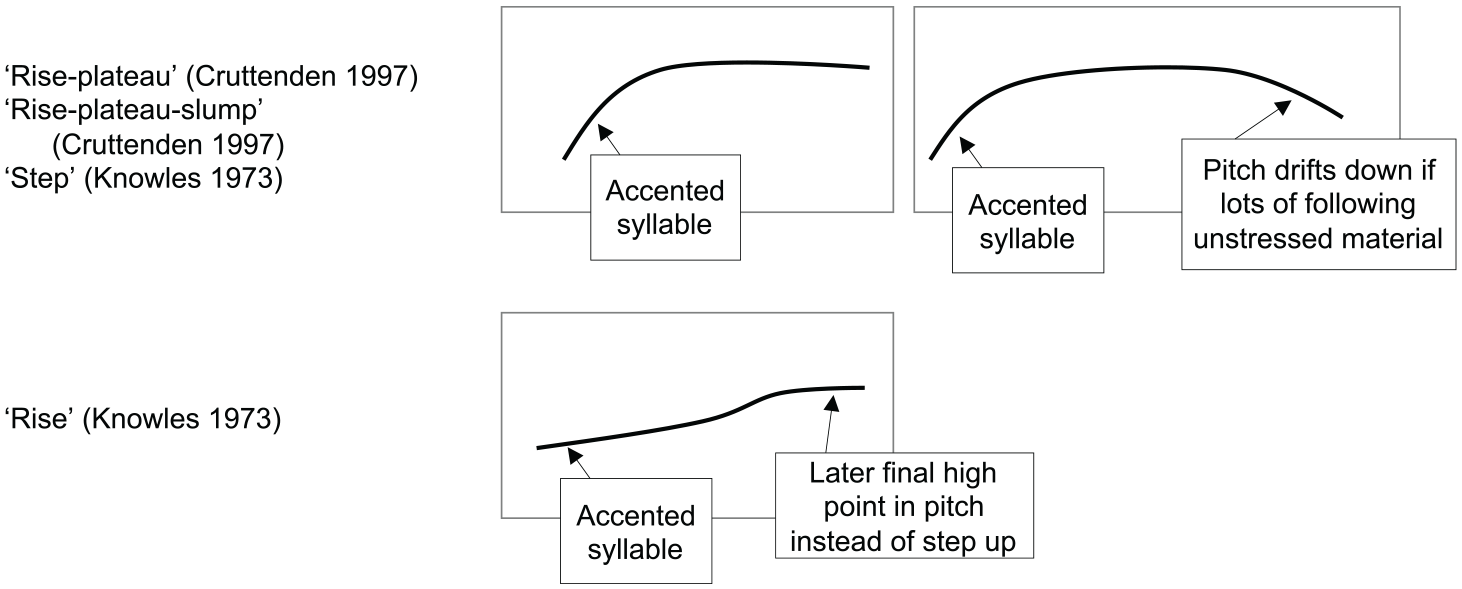
A schematic comparison of phrase-final intonation contours described for Scouse in Knowles (1973), and those described for other UNB dialects in, for example, Cruttenden (1997).
Previous work has suggested that intonation in Liverpool English may be the result of contact with Irish English due to the large numbers of migrants from Ireland during the nineteenth century (Knowles, 1973; Watson, 2007). However, detailed work has not been conducted on Liverpool intonation until now. Specifically, Watson (2007, p. 358) notes the apparent similarity between Liverpool and Belfast intonation and states, “More systematic investigation is required if we are to understand the relationship between the prosodic system of LE and that of other English varieties.” In this paper we present such an investigation.
Manchester is not noted in discussions of UNB intonation (for example, Ladd, 2008). In terms of geography, Manchester is well within the urban north of Britain and is the closest large city to Liverpool. We chose Manchester as a comparison with Liverpool for this reason: it is geographically northern and urban, and also very close to Liverpool, but has not been described as sharing intonational rises characteristic of Liverpool, Belfast, and Glasgow among other cities. A detailed analysis of intonation in Salford (adjacent to Manchester city center) has been conducted in Cruttenden (2001). Cruttenden describes the intonation of Manchester as “mixed,” containing elements of the dialect areas surrounding Manchester (Midlands, Lancashire, Merseyside) as well as possible influence from more RP (Received Pronunciation)-like intonation.
Cruttenden’s analysis considers two pragmatic categories: open and closed. “Open” refers to statements which have information to come, and “closed” refers to statements where no further information will come (Cruttenden, 2001, p. 57). Cruttenden’s data is from conversational dyads rather than our read sentences and contains both open and closed statements. His results from the closed category are most comparable with our read sentences. Cruttenden states that the contour he refers to as “rise-slump” is most common in closed statements (26.5% of tokens) and corresponds to RP falling tones (Cruttenden, 2001, p. 57). He describes the slump as a fall from high to mid-range in pitch. From this we interpret that the most common declarative contour in Manchester is a fall, which may not fall as far in pitch as an RP fall. A further 16.7% of tokens were a “slump,” which corresponds to a fall from high to mid pitch. In Cruttenden’s data there are some contours which may correspond to those described for UNB varieties such as Glasgow, above. In the closed statements, Cruttenden found 9.5% of tokens were “rise-level,” which seems to correspond to a “rise-plateau” as described above (Cruttenden, 1997), and 1.1% of tokens were “rise-level-slump,” corresponding to the “rise-plateau-slump” in Glasgow.
1.4 Summary and remaining questions
Our analysis, therefore, contains a descriptive account of intonation in Liverpool and comparison with Manchester, a city in close geographical proximity but where UNB rising declaratives are not reported in the manner of Belfast or Glasgow (Cruttenden, 2001). In doing so, we present the detailed investigation into intonation in Liverpool which is called for in Watson (2007). Our investigation enables discussion of the possible origins of Scouse UNB rises and comparison with other dialects in this group. Finally, we contribute prosodic data to the literature on new dialect formation, which has, so far, largely concentrated on segmental aspects in terms of phonological contribution.
2 Methods
2.1 Participants
Data were collected from 32 speakers for the purposes of this analysis. These include 17 speakers of Liverpool English (8f, 9m) and 15 speakers of Manchester English (7f, 8m). All were aged 20–22 at the time of recording and were students at Lancaster University, or close friends of students at Lancaster University. Our participants were from lower-middle-class and upper-working-class backgrounds and were in the process of being educated to degree level. All were recruited as friends of the research assistants involved in data collection, or friends of friends via social media. They were monolingual other than some foreign language learning at school.
Our Liverpool participants were born and raised in central Liverpool or Bootle (a town just north of Liverpool city center with an industrial heritage linked to the Liverpool docks). 1 Our Manchester participants were from central Greater Manchester as defined by being raised inside the M60 ring road. The M60 is a large motorway which encircles the center of Manchester. We chose this boundary to include those living nearer to the city center and less likely to be influenced by the historic dialect areas of Cheshire and Lancashire surrounding the outskirts of Greater Manchester. The M60 is approximately six miles from Manchester city center at its furthest point. 2 The participants who were currently studying at Lancaster University were living in Lancaster for the duration of their studies but had otherwise lived in Liverpool or Manchester and returned there during the holidays.
2.2 Recordings
Nine of the speakers from Liverpool (lf01–04 and lm01–05) were recorded in the participant’s home by a research assistant. The remaining speakers were recorded in Lancaster University’s phonetics lab in the noise-attenuated sound booth by research assistants including the third author. The data were recorded using a Beyerdynamic Opus 55 headset microphone, and a Sound Devices USB Pre2 audio interface. This equipment was used in all recording locations. Data were recorded at a sampling rate of 44.1kHz.
2.3 Materials
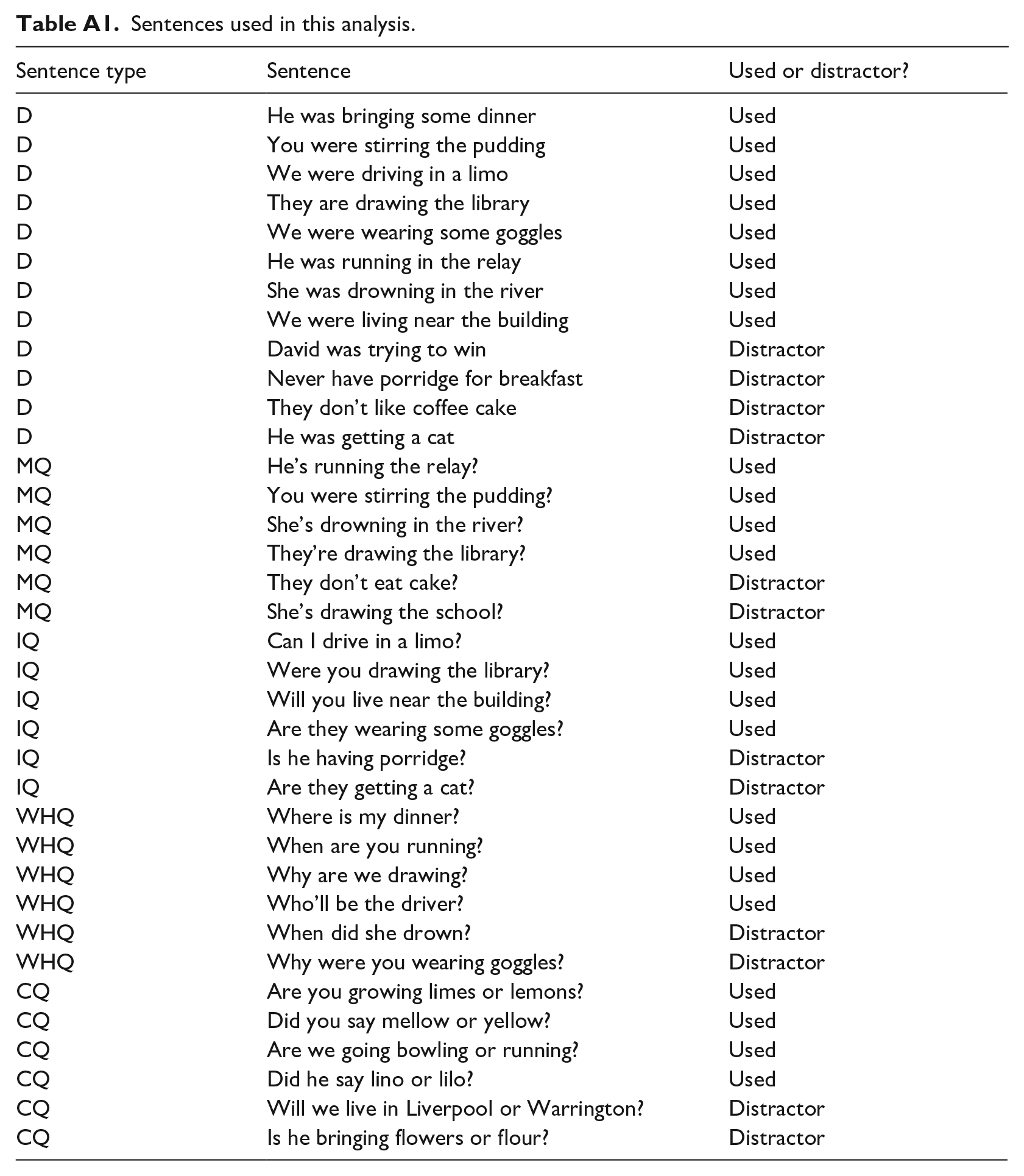
Our recording stimuli were presented to participants and their responses recorded using an experiment conducted in PsychoPy (Pierce et al., 2019). Our participants read a list of 36 sentences from a computer screen in random order for the intonation part of our data collection. These sentences were based on the IViE project materials (Grabe et al., 1998) but adapted for participants from the north of England. For example, we removed sentences such as “You live in Ealing?”, as Ealing is a suburb of London, and replaced it with “He’s running the relay?” The full list of our sentences are shown in the Appendix in Table A1. The stimuli included the different sentence types used in Grabe (2004): declaratives (D, eight sentences), questions without morphosyntactic markers (MQ, four sentences), inversion questions (IQ, four sentences), wh-questions (WHQ, four sentences), and coordinating questions (CQ, four sentences). The sentences were designed to include two pitch accents and avoid voiceless sounds for the purposes of measuring F0 values. The final pitch accent was intended to fall on a disyllabic word so that the final pitch accents and following material would not be truncated or compressed (Grabe et al., 2000). Words were designed such that it was natural for the most prominent pitch accent, the nuclear accent, to fall on the final disyllabic word. The remaining 12 sentences were distractors of the same sentence type as those above. The distractors were roughly the same length in terms of syllables as the target sentences, but contained some voiceless sounds to break up the pattern of the target sentences. Each sentence was recorded as an individual sound file and repeated twice.
Our experiment also included a word list and a video story retelling task. These data are not analyzed here, but see Kirkham et al. (2019) for analysis of the word list data. We acknowledge that our data lose some ecological validity in being taken from a sentence reading task. Intonation has been studied in story retelling or map tasks (Ritchart & Arvaniti, 2014), as well as stretches of spontaneous speech (Cruttenden, 2001; Podesva, 2011; Nance, 2015; Levon, 2016). Some studies have argued that intonation in sentence tasks may differ from intonation in spontaneous speech (Face, 2003; Ruiter, 2015). However, for this typological study focusing on Scouse intonation we wished to produce comparable results to other studies of intonation in British English such as the work on the IViE project as well as Lowry’s work in Belfast, and Mayo in Glasgow. We therefore chose a sentence reading task as most comparable, but future work could expand to other task types.
2.4 Data processing
Prior to analysis, all data were low pass filtered at 11.025 kHz and down sampled to 22.05 kHz in Praat (Boersma & Weenink, 2019). Textgrids were created for each sentence and the following information added using an R script (R Core Team, 2013): sentence transcription, speaker, token number, sentence type.
2.5 Labelling
Before labelling, all the data were listened to and an initial screening carried out. Thirty-six sentences were excluded which did not fit the expected prosody, for example the speaker did not produce the most prominent accent on the final word, produced completely monotone intonation, or where extensive creaky voice made intonational analysis impossible. Data were then labelled for the following durational characteristics: duration of the word containing the pre-nuclear accent, duration of the word preceding the nuclear accent, duration of the word containing the nuclear accent, duration of the pre-nuclear syllable, duration of the nuclear-accented syllable. This durational labelling was carried out by research assistants including the third author.
After this durational labelling, intonational labelling of the pre-nuclear and nuclear accents was carried out by the first and fourth authors. Twenty-five percent of the Liverpool data was checked by the second author until agreement was reached and 50% of the Manchester data was labelled by the fourth author and then checked by the first author until agreement was reached. We employ an Autosegmental Metrical Phonology analysis (Pierrehumbert, 1980; Ladd, 2008), using a labelling scheme specifically designed for UNB rises, GlaToBI (Mayo, 1996). The aim of this approach is to reduce an intonational contour into its most phonologically relevant pitch events (Ladd, 2008, p. 45). In this study, we take Mayo’s (1996) work as a phonological basis for UNB and apply it to Scouse. We acknowledge that this approach assumes the phonological analysis of UNB in Mayo (1996) is correct, and that such an analysis of one UNB dialect can be successfully transferred to another dialect in the UNB group. In support of our approach, the model employed in Mayo (1996) is similar to the analysis of Belfast English (Grabe, 2004; Lowry, 2002b, 2011; Sullivan, 2010), Donegal Irish (Dalton & Ní Chasaide, 2005; Dorn et al., 2011) and Glasgow Gaelic (Nance, 2015). We hope that our study can provide a base for future detailed work on the intonational phonology of Scouse and other UNB dialects. Unlike Cruttenden (2001), we do not take a holistic approach to mapping tones to meanings. Instead, we show the proportion of each tone sequence used for five different sentence types as in, for example, the approach used in Grabe (2004). However, a more holistic account of intonation in its pragmatic context in Scouse as well as more detailed phonetic realizational analysis as used by Cruttenden (2001) for Manchester would be a useful contribution of future work.
The major differences between GlaToBI and ToBI (Beckman & Ayers Elam, 1993) are as follows: GlaToBI removes the intrinsic up step cuing property of an H phrase accent such that H-L% represents a falling pitch, rather than a level pitch in other forms of ToBI. A second deviation we have adopted is the use of !H to indicate up step rather than its more conventional meaning on down step in ToBI. This is suggested as an addition to GlaToBI in Mayo (1996, p. 44) and we found it very useful to describe the continuing high-rises noted for HRT contours (Ladd, 2008, p. 125). Additionally, we have retained the L* and L*+H labels used in, for example, Grabe et al. (2001) rather than the suggested L*H in Mayo (1996).
An initial narrow labelling was carried out and several categories were collapsed for clarity of comparison: specifically, for pre-nuclear accents, H+L* and L* were combined, and L+H* and H* were combined. For nuclear accents, H*+L and L+H* were combined with H*. Down stepped H* was considered as H*. H+L* and L*+H were combined with L*. A schematic representation of the final transcription used for the nuclear accents and following material is shown in Figure 2. In terms of how these categories relate to the work carried out on Scouse and UNB intonation previously, L* L-H% represents what Knowles (1973) refers to as the “rise”, L* H-L% represents the “rise-plateau-slump” (Cruttenden, 1997), L* H-H% represents the “rise-plateau” (Cruttenden, 1997) or “step” (Knowles, 1973), and L* H-!H% and H* H-!H% represent possible High Rising Terminals (Ladd, 2008; Warren, 2016). A point to note here is our use of L* H-L% to capture “rise-plateau-slump.” Cruttenden (2001) uses L*+H !H-L% to denote the same sequence (referred to as “rise-level-slump” in the 2001 paper). Our transcription is based on Mayo (1996) as closely as possible so will have some differences from Cruttenden (2001). Our collapsing of some categories as described above led to some narrow distinctions being removed, but we feel this enhances the clarity of the analysis.
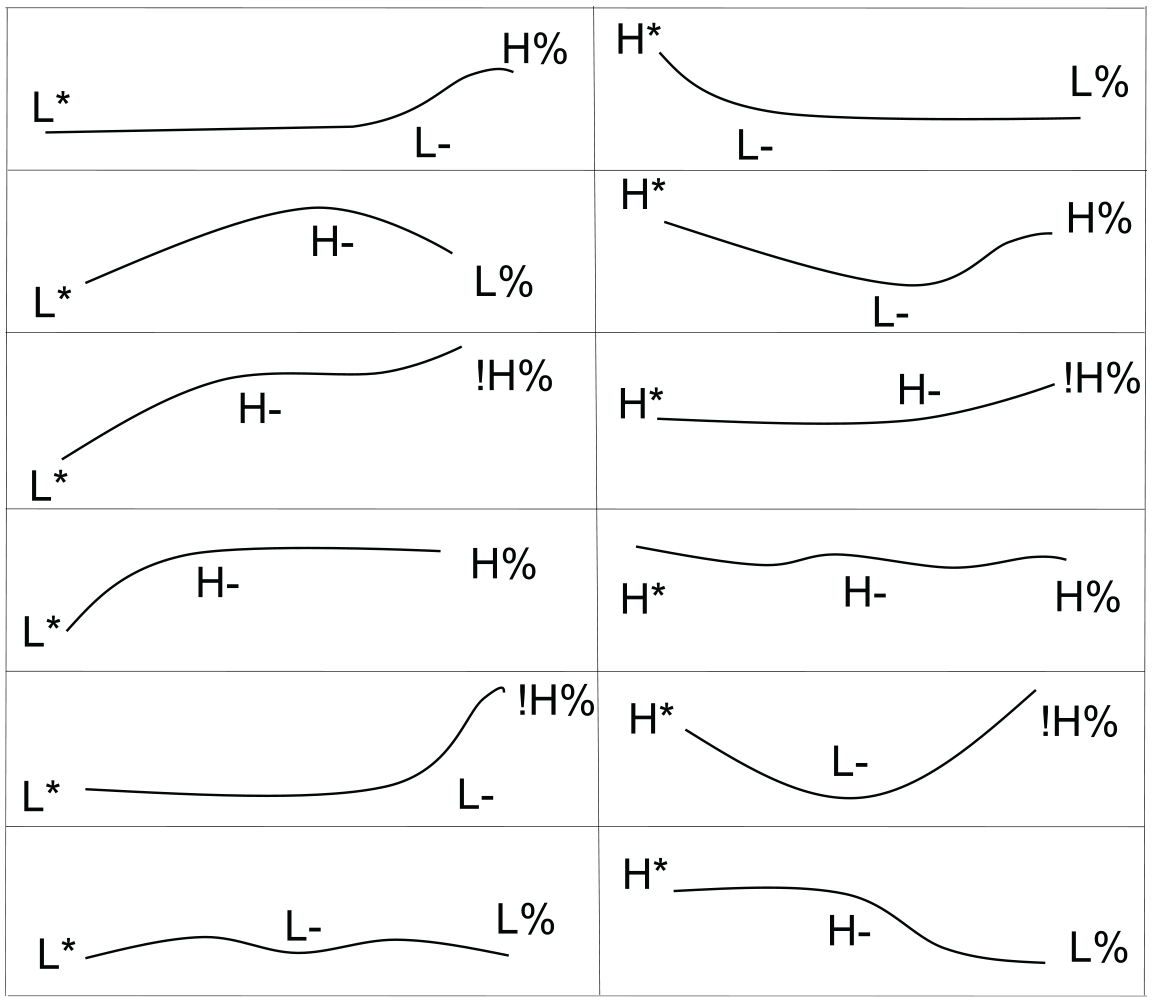
A schematic representation of the intonational transcription used for nuclear accents and following material.
Finally, we labelled linguistically relevant turning points in the F0 trace on a point tier in Praat. The turning points were those associated with the phonological analysis of intonation described above and thus do not relate to microprosodic variation. Labelling F0 turning points associated with intonational events allowed extraction of F0 values used in the pitch range analysis described below. Examples of the phonological labelling are shown in Figure 3.
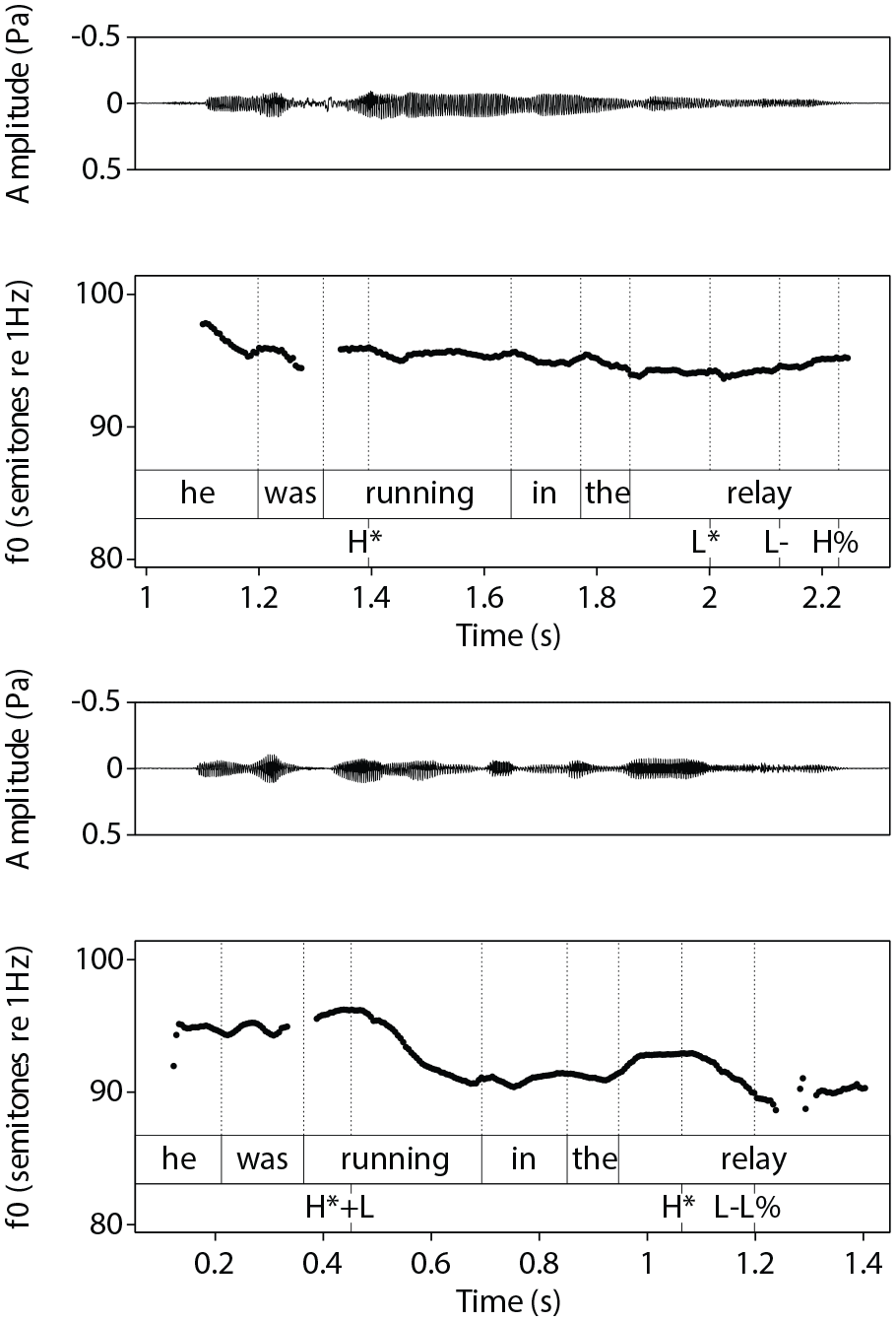
Example waveform and pitch traces from the most common phrase-final contours in Liverpool (L* H-H%) and Manchester (H* L-L%) produced by female speakers.
2.6 Analysis
2.6.1 Phonological analysis of intonation
Our linguistic analysis focuses on providing an account of intonation in Liverpool in comparison with Manchester. In doing so, we provide a summary of the phonological results for pre-nuclear accents and for nuclear accents plus boundary tones. Our analysis considers the production of each sentence type in both cities for both genders studied. Labels for the phonological labelling were extracted from Praat TextGrids in R and further analysis was conducted in R.
Following Kozminska (2019) we present descriptive statistics of the different realizations for pitch accents and contours and discuss these results. We also conducted mixed effects logistic regression modelling to test differences between cities, genders, and sentence types using the lme4 package in R (Bates et al., 2015). Our analysis focuses on intonation in Liverpool. We therefore tested the occurrence of the most common contour in Liverpool accents against its occurrence in Manchester. In pre-nuclear accents, we therefore tested the occurrence of L*+H contours against other realizations, and in nuclear accents we tested the occurrence of L* L-H% contours.
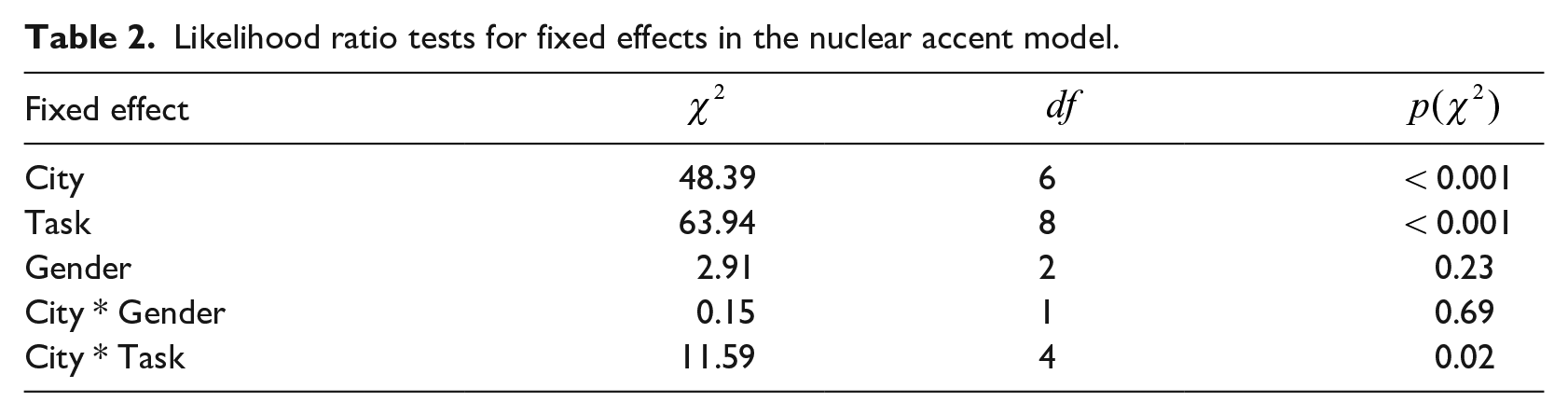
In each case, models included fixed effects of city, gender, and sentence type, interactions of city*gender, city*sentence type, random intercepts of speaker and sentence. The addition of a random slope of speaker by sentence type, and an interaction between gender and sentence type resulted in the model failing to converge so were removed. In order to conduct significance testing, we employ likelihood ratio testing to compare a full model containing all of the variables listed above, against a reduced model not containing the variable being tested (Winter, 2020, p. 260). A significant difference between models indicates a significant influence of the variable in question. The structure of our full pre-nuclear model was therefore: production of L*+H ~ gender + city + sentence type + gender*city + city*sentence type + (1| speaker) + (1| sentence). A corresponding full model was constructed to test the production of L* L-H% in nuclear accents. The baselines were Liverpool, declaratives, and female speakers, and contrast coding was used.
2.6.2 Pitch range analysis
As well as the phonology of the contours produced we also present analysis of the pitch range employed by speakers in each city. It has been commented previously by Knowles (1973) that speakers in Liverpool can appear somewhat monotone. We wished to test this claim empirically. In order to assess the range of fundamental frequency values used by each participant we first extracted F0 values at the linguistically relevant turning points in the F0 contour using a Praat script. The minimum F0 value was set at 40Hz, the maximum value at 500Hz, and a 0.01s time step was used.
We wished to capture a perception of small pitch excursion. The measure we chose to do this is the difference between the L* turning point in pitch and the final H%, in L* L-H% contours which we found to be the most common realization in Scouse. Sullivan (2010) refers to this measure as “F0 excursion” and Dorn et al. (2011) as “scaling.” Sullivan provides the most immediate comparison data as she conducted the same analysis on statement rises in Belfast. We chose, therefore, to adopt Sullivan’s naming of the measure and method to compare L and H points in Hertz. We first extracted the contours which were L* L-H% declaratives in the data from Liverpool speakers. We did not include the Manchester speakers in this analysis as they produced so few L* L-H% contours. We then calculated the difference between Hertz values at L* and H%. Tokens were removed from the dataset where they obviously constituted pitch tracking errors. We excluded tokens which were below zero and above 2.5* the standard deviation (10 tokens). The resulting data contained 138 values from 16 out of 17 Liverpool speakers. Our analysis is compared descriptively with Sullivan’s (2010) results. We also use mixed effects regression modelling to investigate gender differences in our speakers. We constructed linear mixed effects models to test the effect of gender, comparing a full model with one not containing gender via likelihood ratio testing as described above. The full model was therefore of the formula: F0 excursion ~ gender + (1| speaker) + (1| sentence), and the comparison model was constructed as: F0 excursion ~ (1| speaker) + (1| sentence).
3 Results
3.1 Phonological analysis of intonation
The results of the phonological analysis of intonation in pre-nuclear accents are shown in Figure 4, and the results of the nuclear accents and following material are show in Figure 5. For a reader who wishes to see the exact numbers of each kind of contour, these results are tabulated in the supplementary materials.
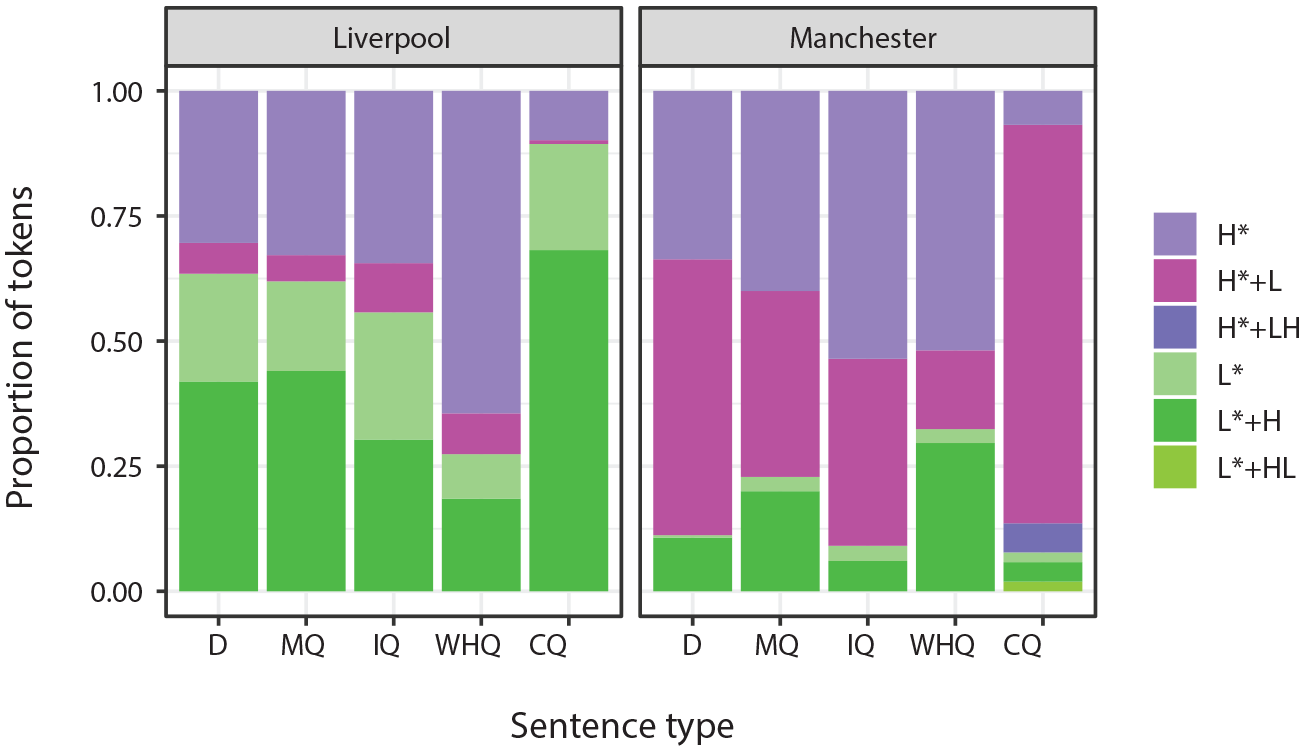
Phonological labelling of pre-nuclear accents in Liverpool and Manchester. Different pitch accents are shown as a proportion of each sentence type. Color online: H* accents are shown in shades of purple and L* accents in shades of green. D = Declaratives, MQ = Questions without morphosyntactic markers, IQ = Inversion questions, WHQ = Wh-questions, CQ = Coordinating questions.
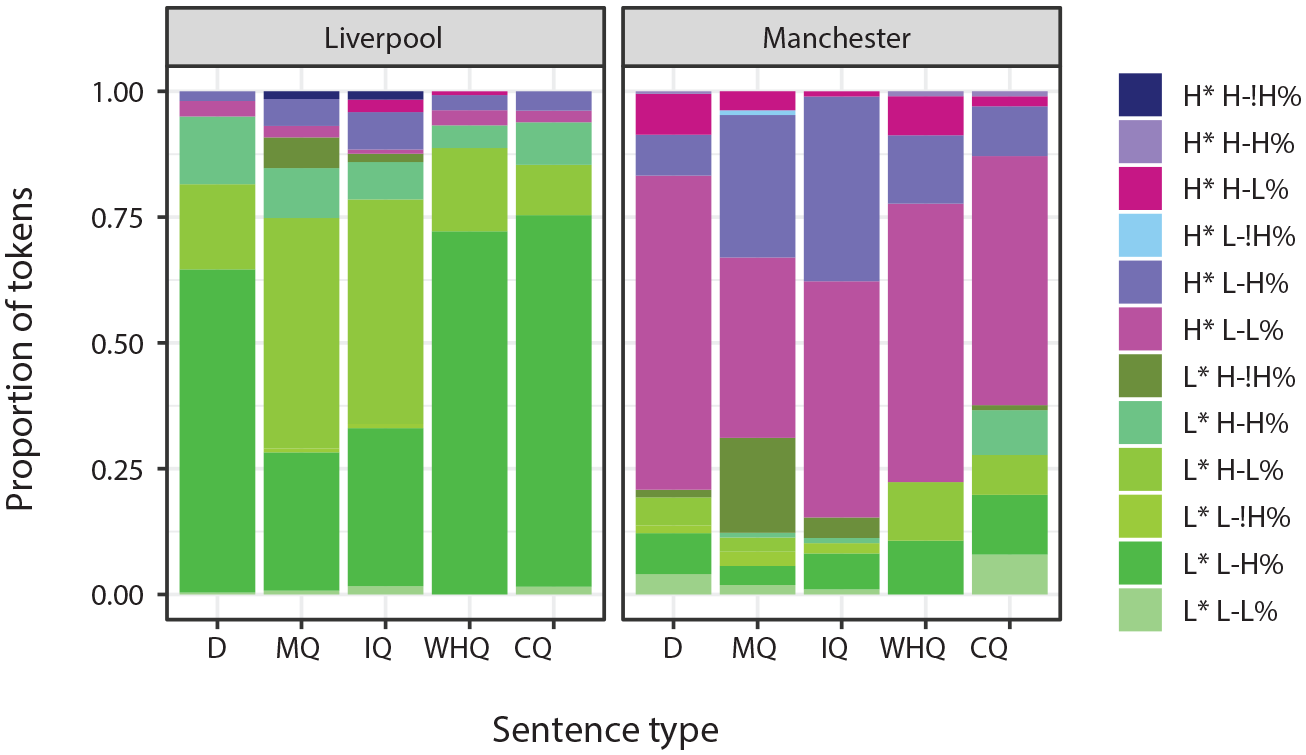
Phonological labelling of nuclear accents and following material in Liverpool and Manchester. Color online.
From these descriptive statistics we can make the following generalizations: there are very large differences in how intonation is realized between Liverpool and in Manchester. Liverpool pitch accents are typically L* (low) across all sentence types while Manchester pitch accents are typically H* (high).
In terms of pre-nuclear accents, declaratives, questions without morphosyntactic markers, and inversion questions are realized similarly in Liverpool. Wh-questions often have a H* tone on the pre-nuclear accent, which was the question word itself in our sentences, for example, “Why?” Coordinating questions have a greater number of rising L*+H pre-nuclear accents compared with other sentence types and fewer tones beginning with H*. Similarly, in Manchester, coordinating questions are again different from other sentence types by having a greater proportion of H*+L falling tones. Coordinating questions, then, in both cities, are characterized by pitch movement on the pre-nuclear accented word.
For the sentence-final nuclear accents, phase accents, and boundary tones there are perhaps even larger differences between both cities. The majority of contours in Liverpool are realized as what Knowles (1973) describes as the “rise” and we have transcribed as L* L-H%. This contour accounted for 54% of tokens in Liverpool (only 7% in Manchester) and supports results found in a pilot of the current study (Nance et al., 2015). The second most common contour in Liverpool is the rise-plateau-slump (L* H-L%). This was particularly prevalent in questions without morphosyntactic markers and inversion questions so may signal interrogativity when there is no wh-question word present. Rise-plateau-slump accounts for 24% of the contours in Liverpool (5% in Manchester). In Manchester the most common contour is a simple fall, H* L-L% (46% of the data).
Warren (2016, p. 90) suggests that HRT is not commonly used in UNB dialects and this claim appears to be true in our data. Grouping together all contours with a very high final rise, that is, H* H-!H%, H* L-!H%, L* H-!H% and L* L-!H%, 3 possible examples of HRT in declaratives account for six tokens out of 495 declaratives in our dataset. All of these occur in Manchester.
In terms of how each sentence type is realized, we summarize the main patterns for each city here. Liverpool declaratives are most commonly realized with low or rising pre-nuclear accents and “rise” (L* H-H%) phrase-final contours. Questions without morphosyntactic markers and inversion questions typically also have low/rising pre-nuclear accents, but are most likely to have a phrase-final rise-plateau-slump. Wh-questions typically have high pre-nuclear accents and then a phrase-final “rise.” Coordinating questions are usually produced with a rising pre-nuclear accent and then a phrase-final L* H-H% (“rise”).
Manchester declaratives typically have pre-nuclear high tones or falls and phrase final H* L-L%. Questions without morphosyntactic markers are usually produced with high or falling pre-nuclear accents and high or falling nuclear accents and following material. A small number of MQ tokens included high rises. Inversion questions and wh-questions also have high or falling pre-nuclear accents and typically have falling phrase-final contours. Coordinating questions are almost universally realized with a marked fall on the pre-nuclear accent and a phrase-final fall.
3.1.1 Gender variation
The results of the phonological analysis of intonation in pre-nuclear accents split by participant gender are shown in Figure 6 and the results for nuclear accents and following material split by participant gender in Liverpool and Manchester are shown in Figure 7. For a reader who wishes to see the exact numbers, tables of these results are shown in the supplementary materials.
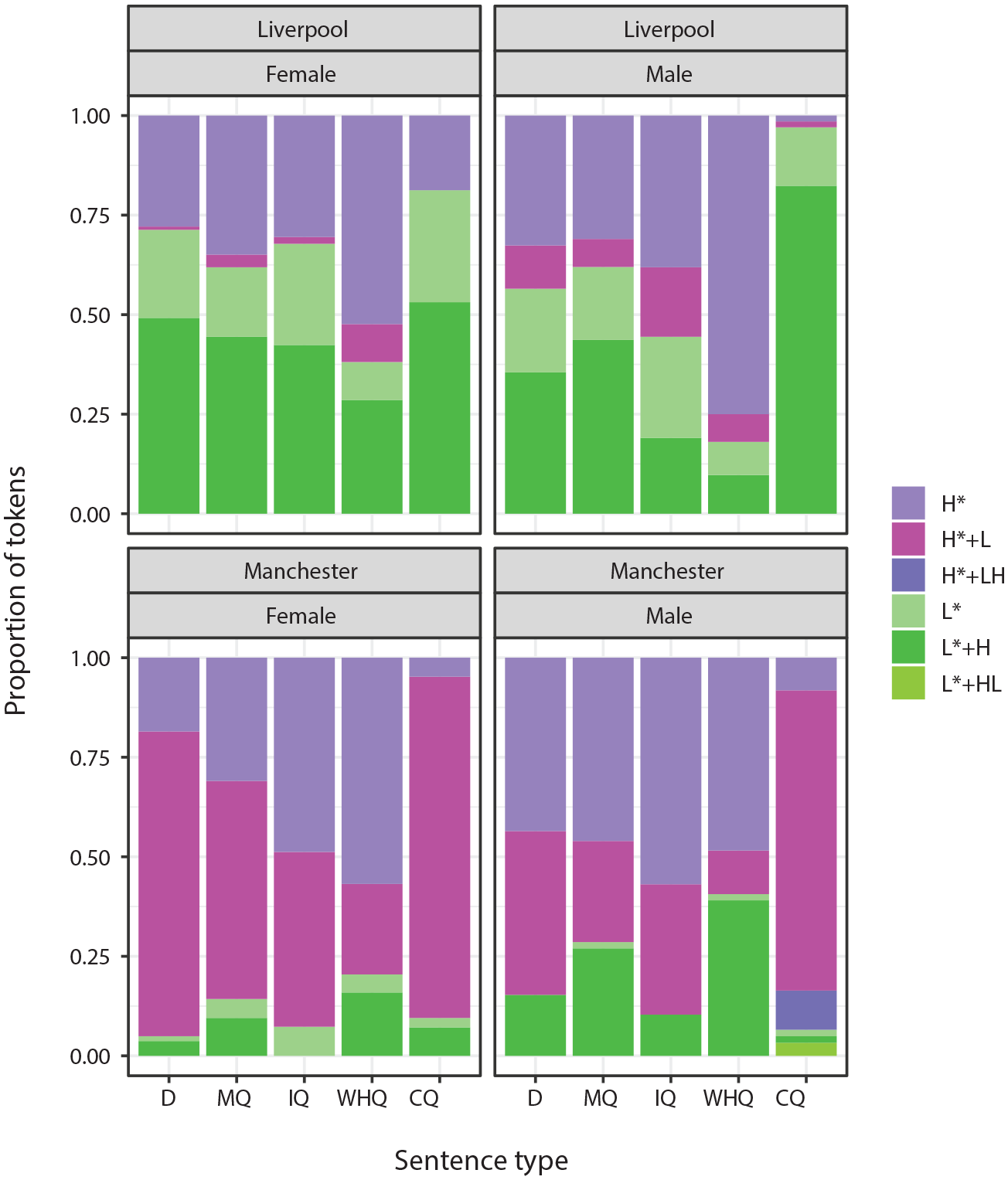
Phonological labelling of pre-nuclear accents in Liverpool and Manchester according to gender. Color online.
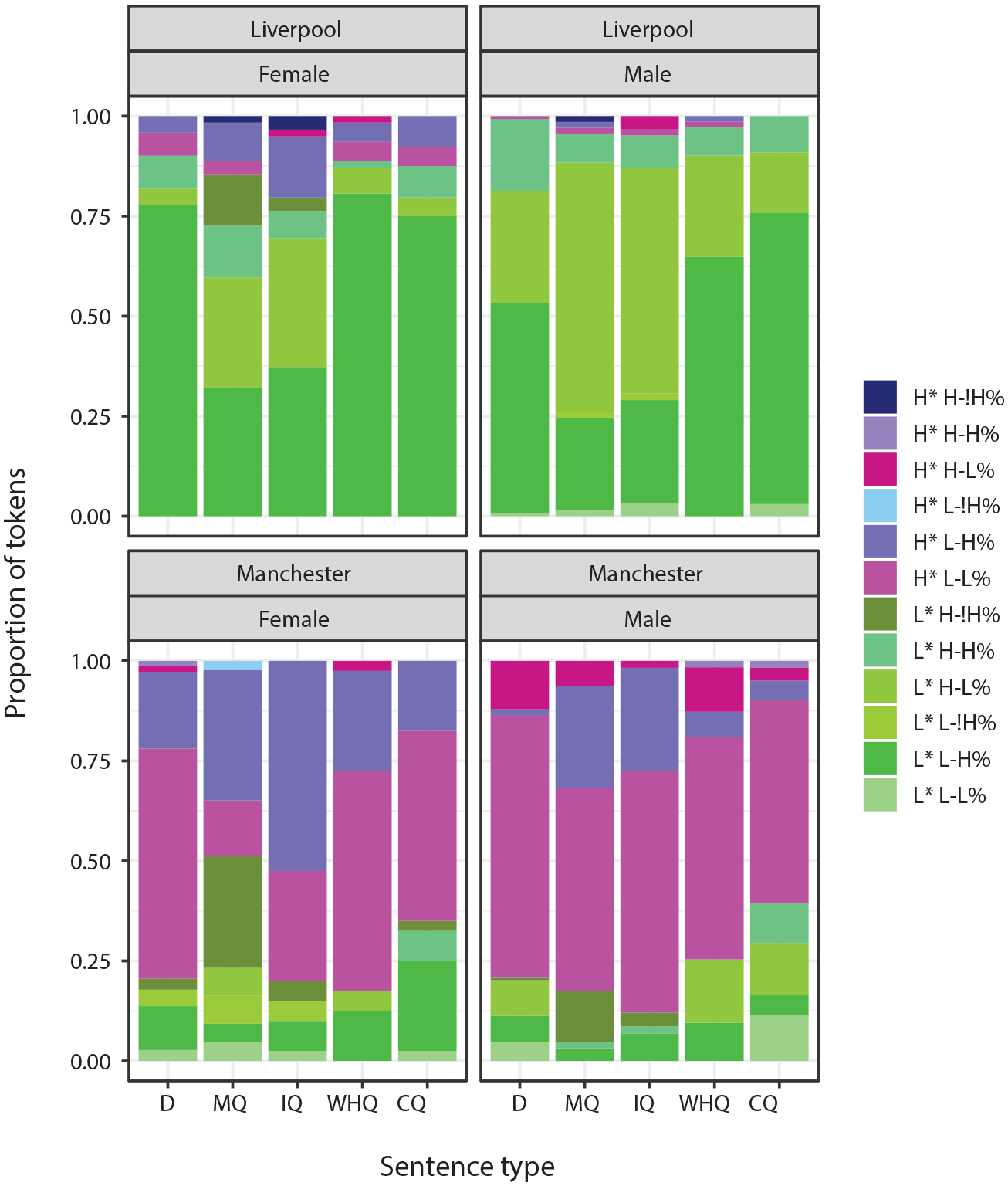
Phonological labelling of nuclear accents and following material in Liverpool and Manchester according to gender. Color online.
The pre-nuclear accents are not produced very differently by the two genders in each city, except for somewhat more L*+H* accents in Liverpool male coordinating questions (56 tokens, 80%) compared with Liverpool female coordinating questions (34 tokens, 54%). In terms of the phrase final contours in Liverpool, the rise-plateau-slump is widely used by males (145 tokens, 34%) but less by females (48 tokens, 13%). Liverpool females use rise-plateau-slump almost exclusively in questions without morphosyntactic markers and inversion questions (36 out of 48 tokens occur in these contexts). Liverpool males also use rise-plateau-slump most commonly in these kinds of questions (78 out of 145 tokens), but use it in other sentence types as well, where Liverpool females instead use rise contours (L* H-H%). In Manchester, there are also gender differences in the production of phrase-final contours. In particular, females use fall-rises (H* L-H%) more often than males (66 tokens, 22% of tokens among females compared with 40 tokens, 10% among males). Both genders use this contour most in questions without morphosyntactic markers and inversion questions, but females also use the contour across other sentence types whereas this is less common among males.
As noted above, HRT in declaratives is not common overall, and is not used in our data from Liverpool. Out of the six possible declarative examples, five were produced by female speakers and one by a male speaker. This gendered pattern of HRT usage is comparable with other studies of the contour which report it is used more (but not exclusively) by female speakers (Warren, 2016).
3.1.2 Statistical testing
As described above we conducted mixed effects logistic regression modelling on the most common contour in Liverpool pre-nuclear accents, L*+H, compared with the rest of the dataset, and on the most common contour in Liverpool nuclear accents, L* L-H% compared with the rest of the dataset. The results of the likelihood ratio tests are shown in Table 1 for pre-nuclear accents and in Table 2 for nuclear accents.
Likelihood ratio tests for fixed effects in the pre-nuclear accent model.
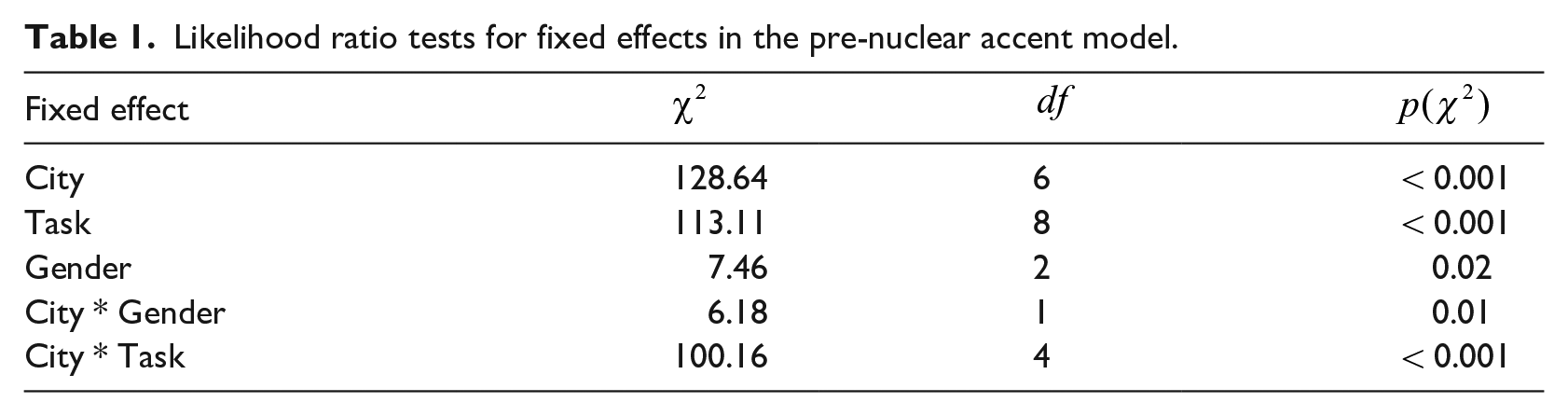
Likelihood ratio tests for fixed effects in the nuclear accent model.
In order to interpret these results, we have plotted the fixed effects and levels of fixed effects from the full model where the effect’s confidence intervals did not span zero in Figure 8.
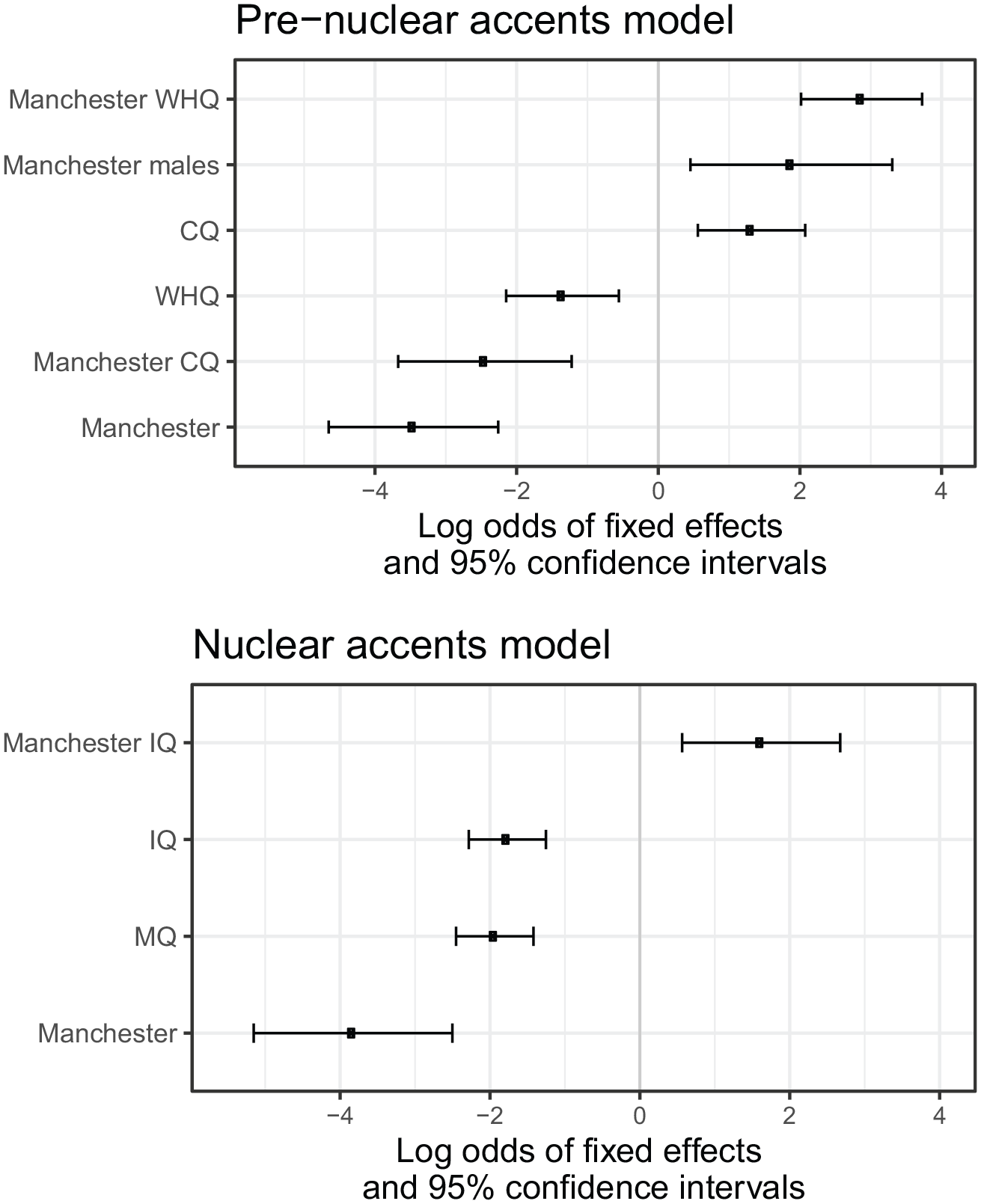
Log odds of fixed effects from the pre-nuclear and nuclear accent full models where CIs did not span zero.
In terms of the pre-nuclear accents, Figure 8 shows that the significant effect of city is a result of Manchester having a far lower likelihood of L*+H contours. L*+H is less likely overall in CQs and WHQs, and also CQs in Manchester. Manchester males are more likely than Manchester females to produce L*+H, and Manchester WHQs are more likely than other sentence types in Manchester to be produced with this contour. For nuclear accents, again L* L-H% is far less likely to occur in Manchester as compared with Liverpool. L* L-H% is less likely in IQs and MQs as compared with declaratives, but more likely in Manchester IQs as compared with other sentence types in Manchester.
3.2 Pitch range analysis
Our final analysis considers the pitch range exploited by Liverpool speakers in the realization of L* L-H% contours. To capture this, we calculated the distance in Hertz between L* and H%. The results of this analysis are shown in Figure 9.
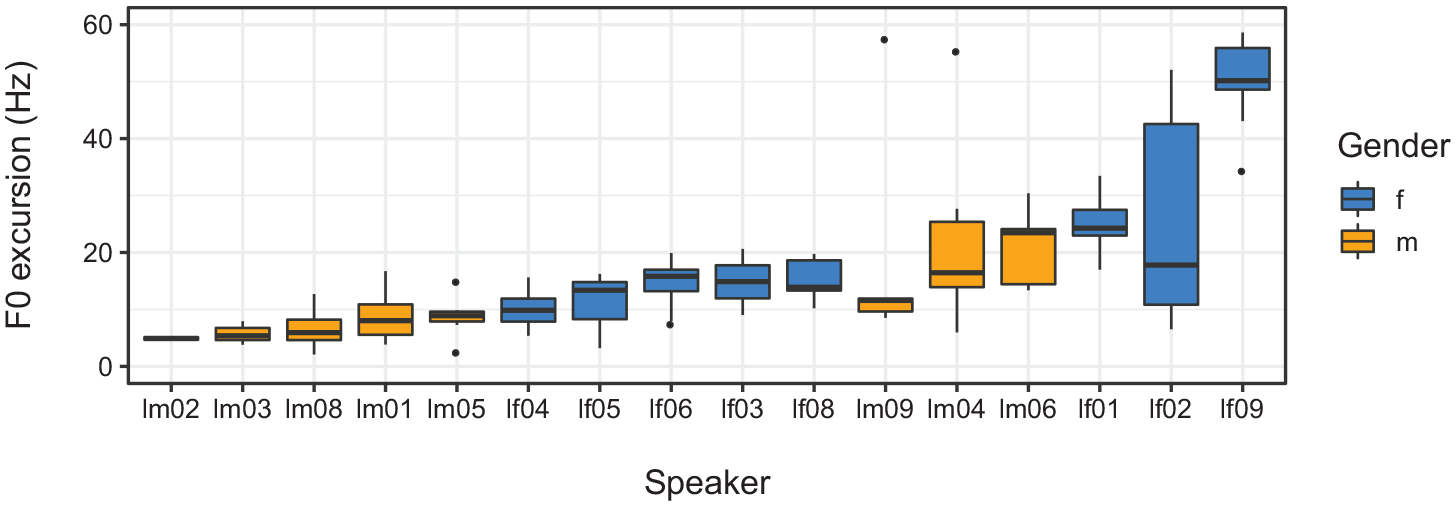
Values of F0 excursion in Hertz for each speaker. Values indicate the difference between L* and H%. Values are ordered from lowest to highest mean values.
The mean value in this analysis is 18Hz, standard deviation 14.6Hz. In Sullivan (2010, p. 237), the mean for Belfast speakers was 19Hz, sd. 14Hz. Sullivan’s analysis also combined data from both male and female speakers together. These values are strikingly similar and suggest that Liverpool speakers are not noticeably more monotone than speakers of other UNB varieties. The perception of a narrow pitch range referred to in Knowles (1973) may stem from the use of UNB contours in declaratives, rather than Liverpool speakers exploiting a narrower range in rises compared with other comparable dialects.
The F0 excursion mean for female speakers was 23.0Hz and the mean for male speakers was 12.7Hz. To test a possible gender difference, model comparison via likelihood ratio testing compared a model containing gender and random intercepts of speaker and sentence, against a model not containing gender (an intercept only model). There was no significant effect of gender, though this may be due to the relatively small number of tokens in this analysis,
3.3 Summary of results
In summary, intonation in Liverpool is characterized by low and rising contours. The most common type of declarative phrase-final contour is what Knowles (1973) refers to as a “rise,” where pitch gradually rises until a relatively low high point is reached at the end of the phrase. Overall, the second most common phrase-final contour is the rise-plateau-slump, which is more common among male speakers than female speakers and most used in questions without morphosyntactic markers and inversion questions. Statistical analysis demonstrates that the most common Liverpool pre-nuclear accent, L*+H, and the most common nuclear contour L* L-H% are significantly less likely to occur in Manchester, though Manchester males produce more L*+H pre-nuclear accents than Manchester females.
The rise-plateau contours reported as most common in Belfast and Glasgow declaratives are present but only in very small numbers. HRT is not used in Liverpool declaratives in this dataset. Manchester intonation seems to be typical of non-UNB English dialects in England similar to those reported in Grabe (2004). Liverpool speakers exploit a similar pitch range to speakers in Belfast reported in Sullivan (2010). The range used is on average lower in male speakers compared with female speakers, though not significantly so.
4 Discussion
In this section we consider each of the three research questions identified above in turn.
4.1 Description of intonation in Liverpool
Our analysis confirms previous reports in Knowles (1973) and Watson (2007) that Liverpool intonation is characterized by rising declaratives. Knowles describes three typically occurring declaratives, the “rise,” the “rise-plateau-slump,” and the “step,” schematized in Figure 1. Of these we found that the “rise” occurred widely across declaratives and other sentence types. The “rise-plateau-slump” is most used in questions without morphosyntactic markers and inversion questions, and most used by male speakers, but is also used in all sentence types. The contour described as “step” does occur in our dataset but is not common. The results are starkly different from the data from Manchester, a city less than 40 miles from Liverpool, and support claims in Knowles (1973) that Scouse is an abrupt shift in the dialect continuum of the north of England.
Our finding that rise-plateau-slump is most used in certain types of question and by male speakers is interesting because Knowles (1973) and Ladd (2008) suggest that the slump is a phonetic consequence of having a lot of unaccented material following the nuclear pitch accent. All of our speakers read the same materials but use of the slump appears to pattern with grammatical meaning and with gendered behavior. This result suggests that the slump is not a phonetic side effect of unaccented material, but instead has become phonologized for intonational meaning and is employed in the realization of gendered use of language. This result was an unexpected outcome of our study and could form the subject of future research.
Liverpool has been hypothesized to be a part of the group of dialects in the north of the UK referred to as the “Urban Northern British” (UNB) group where rising declaratives are common (Cruttenden, 1997; Ladd, 2008). Our results support this account and demonstrate that Scouse is very different intonationally from dialects such as Mancunian. However, we have found some differences in the types of rises used. The most common rises in Belfast and Glasgow have been described as a “rise-plateau” (“step” in Knowles, 1973) in detailed phonological work conducted by Mayo (1996), Lowry (2002a), and Grabe (2004). While Liverpool declaratives are certainly still rising, the final high point is reached much later in the phrase, which we have represented by an L-phrase accent before an H% boundary tone. Interestingly, Sullivan (2010, p. 146) notes that this pattern was the most common in her statement data from Belfast speakers. She acknowledges that her sample of three speakers is probably too small to make generalizations about Belfast or test thoroughly whether descriptions of Belfast intonation need revising, but it is interesting to note that the pattern we find as most common in Liverpool has also recently been found in data from Belfast speakers. To summarize, we consider Liverpool a worthy member of the UNB group, but note that the nature of the declarative rises are a little different from most other cities in this grouping.
Our analysis focuses on Liverpool, but also contributes to descriptions of Manchester in addition to that already published in Cruttenden (2001). Cruttenden describes the most common contours in closed declaratives as a gradual fall from high to mid-range or a sharp fall from high to mid-range. In this respect, our results are similar to those found by Cruttenden: we found the most common contour to be a fall in declaratives (62.44% of our Manchester declaratives; Cruttenden (2001) “rise-slump” + “slump” together = 43.2% of closed sentences). Impressionistically, we felt that our intonation from Manchester was less “mixed” dialectally than Cruttenden suggests and conformed more towards an RP-like model. It may be the case that intonation has changed in the 20 years since Cruttenden’s analysis, or that our speakers were from a different background, or our methods are too different to compare. But the possibility of change in Manchester could be an interesting direction for future work.
4.2 Possible origins of Liverpool declarative rises
The second aim of the paper was to discuss possible origins for the UNB rises found in Liverpool intonation. Historical properties of intonation are difficult to investigate due to a lack of representation in orthography and the lack of widespread modern descriptive frameworks prior to Pierrehumbert (1980). Second, some assumptions must be made about how speakers of nineteenth-century dialects may have spoken based on evidence from twentieth-century studies of intonation. Our analysis must, therefore, be somewhat speculative. However, bearing these challenges in mind, we offer some analysis here. Previous work has tentatively suggested a possible Irish influence due to the similarities between Liverpool and Belfast intonation (Watson, 2007, p. 358).
As discussed above, it is thought that Scouse developed through a process of new dialect formation during the nineteenth century when the population expanded exponentially (Honeybone, 2007; Watson & Clark, 2017) (though this process may have been under way earlier (Crowley, 2012)). We showed above that nineteenth-century Liverpool was indeed home to large numbers of immigrants from Ireland, approximately 15% of the population in 1871. Could it be the case that intonation was a feature transferred to the nascent Scouse dialect through language contact? This simple explanation does not seem likely when we consider the detail of intonation in varieties of Irish and Irish English. Belfast and Derry are part of the UNB group of dialects, but Dublin English is not part of the UNB group, having a large number of falling contours in declaratives similar to non-UNB dialects (Grabe & Post, 2002). Research conducted on Irish suggests that Donegal Irish uses rising contours similar to UNB rises, while other south and western dialects of Irish do not (Dorn et al., 2011). This finding leads Dalton and Ní Chasaide (2005) to argue that rises in Belfast and Derry may be the result of contact with Ulster Irish, though no analysis has been carried out on historical data. However, some of the more striking intonation patterns that characterize Belfast English are not necessarily found in rural Ulster English varieties, especially in the west of the province (Warren Maguire personal communication) suggesting that the origin of Belfast and Derry rises may not be the result of simple language contact with Irish either. Similarly, Sullivan (2010, p. 173) notes that Belfast-style rises are not the majority variant in archival data collected in the 1940s in rural Ulster.
Previous work on new dialect formation suggests that a feature will be adopted if it is numerically superior (Trudgill, 1986, 2004). Considering the evidence from Irish and Irish English above, it seems probable that rising declaratives were used by a relatively small number of immigrants from some parts of Ireland. Migrants from all parts of Ireland made up 15–20% of the population in nineteenth-century Liverpool, and while we cannot say for certain due to the lack of archival evidence of all the Scouse input varieties, it therefore seems highly likely that rising declaratives were a minority variant in the feature pool which eventually developed into Scouse. Trudgill (1986, 2004) and Kerswill and Williams (2000) also suggest that features which are not salient and are unmarked tend to be those used in the eventual new dialect. While it is difficult to conclusively say what constitutes a “salient” or “marked” language form, rising declaratives seem a poor candidate for being non-salient and unmarked since typological and perceptual works suggest that phrase-final falls are likely to be associated with declaratives due to aerodynamic constraints on pitch (Bolinger, 1978; Gussenhoven & Chen, 2000; Gussenhoven, 2004). Cheshire et al. (2011) also note that a feature may be adopted in new dialect formation if its speakers have some kind of socially attractive features or associated practices. Many of the migrants from Ireland to Liverpool in the nineteenth century were leaving Ireland due to the Potato Famine and would have been destitute (MacRaild, 1999; Cardoso, 2015, p. 31). It seems highly unlikely, then, that forms used by a small number of Irish immigrants would be considered socially attractive in the manner of Jamaican variants which are associated with wider Caribbean and African-American youth cultures in London (Cheshire et al., 2011, p. 164).
Alternative explanations are as follows: rising declaratives are the result of contact with local Lancashire Englishes in the area surrounding Liverpool, or that rising declaratives originated independently since the development of Scouse. The first of these explanations is very unlikely since UNB rises have not been reported previously in other Lancashire varieties and are not widely found in Manchester. It is possible that the intonation of Lancashire more generally has not yet been studied in enough detail to conclusively say UNB rises are not found in other places. However, detailed studies of intonation such as Ladd (2008) do not mention Lancashire intonation as corresponding to the UNB pattern. Similarly, Wells (1982, p. 373) suggests that Scouse is most distinct from surrounding areas of Lancashire in terms of prosody, implying that UNB rises are not found in the surrounding areas. The second explanation that UNB rises developed independently is also unlikely since, as discussed in Gussenhoven (2004), rising declaratives are typologically unusual and are therefore very unlikely to spontaneously develop in so many UNB cities in close geographical proximity.
Instead, we offer an explanation based on rising declaratives being selected from the feature pool for discourse-pragmatic function. The research on nineteenth-century Liverpool discussed above suggests that the city was a very multicultural and multilingual place, with speakers of Irish, Scottish Gaelic, Welsh, West African languages, and Chinese languages in close proximity with speakers from England (Honeybone, 2007; Cardoso, 2015). Many of the inhabitants in Liverpool would, therefore, have been second-language or second-dialect speakers and needed to communicate with one another as easily as possible while negotiating intercultural differences. Research on the spread of another rising contour, HRT, may prove helpful in this instance. It has been suggested that a rise may be favored in contexts with a lot of social and linguistic mixing due to its use in facilitating understanding (Warren, 2016, p. 102; McGregor, 1980, p. 2). Similarly, other discourse functions of HRT might lead themselves to interaction with new interlocutors from different backgrounds, such as mitigating face threat (Ching, 1982), politeness towards the addressee (Britain, 1992), mitigating threat to the addressee’s sociality rights for female speakers (Levon, 2016), demonstrating narrative involvement for male speakers (Levon, 2016), and creating in-group solidarity (Guy et al., 1986; Warren & Britain, 2000). Warren (2016, ch. 5) provides an extensive overview of the possible origins of HRT. Geographically, it seems that it developed first in either California or Australia/New Zealand before spreading across the world via television (Warren, 2016, p. 110). It is suggested that post-World War II migration patterns led to the reallocation of rising contours in multicultural contexts as a declarative. While UNB rises and HRT are different, we suggest that a similar mechanism may have led to the development of UNB rises too. We note that HRT is now primarily associated with female and middle-class speakers (though used by many groups of people), rather than multicultural migrants (for example, Ritchart & Arvaniti, 2014). We suggest that since its evolution as a declarative the social meanings have also evolved and been adopted by different groups of speakers.
Why are rises employed for meanings such as these? The answer might lie in the dual nature of intonation: as discussed above, intonation encodes both universal tendencies based on aerodynamics and laryngeal tension, but also language-specific phonologized aspects of these (Gussenhoven, 2004, p. 50). Ohala (1983, 1996) provides an explanation for how rises become associated with meanings such as “polite” and “non-aggressive,” suggesting that in nature smaller larynxes and higher pitch are associated with smaller and less aggressive mammals/birds, and larger larynxes and lower pitch are associated with larger and more dominant mammals/birds (see also Gussenhoven, 2004, p. 80). Ohala suggests that this link between larynx size, pitch, and aggression may have become phonologized in human languages leading to rises being associated with meanings such as “polite” across languages. This is referred to as the frequency code.
UNB rises may, therefore, have originated in a similar manner to HRT: rises were initially selected from a pool of possible prosodic variants due to their facilitative communicative role and cross-linguistic politeness meaning in groups of diverse migrant speakers, and eventually became the default realization for declaratives. Such a process is now happening in some English dialects with respect to HRT, which is becoming an unmarked realization for declaratives in southern California (Ritchart & Arvaniti, 2014). We argue that during the nineteenth-century new dialect formation process in Scouse, rises eventually became the default declarative. This was a similar but unrelated phenomenon to the development of HRT. The reasons behind why each kind of rise developed differently, and slightly different between UNB cities, are probably impossible to explain due to the impossibility of examining each input variety in detail. Presumably, slightly different input dialect mixes in each city led to slightly different outcomes in, for example, the prosody of Newcastle compared with Liverpool compared with Belfast (but Sullivan (2010, p. 146) suggests that Belfast rises may now be similar to what we find in Liverpool). Speculatively, we suggest that UNB rises developed separately in each city concerned. However, groups of travelling workers such as Irish and Scottish navvies may have moved between such cities and also contributed to new dialect formation via contact. Further demographic and migrational analysis on populations in UNB cities may shed more light on this suggestion. As discussed above (UK Census, 1871), the expanding population in Manchester was largely drawn from surrounding counties such as Lancashire to a greater extent than, for example, Liverpool, so we argue that Manchester did not undergo changes in prosody during new dialect formation in the same way as Liverpool.
We suggest that the UNB rises originate from a melting pot of dialects and languages in nineteenth-century Liverpool. A comparable analysis of intonation resulting from multilingual immigration is found in Colantoni and Gurlekian (2004), who investigate Spanish intonation in Buenos Aires. These authors suggest that the distinctive intonation in Buenos Aires Spanish is due to large-scale immigration of Italians in the early twentieth century coinciding with a massive population growth in the city. The resulting prosody is not entirely Italian-like, but shows convergence of typical South American Spanish intonation towards Italian (dialectal complexity in Italian is acknowledged here). Italians in Buenos Aires in the early twentieth century accounted for 40% of the population (Baily, 1999, p. 123) so were a much larger proportion of the population than Irish migrants to nineteenth-century Liverpool. However, the relevant implication from Colantoni and Gurlekian (2004) is that large-scale migration and population growth can lead to a new prosody in the resulting new dialect which incorporates aspects of intonation from a minority population. In terms of the outcomes of multilingual contexts and new varieties across the world, these are diverse and depend on the context of the varieties in contact. For example, Gut (2005) reports largely level tones in Nigerian English as a result of contact with other Nigerian languages such as Hausa, Yoruba, and Igbo, which are register tone languages. For an overview of prosody in new Englishes, see Grice et al. (2020, s. 4).
Our argument is that Scouse declarative rises were a minority variant selected from the feature pool due to a phonologization of a polite intonation among multicultural speakers via the frequency code (Ohala, 1983). This explanation is supported by Sullivan (2010, p. 149), who argues for a pragmatic origin in Belfast statement rises suggesting that they were adapted from continuation rises. Her analysis, however, does not extend to why this might occur. We suggest a communicative function, but it is likely that this explanation will have to remain speculative since detailed perpetual and attitudinal work with speakers in early Liverpool is clearly impossible. In summary, then, we argue that declarative rises may have been available for selection in nascent Scouse due to a small group of immigrants to Liverpool possibly from Donegal or Belfast and Derry. Rising contours were not the majority variant in the feature pool, were salient, marked variants, and were not socially prestigious. However, they may have formed part of the eventual new dialect of Scouse due to their role in facilitating communication between diverse groups of speakers.
4.3 Prosody and new dialect formation
The argument outlined above appears to contradict previous theoretical models of new dialect formation such as Kerswill and Williams (2000); Trudgill (2004); and Cheshire et al. (2011). These accounts suggest that a majority, unmarked, socially prestigious variant will be selected from the feature pool. Declarative rises were none of these in nineteenth-century Liverpool. The argument above suggests instead that declarative rises were present in the feature pool and were selected and adapted for reasons of communication in new communities. Much of the phonetic and phonological research on new dialect formation and multi-ethnolects focuses on segmental aspects rather than prosody (Trudgill, 1986; Kerswill & Williams, 2000; Lane, 2000; Gordon et al., 2004; Honeybone, 2007; Cheshire et al., 2011; Watson & Clark, 2017), though see Quist (2008); Hansen and Pharao (2010); and Torgersen and Szakay (2012) for investigations of timing and “rhythm.”
Our data contribute to this field by providing a detailed analysis of intonation in a dialect which was formed via new dialect formation 150 years ago. We suggest that prosodic features may follow slightly different principles of inclusion in the new dialect compared with those outlined in Trudgill et al. (2000) and Kerswill and Williams (2000). Other factors may be taken into account, such as the need for efficient and timely communication between new members of the community since intonation is used to signal both linguistic and paralinguistic meaning (Gussenhoven, 2004; Ladd, 2008). These additional factors may then come into play when intonational contours are selected from the feature pool. We argue that in new dialect formation contexts, a default declarative contour will be selected for the eventual mix which is not necessarily the majority variant in the input dialects/languages (see also Colantoni & Gurlekian, 2004). Instead, it is that prosodic structure which allows socially meaningful interaction to take place among members of the new community. In the case of Liverpool, and possibly other UNB cities, this role was filled by rising declaratives which may have originated in Donegal or the growing cities of Belfast and Derry.
Our analysis attempts to consider intonational change within the process of new dialect formation. While previous studies of new dialect formation have mainly considered phonemic structure such as particular vowels or consonants, or the phonetic realization of vowels and consonants, it is less straightforward to apply this framework to aspects of prosody and understand exactly what sort of intonational unit speakers are adopting in the new dialect. 4 Do new dialect formers adopt specific tones, adjust existing tonal alignment, adopt whole new contours, or shift the frequency or meaning of exist contours? We suggest that all of these options are potentially possible. For example, Sullivan (2010) argues that her Glasgow data support a realignment of existing tonal structure, but her data from Belfast are better explained by a change in meaning and frequency of an existing minority variant. In terms of the Liverpool data examined here, we are proposing that a minority variant in the feature pool became the default declarative in the eventual new dialect, that is to say, reallocation of an existing contour for pragmatic reasons. Other intonational scenarios are possible in new dialect formation, as Sullivan (2010) demonstrates, and would be fascinating for future projects to explore. This discussion only relates to intonation, and other prosodic scenarios are also possible: for example the development of new “rhythms” as discussed above, or tonogenesis, for example, Kang and Han (2013).
5 Conclusions
Our analysis has demonstrated that the contour Knowles (1973) refers to as a “rise” is the most common pattern in declaratives and most other sentence types in Liverpool. The nuclear accented syllable is realized with low F0 values and then F0 rises steadily until the end of the phrase. This is slightly different from the declarative rises in other UNB cities, where a rise-plateau pattern is usually found to be more common. However, we agree with previous literature that Liverpool is very much part of the UNB group of dialects where rising declaratives are the norm. This is in contrast to the results from Manchester, reinforcing claims in the literature that Scouse represents a departure from the dialect continuum of northern England.
We secondly investigated possible origins of intonation in Scouse based on previous accounts of intonation in northern English varieties, Irish, and Irish English, and theoretical work on new dialect formation. We suggest that rising declaratives may have been used by a small minority of migrants to Liverpool from Donegal and possibly Derry and Belfast during the nineteenth century. Previous work on new dialect formation would suggest that a minority, marked variant from a socially non-prestigious group would not be taken up in the emerging new dialect. We suggest, however, that communication between diverse and multilingual groups of speakers facilitated the acceptance of a rising contour due to intonation’s role in paralinguistic communication. This factor may have led to its inclusion in the new dialect of Scouse.
Finally, we highlight the contribution of intonational data to the study of new dialect formation and suggest additional factors such as communication in a diverse group which may influence the adoption of particular features from the feature pool. We propose that a variety of intonational structures may be modified in the formation of a new dialect. In this case, we argue that an existing minority contour has been reallocated to fulfill the default declarative meaning but other scenarios such as the realignment of existing tones may also be possible.
Supplemental Material
sj-bst-1-las-10.1177_0023830920969735 – Supplemental material for Intonational Variation in the North-West of England: The Origins of a Rising Contour in Liverpool
Supplemental material, sj-bst-1-las-10.1177_0023830920969735 for Intonational Variation in the North-West of England: The Origins of a Rising Contour in Liverpool by Claire Nance, Sam Kirkham, Kate Lightfoot and Luke Carroll in Language and Speech
Supplemental Material
sj-pdf-2-las-10.1177_0023830920969735 – Supplemental material for Intonational Variation in the North-West of England: The Origins of a Rising Contour in Liverpool
Supplemental material, sj-pdf-2-las-10.1177_0023830920969735 for Intonational Variation in the North-West of England: The Origins of a Rising Contour in Liverpool by Claire Nance, Sam Kirkham, Kate Lightfoot and Luke Carroll in Language and Speech
Footnotes
Appendix
Sentences used in this analysis.
| Sentence type | Sentence | Used or distractor? |
|---|---|---|
| D | He was bringing some dinner | Used |
| D | You were stirring the pudding | Used |
| D | We were driving in a limo | Used |
| D | They are drawing the library | Used |
| D | We were wearing some goggles | Used |
| D | He was running in the relay | Used |
| D | She was drowning in the river | Used |
| D | We were living near the building | Used |
| D | David was trying to win | Distractor |
| D | Never have porridge for breakfast | Distractor |
| D | They don’t like coffee cake | Distractor |
| D | He was getting a cat | Distractor |
| MQ | He’s running the relay? | Used |
| MQ | You were stirring the pudding? | Used |
| MQ | She’s drowning in the river? | Used |
| MQ | They’re drawing the library? | Used |
| MQ | They don’t eat cake? | Distractor |
| MQ | She’s drawing the school? | Distractor |
| IQ | Can I drive in a limo? | Used |
| IQ | Were you drawing the library? | Used |
| IQ | Will you live near the building? | Used |
| IQ | Are they wearing some goggles? | Used |
| IQ | Is he having porridge? | Distractor |
| IQ | Are they getting a cat? | Distractor |
| WHQ | Where is my dinner? | Used |
| WHQ | When are you running? | Used |
| WHQ | Why are we drawing? | Used |
| WHQ | Who’ll be the driver? | Used |
| WHQ | When did she drown? | Distractor |
| WHQ | Why were you wearing goggles? | Distractor |
| CQ | Are you growing limes or lemons? | Used |
| CQ | Did you say mellow or yellow? | Used |
| CQ | Are we going bowling or running? | Used |
| CQ | Did he say lino or lilo? | Used |
| CQ | Will we live in Liverpool or Warrington? | Distractor |
| CQ | Is he bringing flowers or flour? | Distractor |
Acknowledgements
Many thanks to the participants who gave up their time to take part in this study. Thank you to Eve Groarke, Beth Littlewood, and Chloe Cross, who completed parts of the data collection and labeling. Thank you to Warren Maguire for advice on migration patterns from Ulster and traditional intonation in Ulster Englishes. Thank you very much to the Editors of Language and Speech, the Editors of this special issue, and the anonymous reviewers of the manuscript. Your insights and recommendations have made this a much stronger paper.
Funding
This research was funded by two undergraduate research internships from the Department of Linguistics and English Language at Lancaster University, and two Faculty of Arts and Social Sciences Small Research Grants awarded to the first and second authors.

Notes
References
Supplementary Material
Please find the following supplemental material available below.
For Open Access articles published under a Creative Commons License, all supplemental material carries the same license as the article it is associated with.
For non-Open Access articles published, all supplemental material carries a non-exclusive license, and permission requests for re-use of supplemental material or any part of supplemental material shall be sent directly to the copyright owner as specified in the copyright notice associated with the article.
