




Abstract
Animal facility personnel provide the husbandry and care of laboratory animals. We aimed to investigate their work-related quality of life, empathy and mental well-being. Participants living in Spain were contacted by email and asked to complete an anonymous online questionnaire, in which they answered the Professional Quality of Life scale, the Cognitive and affective empathy test, the Warwick–Edinburgh Mental Well-Being Scale, and their perceived human–animal interaction. Participants were asked whether they were receiving psychological therapy or were taking anxiolytics, hypnotics or antidepressant medication. The study comprised 80 participants. No differences were observed related to personal or professional variables. Participants working with small carnivores reported higher total empathy, and those working with non-human primates reported higher emotional comprehension. Higher human–animal interaction was reported by participants working with small carnivores, farm animals and non-human primates. More than half of the participants reported high levels of mental well-being, positively correlated with emotional comprehension, emphatic joy and compassion satisfaction. Participants working with farm animals reported higher levels of secondary traumatic stress that was positively correlated with human–animal interaction and negatively with mental well-being. Most participants reported low–average levels of burnout, which was negatively correlated with mental well-being. The percentage of animal facility personnel in psychotherapy was higher than in the general population, and the consumption of anxiolytics was a little lower and antidepressants higher. Overall, our results indicate that animal-facility personnel who felt stress or worse mental well-being were in therapy and took medication to improve their condition.
Introduction
The husbandry and care of laboratory animals are provided by a team of animal caregivers, technicians, welfare officers and veterinarians (animal facility staff or personnel) that contribute to the animals’ well-being and the success of research outcomes. According to RD53/3013, 1 which is the transposition of Directive 2010/63 2 into Spanish law, the criteria applicable to personnel working with animals are as follows: (a) care of the animals, (b) euthanasia, (c) performance of procedures, (e) assuming responsibility for on-site supervision of animal welfare and care and (f) assuming the duties of designated veterinarian. Following these criteria, animal facility personnel are accredited for the following functions: caregivers (at least (a); usually also (b)), technicians (at least (c); usually also (a + b)), welfare officers (at least (e)) and veterinarians (at least (f)). Working with laboratory animals can bring satisfaction but it can also result in workplace stress. 3
Professional quality of life refers to how one feels about one’s work as a helper and is influenced by both the positive and the negative aspects of doing one’s job. On the positive side, workers may experience compassion satisfaction (CS), which refers to the pleasure that can be derived from an individual’s ability to perform their job well and contribute to the work setting and the greater good of society. 4 It has been described that working closely with research animals can increase perceived CS due to the strong human–animal bonds that may develop.5 –7 On the negative side, workers can experience compassion fatigue (CF), a psychological syndrome comprising secondary traumatic stress (STS) and burnout (BO). STS is thought to occur as a result of providing care to those who have suffered or are suffering from trauma and BO is understood to stem from cumulative exposure to working stressors. 4 CF in animal-care professionals may lead to a reduced quality of life and is associated with, among others, loss of empathy, isolation, substance abuse, and feelings of anger and sadness. 8 There has been an increasing recognition that people working with laboratory animals worldwide are potentially vulnerable to CF.6 –9 Recently, it has been reported that half of laboratory animal professionals from China (50%) reported experiencing CF, and the prevalence was 45% in the European Union and 36% in Japan. 10
Animal facility personnel may feel simultaneously negative emotions from performing stressful tasks, but also feel unable or unsupported in expressing these emotions. This may be exacerbated when there is a stronger attachment due to more frequent or intense interaction or for animals with closer evolutionary relationship to humans. 11 Personnel working with laboratory animals may also perform or view procedures that cause pain and distress during an experimental procedure. It has been shown that people working with the animals are clearly aware of this and show great sensitivity to their well-being. 12 Moreover, perceived animal stress/pain negatively affects the professional quality of life of people working with laboratory animals.6,7,13,14
The lack of social support at work and/or home is another factor that could induce workplace stress. 13 Working in an animal laboratory may lead to social isolation because of concerns about negative social views or public pressure, the secrecy and confidentiality that some organizations encourage, the lack of support from their fellows or the requirement to work unsocial hours for some studies.6,7,10,11,14,15 In Spain, the vast majority of people working with laboratory animals considered their job a socially sensitive issue but they believed that their work was justified.12,16
Learning to cope with stress is critical. Maladaptive (passive) coping strategies are regarded as harmful, 17 for example, substance abuse or denial of emotions, and have been linked to increased risk of BO. 18 Adaptive (active) coping strategies aim to deal with the stressor in a positive manner to enable the individual to overcome the adverse event and learn from it, for example, to visit a psychiatrist or psychologist. This type of strategy is considered to be the best for coping with stress in the long term because it allows individuals to cope better if faced with similar situations in the future. 17 Recently, 50% of animal facility personnel in different countries reported that talking to someone, physical activity, getting away from work, and self-care were effective coping mechanisms. 10
In the present study, our aim was to analyse the perceived professional quality of life, empathy and mental well-being among animal facility personnel working in Spain, and whether they were in psychological therapy or took medication.
Materials and methods
Participants and procedure
Participants were recruited online between 4 October 2022 and 21 November 2022, through the email list of the Spanish Society for Laboratory Animal Science. The study was restricted to animal facility staff working in Spain. In a cover letter attached to the questionnaire, participants were informed that the survey data would be used for scientific purposes only and that they would remain completely anonymous. All participants gave their voluntary informed consent prior to completing the 15-min online questionnaire (Google Drive platform). The study was conducted according to the guidelines established by the Declaration of Helsinki. All procedures and informed consent protocols were approved by the Ethics Committee for Human-Related Research of the University of the Basque Country (UPV/EHU); 2021/274 – M10/2021/366).
Instruments
The survey contained questions related to participants’ information, such as gender, age, current professional role, institution, hours working directly with laboratory animals per week and total years working. Participants were asked to answer yes or no whether they were working with rodents (rats, mice, hamsters, guinea pigs), small carnivores (dogs, cats, ferrets), farm animals (pigs, horses, goats, sheep, cows), non-human primates and/or aquatic animals.
To measure participants’ perceived work-related quality of life during the 30 days prior to completing the questionnaire, we used the Spanish version of the Professional Quality of Life (ProQOL) scale, adapted to animal-care professions (by substituting the term ‘animal’ for ‘person’). 19 This scale comprises 30 items rated on a six-point Likert-type scale (0 = never; 5 = always) and measures two principal subscales: positive (CS) and negative (CF), the latter being subdivided into two subscales: BO and STS. Empathy was measured using the Spanish version of the Cognitive and Affective Empathy Test (TECA) composed of 33 items with yes or no answers. 18 This scale includes perspective adoption, emotional comprehension, emphatic stress, and emphatic joy subscales as well as empathy total score. 20 Subjective mental well-being was measured using the Spanish version of the Warwick–Edinburgh Mental Well-Being Scale (WEMWBS) with 14 items rated on a six-point Likert-type scale (1 = never; 6 = always). 21 Human–animal-interaction score was assessed by asking participants how strongly they agreed or disagreed, from 1 (strongly disagree) to 7 (strongly agree) about how often they observed, petted, talked to or named the laboratory animals.6,12
Finally, participants were asked whether they were receiving psychological therapy and, if so, how often they attended sessions, whether sessions were individual or group, the type of therapy they received and whether they paid for it themselves or through the social security system or private insurance. They were also asked if they were taking any prescribed anxiolytics or hypnotics and, if so, how often and what type; and if they were taking prescribed antidepressants and, if so, what type.
Statistical data analysis
All statistical analyses were performed using the Jamovi (1.16.15) and SPSS (Statistics 28) software packages, with the level of significance set to p < 0.05. Frequency (%) and distribution – mean ± standard deviation (SD) – statistics were used to describe the sample. Each ProQOL subscale was transformed into cut-off scores (≤22 low, 23–41 average and ≥42 high), the same as the WEMWBS scale (≤40 low, 41–58 average and ≥59 high).
The normality Kolmogorov–Smirnoff test revealed a normal distribution in ProQOL subscales and WEMWBS; on the contrary, non-normal distribution was found in TECA total score and subscales and animal–human interaction total score. Subsequently, Pearson correlation (r) and Student’s t (t) mean comparison were used as parametric analyses, and Spearman correlation (rho) and Mann–Whitney U mean comparison tests (U) as non-parametric analyses. Apart from r and rho values (correlation analyses), rank biserial correlation (rrb) and Cohen’s d coefficient (d) were used to calculate the effect size in Mann–Whitney U and Student’s t analyses respectively, with the reference values being r, rho and rrb < 0.3 (small effect), 0.3–0.5 (moderate effect) and >0.5 (large effect); and d–<0.49 (small effect), 0.50–<0.79 (moderate effect) and ≥0.80 (large effect). When analysing categorical variables relations (psychological therapy and medication use with gender, job category and species working with) were analysed using the chi-square test (χ2), and if the results were significant, adjusted residuals were calculated. Cramer’s V (V) was used to calculate the effect size, with the reference values being ≤0.2 (small effect), 0.2–≤0.6 (moderate effect) > 0.6 (large effect).
Results
Participants’ personal and professional information
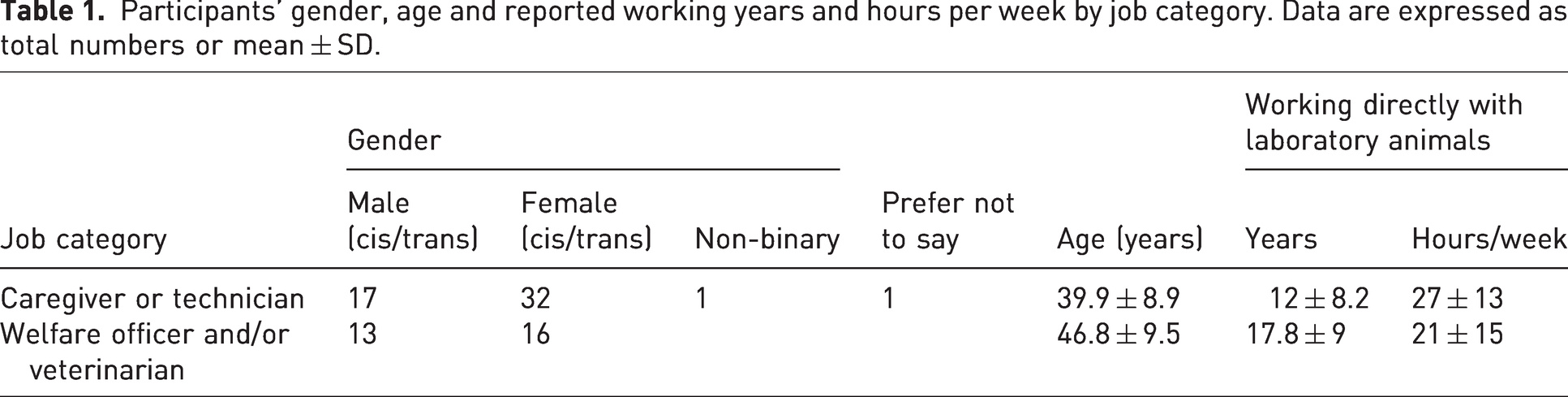
A total of 82 individuals started the survey, one later did not agree to be included in the study and another one was unemployed and was excluded. The sample therefore comprised a total of 80 participants. As in our previous studies,6,12 we divided the participants into two job categories: animal caregivers and technicians, personnel in charge of the daily care and husbandry of animals; and welfare officers and veterinarians, those responsible for enforcing animal welfare legislation in their facilities. Most participants were cis/trans women, aged between 19 and 60 years (42.4 ± 9.7), with a working experience from two months to a maximum of 35 years (14.1 ± 8.9) and a median of 25 h ± 14 working hours per week (Table 1).
Participants’ gender, age and reported working years and hours per week by job category. Data are expressed as total numbers or mean ± SD.
Participants worked in universities (35/43.8%), research institutes (32/40.2%), contract research organizations (CROs) (5/6.3%), hospitals (4/5%), pharmaceutical companies (3/3.8%) or research foundations (1/1.3%). The vast majority of participants worked with rodents (72/90%), followed by farm animals (22/27.5%), aquatic animals (17/21.3%), non-human primates (16/20%) and small carnivores (11/13.8%).
Empathy, human–animal interaction and mental well-being
TECA results indicated that participants working with small carnivores showed higher total empathy than those not working with them (29.45 ± 1.6 vs. 26.8 ± 4.3; U = 228; p = 0.034; rrb = 0.48), and participants working with non-human-primates reported higher emotional comprehension in comparison with those who did not work with these animals (7.06 ± 0.9 vs. 6.06 ± 1.8; U = 352.5; p = 0.049; rrb = 0.31). Higher human–animal interaction was reported by participants working with small carnivores (23.82 ± 4.9 vs. 18.01 ± 4.9, U = 159; p = 0.002; rrb = 0.58), farm animals (21.68 ± 5 vs. 18.72 ± 5; U = 360.5; p = 0.003; rrb = 0.43) and non-human primates (23.25 ± 3.8 vs. 17.70 ± 5; U = 218; p < 0.001; rrb = 0.57) compared with those not working with them. No differences were observed related to personal or professional variables.
The WEMWBS results revealed that more than half of the participants reported high levels of mental well-being, and less than 10% had low levels (Table 2). No differences were observed in relation to personal or professional variables (Supplementary material Table 1 online). Mental well-being was positively correlated with emotional comprehension (rho = 0.361; p = 0.001) and emphatic joy (rho = 0.336; p = 0.002).
WEMWBS results using t-score cut-offs, means, standard deviations, median and range.
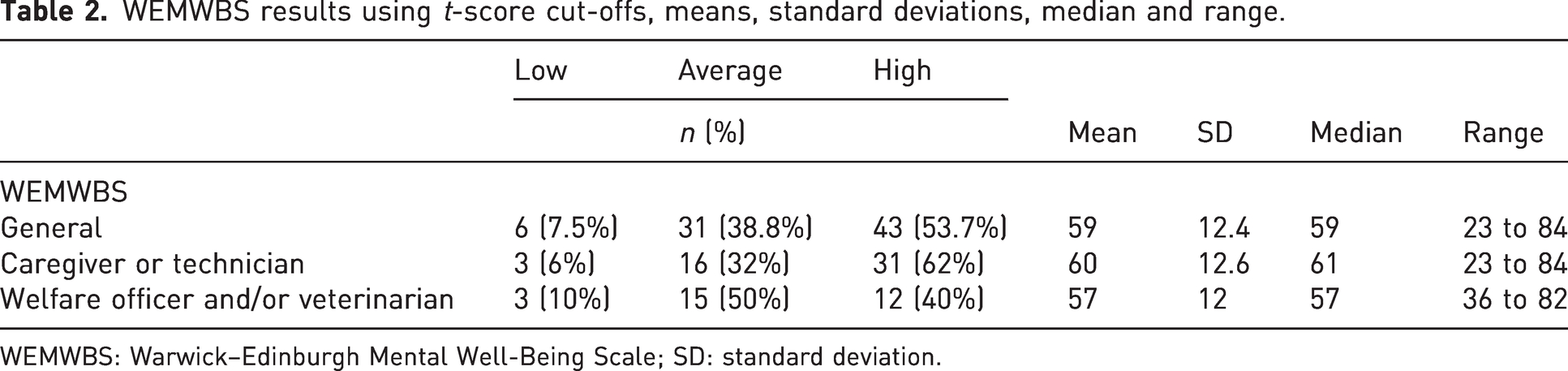
WEMWBS: Warwick–Edinburgh Mental Well-Being Scale; SD: standard deviation.
ProQOL
Overall, the majority of participants reported average levels of CS, low levels of STS and low–average levels of BO (Table 3). Our results indicate no differences in relation to personal or professional variables (Supplementary Table 2). In terms of the species they work with, the only difference was observed in those working with farm animals, which showed higher levels of STS (21.77 ± 8.7 vs. 15.93 ± 8.4; t(78) = −2.77, p = 0.007, d = –0.69).
ProQOL results using t-score cut-offs, means, standard deviations, median and range.
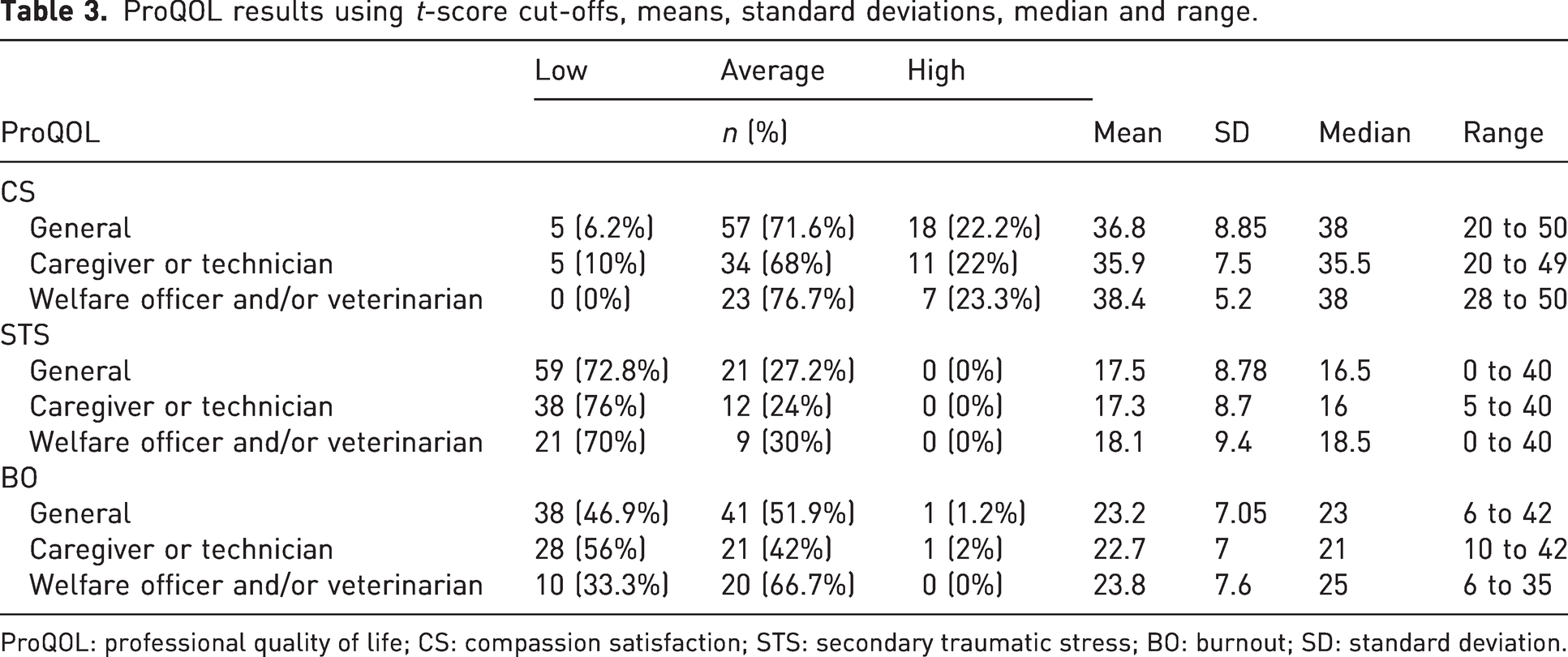
ProQOL: professional quality of life; CS: compassion satisfaction; STS: secondary traumatic stress; BO: burnout; SD: standard deviation.
Correlation analysis indicated a positive correlation between human–animal interaction and STS (rho = 0.310, p = 0.005). Mental well-being was positively correlated with CS (r = 0.495, p < 0.001) and negatively correlated with STS (r = –0.456, p < 0.001) and BO (r = −0.509, p < 0.001). Regarding empathy, BO was correlated positively with perspective adoption (rho = 0.370; p < 0.001).
Psychological therapy and medication
Just under one-fifth of the participants in our study (13/16.3%) reported being in individual psychological therapy. Our results indicate no differences in relation to personal or professional variables. Most (10/76.9%) paid for the therapy themselves, although in some cases, it was paid for by either private insurance (2/15.4%) or the social security system (1/7.7%). Moreover, 15.43% went to therapy ‘less than once a month’, 46.2% had ‘monthly’ sessions, 30.8% had ‘fortnightly’ sessions and 7.7% had ‘weekly’ sessions. Regarding the type of treatment sought, 30.8% of participants received cognitive-behavioural therapy, 7.7% psychoanalytic therapy, 7.7% Gestalt therapy and 7.7% solution-focused brief therapy. The rest claimed not to know what type of therapy they were receiving. Participants who were in therapy reported lower CS (33.15 ± 7.1 vs. 37.54 ± 6.6; t = 2.16; p = 0.034; d = 0.66), higher STS (23 ± 8.9 vs. 16.48 ± 8.4; t(78) = −2.53; p = 0.013; d = −0.77) and BO (27 ± 6.1 vs. 22.42 ± 7; t(78) = −2.20; p = 0.031; d = −0.66), and scored lower for mental well-being (48 ± 11.8 vs. 61.07 ± 11.5; t(78) = 3.74; p < 0.001; d = 1.13).
When asked if they were taking anxiolytics or hypnotics, seven participants (8.8%) said that they were, with 57.1% of these claiming to take them ‘once a month’, 28.6% ‘one to five times a week’ and 14.3% ‘six or more times a week’. Five (71.4%) of these participants attended psychological therapy. Lorazepam (3/50%) was the most commonly-prescribed anxiolytic, followed by alprazolam (2/33.3%) and clorazepate dipotassium (1/16.7%). Lormetazepam (2/66.7%) was the most common hypnotic, followed by zopiclone (1/33.3%). Eight participants (10%) said that they were taking antidepressant medication, being amitriptyline, escitalopram and mirtazapine (2/22.2%, each), as the most common antidepressant, followed by bupropion, fluvoxamine and venlafaxine (1/11.1%, each). Five (62.5%) of these participants attended psychological therapy. Participants who work with farm animals (χ2(1) = 10.059; p = 0.002; V = 0.355; adjusted residual = 3.2) and small carnivores (χ2(1) = 4.228; p = 0.040; V = 0.230; adjusted residual = 2.1) take more antidepressants than expected by chance. The fact that in our study the number of participants taking medication was small makes it difficult to observe statistically significant differences. However, some differences were found with high effect size, and in other cases, although the results were not significant, the size effect was considerable. Specifically, participants taking anxiolytics or hypnotics reported higher BO (28.14 ± 6.1 vs. 22.68 ± 7; t(78) = −1.99, p = 0.050, d = −0.789) and lower CS (32.57 ± 8.9 vs. 37.23 ± 6.6; t(78) = 1.74, p = 0.085, d = 0.690) and mental well-being (50.29 ± 9.8 vs. 59.78 ± 12.4; t(78) = 1.96, p = 0.053, d = 0.777). Those on antidepressant medication reported higher STS (24.25 ± 8.1 vs. 16.79 ± 8.6; t(78) = −2.34, p = 0.022, d = −0.873) and lower mental well-being (49.25 ± 14.9 vs. 60.03 ± 11.77; t(78) = 2.39, p = 0.019, d = 0.892).
Discussion
Overall, our study indicates that participants perceived average levels of CS and mostly low levels of CF. These results could indicate that animal-facility personnel in Spain perceived their ProQOL to be good, although laboratory animal professionals working with farm animals showed higher levels of STS, which should be studied further. It is interesting to note that it has been reported that low CS and high BO have been found to predict intentions to leave one’s current job, while high BO has been found to predict intent to leave the profession. 22 So based on our data, it does not appear that most of the participants in our study will leave their profession.
The above-mentioned results are in line with the observation that animal facility staff reported higher ProQOL than researchers working with laboratory animals 6 or veterinary surgeons 19 in Spain. Although we cannot directly compare our results with those obtained in other studies because we did not use the same scale to assess CF, our results indicate that the percentage of our participants suffering from CF was slightly lower than those observed in other countries of the EU, North America and China.8,10 Although we have not found any differences in terms of the institution where they worked, it is noteworthy that these studies focused only on staff working in CROs.
As in previous studies,6,7,10 gender, age, job category and the number of years and hours working directly with laboratory animals minimally affected ProQOL. However, in this study, we have been able to study the effect of working with animals that are phylogenetically or emotionally closer to human beings. In this regard, we found that people working with small carnivores and non-human primates scored higher on TECA, a result that is not surprising in light of a recent survey in our country where the findings suggest that there is a difference in moral status between monkeys and dogs compared with pigs and mice. 16 Likewise, people working with small carnivores, farm animals and non-human primates reported more interaction with them. Although this was not the case in our study, it has been observed that human–animal interaction correlates positively with CS,6,7 and may indicate that animal-facility personnel may take satisfaction from assuring laboratory animals’ well-being and having a closer relationship with them. However, we cannot forget that people working with farm animals reported higher STS and took more antidepressants than expected by chance.
Our results indicate that mental well-being influences all three ProQOL subscales and some subscales of empathy. The mean WEMWBS score of laboratory animal professionals was very similar to that reported among the employed population21,23 and five points higher than veterinary surgeons in Spain. 19 Interestingly, participants with lower job engagement, workplace stress, and lower mental well-being were more likely to be in psychological therapy. If we take these data from 2014, in which 4.61% of the Spanish population claimed to have visited a psychologist, 24 we see that the percentage of animal facility personnel in psychotherapy is higher than the general population but lower than that of Spanish veterinary clinicians (21.8%). 19 We have to consider that currently going to psychotherapy is no longer socially frowned upon so the 2014 data may be a little outdated. In Spain, the consumption of anxiolytics, hypnotics and antidepressants continues to grow. Consumption of anxiolytics among animal facility personnel was a little lower than the general population (5.76%), whereas the consumption of antidepressants was a little higher (8.04%). 25 This may indicate that the participants in our study suffered more from depression than from anxiety. In a recent study, it has been reported that the percentage of Spanish veterinary surgeons with anxiety is higher than among the general population. 19
Since participants in our study were recruited via convenience sampling, three main limitations should be noted. First, individuals with severe CF may be less likely to participate because they may be withdrawing from any additional responsibilities related to their job and, therefore, we could have missed data from them. By conducting a face-to-face study, these cases could be detected. Second, individuals who may have previously worked with laboratory animals but left their positions due to CF are also absent from the study. Third, the use of questionnaires relies on the participants’ honesty, which should also be considered.
In a nutshell, participants working with small carnivores showed higher total empathy and those working with non-human primates had higher emotional comprehension. Higher human–animal interaction was reported by participants working with small carnivores, farm animals and non-human primates. More than half of the participants reported high levels of mental well-being, and it positively correlated with emotional comprehension and emphatic joy. Most participants reported average levels of CS, which positively correlated with mental well-being. Participants working with farm animals showed higher levels of STS, positively correlated with human–animal interaction and negatively with mental well-being. Most participants reported low–average levels of BO which were correlated negatively with mental well-being and positively with prospective adoption. The percentage of animal facility personnel in psychotherapy is higher than in the general population and the consumption of anxiolytics was a little lower and antidepressants higher.
Conclusions
Our study indicates that a large majority of animal-facility personnel in Spain reported good levels of perceived ProQOL and mental well-being. However, we cannot forget that certain participants reported work-related stress, for example, those working with farm animals. Therefore, any analysis in each animal facility should not be discarded to determine both CS and CF and be able to intervene if necessary. Our results indicate that participants who felt stress or worse mental well-being were in therapy and took medication to improve their condition.
Supplemental Material
sj-pdf-1-lan-10.1177_00236772231187177 - Supplemental material for Perceived professional quality of life and mental well-being among animal facility personnel in Spain
Supplemental material, sj-pdf-1-lan-10.1177_00236772231187177 for Perceived professional quality of life and mental well-being among animal facility personnel in Spain by Olatz Goñi-Balentziaga and Garikoitz Azkona in Laboratory Animals
Footnotes
Acknowledgements
The authors would like to thank the Spanish Society for Laboratory Animal Science (SECAL) and all participants in the study.
Authors’ contributions
OG-B and GA designed the survey, collected and analysed the data and wrote the paper.
Availability of data and materials
The study data will be made available upon reasonable request to the corresponding author.
Consent to participate
Informed consent was obtained from all individual participants included in the study.
Consent to publish
The authors confirm that all human research participants gave their informed consent for the publication of the data.
Declaration of conflicting interests
The author(s) declared no potential conflicts of interest with respect to the research, authorship, and/or publication of this article.
Ethical approval
The study was conducted in accordance with the guidelines established in the Declaration of Helsinki. All procedures and informed consent protocols were approved by the Ethics Committee for Human-Related Research (CEISH) of the University of the Basque Country (UPV/EHU); 2021/74 – M10/2021/366.
Funding
The author(s) received no financial support for the research, authorship, and/or publication of this article.

Supplemental material
Supplemental material for this article is available online.
References
Supplementary Material
Please find the following supplemental material available below.
For Open Access articles published under a Creative Commons License, all supplemental material carries the same license as the article it is associated with.
For non-Open Access articles published, all supplemental material carries a non-exclusive license, and permission requests for re-use of supplemental material or any part of supplemental material shall be sent directly to the copyright owner as specified in the copyright notice associated with the article.
