




Abstract
The exact timing of puberty is fundamental in preclinical studies. In male rats, the age at sexual maturity varies considerably between 40 and 60 days of age. Here, we summarize pubertal onset evaluation of two outbred rat strains (Crl:CD(SD) and Crl:LE), relying on the balano-preputial separation test. Evaluation was carried out on animals under standard barrier conditions, from four to nine weeks of age. In the Crl:CD(SD) population, 90% of males gained puberty at week 6, and 100% in the following weeks, whereas 75% of Crl:LE reached puberty at week 6, 90% at week 7 and 100% from week 8. Remarkably, in both strains, puberty onset was gained at the average weight of 200 g, suggesting that weight range, not only age range, can be considered a biomarker of puberty onset in these two strains. On the contrary, descended testes cannot be considered an additional factor to identify full puberty onset either in Crl:CD(SD) or Crl:LE rats.
Introduction
Defining the precise dating of puberty is crucial for preclinical studies due to the complex neuroendocrine controlling networks action. Onset of puberty has proven to be a reference target in neurobiological studies, 1 repro-toxicology essays,2,3 endocrinology,4,5 and nutrition and development research 6 as well as a threshold to appropriately plan pre/post pubertal surgical interventions on the reproductive system (vasectomy and orchiectomy). In rodent males, among the most common non-invasive methods to evaluate pubertal onset is the preputial or balano-preputial separation (BPS) test. 7 By convention, such a threshold is targeted on age. In this report we provide a puberty onset curve for two widely used outbred rat strains, Crl:CD(SD) and Crl:LE, analysing preputial separation in the light of two parameters: age and weight. Crl:CD(SD) is an outbred strain originated in 1925 by Robert W Dawley from a hybrid hooded male and a female Wistar rat, and is widely used as a general multipurpose model in safety and efficacy testing, ageing, nutrition, diet-induced obesity, oncology and surgical model preparation. Crl:LE is an outbred strain originated by Drs Long and Evans in 1915 by crossing several Wistar Institute white females with a wild grey male, and is widely used as general multipurpose model, specifically in behavioural research and diet-induced obesity studies.
Materials and methods
Data were collected from production colonies housed at Charles River Laboratories Italy by veterinary staff and trained animal care technicians. Animal breeding and management were performed in accordance with corporate guidelines and AAALAC International requirements and in full compliance with Italian Legislative Decree 26/2014. Animals were group housed in open cages, in barrier room under SPF conditions and controlled environmental parameters, with temperature range of 22°C ± 2°C, relative humidity (RH) set point at 50% ± 20% and light:dark cycle of 12:12 h. Rats received ad libitum a commercial standard rodent diet (SDS VRF1). The Crl:CD(SD) colony is bred under the international genetic stability standard.
The BPS test was performed according to Korenbrot et al. 7 and Lewis et al. 8 on male rats 4–9 weeks of age by restraining the animals in supine position and manually retracting the prepuce, applying a gentle pressure to the prepuce sides, downward: 45 animals/week for Crl:CD(SD) population (total 270); 20 animals/week for Crl:LE rats population (total 120).
The sample size was calculated with an a priori power analysis (α = 0.05; 1–β = 0.80) taking into consideration the numerosity of males of the two production colonies (CRL:CD(SD) and CRL:LE) available for each time point analysed.
The assessment was performed as a non-blinded population screening involving animals consolidated from multiple litters, in two different sessions and simultaneously covering different ages, meaning that the assessment was not repeated on the same animals at progressive time points. Animals were also screened for clinical and phenotypical integrity; one animal within the four weeks old CRL:LE cohort was discarded due to congenital hindlimb malformation.
The correspondence between weeks and days of age used by the breeder to consolidate animals is summarized in Table I. Statistical analyses were performed by using GraphPad Prism 9. Wilcoxon signed-rank test and Pearson correlation were applied for assessing how preputial separation correlated with age, weight and descended testes in the two strains.
Summary of BPS screening in the two outbred strains populations.
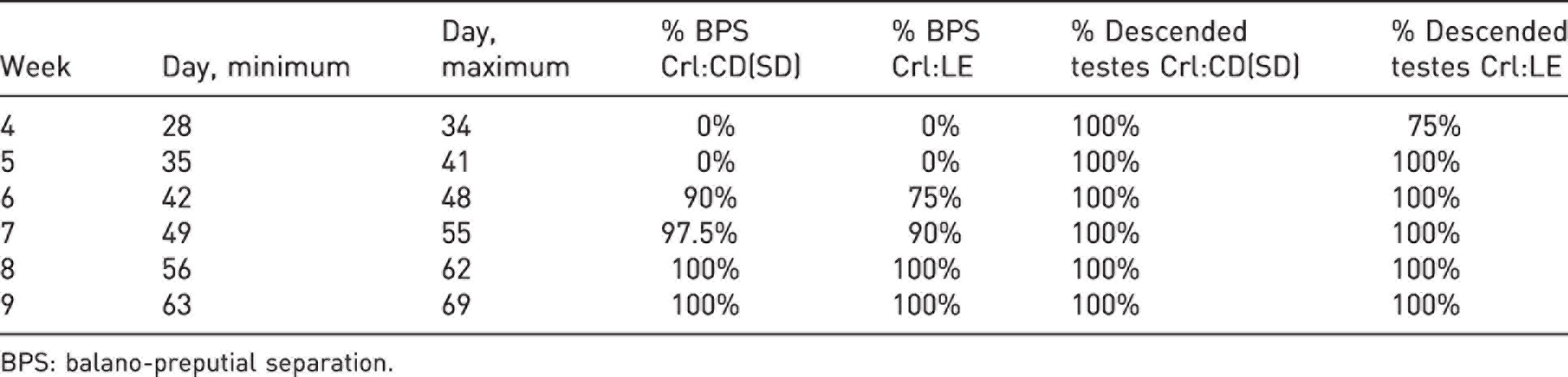
BPS: balano-preputial separation.
Results
Animals of both strains were negative to the BPS test (schematically represented in Figure 1(a)8,9) at weeks 4 and 5: in the Crl:CD(SD) population, 90% of males gained puberty at week 6, and 100% in the following weeks (Figure 1(b)); in CRL:LE the puberty onset appeared more gradually, with 75% of males positive to the test at week 6, 90% at week 7 and 100% from week 8 (Figure 1(b) and Table I). Males at nine weeks old were checked to validate the data recorded in the eight-week-old population. We observed a slope in the weight of both strains (p > 0.005), with a discrepancy of 203 (Crl:CD (SD) vs. 199 (CRL:LE), while no statistically significant differences were assessed with regard to the age of preputial separation (p < 0.005) (discrepancy 3 vs. 825). In both strains, a positive correlation between preputial separation and age (r(Crl:CD(SD)BPS:age) = 0.89; r(Crl:LE BPS:age) = 0.94) as well as between preputial separation and weight (r(Crl:CD(SD)BPS:weight) = 0.84; r(Crl:LE BPS:weight) = 0.90) was calculated. Notably, descended testes were 100% visible in Crl:CD(SD) from week 4 onward, while 75% in Crl:LE from week 4 (Figure 1(c)).
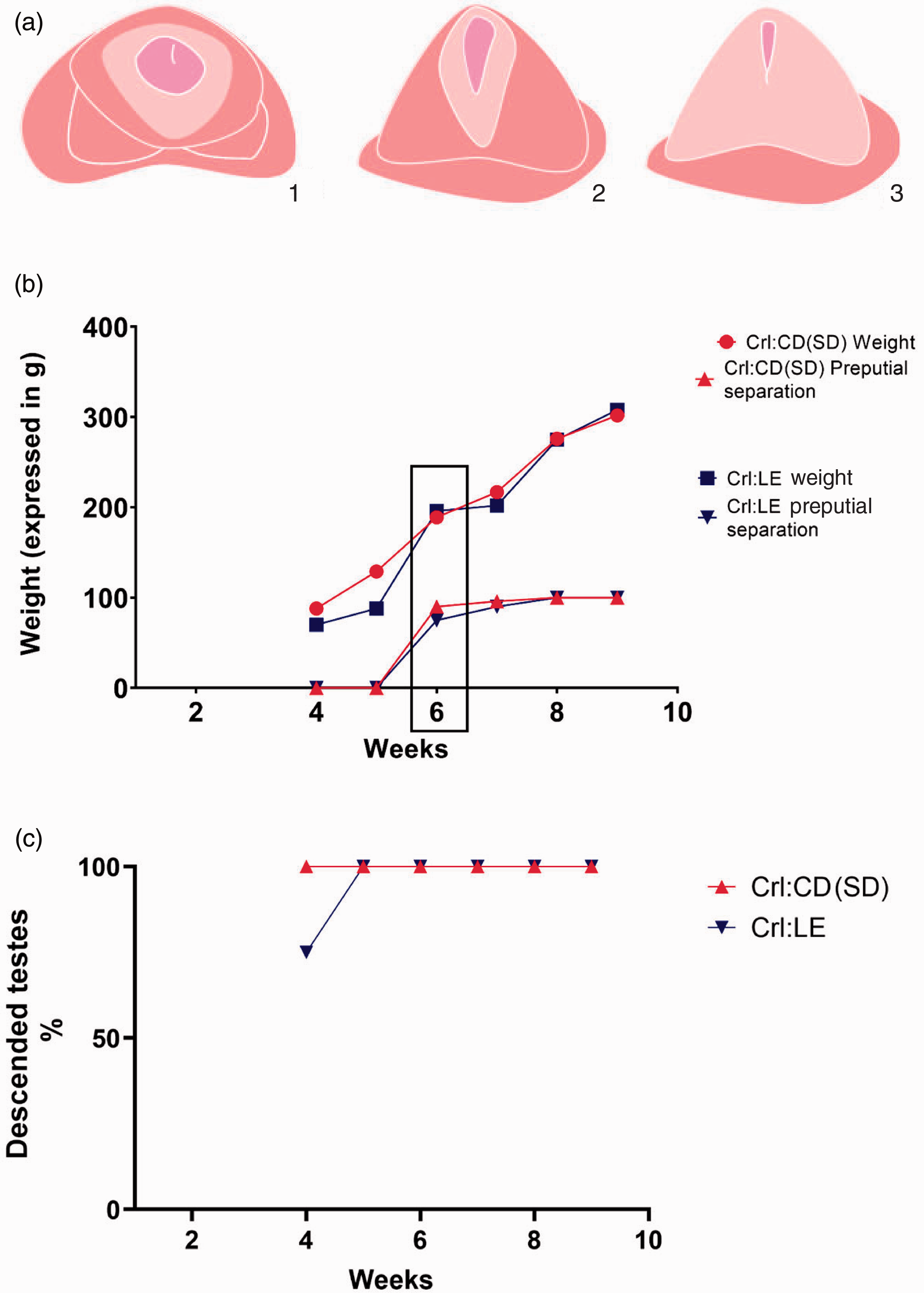
(a) Schematic drawing of balano-preputial separation (BPS) (rearranged by Lewis et al.8 and Yamasaki et al.9) representing (1) unpuberal, (2) prepuberal and (3) puberal rat with a colour code identifying the anatomical structures: lilac: external urethral orifice; light pink: glans; dark pink: prepuce. (b) Comparison of growth curves and puberty onset (based on BPS) between the two rat strains Crl:CD(SD) and Crl:LE by applying Wilcoxon signed rank, demonstrating that the minimum weight for positive BPS test is above 200 g in both strains, corresponding to week 6 of age. Significant differences (p > 0.05) were observed when comparing the weight at different weeks of age in both strains. (c) Average of descended testes in Crl:CD(SD) and Crl:LE and the correlation with age (weeks).
Discussion
BPS is an androgen-dependent event necessary for complete copulatory behaviour and is therefore a commonly used index of pubertal development. 7 Sexual maturity does not mark the beginning of adulthood, rather it denotes the beginning of adolescence as in humans. Rats progress through a period of adolescence characterized by behaviours such as increased risk-taking and social play, which extend well beyond the pubertal period through the transition to adulthood. 10 Therefore, defining puberty is a fundamental tool when using rats as translational models. The classical studies of Kennedy and Mitra 11 established that weight is well associated with the timing of sexual maturation and with the concept that the body weight of an animal can be considered an approximate marker of its age. Here, we report that almost 100% of sexual maturity is reached by animals with a weight above 200 g in both strains, at an average age of six weeks in the case of Crl:CD(SD) and seven weeks in Crl:LE. Consistently with Lewis et al., 8 in Crl:CD (SD) we observed no positivity for BPS prior to post-natal day 39, and that the BPS positivity window widens when multiple animals per litter are assessed compared with single animal/sex/litter assessment range. The timing observed in Crl:LE is in line with the observation of an average age of 50 days after birth (P50) made by Long and Evans in their pioneering work. Notably, we have also analysed animal weight, positively consistent with official models’ growth curves, and observed a higher growth variability in Crl:LE compared with Crl:CD(SD), reinforcing the fact that weight is a relevant biomarker in defining puberty onset.
We also evaluated descended testes, an indicator of incipient puberty, this phase being predominantly under androgen control. 12 Interestingly, we observed that testicle descent is more gradual in Crl:LE, with a progression from 75% (four weeks old) to 100% at week 5. In Crl:CD(SD) the passage is precocious, with 100% at four weeks old. As testicle descent is visible in 100% of the male population of both strains long before BPS – week 4 versus week 8 in Crl:CD(SD) and week 5 versus week 8 in Crl:LE rats, respectively – this factor should not be considered a valuable biomarker of puberty onset. Overall, these data confirm that the timing of full sexual maturity varies between strains and suggest that weight, not only age, should be considered a biomarker of puberty onset in these two outbred strains.
Footnotes
Consent statement
Informed consent was not required for this short report, due to the intrinsic nature of the assessment performed and reported herein.
Data availability statement
Raw data that support the findings of this study are available from the corresponding author upon request.
Declaration of conflicting interests
The author(s) declared the following potential conflicts of interest with respect to the research, authorship, and/or publication of this article: MEG and RC are employees of Charles River Laboratories Italy, who owned the animals included in this morphological screening and provided salary for the aforementioned authors. SF was an employee of Charles River Laboratories Italy at the time of the morphological screening. No others have conflict of interest existing.
Ethics statement
No animal was involved in any experimental procedure to perform this assessment. Animals were bred and housed under approved breeding facility licence, released by the competent authority in accordance with EU Directive 63/2010 and its implementation on the Italian territory, Legislative Decree 26/2014. No experimental licence was required.
Funding
The author(s) received no financial support for the research, authorship, and/or publication of this article.