




Abstract
Policies and guidelines are available for acute disasters such as earthquakes, fire and floods, however, little is available on how laboratory animal facilities should mitigate subacute disasters like the COVID-19 pandemic that imposed major restrictions on the free movement of people. As such, laboratory animal facilities had to find plausible mitigating measures to safeguard the welfare of animals in their care, to prevent animal suffering if staff could not reach the animals, albeit with limited time. The simplest approach was to stop active experiments and halt animal breeding, or to euthanize all animals. Challenges with such methods included the ethical debate regarding euthanasia of animals at the start of a pandemic and the need to perform a harm–benefit analysis while drafting the disaster plans, termination of studies at advanced stages with information loss or killing of genetically modified strains that would be difficult to replace.
Two research animal facilities in South Africa addressed these challenges by implementing several changes such as allowing only essential studies to continue, maintaining small breeding colonies for essential strains, and providing staff with private transport for travelling to and from work to avoid public transport and risk of exposure to SARS-CoV-2. Engineering changes included redesigning working areas to cater for social distancing.
The mitigating measures put in place by the two laboratory animal facilities were successful in ensuring the continued welfare of animals during the COVID-19 lockdown restrictions. These measures can be adopted in future pandemics that lead to restricted movement of staff.
Plans de gestion en cas de catastrophes telles que le COVID-19 pour deux installations d’animaux de laboratoire en Afrique du Sud
Introduction
In an era of climate change and variability, worldwide disasters have been on the rise with devastating consequences. In South Africa, disasters such as floods, drought, livestock diseases and veld fires have become a common occurrence that repeatedly takes a heavy toll on life and property.1,2 Since the turn of the millennium, new risks have been emerging, for example COVID-19, Ebola, and terrorist attacks.3–6 These disasters do not only affect civil society, but they could also have a devastating impact on research animal facilities.
Research animal facilities are used for housing laboratory animals of multiple species. These animals are used in biomedical research for investigating solutions to prevent, diagnose and treat diseases that cause health problems in humans and animals.7,8 Research animal facilities are extremely complex as they may deal with high-risk infectious agents and toxins, and therefore have specialized needs. These facilities are highly dependent on specialized equipment, supplies, regulated environments, information technology systems and a highly skilled workforce amongst other factors. Disruptions due to disasters can cause serious harm to ongoing research projects that may result in major loss of funding and time.
In December 2019, China alerted the World Health Organization (WHO) about the unusual cases of respiratory infections that had been observed in Wuhan, Hubei province.5,6,9 At that time, the aetiology of the disease was not yet known but the clinical symptoms were consistent of a viral cause.9–11 One month later, on 7 January 2020, a novel coronavirus was implicated as the causative agent and was named Severe Acute Respiratory Syndrome Coronavirus 2 (SARS-CoV-2) and the disease was named the coronavirus disease 2019 (COVID-19). Since the virus was spreading rapidly across the world, it was declared a Public Health Emergency of International Concern on 30 January 2020. In line with international recommendations, South Africa implemented a countrywide lockdown restriction on 29 March 2020 with five lockdown alert levels:
Level 1: Low virus spread, high health system readiness. Level 2: Moderate virus spread, with high health system readiness. Level 3: Moderate virus spread, with moderate health system readiness. Level 4: Moderate to high virus spread, with low to moderate health system readiness. Level 5: High virus spread, and/or low health system readiness. All sectors of the economy closed, and everyone stayed at home with only essential service workers being allowed to travel to work.
At the time of writing this article, more than 80 million cases of SARS-CoV- 2 infection have been confirmed, and more than one million people have died of COVID-19 worldwide, while South Africa had over one million cases and more than 30,000 mortalities.
The COVID-19 pandemic caused devastating consequences for the welfare of animals worldwide. In Wuhan, residents were forced to leave their pets with limited supplies of food and water when authorities evacuated them from their homes. 12 The food left for animals was not enough to last the period that the people had to be quarantined and animals on medication were left with no one to care for them. 12 In South Africa, laboratory animal facilities had to find plausible mitigating measures to safeguard the welfare of animals used for scientific research, albeit with limited time. Very little has been published on how laboratory animal facilities should mitigate slow-onset or subacute disasters such as the COVID-19 pandemic to ensure the continued welfare of animals used for scientific purposes.13,14 This article describes the main steps taken by two academic research animal facilities in South Africa during the COVID-19 pandemic lockdown restrictions.
Research animal facilities
University of Cape Town Research Animal Facility (UCT-RAF)
The University of Cape Town Research Animal Facility (UCT-RAF) is an academic research animal facility in the Faculty of Health Science. The facility has a staff complement of 28 personnel supporting a broad range of research, including infectious disease (e.g. tuberculosis, HIV), medical devices, vaccine and drug discovery, basic research and preclinical testing in Biosafety Level 1, 2 and 3 (BSL 1–3) facilities. Human access to the UCT-RAF is strictly controlled via activated card readers, with personnel being given adequate competence-based training before being granted access. The UCT-RAF has a breeding programme for rats and mice.
The Onderstepoort Veterinary Animal Research Unit (OVARU)
The Onderstepoort Veterinary Animal Research Unit (OVARU) is an academic research animal facility situated in the only Faculty of Veterinary Science in South Africa, with a staff complement of 13 people. The OVARU does not have a fixed breeding programme but has the capacity to do project specific breeding. The facility has Biosafety Level 1 and 2 (BSL 1 & 2) facilities which include, conventional housing facilities for rodents, a rodent SPF unit, a primate unit and an extensive conventional farm animal unit to support veterinary research including disease research. The facility supports research in infectious disease (e.g. veterinary vaccine development), drug discovery, veterinary drug registration and preclinical toxicity testing. The OVARU is on the veterinary campus of the University of Pretoria which has a comprehensive veterinary hospital, research laboratories and teaching animal unit. The campus is supported by an extensive large animal feed store and veterinary pharmacy store.
Animal ethics
The UCT-RAF and OVARU are research animal facilities that are registered by the South African Veterinary Council in compliance with the Veterinary and Para-veterinary Professions Act No. 19 of 1982 and are regularly inspected by the National Council of Society for the Prevention of Cruelty to Animals (NSPCA). All animal experiments conducted in these two facilities are authorized by the respective institutional Animal Ethics Committee (AEC) and all management changes with a potential to impact animal welfare are communicated to the AEC. This article only describes the COVID-19 disaster management plans that were implemented by the two research animal facilities and as such no experiments involving animals were performed by any of the authors.
Mitigating measures implemented
Pre-lockdown phase
The University of Cape Town set up a committee to oversee the smooth flow and implementation of the university-wide as well as faculty-specific plan for responding to the COVID-19 pandemic, whilst at the OVARU a similar committee was set up at faculty level. At UCT, the committee reviewed all university functions and identified those departments to be shut down during different stages of the lockdown. In both cases, the animal facilities were among the departments that were identified as essential and had to remain open during the lockdown. In terms of South African legislation, veterinary services were deemed as emergency and essential services for animal care. All essential service personnel were identified and issued with letters to enable them to travel to and from work. These letters were to be presented at national police roadblocks and entrances to the university premises. Everyone else, other than those who had been classified as essential workers had to work from home and the university provided cost of broadband and laptops/computers to enable staff and students to execute their duties from home.
Personal protective equipment (PPE)
All staff and researchers using the experimental laboratories were provided with N95 masks. The N95 masks were to be reused and were kept in labelled plastic Ziplock bags in the laboratory and never to be taken out. All staff members were provided with homemade cloth masks (not certified) to use when outside animal rooms and when travelling to and from work.
Operational changes
Health screening
UCT-RAF staff members were health screened by the university’s department of occupational health and safety to determine if they were fit to continue reporting for duty. OVARU relied on doctors’ notes to decide on comorbidities as a university-wide policy. High-risk staff members were requested not to report for duty but work from home. Staff members were deemed high risk when they had existing comorbidities or chronic diseases such as diabetes.
Stocking
The UCT-RAF purchased a six-month supply of essential animal-care supplies, for example food, bedding, disinfectants, PPE and emergency medicines for use on animals. Importantly, sufficient euthanasia medicines were kept in stock to effect euthanasia of all animals in the unit, to cater for a worst-case scenario should no staff be able to reach the animals due to restriction of movement or illness, thus preventing an animal welfare catastrophe. The OVARU had three months’ supply of stock and had plans in place to request more supplies from the veterinary academic teaching hospital had the need arisen.
Breeding animals
Animal numbers in the breeding units at UCT-RAF were decreased to limit the number of animals per strain to the minimum that is required to keep the strain alive. Principal investigators who own some of the breeding animals were notified of this decision and agreed to its implementation. Breeding was halted by housing males in separate cages from females. The OVARU continued breeding of transgenic strains.
Experimental animals
At both facilities, principal investigators for animal experimental studies were notified that ongoing essential and long-term studies were permitted to continue, but strongly recommended to scale down or completely stop all animal research which could not be motivated as being essential under the circumstances (unless there was an ethical reason not to), to relieve pressure on animal support services. At the OVARU, a large sheep study had to be stopped and the animals put out to pasture as there was no capacity to clean the animal pens.
Meetings
All face-to-face meetings with students and researchers were suspended. Meetings were conducted by telephone or through online platforms such as WhatsApp, Microsoft Teams, Skype, Google Meet or Zoom for the period of the lockdown.
Segregation of staff
The UCT-RAF divided its staff members into three groups: two non-overlapping groups responsible for the day-to-day care of the animals and a third group comprising volunteers as an emergency backup in case several members of the first two groups became infected with COVID-19 or needed to self-isolate or quarantine. The OVARU had weekly rotations of three caretakers and one animal technologist. Members of the two groups responsible for day-to-day care of the animals came to work on alternate days. To further reduce the risk of getting infected, UCT-RAF animal care staff were not allowed to use public transport during lockdown levels 3–5. At the University of Pretoria all essential service staff used their own transport to travel to and from work. The UCT-RAF provided vehicles for transporting staff members and social distancing was maintained in the vehicle (i.e. not more than three people in a five-seater car). The driver of the vehicle ensured that all passengers disinfected their hands and wore an N95 face mask before being allowed into the vehicle. Contingency plans for a scenario where all staff, including emergency backup volunteers, might fall sick and insufficient staff being left to provide basic animal care, depopulation would be the only option with valuable rodent strains being cryopreserved.
Infection prevention in shared spaces (offices and tea rooms)
This section describes the proper etiquette that staff had to follow when in common or shared areas in the different UCT-RAF units. OVARU’s prevention etiquette was similar but simplified due to the comparatively small staff complement of three caretakers and one animal technologist in the facility. The first person to enter any room (normally the first person to unlock the unit or office space in the morning) was responsible for the initial sanitization of surfaces (e.g. door handles, taps, bench tops etc). Surfaces of shared electrical devices such as microwaves and telephones were wiped with a hand towel sprayed with 70% hydro-alcohol. It was mandatory to wear face masks except when eating or drinking and practise social distancing (at least 1.5 metres apart). Staff sat at designated table spaces and the number of people allowed inside a room was limited according to the room’s size and air changes per minute, though at the UCT-RAF only one person could occupy a staff room at a time where eating or drinking was permitted. Where possible, windows had to be kept open when more than one person was in a room to allow for adequate air circulation. Cutlery and crockery were assigned to individuals and marked for ease of identification. Each person was responsible for cleaning and storing their assigned items safely in a dedicated locker provided. Additional cutlery or crockery not assigned to personnel were locked away. Each person was responsible for cleaning up after themselves, and no dirty or drying dishes were allowed on the drainer or in the basin.
Engineering changes
No major engineering changes were made since laboratory animal facilities are designed to contain and/or exclude pathogens; only hand washing and 70% hydro-alcohol spray stations had to be installed at office entry points. All other entrance points to animal rooms already had PPE stations and disinfectants. Foot-operated 70% hydro-alcohol-based sanitizer dispensers were provided at all entrances.
Psychosocial support
Unit managers were encouraged to have information sessions with their staff to share as much information about the pandemic as possible. This was done to combat staff emotions of loneliness and isolation as well as to share university/faculty-wide communication about the pandemic. Facility management sent out packages of appreciation to all animal care staff to boost morale. The Vice Chancellors at both facilities sent out emails of appreciation to all staff working during the lockdown period. The UCT-RAF held small group workshops with an industrial psychologist for all animal care staff at the end of 2020, addressing issues such as resilience and compassion fatigue, with major psychological and mental benefit to staff after an extremely challenging year.
Discussion and recommendations
Introduction
Exposure to hazards such as an infectious disease can be controlled by elimination (i.e. physically removing the hazard) and substitution (i.e. replacing the hazard) controls, however these are often limited or not possible. 15 Spread of respiratory pathogens such as SARS-CoV2 can be reduced by putting in place engineering controls (barriers between hazards and personnel), administrative and operational controls (policies to prevent exposure to hazards) and the wearing of PPE.15,16 Laboratory animal facilities are designed with specific engineering controls to minimize or prevent the spread of infectious diseases since the facilities are used for the housing of animals that might be experimentally infected with infectious diseases. For these two facilities (UCT-RAF and OVARU), no major engineering changes were made since the facilities were designed to contain pathogens during animal experiments, and as such only hand washing, and 70% hydro-alcohol spray stations had to be installed at entrances to offices and tea rooms. With engineering controls already in place, the two facilities focused on operational controls and the wearing of PPE to mitigate the spread of COVID-19 while ensuring continued operations of the research animal facilities.
In South Africa, there is currently no specific legislation governing the use of animals for scientific purposes and as such, research animal facility management must be mindful of other legislation that have an impact on animal welfare when designing a disaster emergency plan. Examples of such legislation is the Veterinary and Para-veterinary Professions Act No. 19 of 1982 that protects animal welfare and scientific quality by establishing minimum standards for research animal facilities and the practical competency of the personnel handling the animals. The Societies for the Prevention of Cruelty to Animals Act No. 169 of 1993 describes offences in respect of animal cruelty, and the Medicines and Related Substances Control Act No. 101 of 1965 governs the use of scheduled medicines. Most research animal facilities in South Africa have adopted the South African National Standard for the Care and Use of Animals for Scientific Purposes (SANS: 10386:2008) as a minimum standard. 17 The current version of SANS: 10386: 2008 does not cover emergency preparedness for slow onset disasters of biological origin. Therefore, limited reference documents were available when contingency measures were being prepared to ensure continued welfare support for research animals during the COVID-19 pandemic. We therefore recommend that the relevant legislation and the SANS: 10386:2008 document be revised to include a section on emergency preparedness for research animal facilities. International guidelines such as the Guide for the Care and Use of Laboratory Animals contains specific recommendations that animal care and use programmes develop a disaster emergency preparedness plan. 8
A disaster emergency preparedness plan for laboratory animal facilities could be divided into four phases: preparedness, response, recovery and mitigation.18,19 The preparedness phase marks the time prior to the disaster, and involves the making of plans, preparing responses and rescue operations. The planning should not be done in a vacuum but rather be part of the university-wide plan and should include satellite facilities, local police, fire, or public health departments. University senior management should be involved to ensure organizational support and financial allocations for disaster management planning and training. The disaster preparedness plan should consider all aspects of the law beyond animal welfare and other research-related regulatory requirements. The preparedness plan should be managed by a committee with representation from departmental heads, principal investigators animal facility management, veterinary services, occupational health and safety, human resources and AEC. At the UCT-RAF, crisis communication was also used to ensure that the correct information is shared to all people involved and it consisted of frequent communication with institutional management, the animal research community and authorities. Communication with institutional management was critical to ensure appropriate risk mitigation and to agree on acceptable approaches between the UCT-RAF Director, the Vice-Chancellor for Research, Dean’s office, AEC and institutional Office for Research Integrity. The UCT-RAF Director also served as a member of the Faculty’s COVID-19 return-to-work task team which met on a weekly to two-weekly basis with the Dean’s office to discuss approaches in a consultative forum. Frequent communication with the animal research community was upheld by the Vice-Chancellor for Research, the Dean for Research, and the UCT-RAF Director, keeping researchers abreast of plans for the functioning of laboratories, personnel access, breeding of animals, PPE and other health and safety requirements. Communications with authorities included most prominently the national Department of Agriculture, Department of Health and the South African Veterinary Council, in terms of COVID-19 regulations and their impact on laboratory animal research activities. At research animal facilities such as the OVARU that are associated with a veterinary teaching hospital, input should also be solicited from the teaching hospital to ensure an institution-wide priority by all parties for effective resource sharing. 18 At OVARU, the veterinary academic teaching hospital already had a similar system in place for reduction in operations for a foot and mouth disease outbreak although they did not anticipate an extensive shutdown.
The response phase occurs during the emergency as action is taken to save lives and prevent property damage. Recovery occurs after the emergency, and include actions taken to return to normal operations. Mitigation occurs before and after the emergency and is aimed at preventing disasters from happening or reduce damaging effects of unavoidable disasters.
PPE
Prevention of the spread of infectious pathogens relies on effective use of PPE (gloves, face masks, face shields, gowns). PPE is the last line of protection for laboratory personnel especially in the context of cross-infection between staff members from different households. During the pandemic PPE became a scarce and precious commodity in many facilities. Although PPE is worn daily in laboratory animal facilities, it is not common practice to wear PPE outside of the facility which is something that had to be implemented.
Administrative and operational changes
When South Africa’s president announced that the country will be on lockdown and all services stopped except for essential services, the initial response was on making sure that the facilities were stocked up following the Laboratory Animals Veterinary Association (LAVA) a division of the British Veterinary Association recommendation. Since the lockdown in South Africa was announced months later than in many other parts of the world, several aspects of preparation could be undertaken before the government imposed the lockdown. At least six-months (for UCT-RAF) and three-months (for OVARU) worth of essential animal-care supplies, for example PPE as well as food, bedding and emergency medicines for the animals were purchased. By that time, the LAVA recommendation on stocking could not be fully implemented, because it was already impossible to import items such as special diets for research animals from overseas due to disruption to transport systems. Stockpiling was important because of multiple uncertainties, for example if the lockdown was enforced for prolonged periods, and suppliers could not guarantee the continuous production and supply of resources. On an international level, panic levels were high in countries that had been placed in lockdown before South Africa, evident in their retail stores running out of supplies. 20 World over, governments recommended that face masks be worn in public spaces which led to shortages of surgical masks. Because of the shortage of surgical face masks, the UCT-RAF decided to reuse N95 masks for a period of at least one month from the date of first use.21,22 The decision to reuse N95 masks was made because of the limited supply of surgical masks and N95 masks at the beginning of the lockdown restrictions. This decision followed CDC guidance for extended use and limited reuse of N95 filtering facepiece respirators in healthcare settings. 23 In anticipation of shortages during slow onset disasters, we recommend that facilities should always be stocked and prepared for any form of disaster that might affect the normal day-to-day functioning of business to prevent major shortages. One major challenge of stockpiling is the lack of storage space; therefore, we recommend that when designing a new facility, enough storage space be allocated.
When Level 5 lockdown restrictions were implemented, the UCT-RAF animal care staff were provided with university transport while at the University of Pretoria all essential service staff used their own transport to travel to and from work. Although the LAVA recommends that transport should be provided, when implementing this, the socioeconomic status of the country should be considered. For example, South Africa is an unequal country with a Gini-coefficient of 0.63, mostly due to its segregationist history, 24 translating to about 14% of South Africans living in informal settlements and townships. 25 Since most animal care staff members stay in informal settlements and townships, we faced challenges in that taxi associations barred university vehicles from transporting staff from the townships; part of taxi associations’ attempt to illegally control transport in certain areas. Some staff were thus not willing to drive university-branded vehicles. In some townships there was also a risk of vehicles being hijacked or stolen. These problems were addressed by using vehicles that were not branded and requesting that staff members find alternative transport from their respective homes to a place where they could be safely collected by the university vehicles. Essential workers were provided with letters to present at government roadblocks or when stopped by police when travelling. This proved challenging in that the essential service letters were different for different organizations which caused problems at police roadblocks. Some staff members were turned away or were unnecessarily delayed because the police questioned the authenticity of these letters.
The BSL 1–3 laboratories were functional with researchers and staff donning standard PPE (face mask, hair nets, gloves, overshoes and gowns) with N95 masks used throughout. This PPE has always been provided irrespective of the COVID-19 pandemic. The UCT-RAF euthanized around 50% of breeding rodents and separated males from females to stop breeding (to maintain breeding colonies, 14 females and seven males were kept for outbred stock whilst six females and three males were kept for inbred strains), while the OVARU continued breeding to maintain a transgenic mouse strain but terminated a sheep study by putting the animals out to pasture. Such reduction in animal numbers was similarly done at many other international facilities and was deemed necessary to decrease the workload on animal care staff to enable continued operations and animal welfare standards with a limited staff complement during the lockdown.26–31 The harm–benefit analysis considered that the harm to the animals could conceivably be significantly greater if the animals were not euthanized at the beginning of the pandemic, considering the potential major animal welfare challenges that could develop should animal caretakers not be able to reach the animals due to illness or restrictions to movement.
At both facilities essential studies could continue but it was strongly recommended to scale down or stop non-essential studies under the circumstances. Essential studies referred to studies that were at an advanced stage having gathered significant amounts of data or COVID-19 related studies, whilst non-essential studies referred to those studies that had recently been initiated without having gathered significant data. The principal investigators and researchers were responsible for the decisions on whether the data gathered was significant. We are of the opinion that such decisions should be made by the AEC after researchers submit progress reports for consideration on whether their studies should continue or not.
In the OVARU primate unit, no specific safety measures were applied for non-human primates even though primates are susceptible to COVID-19. The only exception was to restrict access of non-essential personnel, that is only direct staff working in the unit had access. Staff always wore masks, and daily temperature screening before entry was undertaken. Staff also completed the online health check, which monitored for the common symptoms associated with COVID-19 infection. The primates were monitored at least twice daily with no signs of COVID-19 recorded in the primates.
All face-to-face meetings with students and researchers were cancelled. Large group meetings were suspended to reduce potential cross-infection among personnel. We have found the use of videos and photos very helpful for sharing clinical problems with the veterinary team on duty and assisting without physically being present in the animal facility.
During the lockdown none of the staff members from the UCT-RAF contracted or showed clinical symptoms of COVID-19 whilst two staff members of the OVARU became infected on two separate occasions. It would have been ideal to have COVID-19 rapid test kits in use to confirm the non-presence of the infection among staff members, though this would have been difficult at the beginning of the lockdown as rapid testing kits were in development and in short supply in most countries. At the UCT-RAF the LAVA recommendation was successfully implemented with members of the two groups responsible for day-to-day care of the animals working on alternate days to ensure that not everyone would be infected at the same time. 18 When staff members were infected or came into contact with a confirmed positive person (e.g. family member or from social groups), the national protocol on quarantine was followed for all staff members exposed. This entailed self-isolation for at least 10 days. All rooms visited by the infected person were disinfected. The LAVA recommendation was difficult to implement in facilities such as the OVARU which has a small complement of staff. If we take into consideration the WHO recommendation that people with comorbidities were supposed to stay at home to reduce their chances of becoming infected, this meant, for a country like South Africa that had an adult (15–49 years old) HIV prevalence rate of 19% in 2018, 25 a further depletion of the human resource pool
Psychosocial support
Traumatic events such as disasters are potential causes of distress to humans that may lead to various psychological reactions. People affected by disasters, directly or indirectly may need psychosocial support of varying degrees ranging from counselling sessions to requiring more substantial or sustained intervention such as psychological treatments. 31 Psychosocial support addresses a broad range of psychosocial problems while promoting the restoration of social cohesion and infrastructure as well as the independence and dignity of individuals and groups with the aim of preventing pathological developments and further social dislocation.31,33
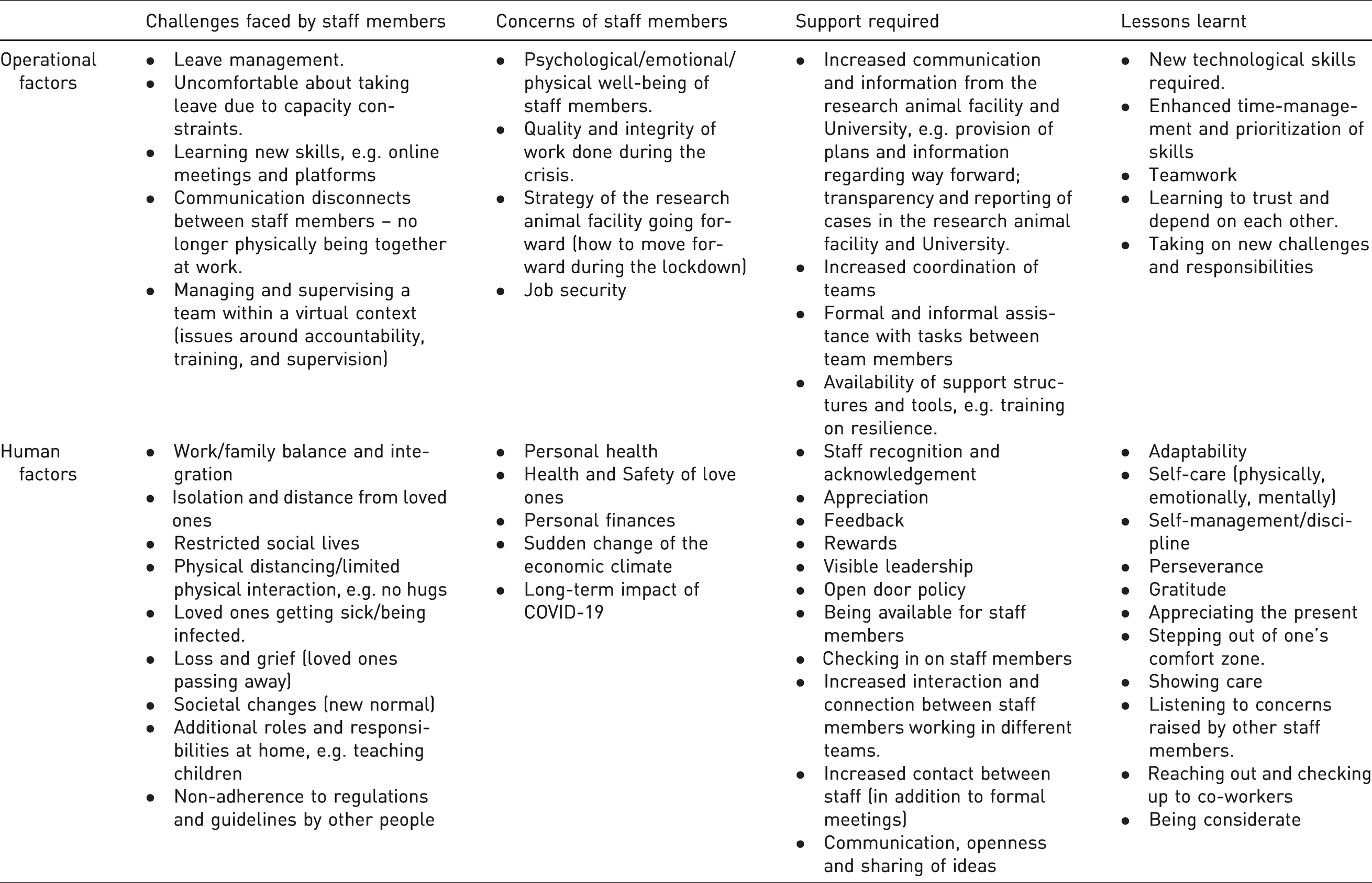
The UCT-RAF held small group workshops with an industrial psychologist for all animal care staff at the end of 2020, aimed to evaluate the stress of the pandemic and its consequences, provide emotional and psychological support to staff, as well as improve resilience and coping skills. Staff members reported that they experienced a range of emotions, from shock, anger, loss, grief, relief, or numbness. Many staff felt as though life was suddenly out of control and finding themselves more tired than usual during the day and more restless at night. Based on staff feedback, we therefore recommend an effective response strategy that takes into cognizance a balance between strategic and operational needs of the facility and at the same time minimize the emotional and psychological impact of the pandemic on staff. Table 1 delivers a consolidated view of the challenges, concerns, perceived support required and lessons learnt, as expressed by the animal facility staff members in the session. The findings have been divided into two sections: operational and human factors, for prioritization purposes, as well as ease of understanding. The strategic and operational recommendations below are important for a research animal facility’s short-term and long-term success.
Challenges, concerns, support and lessons learnt at the University of Cape Town Research Animal Facility during the COVID-19 pandemic lockdown restrictions.
Strategic recommendations
Research animal facilities should have a formal tiered support wellness strategy (from self-help wellbeing resources to professional psychological counselling). The strategy should have an action review whereby information is gathered and recorded (before, during and after the pandemic). Lessons learnt and conclusions drawn from the action review should be used to help research animal facilities in strategizing for event-driven transformation.
Operational recommendations
Crisis communication: clear and effective communication and transparency to avoid information overload or lack of information.
Leave management: clear communication on taking leave during the pandemic or what will happen to leave days that expire during the pandemic. Management should constantly monitor staff for exhaustion and strongly encourage and accommodate leave requirements where necessary.
Training on technology: train staff on how to effectively use online collaboration tools such as video conferencing tools, a practice that will make all staff members more comfortable with digital tools and technology. Training empowers staff members and encourages a culture of understanding as staff transitions to the unfamiliar technology centered communication and work routines.
Education and information sharing: provide online website and resources on well-being as well as upskilling staff on wellness tools and techniques through regular webinars and training sessions. Provide guidance and resource sharing on COVID-19 related questions.
Leadership training and development: facility managers and supervisors should be equipped with the necessary knowledge, tools and skills to effectively support the wellbeing of their team. For example, the use of well-being monitoring tools, how to build and effectively manage virtual teams, use of technology to maintain team cohesion and morale, and monitoring of high-risk team members through frequent line manager check-ins and any additional interventions as deemed necessary.
In a study on the psychological impact of the SARS 2003 outbreak in China, about 10% of the hospital employees interviewed had high SARS-related post-traumatic syndrome three years after the outbreak. 34 Another survey assessing the magnitude of mental health outcomes and associated factors among healthcare workers treating patients exposed to COVID-19 in China concluded that 50.4, 44.6, 34.0 and 71.5% of all participants reported symptoms of depression, anxiety, insomnia and distress, respectively. 35
China, Italy and Spain – some of the first countries to be hardest hit – had many healthcare professionals succumbing to COVID-19. This information was widely publicized on news channels, and it is speculated that this could also have exacerbated stress levels of staff. Post-traumatic stress has been reported in other disasters for example 22.5 and 20% of disaster workers were found to suffer from post-traumatic stress disorder (PTSD) at 2 weeks and 10–15 months post the 9/11 terrorist attacks in New York City and Washington, DC, respectively; 4 while the Turkey earthquakes estimated the prevalence of PTSD to be 11.7% even three years after the disaster. 36 The fear of getting infected and transmitting infection to loved ones at home, as well as the anxiety caused by the pandemic and uncertainty of the future could have caused some stress in staff. Staff staying alone or with family members with underlying medical conditions were at greatest risk of distress.
The facility managers are commended for encouraging staff to attend online information sessions or face to face discussions to share as much information about the pandemic as possible to combat staff feelings of loneliness during the pandemic and lockdown. The OVARU also provided online wellness sessions via their human resources department. Although online information sessions are good, they have a drawback in that animal care staff rarely have computer or internet access.
Facility management send out ‘thank you’ cards and care packages to all animal care staff to express gratitude for the services provided during the pandemic and to boost staff morale. Whilst this was a positive gesture, facilities must also have measures of reaching out to the families of staff in the event of localized disasters such as fires or bomb attacks etc., since psychosocial support should target three types of victims (primary, secondary and tertiary). 37 The primary victims are individuals who are directly affected by the disaster. The secondary victims are the family members and friends of the primary victims. The third level victims are the members of the community, emergency and rescue personnel and care workers etc. who have been involved.
It is therefore recommended that animal facilities be prepared for post-disaster psychological intervention by having written policy in place. Strategic preparedness supports psychosocial resilience and is likely to reduce the risks of severe distress and mental disorder. 38 The policy should be flexible and adaptable to all forms of disasters. It should take into consideration the different demographics of facility staff since they are likely to react differently to disasters. Factors that could influence the reactions of people to disasters include the nature and severity of the disaster, amount of exposure to the disaster, availability of adequate social support, age, gender, marital status, separation/displacement from locality, separation from family/primary support group and personal losses (e.g. kin, property). 32
Conclusion
The mitigating measures put in place by the two laboratory animal facilities were successful in ensuring that the welfare of research animals was provided for during the COVID-19 pandemic lockdown restrictions. These measures can be adopted for other animal facilities in future infectious disease outbreaks that may warrant economic shutdown after considering the challenges and lessons learnt in South Africa. Although COVID-19 lockdown was a governmental enforced restriction, we do not think a full lockdown was necessary leading to the euthanasia of animals. During the later stages of the lockdown, it became clear that proper biosecurity and use of PPE would have been adequate to protect staff members while at work. Things that could have been done differently include not immediately euthanizing animals until such a time that the severity of the pandemic has been determined, use of COVID-19 rapid test kits to confirm the non-presence of infection in staff members, providing psychosocial support to staff members from the beginning of the pandemic, and always ensuring clear communication and training of staff members on the latest communication technologies.
Footnotes
Acknowledgements
We would like to thank the University of Cape Town Research Animal Facility and Onderstepoort Veterinary Animal Research Unit for allowing us access to their disaster management plan for the COVID-19 pandemic.
Data availability statement
The data supporting this study are available on reasonable request from the corresponding author John Chipangura.
Declaration of conflicting interests
The author(s) declared no potential conflicts of interest with respect to the research, authorship, and/or publication of this article.
Funding
The author(s) received no financial support for the research, authorship, and/or publication of this article.
